Implications
Site of starch digestion affects type of nutrients absorbed and therefore energetic value of digested starch. Development of methods for partitioning of starch digestion among the major compartments of the digestive tract is therefore important. The ability of the in situ mobile nylon bag method to estimate the in vivo starch digestibility in the small intestine and total tract was evaluated for 18 starch-rich feedstuffs. Weak correlations were observed between starch digestibilities measured in vivo and in situ, and the usefulness of the mobile bag method for estimation of in vivo starch digestibility will therefore depend on the starch type.
Introduction
In certain situations, it may be advantageous to increase the fraction of starch escaping rumen degradation to achieve a higher glucogenicity of the diet (Nocek and Tamminga, Reference Nocek and Tamminga1991). Starch escaping rumen degradation will not only reduce fermentation losses in the rumen and the negative effect of starch fermentation on rumen fibre digestibility, it will also supply the animal with more glucose if digested in the small intestine (Yu et al., Reference Yu, Goelema, Leury, Tamminga and Egan2002). If not, increased rumen bypass starch may be fermented in the hindgut, whereby efficiency of utilisation will be lower as microbial matter synthesised will be excreted in faeces, or bypass starch may even be excreted in the faeces.
The proportion of starch that escapes rumen degradation ranges from 50 to 650 g/kg of starch intake (Huntington, Reference Huntington1997; Crocker et al., Reference Crocker, DePeters, Fadel, Perez-Monti, Taylor, Wyckoff and Zinn1998). Technological treatments (grinding, cracking, steam flaking, pelleting, extrusion, expander processing and chemical treatment) can have a significant effect on ruminal starch degradability, resulting in significant amounts of starch escaping the rumen and entering the small intestine (Tothi et al., Reference Tothi, Lund, Weisbjerg and Hvelplund2003; Larsen et al., Reference Larsen, Lund, Weisbjerg and Hvelplund2009). The small intestinal digestibility of ruminal escape starch has been estimated in the range of 380 to 880 g/kg entering the small intestine (Owens et al., Reference Owens, Zinn and Kim1986). Generally, as rumen escape of starch increases, post-ruminal starch digestion increases in absolute amount but not necessarily in proportion of ruminal escape, and there does not appear to be a quantitative limitation to intestinal starch digestion (Harmon et al., Reference Harmon, Yamka and Elam2004).
All the methods used to estimate in vivo ruminal starch digestibility have problems and only in vivo total tract starch digestibility can be measured with small errors (Huhtanen and Sveinbjörnsson, Reference Huhtanen and Sveinbjörnsson2006). In vivo methods are laborious and can only measure the apparent digestibility of a limited number of feedstuffs (Weisbjerg et al., Reference Weisbjerg, Hvelplund, Hellberg, Olsson and Sanne1996). A possible alternative is the mobile nylon bag technique (Hvelplund, Reference Hvelplund1985). The mobile bag method is relatively easy and cheap compared with in vivo experiments and has been found useful for estimating small intestinal digestibility of protein and amino acids (Weisbjerg et al., Reference Weisbjerg, Hvelplund, Hellberg, Olsson and Sanne1996). Few attempts have been made to use the mobile bag technique to assess the intestinal starch digestibility (Volden, Reference Volden2011) and no comparisons to in vivo digestibility have been made.
The hypothesis of this study was that mobile bag starch disappearance, either with or without rumen pre-incubation, could be used as predictor for in vivo small intestinal digestibility.
The objective of this study was to evaluate the mobile bag method as a rapid method to assess intestinal and total tract starch digestibility by comparing in vivo data with mobile bag starch disappearances.
Material and methods
The present experiment complied with the guidelines of the Danish Ministry of Justice with respect to animal experimentation and care of animals under study.
Two dry Danish Holstein cows fitted with a rumen cannula (No. 1C; Bar Diamond Inc., Parma, ID, USA) were used for rumen pre-incubation (RP), and two lactating Danish Holstein cows fitted with duodenal (open T-piece placed 60 cm caudal to the pylorus) and ileal (open T-piece placed 20 cm cranial to the caecum) cannulas were used for post-ruminal digestion studies. Cows were housed in tie stalls with rubber mats, and had free access to water.
Dry cows were fed standard rations for normal rumen incubation protocol in accordance to the NorFor standard (Åkerlind et al., Reference Åkerlind, Weisbjerg, Eriksson, Thøgersen, Uden, Olafsson, Harstad and Volden2011). Cows were fed (kg/day): 2.0 spring barley straw, 4.0 artificially dried grass hay, 2.8 concentrate (containing g/kg: 400 barley, 400 oats, 100 soya bean meal, 30 rapeseed meal, 30 beet molasses and 40 mineral mixtures) and 0.150 kg vitamin mix per week. Ration chemical composition (g/kg dry matter (DM)) was 139 CP, 465 NDF and 137 starch.
Lactating cows with an average daily milk yield of 27 kg and feed intake of 16 kg DM were used for intestinal incubations. The diets were fed ad libitum as total mixed rations consisting of (g/kg DM) 385 maize silage, 154 grass–clover silage, 63 lucerne silage, 162 rolled barley, 86 dried sugar beet pulp, 82 rapeseed meal, 54 soya bean meal, and 15 mineral–vitamin mix. Ration chemical composition was (g/kg DM) 189 CP, 375 NDF and 239 starch.
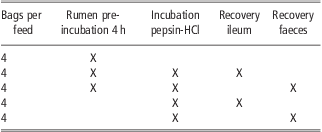
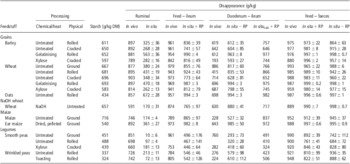
Bag incubation design is shown in Table 1. Eighteen feed samples of cereals and legumes subjected to different physical and chemical processing methods were examined (Table 2). Feed samples were used and described in the study of Larsen et al. (Reference Larsen, Lund, Weisbjerg and Hvelplund2009). In this experiment, in vivo starch digestibility was obtained with rumen, duodenal and ileal fistulated cows fed the starch sources in rations based on grass–clover silage and supplemented with soya bean meal.
Overview of experimental design
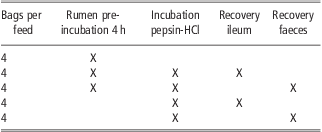
Starch disappearance in the rumen after 4 h incubation and disappearance from mobile bags with or without RP, followed by insertion in duodenum and recovery at either ileum or faeces (±s.e.), compared with in vivo digestibility data from Larsen et al. (Reference Larsen, Lund, Weisbjerg and Hvelplund2009)

RP = rumen pre-incubation; DM = dry matter.
All feed samples were ground to pass a 1.5 mm screen (Cutter mill, Pulverisette 15, Fritsch GmbH, Germany) for the mobile bag studies, and to pass a 0.5 mm screen for starch analysis.
Per feedstuff, 20 tared bags were filled with 1 g and closed by heat sealing. The bags had a pore size of 12 μm and a size of 6 × 6 cm (PES 12/6 WH TW, 6% open area, Saatitech S.p.A., Como, Italy). Twelve bags per feedstuff were rumen pre-incubated (RP) in two cows for 4 h with six bags in each cow. Mobile bags were placed in larger bags with a pore size of 200 μm and mounted on rubber stoppers. Immediately after removal of bags from the rumen, they were rinsed in cold tap water and washed in a washing machine with temperate water (25°C) using 2 × 22 l (Åkerlind et al., Reference Åkerlind, Weisbjerg, Eriksson, Thøgersen, Uden, Olafsson, Harstad and Volden2011). RP bags for duodenal insertion (eight bags per feedstuff) were stored (−18°C) until pepsin-HCl incubation.
Sixteen bags (eight bags with intact feed not subjected to rumen pre-incubation and eight bags previously incubated in the rumen) were soaked for 1 h in HCl solution and thereafter for 2 h in HCl-pepsin to simulate abomasal digestion (Hvelplund et al., Reference Hvelplund, Weisbjerg and Andersen1992). Subsequently, bags were stored at −18°C until incubation in the duodenum. After thawing, a maximum of nine bags per cow per day were inserted into the duodenum via the duodenal cannula at 0700 to 0900 h at a rate of two bags per 20 min. To recover bags from the ileum, two iron balls were placed in the bags along with the feed sample (Jarosz et al., Reference Jarosz, Hvelplund, Weisbjerg and Borg Jensen1994; Prestløkken and Rise, Reference Prestløkken and Rise2003). A strong cylindrical magnet (1.0 cm in diameter and 4 cm long) was placed in the ileal cannula to collect bags from the ileum. The ileal cannula was inspected every 30 min for bags captured by the magnet starting 4.5 h after the first bags were inserted in the duodenum. Time between duodenal introduction and ileal recovery was recorded. The magnet was removed at 0500 h. If collection at the ileum was not successful, the bag was then collected from faeces, and the corresponding bag intended for faecal recovery was then retained at the ileum cannula, resulting in an equal number of bags recovered from each site.
After recovery from ileum or faeces, bags were washed, dried (60°C) and weighed to determine DM residues. Then, the residues were ground for 4 min in a mixer mill (Retsch MM400, Haan, Germany), and stored at room temperature in airtight glass tubes until analysis.
DM concentration was determined by drying in a forced air oven at 60°C. Starch concentration of feedstuffs and residues after rumen and intestinal incubation was analysed according to Bach Knudsen (Reference Bach Knudsen1997) with determination of glucose on a Hitachi 912 analyzer (Roche Diagnostics, Hvidovre, Denmark).
The intestinal digestibility of rumen-undegraded starch was calculated according to following equation:
 $$ {\rm{DS}}\,{\rm{ = }}\,{\rm{(UDS}}\,{\rm{ - }}\,{\rm{IS)}}\,{\rm{/}}\,{\rm{UDS}} $$
where DS is the digestibility in the small intestine; UDS the rumen-undegraded starch calculated from rumen pre-incubation (proportion of feed starch); and IS the starch recovered in ileum (proportion of feed starch).
Feeds were grouped into four groups (grains, NaOH treated wheat, maize and legumes). Effect of recovery site and rumen pre-incubation was analysed within feed group using the mixed procedure of SAS (SAS Institute, 2005). The statistical model included feed, cow, site, rumen pre-incubation and all possible interactions. Bags within feed × cow × site were regarded as repeated measures using a compound symmetry covariance structure. Comparison of in situ and in vivo digestibilities was conducted using simple linear regression analysis.
Results
The concentration of starch varied between 324 in wrinkled peas and 716 g/kg DM in maize (Table 2). Although oats showed the lowest content of starch in cereals, the highest value was found in maize. Legumes had lower starch content than cereals.
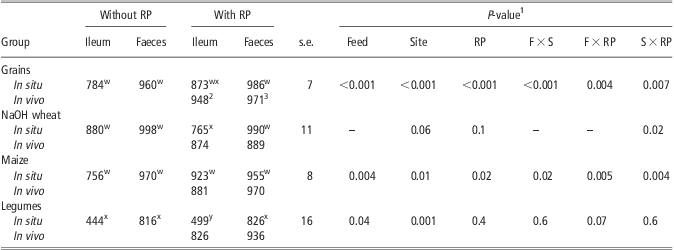
The disappearance of starch after 4 h RP and disappearance of starch from bags with and without RP recovered in ileum and faeces are shown for each feed in Table 2. Starch disappearance from bags recovered at ileum or in faeces, when analysed within starch group, were affected by feed, site and RP and generally double, but not triple, interactions were significant (Table 3). The statistical analysis showed, as also obvious from the disappearance data in Table 2, that starch disappearance varied substantially among and within the different feedstuff groups and thereby the effect of RP and recovery site was highly dependent on the group and feedstuff within the group. The ruminal disappearance of starch was lowest for legumes followed by NaOH wheat, maize and grains (barley, wheat and oats; Table 2). Within the grain group, gelatinising highly increased ruminal disappearance. Without RP, disappearance of starch from bags recovered in ileum was highest for gelatinised, rolled wheat and rolled oats (Table 2). The mean values for the different groups are shown in Table 3. Legumes showed the lowest disappearance of starch from bags recovered in the ileum or in the faeces, whereas the ranking of the other three groups varied with site and RP.
Starch disappearance from mobile bags with or without RP, followed by insertion in duodenum and recovery at either ileum or faeces for feed groups grains, NaOH wheat, maize and legumes
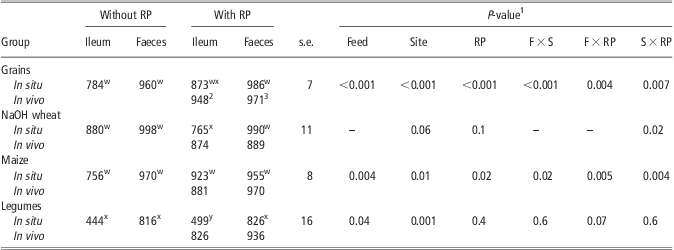
RP = rumen pre-incubation; F = Feed; S = Site.
w,x,ySuperscripts signify difference (P < 0.05) among means for in situ data within columns.
1No triple interactions were observed.
2Feed – ileum, Larsen et al. (Reference Larsen, Lund, Weisbjerg and Hvelplund2009).
3Feed – faeces, Larsen et al. (Reference Larsen, Lund, Weisbjerg and Hvelplund2009).
Transit times of the mobile bags from duodenum to ileum did not differ (P = 0.8) between feeds, but the transit time for bags without RP (6.53 h) was lower (P = 0.003) than for bags with RP (7.22 h).
Starch disappearance from mobile bags with and without RP was generally lower than in vivo data for pre-ileal starch digestibility (Table 2). For pre-ileal digestibility, in vivo values were considerable higher for legumes, higher for grains, higher for NaOH wheat with RP and higher for maize without RP. On the basis of feedstuff groups, differences in total tract starch digestibility were small except for NaOH wheat where mobile bag disappearance was highest and for legumes where in vivo digestibility was highest (Table 3).
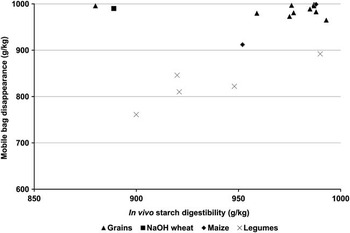
Correlations between mobile bag disappearance and in vivo digestibility were examined across all feedstuffs. Correlations were modest for small intestinal digestibility based on bags recovered in the ileum with R 2 = 0.14 with RP (Figure 1) and R 2 = 0.16 without RP. For total tract digestibility in situ v. in vivo correlations were R 2 = 0.19 with RP (Figure 2) and R 2 = 0.06 without RP.
Relationship between in vivo small intestinal starch digestibility (g/kg of intestinal entering starch) and starch disappearance calculated using equation (1) based on rumen disappearance and starch disappearance from mobile bags preincubated in the rumen, inserted at duodenum and recovered at ileum.

Relationship between in vivo total tract starch digestibility (g/kg starch intake) and starch disappearance from mobile bags preincubated in the rumen, inserted at duodenum and recovered in faeces.

Discussion
The objective of the present study was to investigate the possibility to use the mobile bag technique to determine the small intestinal and total tract digestibility of starch by comparing the obtained mobile bag measurements with in vivo starch digestibilities for the same feedstuffs. However, weak correlations were found between the digestibilities obtained in vivo and with the mobile bag technique. Hence, the focus of the discussion is weaknesses and limitations of the mobile bag technique with the aim to point out critical steps in the technique that potentially could be modified to enhance the technique with respect to intestinal starch digestion.
Intestinal and total tract disappearances were examined both with and without rumen pre-incubation, as rumen pre-incubation might influence the intestinal availability of the starch. The 4 h rumen pre-incubation time was chosen as a compromise between sufficient time for microbial activity and sufficient residue for subsequent mobile bag investigations. Norberg et al. (Reference Norberg, Volden and Harstad2007) used 12 h rumen pre-incubation before examining mobile bag disappearance, resulting in as little as 0.5% to 21.9% of the original starch, as compared with 32.8% to 99.0% in the present study using 4 h pre-incubation. Except for ground smooth peas, the observed rumen disappearances indicate that feeds had been subjected to substantial microbial activity, as the use of 12 μm pore size bags prevents excessive particle loss without hampering starch degradation (Tothi et al., Reference Tothi, Lund, Weisbjerg and Hvelplund2003).
Mobile bags were inserted into the duodenum with two bags at 20-min intervals, without apparent intestinal blockage or discomfort to the cows. Voight et al. (Reference Voight, Piatkowski, Engelmann and Rudolph1985) inserted 10 to 15 bags, of smaller size, per cow at 3- to 5-min intervals and Hvelplund (Reference Hvelplund1985) inserted 12 bags at similar intervals. In our study, transit times of the mobile bags from duodenum to ileum were not significantly different among feeds, although the transit time for feeds without RP (6.53 h) was significantly shorter than for RP feeds (7.22 h), possibly due to less material in the RP bags. On the other hand, no significant effect (P = 0.11) of the rumen DM residue on transit time could be demonstrated. Disappearance of substrate from the mobile bag is affected by the retention time of the bags in the intestine (Vanhatalo and Ketoja, Reference Vanhatalo and Ketoja1995). Prestløkken and Rise (Reference Prestløkken and Rise2003) observed that the intestinal retention time was significantly longer for bags containing a metallic slice compared with bags without a metal slice.
The difference between in vivo and in situ digestibility could be due to washing losses with the bag technique. Varvikko and Vanhatalo (Reference Varvikko and Vanhatalo1990) reported that washing losses could increase disappearance values determined by the mobile bag method. However, in the present experiment all incubations were performed in 12 μm bags, without any sample transference, which should minimise particle losses compared with other published data (Tothi et al., Reference Tothi, Lund, Weisbjerg and Hvelplund2003; Norberg et al., Reference Norberg, Volden and Harstad2007). Comparisons between in vivo and in situ measurements of starch digestion (Nocek and Tamminga, Reference Nocek and Tamminga1991; Offner and Sauvant, Reference Offner and Sauvant2004) showed that the in situ method tends to underestimate in vivo ruminal starch digestibility of slowly degrading starch feedstuffs, whereas digestibility of rapidly degrading starch tended to be overestimated possibly due to particle losses in agreement with the present study. Starch disappearance was generally lower without than with RP when mobile bags were recovered from the ileum, except for NaOH and untreated ground wheat (Table 2). These results indicate that exposure to microbial digestion in the rumen may increase the availability of rumen-undegraded starch for enzymatic digestion in the small intestine as also shown by Norberg et al. (Reference Norberg, Volden and Harstad2007). In barley, a protein matrix surrounds the starch granules and ruminal pre-incubation increases intestinal digestibility of barley protein (Volden and Harstad, Reference Volden and Harstad1995). Thus, ruminal pre-incubation promotes digestion of the protein matrix and exposes the starch granules to enzymatic digestion in the small intestine. When the bags were collected in faeces, no significant differences in disappearance of starch were seen between bags with or without RP. This indicates that depressed starch digestion in the small intestine is, to a great extent, compensated for by digestion in the large intestine (Mills et al., Reference Mills, France and Dijkstra1999). In this study, the starch digestibility was higher in bags recovered from faeces than from the ileum for all feedstuffs tested (Table 3).
In our study, the small intestinal digestion of starch from gelatinised wheat and barley, rolled oats, NaOH wheat and pelleted ear maize was higher and the hindgut disappearance of starch lower compared with the other feedstuffs. For these feedstuffs, the effect of site and RP was prone to be low as bags without RP recovered at the ileum already had very high starch disappearance. Holm et al. (Reference Holm, Lundquist, Bjöck, Eliasson and Asp1988) found a correlation of 0.96 between extent of gelatinisation and digestion rate, indicating that the relationship is close to linear for pure starch. Norberg et al. (Reference Norberg, Volden and Harstad2007) support our findings of nearly 100% intestinal starch digestion without pre-incubation in the rumen for oats. Goelema et al. (Reference Goelema, Smits, Vaessen and Wemmers1999) reported that total starch digestibility and intestinal digestibility of rumen-undegraded starch in situ were not affected by toasting, whereas pelleting significantly increased total starch digestibility and, in some cases, also intestinal digestibility of rumen-undegraded starch. Results of Goelema et al. (Reference Goelema, Smits, Vaessen and Wemmers1999) show that the effects on starch digestibility depend on the conditions applied during processing, probably mainly due to effects on particle size.
The legumes (peas) generally showed the lowest starch availabilities in all digestive tract compartments, and the ground smooth peas with very low ruminal disappearance was established as an outlier for mobile bags without RP when comparing the mobile bag method and the in vivo (proportion of starch entering) method in this study. With RP, as shown in Figure 1, legumes showed considerable lower mobile bags disappearance compared with the other feed samples irrespective of level of in vivo digestibility. Total tract starch disappearance (Figure 2) showed less significant but similar lower disappearances for the legumes. These results indicate that legume starch, compared with the other starch sources tested, is more dependent on rumen incubation to make the starch available for post-rumen digestion. The type of starch granules found in most legumes is more resistant to amylase hydrolysis than the types found in cereals, probably reflecting different degrees of crystallinity (Gallant et al., Reference Gallant, Bouchet, Buleon and Perez1992). Legume starch is known to be low digestible (Larsen et al., Reference Larsen, Lund, Weisbjerg and Hvelplund2009) and with a low rate of starch degradation in rumen fluid (Focant et al., Reference Focant, Van Hoecke and Vanbelle1990), and therefore probably longer rumen pre-incubation times are needed for legume starch compared with other starch types to assure post-ruminal digestion. Both rumen and intestinal disappearance of legume starch was lower, compared with starch from grains (Table 3). Larsen et al. (Reference Larsen, Lund, Weisbjerg and Hvelplund2009) showed in vivo that starch from legumes has a lower accessibility in both the rumen and small intestine compared with starch from barley and wheat in lactating dairy cows. This indicates that the same factors are limiting the ability of both bacterial and pancreatic amylase to hydrolyse legume starch. Mobile bag disappearance for legumes seems to be lower compared with other feed samples for total tract starch disappearance as mentioned above (Figure 2). Omitting NaOH wheat and xylose-treated barley as outliers, the relationship between in situ and in vivo for the remaining 16 observations seems reasonable with r = 0.87. NaOH wheat was fed as whole grains in the in vivo study (Larsen et al., Reference Larsen, Lund, Weisbjerg and Hvelplund2009), and this major difference in particle size could be a plausible explanation for the deviation. Xylose-treated barley was cracked, which should make it highly available in vivo; however, starch from barley seem to be quite susceptible to chemical treatment, as treatment with NaOH (McNiven et al., Reference McNiven, Weisbjerg and Hvelplund1995) and xylose (Larsen et al., Reference Larsen, Lund, Weisbjerg and Hvelplund2009) greatly reduced both ruminal and small intestinal digestibility.
Conclusion
The present study showed a weak positive correlation between in vivo small intestinal and total tract digestibility of starch and disappearance obtained using the mobile bag technique across a broad range of starch sources. Omitting two less conventional starch sources (NaOH wheat and xylose-treated barley) resulted in high (0.87) correlation between total tract in vivo digestibility and mobile bag disappearance. The use of the mobile bag method for estimation of in vivo starch digestibility will therefore depend on the starch type. Legume starch had lower in situ disappearance and in vivo digestibility both in the small intestine and total digestive tract compared with starch from barley, wheat, oats, ear maize and maize.
Acknowledgements
The authors would like to express their thanks to Torkild N. Jakobsen and the laboratory staff for technical assistance. This work has been carried out with financial support from the Commission of the European Communities, FP7, KBB-2007-1.