1 Introduction
Tourism is an enriching activity which promotes relaxation and well-being. The tourist, when faced with the prospects of travelling, searches for a tourism product which suits his tastes and interests and, simultaneously, optimises time and money. However, tourism products are highly heterogeneous and involve multiple interdependent resources such as transportation, food, accommodation, historical or leisure attractions. The selection of tourism products according to the user profile is a complex challenge, which is typically addressed by tourism recommendation systems. These decision support systems apply Artificial Intelligence (AI) methodologies to suggest products, for example, destinations, routes, mobility solutions or information about places, according to the tastes, interests and user needs. In this context, mobile devices play an important role as the preferred end-user equipment, given that they provide ubiquitous service access. These applications rely on context-aware information, for example, location, time or weather, to enrich the user profile and identify the surrounding environment. Furthermore, in the tourism domain, there is a considerable number of platforms which support travelling based extensively on crowdsourced data, for example, TripAdvisor, Expedia or Booking. In such cases, the tourist is highly influenced by the crowd knowledge, trusting his peers’ judgement, and making decisions regarding tourism resources accordingly.
This article presents a state of the art survey on mobile context-aware tourism applications (CATA). The main goal is to identify essential features based on a tourist-centric perspective in order to foresee future research directions, meeting current needs and anticipating future expectations. In particular, we are motivated by the challenge of improving the quality of the information seamlessly provided to tourists by CATA. This information relies on the data collected and stored (Knowledge Acquisition and Knowledge Representation) as well as on the adopted Knowledge Processing techniques to provide dedicated tourism services. Therefore, we propose and apply a CATA analysis framework, distinguishing four possible dimensions: (i) knowledge acquisition; (ii) knowledge representation approaches; (iii) knowledge processing—from profiling to recommendation techniques; and (iv) the services offered to the tourist. From such framework we anticipate future research trends, and highlight key areas for CATA enhancement and development.
The rest of this article is structured as follows. Section 2 reviews related work on CATA, and tourism ontologies. Section 3 presents the analysis framework we propose and have applied in this study. Section 4 addresses the Knowledge Acquisition, Section 5 focusses on Knowledge Representation and Section 6 describes Knowledge Processing technologies found in the surveyed CATA. Based on the previous sections, Section 7 discusses possible trends. Finally, Section 8 draws the conclusions, and suggest potential areas for CATA improvement.
2 CATA-related work
Mobile devices have a large collection of embedded sensors, increased computational capabilities, ubiquitous Internet access and accompany the user throughout the day. In tourism, mobile devices support as well as influence the behaviour of tourists. Nowadays, tourists have mobile devices as smartphones, tablets, etc., that allow them to take advantage of tourism applications (Borras et al., Reference Borras, Moreno and Valls2014). When travelling, mobile devices are the only tools that tourists can rely on to obtain information about the current city (Wang et al., Reference Wang, Park and Fesenmaier2012). Additionally, most mobile devices are equipped with Global Navigation Satellite System (GNSS) receivers, for example, Global Positioning System (GPS) receivers, which provide the user position, velocity and time (PVT). Thus, mobile devices play an important role in context-aware applications, mainly, in terms of data acquisition and front-end for the provision of knowledge-based services. In this section, we present several CATA proposals, including context-aware tourism ontologies, which will be compared using a framework for CATA analysis described in Section 3.
2.1 Mobile applications
In the context-aware tourism mobile applications literature, Borras et al. (Reference Borras, Moreno and Valls2014) presents a survey on tourist applications (mobile and Web-based) grouping the different technologies. On the other hand, Gavalas et al. (Reference Gavalas, Konstantopoulos, Mastakas and Pantziou2014) offers a detailed description of support functions commonly offered by existing mobile tourism Recommender Systems prototypes. In turn, Luz et al. (Reference Luz, Anacleto and Almeida2010) and Chen and Kotz (Reference Chen and Kotz2000) provide a review on older applications. This paper complements the previous research surveys covering recent mobile CATA. Specifically, it analyses, in chronological order, the most representative mobile CATA applications found, excluding those covered by the previous surveys referred, in terms of knowledge acquisition, knowledge representation, knowledge processing and knowledge-based services. Moreover, the selected applications are compared to anticipate future research trends in the tourism domain.
Mobile Application to Encourage Local Tourism with Context-Aware Computing (MAELT) relies on multiple Application Programming Interface (API) and mobile sensors to suggest tourism attractions. In terms of context-aware information, MAELT uses the weather (Open Weather Map), location and time (GPS). As front-end functionalities, the application provides a map-based display, agglomerating the collected context-aware information (Silva et al., Reference Silva, Toasa, Guevara, Martinez and Vargas2018).
POST-VIA 360 is a context-aware mobile recommendation system intended to assist the tourist before, during and after the travelling. It adopts the customer relationship management to improve tourism loyalty and overall performance. The Point of Interest (POI) are classified and recommended using an artificial immune system (AIS) to successively rate the POI based on previous tourist ratings (Colomo-Palacios et al., Reference Colomo-Palacios, García-Peñalvo, Stantchev and Misra2017).
Cold Start Context-Aware Recommender System (HCRST) generates personalised tours based on tourist preferences and contextual information. It is an hybrid interactive context-aware recommender system which exploits case-based reasoning (CBR) techniques and neural networks (Bahramian et al., Reference Bahramian, Ali Abbaspour and Claramunt2017).
Mobile Guide–TAIS is an intelligent mobile tourist guide (Smirnov et al., Reference Smirnov, Kashevnik, Balandin and Laizane2013). Kashevnik et al. (Reference Kashevnik, Ponomarev and Smirnov2017) use this mobile application to test a multi-model context-aware tourism recommendation service. The system relies on context-aware collaborative filtering where the ratings of attractions received from users are supplemented by context parameters (time, weather, type of trip, etc.), using fuzzy inference.
South Tyrol Suggests (STS) is a mobile recommendation system which provides context-aware recom mendations (location-based) regarding the Italian province of South Tyrol, employing matrix factorisation to predict unknown ratings (Braunhofer et al., Reference Braunhofer, Elahi and Ricci2014). After registration, the tourist has to answer a personality questionnaire, which will be used to suggest personalised POI. Finally, the tourist is requested to rate the offered recommendations. An improved version of STS uses the Google’s Android Activity Recognition API to recognise the current activity context of the tourist and make appropriate recommendations (Najafian et al., Reference Najafian, Wörndl and Braunhofer2016).
Context-Aware Proactive Tourist Recommender System (CAPTRS) is a mobile application which provides recommendations based on the context of the tourist and on multi-criteria collaborative filtering. The recommendations are predicted using explicit ratings provided by tourists concerning POI. Furthermore, the tourist is asked to rate the contextual factors (location, time and weather) associated with the POI (Ashley-Dejo et al., Reference Ashley-Dejo, Ngwira and Zuva2016).
GiveMeAPlan is a mobile recommendation service, considering simultaneously the tourist preferences and the ratings of similar tourists. The recommendations are presented in a map-based display, detailing how and when to perform the recommended activities, for example, direct the user to the POI in time (Barragáns-Martínez & Costa-Montenegro, Reference Barragáns-Martínez and Costa-Montenegro2015).
Semantic Personalising Location Information Service (SPLIS) is a rule-based service for context-aware POI exploration developed at University of Thessaloniki, Greece. SPLIS collects data concerning the POI from Google Places API and represents users, POI and corresponding relations using the schema.org ontologyFootnote 1 . After authentication, the user profile is built from the user’s Google+ information and POI data from Google Places API. The context encompasses the user profile, relationships, rules, time, day and weather, whereas the POI description contains properties, ownership and rules. The processing module features a rule-based mechanism supported by RuleML and the JessFootnote 2 rule engine. The service stores and retrieves Resource Description Framework (RDF) triples using the SesameFootnote 3 framework for knowledge sharing and re-usability. The personalised information is provided by SPLIS using Goggle maps, highlighting the recommended POI and the user current location, and enables user rating (Viktoratos et al., Reference Viktoratos, Tsadiras and Bassiliades2014, Reference Viktoratos, Tsadiras and Bassiliades2015).
ErasmusApp is a location-based collaborative mobile application to help Erasmus Students in Porto overcoming language difficulties and finding lodging, restaurants, etc. The application is a client/server application and provides an Android Graphical User Interface (GUI) as front-end that works in stand-alone and distributed mode. The stand-alone mode is devoted to guest users and offers functionalities such as current location map, main POI (hospitals, accommodation, leisure places, etc.) as well as addition, edition and deletion of private POI stored in the local database (SQLite). The distributed mode requires user authentication in order to take advantage of other functionalities such as the user profile creation and update, POI recommendations and ratings. The back-end contains the server module and the central database. The system inputs are the user location, obtained from the on board GPS receiver, and demographic information provided by the registered users. The user recommendations are generated according to the distance between the user current position and the POI, the user preferences and the average POI rating (Bruyneel & Malheiro, Reference Bruyneel and Malheiro2014).
GuideMe is a tourist guide supported by a recommender system and social interaction. The recommendations are based on collaborative filtering. The mobile prototype offers a guest and an authenticated user interface. Guest users can only explore a list of provided POI and get recommendations based on their current context (country, city, category and weather conditions), whereas authenticated users can insert or update tourism locations (POI). The main input of the mobile application is the location obtained via the GPS sensor or Wi-Fi provider. If it is not possible to obtain the user location, the system shows just the POI description without the distance between user and POI. The systems includes a MySQL relational database, a log service and a data security service developed using Java Hibernate Framework. Finally, the prototype was tested using the MovieLens data setFootnote 4 —a movie rating dataset built by GroupLens research group (Umanets et al., Reference Umanets, Ferreira and Leite2014).
Trip@Cloud is a stand-alone mobile cloud computing location-aware tourist guide application. It provides information about the nearby POI based on current user location. The system requires authentication in order to install the application and grant a personal space in the cloud. The architecture holds two main modules: Client Module and Cloud Module. The Client Module presents a GUI for interaction with the user interaction and collects the user profile, encompassing the authentication information, location, preferences and device features. User profile is shared with the Cloud Module, which replies back with the appropriate content. The profiles are stored in a personal database in the cloud. In addition, the Cloud Module contains a global database with the information about all POI. The system provides automatic notifications about the POI in audio or text format, a navigation list (list of POI in a pre-defined area) and supports user requests (Qureshi et al., Reference Qureshi, Ahmad and Rafique2011).
iTravel is a travel recommendation system for mobile peer-to-peer environments, for example, Bluetooth or Wi-Fi. The tourists can use iTravel to browse through and rate local attractions. The system recommends attractions and allows sharing attraction ratings between users. The system is composed of Interface Manager (presents the information to the user), Location Manager (supported by a GNSS sensor), Communication Manager (based on broadband short-range wireless technologies), Rating Data Manager (management of attraction ratings) and Recommendation Manager (Pearson correlation collaborative filter). iTravel adopts the Bluetooth technology due to lower power consumption and cheaper hardware, despite the smaller coverage. The system provides a navigation map which highlights, using different icons, the user position, nearby users and recommended attractions (Yang & Hwang, Reference Yang and Hwang2013).
Virtual Intelligent System for Informing Tourists (VISIT) is a mobile application under development at the University of Ulster, Derry, Northern Ireland. All entities (person, place or object) are characterised by means of its context in order to generate recommendations. The application is an intelligent context-aware recommendation system for the tourism domain. The VISIT inputs used by the recommendation process encompasses, not only, weather and spatio-temporal features, but also, personal and social information (social media sentiment and personalisation). VISIT implements a hybrid recommendation system with several probabilistic and statistical techniques to process data, for example, artificial neural networks and fuzzy logic (Meehan et al., Reference Meehan, Lunney, Curran and McCaughey2013).
Travel Recommender System (TRS) is a mobile social system, supported by a client-server architecture. that helps tourists discover and select POI. The mobile module (client) interacts with the service module and presents the user with the list of recommended POI. The server stores all the information, performs user modelling and applies the recommendation algorithms. Demographic information and explicit preferences about the categories are the main data input used to generate the recommendations. However, users have the possibility to assign tags to POI to share their opinion. The server system architecture implements the user modelling and recommendation services. User modelling relies on demographic information and explicit preferences. The demographic information can be imported from Facebook, Twitter or Gloogle+ social networks. The system processes the recommendations using a hybrid approach which combines content-based and collaborative filtering. The Mobile Social Travel Recommender System was integrated in the final prototype of the CRUMBS project (Garcia et al., Reference Garcia, Torre and Linaza2013).
Location-based Mobile Tourism Application (Loc-based App) runs on Apple mobile devices and helps tourists to find POI for as well as their whereabouts. In terms of architecture, it contains a front-end, middleware and back-end modules. The front-end provides a map-based interface with location and POI information, that is, the nearest cultural attractions within 1 km radius from the user current location in Kuala Lumpur, Malaysia. When the application displays a POI on the map, it stores the title, description, photo URL, latitude and longitude in memory as well as in the SQLite local database for further off-line usage. The communication between front-end and back-end is done through a middleware Web service. The application back-end is a cloud-based platform (Panahi et al., Reference Panahi, Woods and Thwaites2013).
Trip Planning is a multi-agent system developed in Sri Lanka. It provides a travelling guide that finds routes according to the user’s requirements, for example, type of place and means of transportation, duration, etc. The multiagent system includes a Location Displaying Agent, Place Suggestion Agent, Tour Plan Agent and Interface Agent. The Location Displaying Agent interacts with the GNSS sensor in order to obtain the current location and present it on a Goggle map. The Tour Plan Agent generates a tour plan based on user preferences, whereas the Place Suggestion Agent provides additional places to the Tour plan agent. Finally, the Interface Agent displays the map on the Web-based or mobile-based environment. The information is represented and stored in an ontology which describes the concepts and their relationships with the agents and external sources, for example, Goggle Maps (Herath & Ratnayake, Reference Herath and Ratnayake2013).
3D Geographic Information System (GIS) is a restaurant recommendation system for Jaén, Spain. The architecture is composed of three main modules: (i) Recommender Server; (ii) GIS Server; and (iii) Mobile Client Application. After authentication, the system acquires the location and velocity of the device using the GPS and compass sensors. In a cold start situation, the user should, first, indicate preferences and, then, request recommendations. The native application was developed using industry-standard 3D graphics library OpenGL Embedded Systems in order to take advantage of interactive 3D maps. The server is composed of a GIS Server and a Recommender Server. The GIS manages the communication and data transaction with the mobile client. The Recommender Server implements an hybrid model, using collaborative filtering and knowledge-based techniques, in order to provide real-time recommendations based on the user location and preferences. The GIS module communicates with Recommender module through a Web service (Noguera et al., Reference Noguera, Barranco, Segura and MartíNez2012).
Turist@ is an agent-based recommendation system developed by University of Rovira i Virgili in Cata lonia, Spain. The architecture of Turist@ includes four main agents: User Agent, Activity Agent, Broker Agent and Recommender Agent. The User Agent runs in a mobile device (preferably with geo-position capabilities) and provides the GUI, allowing the user to search for activities and receive recommendations. The user relies on this agent not only to introduce personal and demographic data (birth date, nationality, level of studies, spoken languages, kind of travel group, disabilities), but also to specify his interests in art, science, sport, history, music, theatre or cinema. The gathered user profile is shared with the other Turist@ agents. The system adds each new user to a group with similar preferences and, from that moment on, the user profile is automatically updated implicitly, by analyzing the activity, or explicitly, by taking into account the expressed preferences. The Activity Agent manages the agents that describe particular attractions, for example, attractions like exhibitions, museums, cinema, etc. The Broker Agent is a facilitator of the communications between the User Agent and the Activity Agent, that is, is a gateway between both agents. The Recommender Agent makes recommendations according to the user profile. The user location, which is obtained via the device’s GPS sensor, is used to provide location-aware proactive recommendations in real time. The personalised recommendations are generated by submitting the user profile to a hybrid recommender system, which combines content-based and collaborative filters. The content-based filter applies the Euclidean distance to compute similarity and the collaborative filter implements clustering (Batet et al., Reference Batet, Moreno, Sánchez, Isern and Valls2012).
GeOasis is a knowledge-based geo-referenced tourist assistant developed at the University of Jaén, Spain. It generates plans to guide tourists taking into account several factors, for example, PVT, user preferences or history. The GeOasis adopts a client-server architecture. The client module includes the user interface and a planning engine. The user interface allows two kinds of interaction: tactile or voice-based. The planning engine generates a plan based on the POI, user profile and user history data. This engine is implemented on the client side to minimise the communication bandwidth usage. The current geodetic coordinates and velocity are gathered from the mobile device, using the on board GPS sensor. On the server side there are the Map server (Web Map service), Route server (with the same functionalities of the Map server, but with Goggle Maps) and GeOntology. GeOntology manages the system knowledge, including the user profile, user history, the description of the POI, their relationships and the inference mechanism. The planning algorithm is location-based, that is, relies on the current user location, for example, city, near to a city or on the road (Santiago et al., Reference Santiago, López, Montejo-Ráez and López2012).
ReRex is a mobile application developed in Italy. It provides context-aware recommendations (POI) using a client/server approach. The context data, including distance to POI, temperature, weather, season, time day and weekday, are provided automatically, whereas companion, crowdedness, familiarity, mood, budget, travel length, means of transport and travel goal are supplied by the user. The user obtains a list of recommended POI, which includes access to detailed complementary POI information (map, text description, etc.) and to the POI rating interface. Additionally, the application provides a wish list, that is, a personal list of POI recommendations managed by the user (Baltrunas et al., Reference Baltrunas, Ludwig, Peer and Ricci2011).
Smart-Travel is a mobile social-based system supported by a cloud environment. The user context data are acquired via the Social Networking Service, the Internet of Things and user-generated content. The system provides real-time travel information by combining XML and augmented reality into mobile devices. The location-based application processes the social data (e.g. Twitter, Facebook or Youtube) through a hybrid search engine to determine the user preferences, generate and store personalised recommendations in the cloud. Thus, the Smart-Travel system provides not only personalised travel services, including personal information, recommendations, search filter and location-based services, but also a Web service platform holding real-time traffic information, personal location-based recommendations and task information (Hung et al., Reference Hung, Hsu and Wang2011).
liveCities is a context-aware and proactive geofencing mobile tourism service, which sends personalised notifications to mobile devices. The notifications provide nearby POI information, activity suggestions as well as special offers or discounts in real time, according to the user context. Notifications can contain plain text, audio, video, HyperText Markup Language (HTML) or a link to an external website. To present and process all information, the system relies on the Mobile Client and the Notification Manager Web Client. The client allows the configuration of: (i) the user static profile, using parameters like user name, age, gender and nationality; and (ii) the user social context, using Bluetooth technology to search and group nearby devices in family, friend, etc. Furthermore, the Mobile Client captures the current user location and moving mode. The Notification Manager is a Web application that generates notifications according to the context gathered by the Mobile Client. Additional external services can be added, for example, a weather Web service. LiveCities goal is to customise data for the mobile scenario and improve the tourist experience and satisfaction with reduced device interactions (Martin et al., Reference Martin, Alzua and Lamsfus2011).
Personalised Sightseeing Tours Recommendation System (PSiS) recommends context-aware tourism resources to the end-user. The main components of the application are the ContextService, the UserInterface, the Communication Manager and the Mobile Database components. The ContextService uses the Location Manager, Weather Service, Phone Status Manager, DateTime Manager, Planning Service and Tracking Service to acquire context-aware data. The UserInterface component provides the user interface. PSiS recommends a list of POI along the programmed route. The application requires Internet connection to re-plan the route, using decision trees, and generate recommendations whenever the context changes. In terms of recommendation algorithms, it applies content-based filters which use the weather conditions, time, schedule of POI, etc. to produce personalised recommendations (Anacleto et al., Reference Anacleto, Figueiredo, Luz, Almeida and Novais2011).
Social Pervasive e-Tourism Advisor (SPETA) is a tool for tourists developed by Carlos III University in Madrid, Spain. This application combines social networking, semantic Web and context-awareness in order to offer personalised guidance. The system gathers in real-time location, weather forecast, time, user preferences, friend recommendations and history data. The user location corresponds to the geodetic coordinates obtained from a GIS. The GIS provides the list of places to visit and offers the possibility to find friends located in the vicinity. The user profile includes the location, explicit preferences and social data. Social data regarding friends is collected using the Open Social API. The recommendation algorithm is a hybrid filtering composed of context-aware, knowledge-based and collaborative-based filters. First, the system filters the results based on the contextual information using a sliding grid-window. Second, it applies knowledge-based filtering taking into account the semantic similarity between ontologies. Then, the recommender relies on social information to create and order recommendations using collaborative-based filtering (García-Crespo et al., Reference García-Crespo, Chamizo, Rivera, Mencke, Colomo-Palacios and Gómez-Berbís2009).
PaTac is a platform developed by TMT Factory, Barcelona, Spain, for the Interactive Community Dis plays, that is, city information panels, bus shop shelters, kiosk systems, interior panels and mobile devices. The platform uses ontologies and software agents to offer ubiquitous services to citizens and tourists. It provides the following personalised services: (i) Interactive maps for information about locations; (ii) Recommendations of restaurants, monuments, bars, places of interest and public transport; (iii) Description of places of interest; (iv) Route planning suggestions, for instance, walking routes; and (v) Social feedback with tags, send images, add comments and share all this information. The user profile is obtained by determining the similarity with predefined stereotypes and the initial profile is build from demographic data. User modelling relies on social data and learning algorithms based on implicit and explicit feedback. The tourist recommendations are provided by a content-based filter. PaTac reuses several standard ontologies to represent data: (i) W3C Time; (ii) WGS84 Geo positioning vocabulary; (iii) General User Model Ontology; (iv) Friend of a Friend (FOAF) ontology; and (v) Upper Mapping and Binding Exchange Layer. In summary, PaTac offers an ubiquitous service using a multiagent system, ontologies and the Semantic Web (Ceccaroni et al., Reference Ceccaroni, Codina, Palau and Pous2009).
SAMAP is a multiagent user-oriented adaptive system for the planning of tourism activities developed by Granada University, Spain. Specifically, it implements plan optimisation algorithms. The multiagent system is composed of User, CBR and Planning agents. The User agent acts as a middleware between the other agents and provides the user interface, information management and user modelling (needs and preferences) functionalities. The system creates: (i) the user and visit models from the personal data, preferences and the destination city, using machine learning techniques; (ii) the list of recommended activities based on the user and visit models, past user activities and users with similar preferences and interests, using CBR; and (iii) the tourist plan based on the list of recommended activities. SAMAP allows the user to refine the plan, that is, the user can accept or refuse recommendations based on his preferences. The CBR agent builds a list of activities, that is, it tries to find a solution for the given user model. This agent is capable of explaining the results since the recommendations are based on similar users. The list of activities selected is provided to the Planning agent to produce a schedule for each visit depending on the city and taking into account time management, preferences, locations and specific goals. Finally, this agent stores the final plan in the SAMAP ontology (Castillo et al., Reference Castillo, Armengol, Onaindía, Sebastiá, González-Boticario, Rodríguez, Fernández, Arias and Borrajo2008).
The surveyed CATA embed an architecture responsible for the acquisition, representation, processing and provision of personalised tourism services. This section provides a complete description of these architectural components, contemplating the current tourism mobile technologies and services.
2.2 Context-aware tourism ontologies
The ontology-based representation promotes interoperability, can be applied to any domain and allows content recovery, knowledge management and knowledge reuse. In the tourism domain, ontologies are frequently adopted for knowledge representation, inference and storage, facilitating not only search, but also storage and manipulation. Additionally, there are several tourism-related ontologies already developed for generic tourism applications.
Siricharoen (Reference Siricharoen2007) and Prantner et al. (Reference Prantner, Ding, Luger, Yan and Herzog2007) gathered and analyzed the tourism ontologies available at the time. Prantner et al. (Reference Prantner, Ding, Luger, Yan and Herzog2007) describe, succinctly, the Mondeca (Kiryakov et al., Reference Kiryakov, Popov, Terziev, Manov and Ognyanoff2004), Harmonise (Dell’Erba et al., Reference Dell’Erba, Fodor, Ricci and Werthner2003) and Ontur (Prantner, Reference Prantner2004) tourism ontologies. The review of Siricharoen (Reference Siricharoen2007) partially overlaps the survey by Prantner et al. (Reference Prantner, Ding, Luger, Yan and Herzog2007), in terms of tourism ontologies, with the exception of the Hi-Touch ontology (Legrand, Reference Legrand2004). Our article complements the state of the art on tourism ontological knowledge representation by describing, in addition, the SigTur (de la Flor et al., Reference de la Flor, Borràs, Isern, Valls, Moreno, Russo, Pérez and Anton-Clavé2012), QALL-ME (Ou et al., Reference Ou, Pekar, Orasan, Spurk and Negri2008), Contur (Cárcel et al., Reference Cárcel, Campo, Gil, Garcia, Martin, Zugasti, Bilbao, Perez, Koshutanski, Maña and De Albeniz2012), SAMAP (Castillo et al., Reference Castillo, Armengol, Onaindía, Sebastiá, González-Boticario, Rodríguez, Fernández, Arias and Borrajo2008), GeOntology (Santiago et al., Reference Santiago, López, Montejo-Ráez and López2012), mIO! (Poveda Villalon et al., Reference Poveda Villalon, Suàrez-Figueroa, García-Castro and Gómez-Pérez2010) and multi-dimensional ontologies (Rodríguez et al., Reference Rodríguez, Bravo and Guzmán2012). Specifically, it analyses, in chronological order, the tourism ontologies found, excluding those covered by the previous surveys referred. The surveyed ontologies belong to tourism-related projects, mobile applications or CATA, and are reusable in new tourism applications.
SigTur Ontology is a component of the SigTur Web-based tourism recommendation system. This system uses GIS and ontologies to represent the knowledge. Additionally, the SigTur ontolology was developed to represent tourist activities. It uses the World Tourism Organization (WTO)Footnote 5 thesaurus and defines more than 187 concepts. These concepts are grouped into different categories such as leisure, sports, culture, nature, events and routes. The ontology was developed in Web Ontology Language (OWL), using the Protégé ontology editor. Moreover, SigTur uses Jena Semantic Web framework for inference (de la Flor et al., Reference de la Flor, Borràs, Isern, Valls, Moreno, Russo, Pérez and Anton-Clavé2012).
Harmonise Ontology is currently the centrepiece of Harmonet, a Network for the Harmonisation Exchange of Travel and Tourism Information. The main goal of Harmonet is the creation of an international network for standardisation and data exchange within the tourism industry. Harmonise acts as a mediator between different tourism ontologies, enabling the receiver to interpret the data source as an extension of their own database without needing to know any data representation details. It is implemented in RDF and contains, at least, 200 concepts and properties for describing tourism entities, including accommodation (hotels, bed and breakfast accommodations, camping sites), events and activities (festivals, conferences, sporting events), gastronomy, monuments and sights (Dell’Erba et al., Reference Dell’Erba, Fodor, Ricci and Werthner2003; Missikoff & Taglino, Reference Missikoff and Taglino2004).
Mondeca Tourism Ontology Footnote 6 introduces fundamental concepts in the tourism domain defined in the WTO thesaurus, which include information and definitions about tourism and leisure activities. The ontology covers entities, packages and multimedia content. It is developed in OWL and contains approximately 1000 concepts. The Mondeca tourism ontology is private, that is, public access and usage is not allowed (Kiryakov et al., Reference Kiryakov, Popov, Terziev, Manov and Ognyanoff2004).
Hi-Touch Ontology was developed within the European Programme IST/CRAFT Hi-Touch project. Hi-Touch ontology aims to ensure global semantic interoperability among components. The first version represented tourism objects, not only managing different classes (activity, certification, environment, ethics, logistics and philosophy) and keywords contained in WTO thesaurus, but also, capturing their semantic relationships. The improved version represents tourist preferences with personalisation concepts. The Hi-Touch ontology uses OWL language and it was built on top of the semantic database repository provided by the Mondeca company (Legrand, Reference Legrand2004).
QALL-ME Ontology Footnote 7 was developed within an EU-funded research project to support a tourism question/ answer system. It focusses on static entities (tourism infrastructure, events, accommodations) instead of dynamic entities (business, tourist routes) and has a good coverage in sub-domains related to tourism attractions and events. It is written in OWL Description Logic (OWL-DL), a variant of OWL, and covers tourism destinations (i.e. cities and towns), tourism sites (i.e. accommodation, gastronomy, attraction and infrastructure), tourism events (e.g. films and shows) and transportation (Ou et al., Reference Ou, Pekar, Orasan, Spurk and Negri2008).
ConTur Ontology belongs to an intelligent tourism-related content management platform. The Contur ontology allows the representation of destination, geographic region, accommodation, gastronomy or transport entities. This ontology was built according to the state of the art. It uses the OWL ontology language and reuses the W3C TimeFootnote 8 and GeoFootnote 9 ontologies to model the time and the location entities (Cárcel et al., Reference Cárcel, Campo, Gil, Garcia, Martin, Zugasti, Bilbao, Perez, Koshutanski, Maña and De Albeniz2012).
Ontur Ontology The Digital Enterprise Research Institute e-Tourism ontologyFootnote 10 was developed within the OnTour project by the University Innsbruck. The goal was to support the creation of a tourism portal, using Semantic Web technologies. The ontology represents different tourism-related concepts such as Accommodation, Activity, Date, Time, Event, Infrastructure and Location. The ontology is written in OWL, is based on the WTO thesaurus and takes into account geographical data such as postal address or the geodetic coordinates to calculate distances between points (Prantner, Reference Prantner2004).
SAMAP Ontology was developed within the SAMAP project. The ontology represents the following concepts: (i) User context—represents the user-related information; (ii) Visit—represents a city to be visited, the user free time and new user preferences through machine learning mechanisms based on past visits; (iii) City—represents the transports, places of interest and streets, including the traffic, of a city; (iv) Place—represents a place to be visited (restaurants, museums, bars, theatres, etc.); (v) Transport—represents a mean of transportation (bus, taxi, walking, etc.); and (vi) Activity—represents a specific activity (Castillo et al., Reference Castillo, Armengol, Onaindía, Sebastiá, González-Boticario, Rodríguez, Fernández, Arias and Borrajo2008).
SPETA Ontology was built to answer, not only, questions such as What can a tourist view and visit?, Where are the interesting places to see and visit? or When can one visit a particular place?, but, also, questions like Which friends visited this place? and What can one do in this place?. Activity, Attraction, Place and Person are the main concepts modelled in the ontology. To represent people, SPETA uses the FOAF standard ontology. The remaining concepts reuse the DBpedia ontology. Besides these ontologies, it includes a taxonomy of attractions in order to enhance the accuracy of the recommendation algorithm. This taxonomy of attractions is enriched with different categories of museums and historical period data (García-Crespo et al., Reference García-Crespo, Chamizo, Rivera, Mencke, Colomo-Palacios and Gómez-Berbís2009).
GeOntology is a tourism ontology defined and used by the GeOasis project. The ontology conceptual model was designed using CommonKads (Kingston, Reference Kingston1998) and represents: (i) POI (cathedral, castle or an archaeological site); (ii) Categories (Art, History, Archaeology, Ethnology and Architecture); (iii) Group (tourist route group, an architectural complex group or main POI group of the city); (iv) Catálogo General del Patrimonio Histórico Andaluz (thesaurus that describes all types of items); (v) User (user profile); (vi) Area (in the city, near the city, on the road); and (vii) Route (origin, destination and intermediate points). Additionally, this ontology represents relations among concepts which improve the ontology results: (i) has-visited (log user history to prevent POI repetitions); (ii) is-located-in (user current position in a route); (iii) is-selected (particular route); (iv) is-in-area (area kind); (v) is-part-of (group indications; and (vi) is-point-of (build up routes) (Santiago et al., Reference Santiago, López, Montejo-Ráez and López2012).
mIO! Ontology Network Footnote 11 is a collection of ontologies in OWL-DL which are linked to represent the user context as a whole. Thus, the mIO! ontology network reuses other ontologies (CoDAMoSFootnote 12 , SOUPAFootnote 13 , Delivery ContextFootnote 14 , OWL TimeFootnote 15 and FOAF) to model devices, environment, interfaces, location, network, service providers, roles, services, context sources, time and users (Poveda Villalon et al., Reference Poveda Villalon, Suàrez-Figueroa, García-Castro and Gómez-Pérez2010).
Multi-Dimensional Ontology Model Footnote 16 which is written in OWL, represents mobile user contexts, Web services information and application domains whenever intersections are found among service functionalities and user interests. The multi-dimensional space model reuses different ontologies and applies inference and query rules to discover semantic relations. This ontology model facilitates the generation of intelligent and dynamic service recommendations to end users in mobile environments (Rodríguez et al., Reference Rodríguez, Bravo and Guzmán2012).
3 CATA framework
Nowadays, personal mobile devices are indispensable both for work and leisure purposes. These devices accompany users daily, gathering and storing private information. The device technologies extract significant user information, particularly with respect to the context-awareness field (Raento et al., Reference Raento, Oulasvirta, Petit and Toivonen2005).
Context-awareness is a mobile device property which encompasses several kinds of data. It can be used to define the environment around a mobile device. With this mobile computing paradigm, applications can discover and take advantage of context-aware information such as user location, time, neighbouring devices, user activity (Musumba & Nyongesa, Reference Musumba and Nyongesa2013), weather, season, temperature or velocity context (Abowd et al., Reference Abowd, Dey, Brown, Davies, Smith and Steggles1999). This interaction between humans and mobile computing allows, thus, the building of a multitude of applications focussed on the current needs of the user. When the system explores this context information to provide knowledge-based services to the user, this is known as context-aware computing.
In the tourism domain, the context-aware applications emerged with the development of information and communications technologies, particularly, mobile devices. Mobile devices hold embedded sensors and grant ubiquitous Internet access, which permanently capture the current tourist context and provide a means to interact with external services. Increasingly, tourists install CATA on their mobile devices to get personalised context-aware recommendations, and further enrich their travelling experiences. Considering CATA development, it is usually necessary to consider several modules that provide functionalities across four different dimensions: knowledge acquisition, knowledge representation, knowledge processing and knowledge-based services; in order to finally get tourism context-aware recommendations.
3.1 Analysis dimensions
Tourism is an ideal domain for context-aware systems since it highly depends on context-aware information. This information is used to model and update the profiles of tourism stakeholders and, then, provide context-aware recommendations. Then, a CATA can be classified in terms of:
1. Knowledge Acquisition: considering data about the tourist (context, behaviour, profile, etc.) and the resource (context, features, etc.).
2. Knowledge Representation: organising the information to support the service, simplifying the infrastructure and allowing different execution levels.
3. Knowledge Processing: profiling tourists and resources as well as issuing personalised context-aware recommendation of tourism resources.
4. Knowledge-Based Services: supporting all front-end functionalities offered to tourists.
3.2 Architectural modules
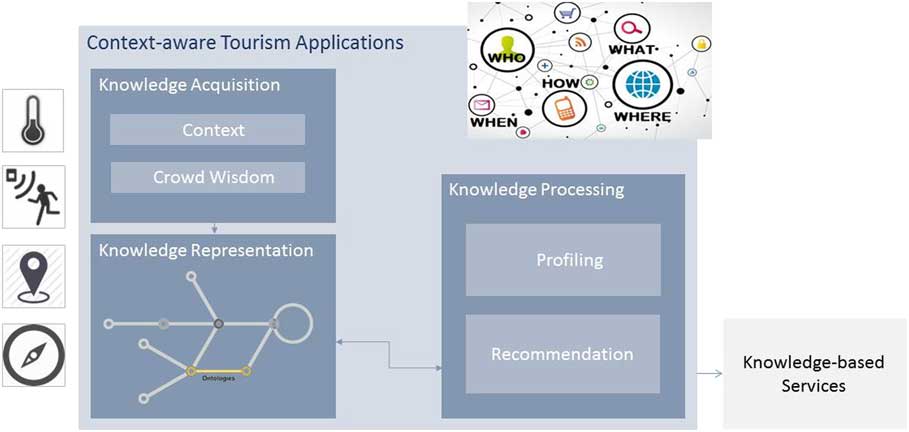
CATA architecture incorporates modules to acquire, represent and process information as well as to provide the tourism services based on a tourist-centric perspective, where the main goal is to finally provide tourism context-aware recommendations. This scenario relies on three pillars: the gathered knowledge, the adopted knowledge representation and processing techniques. Figure 1 illustrates the CATA architecture components which will be analyzed throughout this article.
Context-aware tourism application components

Typically, CATA encompass a Knowledge Acquisition Module, a Knowledge Representation Module and a Knowledge Processing Module to provide the personalised context-aware tourism services, that is, Knowledge-based services. On the on hand, the knowledge acquisition module collects the information which will be used to build the profiles of both tourists and tourism resources. On the other hand, the knowledge is represented and processed using dedicated technologies and algorithms. The offered knowledge-based services are the visible CATA outcome.
Knowledge Acquisition Module performs the data collection. The module relies on distinct data sources in order to obtain the different context information, including internal and external data sources. These data sources provide information which allows to derive the multiple context components of stakeholders: (i) personal context; (ii) social context; and (iii) environmental, spatial and temporal context.
Knowledge Representation Module addresses the computational representation of the tourist and tourism resource information. Tourism resources may include tourism activities, hotels, routes, attractions, etc. Semantic networks, production rules, frames or ontologies are popular tourism knowledge representation approaches. The tourist-related information encompasses the different types of context. The devices collect information both on the tourist and on the tourism resources. The context-aware information is obtained via embedded sensors or dedicated services. Finally, the tourist crowd wisdom, which provides essential feedback information regarding tourism resources, supports the personalisation of recommendations.
Knowledge Processing Module is the core of any application and CATA are not an exception. Once knowl edge is acquired, represented and stored, it is ready to be processed to produce the expected context-aware recommendations. The knowledge processing module in CATA encompasses: (i) a profiler and (ii) a recommender.
Knowledge-Based Services are the collection of CATA services provided to the end-user. These tourist-centric services may range from the recommendation of personalised routes, accommodation, transportation solutions or trendy attractions to complete tourism packages and, additionally, be enriched with complementary articles, videos, images, websites, news or meteorological forecasts.
4 CATA: knowledge acquisition module
Knowledge Acquisition includes implicit—user unconscious—context acquisition, that is, the context is inferred from the tourist behaviour and sensor data seamlessly acquired, and explicit—user conscious—context acquisition, that is, the context is intentionally provided by the user, or a hybrid approach, that is, combining both data acquisition techniques. Therefore, the knowledge acquisition module typically collects information from multiple data sources, namely, internal or external sources. Internal sources are intrinsic to the CATA and may encompass sensor-based and user provided data. The external sources rely on external services such as social platforms, LOD, Web services, etc.
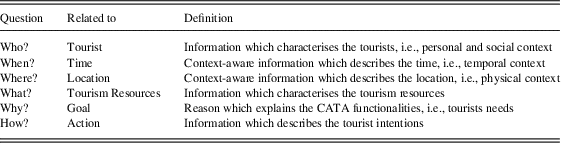
Both data sources collect the personal, social and context-aware data. While personal context data includes the tourist-related data the social context data encompasses the information collected from social platforms. The context-aware data allows to describe the surrounding context regarding environment, space and time. This information models the tourism stakeholders, using the multiple types of context, in order to support personalised recommendations. Moreover, CATA use the 5W1H questions—Who?, When?, Where?, What?, Why? and How? —to collect the tourist context (Li et al., Reference Li, Eckert, Martinez and Rubio2015) This information is essential to match the tourist context with the tourism resources contexts. Regarding the knowledge acquisition module, the CATA will be analyzed and compared in terms of data sources and context information. In particular, this module allows to identify multiple types of CATA.
4.1 Sources
The data sources provide CATA with the information related to the tourism stakeholders. This information can be explicitly provided by tourist and tourism businesses, or acquired implicitly via external services, user behaviour, or mobile device capabilities. Thus, CATA can use internal sources, that is, sensors or users, and external sources, that is, services, social platforms or LOD repositories.
Internal Sources are intrinsic to CATA, that is, are obtained internally by the system. These sources can be sensor-based (via mobile devices) or user-based (using the user behaviour or personal data).
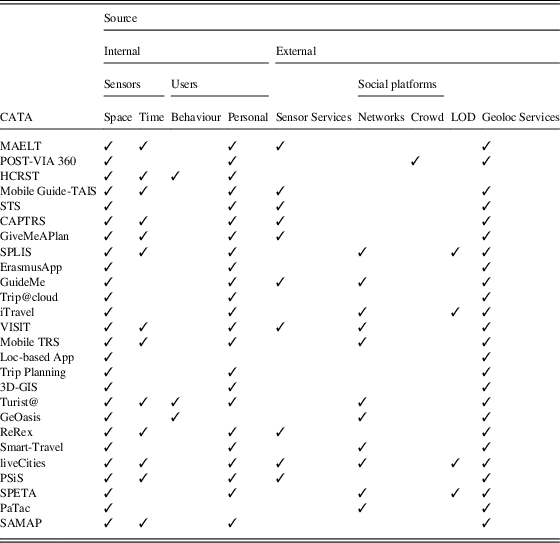
∙ Sensors generate seamlessly real time context data. Motion sensors (e.g. accelerometers, gravity sensors, gyroscopes and rotational vector sensors.), environmental sensors (e.g. barometers, photometers and thermometers), position sensors (e.g. orientation sensors and magnetometers) and the embedded GNSS sensor acquire implicitly the tourist context-aware information. All of the surveyed CATA acquire sensor data.
∙ Users generate information through interaction.
− Behaviour tracking is derived from the user interaction. The information provided by the user can be implicit or explicit. While implicit information is deduced from the past behaviour of the user, the user can provide information explicitly via the system functionalities. The explicit feedback can be provided in the form of star ratings, likes, shares, etc. The modelling of the user behaviour, which is derived implicitly, was contemplated by GuiveMeAPlan (Barragáns-Martínez and Costa-Montenegro, Reference Barragáns-Martínez and Costa-Montenegro2015), STS (Braunhofer et al., Reference Braunhofer, Elahi and Ricci2014), Turist@ (Batet et al., Reference Batet, Moreno, Sánchez, Isern and Valls2012) and GeOasis (Santiago et al., Reference Santiago, López, Montejo-Ráez and López2012).
− Personal Data corresponds to data explicitly provided by the user, for example, user authentication, demographic data or preferences, using the CATA front-end. While authentication is mandatory for identification purposes, demographic or preference information is, usually, obtained via forms. With this information, CATA can start the profiling and recommendation processes. Personal information is required by the majority of the surveyed CATA. Only, Loc-based App (Panahi et al., Reference Panahi, Woods and Thwaites2013) and PaTac (Ceccaroni et al., Reference Ceccaroni, Codina, Palau and Pous2009) do not rely on user data to provide recommendations.
External Sources correspond to indirect data acquisition via standard Web Service API. This complementary data are typically used to enrich the user experience and for further personalisation:
∙ Sensor Services are used in CATA to obtain in real or deferred time environmental information, for example, weather. GuideMe (Umanets et al., Reference Umanets, Ferreira and Leite2014), VISIT (Meehan et al., Reference Meehan, Lunney, Curran and McCaughey2013), ReRex (Baltrunas et al., Reference Baltrunas, Ludwig, Peer and Ricci2011), liveCities (Martin et al., Reference Martin, Alzua and Lamsfus2011) and PSiS (Anacleto et al., Reference Anacleto, Figueiredo, Luz, Almeida and Novais2011) rely on remote sensor services to gather meteorological information.
∙ Social Platforms expose user generated content known as crowdsourced data. Social networks and tourism crowdsourcing platforms are popular for sharing tourism experiences. These external sources are important for CATA due to its relevance in terms of decision making.
− Social Networks are an inevitable data source while shared repositories of explicit opinions, interests and preferences. The tourist shares explicitly tourism experiences in social networks in the form of likes, tweets, posts, shares, etc. The social networks (e.g. Facebook, Twitter, Flickr, etc.), contain information which completes the social profile of the tourist. Moreover, they allow the identification of people with similar tastes or behaviours and play an important role both in individual and in group recommendation processes. Regarding the surveyed CATA, the social networks are incorporated in GeOasis (Santiago et al., Reference Santiago, López, Montejo-Ráez and López2012), GuideMe (Umanets et al., Reference Umanets, Ferreira and Leite2014), iTravel (Yang & Hwang, Reference Yang and Hwang2013), liveCities (Martin et al., Reference Martin, Alzua and Lamsfus2011), SPLIS (Viktoratos et al., Reference Viktoratos, Tsadiras and Bassiliades2015, Reference Viktoratos, Tsadiras and Bassiliades2014), Mobile TRS (Garcia et al., Reference Garcia, Torre and Linaza2013), PaTac (Ceccaroni et al., Reference Ceccaroni, Codina, Palau and Pous2009), Smart-Travel (Hung et al., Reference Hung, Hsu and Wang2011), SPETA (García-Crespo et al., Reference García-Crespo, Chamizo, Rivera, Mencke, Colomo-Palacios and Gómez-Berbís2009), Turist@ (Batet et al., Reference Batet, Moreno, Sánchez, Isern and Valls2012) and VISIT (Meehan et al., Reference Meehan, Lunney, Curran and McCaughey2013).
− Crowdsourcing is the process of getting work done by a crowd of individuals, that is, corresponds to any collective and collaborative activity performed by a large number of volunteers with the support of information and communication technologies (Howe, Reference Howe2006).
Specifically in the tourism domain, there is a significant number of well-known dedicated portals (e.g. TripAdvisor, Expedia, airbnb, Wikivoyage, etc.) which help the tourist to plan, book, experience, and share their travels and reviews. In these portals, the tourist can search, comment, share and evaluate resources, that is, the tourists insert the information collaboratively. These collaborative platforms can be envisaged as reputation-based crowdsourcing platforms, as users can increase their reputation by evaluating and making recommendations. The tourist makes decisions based on crowdsourced information, that is, on the feedback of other tourists. Tourism crowdsourced information includes experience sharing in the form of ratings and reviews (evaluation-based), pages (wiki-based), likes, posts, images or videos (social-network-based).
On the other hand, Crowdsourcing has become an essential source of information for tourism businesses. While tourists make decisions based on crowdsourced reviews and ratings, tourism businesses, according Sigala (Reference Sigala2015), regard the tourist crowd know-how as a valuable contribution for personalised marketing. In addition, Crowdsourcing, while a continuous source of tourist-generated, shared and maintained data, promotes intangible tourism experiences (Sigala et al., Reference Sigala, Christou and Gretzel2012). Furthermore, according to Gula (Reference Gula2013), the tourism industry has, not only, adopted Crowdsourcing as the major source of tourist feedback data, but relies heavily on crowdsourced data analytics to define new business strategies.
Regarding these aspects, the tourism crowdsourced information enriches the knowledge acquisition module. The crowd wisdom not only improves the quality of information provided to tourist by CATA, but also supports the definition of new business strategies. However, crowdsourcing as a source of tourism information is a new research topic in CATA and was not found in the surveyed CATA.
∙ LOD Repositories offer structured and interlinked semantic data on the Web. The LOD relies on standard Web technologies such as Hypertext Transfer Protocol (HTTP), RDF and Uniform Resource Identifier. In terms of CATA, LOD repositories contain information which can be highly relevant, for example, to describe a place or monuments. Additionally, it also may provide complementary information in terms of articles, images or maps. SPLIS (Viktoratos et al., Reference Viktoratos, Tsadiras and Bassiliades2015, Reference Viktoratos, Tsadiras and Bassiliades2014), iTravel (Yang & Hwang, Reference Yang and Hwang2013), liveCities (Martin et al., Reference Martin, Alzua and Lamsfus2011) and SPETA (García-Crespo et al., Reference García-Crespo, Chamizo, Rivera, Mencke, Colomo-Palacios and Gómez-Berbís2009) use LOD to collect complementary information and enrich the recommendations.
∙ Geolocation Support Services are the main support to the tourist during the tourism experience. These external sources provide location-related data to guide the tourist such as maps or routes. Using a map or route, the tourist feels more confidence to explore a recommended POI. Geolocation support services are used in all surveyed CATA. The map-based interfaces and routes are invaluable to guide the mobile tourist.
4.2 Context data
Context information models the tourism stakeholders, that is, creates the corresponding profile. A rich context acquisition contributes to profiling refinement. Dey (Reference Dey2001) gathers the different context definitions described in the literature. Furthermore, Dey (Reference Dey2001) concludes that the context of an entity encompasses any information which helps to characterise the entity. In the case of tourism domain, the entities are tourists and tourism resources. According to Adomavicius and Tuzhilin (Reference Adomavicius and Tuzhilin2015), the context information can be obtained explicitly (introduced by user), implicitly (provided by mobile devices sensors or external services) or deduced (using statistical or data mining algorithms). Typically, CATA raise the 5W1H questions—Who?, When?, Where?, What?, Why? and How? —to collect the tourist context (Li et al., Reference Li, Eckert, Martinez and Rubio2015). These questions provide a complete perspective of the tourist needs, that is, contextualise the tourist’s current situation. Table 1 contains the definition of the 5W1H questions in the CATA scenario. In terms of contextual information, we highlight: (i) Personal, (ii) Social and (iii) Context-Aware Information.
5W1H context questions

CATA=context-aware tourism applications.
Personal Context Data encompasses tourist-centred information such as demographic data, preferences and interaction record (history). The demographic information contains personal information related to the tourist, for example, name, age, genre, nationality, native language, job, etc. The preferences represent the real tourist interests and can be expressed explicitly, that is, provided directly by the tourist (e.g. voluntary feedback in the form of likes, interests or hobbies) or implicitly, that is, inferred automatically by the system. Finally, the tourist record, that is, the tourist history, corresponds to the tourist interactions.
Social Context Data encompasses the information inserted by the tourist in the social platforms. In addition, it allows the discovery of important relations between tourists, identifying similar tastes and preferences.
Context-Aware Data integrates three types of context (Schiaffino & Amandi, Reference Schiaffino and Amandi2009): (i) environment context; (ii) spatial context; and (iii) temporal context. The environment context includes the temperature, light, humidity, noise, pressure, wind, etc. The spatial context is essentially associated to location, namely the geodetic coordinates, velocity and acceleration, the geographical region and its characterisation. The country and islands are geographical region examples, whereas city, town, village, countryside or beach are examples of space characterisation. The temporal context includes the epoch, time of day, day of week, season, holidays, etc. Frequently, in CATA, the spatial and temporal contexts are referred as spatio-temporal context.
5 CATA: knowledge representation module
Knowledge representation and reasoning is a sub-field of AI. In the case of the tourism domain, the knowledge describes the stakeholders through the multiple context components. The knowledge representation module uses dedicated techniques to structure and represent all acquired knowledge.
Various knowledge representation techniques have been proposed in the literature (Brewster & O’Hara, Reference Brewster and O’Hara2004; Stephan et al., Reference Stephan, Pascal and Andreas2007). According to Grimm (Reference Grimm2010), the most prevalent forms of knowledge representation are logic-based, rule-based, ontology-based and semantic networks. While semantic networks use graphs to visualise conceptual structures, rules exhibit some if-then-reading to express statements regarding a domain. Logic is used to implement accurate formal semantics for both semantic networks and rules. In turn, the ontologies represent types, properties, and interrelationships of the entities of a given domain. Several tourism projects have adopted tourism ontologies to represent and store tourism knowledge.
The majority of surveyed CATA omit the adopted knowledge representation approach. SPLIS (Viktoratos et al., Reference Viktoratos, Tsadiras and Bassiliades2015, Reference Viktoratos, Tsadiras and Bassiliades2014) implements a rule-based system together with an ontology to represent the data relationships. On the other hand, GeOasis (Santiago et al., Reference Santiago, López, Montejo-Ráez and López2012), SPETA (Garcia-Crespo et al., Reference García-Crespo, Chamizo, Rivera, Mencke, Colomo-Palacios and Gómez-Berbís2009) and SAMAP (Castillo et al., Reference Castillo, Armengol, Onaindía, Sebastiá, González-Boticario, Rodríguez, Fernández, Arias and Borrajo2008) adopt ontologies for knowledge representation.
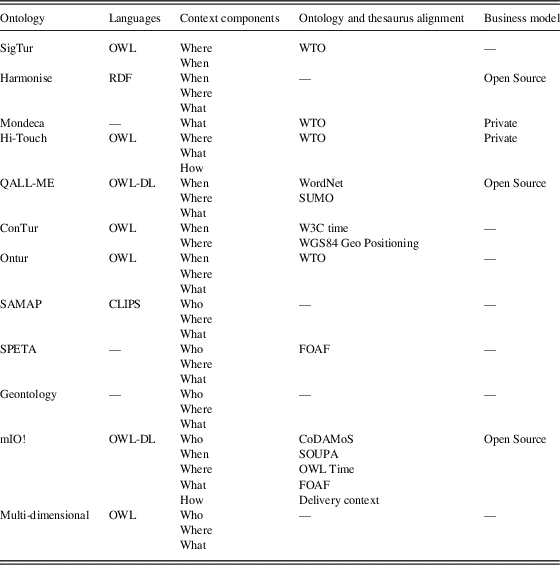
In terms of tourism-related knowledge representation, we found a relevant set of tourism ontologies which can be reused by new CATA. We analyze these surveyed tourism ontologies in terms of ontology development languages and, in particular, contemplated context features (using the 5W1H questions), alignment with other ontologies and thesaurus and the business model. Table 2 shows this comparison.
Tourism ontologies: comparison of features

OWL=Web Ontology Language; WTO=World Tourism Organization; RDF=Resource Description Framework; OWL-DL=OWL Description Logic; FOAF=Friend of a Friend.
OWL is the most used development language. In terms of context components, the Where? and What?, that is, the location and tourism resources, are the main features represented. The majority of tourism ontologies are aligned with other ontologies or thesaurus. Namely, the WTO is used by four ontologies since it offers a Thesaurus on Tourism and Leisure ActivitiesFootnote 17 . This thesaurus contains detailed information about tourism activities, including concepts and semantic relations, defining tourism terminology and providing standardisation and normalisation of tourism concepts. Finally, in terms of business model, there are open source and commercial ontologies. However, some ontologies omit the details of the adopted business model.
In CATA, the contextualisation of the tourist’s current situation is essential. The majority of these ontologies do not cover context-aware information, that is, do not answer all 5W1H questions. A notable exception is the mIO! ontology network (Poveda Villalon et al., Reference Poveda Villalon, Suàrez-Figueroa, García-Castro and Gómez-Pérez2010) which allows the representation of all context components depicted in CATA framework. This open source ontology presents the best context representation within the surveyed CATA, using a tourist-centric approach.
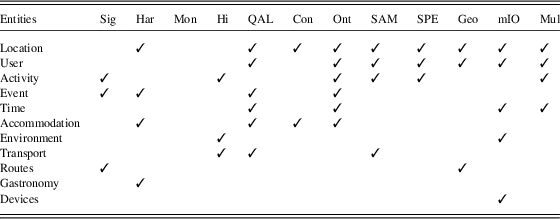
The entities represented are other relevant aspect of these ontologies. Table 3 compares the main entities represented. The most common context entities are Location, User, Activity, Event, Time, Accommodation and Transport. Regarding the representation of tourism entities, the QALL-ME (Ou et al., Reference Ou, Pekar, Orasan, Spurk and Negri2008) and Ontur (Prantner, Reference Prantner2004) represent the largest number of tourism entity categories.
Tourism ontologies: comparison of represented entities

6 CATA: knowledge processing module
Knowledge processing is the core of any CATA. It is composed by: (i) a profiler, which models the tourist using the contextual information; and (ii) a recommender, which generates personalised recommendations. Once the knowledge is acquired, represented and stored, it is ready to be processed by both profiler and recommender, in order to originate the expected context-aware recommendations.
In terms of profiling, there are several techniques to model entities according to the data available. In this context, Hildebrandt (Reference Hildebrandt2006, Reference Hildebrandt2008) identify: (i) individual profiling; and (ii) group profiling. While individual profiling is centred on individual users, group profiling characterises groups of users. Considering the group profiles, these can be distributive or non-distributive, that is, applying or not the same properties to all group members. Additionally, the profiler can build and use trust and reputation models to improve the quality of data, and, consequently, a profiling refinement. Trust and reputation is particularly valuable in the case of profiles which use social information.
The recommendation process can incorporate different techniques: content-based, collaborative; and hybrid filtering. Content-based filters search the space according to the user and item context. Collaborative filters depends on the classification each user gave to the items he/she was exposed to. The hybrid approaches aggregate both content-based and collaborative methodologies. The recommendation processing can be done on-line or off-line, using dedicated techniques to make recommendations. While on-line processing requires a continuous updating, that is, the process updates the model incrementally and generates recommendations as soon as the system receives new data, the off-line approach processes large amounts of data partitioned into the train subset—used to build an initial model—and test subset—used to generate recommendations and evaluate the built model.
The following sub-sections provide an overview regarding the knowledge processing module. Each sub-section includes a short description and the main techniques present in the literature in order to be applied in new CATA.
6.1 Profiling
Profiling is the activity of modelling entities based on the collected information. According to Middleton et al. (Reference Middleton, Shadbolt and De Roure2004), a profile is typically either knowledge-based (static profile) or behaviour-based (dynamic profile). CATA adopt a dynamic profiling given that the stakeholders context is always changing. The stakeholder profiles are modelled according to the current context, and, then, over time, are updated. Depending on the available data and the system requirements, the profiler can build individual or group profiles. Particularly, the group profiles can be classified as distributive and non-distributive profiles. In this scenario, we detected two general types of profiling:
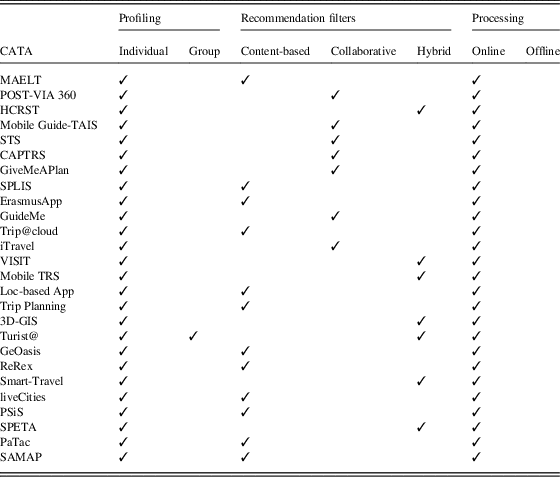
Individual Profiling models a single user using user-centric information. Thus, personalised or individual profiling relies on a set of attributes regarding an individual user. Moreover, individual profiling discovers, implicitly or explicitly, user characteristics which enable personalisation. Regarding the surveyed CATA, the individual profiling is included in all applications.
Group Profiling models collections of related users. Group profiling characterises a group (community or category), described by a set of attributes. The group may consist of a community (i.e. an already existing group) or a group of people which shares one or more common attributes. In contrast to individual profiling, group profiling aims at combining individual user profiles to model a group. Group profiles are vital in those domains where it is necessary to provide recommendations to groups of users rather than to individual users. Additionally, group profiling can be classified as distributive or non-distributive. Distributive profiling groups together users who share the same attributes, whereas non-distributive profiling groups users who do not share all attributes. In the tourism domain, non-distributive profiles are the most common since it is difficult to identify users sharing the same attributes. These profiling mechanisms use probabilistic techniques containing a certain degree of inaccuracy. Regarding the surveyed CATA, only Turist@ (Batet et al., Reference Batet, Moreno, Sánchez, Isern and Valls2012) adopts group profiling.
Additionally, trust and reputation, stereotyping, and clustering are mechanisms which can be incorporated in profiling. While trust and reputation enable the refinement of the individual profiles, stereotyping and clustering are techniques to build group profiles regarding users or/and items. These mechanisms can be defined as:
Trust and Reputation are distinct, but intrinsically linked concepts, for example, “I trust that hotel because it has good reputation”. Jøsang et al. (Reference Jøsang, Ismail and Boyd2007) analyze the different interpretations of trust and reputation. The tourism social information, that is, the information shared in social networks and crowdsourcing platforms, takes advantage of the data-sharing trend on tourism platforms. The validation of this shared data relies on the modelling of the trust and reputation of publishers. In this context, trust is based on direct experiences between stakeholders, while reputation is based on third party experiences, for example, the crowd. Both are used to represent the reliability of publishers (tourists and businesses). With the proliferation of crowdsourcing in the tourism domain, trust and reputation became an important profiling dimension, representing the reliability of information and information publishers. The surveyed CATA do not refer to trust and reputation modelling.
Stereotyping is a generalisation regarding a particular cognitive social category that brings together members of a group with particular attributes, that is, a stereotype (Albu, Reference Albu2013). Basically, the stereotype is a preconceived set of features which aim to group similar entities.
In terms of CATA, it is possible to associate context attributes with stereotypes. On the one hand, tourists are grouped according to their similarity in terms of the stereotype context attributes. On the other hand, the tourism resources can be stereotyped according to the context components. In this scenario, recommendations are based on both tourist and tourism resources stereotypes. PaTac (Ceccaroni et al., Reference Ceccaroni, Codina, Palau and Pous2009) is the single surveyed CATA which uses stereotypes. Specifically, it builds the initial user profile with the help of demographic stereotyping.
Clustering is the task of identifying homogeneous groups of objects or entities called clusters. The cluster members share similar characteristics, allowing the identification of dense and sparse regions as well as the discovery of the overall distribution pattern and correlations among data attributes. In terms of profiling, clustering techniques allow to detect patterns in a set of users which can be used as profile components. The surveyed CATA exclude clustering mechanisms as profile builders.
6.2 Recommendation
Recommendation systems are currently being applied in many different domains. These tools produce personalised recommendations before a large variety of choices. In the tourism domain, the recommendation systems have been extensively applied to reduce the information overload. Recommenders are seamless components that work on behalf of tourists to provide personalised recommendations (travel plans, routes, POI, etc.). According to Adomavicius and Tuzhilin (Reference Adomavicius and Tuzhilin2005) there are three generic recommendation methodologies:
Content-based techniques filter the search space (features of products, goods or services) according to the user-related context information features. Thus, content-based filters provide recommendations analyzing contextual information. Normally, content-based filters determine the similarity between users and items (e.g. cosine similarity). MAELT (Silva et al., Reference Silva, Toasa, Guevara, Martinez and Vargas2018), SPLIS (Viktoratos et al., Reference Viktoratos, Tsadiras and Bassiliades2015, Reference Viktoratos, Tsadiras and Bassiliades2014), Trip@cloud (Qureshi et al., Reference Qureshi, Ahmad and Rafique2011), Loc-based App (Panahi et al., Reference Panahi, Woods and Thwaites2013), Trip Planning (Herath & Ratnayake, Reference Herath and Ratnayake2013), GeOasis (Santiago et al., Reference Santiago, López, Montejo-Ráez and López2012), ReRex (Baltrunas et al., Reference Baltrunas, Ludwig, Peer and Ricci2011), liveCities (Martin et al., Reference Martin, Alzua and Lamsfus2011), PSiS (Anacleto et al., Reference Anacleto, Figueiredo, Luz, Almeida and Novais2011), PaTac (Ceccaroni et al., Reference Ceccaroni, Codina, Palau and Pous2009) and SAMAP (Castillo et al., Reference Castillo, Armengol, Onaindía, Sebastiá, González-Boticario, Rodríguez, Fernández, Arias and Borrajo2008) use a content-based filter to produce the recommendations.
Collaborative filtering is a classification-based technique, that is, depends on the classification each user gave to the items he/she was exposed to. These techniques rely on the availability of user classifications to generate the recommendations. Collaborative filtering encompasses memory-based and model-based techniques. On the one hand, memory-based filtering uses the entire or a sample of the user-item database to generate predictions. These techniques are neighbour-based and provide top@N recommendations, that is, a set of the best predictions regarding item-based or user-based recommendations. On the other hand, model-based techniques use rating data to estimate or learn a model in order to predict unknown ratings. Model-based techniques include Bayesian networks, clustering and latent semantic models (Su & Khoshgoftaar, Reference Su and Khoshgoftaar2009). We can find these collaborative approaches in the GiveMeAPlan (Barragáns-Martínez & Costa-Montenegro, Reference Barragáns-Martínez and Costa-Montenegro2015), STS (Najafian et al., Reference Najafian, Wörndl and Braunhofer2016), POST-VIA 360 (Colomo-Palacios et al., Reference Colomo-Palacios, García-Peñalvo, Stantchev and Misra2017), Mobile Guide-TAIS (Kashevnik et al., Reference Kashevnik, Ponomarev and Smirnov2017), CAPTRS (Ashley-Dejo et al., Reference Ashley-Dejo, Ngwira and Zuva2016), GuideMe (Umanets et al., Reference Umanets, Ferreira and Leite2014) and iTravel (Yang & Hwang, Reference Yang and Hwang2013) applications.
Hybrid systems combine two or more recommendation techniques to improve the quality of the recom mendations. These approaches aggregate content-based and collaborative methodologies to generate recommendations compatible with the past behaviour and the current context of the user (Burke, Reference Burke2002). HCRST (Bahramian et al., Reference Bahramian, Ali Abbaspour and Claramunt2017), VISIT (Meehan et al., Reference Meehan, Lunney, Curran and McCaughey2013), Mobile TRS (García et al., Reference Garcia, Torre and Linaza2013), 3D-GIS (Noguera et al., Reference Noguera, Barranco, Segura and MartíNez2012), Turist@ (Batet et al., Reference Batet, Moreno, Sánchez, Isern and Valls2012), Smart-Travel (Hung et al., Reference Hung, Hsu and Wang2011), and SPETA (García-Crespo et al., Reference García-Crespo, Chamizo, Rivera, Mencke, Colomo-Palacios and Gómez-Berbís2009) rely on hybrid filters to create the context-aware recommendations.
Recommendation filters may adopt on-line or offline modelling. Offline modelling creates offline models which will be applied during a given period, that is, will remain static till a new offline model is created. Online modelling updates the existing model every time a new event occurs.
Offline Processing explores a large amounts of data to model users and items. The offline processing relies on, essentially, data mining and machine learning algorithms for learning the user context, and, then, to provide recommendations using, only, the static model. Ren et al. (Reference Ren, Li and Zhou2015) survey recent progress in the research of recommendations based on offline data processing. They highlight new features (e.g. serendipitous recommendation) and new research issues (e.g. tag recommendation or group recommendation). The surveyed CATA do not refer this type of processing.
Online Processing is event-driven and performs incremental updating, that is, the model is updated as soon as the system receives new data. The online processing mines these data streams to learn and predict the user behaviour. Stream mining is the process of discovering knowledge or patterns from continuous data streams (Han & Ding, Reference Han and Ding2009). Applying stream mining techniques, it is possible to learn the user behaviour and provide online recommendations. Amatriain (Reference Amatriain2013), Gama (Reference Gama2010) and Sayed-Mouchaweh (Reference Sayed-Mouchaweh2016) address the problems of modelling, prediction, classification, data understanding and processing in unpredictable environments exploiting data streams processing techniques. These stream mining and knowledge discovery techniques are used for personalisation in online systems. Since all surveyed CATA update the user and item profiles whenever a new user event occurs, this means that content-based and collaborative memory-based models are updated online.
7 CATA Trends
Mobile technology has changed the paradigm of the tourism industry, revolutionising the role of the tourist and transforming travel planning, booking, experiencing and sharing, that is, the travel cycle. Tourists evolved from being end-consumers of the tourism industry to becoming central active players, sharing large volumes of feedback data on tourism resources. Technology caused a strong impact in the tourism sector from the tourist perspective and offers tourism researchers and businesses the opportunity to design the future of the tourism mobile technology. Additionally, the technology provides the tourist with crucial support throughout the travel cycle and, in particular, highlights the relevance of crowdsourced information in the tourist decision-making process.
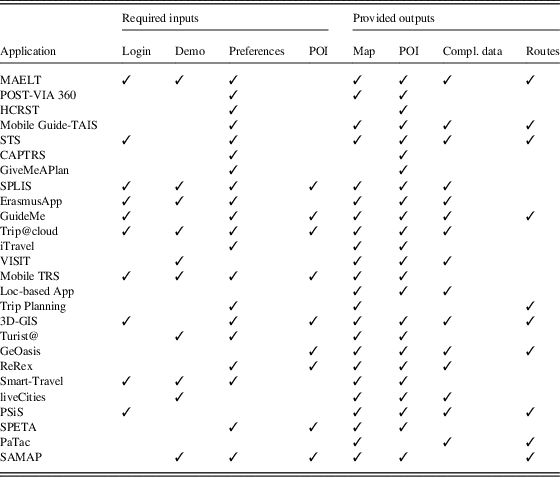
The aim of any survey is to compare existing solutions in order to understand the current system features, not only, at the user level, but also at the system level. Thus, the following discussion contains a comparison taking into account the CATA framework components:
Knowledge Acquisition performed by knowledge acquisition module uses internal and external data sources to obtain information. The internal and external data sources provide multiple types of information. In CATA, the type of data available has a relevant role in the final recommendations. To compare the surveyed CATA in terms of data acquisition, we consider both the context data sources and contents.
Table 4 summarises the surveyed CATA in terms of context acquisition sources, that is, internal sources (sensors-based and user-based) and external sources (sensor services, social platforms, LOD repositories and geolocation support services).
Context-aware tourism applications (CATA): comparison of context knowledge acquisition

MAELT=Mobile Application to Encourage Local Tourism with Context-Aware Computing; HCRST=Cold Start Context-Aware Recommender System; STS=South Tyrol Suggests; CAPTRS=Context-Aware Proactive Tourist Recommender System; SPLIS=Semantic Personalising Location Information Service; VISIT=Virtual Intelligent System for Informing Tourists; TRS=Travel Recommender System; GIS=Geographic Information System; PSiS=Personalised Sightseeing Tours Recommendation System; SPETA=Social Pervasive e-Tourism Advisor.
Regarding the internal context knowledge acquisition sources, we verify that the majority of the applications require user mandatory inputs and use the mobile device sensors to acquire the context-aware information, namely, spatio-temporal information. In turn, the user mandatory inputs, that is, personal data, include authentication, demographic and preferences information. In terms of internal sources, CATA tend to ignore that the past user history allows to predict the user behaviour. CATA favour explicit user inputs instead of the inference of the user behaviour.
External data sources are common in CATA. While some systems use external sensor services to obtain remote weather information, the majority interact with social networks. However, the latter excludes tourism crowdsourcing platforms. Additionally, SPLIS (Viktoratos et al., Reference Viktoratos, Tsadiras and Bassiliades2015, Reference Viktoratos, Tsadiras and Bassiliades2014), iTravel (Yang & Hwang, Reference Yang and Hwang2013), liveCities (Martin et al., Reference Martin, Alzua and Lamsfus2011) and SPETA (García-Crespo et al., Reference García-Crespo, Chamizo, Rivera, Mencke, Colomo-Palacios and Gómez-Berbís2009) applications rely on LOD repositories to provide complementary information to the tourist. Finally, the geolocation support services (maps and routes) are the most used external services in CATA.
Regarding knowledge acquisition, the inference of implicit tourist behaviour, that is, using the history or explicit preferences, and the usage of crowdsourced information needs to be explored in terms of new CATA.
Knowledge Representation structures information using dedicated techniques. The majority of the sur veyed CATA do not specify the representation technique used. However, we found two types of representation: rule-based and ontologies. It is the case of SPLIS (Viktoratos et al., Reference Viktoratos, Tsadiras and Bassiliades2015, Reference Viktoratos, Tsadiras and Bassiliades2014), which adopts a rule-based system together with an ontology for context-aware POI recommendation.
Ontologies enable the representation, storage, reuse and the discovery of new knowledge, using the Semantic Web. Several tourism research projects produced tourism ontologies and, consequently, some have been reused by CATA. Trip Planning (Herath & Ratnayake, Reference Herath and Ratnayake2013), GeOasis (Santiago et al., Reference Santiago, López, Montejo-Ráez and López2012), PaTac (Ceccaroni et al., Reference Ceccaroni, Codina, Palau and Pous2009) and SAMAP (Castillo et al., Reference Castillo, Armengol, Onaindía, Sebastiá, González-Boticario, Rodríguez, Fernández, Arias and Borrajo2008) are examples of CATA supported by ontologies. Particularly, GeOasis Santiago et al., Reference Santiago, López, Montejo-Ráez and López2012) and SAMAP (Castillo et al., Reference Castillo, Armengol, Onaindía, Sebastiá, González-Boticario, Rodríguez, Fernández, Arias and Borrajo2008) were created within tourism projects.
Concerning knowledge representation, we anticipate the representation of both social and group information. From the CATA analysis, we noticed that most ontologies tend to disregard the social dimension. The only exception was the reuse of FOAF ontology, which provides a social perspective. However, the shared information introduced explicitly by the tourist in social platforms (social networks and crowdsourcing platforms) is not truly considered. On the other hand, we forecast that group travelling will play an important role. Thus, a representation of group information is another challenge for the knowledge representation module.
Knowledge Processing includes profiling and recommendation.
Table 5 compares the surveyed CATA in terms of profiling (individual or group), recommendation filters (content-based, collaborative or hybrid), and the type of processing (online or offline).
Context-aware tourism applications (CATA): comparison of processing techniques

MAELT=Mobile Application to Encourage Local Tourism with Context-Aware Computing; HCRST=Cold Start Context-Aware Recommender System; STS=South Tyrol Suggests; CAPTRS=Context-Aware Proactive Tourist Recommender System; SPLIS=Semantic Personalising Location Information Service; VISIT=Virtual Intelligent System for Informing Tourists; TRS=Travel Recommender System; GIS=Geographic Information System; PSiS=Personalised Sightseeing Tours Recommendation System; SPETA=Social Pervasive e-Tourism Advisor.
The surveyed CATA use individual profiling with the exception of Turist@ (Batet et al., Reference Batet, Moreno, Sánchez, Isern and Valls2012). The majority of CATA includes personal, social and context-aware information to create the tourist profile. Particularly, ErasmusApp (Bruyneel & Malheiro, Reference Bruyneel and Malheiro2014) provides a collaborative upload of tourism information. However, this application does not apply trust and reputation modelling to profiling to validate the information. Additionally, PaTac (Ceccaroni et al., Reference Ceccaroni, Codina, Palau and Pous2009) incorporates stereotyping to create an individual tourist profile.
All CATA use recommendation techniques, being the content-based filtering the most used. It is related to the knowledge acquisition where the systems require user mandatory inputs. This information is compared with the tourism items to generate the recommendations. However, the most recent applications, that is, POST-VIA 360 (Colomo-Palacios et al., Reference Colomo-Palacios, García-Peñalvo, Stantchev and Misra2017), Mobile Guide-TAIS (Kashevnik et al., Reference Kashevnik, Ponomarev and Smirnov2017), STS (Najafian et al., Reference Najafian, Wörndl and Braunhofer2016), CAPTRS (Ashley-Dejo et al., Reference Ashley-Dejo, Ngwira and Zuva2016) and GiveMeAPlan (Barragáns-Martínez & Costa-Montenegro, Reference Barragáns-Martínez and Costa-Montenegro2015), explore the collaborative filtering to generate the recommendations, doing, particularly, rating prediction. Therefore, the researchers are applying collaborative filtering to the context-aware tourism recommendations.
Finally, the surveyed CATA omit the model creation and updating details. They emphasise more on the provided services rather than on the back-end processing details. Since all surveyed CATA update the user and item profiles whenever a new user event occurs, this means that context based and memory-based collaborative models are updated on-line. Additionally, these applications do not provide any recommendation evaluation results nor use standard data sets, making it impossible to compare the quality of the provided recommendations.
In terms of profiling, group profiling is not contemplated in the surveyed CATA, although groups play a relevant role in tourism domain. Regarding social information, trust and reputation mechanisms need to be further explored in order to evaluate the quality of the information and the reliability of the publishers. User data privacy is usually not considered in the surveyed applications. Finally, the multiple criteria of tourism-related data (e.g. multiple ratings, textual reviews, multiple context-aware information, etc.) should be explored.
Knowledge-based Services: most applications require an initial user interaction in order to provide per sonalised services. The typical user inputs required to generate recommendations are authentication, demographic configuration and explicit preferences. Depending on the application, recommendations may include list of POI, suggested routes, maps as well as complementary data, for example, images, videos, space and time triggered notifications, weather forecast and LOD resources. Table 6 compares the surveyed tourist mobile applications in terms of the user inputs and the offered services. In terms of offered services the majority of CATA provide maps as a geolocation support service to locate the recommendations. These CATA, which provide map-based display, add routes to provide a better guidance to the tourist excepting POST-VIA 360 (Colomo-Palacios et al., Reference Colomo-Palacios, García-Peñalvo, Stantchev and Misra2017), Trip Planing (Herath & Ratnayake, Reference Herath and Ratnayake2013) and PaTac (Ceccaroni et al., Reference Ceccaroni, Codina, Palau and Pous2009), all CATA includes POI as a recommendation. In turn, the complementary data are also frequently used for a better description of the services via images, videos, articles, sounds, etc. The traditional maps or routes (strongly used in CATA) can be improved by augmented reality and immersive techniques using remote sensor services information.
Context-aware tourism applications (CATA): Service Inputs and Outputs

POI=Point of Interest; MAELT=Mobile Application to Encourage Local Tourism with Context-Aware Computing; HCRST=Cold Start Context-Aware Recommender System; STS=South Tyrol Suggests; CAPTRS=Context-Aware Proactive Tourist Recommender System; SPLIS=Semantic Personalising Location Information Service; VISIT=Virtual Intelligent System for Informing Tourists; TRS=Travel Recommender System; GIS=Geographic Information System; PSiS=Personalised Sightseeing Tours Recommendation System; SPETA=Social Pervasive e-Tourism Advisor.
8 Conclusion
CATA improve the user travel experience in both familiar and unknown territories. They benefit from the current technological status, for example, the availability of personal mobile devices and ubiquitous services. This article presents a survey of existing CATA, and an analysis framework with four dimensions, considering Knowledge Acquisition, Knowledge Representation, Knowledge Processing and user-centric Knowledge-based Services. The CATA analyzed here are mainly research prototypes not yet fully matured, and this review shows that there are important challenges ahead, and many future improvement opportunities regarding the different framework dimensions.
Knowledge acquisition involves the interaction with internal (sensor-based and user-based sources) and external (sensor services, social platforms, LOD repositories and geolocation support services) data sources. Mobile context acquisition relies on the internal sources for user spatio-temporal, demographic and preference data, and on external sources for social, maps, weather and LOD related information. Knowledge representation supports reasoning, by providing structure and semantics. Particularly, we reviewed and compared several tourism-related ontologies in terms of development languages, entities, highlighting context-related features (Who, When, Where, What, How and How much) or alignment with other ontologies and thesaurus. Knowledge processing includes the profiling of tourists and tourism resources as well as the generation of personalised recommendations. We provide an overview of the most frequent knowledge processing techniques found in the surveyed CATA, ranging from profiling (individual and group) and recommendation (content-based, collaborative and hybrid filters, including online and offline approaches). Finally, knowledge-based services are the front-end functionalities offered to the tourists. We have analyzed and compared the different services provided to the tourists by CATA.
According to our analysis, there are topics that would benefit from further research. Concerning the knowledge acquisition dimension, we believe it can be enhanced by means of: (i) increased transparency, that is, requiring less user intervention and relying more on implicit techniques; and (ii) exploring crowdsourced feedback and wisdom regarding tourism resources. The knowledge representation dimension can be improved in terms of social and group data representation since the analyzed ontologies do not contemplate crowdsourced and travel group data. The knowledge-processing dimension can be further advanced by exploring: (i) multi-criteria recommendations, that is, using the multiple data features to profile tourism entities; (ii) trust and reputation models of crowdsourced information publishers; and (iii) group profiling and recommendation to support group travel needs in terms of context-aware technologies. Finally, regarding the knowledge-based services provided to the tourist, we foresee that user immersion (e.g. augmented reality), multimedia information (e.g. sounds, videos, weather effects, images) and complementary data (e.g. news) will enhance future user-centric services.
Acknowledgements
This work has been supported by: (i) the European Regional Development Fund (ERDF) through the Operational Programme for Competitiveness and Internationalisation—COMPETE Programme—within project (FCOMP-01-0202-FEDER-023151) and project (POCI-01-0145-FEDER-006961), and by National Funds through Fundação para a Ciência e a Tecnologia (FCT)—Portuguese Foundation for Science and Technology—as part of project UID/EEA/50014/2013; and (ii) the ERDF together with the Galician Regional Government under agreement for funding the Atlantic Research Center for Information and Communication Technologies (atlanTTic).