Helping and being helped are part of human life and have been subject to philosophical debate over centuries (Stürmer & Snyder, Reference Stürmer and Snyder2010). Helping behaviors are “voluntary acts performed with the intent to provide some benefit to another person” (Dovidio, Reference Dovidio and Berkowitz1984, p. 364). Helping behaviors may be spontaneous or nonspontaneous (i.e., Benson et al., Reference Benson, Dehority, Garman, Hanson, Hochschwender, Lebold and Sullivan1980). They are spontaneous when the potential helpers are faced with a surprising event and have to decide at that moment whether or not to help. When helping behaviors involve some sort of planning they are nonspontaneous. Such is the case of volunteering.
Previous studies have shown that willingness to help is predicted separately or in combination by the belief in a just world (BJW; Lerner, Reference Lerner1980) and self-efficacy to promote justice in the world (SEJW, i.e., Mohiyeddini & Montada, Reference Mohiyeddini, Montada, Montada and Lerner1998). Although this is an important finding in itself, that research encompasses several limitations which we address here. In fact, research on the association between the BJW and SEJW has been restricted to specific behaviors in specific contexts and has not been investigated for general attitudes towards helping. Furthermore, previous research has not been conducted with participants that do volunteer service. However, because volunteers engage in planned helping they are a crucial category of people to take into account in research towards a more in depth understanding of how BJW may be related to helping. Finally, the relative impact of personal and general BJW on the prediction of helping has not been investigated.
In this paper we focus on helping attitudes, defined as beliefs, feelings and behaviors related to helping others (Nickell, Reference Nickell1998). Specifically, we investigated if BJW (personal and general) and self-efficacy to promote justice in the world predict helping attitudes on a sample of university students as well as on a sample of volunteers.
Belief in a just world, self-efficacy to promote justice in the world and helping behavior
Just world theory (Lerner, Reference Lerner1980) states that individuals are motivated to perceive the world as a just place where people get what they deserve. The perception that the world is just gives people confidence that no unjust events will happen to them. Such fundamental perception can be preserved in two main ways (Lerner, Reference Lerner1980): if individuals perceive they can actually restore justice, they will try to improve the situation of the victims, for instance by helping them. On the contrary, when individuals perceive their actions cannot be effective in relieving victim suffering, they are unlikely to try to help. Instead, they restore justice cognitively by simply changing their perceptions of the situation. For instance, they will perceive innocent victims as people who deserve to suffer. Thus, attempts to restore justice in reality or simply cognitively depend on the interaction of two factors: individuals’ motivation to reestablish justice and their perceived efficacy to eliminate injustice (Lerner, Reference Lerner1980). A strong (versus a weak) motivation to reestablish justice is more likely to lead to helping behavior when individuals think they are actually able to eliminate injustice; if individuals think they are unable, a strong (versus weak) motivation to reestablish justice will likely lead to victim derogation.
In other words, perceived efficacy to restore justice moderates the impact of BJW on helping behavior. In fact, when helping is likely to be efficacious, high versus low just world believers are more likely to help people in a real life emergency (Bierhoff, Klein, & Kramp, Reference Bierhoff, Klein and Kramp1991), or to help an innocent hospitalized patient (DePalma, Madey, Tillman, & Wheeler, Reference DePalma, Madey, Tillman and Wheeler1999). In two experiments, Miller (Reference Miller1977) showed that high versus low believers in a just world gave more time and money to victims when their help could be effective than when it could not. In the same line, White, MacDonnell, and Ellard (Reference White, MacDonnell and Ellard2012) showed that when consumers think they can help disfavored producers increase their living conditions, high believers in a just world support fair trade to a higher extent than low believers. In fact, for low believers in a just world there was no difference in their support regardless of whether they thought their purchases would or would not alleviate injustice.
Both the motivation to reestablish justice and SEJW have been examined from a situational and a dispositional perspective. As a situational variable, the motivation to reestablish justice has been operationalized as the degree of injustice the victim suffers. Very often this construct is operationalized by presenting victims as responsible or non-responsible for their suffering, that is as non-innocent or innocent victims respectively (i.e., DePalma et al., Reference DePalma, Madey, Tillman and Wheeler1999), with the latter representing threats to the BJW, and especially for people who more strongly endorse a high BJW. As a disposition, the motivation to reestablish justice has been operationalized as the degree to which individuals endorse the BJW (i.e., White et al., Reference White, MacDonnell and Ellard2012, Study 1). Although there has been much controversy surrounding the extent to which scores on BJW scales actually assess the motivation to perceive the world as just (i.e., Hafer & Bègue, Reference Hafer and Bègue2005), scores on BJW scales and experimental threats to the BJW similarly predict reaction to victims and helping behaviors.
Perceived efficacy to restore justice in the world as a situational variable has been operationalized according to the characteristics of the situation the person in need is in (Miller, Reference Miller1977). As a disposition it has been operationalized as the degree to which perceivers believe they can actually eliminate the injustice (i.e., White et al., Reference White, MacDonnell and Ellard2012, Pilot Study).
As far as we know, only one study considered self-efficacy to restore justice in the world as a general measure and considered it as an individual difference characteristic. Specifically, self-efficacy to promote justice in the world (SEJW; Mohiyeddini & Montada, Reference Mohiyeddini, Montada, Montada and Lerner1998) was conceptualized as indicating the degree to which individuals judged themselves capable of correcting or reducing injustice.
According to Mohiyeddini and Montada (Reference Mohiyeddini, Montada, Montada and Lerner1998), BJW and SEJW are independent constructs that may jointly explain attitudes towards victims and willingness to change unjust situations. One study tested the prediction that the SEJW could decrease the negative association between the BJW and positive attitudes towards victims (Mohiyeddini & Montada, Reference Mohiyeddini, Montada, Montada and Lerner1998). In that study the participants were employed adults and the victims were unemployed. The study took place in the period after the reunification of Germany where unemployment in some regions of Germany was relatively high. It is thus possible to deduce that participants did not consider the situation of these victims could be solved easily and rapidly. In this case, BJW theory would predict a cognitive restoration of justice, for instance through negative attitudes towards victims. In that study participants answered to four variables: sympathy with the unemployed, blaming the unemployed for self-infliction of their fate, willingness to fight against unemployment financially, and willingness to fight against unemployment politically. The results showed that SEJW correlated positively with willingness to fight against unemployment (either financially or politically). BJW correlated positively with blaming the unemployed for self-infliction of their fate. For participants with high BJW, SEJW was associated with positive attitudes towards the unemployed. For participants with low BJW, SEJW was even more strongly associated with positive attitudes towards the unemployed. This presumably resulted from the fact that for low just world believers, the victim situation does not represent a threat.
Volunteering, belief in a just world, and helping attitudes
Volunteerism is a particular type of nonspontaneous help that requires active planning. It includes seeking out opportunities to help others, deciding which organization to volunteer to, which type of task to do, and how much time to dedicate to it (Bierhoff, Reference Bierhoff2002; Clary et al., Reference Clary, Snyder, Ridge, Copeland, Stukas, Haugen and Miene1998). Therefore, it is “voluntary sustained and ongoing helpfulness” (Clary et al., Reference Clary, Snyder, Ridge, Copeland, Stukas, Haugen and Miene1998, p. 1517). Volunteers often commit themselves to these helping activities over extended periods of time that may entail considerable personal costs of time, energy, and opportunity (Clary et al., Reference Clary, Snyder, Ridge, Copeland, Stukas, Haugen and Miene1998).
Psychology has focused on why people help and which people help or do not help (i.e., Batson, Duncan, Ackerman, Buckley, & Birch, Reference Batson, Duncan, Ackerman, Buckley and Birch1981). Both situational (i.e., Darley & Latane, Reference Darley and Latané1968) and intrapersonal factors (i.e., Benson et al., Reference Benson, Dehority, Garman, Hanson, Hochschwender, Lebold and Sullivan1980) are important predictors of spontaneous helping behavior. On the contrary intrapersonal factors better predict non-spontaneous helping behavior than situational factors (Clary & Snyder, Reference Clary and Snyder1999). In fact, intrapersonal factors, such as social responsibility and intrinsic religious orientation, have been found to be good predictors of volunteering (Benson et al., Reference Benson, Dehority, Garman, Hanson, Hochschwender, Lebold and Sullivan1980). Also, Other-Oriented Empathy and Helpfulness, two factors of the Prosocial Personality Orientation (Penner, Fritzsche, Craiger, & Freifeld, Reference Penner, Fritzsche, Craiger, Freifeld, Butcher and Spielberger1995), correlate with volunteerism (Penner & Fritzsche, 1993, cited in Penner & Finkelstein, Reference Penner and Finkelstein1998). However, the predominant research approach to volunteerism has been functional and has focused on understanding the motivations that lead people to become volunteers and to sustain their efforts over time (Clary et al., Reference Clary, Snyder, Ridge, Copeland, Stukas, Haugen and Miene1998). Surprisingly, no studies on belief in a just world theory have been conducted among volunteers. However, a recent study (Moreno-Jiménez, Reference Moreno-Jiménez2015) showed that people that have a higher level of community participation, which includes volunteering, are the ones that least consider the social and economic system as fair.
Theoretically the BJW, conceptualized as a justice motive (Dalbert, Reference Dalbert2001), is indicative of a personal contract (Lerner, Reference Lerner1980) that compels individuals to behave fairly and to restore justice when injustice occurs. In fact, high (versus low) just world believers seem to avoid behaving unjustly and to strive more for justice. Specifically, they indicate fewer delinquent intentions (Sutton & Winnard, Reference Sutton and Winnard2007), fewer rule-breaking behaviours (Otto & Dalbert, Reference Otto and Dalbert2005) including bullying (Correia & Dalbert, Reference Correia and Dalbert2008), and more commitment to just means (Hafer, Reference Hafer2000). Also the self-esteem of individuals endorsing high BJW decreases when they are aware their behavior is unfair (Dalbert, Reference Dalbert1999).
According to BJW theory (Lerner, Reference Lerner1980), helping behavior can be conceived not only as reactive actions to restore justice, but also as a proactive tool to cognitively increase the likelihood of good rewards for the self. In fact, in a just world, good actions make the person more deserving of good outcomes, even when the outcomes are not directly related to their actions. This claim received empirical support by Zuckerman (Reference Zuckerman1975). In that study when people needed to believe they would get good outcomes (i.e., immediately before university exams), high versus low believers in a just world were more available to help. Some weeks before the exams this difference was not significant.
We may wonder if the relations between BJW, SEJW and helping are different for people in general and for volunteers. If volunteers try somehow, even unconsciously, to increase their deservingness of good rewards through helping behavior, it could be expected BJW to positively predict helping attitudes. Nevertheless, since individuals endorsing a stronger BJW tend to help more when they perceive their help can be efficacious, we can predict that BJW will only predict helping attitudes positively when SEJW is also high. Therefore we may expect BJW and SEJW to jointly predict helping attitudes in a sample of volunteers. For a sample where people are not committed with planned helping, the motivation to get good rewards through helping may be weaker and helping attitudes may not be associated with the BJW. These people may be motivated to get good rewards in the future simply by being honest (just) citizens who follow social rules and respect other people.
With the present study we first aimed to investigate if the joint effect between BJW and SEJW can be extended to predict helping attitudes in two samples that differ in their planned helping behavior: a convenience sample of university students, which have been often used in BJW and helping behavior studies, and a convenience sample comprising only volunteers, who are formally committed to helping other people. As far as we know, volunteers have never been used to test relations between BJW and helping behavior.
We also introduced two modifications to research conducted by Mohiyeddini and Montada (Reference Mohiyeddini, Montada, Montada and Lerner1998). Firstly, we considered helping attitudes in general instead of willingness to support a particular type of victim whose situation is difficult to change, such as the unemployed. Given that our predictor variables, BJW and SEJW, are measured at a general level, it is relevant to study their association with helping attitudes also defined at a general level. Secondly, we assessed BJW with two different measures: in addition to the general belief in a just world scale (GBJW; Dalbert, Montada, & Schmitt, Reference Dalbert, Montada and Schmitt1987) as in Mohiyeddini and Montada (Reference Mohiyeddini, Montada, Montada and Lerner1998), we also used personal BJW scale (PBJW; Dalbert, Reference Dalbert1999). General BJW measures the degree to which people believe people in general get what they deserve whilst personal BJW indicates the degree to which individuals believe that they themselves get what they deserve (Dalbert, Reference Dalbert1999). Individuals tend to endorse personal BJW more strongly than general BJW (i.e., Correia & Dalbert, Reference Correia and Dalbert2007), and personal BJW seems to be a better predictor of just behavior than general BJW (Sutton & Winnard, Reference Sutton and Winnard2007). By measuring both constructs we were be able to compare the predictive power of the interaction between each sphere of the BJW (personal and general) and SEJW on helping attitudes.
In sum, first we aim to investigate if the BJW and SEJW interact to predict a more general measure of helping, such as helping attitudes. Secondly, we aim to study this association in a sample of volunteers. Thirdly, we aim to compare the predictive power of the interaction between each sphere of BJW (personal BJW and general BJW) and SEJW. We expect that for people who strongly endorse SEJW, BJW will be positively associated with helping attitudes. For people who weakly endorse the SEJW, BJW will not be significantly associated with helping attitudes because people are likely to perceive their efforts as not leading to a change of the victims’ situation. Since helping attitudes are related with the restoration of justice by the self we expect personal BJW (reflecting the motivation to perceive the world as just for the self) to be a better predictor of these attitudes than general BJW (which reflects the motivation to perceive the world in general as just). We expect this association to happen especially on the volunteer sample.
Method
Participants and Procedure
Sample 1: One hundred and fifty students (96 females and 54 males) from a University in Lisbon and from different courses (mainly management and social sciences) took part in this study. Their ages ranged between 18 and 54 (M = 23.96, SD = 7.32). An experimenter approached the students on the university campus and invited them to complete a questionnaire.
Sample 2: Two hundred and thirty-five participants took part in this study (145 females and 90 males). Their ages ranged between 18 and 75 (M = 31.76, SD = 15.71). Forty-five percent reported educational experiences beyond high school, with 38% reporting a university degree. Participants did volunteer work in seven organizations located in Lisbon and Santarém. The volunteer work included a broad spectrum of different activities, such as taking care of physically handicapped people or cancer patients, social service, tutoring or helping in emergencies.
In both samples it was made clear that participation was voluntary and anonymous. At the end of the questionnaire participants were thanked and debriefed.
Measures
Personal belief in a just world
This construct was measured with the 7-item PBJW Scale (Dalbert, Reference Dalbert1999; i.e., “I am usually treated fairly”; Sample 1: α = .84; Sample 2: α = .82).
General belief in a just world
We measured this construct with the 6-item GBJW Scale (Dalbert et al., Reference Dalbert, Montada and Schmitt1987; i.e., “I think basically the world is a just place”; Sample 1: α = .75; Sample 2: α = .75).
Self-efficacy to promote justice in the world
We measured this construct with the 8-item Self-efficacy in Contributing to Justice Scale (SEJW Scale, Mohiyeddini & Montada, Reference Mohiyeddini, Montada, Montada and Lerner1998; i.e., “I can contribute to make the world more just”; Sample 1: α = .90; Sample 2: α = .89).
Helping attitudes
We measured this construct with the 20- item Helping Attitudes Scale (Nickell, Reference Nickell1998, i.e., “It feels wonderful to assist others in need”; “I try to offer my help with any activities my community or school groups are carrying out”. “Helping people does more harm than good because they come to rely on others and not themselves” (reverse coded); Sample 1: α = .84; Sample 2: α = .76).
All measures had 5-point scales ranging from 1 (totally disagree) to 5 (totally agree). We computed scores within each scale by averaging across items, with higher scores indicating stronger endorsement of the construct. Sex was coded as –1 indicating being a male, and +1 indicating being a female.
All participants responded to all measures in the same order: PBJW Scale, GBJW Scale, SEJW Scale, helping attitudes scale.
Results
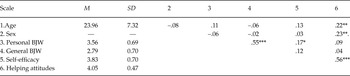
First, we inspected the zero-order correlations among all variables for each sample separately. In the sample of university students (Table 1), SEJW correlated positively with PBJW, but not with GBJW. Helping attitudes correlated significantly with SEJW, but not with PBJW or GBJW. As in previous studies (i.e., Nickell, Reference Nickell1998), helping attitudes correlated with participants’ sex: females had more positive attitudes toward helping than males. Moreover, the older the participants the more positive attitudes towards helping.
University Students’ Sample: Correlations and Descriptive Statistics (N = 150)

Note: All scales range from 1 to 5, with higher values indicating stronger endorsement of the construct. For sex, –1= male, 1 = female.
*p < .05 **p < .01 ***p < .001
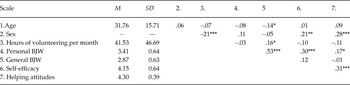
For the volunteers sample (Table 2), SEJW also correlated positively with PBJW but not with GBJW. As with the other sample, helping attitudes also correlated significantly with SEJW but not with GBJW. In this sample however, helping attitudes correlated significantly with PBJW. Again females had more positive attitudes toward helping than males. Hours of volunteering correlated significantly with participants’ sex and GBJW: males served more hours than females and the higher the GBJW the higher the number of hours of volunteering a month.
Volunteers’ Sample: Correlations and Descriptive Statistics (N = 215)

Note: All scales range from 1 to 5, with higher values indicating stronger endorsement of the construct. For sex, –1= male, 1 = female.
*p < .05 **p < .01 ***p < .001
We then tested for each sample whether SEJW moderated the relationship between BJW and helping attitudes, whilst controlling for the effects of sex and age, hours of volunteering (only on Sample 2). In both samples we conducted two separate hierarchical regressions, one with PBJW and the other with GBJW. We entered the following predictors: sex, age, PBJW and SEJW (and hours of volunteering only for Sample 2) (Block 1), and the product between PBJW and SEJW (Block 2). All variables were centered before analyses (Aiken & West, Reference Aiken and West1991).
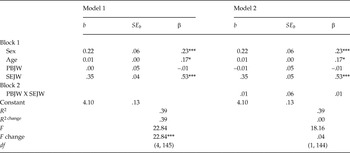
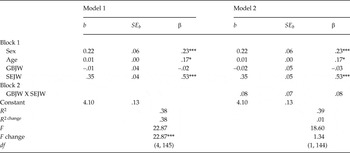
For the sample of university students (Table 3), there were only main effects of sex, age and SEJW. Females had higher helping attitudes than males, B = .23, t(144) = –3.51, p < .001. The older the participants the more positive attitudes towards helping, B = .17, t(144) = 2.54, p = .012, and SEJW positively predicted helping attitudes, B = .53, t(144) = 7.92, p < .001. Neither PBJW, nor the product between the PBJW and SEJW, predicted helping attitudes.
University Students’ Sample: Regression of helping attitudes on age, sex, personal BJW, and self-efficacy to promote justice in the world (Block 1), and the product between personal BJW and self-efficacy to promote justice in the world (Block 2)

Note: b = Unstandardized coefficients; β = Standardized coefficients.
For all measures, scores were computed by averaging across items, with higher scores indicating stronger endorsement of the construct. For sex, –1 indicates “male” and 1 “female.”
*p < .05; **p < .01; ***p < .001.
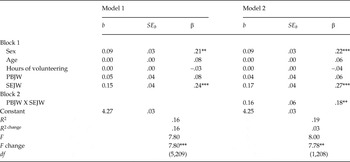
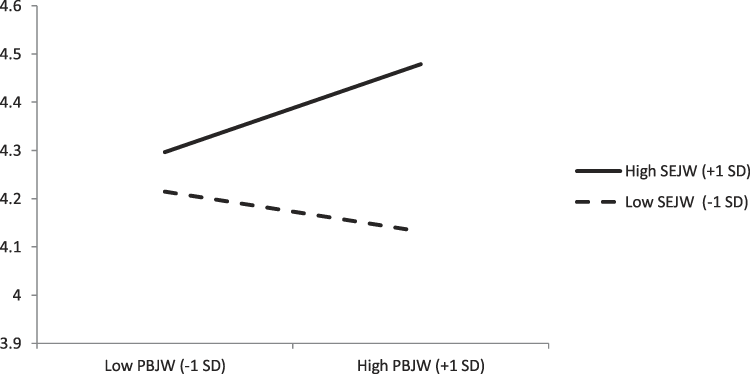
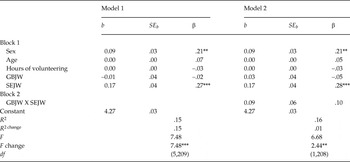
For the sample of volunteers (Table 4), there were main effects of sex, SEJW and the interaction between PBJW and SEJW on helping attitudes (Table 4). Females had higher helping attitudes than males, B = .22, t(208) = 3.41, p < .001, and SEJW positively predicted helping attitudes, B = .27, t(208) = 4.01, p < .001. PBJW alone did not predict helping attitudes, but it interacted significantly with SEJW, B = .18, t(208) = 2.79, p = .006. As can be seen in Figure 1, simple slope analyses showed that for participants who strongly endorsed the SEJW (i.e., 1 SD above the mean), PBJW was positively associated with positive helping attitudes, B = .14, t(208) = 2.73, p = .007. In contrast, for participants who weakly endorsed the SEJW (i.e., 1 SD below the mean), PBJW was not significantly associated with positive helping attitudes, B = –.07, t(208) = –1.13, p = .26. We repeated the previous hierarchical regressions on both samples with general BJW instead of PBJW. In both samples, neither GBJW nor the product between BJW and SEJW predicted helping attitudes (Tables 5 and 6).
Volunteers’ Sample: Regression of helping attitudes on age, sex, hours of volunteering, personal BJW, and self-efficacy to promote justice in the world (Block 1), and the product between personal BJW and self-efficacy to promote justice in the world (Block 2)

Note: b = Unstandardized coefficients; β = Standardized coefficients.
For all measures, scores were computed by averaging across items, with higher scores indicating stronger endorsement of the construct. For sex, –1 indicates “male” and 1 “female.” *p < .05; **p < .01; ***p < .001.
Volunteers’ Sample: The interaction effect between personal BJW and SEJW on helping attitudes.

University Students’ Sample: Regression of helping attitudes on age, sex, general BJW, and self-efficacy to promote justice in the world (Block 1), and the product between general BJW and self-efficacy to promote justice in the world (Block 2)

Note: b = Unstandardized coefficients; β = Standardized coefficients.
For all measures, scores were computed by averaging across items, with higher scores indicating stronger endorsement of the construct. For sex, –1 indicates “male” and 1 “female.”
*p < .05; **p < .01; ***p < .001.
Volunteers’ Sample: Regression of helping attitudes on age, sex, hours of volunteering, general BJW, and self-efficacy to promote justice in the world (Block 1), and the product between general BJW and self-efficacy to promote justice in the world (Block 2)

Note: b = Unstandardized coefficients; β = Standardized coefficients.
For all measures, scores were computed by averaging across items, with higher scores indicating stronger endorsement of the construct. For sex, –1 indicates “male” and 1 “female.” *p < .05; **p < .01; ***p < .001.
Discussion
Mohiyeddini and Montada (Reference Mohiyeddini, Montada, Montada and Lerner1998) found that high SEJW, considered as an individual difference variable, could buffer the association between BJW and negative reactions to victims. Drawing on their research we had three goals when we conducted these studies. First, we aimed to investigate if the BJW and SEJW interact to predict a more general measure of helping, such as helping attitudes. Secondly, we aimed to study this association in a sample of volunteers. Lastly we aimed to compare the predictive power of the interaction between each sphere of BJW (personal BJW and general BJW) and SEJW. Since helping attitudes are related with the restoration of justice by the self we expected personal BJW to be a better predictor of these attitudes than general BJW.
Our hypotheses were partially supported. We found that the interaction between personal BJW and SEJW predicted helping attitudes in the volunteers’ sample, but not in the university students’ sample. Specifically, among volunteers who strongly endorse SEJW, personal BJW (but not general BJW) was positively associated with helping attitudes. For volunteers who weakly endorse the SEJW however, personal BJW was not significantly associated with helping attitudes. The fact that the relations between BJW, SEJW and helping differ between the two samples supports the hypothesis that for volunteers helping behavior may be a way to cognitively try to reap positive outcomes in the future by increasing perceptions of own deservingness. We must stress, however, that this does not exclude that volunteers also intend to reduce injustices in the world through helping. On the other hand, people not committed with planned helping may be motivated to get good rewards in the future by being honest and respectful citizens.
A possible reason for not having replicated the significant interaction between general BJW and SEJW obtained by Mohiyeddini and Montada (Reference Mohiyeddini, Montada, Montada and Lerner1998) in our two samples may be the fact that we measured general attitudes towards helping instead of the intention to help specific victims (in that case outgroup victims) by means of specific actions. Furthermore, we measured attitudes, and attitudes are not always good predictors of behavioral intentions (Ajzen & Fishbein, Reference Ajzen and Fishbein1977). Future studies should explore if this joint association can be extended to predict helping behaviors and not mere attitudes towards helping. Future studies should also try to replicate these results in other samples, either of the population in general or of volunteers.
These studies also contribute to the validity of the scales used to measure SEJW and helping attitudes. In fact, apart from the original studies reported (Mohiyeddini & Montada, Reference Mohiyeddini, Montada, Montada and Lerner1998; Nickell, Reference Nickell1998) we could not find any other study that has used these scales. Our studies support their reliability as well as their construct validity in two different samples.
Although the correlational design of this study prevents conclusions about the causal and sequential relations among belief in a just world, SEJW and helping attitudes, we may nonetheless speculate about practical implications of our results to campaigns intended to promote helping attitudes. In fact, from our findings we may speculate that justice concerns are important to helping, but only if they are joined with a high self-efficacy in contributing to justice. Therefore campaigns should promote both factors, as already have been recommended for campaigns promoting the consumption of fair-trade goods (White et al., Reference White, MacDonnell and Ellard2012).
In sum, this study emphasizes BJW and SEJW as intrapersonal factors are associated with helping attitudes. It also contributes to the development of just world theory by showing that in the process of restoring justice in reality, the personal BJW is a better predictor than the general BJW, at least for volunteers. Contrasting with other studies relating BJW and helping behavior (i.e., Bierhoff et al., Reference Bierhoff, Klein and Kramp1991; DePalma et al., Reference DePalma, Madey, Tillman and Wheeler1999) which measured only general BJW, from our results we recommend that personal BJW should be measured instead, or at least, in addition to general BJW.