Impulsiveness influences many life outcomes. Present bias is a primitive trait that leads to a focus on the here and now such that immediate costs and benefits are over-weighted relative to longer term costs and benefits. Scholars from many disciplines have noted the large consequences of impulsive behavior for individual outcomes. Present bias leads to failure to accumulate sufficient savings for retirement, unhealthy choices in diet and lifestyle, and high-interest consumer debt (Angeletos et al. Reference Angeletos, Laibson, Repetto, Tobacman and Weinberg2001; Volpp et al. Reference Volpp, Troxel, Pauly, Glick, Puig, Asch, Galvin, Zhu, Wan, DeGuzman, Corbett, Weiner and Audrain-McGovern2009; Meier and Sprenger Reference Meier and Sprenger2010). Research, however, has not considered how present bias may impede individual action in the public interest such as reducing carbon footprint, conserving natural resources, or participating in democratic processes like voting, attending Parent Teacher Association Meetings, contacting representatives, or protesting.
I argue here for a theoretical focus that places citizen collective choices in an over-time setting with consideration for impulsiveness. Present bias likely challenges action even for individuals who have been persuaded to act. The theory connecting present bias to negative individual outcomes is straightforward: Individuals with present bias focus too heavily on immediate circumstances and so, for example, fail to limit present consumption to save for the future. I use a model of intertemporal political choice with a parameter for present bias to help understand the problem of following through on intentions to act in public interest. Individuals may believe it important to act with regard to others, but challenges overcoming individual costs on the day of action are magnified for those with present bias. Although there may be future benefits that the individual anticipates following their taking costly action, present biased focus on the here and now leads them to abstain.
I provide empirical evidence in support of negative correspondence between turnout in American elections and measures of present-biased preferences. Team modules from the 2014 Cooperative Congressional Election Study show that Americans with present bias are 6 to 13 percentage points less likely to vote. I also present suggestive evidence that those who express a definite intention to vote prior to the election are less likely to follow through if they have present bias. The measure of present bias is a standard version from economics used to measure time preferences of consumption. That such a simple economic measure is so strongly related to validated political behavior suggests the importance of this internal trait.
I develop a model of turnout extending the cost-benefit model of political science. The key innovation is in extending the standard single-period problem to multiple periods with a present bias parameter. For those not fully cognizant of their own present bias, day of election costs to voting are of larger magnitude than anticipated, hindering follow through for some who had intended to vote. The theory offers an explanation for why many citizens fail to follow through on an intention to vote and a new interpretation of the over-report of turnout in surveys. The research also adds to recent work considering how cognitive biases may inhibit participation in politics.
Empirical regularities of turnout in american elections
The arguments in the present study connect to multiple questions about political participation. The two most consistent correlates of American turnout are demographics of the individual and election context.Footnote 1 Other studies have found clear relationships to other features of individuals and context.Footnote 2 Fowler and Kam (Reference Fowler and Kam2006) show that individuals with more patience are more likely to vote. The authors chose not to measure present bias (see their discussion, p. 117). Present bias and patience are distinct. Patience (discount rate) indicates how the individual trades off costs and benefits from one period to a future period. Present bias, sometimes referred to as impulsiveness, indicates how the individual trades off utility in the immediate present with utility in the future.
Fowler and Kam (Reference Fowler and Kam2006) argue discount rate is relevant to turnout because of the trade-off between short-term costs to voting and long-term benefits to having participated. I argue for a complementary and important place for impulsiveness. Those with present bias would uniquely have problems evaluating their likelihood of participating, committing to do so, and following through, regardless of discount rate. Dawes and Loewen (Reference Dawes and Loewen2018) find evidence relating procrastination to lower turnout in Sweden, suggesting the relationship considered here is not limited to Americans. The arguments and findings here also connect to other findings that suggest cognitive challenges can limit participation in politics (e.g., Dawes and Loewen Reference Dawes and Loewen2018; Denny and Doyle Reference Denny and Doyle2008; Holbein Reference Holbein2017)
Present bias and the follow-through model of turnout
Present bias is thought to be a primitive trait of individuals that influence how they make decisions about the future (Meier and Sprenger Reference Meier and Sprenger2015). Exerting costly effort in the moment for longer term benefit depends upon an individual’s ability to anticipate future experience and control present temptation. These aptitudes vary across the population with consequences for many economic and health outcomes. Scholars from many disciplines have noted the consequences of impulsive behavior (e.g., Samuelson Reference Samuelson1937; Freud Reference Freud1956; Ainslie Reference Ainslie1975; Angeletos et al. Reference Angeletos, Laibson, Repetto, Tobacman and Weinberg2001; Volpp et al. Reference Volpp, Troxel, Pauly, Glick, Puig, Asch, Galvin, Zhu, Wan, DeGuzman, Corbett, Weiner and Audrain-McGovern2009).
In Online Appendix Section A, I apply an intertemporal discounted utility model with present bias to the choice to vote in democratic elections. This intertemporal approach, which I term the Follow-Through Model of Turnout, highlights that those with present bias may put off the costs of voting until they fail to cast a ballot, suggesting that those with present bias should be less likely to vote than those without. The model also suggests that some who are not fully aware of the extent of their present bias (Ali, Reference Ali2011) anticipate taking action to turn out but, when the day of action comes, (unanticipated) present bias prevents them from doing so.
That some with unanticipated present bias may believe they will vote but then fail to follow through provides an alternative interpretation of the pattern of over-reported turnout in surveys. One common explanation is social desirability, i.e. respondents lie to surveyors knowing that they are unlikely to vote but not wanting to admit it to the interviewer. Online Appendix Table S1 and the Follow-Through Model instead suggest that some of this over-report could be due to present biased citizens who truthfully report their intention to vote only to fail to follow through when unanticipated present bias intervenes on the day of the election. Failure to accurately anticipate present bias causes truthful reporting of an inaccurate forecast of future costly behavior.
Although I use an economic model to formalize the consequences of present bias for turnout, the “utility” citizens receive from voting or abstaining need not be solely instrumental. While it may be the case that most of the expressive benefits to voting occur in the act of voting, it may also be the case that the expressive costs to abstaining—i.e., regret or remorse—play out over many future time periods after the election. If regret is a post-election expressive cost to abstention, then present bias would impede follow through of expressive voters just as it does those with post-election instrumental benefits. Voters who fail to anticipate present bias on Election Day may underweight post-election utility—instrumental or expressive—and fail to follow through on their intention to act.
Empirical evidence
Two key empirical implications of the Follow-Through Model are that those with present bias should be less likely to turn out than those without and that those with present bias should be less likely to follow through on an intent to vote than those without. I evaluate each implication with individual observations of present bias and turnout from two modules to the 2014 Cooperative Congressional Election Study (CCES, N=2004). In a pre-election survey, present bias was measured using two questions as described in Table 1, which follows from a standard measurement of this trait from behavioral economics (see Online Appendix Section C and, e.g., Thaler Reference Thaler1981; Ashraf, Karlan and Yin Reference Ashraf, Karlan and Yin2006). After the 2014 midterm elections, the CCES successfully matched 1295 respondents to statewide voter files to create validated records of turnout.Footnote 3 About 21 percent of respondents give answers that indicate present bias. Twenty-six percent of those with present bias report owning stocks compared to 42 percent of those without, consistent with evidence from other samples on the relationship between present bias and saving (Ameriks et al. Reference Ameriks, Caplin, Leahy and Tyler2007).
Measurement of Present Bias in Time Preferences

Note: Respondents were asked “Imagine you are offered the following choices from a person that you trust. For each choice, please indicate which you would prefer:” $26 today or $30 in one month; $26 in six months or $30 in seven months. Respondents preferring $26 today but $30 in seven months discount future payment more steeply in the near future than the farther future. See Online Appendix Section C for discussion of measurement.
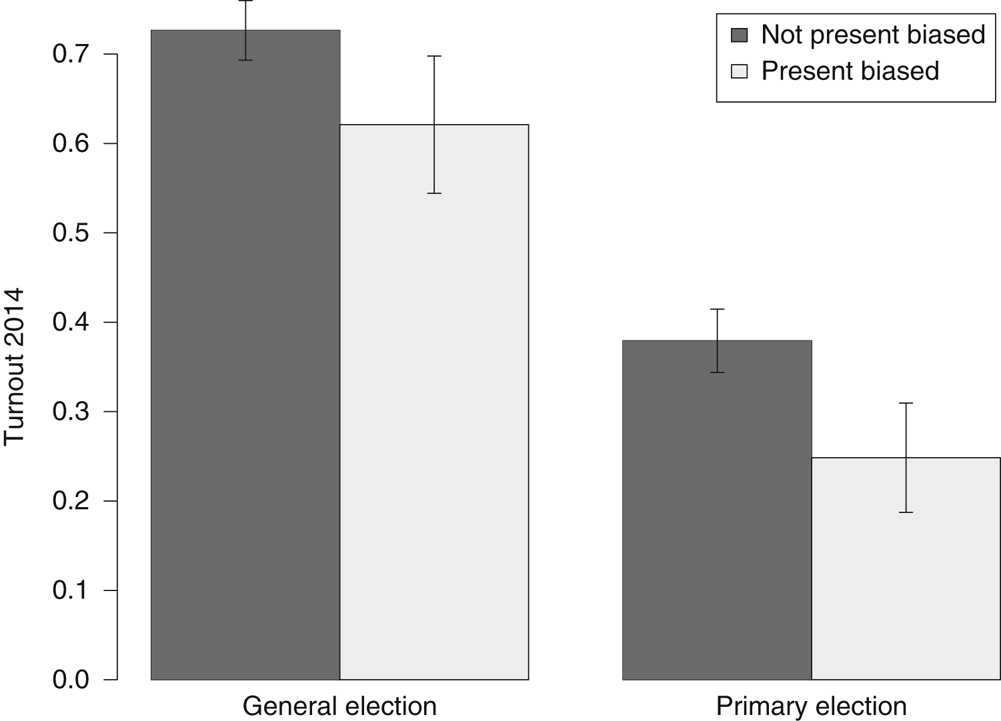
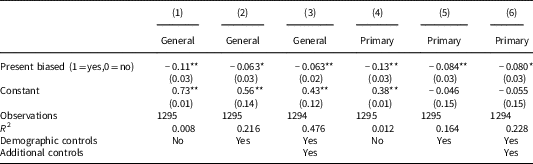
In Figure 1, I plot validated turnout in the 2014 primary and general elections by whether or not the individual exhibits present bias. Among those not present biased, 72.6 percent voted. Among those with present bias, 62 percent voted. A similar difference is apparent for the 2014 primary. These differences hold with statistical controls. In Table 2, turnout (1=yes, 0=no) in each election is regressed on the indicator that the individual is present biased, with and without controls for demographics and additional attitudinal controls.Footnote 4 The present-biased are 6.1–13 percentage points less likely to turn out in these elections, all else equal. Differences between election type are not statistically significant.
Present bias and turnout in 2014 elections Note: Those with present bias are less likely to vote in elections. Error bars extend to 95 percent confidence intervals for each subset.

Present Bias and Turnout in 2014 Elections

Note: Dependent variable in each column is turnout validated to voter files, 1=yes 0=no. Demographic controls include indicators for age in decades, for each category of education, of family income, and of race. Additional controls include indicators for each category of party identification, each category of ideology, and if the individual over-reported turnout on the post-election survey.
Standard errors in parentheses.
** p<0.01
* p<0.05.
Although the questions measuring present bias are commonly used, they are likely to measure present bias with some error induced by survey question wording, inattentive participants, or heterogeneity in discount rate. Analysis in Online Appendix Section D suggests these two questions should systematically produce false negatives of unknown magnitude and that the relationships presented here are most likely understatements due to measurement error. An additional consideration of measurement error is that income, education, or attitudinal variables that are better-measured, correlated with, and potentially causally subsequent to present bias could pick up some of the (mismeasured) effect of present bias when included in a multiple regression model.
Overall, Figure 1 and Table 2 provide evidence that those with present bias are around ten points less likely to vote in general and primary elections. The magnitudes of this relationship are large relative to other individual characteristics, suggesting the potential importance of present bias to decision making about collective action. Within this sample of respondents, the difference in validated turnout between those with and without present bias is similar to the difference in turnout between those without a high school degree (56 percent) and high school graduates (65 percent), or between high school graduates and those with a four-year college degree (79 percent).
Following through on intention to vote
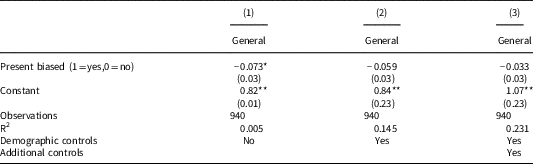
In this section, I present evidence that present bias hinders follow-through among those who intend to vote. The pre-election survey asked if individuals intended to vote in the November election.Footnote 5 Among those who said they would definitely vote, 82 percent of those without present bias were validated to have voted versus 74 percent of those with. The usual interpretation of turnout over-reporting is that individuals lie so as not to look bad to interviewers by admitting they do not intend to vote. The Follow-Through Model suggests an alternative: Those who do not fully anticipate their present bias on election day report an accurate intention to vote prior to the election but then fail to overcome present bias on Election Day.
Point estimates in Table 3 indicate that those with present bias are 7.3 points less likely to follow through on an intention to vote, though statistical significance is lost and magnitude declines with additional variables. The point estimate in column 1 of Table 3 is almost four points smaller than the corresponding relationship to turnout in Table 2. If the point estimate is accurate, it would mean that some, but not all, of those with present bias may be aware that it will hinder their turnout and do not report that they intend to vote when asked.Footnote 6 Caution should be applied to these estimates given the larger standard errors in the two columns with controls.
Following Through on an Intention to Vote, 2014 General Elections

Note: Sample limited to respondents responding “Yes, definitely” to a pre-election question asking if they intended to vote. Dependent variable in each column is an indicator for validated voter file turnout, 1=yes 0=no. Demographic controls include indicators for age in decades, for each category of education, of family income, and of race. Additional controls include indicators for each category of party identification, each category of ideology, and if the individual over-reported turnout on the post-election survey.
Standard errors in parentheses.
** p<0.01
* p<0.05.
Table 3 implies that present bias is not only negatively related to turnout, but that even those who intend to vote are less likely to follow through when present biased. The Follow-Through Model provides a theoretical interpretation to these observational relationships: Those who value participating in politics are confronted on election day with making time to vote, acquiring transportation to and from the polling place, and learning about the candidates and issues on the ballot. These short-term costs are particularly salient for those who focus extensively on the here and now and, for those who did not anticipate the extent of their present bias, changes an intention to act into inaction.
Voting reforms, mobilization, and present bias
These results have implications for those interested in increasing individual action towards collective goals. A large amount of reformers’ existing effort goes towards lowering the costs of voting on and before election day, the time of costly action. For those with present bias, changes to the day of action costs must be of sufficient size to overcome focus on the here and now, which may be a large hurdle because most reforms do not drive costs to zero. This may be why convenience reforms such as early or absentee voting have only small effects on aggregate rates of turnout (e.g., Gerber, Huber and Hill Reference Gerber, Huber and Hill2013). Convenience voting reforms may lower the costs to voting, but for those who value today more than tomorrow, voting early or by absentee is delayed similarly to voting at the polls.
The findings here suggest alternative approaches for reform. For the present biased, focus on informational campaigns targeting the post-action world may be particularly useful. For example, present bias on election day does not change the value to post-election motivations to having voted such as offering praise for previous turnout or highlighting social consequences to turnout (Green, McGrath and Aronow Reference Green, McGrath and Aronow2013, 36–7). While financial incentives for turnout (Panagopoulos Reference Panagopoulos2013) are not legal in federal elections, other legal post-election carrots or sticks could be developed. Reformers might deliver information about how common others in the individual’s social network discuss voting, or how many bumper stickers “Don’t blame me, I voted for the Democrats” are produced to change the individual’s beliefs about likely post-election experiences.
Contributions and conclusions
This study makes three contributions. First, the trait present bias found to influence choices in the realm of individual economic and health choices is also related to the collective behavior of voting. Second, the Follow-Through Model provides a new explanation why many would report an intention to vote prior to the election but fail to follow through. These first two contributions present significant challenges for those motivated to mobilize action in the public interest: it is not enough to convince individuals to report an intention to act. Rather, effort and attention are required by those who promote behavior for the public good to translate intentions into action when the time arrives.
Third, the model and results suggest present bias as a candidate spurious variable confounding the relationship between socio-economic status (SES) and turnout. Turnout has long been positively correlated with SES, and many argue that those with high SES gain greater representation because of this pattern. Yet, while education and income have increased consistently over the past 50 years, turnout has remained stagnant or declined.Footnote 7 If those with present bias attain less education and have lower incomes and if, as I argue here, present bias also limits participation in politics, then it may be present bias that drives much of the correlation between SES and turnout. Future research should explore the causal place of present bias in this process.
One caveat to these findings is that the survey instrument did not measure other cognitive biases that may be correlated with present bias and also cause turnout. This leaves to the future exploring which cognitive biases drive these relationships. These results also come from one survey in one election year, and so future replication and extension is merited.
These results speak to a new literature on “behavioral political economy” (e.g., Bisin, Lizzeri and Yariv Reference Bisin, Lizzeri and Yariv2015), which notes that citizens with present bias may have different preferences over fiscal policy leading to larger government fiscal deficits and less long-term investment. The results here, however, highlight that models that assume universal turnout may be missing a key aspect of behavioral political economy—that those with present bias are less likely to be part of the voting electorate. Future theory might want to model differential participation.
While I have presented theory and evidence here that present bias is relevant for turnout and following through on intentions to vote, this is not the only form of political participation that may be hindered by present bias. The same process that prevents some from voting on election day may also prevent following through on intentions to attend public meetings, contact representatives, or register to vote. More broadly, political coalitions need members to show up when called upon. Citizens who fail to follow through on commitments are likely to be less valuable members of political coalitions, which may further challenge representation of all citizens in the political process.
Supplementary Materials
To view supplementary material for this article, please visit https://doi.org/10.1017/psrm.2018.56
Acknowledgments
I thank Avi Acharya, Nageeb Ali, James Fowler, Eitan Hersh, John Holbein, Marc Meredith, Tali Mendelberg, John Patty, Jerome Schafer, Chris Tausanovitch, and participants at the Rethinking Ways to Increase Turnout Conference at Princeton for valuable feedback. A replication archive is available at https://doi.org/10.7910/DVN/2HCGWN.