Malformations of the heart and great arteries account for the largest number of human birth defects.Reference Mitchell, Korones and Berendes1 Congenital cardiac defects significantly contribute to morbidity, mortality, and associated medical expenditures in the paediatric age group.Reference Boneva, Botto and Moore2–Reference Kuehl, Loffredo and Ferencz4 Natural history studies have shown that the prevalence of various congenital cardiac defects show a specific gender predilection. Each variant of congenital cardiac defects has a different gender ratio, which does not vary across the world.Reference Pradat, Francannet, Harris and Robert5, Reference Ferencz, Rubin and McCarter6 Gender disparities of morbidity patternsReference van den Bosch, Huygen, van den Hoogen and van Weel7, Reference van den Bosch, Huygen, van den Hoogen and van Weel8 and single disease categoriesReference Beeson9 are well studied in western countries.
It is well accepted that the single best place to screen all babies is in the newborn nursery. Thereafter, the population becomes dispersed, with no common point at which to apply a screening procedure.Reference McCabe and McCabe10 The analysis of gender distribution in congenital cardiac defects usually utilise natural history studies, either from compilation of large registriesReference Pradat, Francannet, Harris and Robert5 or population-based studies.Reference Samánek11 Attempts are also made to study the epidemiology of congenital cardiac defects from tertiary care referral centres.Reference Miyague, Cardoso and Meyer12 However, these studies from developed countries have an objective focus and represent the genetic, environmental, and other issues responsible for the gender predilection. In a developing country such as India, rheumatic heart disease adds on to the burden of congenital cardiac defects to increase the load of paediatric cardiac problems. Here, the data of gender distribution need to be interpreted in the light of different dynamics, as the social and financial elements combine with medical issues. Studies evaluating the relative frequency and gender distribution of paediatric cardiac diseases are not available from the Indian subcontinent or from other developing countries, which share a similar social scenario.
This study was conducted to learn about the relative frequency and gender distribution of children who underwent cardiac surgery or catheter-based interventional procedures for paediatric cardiac diseases. This study typifies the data from a large-volume single centre in a developing country and is not representative of the total population.
Methods
Setting
The study was conducted at the Narayana Hrudayalaya Institute of Cardiac Sciences, Bangalore, which is the largest centre for the treatment of congenital cardiac defects and other paediatric cardiac problems in India. The patients treated at the Narayana Hrudayalaya Institute of Cardiac Sciences are from all across India and a small number from the neighbouring Bangladesh, Pakistan, Gulf countries, and Africa.
Study design and patients
Records of all children under 18 years of age who underwent surgical or interventional procedures (either palliative or definitive) for congenital, rheumatic, and other types of cardiac diseases between October, 2001 (when the Narayana Hrudayalaya Institute of Cardiac Sciences started performing paediatric cardiac surgery and interventions) and December, 2009 formed the basis of the present retrospective study. Only children of Indian origin by birth were included in the study analysis.
Whenever a disparity was found in the echocardiographic diagnosis from that of other modalities, the perioperative diagnosis was considered as final in all those who underwent surgery. Similarly, angiographic diagnosis was considered as final for catheter-based interventional procedures. Whenever a child had more than one lesion, the defect with higher haemodynamic implication was considered and the one with lesser impact was not included in the list. For example, a child with a large patent arterial duct and a small atrial septal defect was represented as patent arterial duct and not an atrial septal defect in the final list.
All the variants of one diagnostic entity were grouped under the same category, irrespective of the surgery or intervention they underwent. To quote some examples, aortic coarctation was considered as one entity irrespective of balloon or surgical coarctoplasty. The double outlet right ventricle was taken as one diagnostic entity irrespective of reduced or increased pulmonary blood flow physiology.
As there could be a gender bias in choosing the surgery against the intervention procedure (for cosmetic and financial reasons), both the surgical and the interventional procedure numbers were clubbed to minimise the bias.
Exclusion criteria
As the study was limited only to patients of Indian origin by birth, all the patients of non-Indian origin were excluded. Each patient was given one representation in the final list, irrespective of the number of interventions carried out on them. Thus, all re-do surgeries or re-do interventional procedures were excluded. Similarly, if any child had undergone a palliative procedure earlier and went through the definitive procedure later, it was considered as a “re-do procedure” and the second procedure was excluded from the final list.
Methods
These patients were subcategorised as per the diagnosis. Gender distribution and the relative frequency of the individual defects were analysed. The data were compared with the gender ratio for the same defect in the literature. The relative frequency of individual defects was compared with the known prevalence for the defects from different studies. The results were compared and the possible causes for any disparity were analysed.
Results
Overall numbers and gender ratio
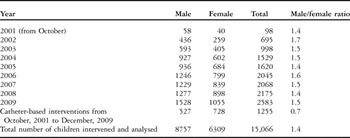
The study population comprised 15,066 consecutive children over an 8-year period. Of these, 8757 were male and 6309 female (Table 1). The male-to-female ratio considered year-wise ranged from 1.4:1 to 1.7:1 with an average ratio of 1.4:1. Although there was a progressive increase in the total number of children undergoing procedures every year, the yearly gender ratio did not differ much from the overall average.
Yearly gender-wise breakup of the consecutive surgeries and interventions performed on children of Indian origin (excluding the re-do procedures).

Relative frequency
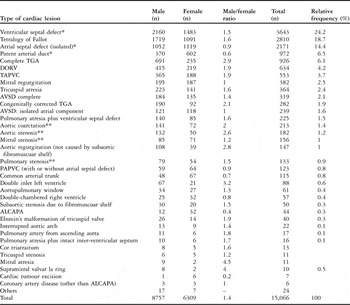
The relative frequency and gender ratio for most of the individual defects were analysed in detail. The most common lesion found was ventricular septal defect in 3643 (24.2%) children with a male/female ratio of 1.3:1. Among the study population, 2810 (18.7%) children had tetralogy of Fallot with a male/female ratio of 1.6:1. Similarly, the 2171 patients with an isolated secundum atrial septal defect – atrial septal defect with partially anomalous pulmonary venous connection was considered as a separate entity – comprised 14.4% of the study population with a male/female ratio of 0.9:1. Patent arterial duct followed with 972 (6.5%) patients and a male/female ratio of 0.6. The 916 cases of transposition of the great arteries formed 6.1% of the study population with a male/female ratio of 2.9:1.
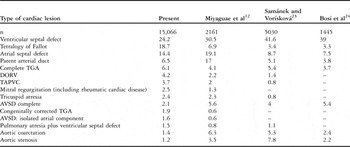
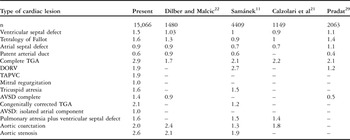
Overall, a total of 44 variants of cardiac lesions were found in the study population. The detailed list of most of these variants with numbers, relative frequency, and male/female ratio is presented in Table 2. The top 15 variants among these formed over 92% of the total population studied, with the remaining 29 variants forming less than 8% of the numbers. The relative frequency and the gender ratios of the top 15 variants found in this study were compared against details available from the literature and are presented in Tables 3 and 4, respectively.
Relative frequency and the gender ratio of the individual cardiac lesions.

ALCAPA = anomalous origin of coronary artery from pulmonary artery; AVSD = atrioventricular canal defect; DORV = double outlet right ventricle; LA = left atrial; PAPVC = partially anomalous pulmonary venous connection; TAPVC = totally anomalous pulmonary venous connection; TGA = transposition of great arteries
*Includes device closures also
**Includes interventional procedures also
Relative frequency of the top 15 variants of cardiac lesion found in this study compared with the incidence or prevalence from other studies (in %).

AVSD = atrioventricular canal defect; DORV = double outlet right ventricle; PAPVC = partially anomalous pulmonary venous connection; TAPVC = totally anomalous pulmonary venous connection; TGA = transposition of great arteries
Gender ratios (male/female) of the top 15 variants of cardiac lesion found in this study compared with the other studies.

AVSD = atrioventricular canal defect; DORV = double outlet right ventricle; PAPVC = partially anomalous pulmonary venous connection; TAPVC = totally anomalous pulmonary venous connection; TGA = transposition of great arteries
Discussion
Congenital cardiac disease has become increasingly important in recent years because it is one of the important causes of morbidity and mortality in infancy, and also since there has been a decline in rheumatic fever in affluent societies of developing countries.Reference Khalil, Aggarwal, Thirupuram and Arora13
Many population-based studies have ascertained the incidence or prevalence of congenital cardiac defects in the western literature,Reference Mitchell, Korones and Berendes1, Reference Hoffman14–Reference Fyler18 but very few from the subcontinent.Reference Khalil, Aggarwal, Thirupuram and Arora13 Most of the studies have an objective of comparing the regional data with the standard reference or a specific issue or a population group.Reference Botto, Correa and Erickson19, Reference Anderson20
The gender ratio of this study for male and female children was 1.4:1. Large population-based studies have shown a male/female ratio of 1:1Reference Calzolari, Garani and Cocchi21, 1.1:1,Reference Samánek11, Reference Dilber and Malcic22 and 1.25:1.Reference Pradat, Francannet, Harris and Robert5 One large hospital-based study has shown a male/female ratio of 1:1.Reference Miyague, Cardoso and Meyer12 This study shows an overall male dominance. The possible causes are discussed after the data on gender ratio for individual lesions have been evaluated. Table 3 lists the relative frequencies of the 15 most common lesions found in this study with their prevalence found in other studies. Ventricular septal defect was the most common lesion found in this study with 24.2% of the total study population. Most of the large population-basedReference Samánek and Vorísková23, Reference Bosi, Scorrano, Tosato, Forini and Chakrokh24 or hospital-basedReference Miyague, Cardoso and Meyer12 studies show the prevalence of ventricular septal defects ranging from 30.5%Reference Miyague, Cardoso and Meyer12 to 41.6%.Reference Samánek and Vorísková23
Tetralogy of Fallot, with a relative frequency of 18.7%, was the second most common lesion. In most of the high-volume studies, the prevalence has been around 3.3%Reference Bosi, Scorrano, Tosato, Forini and Chakrokh24 to 6.9%.Reference Miyague, Cardoso and Meyer12 The higher percentage found in this study might be because many centres in India are still not capable of handling surgeries in cyanotic cardiac diseases. Some Indian centres also insist on a minimal weight criterion of 10 kilograms for paediatric cardiac surgery. Hence, large number of children with cyanotic cardiac diseases get referred to the few available tertiary care cardiac centres in India such as the location of this study. This also explains a similar trend found with the transposition of great arteries (6.1% in this study against 3.7% to 4.1% in other studies), totally anomalous pulmonary venous connection (3.7% in this study against 0.8–2% in other studies), and double outlet right ventricle (4.2% in this study against 1.4–2.2% otherwise). The higher relative frequency of all the complex and cyanotic cardiac lesions found in this study can be explained on the same basis.
Extending the same analogy, the frequencies of lesions like aortic coarctation, aortic stenosis, or pulmonary stenosis were relatively lesser than other studies. It is likely that many Indian centres are capable of handling management of such cases and lesser numbers are referred to higher centres.
The relative frequencies of atrial septal defect and patent arterial duct appeared to be comparable with other studies. However, this study also involves device closures for these lesions, which was probably not a voluminous option in earlier studies. Hence, the comparison may be skewed.
There are a number of practical difficulties in population-based studies for the identification of congenital cardiac defects.Reference Hoffman and Kaplan15 The use of clinical examination combined with pulse oximetry to detect most cases of congenital cardiac defects at birth was successfully carried out by Patton and Hey.Reference Patton and Hey25 All these techniques aim at utilising the best available resource in diagnosing congenital cardiac defects for the statistical purpose. Very often, no further follow-up is possible for those children who did not require any intervention at birth and were discharged for further follow-up.Reference Xue-yong, Xiao-feng, Xiao-dong and Ying-long17 This study is limited only to hospital based assessment of statistics and involves only those children who did require intervention for cardiac diseases in the paediatric age group. However, certain non-medical issues need serious consideration while interpreting the results. Financial constraints are a major factor in developing countries. In a country such as India, poverty is still an important issue to be dealt with making advanced cardiac care a mirage for many.Reference Kothari26 Considering the cost involved in cardiac surgery and relatively short duration available in arranging the finances for emergency surgeries, there could be many children who never made it to the operating theatre, despite having a timely diagnostic evaluation in the hospital. This can explain the paucity of numbers in conditions such as hypoplastic left heart syndrome or pulmonary atresia with intact ventricular septum. It is possible that the figures presented here just represent the “tip of the iceberg” rather than the actual numbers prevailing in the population. In addition, as there is no solid insurance cover for the population, it is unlikely that many patients who actually deserved treatment have reached the hospital for care.Reference Maheshwari and Kiran27 With a huge number of deliveries occurring in the villages with minimal or no medical aid, the critical cases may have missed the diagnosis and not have seen the light of hospital at all. Added to the woes would be the lacunae in the diagnostic facilities in small places and difficulty in the transport system to reach the centre of care. Illiteracy is another factor wherein the mention of “cardiac disease” sounds synonymous with death for many parents. All these and many other similar factors may very well contribute to the variations in the relative frequency of individual lesions in this study from the other population or outpatient-based epidemiological studies. As studies of a similar nature and magnitude are not available from the Indian subcontinent or from any other part of the world, it is difficult to ascertain the validity of all these variations.
The overall gender ratio showed a clear male dominance in this study. Most of the major studies carried out so far have shown a near-equal gender ratio for overall incidence or prevalence.Reference Pradat, Francannet, Harris and Robert5, Reference Ferencz, Rubin and McCarter6, Reference Samánek11, Reference Fyler18, Reference Samánek and Vorísková23 When the gender ratios of the top 15 entities were reviewed, the male gender appeared to dominate in 11 conditions. Male dominance in the transposition of great arteries, aortic stenosis, aortic coarctation, univentricular hearts, tetralogy of Fallot, and totally anomalous pulmonary venous connection are well accepted.Reference Somerville28 The data among these lesions from this study showed a pattern that was similar to other studies.Reference Samánek11, Reference Calzolari, Garani and Cocchi21, Reference Dilber and Malcic22, Reference Pradat29 Lesions such as secundum atrial septal defect and patent arterial duct are known to be more common in female children.Reference Somerville28 The data in this study are concurrent with other studies in these lesions.Reference Samánek11, Reference Calzolari, Garani and Cocchi21, Reference Pradat29 However, among the other lesions described as having an equal gender distribution,Reference Somerville28 this study showed a distinct male dominance in most cases (Table 2). The data on gender distribution from this study are compared against some of the earlier studies and are presented in Table 4.
These variations in gender distribution may have many explanations. The subcontinent is still immersed in a systematic bias against the female gender in every aspect of care.Reference Iyer, Sen and George30, Reference Fikree and Pasha31 That may add to the difference in the numbers and ratio.
Study limitations
Despite all the social and financial causes, there are certain limitations to the study. To begin with, the denominator for the study population is indeterminable. This study only deals with the procedures performed in the form of surgeries or interventions for cardiac diseases in the paediatric age group. It does not account for the follow-up for those lesions that do not require procedural intervention. In addition, the children who are inoperable, or the procedures are rejected for whatever reason, are not accounted at all.
Although a large one, this is still a single-centre study from a tertiary care level. The bias for the population catered cannot be accounted, as a large number of cases are referred rather than screened from population. In addition, the geographical location of the centre in a country as large as India can have its own limitations.
Conclusion
To the best of our knowledge, this is the first ever hospital-based study of this magnitude meant to understand the relative frequency and the gender ratio of children undergoing procedural intervention for cardiac diseases. The results of this study may differ from the actual or standard data for various reasons, as discussed. Despite a number of limitations, this study deals with the relative frequency and gender ratios for major variants of cardiac defects in Indian children, which shows a male preponderance for most of the paediatric cardiac diseases treated in India.
Acknowledgements
The authors declare that this study has not received any grants, contracts, and other forms of financial support.