Introduction
As I am finishing this article, Australia is on fire. The contrast to the cold climate of the polar region could not be more extreme. Yet, the Arctic and the Australian bush are areas that at present face a similar condition: climate change is no longer something of the future but an everyday reality that has brought the future into the present and unsettled lives and communities. As the glaciers and the permafrost of the polar region melt, water is running out and the bush is on fire in the continent down under. It is extreme. It is unprecedented. The new reality of these climate frontiers brings forth a debate about the future that signifies a culture war where conservative values and optimistic belief in technological salvation face a stand-off with deep-seated fears and dystopic visions. Central to this is extraction, as, at the core of transition debate, lies questions about how to move away from a carbon-centred energy system and a fossil-fuel-dependent economy. In Australia, this is a highly emotional debate, in which utopic visions that draw on a history of mining as source of regional growth and national development is juxtaposed by dystopic images of environmental collapse and political inaction. The debates about climate change as a phenomenon and the climate realities of bush fire and drought are symptomatic of a schism that I have observed up close for over four years, in which the values, beliefs and practices of small communities at the extractive frontier are juxtaposed to those of industry and government interests. In this article, I explore this juxtaposition and seek to bring attention to the power relations that shape experiences of environmental change and, specifically, mining. The article presents an empirical counterpoint to the other papers of this Special Issue and, through investigation of an empirically distinct case, I seek to illustrate the conceptual power of the concept of Uchranotopia (Schulz-Forberg, Reference Schulz-Forberg and Schulz-Forberg2013) and mining emotions advanced through the research in the polar region.
In this paper, I explore how emotions have been mined within the Australian context of thermal coal mining, using the debate around so-called final voids and the metaphor of void as my starting point. The article is based upon an ongoing ethnographic study with mining-affected communities on Australia’s east coast. Over the past four years, I have been conducting slow, multi-sited ethnographic fieldwork in coal mining-affected regions in New South Wales (NSW). The project, Land use, kinship and migration: large-scale resource extraction and the question of home, started in 2015 as a long-term ethnography that sought to combine a traditional ethnographic “village approach” with multi-sited anthropological research. The project adopts a combination of methods, including semi-structured interviews and participant observation. It started with one case study, the small village of Wollar in the Mid-Western Region of NSW, but it has since expanded to include Wollar’s neighbour village, Bylong and Gloucester, a larger township on the Mid-Coast. The purpose of the study is to investigate lived experiences of mining and cohabitation of land uses, looking particularly at questions of migration and displacement. To date, I have formally interviewed 46 local residents who either live or have recently moved from the three locations, with additional rich data collected through informal conversation, participant observation and “deep hanging out” in the everyday and at “peak moments,” such as protests or hearings where the future of the villages has been debated. In addition, secondary data have been gathered through document analysis. Through the course of the research, I have noticed a polarisation of views that largely follows the dominant discourse of the economy versus the environment. On the one hand, the mining industry and its supporters emphasise that the contribution mining makes to local economies and sociality and forwards an argument for extraction resting upon an economically rationalist fear of unemployment and regional decline. In none of my field sites have these views, however, been expressed by people at the very coal frontier; that is, by those who live within the small villages that are the mines’ closest neighbours. Here, people express a deep sense of loss and disruption; within these places, mining has caused ruptures—physical, social and ontological—and lead to anguish and despair. No place is this more obvious than in Wollar, where there is now only a handful of residents left.
Wollar, as well as the other two case studies, presents an example of how mining extracts negative emotions and how it disrupts, dispossesses and displaces. It presents a case study of how mining creates “shadow places” (Plumwood, Reference Plumwood2008) that—if we ignore the impact of fossil fuel on climate change and, subsequently, any place imagined to prosper from extractive activity—offers material and ecological support for growth, sustenance and resilience of other places. The story of this village illustrates how mining projects cause dissonance within local communities and localised lives, and how this destruction is enabled and supported by the muting of future imaginings of places outside the capitalist logic of the mining industry.
During the course of my fieldwork, I have noticed how local people intertwine their narratives of suffering and despair with global discourses and academic debate related to environmental change and, specifically, climate change. Whilst the data collected speak to themes of pollution, environmental destruction and climate change, I have focussed the analysis on the way social structures, power and discourse shape people’s experiences of mining and ideas about the future. At the core of their fight is a much more material and immediate condition than what is implied by environmental activist campaigns that hook on to hashtags and slogans, such as #keepitintheground, #timetochoose, #waterislife and #systemchangenotclimatechange. For the people living at the coal face, the fight is not necessarily driven by the sense of crisis and urgency due to climate change. Rather, for them, the fight relates to how mining has dug not only dirt and minerals but also people and emotion out of place. It has left a void—physical, social and temporal—where affective imaginings of future place are colonised by a rationalist mining discourse. In this paper, I will use the notion of voids, both as mining phenomenon and as metaphor, to explore how visions of the future form part of narratives and experiences of mineral extraction. I will explain the notion of mining void as it manifests in the local debate about mining before I explore how it can be used as a metaphorical tool to investigate place-based change, contention and imagining. First, however, I will briefly set up the broad conceptual framework within which the paper is positioned and outline Val Plumwood’s notion of place as intertwined places (Plumwood, Reference Plumwood2005, Reference Plumwood2008). This is followed by an outline of the empirical case study before the notion of mining legacy, and voids and mining emotions are interrogated in detail.
Intertwined places
Within both environmental anthropological work and eco-humanities more broadly, place has been forwarded as a matter of conditioning culture and identity. Rather than in a prescribed, essentialist perspective, the relationship between place and self has been seen as a matter of continuity, identity and consciousness, and “place” is seen as crucial in the (re)creation of meaning (Plumwood, Reference Plumwood2008). But, what is the “true” meaning of place? Reflecting on the role of commodity culture and false consciousness, the Australian feminist and eco-philosopher, Val Plumwood (Reference Plumwood2008, np) writes that the meaning ascribed to place “can be fake” and that “[t]here is a serious problem of integrity for the leading concepts of much contemporary place discourse, especially the concept of heimat or dwelling in ‘one’s place’ or ‘homeplace’, the place of belonging.” Plumwood forwards a critique of the conventional idea of place as dwelling, where place is associated with belonging or ownership to a distinct environmental setting, singularising and individualising “place” into “my place” or “our place.” Place, in such interpretations, become sites of attachment, with the concept of “place attachment” referring to the multi-dimensional bond between an individual and a place; place is perceived and lived through and within the everyday rhythms of practice and habitation, which form subjectivities and connections to local environments (Farrugia et al., Reference Farrugia, Hanley, Sherval, Askland, Askew, Coffey and Threadgold2019; Heidegger, Reference Heidegger1975; Malpas, Reference Malpas1999). Reflecting the work of other geographers, such as Doreen Massey (Reference Massey2005), Plumwood (Reference Plumwood2008, np) contends, however, that places are not singular, self-sufficient atomic sites for recognition but rather sites created through “multiple, complex networks of places that supports our lives.” Forwarding an ecological re-conception of place and dwelling, she argues that places are always “in relationship to others”, and an important relationship is to those downstream.
Plumwood (Reference Plumwood2005, Reference Plumwood2008) forwards a notion of place that points to the interdependency between different sites, communities and settings. Acknowledging how place attachment, on the one hand, may be the saviour of place(s) in the way that it creates an emotive bond between individual and place that foster a distinct capacity for perception and sensitivity, which is the basis of care (for this place), she also recognises how place attachment can create destructive competition. This recognises how places are shaped and reshaped through competition and contradictions in the meaning of place, whereby the maintenance of one place may be the rejection, perhaps even destruction, of another.
The oft-forgotten interdependence between places is at the centre of much debate of mining; not least in the debate about mining for thermal coal, which seeks community approval through discourses around energy security and the associated perseverance of livelihoods and homes. Whilst these arguments often ignore the impact of a fossil-fuel-dependent energy futures and the future consequences of climate change on homes and places, uchronotopic visions of a prosperous future of distinct places—both those who gain the economic benefit of mining and those whose energy and, subsequent, modernist project of development can be fuelled by its outputs (Askland, Reference Askland, Marshall and Cupittforthcoming)—are forwarded as powerful arguments for extractive activity. Mining does, however come with costs and, as Thisted Reference Thisted(this issue) contends in her article on uranium mining in Greenland, where extraction may support uchronotopic visions for some, it may also destroy or violently alter future imaginings of others. Mining, then, does not only mine minerals but also emotions; it extracts powerful, emotional narratives about place and connections to place, which link in with temporal visions of the past and the future. An example of this is Wollar, a village that has become a ghost town in the shadow of three large open-cut coal mines, which have been approved by the NSW Government on the basis of an economic rationalist argument for the mine’s role in sustaining regional growth and the national economy.
Wollar: the sleepy village
Wollar is situated on the land of the Wiradjuri people and is named after a Wiradjuri tribal area, meaning “a rock water hole.” The area retains deep cultural significance for the Wiradjuri, and local Aboriginal people express a strong pride in the landscape, which they see as part of their cultural heritage. Wollar itself has, however, become a village marked by its settlement history, with many of the Aboriginal people who used to live there displaced by pastoralism during the colonial era or forcibly moved in the 1900s to a mission station about 400 km north-west of the village (for information about the Wiradjuri and the colonial dispossession, see Foster, Reference Foster2019; Macdonald, Reference Macdonald1998; Read, Reference Read1983, Reference Read1984).
As with most Wiradjuri Country, which encompasses about 80,000 square kilometres of central NSW, the landscape around Wollar tells you that, today, this land is “peopled by white farmers rather than Aborigines” (Macdonald, Reference Macdonald1998, p. 163). Roads and paddocks for cattle carve out the fields surrounding the village, and, for an uninitiated traveller, the Aboriginal significance of the landscape can be unknown. The landscape itself speaks to the Wiradjuri displacement and dispossession, as well as their disappearance from the contemporary stories of the village as they have been shaped by a predominantly western epistemology and discourse about impact and assessment. This article is in itself a reflection of this disappearance, with my ethnographic material from Wollar recounting no Aboriginal voices. As I here report solely on the primary empirical material from Wollar, I do not account for the Aboriginal experience of mining in the area. Whilst I did not adopt a distinct Aboriginal focus when I set out on this research project I neither set out to exclude Aboriginal perspectives. As such, what is astonishing when reflecting on my material is, indeed, the invisibility of Aboriginal voices in the primary data and the disappearance of the first nation Australians in the public discourses around mining in Wollar. This will be subject in my continuing research, and, at this stage, I will focus on the more recent residents of Wollar, most of whom settled in the area from the 1970s onwards.
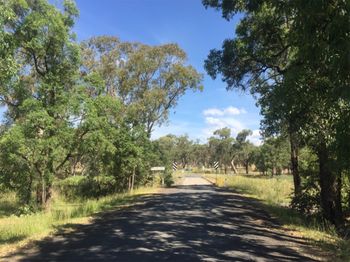
As a settler community, Wollar dates back to the 19th century. The English born Australian explorer, William Lawson (1774–1850), made the first mention of the area in a journal entry that dates back to 1822. In his diary, he describes a country characterised by steep chasm of sandstone and a river running south-eastward towards the sea, interspersed with plains, excellent grass, thick with herbs and vines and rich water sources. The scenic quality of the area, its rich bushland and remoteness saw Wollar and its surrounds become a destination for hobby farmers and people seeking an alternative lifestyle in the 1970s. The village, described by locals as “the sleeping village,” is surrounded by marginal farmland and, with the exception of a few large cattle farms, productive activity in the area has been limited to small- and medium-sized agricultural business or sustenance farming. Some locals have gained an income from work in the village—at the school, local nursery or shop—and some have travelled to Mudgee, the regional centre approximately 54 km northwest of the village, for part-time employment. Others have lived on pensions or formed part of the local rural economy, taking on casual and contractual work on an ad hoc basis. During the 1980s, between 300 and 400 people resided in the area, with 30 children enrolled at the local school and two permanent teachers (Fig. 1).
Wollar, February 2016 (picture by author).

When talking about the village, local residents speak in nostalgic terms about cricket games and bush dances, Friday beers under the village tree and swims in the river on hot days. They describe a close-knit community with supportive neighbours and cross-generational connections. Within their narrative is a nostalgic longing and melancholy of a time past. There are no longer cricket games and bush dances, there are no Friday beers and neighbours and friends are few and far between. The narrative of a close-knit community has been replaced by one marked by the breakdown of the community, increased competition and suspicion, fragmentation and loss. Today, the narrative of the village is not shaped by the residents but by its nearest neighbours: three open-cut coal mines owned by multinational extractive industries.
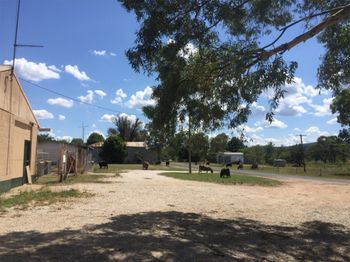
The three mining operations surrounding Wollar include both underground and open-cut mining. In addition to the existing coal mines, a green-field mine application by the Korean mining giant, Kepco, to start open-cut and under-ground operations in Bylong, Wollar’s “sister village” about 30 km east of the village, have for years loomed over the village, and in late 2019 it was reported that the NSW Government urged the development of the Wollar coalfield, which will expand mining to the east of the village (Butler, Reference Butler2019a, b). The three mines, Wilpinjong, Moolarben and Ulan, are owned and operated by multinational companies: Peabody Energy, Yancoal and Glencore, respectively. These mines operate 24 hours a day, seven days per week, with approval for operation until 2033 (Wilpinjong), 2038 (Moolarben) and 2031 (Ulan). Whilst all the ongoing and planned mining operations have a cumulative impact on the village, it is the Wilpinjong mine that has attracted most resistance from the local residence. When I started my fieldwork in Wollar, the locals were mustering strength to oppose a proposed expansion of the Wilpinjong mine, which would bring the mine only 1.5 km away from the village. At this stage, the community was already depleted from the Wilpinjong operation, which had seen a transferral of land ownership from private landowners to Peabody and a corresponding change in sociality. Although both the proponent and the State Government had identified that the expansion would make life in the village untenable, the application was approved by the NSW Planning Assessment Commission in 2017. Only the few remaining residents who lived within the village itself gained voluntary acquisition rights as part of the conditions of consent, leaving the residents on the fringes of the community stranded in a social and economic void. For them, life “has become hell” (Paul) and the future has become even more uncertain. At the time of writing, there is one landowner left in the village who has not sold to the mine (Fig. 2).
Wollar village, January 2017 (picture by author).

When the Wilpinjong mine was approved in 2005, it obtained a 21-year operation license, from 2006 to 2027, and was approved to extract 9.5 million tonnes per annum (mtpa). In contrast to many other mines in the Hunter Valley, which produce coal for overseas markets, the primary purpose of the Wilpinjong mine was to supply domestic coal to Bayswater Power Station in the Upper Hunter. Today, the mine also produces high-quality thermal coal for export. Since Wilpinjong opened in 2006, Peabody has submitted six modification applications and the above-mentioned expansion application. This includes applications for increased blasts to two per day (2007); increased production up to 12 mtpa (2010) and 12.5 mtpa (2012) with subsequent increased train activity (2012); increased size of the mine (2014) and increased extraction rate to 16 mtpa RoM and expansion of mine (2014). Each modification has placed increased pressures on the people in Wollar, with more machinery, increased noise, dust and vibration. There has been a gradual loss of services, the churches have been closed, the one-stop-local-mechanic-and-shop has been bought up by the mine, which now only offers basic take-away and a few very expensive products, the school has closed and the fire brigade has been amalgamated with Cooks Gap Fire Brigade, which is located approximately 50 km away.
The expansion application included a proposal for incremental expansion of the existing open-cut pits over approximately 500 ha, as well as the development of a new 300 ha open-cut pit at Slate Gully. It did, however, not only expand the footprint of the mine but also extended the operation for an additional six years, to 2033. For the local residents, the temporality of the pit has become a matter of great concern and, in response to the environmental impact assessment conducted in relation to the latest modification and extension proposal, several submissions regarding their long-term outcomes were made (Coutts, Woodward, Johnson, & Hann, Reference Coutts, Woodward, Johnson and Hann2017, p. 13). At the time of the 2017 approval, no rehabilitation strategy had been prepared (Coutts et al., Reference Coutts, Woodward, Johnson and Hann2017, p. 13).
The locals are cynical about promises for future rehabilitation planning (let alone implementation of rehabilitation plans) and have no trust in the proponent’s promises. Wollar has an ageing population, and with the depletion of the remote village, the local residents are increasingly vulnerable. For the local residents, the future is fast approaching, and the timescales that are proposed for mining operations exceed the timeframe that they have to work to in terms of negotiating the vulnerabilities of old age. It is, however, not only the future that has become ambiguous; the community is already adversely affected by the mining activity. Over the past 10 years, the small rural community has been reduced with approximately 90% of its population, with less than 30 people living in the area. As people have been bought out, those who remain in this remote village have become even more isolated. Life has become harder. People are aware of increasing risks and more concerned about their safety. Operating and maintaining the farms are more difficult and increasingly more expensive.
Whilst the residents mention the negative impacts of noise, vibration and dust, it is the loss of community and a sense of social and temporal voids that stand out in their narratives. In contrast to the noise, dust and vibrations, which may have a direct impact on the residents’ day-to-day lives, their sleep and health, the hollowing of the community creates a different type of pressure and stress, in which the present destructions are projected to cause future dissonance. In contrast to the direct impact of mining activity—such as noise, dust, blasting and vibrations—which will cease once the mine closes, the loss of community and sociality is feared to be permanent. As one former resident said, “if Peabody left today, Wollar would probably never recover…there is no future” (Steve). The hollowing of the community and the sense of no future are mirrored in community concerns about the ecological legacy of the mines: without rehabilitation plans, what will happen to the pits when mining ceases? Both Moolarben and Wilpinjong have gained approval to leave so-called final voids: Moolarben has approval to leave three final voids with the total area of 82 ha; Wilpinjong was initially approved to leave two final voids with the total area being 35 ha, with a continuation of the two existing voids approved in 2017. The two final voids will become saline over time, and it is estimated that only one void will have reached equilibrium by the completion of mining, with the other expected to need over 300 years to reach equilibrium (Coutts et al., Reference Coutts, Woodward, Johnson and Hann2017, p. 13; Walters, Reference Walters2016, p. 8). But what does this mean? And, how does the temporal materiality of the mines translate into the experience of mining?
Mining legacy
…last year I went down into Mt Owen mine…I had never been down a pit before. And I, I went down in [a] vehicle […] down to the bottom of the pit. And I felt physically ill. I felt so overwhelmed I could’ve cried. Cause I watched…I know this sounds ridiculous, but, I watched the water coming out half way down this massive wall and it was like the earth was crying. It was like, this is something…that’s what I looked at. And I thought, ‘you big softie’, I would never have let that worry me but I look at that and I thought ‘what are we doing to this country? What are we doing, what are we leaving our children?’ That’s what I can’t, what I can’t cope with. We are deliberately wrecking this landscape and we are just doing it because there’s a lot of greed. (Steve, Wollar, interview, 30 April 2016)
A first encounter with an open-cut mine can be confronting. An open-cut mine emerges as a micro-cosmos, stripped of life as we know it and marked by a constantly changing material form that, nonetheless, maintains a sense of repetition and familiarity. High walls marking the edges of the pit, coal seams opening and disappearing into the mouths and bellies of giant machines and haul roads designed and flattened for transferring ungraded coal, soil and rock from pit to preparation plant are images of a modernity we know. An open-cut mine captures the temporalities of past, present and future; they are, as extractive landscapes, temporal landscapes, spatial materialisations of time (D’Angelo & Pijpers, Reference D’Angelo and Pijpers2018). For some, these extractive landscapes represent a link to a utopian future marked by prosperity and well-being. Mining is for them a productive activity that supports present well-being and brings forward future potentialities (cf. Dahlgren, Reference Dahlgren2019), and the everchanging landscape is a reflection of such productive potential. For others, such modernist interpretations are rejected, and the extractive landscapes are instead positioned as symbols of destruction and death. For them, extractive activity is a temporal pathway from a distant past to a dystopic future: coal, a material form that has taken millions of years to develop, is excavated, washed and burnt by technologies of the present, with the consequence of environmental destruction that jeopardises the well-being of future generations.
These two perspectives are at the opposing end of a spectrum of attitudes towards the extractive landscapes in the Hunter region, where my ethnographic work is based. They are simplified representations of community reflections around the moon-shaped landscape that has come to characterise large parts of the region. Coal extraction has a long history in the region, with rich Permian era coal deposits found underneath coastal cities and in long-settled agricultural areas of NSW (Connor, Reference Connor2016a). These deposits were instrumental in the European settlement of the Hunter, with coal and mining integral to 19th century colonisation and industrialisation (Connor, Reference Connor2016b). Where mining was, initially, an underground activity that worked in parallel to alternative land uses, including agriculture, mining expansion and new intensive open-cut extraction methods, has seen coexistence shift to conflict within rural areas.
Mining contributes significantly to the economy of NSW. In 2016–2017, the mining sector produced resources worth about AU$24.7 billion and generated export revenues of AU$22.9 billion (NSW Government, 2017), making it the State’s largest export earner in value terms (NSW Department of Industry, 2019). In the same period, the mining sector employed 27,600 people directly and about 11,000 indirectly, contributed $1.6 billion in royalties and provided approximately 80% of the State’s energy supply requirements (NSW Government, 2017). Mining brings infrastructure, employment opportunities and economic benefits, not least for regional and rural areas. From this, it is clear how a discourse about the role of mining and coal in the protection of places of dwelling gains traction; even without considering the role of employment and local spending, the argument can be made simply by looking at how mining royalties is used to fund infrastructure and services for, as the NSW Government declares, “all people in NSW” (2017, p. 6, my emphasis).
This positive tale of place making is, however, only one side of the story. Indeed, as the NSW Government (2017, p. 6) itself states: “[m]ining can involve significant disturbance of land” and, by extension, mining can involve significance disturbance of the place to which this land is important. Most of the operating mines in NSW are open cut, and significant areas have been earmarked for mining interests. In the Upper Hunter River valley, 64% of the land is allocated to mining exploration leases, with pits, final voids and overburden dumps occupying an additional 16% of the land (31,500 ha) (Connor, Reference Connor2016a, p. 236; Hydrocology Consulting, 2014). Local communities and activists are raising increased concerns about the disturbance that mining is causing on land and water, ecosystems and habitat. As mining expanded in the first 15 years of this millennium, the NSW Government showed little concern about what would happen with the disturbed landscapes. Many mining projects were approved without adequate rehabilitation plans and, according to an Energy and Resource Insights report published in 2016, a total of 45 pits, covering an area of 6050 ha, have been planned and approved for the State, with a 3924 ha of voids to be left in the Hunter Valley coalfields alone (Walters, Reference Walters2016).
These unrehabilitated pits are what is referred to as final voids. A final void is “the location of the active mine pit at closure that is not backfilled by mining operations” (Anglo Coal, 2009). More specifically, as the NSW Government (2017, p. 9) states, final voids can be explained by the process of mining by which “open cut mining involves the displacement of material to access an underground resource,” often resulting “in the formation of large pits or voids where the material has been removed.” The “final void” is, in short, the left-over void after mining operation cease; it is the long-term legacy of mining operations. The scale and impact of final voids remain poorly understood, though it is clear that these voids will pose “multiple threats to both the environment and local residents” (Walters, Reference Walters2016, p. 5). They extend vertically and horizontally and may be hundreds of meters deep and kilometres long.
A key issue with the final voids is water. Modern coal mines commonly extend 150 metres or more below the natural water table, and, in most cases, the final voids will draw down local ground water, functioning as groundwater sinks (Walters, Reference Walters2016, p. 4). Over a long period, often centuries, they will become large pit lakes characterised by poor and deteriorating water quality. The voids in the Hunter are expected to act as terminal sinks that place decreased pressure of groundwater and they will “be a permanent draw on aquifers in the world’s driest inhabited continent” (Dahlgren, Reference Dahlgren2019, p. 245). The water that will form within these pit lakes will become highly saline and, in some instances, may also be contaminated by evaporating heavy metals. Should the lakes overfill; the flooding will have detrimental impact on the surrounding land. Even without an overfill, the pollution caused by the final voids can be devastating, with groundwater seepage potentially contaminating groundwater supply.
For local residents living close to the mine sites and the future final voids, the lack of understanding of potential impact and future planning for how to deal with these voids cause significant distress. For them, they epitomise the dystopian future that mining has brought. The final voids intersect with the social void described above and have become symbols of how the present hardship and anguish caused by the mine will not disappear but continue to mark the vulnerability place and people at the coal face. This is illustrated in the following ethnographic vignette from a community meeting in Wollar where the Department of Planning and Environment met to speak with local residents about a planned expansion of one of the mines in the area:
Jane was moving restlessly in her chair. Next to her, her husband had been raising concerns about the loss of the local fire brigade and the concerns about the mine’s reluctance to generously support the fire prevention and fighting in the area. Jane, a mother of two who lives with her husband in the national park where she runs a tourism business whilst finalising a science degree, appeared frustrated. I had already spoken with Jane about her concerns about the water impacts of the surrounding mines and I knew she felt the environmental and social impact studies had failed to acknowledge the cumulative impacts of mining on water, land and people. Jane raised her hand and asked the government representatives to clarify what would happen to the final void. A scientist herself, she spoke in technical terms about discharge, lap-time, water quality and modelling. The representative from the Department of Primary Industries (DPI) was left to answer, speaking about upstream and downstream issues but, eventually, ending up with the statement ‘there is a need for further assessment’. Jane, clearly unhappy with the DPI’s response, pushed on: ‘but who will be included in the assessment?’, she asked, ‘who will be seen as impacted?’ She continued: ‘what about post-mining, how will risks and hazards in the future be assessed?’ Pushed to answer this question about the temporal frame of the assessment, the government representative pointed to a 50 year period. A sigh went through the room, which was primarily filled with concerned residents and only a handful of mine workers. Jane, looking agitated and frustrated at the bureaucrats, stated: ‘but these voids…they are not a 50-year legacy! The risk and hazards to people and wildlife will be there for at least 200 years!’. (based on fieldnotes, 23 February 2016)
The exchange between Jane and the bureaucrats serves as an illustration of a key bind in the measurement of post-mining futures. In this space, the future is contested, both as a temporal entity (when is the future?) and a qualitative reality (what will the future look like?). For the government, the mining industry and its supporters, the question about the final voids has presented a distinct challenge. In 2017, the NSW Government responded to public pressure (NSW Government, 2017, p. 9), publishing a discussion paper in which feedback was sought on proposals to improve rehabilitation outcomes for State significant projects, such as coal mining. In this paper, proposals are forwarded for improvements, including adoption of policy principles to guide the regulation of mine rehabilitation; development of a policy framework for the assessment of final voids; improvement of consideration of rehabilitation and closure in the early stages of mine planning; assurance that rehabilitation requirements are clear and enforceable and assurance transparent regulatory processes after approval and delivery of consistent rehabilitation outcomes (NSW Government, 2017, p. 10–16). The proposals are a stark admission of the failure to have a rigorous and transparent process for dealing with post-mining futures. It is an illustration of how, as Connor (Reference Connor2016a) contends, rural landholders and local communities have been marginalised in mining law, environmental protection, legislation and regulation. It illustrates the ambiguities surrounding post-mining futures, which relate not only to questions about the environmental legacy that mining leaves but also who will be responsible for costs and delivery, how technology can support rehabilitation and the timeframes by which land disturbances are dealt with. The discussion paper does, however, not provide any indication of what rehabilitation will look like. In the next section, I will look into how the voids are envisioned as future possibility.
Voids: polarising futures
Throughout the course of my fieldwork, I have been struck by how landscape change and the materiality of coal mining have gained little community attention beyond the sites of extraction. For example, in Newcastle, the temporary destination for all Hunter coal destined for export, uncovered coal trains move slowly through the suburbs, adding to the industrial hum of the city. Piles of coal grown and disappear with regular intervals as the coal ships on the horizon await their turn to enter the narrow harbour. Wherever you go, markers of a coal-dependent economy strike you: the coal piles in the port; the ships on the horizon; the remnants of the old steelworks; the suburban miner cottages; the rail line; banners and uniforms at children’s sport activities sponsored by the port or one of the many multinational companies; and so on. The list is long, signalling the interconnections of the city and its interdependence on the global energy market and steel production. The markers of coal, particularly the coal piles and the coal trains, have a distinct materiality that have gained a level of stasis in the image of Newcastle as a place. These markers of capitalist production have become part of what Newcastle is as a city and it features in the promotion of the city alongside the city’s golden beaches; they form part of the landscape and people’s sense of Newcastle as a place. Yet, as the coal economy has filled Newcastle as a place, it has created emptiness elsewhere. At the level of the everyday, outside the regime of planning and assessment, this dependency of place gains limited attention; the costs to other places for Newcastle to become the place that it is are muted in narratives about “the steel city” where its coal heritage is celebrated and embraced. It is not my intention to critique these narratives about Newcastle as a place; coal is an important part of the history of the city and continues to be central to many residents’ livelihood. I do, however, want to emphasise how these narratives about Newcastle as a past, present and future place disregard the places of economic and ecological support upon which they rely. It illustrates one of the central arguments of Plumwood’s (Reference Plumwood2008, np) thesis where she contends that “commodity culture engenders a false consciousness of place” that further creates a “split between our idealised homeplace and the places delineated by our ecological footprint.” Within these narratives, Wollar and other small Hunter villages like it, become unrecognised “shadow places” (Plumwood, Reference Plumwood2008) eluded knowledge and responsibility.
In discussions about the region’s final voids, the muted materiality of mining has, however, gained more attention and brought forward a sense of concern from the mining industry and its supporters. In their emptiness, the voids have triggered strong emotions that speak to future imaginings of place. There are two dominant visions shaping the debate about the final voids. Each of these presents distinct notions about the potentiality of landscape transformation, signalling in their different ways how visions of productive potential inform future visions of place. Both visions speak to a political debate about what can be counted as “ruin” and, not least, whether or not there is a possibility of life in capitalist ruins (Dahlgren, Reference Dahlgren2019, p. 236, 256; Tsing, Reference Tsing2015). As Dahlgren (Reference Dahlgren2019) outlines in her study of the NSW coal lobby, the coal industry lobbyists and their supporters forward a vision of the future voids in which their very emptiness offer potential, generating the voids as sites of hope. Drawing on Weszkalnys (Reference Weszkalnys2015), Dahlgren (Reference Dahlgren2019, p. 248) argues that “the material emptiness of the void […] makes them conducive to incomplete and speculative knowledge.” This knowledge “is generated and encouraged by the coal lobby to shift the focus on the void from a marker of what is lost to an absence that is full of potential” (Dahlgren, Reference Dahlgren2019, p. 248).
Through speculative knowledge and encouragement of imagination, uchronotopic visions are generated, in which the void is no longer a symbol of loss but, rather, a “bright object” (Bryant, Reference Bryant2011, Reference Bryant2012) that, through its relations to other objects, become “an object that functions as a hub or key node in a network, exercising gravity that influences and defines the paths of most other objects in its vicinity” (Bryant, Reference Bryant2012, np). The voids have, as mentioned above, strong affective intensity. The affective capacity of the voids has been problematic for the mining industry: the confrontational effect of the barren, moon-shaped landscapes of the mining pit have forced questions about the future and the industry’s so-called “legacy issue.” For both the mining industry and its supporters it has, thus, been important for the industry to move the imagination of the void away from destruction to potential, tying the void into the discursive optimism of modernisation and progress. This forwards a teleological belief in technology and human potential to control nature and manage its regenerative potential. Scientific constraints are no longer a matter of confinement but a challenge that will be solved as technology advances. The future, then, is suspended yet it is brought close, because present-day research, development and advancement are evidence of the solution to come; the void becomes a bright object that channels the imagination and hope of a uchronotopic vision in which absence and emptiness become potential for future prosperity in place.
Dahlgren (Reference Dahlgren2019, p. 248–254) illustrates this transformation of negative affect to potentiality when describing the different imaginings of voids presented by the mining lobby. Continuing the capitalist logic of extraction, the mining lobby has used speculative knowledge with the aim of making people want the voids. By arguing for how the voids can be used for economic diversification, they have encouraged imaginations that tie in with concerns about the post-mining future and regional decline. Suggestions that channel the voids into opportunities, such as theme parks, bike trails, rock climbing and abseiling, golf courses, film sets, floating villages and surf parks, as well as abattoirs, wool scour, waste management and algae farms have been presented (Dahlgren, Reference Dahlgren2019, p. 252). These resemble successful rehabilitated landscapes elsewhere, including amphitheatres, film sets and sporting grounds (Czech Republic), recreational lake districts (Lusatian Lakes in Germany and Quarry Lakes in Canmore, Alberta) and hotels (China). The practical realisation of such projects is, however, highly questionable because of issues related to the time it will take for the Hunter voids to reach an equilibrium, the size and depth of the voids, and the fact that these voids will be wet terminal sinks. Yet, physical limits are suspended by imaginative schemes and, through such strategies, the void transforms from a matter of destruction and loss to an object of potentiality (Dahlgren, Reference Dahlgren2019).
In conversation with local community members who live close to where the final voids will be and who are not aligned with the mining industry through employment or direct economic benefits, they scoff at the ideas presented by the coal lobby. Their rejection of these imaginative schemes must be seen in relation to their past experience of broken promises and the strong distrust that has built over the last decade as their communities have despaired in the shadow of the mine. “They promised us a rose-garden but all we got was a thorny blackberry bush,” Paul, one of my key informants in Wollar, told me an autumn morning as we met at the community hall. Paul’s use of metaphors is telling. When the mine first presented its interest to extract in the area, it presented itself as an agent of positive change for the small, remote village. It would bring people, jobs and money to the area; the mine would be a partner in shaping a positive future for the small village. “We were naïve,” Paul explained, as he looked out the window, pointing with his eyes towards the empty, derelict houses that now mark the few streets surrounding the community hall. The reality of the mine’s operation emerged early on in the process, as the local people saw friends and neighbours move away, bought out by the mine who needed access to land or who purchased properties in its efforts to manage the environmental impacts of its operations. The mine did not bring people to the community; it took them away. The few workers who did come to live did not bring their families and have become temporary residents who move in and out of the village and who do not nurture ties to Wollar as a place. They work 12-hour shifts and, when in the village, will either be at work or sleep. “We don’t know them; they are not interested in us,” Damien, one of the last remaining long-term village residents, told me when asked about his interaction with his new neighbours.
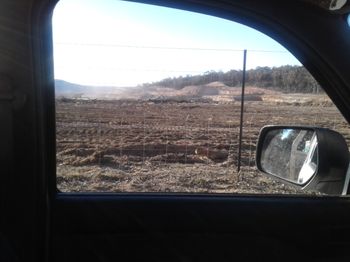
At the same time as the sociality of the place has changed, so has the physical landscape. Over the past 10 years, the footprint of the mine has expanded rapidly. As Paul explained: “they’re just getting bigger and bigger. Considering what it first started out to be [before open-cut mining in the region]…a couple of wheel barrows and a couple of pick and shovels. It’s got bigger and bigger and bigger.” Seeing the expansion of the mine was, at first, a way for the locals to get insight into what was happening to their local area but, as the pit expanded and the locals felt increasingly hostile towards its presence, they tried avoiding it.
[i]t has [gotten bigger], I know. Originally you drove past it and you’d think, just to see what was happening, because nobody ever told you what was happening, and you didn’t see pictures of it. Then it got to the stage where, okay we’re not going to go along that way. We’ll go the long way, so we didn’t have to drive past it. Now … you have to drive past it. (Louise, interview 11 April 2015) (Fig. 3)
The Wilpinjong pit, July 2019 (picture by local resident, reproduced with permission).

For locals, such as Louise and Paul, the pit is a reminder of the loss they have withstood and are enduring. It is a reminder of a lost past, as well as a lost future. Regardless of what rehabilitation is put in place, it can never be the same. This notion of equivalence points to a process of negotiation of value—costs and benefits, damages and reparations—which is embedded in the evaluation of impact and mitigation. In contrast to the logic of markets and exchange forwarded by industry and, frequently, governments, local communities often adopt a rationality underpinned by a different temporal and material scale, which distorts the toxic notion of value as calculable monetary and immediate (Li, Reference Li2015). The locals interpret the plans for the final voids presented by the mining industry as spin and they see the imaginative play of these plans as nothing but evidence of the industry’s insincerity and its efforts to hide the real impacts of their operation. For them, the final voids are ruin, as both noun and verb. They are, or will be, material relics from the past (Gordillo, Reference Gordillo2014, p. 2), as well as symbols of the act of ruin that has happened to ecosystems, biodiversity, sociality and place. For them, the emptiness of the voids does not present potential; it presents destruction and symbolises loss. Wrapped in with their personal and collective experience of dispossession and displacement (Askland, Reference Askland2018), the final voids are dystopian; they represent a lost future and a lost place. The emotions triggered by the material emptiness and the temporal projections of the void are strong. Thus, as coal is extracted, so are emotions. Emotions are mined and, as minerals are moved, so is the sense of self as it is positioned in relation to the place of extraction. Emotions are, as Albrecht (Reference Albrecht2019, p. 1) contends “that which moves us.” The people of Wollar display an “emotional compass” that has instinctively directed them towards a place that once was characterised by its detachment from the capitalist buzz, its beautiful and biophysically rich environment, its remoteness (but not isolation), its rich natural and cultural heritage and its social cohesion. To understand the emotional potency of the voids, it is therefore necessary to understand how its material emptiness comes to symbolise the social desolation and temporal emptiness that has emerged within Wollar as a place and the local residents’ own lives.
Void as ruin
“They are taking our life away”, Anna stated, her eyes swelling up with tears. Anna, one of the few remaining residents in Wollar was speaking to a panel consisting of mining consultants and representatives from the Environmental Protection Authority, Department of Primary Industries and the Department of Planning and Environment. Yet again, she was forced out of her comfort zone to address State officials bestowed with the power to decide her future. The meeting, held in the middle of the day, had forced her to take time off work. Most of her former colleagues, neighbours and friends were not present; gagged after having sold their properties to the mine in the years after it opened in 2006. ‘Looking forward’, Anna said, ‘there is no alternative […] today, if you are not angry, you are extremely depressed’. (based on fieldnotes, 10 April 2017)
In a similar way as with the physical voids, a sense of ruin marks the local Wollar residents’ experience of emptiness as it has been shaped by the mining operations. As in the case of the material voids, the loss and destruction caused by the mine are seen as final, presenting dystopic futures. Efforts to reimagine Wollar as a place require, as is the case in the mining lobby’s uchronotopic revisioning of the final voids, speculative knowledge and encouragement of imagination. Moreover, as in the case of the material voids, it requires not only ideas around regeneration but also repurposing. Such imaginative strategies call for the release of imaginative play from the affective dimension of the past. What I mean by this can be illustrated by the limitations of local residents’ imagination of the mining landscape: within these imaginings, the vision of future place is not only restricted by physical limits but also by ideals of purpose and meaning of place, which, at large, are determined by past purpose and land use. As Graham—a former resident of Bylong who has a close association to Wollar—stated when I asked about his thoughts on the final voids: “[m]y view is pretty basic: there shouldn’t be voids. They are toxic sinkholes. Repurposing them is largely fanciful … There may be some limited reuse possible, but the focus should be on rehabilitation to the best extent possible. That’s not going to happen, of course.” Similarly, Paul stated: “[I would say] no to a void or a lake. The land must be put back to grasses and trees similar to the way it was if possible … a lake of water can only be a problem. How can they be sure that water is drinkable to the wildlife that will visit it from time to time? Let alone if the water escaped during a heavy-duty rain event and ends up in someone else’s backyard. It must be treated as land that has a future to be grazed again one day.” Both these quotes show common sentiments within local spheres towards the final voids and the idea of repurposing flagged by the coal lobby. In their own way, these imaginings are themselves speculative in that they present visions of future landscapes that are not necessarily supported by scientific knowledge, political will and economic capital, all of which are required to see the rehabilitation proceed. Moreover, they are speculative in their assumption of a future audience, implying a past connection and knowledge of what this landscape was like pre-mining. As I will explore later in the article, they point to the relational dynamic of place in which place is only experienced in and through the relation between self (individual) and other (landscape). This very relational dynamic is central to the affective play underpinning the imaginings and are important for how the voids capture not only the removal of soil and rock but also the mining of emotions. In contrast to the coal lobby’s uchronotopic imaginings, this affective, relational dimension means that the ideals of future place are not a matter of repurposing as a functional reconsideration of landscape but, rather, an effort to re-establish the ontological as much as the ecological dimension of place (Askland & Bunn, Reference Askland and Bunn2018).
The case of Wollar and the conflicting visions of final voids as potentiality and ruin illustrate what is highlighted in the introduction of this Special Issue and by Kramvig and Avango (Reference Kramvig and Avangothis issue), who argue that “mining prospects bring forth disputes and ontological conflicts on multiple interest in the utilization of land and ways to know the landscape.” It illustrates how the environmental conflict goes beyond the issue of control over natural resources, extraction and pollution. The experiences and reflections accounted by the participants of this research illustrate how holistic views that bring landscape to the forefront of human activity may exist. The landscapes I here speak of are “taskscapes,” which are, as Ingold (Reference Ingold1993) defines them, shaped through practice over time. They are, as such, not “wilderness” or “bush” but landscapes that in themselves tell a story of human presence and settlement; they are, in the words of Kramvig and Avango (Reference Kramvig and Avangothis issue), “activities and performances of people,” as well as animals, whose movements mark the land. Landscape, as taskscapes, is “the world as it is known [by those] who dwell therein, who inhabit its places and journey along the paths connecting them” (Kramvig & Avango, Reference Kramvig and Avangothis issue). This notion of landscape as taskscape is applicable to both Indigenous and non-Indigenous ontologies; it speaks to how landscape hold histories, meaning and value.
This brings me back to Plumwood’s critique of conventional place-discourse. It may seem contradictory to present an idea of landscape so intimately tied to dwelling as practice, embodiment and experience by which landscape is not only something that we are part of but also something that is part of us. Yet this is, indeed, central to explaining the different future imaginings of voids by the different stakeholders discussed in this paper. During one of my first visits to the village, I met Damien, a widower who left his job and life in Sydney to settle in the village about 30 years ago. Damien owns a few cows and keeps busy with different projects on his two lots. He lives in a rustic small house with a tin roof and old windshields as windows, with a bathtub under the stars that he warms up with firewood from the bush. Sitting outside his modest house one afternoon in 2015, we were chatting about what he would do if the mine extension was approved. Looking at the trees across the road, he stated in a melancholic tone: “I just don’t know what to do; where can I go? This cannot be bought…it’s my life. I planted these golden gums and watched them grow…how can I leave?.” For Damien, as well as the other local residents I have spoken to, Wollar is not just any place. For them, it is a place bestowed with work, meaning, history, memories and, not least, their future. The affective distance between them and Wollar as a place—shaped as taskscapes marked by its distinct biophysical, social and spiritual character—is short. What happens to Wollar, then, happens to them; it directly affects their everyday life, practice and imagined future.
Understanding the emotional dimension of mining requires that we expand the idea of community or sociality to incorporate the non-human. Wollar, as a community, is not only made out of the people who inhabit that space but, rather, it is the assembly of relations between human and non-human entities that create Wollar as a lived place. The local residents are, as such, embedded in an affective ecology that intertwine biophysical, social and ontological dimensions (Vanclay, Reference Vanclay, Vanclay, Higgins and Blakshaw2008). Disruptions in this ecology cause disruptions in the affective space. The hollowing of sociality and landscape caused by the mine is also a hollowing in the affective ecology; it disrupts the relations that connect people to place, as an affective space, through time. As dirt is dug and coal is mined, so are emotions.
The affective distance between the changing landscapes—geophysical and social—and people’s sense of past, present and future self in place generate distinct emotions that enable or restrict the individual and collective imaginative resources. The mining operations have extracted both minerals and people from Wollar, leaving voids that change everyday practice, sociality and the sense of being in place. The conflict at stake mirrors what also occur in the Arctic—as, for example, Kramvig and Avango (Reference Kramvig and Avangothis issue) contend in their analysis of the effort to (re-)open the Biedjovággi mine in Sápmi—and illustrates how contestation may not necessarily be about conflicting interests in their own right but, rather, a matter of political ontology. That is, it is a matter of the definition of the “things” at stake (Blaser, Reference Blaser2009, Reference Blaser and Green2013) and conceptual differences in knowledge, relation and affect. In discussions about the impact and exploration, of experiences and perceptions of extractive industries and their legacy, a matter of concern is the definition of what is at stake. A poignant example of this is the contestation about the final voids: for the local people at the coal face, it is not in itself a matter of repurposing and reimagining, as the narratives and solutions of the industry and its supporters contend; rather, it is a matter of reproducing and reconfiguring place as it sits within the affective ecology.
The contestation around the final voids is a debate about place-based futures. This debate triggers intensely felt emotions, such as hope and fear, and create surfaces of bodies and worlds that align individuals within set communities of belonging (Ahmed, Reference Ahmed2004); that is, within distinct places, as I have used the term throughout this paper. The operating pit and future void is a body and a sign, a point in the circulation of emotion between people and place (operating pit and future void are here seen as a materialisation of the same “thing” but in present and future forms, hence the use of singular preposition). The pit is the final void in making; it is the present material form of a contested future landform. In its present form, then, the pit becomes a cavern of emotions that for those who live in its proximity harbours fear, frustration, anger and resentment. These negative emotions emerge from the experience of becoming a shadow to the extractive process, of becoming part-invisible through the (re-)industrialisation of the landscape. During this process, Wollar as a lived place—marked by the interconnection of the biophysical, social and ontological (Askland & Bunn, Reference Askland and Bunn2018)—has been treated as a place of extraction akin to the pit itself. We can use the extractive process as a metaphor of what the locals describe: like trees, gravel and dirt, those in the way of the industrial project have been pushed out; the valuable resource (coal/people) have been nurtured (washed, treated/listened to compensated) and moved by the mining company in its search for treasure; the remaining overburden (local residents) have been scattered in a hollow that seeks to resemble a lost past and the fringes (fringe dwellers) remain ambiguously placed around what has become an unfamiliar landscape with an ambiguous future whose reproductive potential is compromised.
Conclusion: ecologies in a shadow place
As I conclude, I yet again return to Plumwood and her notion of a shadow place. Where, prior to the dominance of the extractive industries, Wollar was defined as a place in its own right, with a relative autonomy from other places, it is today marked by its distinct productive value as defined by the extractive industries. As a place, it has become defined by the logic of reproduction set by or within another place; it has become a shadow place where the future is dependent on the actions of actors elsewhere rather than the actors whose lives are lived within the geographical bounds of what is known as Wollar; it has become a place that sustains the other, while itself is becoming depleted. Accordingly, through the extractive process, Wollar as a place has been stripped of its potential beyond that envisioned by industry and government. For those who live there, it has become a dystopia; a place with no future. This dystopia has led to a transformation in present and imagined future environments; a change that pose, as Connor and Marshall (Reference Connor, Marshall, Marshall and Connor2016, p. 1) write in their contemplation about how people think and act towards the future in the era of climate change and a time of ecological instability, “existential problems that may lead people to question much of the taken for granted nature of social organizations and their embodied ways of engaging with the world.” In Wollar, this is evident in how the politics of mining have confronted the remaining residents in such a way that their sense of self, community and other has become distorted. In this process, an unarticulated—yet lived—future has become visible. That is, the present has made the future perceptible, articulated through the realisation that this abstract and imagined, yet desired and lived, the future is no longer attainable; as the mines have gained authority over ecological and social space, they have also acquired power over temporal space. As illustrated in the metaphors of the void, they have created an ambiguous, empty hollow in which the individual’s sense of self in place is compromised.
The argument I have presented is underpinned by the assertion that people’s sense of being (ontology) is intimately tied to ecologies and mythologies, and that potentially conflicting and disruptive myths (imaginings) may challenge how the future is lived, felt and imagined. Ecology is here understood as the ecological systems in which social and psychological life unfolds; as Connor and Marshall (Reference Connor, Marshall, Marshall and Connor2016, p. 2) contend: “[p]eople extend out into their environment and the environment extends into them.” Reflecting the system analytical and relational views of Bateson (Reference Bateson1972, Reference Bateson1978), I wish to emphasise, in line with Connor and Marshall, how the human body, mind, emotion and environment are interconnected and how ecologies are, in their various scales, “modes of existence out of which everything grows” (Connor & Marshall, Reference Connor, Marshall, Marshall and Connor2016, p. 2). Ecologies, then, are not simple environments within which human beings live or practice but something that becomes embodied; ecologies—what we live among—are part of everyday life, practice, habit, dreams, imaginings, sense of self; it is part of human life-worlds. Degraded or damaged ecologies—as captured in the materiality and mythology of the mining void—may destabilise human life-worlds and replace “imagined futures with experiences of loss and endings” (Connor & Marshall, Reference Connor, Marshall, Marshall and Connor2016, p. 3; see also: Connor et al., Reference Connor, Albrecht, Higginbotham, Freeman and Smith2004). This is not only a matter of environmental change; the distress linked to negative environmental changes is also about the sense of loss of control over place and, not least, personal well-being (for example, Albrecht, Reference Albrecht2005; Askland & Bunn, Reference Askland and Bunn2018; Connor et al., Reference Connor, Albrecht, Higginbotham, Freeman and Smith2004) and life lived in the present and anticipated for the future. It is from this the Wollarian dystopic future emerges in stark contrast to the uchronotopic ideals forwarded by the mining lobby and their supporters, where the logic of extraction is, ultimately, related to a place beyond the coal face.