Implications
In this study we aimed to estimate and compare the genetic diversity of four native Italian shepherd dog breeds and their relationship to cosmopolitan dog breeds reared in Italy. As these Italian autochthonous breeds are involved in sheep- and cattle-farming in mountainous regions, they play a role in the economic tissue of marginal and disadvantaged areas, it is important to preserve their breeding. These data and information found here can be utilized in the organization of conservation programs planned to reduce inbreeding and to minimize loss of genetic variability.
Introduction
The dog is probably the most phenotypically diverse vertebrate species, thanks to its long history of domestication. Most of the various pure-breed dogs are morphologically clearly distinct and they also differ in behavior, physical properties and specific inherited diseases. Based on available breed histories, the majority of existing dog breeds were developed in the 19th century. At present, more than 400 canine breeds are registered worldwide by the Federation Cynologique Internationale (FCI, World Canine Organisation) and other federations such as the American and British Kennel Clubs (Parker et al., Reference Parker, Kim, Sutter, Carlson, Lorentzen, Malek, Johnson, DeFrance, Ostrander and Kruglyak2004; Streitberger et al., Reference Streitberger, Schweizer, Kropatsch, Dekomien, Distl, Fischer, Epplen and Hertwig2011).
To understand the effect of breed structure on the genomic makeup of the dog, molecular markers can be put to use in both small and large data sets. Autosomal microsatellites have been utilized to study genetic diversity in several dog breeds, primarily for the purposes of determining the power of exclusion for parentage applications (Altet et al., Reference Altet, Francino and Sanchez2001; DeNise et al., Reference DeNise, Johnston, Halverson, Marshall, Rosenfeld, McKenna, Sharp and Edwards2004). Autosomal microsatellites have also been utilized to study genetic diversity in several dog breeds. In dogs, microsatellite typing, combined with phylogenetic analysis and modern genetic clustering methods, allows the definition of related groups of breeds and that genetic relatedness among breeds often correlates with morphological similarity and shared geographic origin (Kim et al., Reference Kim, Tanabe, Park and Ha2001; Irion et al., Reference Irion, Schaffer, Famula, Eggleston, Hughes and Pedersen2003; Parker et al., Reference Parker, Kim, Sutter, Carlson, Lorentzen, Malek, Johnson, DeFrance, Ostrander and Kruglyak2004; Wade, Reference Wade2011; Ciampolini et al., Reference Ciampolini, Cecchi, Paci, Policardo and Spaterna2013; Mellanby et al., Reference Mellanby, Ogden, Clements, French, Gowa, Powell, Corcoran, Schoeman and Summers2013). However, these studies have focused mainly on cosmopolitan breeds, while peripheral breeds have been studied less.
Effective management of farm animal resources requires comprehensive knowledge of the breeds’ characteristics including data on population size and structure, geographical distribution, and within and between breed genetic diversity. Information regarding genetic structure in non-cosmopolitan dog breeds and local populations is still lacking (Pires et al., Reference Pires, Amorim, Ginja, Gomes, Godinho, Simoes, Oom, Petrucci-Fonseca, Matos and Bruford2009). No previous studies about genetic diversity of Italian native dog breeds have been carried out so far, except for the breed Bracco Italiano (Ciampolini et al., Reference Ciampolini, Cecchi, Bramante, Casetti and Presciuttini2011; Cecchi et al., Reference Cecchi, Paci, Spaterna and Ciampolini2013), the Italian Greyhound (Pedersen et al. Reference Pedersen, Liu, Theilen and Sacks2013) and a research into the dog breeds raised in France (Leroy et al., Reference Leroy, Verrier, Meriaux and Rognon2009) that included two Italian autochthonous breeds (Italian Corso Dog and Romagna Water Dog). The aim of this study was to conduct a comparative analysis of the genetic diversity of four native shepherd dog populations in order to investigate the extent of genetic variation characterizing these native dogs, based on microsatellite loci. Moreover we decided to analyze the possible influence of some cosmopolitan dog breeds reared in Italy on these native breeds. At present, 16 Italian dog breeds are officially recognized by the FCI. This study focused on two of these autochthonous breeds: the Maremma Sheepdog is a breed of livestock guard dog indigenous to central Italy, particularly to Abruzzo and the Maremma region of Tuscany and Lazio. It is a large size dog with a solid, muscular build, a thick white coat, a large head and a black nose. It has been used for centuries by Italian shepherds to guard sheep from wolves. As in Italy, in the last few decades, the number of wolves has been rapidly increasing, the use of this dog breed for guarding sheep is growing; the Bergamasco Shepherd originated in the Italian Alps near Bergamo, where it was traditionally used as a herding dog. Today it is largely a show and performance dog. It is a medium size dog, well-proportioned and harmonious, having a rustic appearance. The breed’s most distinctive feature is the unusual felted coat, a normal and healthy characteristic of the breed. Moreover we also considered two not officially recognized Italian native dog breeds: the Lupino del Gigante Shepherd is a medium-sized herding dog, it has a morphological wolf-like appearance in terms of formation, movement, coat, but smaller in size with variable wolf gray, red, black, white and blue merle coats. It originated in the Apennine Mountains near the city of Reggio Emilia. The use of this shepherd dog to herd and guard the flocks dates back centuries, but recently the strong reduction of sheep-breeding in the area has led to a decline in the numbers of the breed which is now reduced to about 300 specimens; the Oropa Shepherd has been used for centuries in the Biella region of the Western Italian Alps to herd indigenous cattle and sheep. Similar types are found throughout the Alps, in Eastern Italy, Switzerland, and possibly in France as well. The coat color of this medium-size dog breed, characterized by wolf like morphology, is usually merle with black and tan markings, black or different shades of brown (Marelli et al., Reference Marelli, Michelazzi, Colombo, Della Noce and Guidobono Cavalchini2009). We also considered three cosmopolitan shepherd dog breeds (Belgian Shepherd, Border Collie and German Shepherd Dog), which have been widely bred in Italy for a long time past, to check possible influence of these dog populations on the Italian autochthonous breeds considered here. We also included the Siberian Husky and the Alaskan Malamute, the two most common spitz-like breeds in Italy, due to a close resemblance of some Lupino Del Gigante specimens to spitz-like breeds; in particular regarding coat texture and undercoat density, head shape and ear shape, thickness and carriage. For the same reason the Czechoslovakian Wolfdog, a quite popular breed in Italy (1024 new entries in 2013 ENCI studbooks), was considered as well, being this hybrid breed very similar morphologically to Lupino del Gigante. Using microsatellite data, we analyzed the genetic diversity of these breeds, within breed diversity, breed relationship, population structure. The four Italian shepherd dogs considered here, because of their small population size are endangered. In particular, based on their current number of specimens and following the Food and Agriculture Organization classification, the two breeds Lupino del Gigante and Oropa are at risk of extinction. Therefore, the conservation is of these breeds is urgently needed.
Material and methods
Sampling and DNA extraction
A total of 212 samples from 22 Bergamasco Shepherds (BER), 26 Belgian Shepherds (BEL), 22 Maremma Sheepdogs (MSD), 15 Siberian Huskies (SHU), 12 Alaskan Malamutes (ALM), 24 Czechoslovakian Wolfdogs (CWD), 24 German Shepherd Dogs (GSD), 22 Border Collies (BCO), 19 Oropa Shepherds (ORO), 26 Lupino del Gigante Shepherds (LGS), were collected from shows according to Italian Kennel Club pedigree certification scheme and field inspections. We recorded the following individual dog’s information: ID number (microchip), breed, age, gender, health status. Pedigrees of the dogs belonging to FCI certified breeds were downloaded from the Italian Kennel Club studbooks. We used genealogical registrations for the uncertified dog breeds Oropa and Lupino del Gigante Shepherds. All sampled dogs were unrelated in the second generation. DNA was extracted from whole EDTA blood or DNA sample cards (Vet Kard with FTA System®, Prion Diagnostica srl), using IllustraTM blood genomicPrep Mini Spin Kit (GE Healthcare UK Limited, Amersham Place, Little Chalfont, Buckinghamshire, UK), according to the manufacturer’s protocols.
Microsatellite genotyping
Samples were genotyped using eighteen microsatellite markers mapping on 17 different autosomes [AHTK211 (map location on CFA26), CXX279 (CFA22), REN169O18 (CFA29), INU055 (CFA10), REN54P11 (CFA18), INRA21 (CFA21), AHT137 (CFA11), REN169D01 (CFA14), AHTH260 (CFA16), AHTK253 (CFA23), INU005 (CFA33), INU030 (CFA12), FH2848 (CFA2), AHT121 (CFA13), FH2054 (CFA12), REN162C04 (CFA7), AHTH171 (CFA6) and REN247M23 (CFA15)]. Gender was confirmed using an amelogenin marker (AMELY and AMELX) that was included in the Canine Genotypes TM Panel 1.1, F-860 S/L microsatellite panel (Finnzymes Diagnostics; Finnzymes OY, Keilaranta 16 A, 02150 Espoo, Finland). These microsatellites are included in the panel of loci by Applied Genetics Committee of Companying Animals of the International Society for Animal Genetics (ISAG) (Budowle et al., Reference Budowle, Garofano, Hellman, Ketchum, Sree, Kanthaswamy, Parson, Van Haeringen, Fain and Broad2005). PCR amplification and electrophoresis (ABI Prism® 310 Genetic Analyzer - Applied Biosystems) were carried out following the manufacturer’s protocols.
Individual genotypes were determined using the software genescan® 3.7 (ABI).
Data analysis
The software Arlequin version 3.5 (Excoffier and Lisher, Reference Excoffier, Smouse and Quattro2010) was used to: (i) calculate the number of alleles per locus and the observed (H O) and expected heterozygosity (H E); (ii) test for Hardy–Weinberg equilibrium (HWE). For multiple comparisons, the statistical significance levels were Bonferroni-corrected (Rice, Reference Rice1989); (iii) compute Wright’s F IS, F IT, and F ST fixation index (Wright, Reference Wright1965; Weir and Cockerham, Reference Weir and Cockerham1984) and their statistical significance was tested using 1000 permutations and to evaluate the significance of genetic differentiation between populations with an analysis of molecular variance (AMOVA; Excoffier et al., Reference Excoffier and Lisher1992) (iv) compute a matrix of Reynolds unweighted distances, D R, between breeds (Reynolds et al., Reference Reynolds, Weir and Cockerham1983).
Fstat software (Goudet, Reference Goudet2001) was used to estimate the presence and frequency of private alleles and to calculate the allelic richness (AR) standardized for variation in sample size.
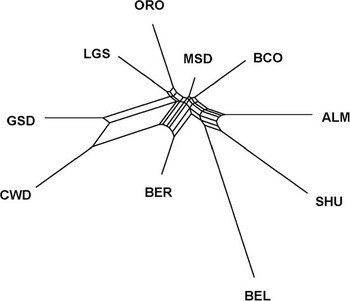
The software Splitstree version 4.11.3 (Huson and Bryant, Reference Huson and Bryant2006) was used to draw a Neighbor-net starting from Reynolds’s genetic distances (D R).
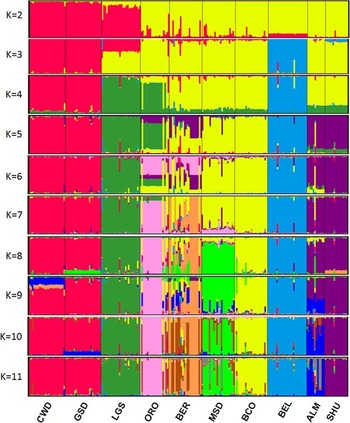
Dog genotypes were clustered using a Bayesian approach to infer populations by the Structure version 2.2 computer program (Pritchard et al., Reference Pritchard, Stephens and Donnelly2000; Falush et al., Reference Falush, Stephens and Pritchard2003). Using a model with admixture and correlated allele frequencies, we made 10 independent runs for each value of the putative number of subpopulations (K) between 1 and 20, with a burn-in period of 20 000 followed by 100 000 MCMC repetitions. The most likely number of clusters in our sample was determined using the method of Evanno et al. (Reference Evanno, Regnaut and Goudet2005). Clumpp (Jacobsson and Rosenberg, Reference Jakobsson and Rosenberg2007) was used to concatenate the data from the multiple runs for each K, and Distruct (Rosenberg, Reference Rosenberg2004) was used to graphically display the results.
To visualize the genetic structure of individuals, a principal coordinates analysis based on inter-individual genetic distance in GenAlex 6 (Peakall and Smouse, Reference Peakall and Smouse2006) was also conducted. Genetic distances were calculated as described in the GenAlex 6 guide for co-dominant data.
Results
A total number of 195 alleles were detected across the 18 microsatellite loci analyzed which were polymorphic in all the dog breeds. The average number of alleles per locus was 10.8 and the number of alleles ranged between 7 (INU055 and REN247M23) and 17 (REN169018).
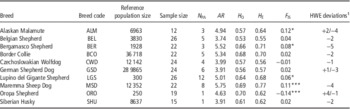
Observed (H O) and expected (H E) heterozygosities, allelic richness (AR), and F IS for each dog breed are presented in Table 1.
Basic information and genetic diversity parameters of 10 dog breeds

N PA=number of private alleles; AR=allelic richness; H E=expected heterozygosity; H O=observed heterozygosity; Fis=within-breed inbreeding coefficient; HWE deviations=number of loci departing from Hardy–Weinberg equilibrium expectations.
1 Negative and positive values indicate the number of loci showing heterozygote deficiency and excess, respectively.
*P<0.05; ***P<0.001.
Among the 10 dog breeds considered, the lowest value of AR was found in Belgian Shepherd (3.74) and the highest in Maremma Sheepdog Dog (5.75). Also for the microsatellite loci tested across populations, the lowest observed and expected heterozygosities were observed in the Belgian Shepherd, whereas the highest were found in the Maremma Sheepdog.
The HWE exact test revealed 31 significant deviations (17.2%) between expected (H E) and observed (H O) heterozygosity after Bonferroni correction. H O was significantly higher than H E in seven cases; in all other cases, H E was higher than H O.
The overall F IS value among all loci was significantly higher than zero, after Bonferroni correction, in five breeds (0.12 in the Alaskan Malamute, 0.08 in the Bergamasco Shepherd, 0.06 in Lupino del Gigante Shepherd, 0.10 in the Maremma Sheepdog and −0.14 in the Oropa Shepherd), indicating heterozygote deficiency in ALA, BER, LGS and MSD and a significant level of heterozygote excess in ORO.
Forty-eight private alleles were identified. At least one private allele was identified in each of the analyzed populations with the Lupino del Gigante Shepherd having the highest number of private alleles (N PA=12), while Oropa Shepherd and Siberian Husky have the lowest (N PA=1).
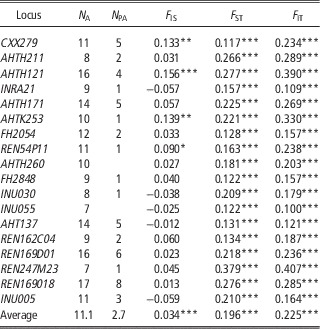
F statistics are shown in Table 2. Genetic differentiation among breeds was very significant: the average F ST values indicate that around 20% of the total genetic variation was explained by breed differences, with the remaining 80% corresponding to differences among individuals. Genetic differentiation among breeds was highly significant (P<0.001) for all loci. A significant excess of homozygotes across all breeds were found for CXX279, AHTK121, AHTK253 and REN54P11. On average, breeds had a 3.4% (P<0.001) deficit of heterozygotes, whereas the total population had a 22.5% (P<0.001) deficit of heterozygotes, although some of the markers showed heterozygosity excess (INRA21, INU030, INU055, INU005 and AHTH137).
Characterization of the 18 analysed microsatellite loci in 10 dog breeds

NA=number of alleles; N PA=number of private alleles; F IS and F IT are measurements of the deviation from Hardy–Weinberg proportions within populations and in the total population, respectively; F ST is the genetic differentiation over subpopulations.
*P<0.05; **P<0.01; ***P<0.001.
AMOVA revealed that 20% of the observed total variance occurred among varieties and among groups whereas 80% was explained by differences within individuals and among individuals within varieties (data not shown).
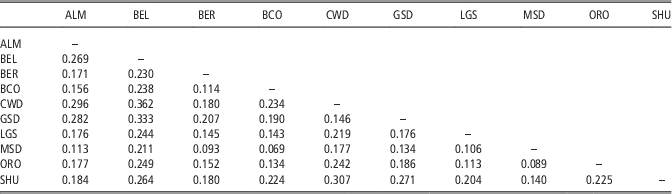
Pairwise F ST values correlate with cluster analyses, ranging from 0.069 between the Maremma Sheepdog and the Border Collie specimens to 0.362 between the Belgian Shepherd and the Czechoslovakian Wolfdogs (Table 3). All F ST values were significantly different from zero (P<0.001).
F ST estimatesFootnote 1 as a measure of genetic distance between dog breeds

BER=Bergamasco Shepherd; BEL=Belgian Shepherd; MSD=Maremma Sheepdog; SHU=Siberian Husky; ALM=Alaskan Malamute; CWD=Czechoslovakian Wolfdog; GSD=German Shepherd Dog; BCO=Border Collie; ORO=Oropa Shepherd; LGS=Lupino del Gigante Shepherd.
All pairwise F ST differences were significantly larger than 0 (P<0.001).
1 F ST estimates calculated as described in Weir and Cockerham (Reference Weir and Cockerham1984).
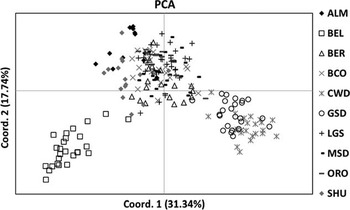
The principal coordinates analysis (Figure 1), both the first and the second axis, which accounted for 31.34.% and for 17.74% of the total variance, separated the Belgian Shepherd from the other dog breeds. The German Shepherd and the Czechoslovakian Wolfdog grouped together and are clearly separated from the other breeds. All the other breeds form a single big group in the center of the graph even if the Alaskan Malamute and the Siberian Husky form a subgroup.
Principal coordinates analysis plot for ten dog populations. BER=Bergamasco Shepherd; BEL=Belgian Shepherd; MSD=Maremma Sheepdog; SHU=Siberian Husky; ALM=Alaskan Malamute; CWD=Czechoslovakian Wolfdog; GSD=German Shepherd Dog; BCO=Border Collie; ORO=Oropa Shepherd; LGS=Lupino del Gigante Shepherd.

The Neighbor-net, reconstructed from Reynolds’s distances, is reported in Figure 2. The German Shepherd and the Czechoslovakian Wolfdog clearly clustered together. This result is expected on the basis of known CWD breed history, as this dog is a hybrid breed of German Shepherd Dog×Carpathian wolf founders (Randi et al., Reference Randi, Hulva, Fabbri, Galaverni, Galov, Kusak, Bigi, Bolfıkova, Smetanova and Caniglia2014). The two Italian breeds Lupino del Gigante Shepherd and Oropa Shepherd grouped together as well as the two breeds Maremma Sheepdog and the Border Collie. Another cluster is formed by the Alaskan Malamute and the Siberian Husky.
Neighbor-net based on Reynolds distance matrix between populations. BER=Bergamasco Shepherd; BEL=Belgian Shepherd; MSD=Maremma Sheepdog; SHU=Siberian Husky; ALM=Alaskan Malamute; CWD=Czechoslovakian Wolfdog; GSD=German Shepherd Dog; BCO=Border Collie; ORO=Oropa Shepherd; LGS=Lupino del Gigante Shepherd.

Clustering using Bayesian approaches was performed on the entire data set with an increasing number of inferred clusters from K=2 to 20 and produced consistent results (Figure 3). The software structure identified K=11 the most probable number of genetic clusters in our sample and the likelihood scores increased for each K up to K=11 (Ln=10 399.2).
Proportion of membership of 212 individuals from 10 dog populations for K=2 to 11, as calculated by Structure software. Multiple runs for each K were concatenated using clumpp, and distruct was used to generate images. BER=Bergamasco Shepherd; BEL=Belgian Shepherd; MSD=Maremma Sheepdog; SHU=Siberian Husky; ALM=Alaskan Malamute; CWD=Czechoslovakian Wolfdog; GSD=German Shepherd Dog; BCO=Border Collie; ORO=Oropa Shepherd; LGS=Lupino del Gigante Shepherd.

Assignment isolated the Belgian breed from the other breeds as early as three groups, and this group maintained its integrity through the analysis. At the same time, Czechoslovakian Wolfdog and German Shepherd shared the same cluster and only when K increased to 16 they separated in two distinct clusters (data not shown). For K=5, there was a clear separation of Alaskan Malamute and Siberian Husky from the other populations. When K increased to 6, the Lupino del Gigante Shepherd separated from the other clusters. When K became 7, Oropa Shepherd also formed a separated cluster, while only for K=8 Maremmano Sheepdog and Border Collie separated in two distinct clusters. As K increased to 10, Alaskan Malamute and Siberian Husky separated into single clusters, while Bergamasco Shepherd seems to be split in two different clusters.
Discussion
The 10 breeds considered in this study were clearly genetically differentiated from each other, regardless of current population sizes and the onset of separate breeding history (Table 2). Our results are in agreement with findings of previous studies based on larger number of breeds which showed that artificial selection and breed management have determined clear genetic distinctions among breeds (Parker et al., Reference Parker, Kim, Sutter, Carlson, Lorentzen, Malek, Johnson, DeFrance, Ostrander and Kruglyak2004 and Reference Parker, Kukekova, Akey, Goldstein, Kirkness, Baysac, Mosher, Aguirre, Acland and Ostrander2007). The among-breeds genetic diversity explained 20% of the total genetic variation, which is quite similar to the results of other dog studies, where values ranged from 18% to 27% (Irion et al., Reference Irion, Schaffer, Famula, Eggleston, Hughes and Pedersen2003; Koskinen, Reference Koskinen2003; Parker et al., Reference Parker, Kim, Sutter, Carlson, Lorentzen, Malek, Johnson, DeFrance, Ostrander and Kruglyak2004). The observed levels of differentiation among dog breeds are higher than values that were found in other domestic species like horses (11%), donkeys (11%), bovines (7%) and pigs (14%) (Canon et al., Reference Canon, Alexandrino, Bessa, Carleos, Carretero, Dunner, Ferran, Garcia, Jordana, Laloe, Pereira, Sanchez and Moazami-Goudarzi2001; Boitard et al., Reference Boitard, Chevalet, Mercat, Meriaux, Sanchez, Tibau and Sancristobal2010; Bigi and Perrotta, Reference Bigi and Perrotta2012; Colli et al., Reference Colli, Perrotta, Negrini, Bomba, Bigi, Zambonelli, Verini Supplizi, Liotta and Ajmone-Marsan2012). Most of the different pure-breed dogs are morphologically distinct and also differ in behavior and physical properties, so the higher level of differentiation in dogs is probably due to the lower utilization of crossbreeding in this species than with other species of domestic animals.
The level of heterozygosity found here (average H E=0.64 among dog breeds) is in agreement with that found by other studies (e.g. Irion et al., Reference Irion, Schaffer, Famula, Eggleston, Hughes and Pedersen2003, 0.39 to 0.76; Bjornerfeldt et al., Reference Bjornerfeldt, Hailer, Nord and Vila2008, 0.40 to 0.77). The native Italian breeds showed generally higher genetic diversity (H E ranging from 0.62 to 0.77) compared with the long established, well-defined cosmopolitan dog breeds. Ciampolini et al. (Reference Ciampolini, Cecchi, Bramante, Casetti and Presciuttini2011) found a similar H E value (0.63) in the Bracco Italiano breed. The main reason of these findings may be the highly variable gene pool for the Italian breeds and the intense artificial selection, inbreeding and low number of founders for cosmopolitan breeds. Moreover many cosmopolitan breeds, selected originally for performance are now bred mainly for conformation. As reported by Pedersen et al. (Reference Pedersen, Liu, Theilen and Sacks2013), selection for conformation induces high inbreeding, while selection for performance is more appropriate to maintain diversity. Performance traits are much less heritable than the phenotypic traits. Conformation characteristics such as size, coat color and body shape usually depend on single or small groups of genes and can be easily fixed by inbreeding. On the other hand, performance traits are genetically complex and heritability is highly variable depending on the particular trait.
The highest H E values and the highest AR were recorded in the Maremma Sheepdog, but then a significant (P<0.001) F IS indicated a certain level of inbreeding. MSD is characterized by a good number of puppies entered every year in the Italian Studbook (780; year 2013) with the presence of numerous breeding kennels, so the high level of H E in this breed could be due to population consistency and the considerable number of breeders. Also the Bergamasco Shepherd showed a significant (P<0.05) F IS value. A finding like this could have several explanations other than inbreeding, for example the inclusion of closely related individuals (although this influence was minimized by our sampling strategy), hidden population structure or the widespread use of a small number of preferred sires. Both the breeds, MSD and BER, are selected to obtain typical, show winning, specimens leading to an increase in inbreeding levels. Also the Lupino del Gigante Shepherd showed a moderate level of inbreeding probably due to the small population size. In contrast, the negative significant (P<0.001) F IS value found in Oropa Shepherd, in spite of the small population size, indicated in this breed an excess of heterozygosity, likely due to a documented crossbreeding with other shepherd breeds, in the last decades. Moreover ORO is characterized by a variegated area of origin being present on the plain, in the hills and in very high mountain valleys. It can herd both sheep and cows. These factors lead to slightly different morphological types with different genetic assets.
In several microsatellites, a total of 21 putative private alleles occurred only as a single allele in the whole population (alleles 143 and 157 in ATH137, alleles 80, alleles 114 and 116 in AHTH121, allele 239 in AHTH171, allele 99 in AHTH211, allele 300 in AHTK253, alleles 130 and 242 in CXX279, allele 248 in FH2848, allele 180 in FH2054, alleles 112 and 116 in INU005, allele 164 in INU030, allele 198 and 216 in REN162C04, alleles 156 and 178 in REN169018, allele 166 in REN169D01, allele 274 in REN247M23 and allele 224 in REN54P11). As the incidence of these alleles was so rare, it was not possible to rule out that their identification resulted from a sampling artifact.
The Lupino del Gigante Shepherd exhibited the highest number of private alleles (N PA=12) with a normal level of genetic diversity (as measured by H E and AR). The high differentiation of this dog population from other breeds is also confirmed by the early segregation in structure, which suggests strong effects of reproductive isolation in the history of the breed.
The Lupino del Gigante Shepherd and the Oropa Shepherd showed a common cluster in the Neighbor-net (Figure 2). The structure analyses partially confirmed this finding, as when K=4, 66% of the ORO and 94% of LGS individuals shared the same cluster. The morphological characteristics of these two breeds are similar and both breeds are utilized for the same purpose in two different but not distant geographic areas. A common origin of the two breeds seems probable as in the past, the traditional transhumance created many occasions of exchange between flocks coming from different areas. The Bergamasco Shepherd did not cluster with other breeds in the Neighbor-net, while in structure analysis, this breed is closer to the Oropa Shepherd, when K=6. A within-breed substructure was detected when K=10 as this breed split into two main groups. Both BER and ORO originated in the Alps where pasture areas for sheep are overlapping and so cross mating between breeds is clearly possible. Considering the reduced number of BER breeding kennels, the subgroups differentiation could be done with different foundation stocks and with continuous in-kennel selection, thus leading to genetic drift and differentiation. Despite the close resemblance of some Lupino Del Gigante specimens to spitz-like breeds, ALM and SHU do not show any close genetic relationship with this breed, neither does the CWD. The Maremma Sheepdog groups with the Border Collie in the Network (Figure 2) and also the results of the Bayesian approaches show a common cluster for these two breeds when K=6. MSD and BCO have different origins, are quite different morphologically and are also utilized for different purposes, as the MSD is a guard dog and the BCO is a herding dog. However this unexpected finding is in agreement with the results of another study (Parker et al., Reference Parker, Kukekova, Akey, Goldstein, Kirkness, Baysac, Mosher, Aguirre, Acland and Ostrander2007), that considered 132 different dog breeds, where the Border Collie clustered together with the Kuvasz. This last breed is a Hungarian dog, that is similar to the Maremma Sheepdog, it is utilized for the same purpose and may have a common ancestor, together with other European dogs, like Tatra from Poland, Sarplaninac from the Balkans and the Pyrenean Mountain Dog (Breber, Reference Breber1990). In general BCO seems closer to the Italian breeds than the other two cosmopolitan dogs considered here with the exception of LGS, which both in structure and in Neighbor-net analyses seems closer to GSD and to CWD. A possible utilization of BCO to improve working performance in Italian traditional working shepherd dogs cannot be ignored.
To conclude, the genetic characterization, in spite of the small population size, showed relatively high genetic diversity in Italian native shepherd dog breeds considered, which is important to maintain. Therefore, effective and proper breeding management schemes in these dog breeds will be advisable in order to avoid the excessive increase of inbreeding, thus avoiding in significant inbreeding depression and in significant loss of genetic variation. As these dog breeds have an active role in the sheep and cattle farminging practiced in mountainous disadvantaged area, it is important to preserve their breeding and diffusion.
Acknowledgments
Samples were provided by numerous dog breeders. The authors thank Cristian Lelli for the Lupino del Gigante and Dr Luca Sala and ‘Amici del Cane Pastore di Oropa’ Association for supplying the samples.