1. Introduction
Air traffic control (ATCo) is a safety-critical system, providing air traffic services and preventing planes from colliding with each other or other obstacles, protecting human lives, property and the environment (Manual of Air Traffic Services (MATS), 2018).
The necessity of prioritising flights, performing teamwork, managing frequent requests from pilots, dealing with high volume and changing air traffic, changing weather conditions, managing emergency landing situations and the need to perform calculations for the safe separation of aircraft are among the factors that will cause information overload, task complexity, time pressure and uncertainty (Li et al., Reference Li, Ng, Fan, Yuan, Liu and Bu2021; Manual of Air Traffic Services (MATS), 2018; Ng et al., Reference Ng, Lee, Chan, Chen and Qin2020; Rassokha, Reference Rassokha2020; Starita et al., Reference Starita, Strauss, Fei, Jovanović, Ivanov and Pavlović2020). Decision-making in such conditions will bring high perceived stress, which will affect the quality of decision-making (Phillips-Wren and Adya, Reference Phillips-Wren and Adya2020).
Decision-making is the process of creating preferences between options, choosing an action and performing it, experiencing the outcome and evaluating it (Ernst and Paulus, Reference Ernst and Paulus2005). Decision-making is a complex process that depends on the adequate performance of various cognitive, emotional and social factors, including working memory capacity, emotional intelligence, information processing discoveries and emotions, as well as external factors such as the quality of information related to the current decision (Bossaerts and Murawski, Reference Bossaerts and Murawski2017; Flouri et al., Reference Flouri, Moulton and Ploubidis2019; Vyatkin et al., Reference Vyatkin, Fomina and Shmeleva2019; Woodrow et al., Reference Woodrow, Sparks, Bobrovskaia, Paterson, Murphy and Hutton2019). A type of decision that is made in conditions dependent on previous decisions, under time constraints and in a changing environment where a person needs to update her or his mental model is called ‘dynamic decision-making’ (Brehmer, Reference Brehmer1992; Gonzalez et al., Reference Gonzalez, Fakhari and Busemeyer2017; Prezenski et al., Reference Prezenski, Brechmann, Wolff and Russwinkel2017). Dynamic decision-making in aviation involves solving complex problems in a dynamic environment characterised by conflicting goals and time constraints (Rosa et al., Reference Rosa, Dahlstrom, Knez, Ljung, Cameron and Willander2021). In such a situation, due to insufficient access to knowledge about a situation that needs action or resolution, the person must rely on statistics and probabilities and, as a result, take risks.
Stress affects people’s risk perception and decision-making strategies (Phillips-Wren and Adya, Reference Phillips-Wren and Adya2020). On the one hand, stress occupies a person’s cognitive resources. On the other hand, by unbalancing people’s psychological needs, stress increases the chances of seeking rewards and causes people to overestimate the positive results of risky options and underestimate the probability of occurrence of perceived negative consequences (Zhong et al., Reference Zhong, Liu, An, Li and Zhou2022; Zilker, Reference Zilker2022).
Zhang et al. (Reference Zhang, Yuan, Zhao and Bai2019) found situational stress in air traffic control (ATCo) increases control errors. Similarly, Rodrigues et al. (Reference Rodrigues, Paiva, Dias, Aleixo, Filipe and Cunha2018), in order to better understand the effect of stress on cognitive performance in ATCo, concluded that even though the participants’ reaction times were slower, their accuracy dropped off significantly, and they made more mistakes after executing the acute stress event. Studies have shown that risk-taking decisions can be influenced by experience. Inexperienced pilots had a relatively stronger intention to take risks that did experienced pilots and a more favourable attitude towards risky behaviour (He et al., Reference He, Nie, Zhou, Yang and Wu2023).
The Cambridge Gambling Task (CGT) is a popular neurocognitive task used to assess indicators related to decision-making and risk-taking in clinical and healthy populations (Flouri et al., Reference Flouri, Ji and Roiser2022; Nisticò et al., Reference Nisticò, De Angelis, Erro, Demartini and Ricciardi2021; Perrain et al., Reference Perrain, Dardennes and Jollant2021; Romeu et al., Reference Romeu, Haines, Ahn, Busemeyer and Vassileva2020; Woodrow et al., Reference Woodrow, Sparks, Bobrovskaia, Paterson, Murphy and Hutton2019). Studies have shown that there is a correlation between the neurobiological activity of different brain regions and decision-making stages during CGT. Yazdi et al. (Reference Yazdi, Rumetshofer, Gnauer, Csillag, Rosenleitner and Kleiser2019) found that during the decision-making process, when the participants bet on the majority choice, activity increased in brain areas involved in decision-making, working memory and learning. They also observed brain activation in parts of the reward system and regions involved in decision-making and impulse control during the outcome phase when participants were winning. Conversely, activation increased in regions involved in risk aversion and managing uncertainties when losing.
Harman et al. (Reference Harman, Zhang and Greening2019) reviewed the basic processes of dynamic decision-making in the police profession. They observed the dynamic accumulation of evidence in the decision to shoot or not to shoot by the police, the impact of previous decisions and experiences on current choices, and the impact of cognitive and neural processing of fear on decisions and decision errors.
According to our knowledge, no study has been conducted to evaluate different characteristics related to decision-making and risk-taking behaviour in people working in aviation. Due to the importance of examining decision-making features and risk-taking, a group of air traffic controllers and a group of technical engineers participated in this research to perform the CGT. This study was conducted to answer four questions: (1) What is the quality of decision-making and risk-taking among air traffic controllers and technical engineers? (2) Is the performance of air traffic controllers in CGT related to different ratings, including ground and tower, approach and radar? (3) Is the performance of air traffic controllers different from that of technical engineers in CGT? (4) Are age and work experience related to the indicators of decision-making quality and risk-taking in CGT?
2. Method
2.1. Participants and test conditions
This study was part of a larger one that followed the independent research questions described in Section 1. In this study, participants were divided into three groups to compare the decision-making quality and risk-taking behaviour in different subsets of aviation employees – technical engineers and two distinct types of air traffic controllers; 16 technical engineers, 12 air traffic controllers with ground and tower ratings and 27 air traffic controllers with radar and approach ratings participated in a cross-sectional analytical-descriptive study with a stratified sampling method. ATCo were divided into two separate groups due to differences in their rating and job roles: ground & tower and radar & approach. This division allows for a deeper understanding of how various responsibilities in the aviation field might influence decision-making under uncertainty. We can explore whether specific job responsibilities and contexts influence performance by examining the decision-making quality and related indicators across these distinct job roles. All the participants were male and were at relatively the same level in terms of organisational status, education and income. After providing oral explanations and instructions on how to perform the test, the subjects participated in the study by giving their oral informed consent at a convenient time that did not interfere with their job duties and in coordination with their supervisor.
Computer tests were performed in the same environmental conditions (including temperature, lighting and background noise) for all the participants in one of the airport rooms. All the participants used a single computer to perform the tests. In this study, an ASUSTeK Computer Inc. model S300CA touch laptop with dimensions of 16.4 × 6.4 inches was used.
Active psychiatric disease, taking psychiatric drugs, uncontrolled hormonal problems such as diabetes and thyroid, work experience of less than one year, and insufficient sleep the night before the test were considered exclusion criteria.
2.2. Computer tests
The CGT was used to assess impulse control and risk-taking in decision-making. The CGT allows for the assessment of several key aspects of decision-making, including risk-taking, deliberation time, and risk adjustment, all of which are relevant in high-stakes environments such as air traffic control and aviation maintenance. Despite being primarily used in clinical settings, CGT has been adapted to assess decision-making in healthy populations and has shown promising results in contexts that require quick, accurate decisions under pressure. The CGT is a computerised task that presents participants with a series of trials in which they must choose between two colours, one with a higher probability of containing a hidden token and one with a lower probability. CGT is specifically designed to assess decision-making under uncertainty. While the probability of the token being hidden behind the majority colour is higher, it is not guaranteed. Participants face a trade-off between choosing the more likely option (majority colour) with a lower pay-out, and selecting the less likely option (minority colour) with a potentially higher reward. This decision-making process under risk is central to the assessment of impulsivity and risk-taking behaviour. For example, when a person is presented with a ratio of 9:1 (9 red and 1 blue, or vice versa), the person must choose whether the yellow token is likely to be under the red or blue boxes. Therefore, due to the higher probability of the yellow token being behind the more numerous numbered boxes, after the initial selection of the blue or red option, a person bets a higher amount of their stock box’s assets on their initial selection. And if this ratio is 5:5, the person bets a smaller amount of stock fund assets. A person’s performance is related to the law of probabilities and the result of their performance in previous trials in choosing the blue or red option, because in the CGT, there is not always a yellow token under the boxes with the dominant colour.
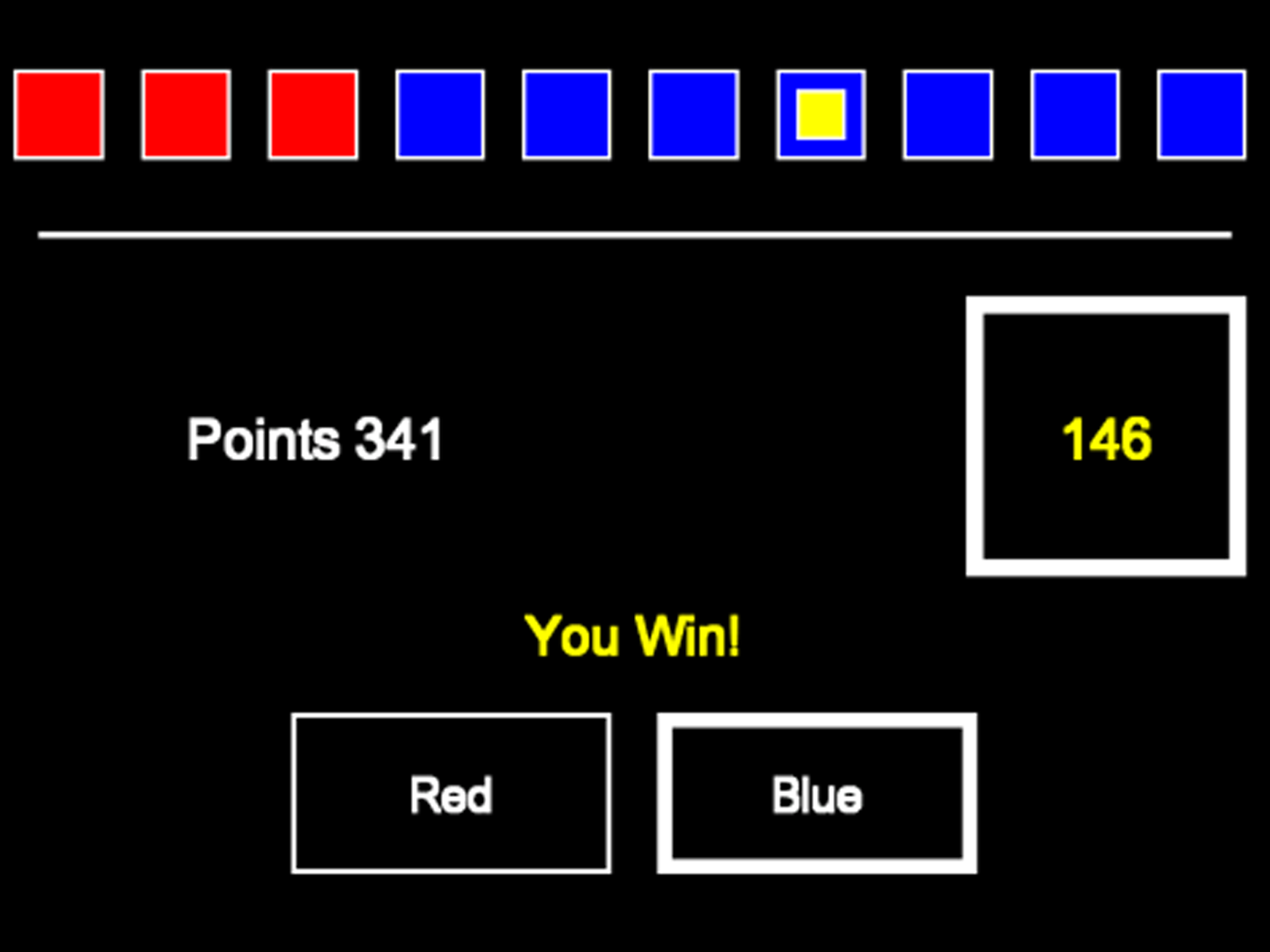
Each trial consists of two stages. In the first stage, participants see a row of 10 coloured boxes, some red and some blue (Figure 1). The number of red and blue boxes varies across trials, but the total number remains 10. A yellow token is hidden behind one of the boxes, and its location changes between trials. Participants must decide whether they believe the token is hidden behind the majority colour (e.g. red if there are more red boxes) or the minority colour (e.g. blue if there are more red boxes).
An example of effort in the GCT test. After successfully betting on the blue box, the subject has just scored 146 points and now has 341 points.

This design creates a decision-making conflict. While choosing the majority colour offers a higher chance of being correct, the potential reward might be lower. Conversely, choosing the minority colour carries a greater risk but offers the possibility of a higher pay-out. This trade-off between potential rewards and probabilities of winning is a crucial aspect of the CGT and is central to assessing impulsivity and risk-taking behaviour.
In the second stage, participants wager a portion of their points on their chosen colour. After selecting red or blue, they are presented with five different participants’ points, funds equalling 5%, 25%, 50%, 75% or 95% of their current points. These options are displayed in either ascending or descending order (similar to number 146 in Figure 1). Participants can choose any one of these percentages to wager on their colour selection. If their chosen colour conceals the token, they win points equal to the wagered percentage. Conversely, if their chosen colour is incorrect, they lose points equal to the wagered percentage.
The CGT test lasts approximately 23 minutes, although this can vary slightly depending on the participant’s decision speed. Six key outcome measures are derived from the CGT to assess different aspects of decision-making under uncertainty. These measures are:
-
1. Quality of decision-making: This measure is calculated as the proportion of trials where participants gambled on the colour with more boxes (a more likely outcome). A higher score indicates better decision-making, as it reflects consistent choices with a higher probability of being correct.
-
2. Deliberation time: This measure is the average time taken from the presentation of the coloured boxes to the participant’s choice of which colour to bet on the existence of a yellow token behind it. The lower the score, the faster the decision.
-
3. Risk adjustment: A tendency to bet a higher proportion of the fund’s points when one sees a greater chance of winning. The measure of risk adjustment shows the tendency to bet a higher proportion of one’s stock box points. The CGT Risk Adjustment score assesses how participants adjust their wagers based on their perceived chance of winning. In simpler terms, it measures how much more they bet when they are very likely to win (indicated by a larger majority of their chosen colour among the boxes).
Formula:
CGT risk adjustment = [(2 * Risk_9 boxes) + Risk_8 boxes - Risk_7 boxes - (2 * Risk_6 boxes)] overall risk
where:
Risk_X boxes: Average proportion of points risked on trials with X out of 10 boxes matching the chosen colour (e.g. Risk_9boxes is the average risk for trials with 9 matching boxes).
-
4. Overall risk: Average proportion of points risked across all trials used in the calculation (excluding practice trials). This is a complex measure to interpret. Higher scores show greater sensitivity to the probability of winning. This is not necessarily ‘better’ in terms of utility, as both the expected value of the overall score and the chance of losing all points increase with the proportion risked.
-
5. Delay aversion: When the possible bet amounts are presented in descending order, subjects who are unable or unwilling to wait will bet larger amounts than when the amounts are presented in ascending order. Choosing the share percentage of the initial offers in ascending and descending mode and not waiting for the next suggested percentages is considered a form of delay aversion, which is calculated by subtracting the risk-taking index in the ascending mode from the descending mode. Delay aversion is calculated by subtracting the risk-taking index in the ascending mode from the descending mode. A higher number indicates a greater dislike of delay.
-
6. Overall proportion bet: This score reflects how much, on average, of total current points (using a nominal percentage between 5% and 95%) participants are willing to risk out of their total points during each actual gambling trial. It considers all trials, including those where they: bet on the less likely colour (potentially higher reward but lower chance of winning) and bet on a colour with an equal chance of winning as the other option. A lower score indicates participants tend to wager a smaller portion of their points overall, suggesting more self-control in their betting behaviour.
2.3. Statistical analysis
The Kolmogorov–Smirnov test, skewness and kurtosis showed that quantitative variables, except the decision-making quality variable, have a normal distribution. The mean and standard deviation were used to describe quantitative data. The t-test and paired t-test were used to check the average in the two groups and compare the average in the ascending and descending modes of the CGT test. ANOVA and Kruskal–Wallis tests were used to compare the means in the studied groups. Statistical analysis was performed using SPSS version 20 software at a significance level of 0.05.
3. Results
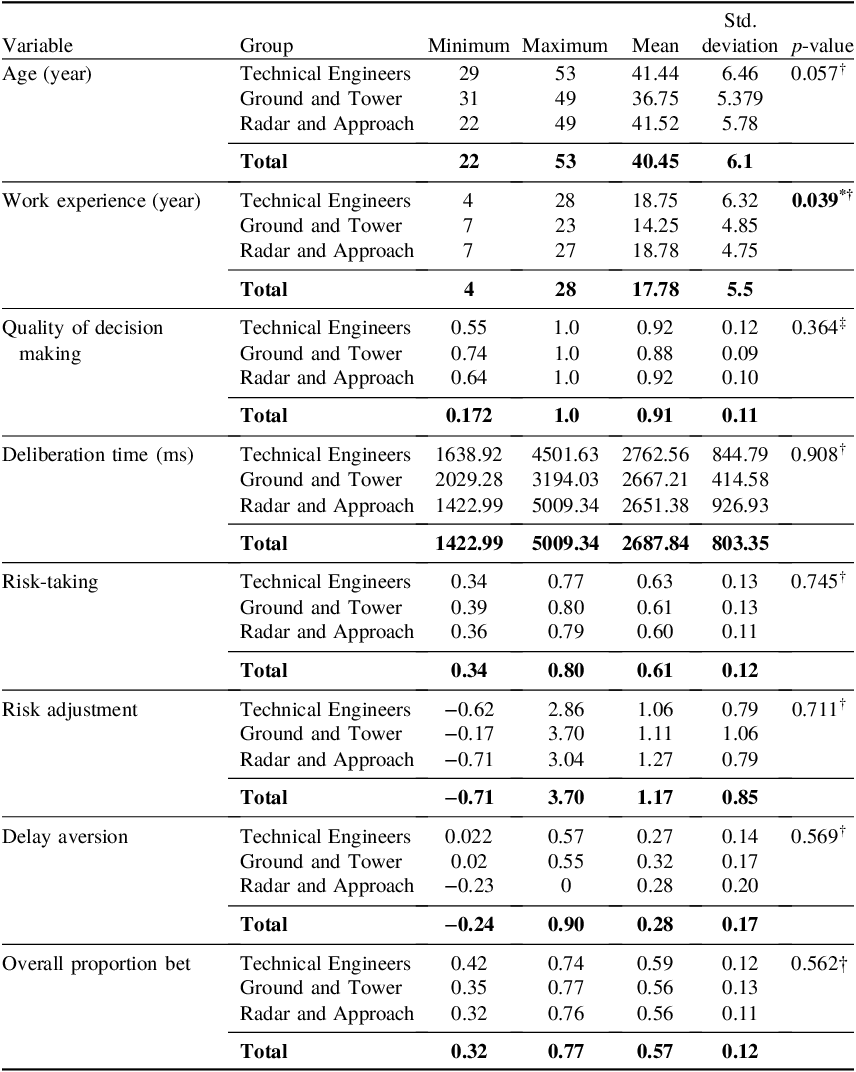
Fifty-five male air traffic controllers and technical engineers, with a mean age of 40.45 and work experience of 17.71 years, participated in this study. As seen in Table 1, the decision-making quality of the participants ranged from 0.55 to 1, indicating a variation in their ability to consistently choose the higher probability outcome in the task. The minimum and maximum average time for choosing between red and blue colours in the first stage of decision-making were 1,422 and 5,009 m/s, respectively. This suggests a wide range of individual differences in decision-making speed among the participants. The risk-taking index of the participants was between 0.34 and 0.80, reflecting varying levels of willingness to take risks in the task. The minimum and maximum risk adjustment indexes for aviation employees were between −0.71 and 3.70. This highlights the substantial variation in how participants adjusted their wagers based on the perceived probability of winning. The delay aversion index, which indicates choosing more values for betting in the ascending state than in the descending state, was between −0.2 and 0.9. This suggests a range of individual preferences for betting strategies in the task. A lower overall proportion bet, which indicates more self-control, was between 0.32 and 0.77 among the participants. This reflects varying degrees of caution and risk-aversion in betting behaviour. Statistical tests comparing the means in the three studied groups did not show any significant difference except in the work experience variable (Table 1).
Comparison of average demographic variables and CGT test in the studied groups (N = 55)

†One-way ANOVA ‡ Kruskal–Wallis Test.
Based on Table 1, no significant differences were observed in the performance of CGT task specialists among the studied groups, including the technical engineers, ground & tower, and radar & approach groups. A Tukey post-hoc test was conducted to compare the mean work experience across three groups. The results showed that there was a significant difference in mean work experience between the office and ground & tower groups (p = 0.074), and between the ground & tower and radar & approach groups (p = 0.043). However, the difference between the office and radar & approach groups was not significant (p = 1.000). The lack of significant findings supports the conclusion that the performance on the CGT task is not influenced by role differences within the aviation industry. However, future studies with larger and more balanced sample sizes would be beneficial for a more comprehensive understanding of how specific roles impact decision-making quality.
3.1. Quality of decision-making
According to Table 1, all three groups participating in the study had no significant difference in the decision-making quality index. Next, the analysis was performed at the level of decision-making quality sub-indices according to the ratio of dominant to non-dominant colours.
In this study (as seen in Figure 2), in all three groups, the greater the ratio of dominant to non-dominant colour in the colour combination of 10 boxes (e.g. 9:1 or 8:2), the higher the quality of the decision-making. And as this ratio decreases (e.g. from 6:4 to 5:5), choosing the colour of the box containing the yellow token in the test has become more difficult, and the quality of decision-making has decreased (Figure 2).
The quality index of decision-making in the ratio of dominant to non-dominant colour in each trial in the three studied groups (e.g. the ratio of 9:1 means 9 boxes in blue or red colour, and 1 box corresponds to another complementary colour).

The performance of all three groups together, according to the Kruskal–Wallis test, in each of the 9:1, 8:2, 7:3 and 6:4 conditions, was not statistically significantly different. Repeated one-way ANOVA tests showed a significant difference in decision-making quality in four ratios measured within the tower and ground groups (p = 0.021).
3.2. Deliberation time
No significant difference was observed between the studied groups in terms of deliberation time (Table 1 and Figure 3c). However, in the performance of all participants in the study, regardless of job grouping, deliberation time in all investigated ratios (9:1, 8:2, 7:3, 6:4 and 5:5) based on the t-test showed a significant difference in the ascending and descending modes. In other words, people in all colour ratios of red and blue boxes spent more time thinking in the ascending mode than in the descending mode.
The deliberation time of the studied groups in deciding to choose a red or blue colour in different proportions of red and blue colour: (a) ascending mode (respectively, 5%, 25%, 50%, 75% and 95% of the balance of the stock box are presented to the person so that the person can bet on the selected colour in each trial); (b) descending mode (respectively, 95%, 75%, 50%, 25% and 5% of the balance of the stock box are presented to the person so that the person can bet on the selected colour in each trial); and (c) overall mode.

Based on the paired t-test, the deliberation time in the ratio of 9:1 in ascending and descending mode was significantly shorter than the reflection time in the ratio of 5:5 and 6:4 (p < 0.0001). According to the same test, deliberation time is in the ratio of 8:2, with a ratio of 5:5. The 6:4 ratio was significantly higher in descending mode than the 5:5 ratio in ascending mode (p < 0.0001).
3.3. Risk-Taking
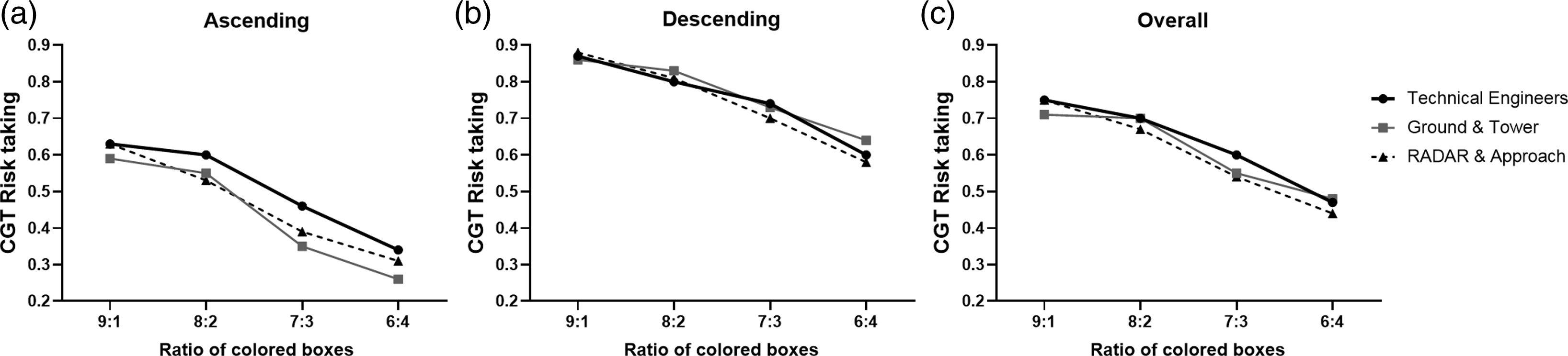
According to Figure 4, section C and Table 1, no significant difference was observed in the risk-taking of the studied groups. However, according to the paired t-test, people’s risk-taking in the descending mode was significantly higher than risk taking in the ascending mode (p < 0.05) (Figure 4, part a, b).
Risk-taking of the participants in: (a) ascending mode; (b) descending mode and (c) overall mode in different studied groups, according to the ratio of the dominant colour in the boxes to the non-dominant colour.

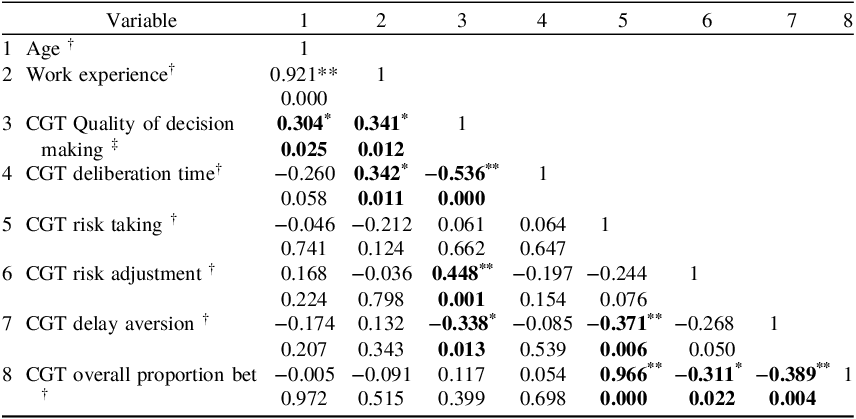
According to the statistical test of Spearman’s correlation, the quality of decision-making had a statistically significant relationship with age and work experience, so the quality of decision-making increased with increasing age and work experience (respectively, r = 0.304* p = 0.025 and r = 0.341* p = 0.012). Also, decision-making quality had a statistically significant and positive relationship with risk adjustment (r = 0.448, p = 0.001). The quality of decision-making had a statistically significant and inverse relationship with deliberation time and delay aversion (respectively, r = −0.536** p = 0.001 and r = −0.338* p = 0.013), Thus, less deliberation time and lower delay aversion resulted in a higher quality of decision-making (Table 2).
Correlation of CGT test indicators together and with age and work experience (N = 55)

**. Correlation is significant at the 0.01 level (2-tailed).
† Pearson correlation.
*. Correlation is significant at the 0.05 level (2-tailed).
‡ Spearman correlation.
According to Pearson’s correlation test, risk-taking with a lower overall proportion bet, which indicates higher self-control, had a statistically significant positive relationship (r = 0.966** p = 0.0001) and an inversely significant relationship with delay aversion (r = −0.371** p = 0.006).
According to Pearson’s correlation test, a lower overall proportion bet, which indicates higher self-control, had a statistically significant and inverse relationship with risk adjustment (indicating greater sensitivity to the probability of winning) and delay aversion (respectively, r = −0.311* p = 0.022 and r = −0.389* p = 0.004) (Table 2).
4. Discussion
This study was conducted to investigate indicators related to decision-making with aviation employees. The quality of decision-making increased with advancing age and work experience. Higher risk adjustment (more sensitivity to the probability of winning), less deliberation time (in choosing between red and blue) and a lower delay aversion index (postponement in choosing the recommended percentage of the stock box for betting) resulted in better decision quality. People with a higher ratio of dominant to non-dominant colour had a higher quality of decision-making, which was obvious and expected according to the law of probabilities. In addition, no significant difference was observed in terms of six indicators of decision-making quality and risk-taking among the three studied groups of aviation employees.
A higher risk adjustment means choosing a higher percentage of the stock box’s assets to bet on the initial choice between the red and blue options. Therefore, in CGT, uncertainty is presented to the participants, which is related to the nature of jobs related to critical safety systems, including aviation. In our study, decision-making quality was associated with higher risk adjustment. In Kale et al.’s (Reference Kale, Kay and Hullman2019) study, it was stated that people who had higher decision-making competence often made good choices, adjusted decision-making according to the level of risk and avoided impulsive action (Kale et al., date). Therefore, the ability to adjust risk can be a key indicator in the screening of aviation employees and similar jobs.
The speed in deciding between options is one of the requirements of decision-making quality for safe and efficient work in ATCo. Many factors, such as experience, age, training, boredom, time pressures, volume and complexity of air traffic, affect the decision-making process (Rassokha, Reference Rassokha2020). In Kale et al.’s study (Reference Kale, Alharasees, Rohacs and Rohacs2023), a less-skilled pilot needed approximately four times more time to decide whether to land or go around during the final approach compared to a more experienced pilot. In the present study, less deliberation time was related to the quality of decision-making. The average deliberation time in our study was 2687.84 milliseconds, and in the control group of Muhlert et al.’s study (Reference Muhlert, Sethi, Cipolotti, Haroon, Parker and Yousry2015), it was 2782.84 milliseconds. It seems that the performance of people in the aviation industry is similar to that of the general population. The average deliberation time in the ATCo occupation was slightly less than that of aeronautical engineers, although this difference was not significant. It seems that the trade-off between speed and accuracy in the processes requiring dynamic and fast decision-making in aviation strengthened this performance in our study participants.
In the present study, the rate of the delay aversion index was 0.28. A higher value of this index is worse and indicates a higher delay aversion. Although there was no significant difference between the occupational groups, this rate was 0.32 in the ground and tower group, 0.27 in the radar and approach group, and 0.28 in the aviation technical engineer group. While shorter thinking time or higher reaction speed were associated with higher decision quality, scoring higher on the delay aversion index – which indicates a lack of procrastination and impatience to be offered the next percentage of the stock fund to bet on – was associated with lower decision quality. Therefore, in addition to the need for a high speed of action, the postponement of available primary choices can be considered an important indicator related to the speed–accuracy trade-off (Donkin et al., Reference Donkin, Little and Houpt2014).
Establishing a balance between the optimal speed of action and the lack of haste and impulsivity in the decision-making process can be influenced by the decision-making style, regret avoidance, conservatism, perceptual errors of knowledge and cognitive preparation, emotions, and the information analysis process, as well as the place and time of the activity that requires decision-making (Rezaian et al., Reference Rezaian, Kharrazi, Jamali and Naderi2019). The speed–accuracy trade-off in decisions in aviation jobs, including ATCo, with very high process speeds and very critical decisions, can have special importance in the selection of employees.
People’s risk-taking was higher in the descending mode than in the ascending mode. This finding emphasises that in all red and blue colour ratios (9:1, 8:2, 7:3, 6:5 and 5:5), when the values for betting on the initial choice of a red or blue option are presented to participants in the descending mode (from 95% to 5%), people accept more risk compared to the ascending mode (from 5% to 95%).
The complementary index of risk-taking in the ascending and descending modes is the index of delay aversion, which is related to this finding in such a way that the delay aversion does not postpone the choice in the descending mode and the person makes a choice from initially suggested higher bet percentages, and therefore risk-taking when the speed of action together with delay aversion causes the choice of available options, even though the risk is higher.
Risk-taking had a statistically significant positive relationship with a lower overall proportion bet, which indicates higher self-control. In other words, people who had higher self-control took significantly more risks. At first, this finding seemed contrary to expectations because self-control is expected to reduce risk-taking. It seems that it can be said that higher risk-taking does not necessarily indicate lower self-control because, in practice, people with higher cognitive abilities may have high risk-taking while having high self-control. Perhaps this issue is related to the nature of aviation jobs and the inevitable acceptance of higher risk because the need to be quick in making decisions leads to less deliberation time and delay aversion in the decision-making process, so accepting higher risk can be influenced by other indicators, such as the necessity of speed in decision-making rather than just lower self-control. This finding is in line with the study of Palmen et al. (Reference Palmen, Derksen and Kolthoff2020). They stated that although the traits of high self-control and high impulsivity are contradictory, combining high self-control with a specific domain of impulsivity can further enhance success in leadership.
Also, in the study of Ebrahim et al. (Reference Ebrahim, Molesworth and Rantz2022) to compare the risk preference of pilots with the general population, it was stated that pilots have a higher risk preference than the general population. However, this risk was moderated by the personality factor of self-control.
In the present study, the overall proportion bet (lower values mean more self-control) had an inversely significant relationship with risk adjustment (a tendency to bet a higher percentage of the stock box when the odds are in the participant’s favour). In other words, higher self-control causes a more severe and stricter risk adjustment. Therefore, with less self-control, decisions have a higher risk, so people choose higher percentages of the stock box for betting. And when self-control increases, risk adjustment is affected, so self-control does not allow choosing a higher percentage of the stock box’s assets, even in the case where there is a higher probability of winning. In similar studies, this finding confirmed that self-control had a significant negative relationship with risk-taking and risk preference. (Wang et al., Reference Wang, Chen, Zhang, Xu, Zhang and Suo2019; Sekścińska et al., Reference Sekścińska, Rudzinska-Wojciechowska and Jaworska2021).
Age-related abilities, including sensory abilities and some cognitive abilities, such as memory, processing speed and reasoning, are known predictors of a person’s decision-making performance, and their reduction will reduce decision-making competence (Del Missier et al., Reference Del Missier, Hansson, Parker, Bruine de Bruin, Nilsson and Mäntylä2017; Zakirov and Krasilnikov, Reference Zakirov and Krasilnikov2020). Research has shown that the relationship between age and competence and quality of decision-making is not only affected by fluid intelligence but can also be affected by the possible cognitive deterioration caused by aging, experiences (or crystallised intelligence), and the regulation of a person’s emotions and motivations (Li et al., Reference Li, Baldassi, Johnson and Weber2013; Tamir et al., Reference Tamir, Bigman, Rhodes, Salerno and Schreier2015; Bruine de Bruin et al., Reference Bruine de Bruin, Parker and Fischhoff2020). But this is not a general and fixed rule. Although cognitive decline and fluid intelligence decrease with age, older people may maintain decision-making ability by improving other age-related skills (Zakirov and Krasilnikov, Reference Zakirov and Krasilnikov2020; Bruine de Bruin et al., Reference Bruine de Bruin, Parker and Fischhoff2020). In the present study, the quality of decision-making increased with advancing age. Since the average age of the participants in our study is 40.45 years, with a maximum age of 53 years, this result seems to be expected; as in the previous studies, the general increase in indicators related to decision-making competence was indicated up to the age of 55 years (Bruine de Bruin et al., Reference Bruine de Bruin, Parker and Fischhoff2020). In the study of Eberhardt et al. (Reference Eberhardt, Bruine de Bruin and Strough2019) which was conducted to investigate age differences in financial decisions, the researchers stated that older age was associated with better scores in each of the four financial decision-making criteria.
Also, in the present study, work history had a positive and significant correlation with the quality of decision-making. Since age and work experience have a high correlation, the reason for the correlation of work experience with the quality of decision-making can be affected by increasing age. Studies have pointed out the positive relationship between work experience and the judgment of inspectors, so that experience on the job causes the removal of irrelevant information, and as a result, work experience has a positive effect on the quality of decision-making (Aida, Reference Aida2021).
5. Conclusion
The quality of decision-making, risk-taking and risk adjustment in time constraints and conditions of uncertainty are among the most important issues related to critical safety systems jobs, including aviation and air traffic control. This study investigated the decision-making quality and risk-taking behaviour among aviation employees. Our findings suggest that better decision-making quality was associated with higher risk adjustment, shorter deliberation time and a lower delay aversion index. Importantly, increased risk-taking does not inherently indicate reduced self-control. Regardless of role – whether air traffic controllers or technical engineers – there were no significant differences in decision-making performance across the groups. The study also found that decision-making quality improves with age and work experience, which has important implications for training and selection processes. The CGT proved to be an effective tool for assessing key decision-making indicators under uncertainty, demonstrating its relevance in aviation settings.
6. Limitations and future research
While this study uniquely focused on occupational decision-making within critical safety systems, unlike prior research that primarily measured decision-making indicators in the medical field, it employed a cross-sectional design with stratified sampling. This design has a limitation: the average age within one stratum may differ significantly from others, potentially impacting the results due to the inherent nature of cross-sectional studies and stratified sampling.
Future research could involve: (1) longitudinal studies to track decision-making changes over time; (2) specialised tasks for developing tasks that mirror real-world aviation decision-making scenarios with varying difficulty and uncertainty levels; and (3) training interventions for investigating the effectiveness of training programs in enhancing decision-making skills specific to aviation; (4) specialised tests for assessing risk-taking behaviour in aviation personnel to complement the findings of this research.
By addressing these limitations, future research can provide a more comprehensive understanding of decision-making in aviation and inform the development of improved selection and training practices.
Acknowledgements
This paper is the result of the PhD dissertation project of Mrs. Akram Sadat Jafari Roodbandi.
The authors would like to express special thanks to all the air traffic controllers at Shahid Dastghib International Airport in Shiraz, Iran, for participating in this research. Special thanks to Mr. Alireza Tayebi, Mr. Saeed Norouzi, Mr. Mohammad Dayani and Mr. Abdolazim Ghaderi.
Funding statement
The authors would like to thank the ethics committee of Shiraz University of Medical Sciences (No. 98-01-04-20275) for their financial support and approval. The authors would also like to thank the Dana Brain Health Institute; Iranian Neuroscience Society, Fars Branch, Shiraz, Iran for financial support.
Competing interests
The authors declare that this research was conducted in the absence of any commercial or financial relationships that could be interpreted as a potential conflict of interest.