Introduction
Age-related hearing loss is gradually progressive, highly prevalent, and associated with negative cognitive and physical health outcomes. Prevalence estimates range from 30% of individuals aged 65–74 years to more than 40%–60% of those 75 years or older (Lin et al., Reference Lin, Niparko and Ferrucci2011b). Further, many studies have shown associations between hearing loss and poor physical function, poor mental health (including increased rates of depression and anxiety), increased risk of falls, social isolation, caregiver burden, cognitive impairment, and mortality (Kay et al., Reference Kay, Roth and Beamish1964, Weinstein and Ventry, Reference Weinstein and Ventry1982, Bess et al., Reference Bess, Lichtenstein, Logan, Burger and Nelson1989, Mulrow et al., Reference Mulrow1990, Wallhagen et al., Reference Wallhagen, Strawbridge and Shema2008, Kuzuya and Hirakawa, Reference Kuzuya and Hirakawa2009, Karpa et al., Reference Karpa2010, Lin et al., Reference Lin, Metter, O'brien, Resnick, Zonderman and Ferrucci2011a, Gallacher et al., Reference Gallacher2012, Kiely et al., Reference Kiely, Gopinath, Mitchell, Luszcz and Anstey2012, Lin et al., Reference Lin2013, Mener et al., Reference Mener, Betz, Genther, Chen and Lin2013, Fisher et al., Reference Fisher2014; Gispen et al., Reference Gispen, Chen, Genther and Lin2014; Mick et al., Reference Mick, Kawachi and Lin2014). Similar to hearing loss, memory loss is also highly prevalent among older adults and associated with significant consequences for healthy aging (Alzheimer's Association, 2015). Moreover, the public health impact of declining cognitive function in older adults in USA is substantial with estimated annual costs of $226 billion (Alzheimer's Association, 2015).
A possible association between hearing loss and cognitive impairment was first reported by Kay and colleagues in 1964, suggesting that hearing loss was more common in older patients with dementia. Over the past two decades, there has been growing epidemiological evidence using case-control, cross-sectional, and longitudinal population-based studies demonstrating the independent association between hearing loss with impairment in cognitive domains as well as accelerated cognitive decline and higher incident dementia (Wallhagen et al., Reference Wallhagen, Strawbridge and Shema2008; Lin et al., Reference Lin, Metter, O'brien, Resnick, Zonderman and Ferrucci2011a; Gallacher et al., Reference Gallacher2012; Kiely et al., Reference Kiely, Gopinath, Mitchell, Luszcz and Anstey2012; Lin et al., Reference Lin2013). Importantly, beyond an association between hearing loss and cognitive impairment, there is evidence that undiagnosed and/or untreated hearing loss may exacerbate dementia-related behavioral symptoms and contribute to dementia diagnosis due to artificially severe symptoms (Kreeger et al., Reference Kreeger, Raulin, Grace and Priest1995; Palmer et al., Reference Palmer, Adams, Bourgeois, Durrant and Rossi1999). For example, a study of performance on the Mini-Mental State Examination (MMSE) in a group of young adults with simulated hearing loss resulted in poorer performance on MMSE with increased difficulty in audibility (Jorgensen et al., Reference Jorgensen, Palmer, Pratt, Erickson and Moncrieff2015). Moreover, in studies of older adults with and without hearing loss, there is evidence that untreated hearing loss, acutely affects performance on cognitive measures (MacDonald et al., Reference Macdonald, Joyson, Lee, Seymour and Soiza2012). As such, awareness of and correction for a person's hearing abilities is critical prior to undergoing standardized measures that contribute to a cognitive impairment diagnosis.
Despite many studies demonstrating its strong association, the prevalence of hearing loss among cognitively impaired older adults is relatively unknown. Gold et al. (Reference Gold, Lightfoot and Hnath-Chisolm1996) conducted a small case-control study highlighting the prevalence of hearing loss in a memory disorders clinic. Their study reported greater than 90% prevalence of hearing loss among older adults with dementia, which is far greater than age-matched estimates in the general population. Furthermore, they demonstrated an unreliability of self-reported hearing impairment in these patients, suggesting the need for hearing evaluation as part of assessment in cognitive function. A similar study by da Costa Lopes et al. (Reference Da Costa Lopes, Magaldi, Gândara, De Barros Reis and Jacob-Filho2007) compared hearing loss between individuals with mild cognitive impairment (MCI) and normal controls with audiometric testing, and showed higher prevalence of hearing loss among those with MCI compared to normal controls (31.8% and 10.5%, respectively). Notably, these studies are relatively small and use different criteria for labeling a person as hearing impaired.
Due to limited and inconsistent data, the goal of this study was to measure the prevalence of hearing loss in a convenience sample of patients across a range of cognitive function presenting to a tertiary care memory clinic. Furthermore, we investigated risk factors, characteristics of hearing loss, and utilization of hearing aids among this vulnerable population. Understanding the burden and prevalence of hearing loss in this patient population has the potential to improve clinical management plans for individuals and families experiencing memory disorders and age-related hearing loss.
Methods
This is an outpatient-based retrospective cross-sectional study performed in a tertiary teaching hospital. We collected data from medical records of patients seen at the Johns Hopkins Memory and Alzheimer's Treatment Center (Memory Clinic) who had audiometric hearing screening done as part of their routine clinic visit in two physicians’ clinics (EO, MN). Chart review of 133 consecutive patients who had hearing screening completed over a 12-month period from June 2014–June 2015 was conducted. If hearing screening was not performed, the reasons were abstracted from the records. All included individuals were English speaking and over the age of 50 years. All were clinically diagnosed with cognitive impairment. The study was approved by the Johns Hopkins Institutional Review Board.
Audiometric hearing screening was performed as part of the routine clinic visit and consisted of an otoscopic examination and air conduction threshold testing with a portable audiometer (Interacoustics AS608 Screening Audiometer; Denmark). Air conduction thresholds were obtained at octave frequencies from 0.5–8 kHz using a manual testing protocol and behavioral response to presented tones (i.e. hand raise). To ensure accuracy and improve reliability of the testing, the Memory Clinic team measured the threshold response at 1,000 Hz twice in each ear and results were only considered valid if the repeat threshold was within ±5 dB Hearing Level (HL) of the original threshold. Testing was performed in a quiet office using insert earphones. The ambient noise was measured per octave band in accordance with American National Standards Institute (ANSI) standards prior to selecting the most appropriate test environment. The ambient noise measures were well within acceptable permissible noise level values for insert threshold testing (ANSI S3.1-1999).
A speech-frequency pure tone average (PTA) of hearing thresholds at 0.5–4 kHz was calculated and a PTA of >25 dB HL in the better hearing ear was defined as hearing loss in accordance with the World Health Organization's definition of hearing impairment. The degree of hearing loss was defined as: mild (26–40 dB HL), moderate (41–70 dB HL), or severe (>70 dB HL).
In addition, demographic variables, relevant medical history, cognitive test score (MMSE), and hearing aid use data were obtained from chart review. Race/ethnicity was grouped as White, Black, Hispanic, Asian, American Indian, and Native Hawaiian. Variables related to medical history that were known as risks factors for hearing loss and cognitive impairment were recorded, including diabetes, hypertension, cerebrovascular disease, depression, and smoking history. Cognitive impairment was categorized as either MCI or dementia based on their clinical diagnosis in their medical chart. In order to have an adequate number of individuals in each category, different subtypes of dementias (e.g. Alzheimer's disease, vascular dementia, etc.) were grouped together.
Statistical methodology
Prevalence and degree of sensorineural hearing loss were determined using descriptive statistics. χ 2 tests were used to examine the association between categorical variables and analysis of variance (ANOVA) was used for continuous variables. Differences were considered significant if the p-value was less than 0.05. Ordinal logistic regression was performed to examine the associations of variables with the degree of hearing loss (normal, mild, and moderate/severe). All variables with p-values less than or equal to 0.05 were incorporated in the multivariable model. All analyses were conducted using STATA (StataCorp LP, College Station, TX).
Results
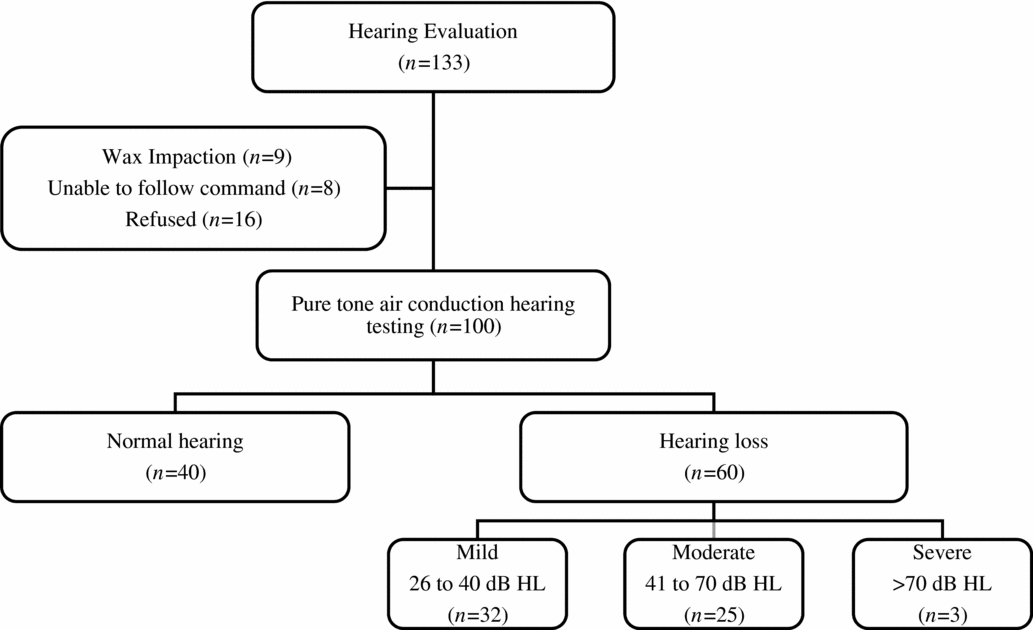
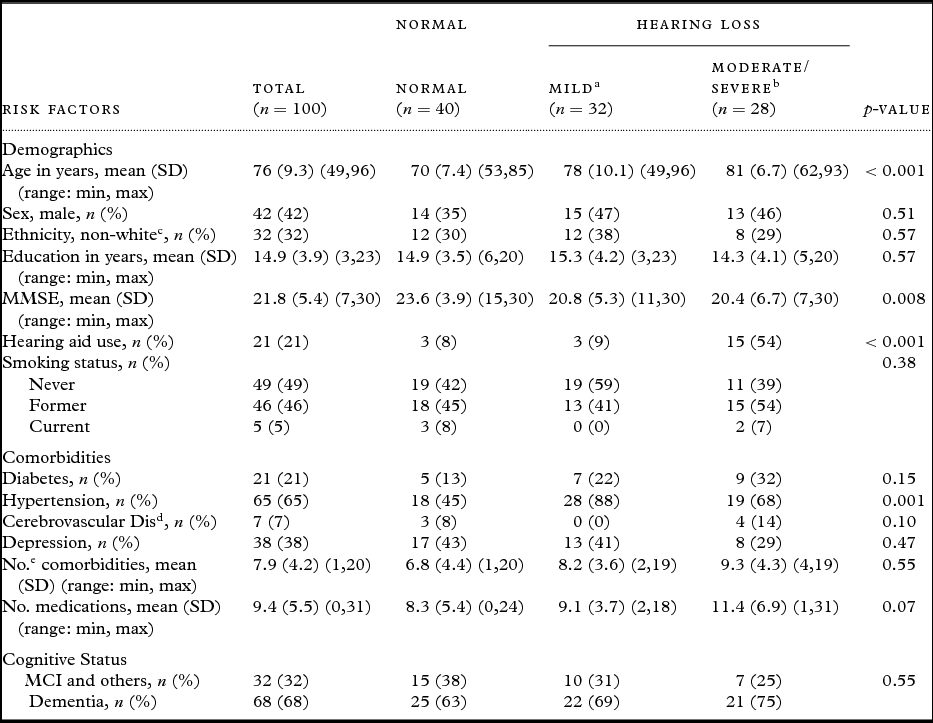
There were 133 patients whose charts reported that they had been offered an in-office hearing screening (Figure 1). Of those offered screening, 33 individuals did not have hearing results due to impacted cerumen (n = 9), an inability to follow instructions (n = 8), or patient refusal (n = 16). The average age of patients who received a hearing test was 76-years old (SD 9.3), 42% were male, and 32% were non-white (Table 1). The cognitive status of patients who completed the hearing test was categorized as MCI/other (32%) and dementia (68%). Other baseline characteristics and risk factors abstracted from the medical charts included average years of education (14.9, SD 3.9), hearing aid use (21%), smoking status (current/former = 51%), diabetes (21%), hypertension (65%), cerebrovascular disease (7%), depression (38%), average number of comorbidities (7.9, SD 4.2), and medications (9.4, SD 5.5). There were no statistical differences in baseline characteristics between individuals who completed hearing screening and those who did not except for MMSE. The average baseline MMSE was higher in those who completed hearing screening versus those who did not (21.83, SD 5.41 vs. 16.30, SD 8.42, p = 0.001).
Prevalence of hearing loss among cognitively impaired older adults in a memory clinic.

Baseline data of patients with audiology assessment

a Mild (26 to 40 dB).
b Moderate (41 to 70 dB), Severe (>70 dB).
c Black, Hispanic, and Asian and Pacific Islanders.
d Dis – disease.
eNo – Number.
The overall prevalence of hearing loss among the patients tested at the Memory Clinic (age range: 53–96 years) was 60%. Almost half of those with hearing loss had at least a moderate degree of hearing loss (Figure 1), which the WHO defines as a disabling hearing loss. Individuals with hearing loss were older and had lower MMSE scores (Table 1). In terms of comorbidities, the prevalence of hypertension was significantly different among groups with different degrees of hearing loss. Also, there was a trend toward significance in the number of medications taken between the groups.
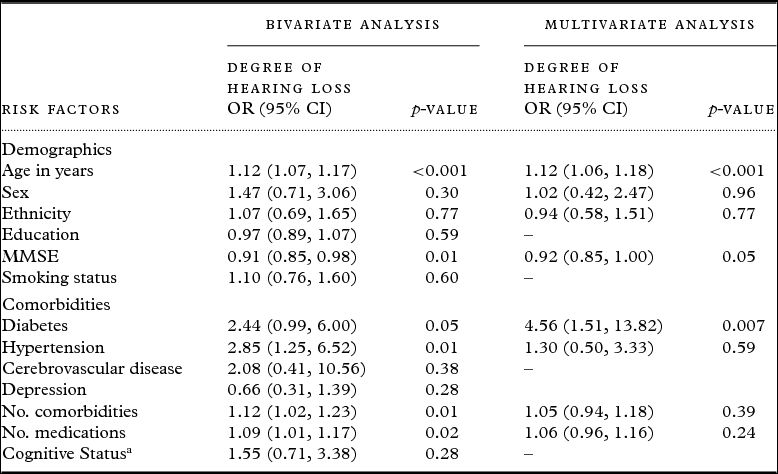
In bivariate analysis, age, MMSE, diabetes, hypertension, number of comorbidities, and number of medications were associated with degrees of hearing loss. However, only age, MMSE, and diabetes remained significant in multivariable analysis (Table 2).
The association of baseline risk factors and degree of hearing loss bivariate and multivariable analysis

a Cognitive Status: MCI and others, dementia.
Overall, hearing aid utilization among this sample of cognitively impaired older adults was low with less than 10% of the participants with mild hearing loss utilizing hearing aids. The number, however, increased substantially to greater than 50% in the more severely hearing impaired participants.
Discussion
In this sample of older adults with cognitive impairment, the prevalence of at least a mild hearing loss (>25 dB HL) in the better hearing ear was 60%, with almost half of those with hearing loss experiencing a moderate or worse (>40 dB HL) hearing loss, which is defined as disabling by the WHO. This result is consistent with high prevalence of hearing loss reported for older adults in the USA, as measured in a nationally representative sample (Lin et al., Reference Lin, Niparko and Ferrucci2011b). In contrast to a previous report on prevalence in a dementia-specific sample, our study showed considerably lower prevalence than the high estimate of >90% reported by Gold and colleagues (Reference Gold, Lightfoot and Hnath-Chisolm1996). This could be due, in part, to the different methodologies used to define hearing loss. In our study, a speech frequency PTA of hearing thresholds at 0.5–4 kHz was calculated and hearing loss was defined as PTA of >25 dB HL in the better hearing ear. Gold and colleagues used a single-frequency criteria, and failure to respond to a 40 dB HL pure tone at 1,000, 2,000, or 4,000 Hz in either ear was defined as hearing loss. Another difference could be due to test conditions; specifically, the current study used insert earphone testing and a standard audiometric threshold protocol, rather than single level screening audiometry. Taking an average across a range of frequencies, as done in the current study, will likely lead to a more clinically meaningful estimate of hearing loss than the single-frequency screening method used previously.
In contrast to previous studies indicating negative associations between cardiovascular risk and male sex with hearing loss (Gates et al., Reference Gates, Cobb, D'agostino and Wolf1993; Wallhagen et al., Reference Wallhagen, Strawbridge and Shema2008; Agrawal et al., Reference Agrawal, Platz and Niparko2009; Gallacher et al., Reference Gallacher2012; Kiely et al., Reference Kiely, Gopinath, Mitchell, Luszcz and Anstey2012; Lin et al., Reference Lin2013), we did not find those factors to be associated with hearing loss in this sample. Failure of our study to show such associations is possibly due to a relatively small sample size and lack of longitudinal data. Interestingly, bivariate and multivariable analyses showed an association between diabetes and hearing loss; although, due to the wide confidence interval, the data must be interpreted with caution. Among demographic variables and relevant medical history examined, age and MMSE were strongly associated with hearing loss.
It is estimated that less than 20% of adults with hearing loss use hearing aids (Chien and Lin, Reference Chien and Lin2012), despite studies indicating that hearing aid use can provide substantial benefits in quality of life in older adults (Mulrow et al., Reference Mulrow1990). In the present study, the overall prevalence of hearing aid utilization among cognitively impaired older adults was 30%. Specifically, hearing aid utilization in this sample was less than 10% of participants with mild hearing loss and greater than 50% in the more severely hearing impaired participants. The present study is consistent with the pattern in the general population that shows that the degree of hearing loss influences the help seeking behavior, which is likely due to increased difficulty with speech communication (Knudsen et al., Reference Knudsen, Oberg, Nielsen, Naylor and Kramer2010). Despite the consistent finding of low usage, compared to previous studies in the general population, our study showed relatively higher utilization (Chien and Lin, Reference Chien and Lin2012), which may be related to characteristics of the current sample, including high educational attainment (average of > 14 years), high socio-economic status, primarily White sample, and advanced age, all of which result in increased likelihood to use hearing aids (Bainbridge and Ramachandran, Reference Bainbridge and Ramachandran2014; Nieman et al., Reference Nieman, Marrone, Szanton, Thorpe and Lin2016).
While adults with more severe degrees of hearing loss are more likely to pursue and use hearing aids due to an increased difficulty hearing speech, there is need to understand the effects of treating mild hearing loss, especially among adults with cognitive impairment, who may need additional support to communicate well due to the combination hearing and cognitive impairment. The proportion of older adults with cognitive impairment who use hearing aids to help treat hearing loss or the effects of hearing aid use on dementia is relatively unknown (Palmer et al., Reference Palmer, Adams, Bourgeois, Durrant and Rossi1999; Allen et al., Reference Allen2003). One study found that treating hearing loss in persons with dementia reduced caregiver identified dementia-related problem behaviors (Palmer et al., Reference Palmer, Adams, Bourgeois, Durrant and Rossi1999), suggesting that hearing loss treatment may have potential benefits related to the clinical management of dementia.
There are some limitations to our study. The accuracy and reliability of pure tone audiometry as a tool for hearing loss screening in vulnerable older adults with cognitive impairment is not well established. In addition, the audiometric hearing testing was not performed in a sound-attenuated booth. Further, our relatively modest cohort size caused limited power to detect weaker associations and to explore potential interactions between different covariates. Last, our sample was derived from a tertiary teaching hospital, as such the participants’ demographic and clinical characteristics might be unique to this population. Our findings should be viewed in light of these limitations.
Conclusion
In conclusion, our results demonstrate that hearing loss is highly prevalent among vulnerable cognitively impaired older adults with a significant proportion experiencing disabling hearing loss. Among the non-modifiable risk factors, age is strongly associated with hearing impairment. Despite higher prevalence of hearing loss, hearing aid utilization is low, similar to rates seen in the general older adult population. This study further emphasizes the importance of hearing evaluation as part of cognitive assessment. In addition, future research should address more accessible models to detect and treat hearing loss in this vulnerable population.
Conflict of interest
Dr Mamo reports that meeting expenses were paid for by the Oticon Foundation. Dr Lin reports being a consultant to Cochlear, on the scientific advisory board for Autifony and Pfizer, and a speaker for Med El and Amplifon. For the remaining authors, none were declared.
Description of authors’ roles
O. Nirmalasari carried out the study, contributed to data analysis and interpretation, and drafted the paper. S. Mamo contributed to study design, data interpretation, and drafted the paper. C. Nieman contributed to the design of the study. A. Simpson carried out the study. J. Zimmerman contributed to data analysis. M. Nowrangi contributed to the interpretation of the data. F. Lin designed the study and interpreted data. E. Oh designed the study, performed statistical analysis, and interpreted data. All authors contributed to revising the paper for intellectual content.
Acknowledgments
This work was supported by NIH/NIDCD K23DC011279 and T32DC000027, NIH/NIA K23AG043504, the Roberts Fund, the Eleanor Schwartz Charitable Foundation, the Ossoff Family Fund, Johns Hopkins Alzheimer's Disease Research Center P50AG005146, and Johns Hopkins Institute for Clinical and Translational Research UL1TR001079.