Introduction
Since the majority of maize produced in the world is used for food or feed, nutritional quality is an important trait. While lysine is the nutritionally limiting essential amino acid, supplements are available and relatively inexpensive. Methionine and tryptophan can also be limiting and supplements for these amino acids are more expensive. Breeders have therefore focused considerable attention on improving the lysine, methionine and tryptophan concentration of maize grain. A mutation called dzr1 that results in increased methionine content has been used to develop inbred lines with improved grain methionine content (Olsen et al., Reference Olsen, Krone and Phillips2003). The opaque2 (o2) mutation results in increased levels of tryptophan and lysine in grain, and has been used to develop nutritionally enhanced, agronomically acceptable germplasm (Prassana et al., Reference Prasanna, Vasal, Kassahun and Singh2001).
Transgenic approaches have been employed successfully to improve amino acid balance as well. One such approach utilized a molecular mechanism similar to that occurring in dzr1 and resulted in an increase in methionine content of maize grain (Lai and Messing, Reference Lai and Messing2002). Lysine concentration was increased by manipulation of enzymes involved in lysine metabolism in transgenic plants (Huang et al., Reference Huang, Kruger, Frizzi, D'Ordine, Florida, Adams, Brown and Luethy2005; Houmard et al., Reference Houmard, Mainville, Bonin, Huang, Luethy and Malvar2007; Frizzi et al., Reference Frizzi, Huang, Gilbertson, Armstrong, Luethy and Malvar2008) or by the addition of a high lysine protein to the grain (Bicar et al., Reference Bicar, Woodman-Clikeman, Sangtong, Peterson, Yang, Lee and Scott2008).
Novel sources of genetic diversity are critical for making progress in crop improvement. In the US Corn Belt, relatively little germplasm is derived from tropical sources (Nelson et al., Reference Nelson, Jines and Goodman2006). Tropical germplasm is therefore a potentially valuable source of genetic diversity for the improvement of US Corn Belt varieties but integration of this germplasm into Corn Belt breeding programs has been hindered by lack of adaptation of this germplasm to Corn Belt environments. To facilitate the use of tropical germplasm in Corn Belt breeding programs, the Germplasm Enhancement of Maize (GEM) Project was developed as a cooperative effort between the USDA-ARS, private industry and public researchers. In this program, selected accessions from the Latin American Maize Project were crossed to elite inbred lines contributed by commercial plant breeding programs. In most cases, the resulting hybrids were crossed to a second commercial inbred line and the resulting hybrids were used as breeding populations. GEM lines are developed by repeated cycles of self-pollination and selection from GEM breeding populations to the S3 level, whereupon the lines are maintained as bulks to preserve the diversity within them.
The GEM Project has been successful in developing and utilizing exotic germplasm for the enhancement of value-added grain traits (protein >13%, oil >5% or unique starch thermal properties), sources of disease and insect resistance, reduced mycotoxins and yield (Pollak, Reference Pollak2003; Blanco et al., Reference Blanco, Gardner, Salhuana and Shen2005). Recently, a source of germplasm with modifier genes that enhance amylose content above 70% was released (Campbell et al., Reference Campbell, Jane, Pollak, Blanco and O'Brien2007).
In this study, we characterized germplasm from the GEM program with regard to its content of the essential amino acids methionine, tryptophan and lysine in order to identify additional sources of genetic variation for these traits. One challenge to screening germplasm for amino acid levels is to develop and implement an alternative method to the standard analytical method (AOAC International, 2002), which is time consuming and expensive. For evaluating amino acid levels in breeding programs, microbial methods with high throughput and high precision have been shown to be effective. A microbial method for grain methionine concentration determination was shown to be an effective tool for the selection of varieties with altered methionine content in a recurrent selection program, and the results of this method correlated very well with those of the standard analytical method (Scott et al., Reference Scott, Darrigues, Stahly and Lamkey2008). Our second challenge was that we had a constantly changing set of germplasm to be evaluated, but we needed multiple-year evaluations to obtain reliable data. The objective of this work, then, was to develop a sustainable process for an evaluation of germplasm that would accommodate a changing set of entries, while allowing multiple-year testing for the content of the amino acids tryptophan, methionine and lysine in the grain. We met this objective by an ongoing evaluation of entries with good performance in multiple-year field trials that included a common set of check varieties.
Materials and methods
Grain production
The GEM Project currently evaluates over 1500 germplasm sources per year in top cross yield trials with elite testers provided by GEM commercial co-operators. First year trials are conducted on S2 lines. Lines that meet benchmark standards of yield (within 10% of commercial check hybrids), lodging resistance and maturity are further studied for resistance to disease, insects, reduced mycotoxins and value-added grain traits, and these lines are advanced in the breeding program. The selected lines are subsequently evaluated for a second year of yield trials. Thus, there is a constant turnover of lines in the evaluation process for yield and traits, with selected lines continued, new lines added and other lines deleted after each year of evaluation.
For an evaluation of amino acid content, a group of check samples were included in the field trial every year. As a group, these check samples have a wide range of content of the amino acids of interest. Standard Corn Belt checks included the inbreds B73, Mo17 and the F1 hybrid, B73 × Mo17. Two high-amino acid inbreds included B45 o2 for lysine and tryptophan and B101, which is high in methionine (Hallauer and Wright, Reference Hallauer and Wright1995). In addition to the checks, a number of GEM lines were included to bring the total number of samples analyzed each year to about 90. About half of these GEM lines were selected as lines that performed well in previous evaluations and about half are new entries. Selected inbreds were advanced by self-pollination of eight to ten plants planted in our nursery in single-row plots of 365 cm length and 76 cm width. Fertilizer was applied as a dry custom mix of 30–10–10 with actual N of 135 kg per hectare, and P and K at 45 kg per hectare.
Amino acid analysis
Hand-pollinated (self-pollinated) ears were harvested from each nursery row. Forty randomly selected kernels from a bulked sample of eight ears of each line were dried and ground to a fine powder. The amino acids methionine and tryptophan were analyzed using the microbial methods previously described (Scott et al., Reference Scott, Bhatnager and Betran2004). In this method, ground grain was treated with pepsin in acidic solution to hydrolyze proteins and extract amino acids. The resulting extract was added to bacterial culture systems designed, so that culture growth was limited by the availability of an amino acid of interest. For example, the cultures used to assay lysine lacked lysine in the culture medium and contained Escherichia coli strain KL334, a strain that is auxotrophic for lysine (Birge and Low, Reference Birge and Low1974). Following culture growth, the turbidity of each culture was measured using a microplate spectrophotometer. These optical density measurements were converted to g of each amino acid per 100 g of grain using standards containing pure amino acids in known concentrations. Each year, about 90 samples were analyzed in triplicate with each replication treated as a block in a randomized complete block design. In 2004, seven samples were selected for amino acid analysis by the AOAC official method (AOAC International, 2002).
Statistical analysis
To determine performance across years, the amino acid values for each genotype in each year were analyzed using a fixed effects model using the standard least-squares fitting method.
Variance was partitioned among years, genotypes and error. Outliers from the model were identified as those data points with studentized residuals greater than 3.5 or less than − 3.5. Fewer than 3% of the measurements were identified as outliers. Least-squares mean values predicted by the model are reported for each genotype in Tables 2, 3 and 4. Significance groupings were assigned using a Student's t test of the least-squares mean values. Because the prediction of each genotype least-squares mean value had a different amount of error, it is possible for two genotypes to have the same least-squares mean value and belong to different significance groups. The least-squares mean values for each genotype were used to calculate Pearson product moment correlations and amino acid distributions. The broad-sense heritability (H2) was calculated from the estimated variances of the genotype, year and error effects.
Results
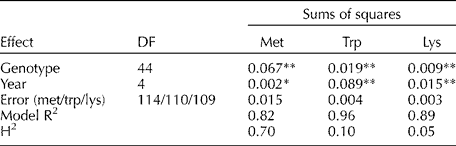
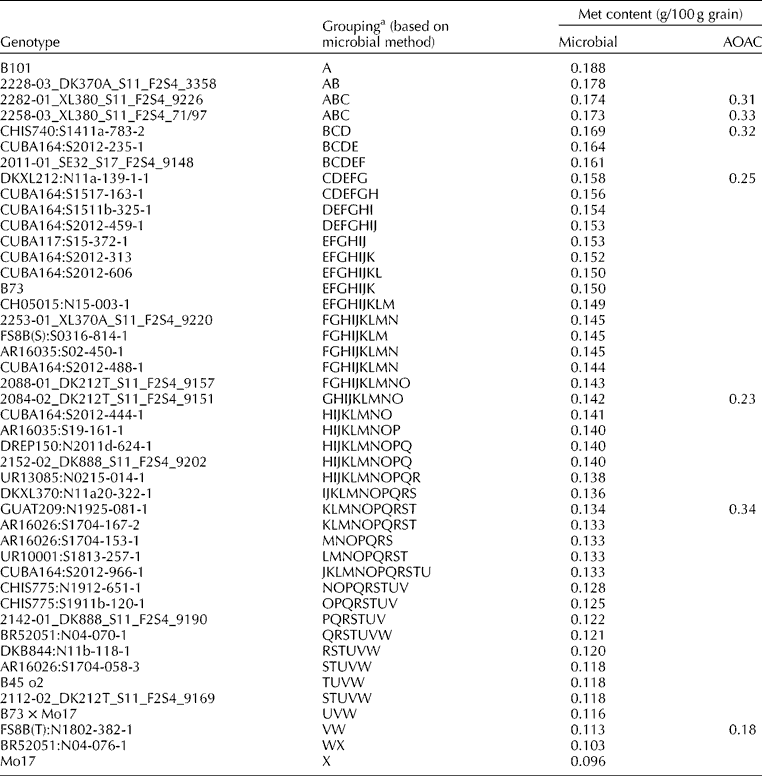
An outcome of the germplasm enhancement program used by GEM is that new germplasm is continually being developed and this germplasm is in need of testing. We developed an evaluation program that involved the evaluation of a set of GEM lines each year using a microbial amino acid analysis method. Over the course of 5 years of evaluation (2003–2007), we have evaluated 160 lines, although some lines appear in many of the years and some lines appear in only a few years of the trial. For all amino acids, both genotype and year contributed significantly to the variation observed in the data (Table 1), although the genotypic variation was much more prominent for methionine than for tryptophan and lysine. This resulted in the broad-sense heritability (H2) of methionine concentration being much higher than those of the other two amino acids. The heritabilities of methionine, lysine and tryptophan concentration were 0.70, 0.10 and 0.05, respectively (Table 1). Methionine concentration for the genotypes in the study is summarized in Table 2. While the high methionine check B101 was the highest in the test, three GEM lines were not significantly different from B101. The three lines were derived from 50% exotic breeding populations that originated from the Brazilian tropical hybrids DKXL370A and DKXL380. These hybrids were crossed to an adapted proprietary stiff stalk line designated as S11. The three GEM lines are publicly available from the North Central Regional Plant Introduction (NCRPIS) at www.ars-grin.gov. Two of the three lines were registered in Crop Science (Balint-Kurti et al., Reference Balint-Kurti, Blanco, Millard, Duvick, Holland, Clements, Holley, Carson and Goodman2006), and are designated as PI 639055 (2258-03 XL380 S11 in Table 2), and PI 639056 (2282-01 XL380 S11 in Table 2). The third line ‘2228-03 DK370A’ has not been registered but is also publicly available as Ames 26 501 from the NCRPIS.
ANOVA of microbial amino acid assay results

* Statistically significant at P < 0.05,
** Statistically significant at P < 0.01.
Methionine content of GEM lines evaluated for 3 or more years
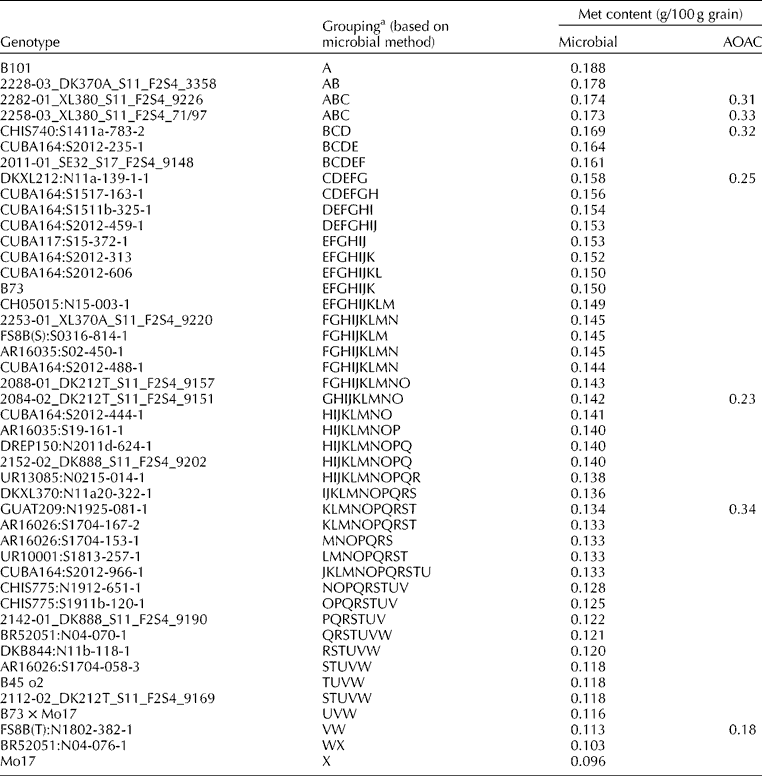
a Genotypes not connected by the same letter are significantly different (P < 0.05).
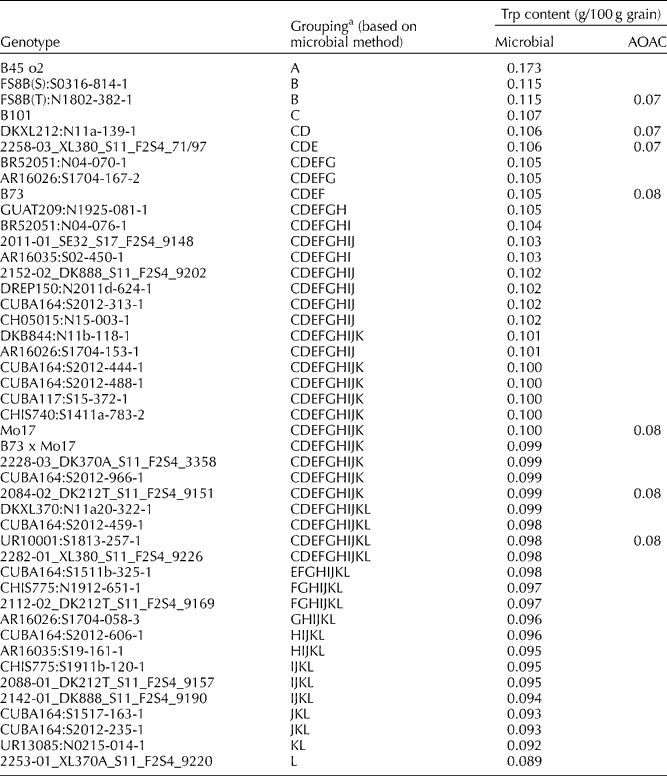
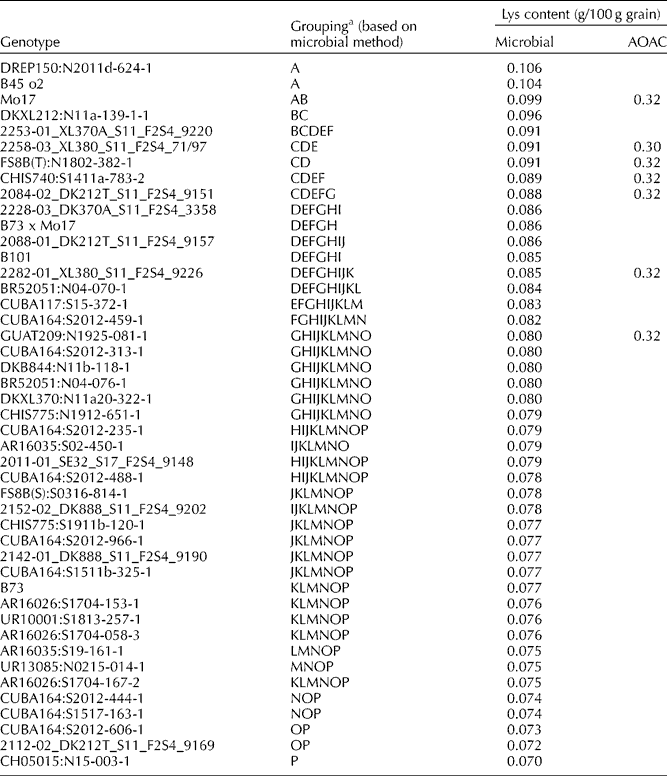
Tryptophan content for the genotypes in the study is summarized in Table 3. The most notable feature of these data is that with the exception of the high tryptophan check, B45 o2, there is very little significant variation among the samples. A similar result was obtained for lysine (Table 4), although for lysine, one GEM line was not different from the high lysine check, B45 o2.
Tryptophan content of GEM lines evaluated for 3 or more years

a Genotypes not connected by the same letter are significantly different (P < 0.05).
Lysine content of GEM lines evaluated for 3 or more years

a Genotypes not connected by the same letter are significantly different (P < 0.05).
It is most desirable to improve multiple nutritionally limiting amino acids simultaneously. For this reason, it is important to examine the relationship between the different amino acids. We determined Pearson product-moment correlations for the three amino acids examined in this study. Tryptophan and lysine exhibited a significant correlation of 0.44, while methionine was not significantly correlated with the other two amino acids. These data suggest that it should be possible to improve multiple amino acids simultaneously, although it may be easier to improve lysine and tryptophan together than in combinations involving methionine.
Discussion
Our objective was to develop a procedure for obtaining reliable grain amino acid content data in the course of development of germplasm by the GEM program. We accomplished this with an evaluation plan that included evaluation of germplasm with a high-throughput amino microbial assay for the nutritionally limiting amino acids, lysine, methionine and tryptophan. Yearly evaluations were carried out, with common checks included in the trial in each year. Germplasm that performed well in the trial was retained in subsequent years and germplasm that did poorly was removed from the trial, so new germplasm could be added. By changing a portion of the entries in the study each year, we reduced our power to precisely determine amino acid concentration, but it is important to keep in mind that the GEM program produces new germplasm sources for evaluation each year, and this system provides a rigorous, multiple-year and cost-effective evaluation method that accommodates the addition of new germplasm.
We observed more variation for methionine than for tryptophan and lysine in this study. The reduced variation for tryptophan and lysine is likely to slow the progress in breeding for these two amino acids. By contrast, the relatively high variability for methionine suggests that recurrent selection may be an effective way to improve this amino acid. This variability may be a consequence of the multiple roles it serves in plant metabolism. In addition to being a component of proteins, methionine is involved in one-carbon metabolism in the form of S-adenosyl methionine. It would be interesting to determine whether the variation observed in methionine is primarily in methionine contained in proteins or whether it is in free methionine involved in other aspects of metabolism.
The values produced by the microbial method, while very reproducible, are known to be lower than those produced using the standard AOAC method, so these values should not be used for comparisons across studies but rather for making comparisons within this study. In addition, the correlation between the AOAC method and the microbial method is low for lysine and tryptophan. One explanation for this is that there is very little variation for these amino acids in the germplasm examined. A second possible explanation is that the AOAC data were obtained only in one year of the study, while the microbial data were obtained in at least 3 years.
The significant correlation between lysine and tryptophan is consistent with earlier observations (Vivek et al., Reference Vivek, Krivanek, Palacios-Rojas, Twumasi-Afriyie and Diallo2008). As suggested in this earlier study, it may be possible to improve both lysine and tryptophan by selecting for one or the other of these amino acids. The lack of strong, negative correlations between the three amino acids suggest that it should be possible to improve all three amino acids simultaneously; however, the low heritability of tryptophan and lysine suggest that breeding progress for these traits will be slow and mutation breeding or transgenic approaches might be more appropriate for these traits.
A great deal of effort has been devoted for improving the amino acid balance of grain, with the majority of the effort being devoted to mutation breeding and transgenic approaches. The agronomically superior germplasm with good amino acid content identified by this program provides a foundation to which these other breeding methods can be applied. We conclude that GEM germplasm is a valuable resource for breeding for methionine content.
Acknowledgements
The authors wish to acknowledge Fred Engstrom, Andy Smelser, Merinda Struthers and Adrienne Moran-Lauter for their technical assistance. Names are necessary to report factually on the available data; however, the USDA neither guarantees nor warrants the standard of the product, and the use of the name by the USDA implies no approval of the product to the exclusion of others that may be suitable. This work is a joint contribution of the USDA-ARS Corn Insects and Crop Genetics Research Unit and the USDA-ARS North Central Plant Introduction Station.