Introduction
African lovegrass [Eragrostis curvula (Schrad.) Nees] is a highly invasive weed that is found within Australia and around the world, posing a serious threat to native biodiversity (Firn Reference Firn2009). It has the capacity to quickly inundate landscapes and compete against native flora for resources such as light, nutrients, and soil moisture (Firn et al. Reference Firn, Ladouceur and Dorrough2018). Many animals (native and nonnative) avoid grazing this grass, which in addition to being unpalatable, provides little or no dietary benefit. This results in dense swards of E. curvula forming in grazed grass-dominated vegetation, altering the carrying capacity of an area, intensifying competition with other flora, and increasing fuel loads, which ultimately changes the frequency of fire throughout the landscape (Firn Reference Firn2009; Firn et al. Reference Firn, Ladouceur and Dorrough2018). Although many management techniques have been explored, such as burning (Archibald et al. Reference Archibald, Bond, Stock and Fairbanks2005), heavy grazing (Firn Reference Firn2009), and herbicide application (Campbell et al. Reference Campbell, Kemp, Murson, Dellow and Ridings1987; Firn et al. Reference Firn, Ladouceur and Dorrough2018), there has been little long-term success in controlling this weed.
To date, there has been no comprehensive study that investigates the seed ecology of E. curvula from multiple populations. However, it is known that investigating the seed ecology of any weed species can provide useful information for improved management by identifying what factors may inhibit or enhance its growth and future seed production (Ahmed et al. Reference Ahmed, Opeña and Chauhan2015; Schwartz et al. Reference Schwartz, Gibson, Gage, Matthews, Jordan, Owen, Shaw, Weller, Wilson and Young2017). Many weed species can adapt remarkably well to different environmental conditions, an attribute often linked to genetic variability and ability to adapt to localized climatic and soil conditions (Geng et al. Reference Geng, Van Klinken, Sosa, Li, Chen and Xu2016; Hereford Reference Hereford2009; Seglias et al. Reference Seglias, Williams, Bilge and Kramer2018). This allows them to easily invade new areas across a wide area. Therefore, understanding the environmental factors that regulate seed germination is essential in formulating species-targeted management for greater efficacy in control (Chauhan et al. Reference Chauhan, Manalil, Florentine and Jha2018; Mobli et al. Reference Mobli, Mollaee, Manalil and Chauhan2020). Consequently, this study is innovative in that it investigated several environmental factors (photoperiod, alternating temperature, pH, and salinity) by analyzing several measures of seed germination on multiple climatically and spatially varied populations within Australia from Maffra (mild temperate climate) and Shepparton (hot dry summer–cool winter climate) VIC; Tenterfield, NSW (mild temperate climate); and Midvale, WA (warm temperate climate). Investigating which environmental factors influence this species’ seed germination can provide information to be applied in a new holistic approach to managing this species at a landscape scale.
Methods and Materials
Seed Collection, Site Description, and Seed Storage
Mature E. curvula seeds were collected using haphazard sampling methods between January and March 2019 from >100 individual plants from each of four localities across Australia: Maffra (37.925°S, 146.996°E) and Shepparton (36.348°S, 145.368°E) in Victoria; Tenterfield (29.093°S, 152.003°E) in New South Wales; and Midvale (31.872°S, 116.033°E) in Western Australia (Figure 1). These localities were chosen to represent genetic diversity of the species from several spatially varied climatic regions in Australia (Table 1). Studying multiple populations allows for a greater understanding of the species’ seed ecology and can also identify any potential adaptations as a result of a difference in climatic conditions or selective pressures (Gamba and Muchhala Reference Gamba and Muchhala2020). Seeds collected from all localities were carefully sealed within labeled paper bags and transported to Federation University’s seed ecology lab where all trials took place. Seeds were then air-dried for a week, cleaned, and stored in airtight containers at room temperature until trials began in late March 2019.
Eragrostis curvula seed collection sites, Australia.

Site description of the seed locations of Eragrostis curvula seeds from Australia.

Seed Germination Protocol
All seed germination trials were conducted at Federation University’s seed ecology laboratory using the following protocol. To remove the influence of any pathogens, all seeds were carefully surfaced sterilized using 1% sodium hypochlorite for 2 min and then thoroughly rinsed with sterilized reverse-osmosis water (RO water). For each individual treatment, three replicates (repeated twice) of 20 seeds (per population) were placed evenly into a 9-cm petri dish lined with sterilized filter paper (Whatman® No.10). Seeds for each replicate were randomly selected from the batch of seeds collected from their corresponding location. Each filter was then moistened with approximately 10 ml of RO water or another specified solution. Petri dishes were then wrapped in transparent Parafilm® and placed randomly into temperature and light incubators (Thermoline Scientific and Humidity Cabinet, TRISLH-495-1-SD, Volume 240, Wetherill Park, NSW, Australia) fit with white fluorescent lamps with a photosynthetic photon flux of 40 μmol m−2 s−1. Seeds were monitored for 30 d and were considered germinated when the radicle had emerged and reached approximately 2 mm in length (Ferrari and Parera Reference Ferrari and Parera2015). All nongerminated seeds were then assessed for viability using the triphenyl tetrazolium chloride test (Waes and Debergh Reference Waes and Debergh1986). For the 24-h dark trials, petri dishes were wrapped with a double layer of aluminum foil and only examined under a green safe light to avoid any potential photoreaction with the seeds.
Effect of Photoperiod and Alternating Temperature
Seeds from all populations were exposed to two photoperiod regimes (12-h light/12-h dark, and 24h darkness) and incubated under four alternating temperature combinations on 12-h cycles (35/25, 30/20, 25/15, and 17/7 C). These combinations were selected as they correspond approximately with the climatic conditions that occur during the growing season of the species within southern Australia between spring to summer (Borger et al. Reference Borger and Hashem2019). The most efficient combination for germination identified within this study was under the alternating 12-h light and 12-h dark photoperiod at 30/20 C. Therefore, all subsequent trials were conducted under this temperature and photoperiod combination.
Effect of pH
The effect of pH on germination was investigated by exposing seeds to a range of pH buffer solutions between 4 to 10, which are representative of average Australian soils (De Caritat et al. Reference De Caritat, Cooper and Wilford2011). Solutions were prepared and used to moisten the filter paper according to the procedures outlined by Chachalis and Reddy (Reference Chachalis and Reddy2000): for pH 4, 2 mM of potassium hydrogen phthalate solution was prepared and adjusted using 1 N hydrogen chloride; for pH 5 and 6, 2 mM of 2-(N-morpholino) ethanesulfonic acid was adjusted using 1 N of sodium hydroxide (NaOH) solution; for pH 7 and 8, 2 mM of HEPES [N-(2-hydroxymethly) piperazine-N-(2-ethanesulfonic acid)] solution was adjusted using 1 N NaOH; and for pH 9 and 10, tricine [N-Tris (hydroxymethyl) methylglycine] was adjusted using 1 N of NaOH.
Effect of Salinity
The effect of salinity on seed germination was determined using the following sodium chloride (NaCl) solutions: 0 (control), 25, 50, 100, 150, 200, and 250 mM. Solutions were used to moisten filter paper and were made by using the following concentrations of analytical reagent grade NaCl dissolved in 250 ml of RO water: 0, 0.360, 0.731, 1.461, 2.192, 2.922, and 3.653 g, respectively. The range of NaCl solutions was chosen to represent the conditions of Australian soils where this species has the potential to occur (Cook and Dias Reference Cook and Dias2006).
Statistical Analysis
Statistical tests to measure the effects of various environmental factors (photoperiod, light, pH, and salinity) on E. curvula seed germination were conducted using SPSS statistical software (v. 23, IBM, Armonk, NY, USA). The following measures were used to compare any differences in the means of each treatment and population if they occurred: final germination percentage (FGP), mean germination time (MGT), germination index (GI), time to reach 50% germination (T50), and time to start germination (TSG) (Kader Reference Kader2005). The differences in the levels of each factor, population, and their interactions were compared using ANOVAs and relevant post hoc tests (e.g., Tukey’s test). Significant interactions from the ANOVAs were analyzed by investigating the simple main effects with Bonferroni adjustments. For each test constructed, the assumption of normality of the residuals were investigated. To address the large number of ANOVAs constructed for the various measures and treatments, only results with a P < 0.001 were used to identify any significant difference. This cutoff value was chosen to address some slight departures from the assumptions while also addressing any concerns over inflated type I errors. To determine the optimal growing conditions of the species, a three-way ANOVA with interactions was conducted by comparing the final germination percentage of each population across all photoperiod and temperature regimes examined.
The following formulae were used to determine various measures as shown below:
 $${\rm{Final}}\,{\rm{germination}}\,{\rm{percentage}} = {{{\rm{NSG}}} \over {{\rm{TNS}}}} \times 100$$
where NSG is the final number of seeds germinated and TNS is the total number of seeds before germination.
 $${\rm{Mean}}\,{\rm{germination}}\,{\rm{time}} = \left( {{{\sum Dn} \over {\sum n}}} \right)$$
where n is the seeds germinated on day D and D n is the total number of days from the beginning of the trial.
 $${\rm{Germination}}\,{\rm{index}} = \left({n \over {{\rm{day}}\,{\rm{of}}\,{\rm{first}}\,{\rm{count}}}}\right) + ( \ldots ) + \left({n \over {{\rm{day}}\,{\rm{of}}\,{\rm{final}}\,{\rm{count}}}}\right)$$
where GI is the final germination index, and n is the number of germinated seeds.
 $${\rm{Time}}\,{\rm{taken}}\,{\rm{to}}\,{\rm{reach}}\,50\% \,{\rm{germination}} = t_i{{({n \over 2} - n_i)(t_j - t_i)} \over {(n_j - n_i)}}$$
where n is the total number of seeds germinated, n j and n i are the collective number of seeds germinated at the counts at days t j and t i .
Time to start germination (TSG) was calculated by averaging the days taken for seeds to start germinating.
Results and Discussion
Effect of Photoperiod and Alternating Temperature
Collectively, key results from this study show that E. curvula seed germination was greatest under the 12-h light and 12-h dark photoperiod at 30/20 C. For the effect of photoperiod, there was a significant interaction between the population and photoperiod for the FGP and GI (Table 2). Relevant post hoc tests indicated that germination was significantly lower for Maffra, Tenterfield, and Shepparton under the 24-h dark photoperiod compared with the 12-h light and 12-h dark photoperiod for the FGP (52% vs. 79%, 38% vs. 61%, 34% vs. 71%, respectively), and GI (1.3 vs. 2.4, 0.6 vs. 1.4, 0.8 vs. 2.1, respectively). However, Midvale had a consistent FGP (91% vs. 99%) and GI (3.6 vs. 3.8) for both photoperiods. Furthermore, the effect of photoperiod was not significant for the MGT, T50, and TSG.
The effect of photoperiod and alternating temperature on Eragrostis curvula seed germination. a

a For each measure, values (means) that run down each column (within that population) and have the same lower-case letter are not significantly different at P < 0.001. Also, for each measure, values (means) that run across each row and have the same upper-case letter are not significantly different at P < 0.001.
With alternating growth temperatures, there was a significant interaction between the population and temperature for all measures (Table 2). Relevant post hoc tests indicated that Maffra, Tenterfield, and Shepparton had significantly lower or longer germination at 17/7 C compared with the means of all other temperature combinations for the FGP (43% vs. 73%, 34% vs. 55%, 33% vs. 59%, respectively), GI (0.7 vs. 2.2, 0.3 vs. 1.3, 0.4 vs. 1.8, respectively), MGT (15.4 d vs. 6.6 d, 15.1 d vs. 5.4 d, 12.4 d vs. 6.8 d, respectively), T50 (14.6 d vs. 4.1 d, 14.2 d vs. 4.7 d, 11.2 d vs. 5.6 d, respectively), and TSG (12.8 d vs. 4.8 d, 14.5 d vs. 4.6 d, 11.1 d vs. 5.1 d, respectively). However, the germination for Midvale was consistent for all measures across all temperature combinations.
There was only a single photoperiod and temperature interaction, seen for the FGP (Table 2). Post hoc tests indicated that across all populations, the mean FGP was significantly lower under the 24-h dark photoperiod compared with the 12-h light and 12-h dark photoperiod (55% vs. 77%). It also showed that the mean FGP (56% vs. 84%) under the 12-h light and 12-h dark photoperiod was significantly lower at 17/7 C compared with all other temperature combinations. However, under the 24-h dark photoperiod, the mean FGP was significantly higher at 30/20 C (64%) compared with 25/15 (49%) and 17/7 C (46%).
Light is an important factor that regulates seed germination, and it can be mediated by the position of a seed within the soil and any surrounding shadow competition (Batlla and Benech-Arnold Reference Batlla and Benech-Arnold2014). Results from this study identify seeds from Maffra, Tenterfield, and Shepparton as photoblastic. Seeds often require greater amounts of energy and resources when buried within soil, which prevents germination until they are moved closer to the surface or when resources are widely available (Milberg and Lamont Reference Milberg and Lamont1995). This pattern of germination has also been observed in several small-seeded species such as South African lovegrass (Eragrostis plana Nees) (Bittencourt et al. Reference Bittencourt, Bonome, Trezzi, Vidal and Lana2017), feather lovegrass [Eragrostis tenella (L.) P. Beauv. ex Roem. & Schult.] (Chauhan Reference Chauhan2013), and goosegrass [Eleusine indica (L.) Gaertn.] (Chauhan and Johnson Reference Chauhan and Johnson2008). In contrast, seed germination can also occur in complete darkness by the seed utilizing a switch from photomorphogenetic to skotomorphogenic development (Josse and Halliday Reference Josse and Halliday2008). This results in the allocation of resources to hypocotyl elongation, cotyledon growth, and root development, all aimed at seeking light at an accelerated rate (Josse and Halliday Reference Josse and Halliday2008). It is clear from this study that seeds from Midvale did not have reduced germination in complete darkness. This may be a result of localized adaptation. This population was sourced from a diverse open woodland with several larger species of different ages (Table 1). Therefore, increased competition and ground cover may have resulted in the population evolving to produce seeds better adapted to light-limited conditions. However, seeds from the other populations were sourced from an open disturbed grassland with less competition, so this selective pressure may not be as significant.
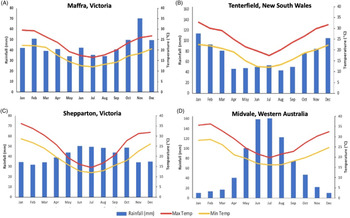
Temperature is also a significant factor regulating seed germination (Baskin and Baskin Reference Baskin and Baskin2014). Seasonal changes in temperature and light availability can influence the rate of germination by altering the availability of resources (nutrients, and soil moisture) and increasing seed deterioration, all factors that may have dormancy-breaking effects on the seed (Kebreab and Murdoch Reference Kebreab and Murdoch1999). Results from the present study highlight that seed germination was lower and took longer at temperatures between 17/7 C for Maffra, Tenterfield, and Shepparton. This pattern of germination is also observed in two other Eragrostis species, E. plana (Bittencourt et al. Reference Bittencourt, Bonome, Trezzi, Vidal and Lana2017) and E. tenella (Chauhan Reference Chauhan2013). In contrast, many species can also germinate across a wide range of temperatures, allowing them to invade a greater range of environments (Burke et al. Reference Burke, Thomas, Spears and Wilcut2003). Seeds from Midvale were not directly influenced by temperature; this suggests a potential localized adaptation or difference in the original seed source. The climate in this region is warmer, and most of its rainfall occurs in winter, in contrast to Maffra, Tenterfield, and Shepparton, which have cooler temperatures and rainfall distributed more evenly throughout the year (Table 1; Figure 2). Therefore, seeds from Midvale may have adapted to respond to such conditions, or germination could be strongly associated with other environmental factors, such as soil moisture.
(A) The average climatic conditions for Maffra, VIC. The average monthly rainfall data (1993 to 2019) were obtained from the Maffra weather station (Station number 85297), approximately 1.4 km from the site. Average temperature data (1945 to 2019) were obtained from the East Sale weather station (Station number 85072), approximately 21.7 km from the site (Bureau of Meteorology 2020). (B) The average climatic conditions for Tenterfield, NSW. The average monthly rainfall data and temperature data (1888 to 2019) were obtained from the Tenterfield (Federation Park) weather station (Station number 56032), approximately 5.9 km from the site (Bureau of Meteorology 2020). (C) The average climatic conditions for Shepparton, VIC. The average monthly rainfall data (1885 to 2019) were obtained from the Mooroopna weather station (Station number 81032), approximately 5.3 km from the site. Average temperature data (1996 to 2019) were obtained from the Shepparton airport weather station (Station number 81125), approximately 5.4 km from the site (Bureau of Meteorology 2020). (D) The average climatic conditions for Midvale, WA. The average monthly rainfall data (1914 to 2019) were obtained from the Midland weather station (Station number 9025), approximately 2.6 km from the site. Average temperature data (1944 to 2019) were obtained from the Perth Airport weather station (Station number 9021), approximately 6.5 km from the site (Bureau of Meteorology 2020).

Effect of pH
Key results from this study show that E. curvula seeds from all populations investigated within this study can germinate successfully between pH 4 to 9. For the effect of pH, there was a significant interaction between the population and pH for most measures (Table 3). Only the Maffra population showed significant variation in its germination, and post hoc tests indicated that germination was significantly lower at pH 10 compared with the means of all other pH values for the FGP (59% vs. 85%) and GI (1.4 vs. 2.8). Further, Maffra also had a significantly longer mean MGT (10.5 d vs. 5.5 d) at pH 8 to 10 and mean T50 (8.9 d vs. 4.8 d) at pH 9 to 10 compared with all other pH values. For all populations, the effect of pH did not influence the time to start germination (TSG). For the Tenterfield, Shepparton, and Midvale populations, the effect of pH did not significantly influence germination or germination time.
The effect of pH on Eragrostis curvula seed germination. a

a For each measure, values (means) that run down each column (within that population) and have the same lower-case letter are not significantly different at P < 0.001. Also, for each measure, values (means) that run across each row and have the same upper-case letter are not significantly different at P < 0.001.
For many weed species, being able to tolerate a wide range of soil pH is beneficial, as it allows them to exploit a wider range of soil types (Humpheries et al. Reference Humpheries, Chauhan and Florentine2018). This trait allows weeds to invade a greater range of environments and has been described in several other weed species, including American sloughgrass [Beckmannia syzigachne (Steud.) Fernald] (Rao et al. Reference Rao, Dong, Li and Zhang2008) and serrated tussock [Nassella trichotoma (Nees) Hack.] (Humpheries et al. Reference Humpheries, Chauhan and Florentine2018). In contrast, a higher pH can inhibit germination, as it can indicate a change in soil conditions and potentially a change in the available resources, such as soil nutrients (Fenner and Thompson Reference Fenner and Thompson2005). Results show that only Maffra had reduced and slower germination at the higher pH levels, which may be due to localized adaptation to soil composition or other environmental factors. This pattern of germination has also been described in crowfootgrass [Dactyloctenium aegyptium (L.) Willd.] (Burke et al. Reference Burke, Thomas, Spears and Wilcut2003) and Crofton weed (Eupatorium adenophorum Spreng.) (Lu and Ma Reference Lu and Ma2006), for which higher soil pH reduced germination. Most Australian soils fall within the range of pH 4 to 9, which suggests that E. curvula has the potential to exploit a range of environments and become problematic in many regions across Australia (Rengasamy Reference Rengasamy2006).
Effect of Salinity (NaCl)
Key results from this study show that E. curvula seeds from all populations were influenced by increasing salinity, with Midvale being the most salt tolerant and Maffra the least. For the effect of salinity (NaCl), there was a significant interaction between the population and NaCl for all measures (Table 4). Post hoc tests indicated that the mean FGP was significantly lower for Maffra (29% vs. 67%) at ≥100 mM, Tenterfield (29.8% vs. 94%) and Shepparton (39.5% vs. 81.5%) at ≥150 mM, and Midvale (39.5% vs. 81.5%) at 250 mM compared with the mean of all other concentrations. Further, the mean GI was also significantly lower for Maffra (0.8 vs. 2.5) and Tenterfield (1.9 vs. 8.4) at ≥100 mM, Shepparton (1.2 vs. 3.8), at ≥150 mM, and Midvale (3.2 vs. 6.9) at ≥50 mM compared with the mean of all other concentrations. Regarding the MGT, only the Tenterfield population (14.1 d vs. 3.9 d) had a significantly longer MGT at 250 mM compared with the mean of all other concentrations. For the mean T50, germination was significantly longer for Maffra (8.9 d vs. 3.3 d) and Tenterfield (5.6 d vs. 2.6 d) at ≥200 mM, Shepparton (13 d vs. 3 d) at 250 mM, and Midvale (6 d vs. 2 d) at ≥50 mM compared with the mean of all other concentrations. Regarding the TSG, only Maffra (7.6 d vs. 3.2 d) had a significantly longer mean TSG at 250 mM compared with all other concentrations.
The effect of salinity (NaCl) on Eragrostis curvula seed germination. a

a For each measure, values (means) that run down each column (within that population) and have the same lower-case letter are not significantly different at P < 0.001. Also, for each measure, values (means) that run across each row and have the same upper-case letter are not significantly different at P < 0.001.
Salinity influences germination through (1) ion toxicity and (2) osmotic stress (Bliss et al. Reference Bliss, Plattaloia and Thomson1986). Studies of ion toxicity have shown that an increase in Na+ and Cl− ions can disrupt seed development by limiting cellular activity, energy production, and the essential uptake of macronutrients (Gupta and Huang Reference Gupta and Huang2014; Maathuis et al. Reference Maathuis, Ahmad and Patishtan2014). In addition, osmotic stress reduces uptake of water and important nutrients (potassium, calcium, and magnesium) and alters the hormonal and enzymatic processes within a seed (Thiam et al. Reference Thiam, Champion, Diouf and Ourye2013). Therefore, germination is reduced or slowed with increasing salinity, which was observed within this study. This pattern of germination has also been observed in several Eragrostis species, such as E. plana (Bittencourt et al. Reference Bittencourt, Bonome, Trezzi, Vidal and Lana2017), E. tenella (Chauhan Reference Chauhan2013), and teff [Eragrostis tef (Zuccagni) Trotter] (Papastylianou et al. Reference Papastylianou, Travlos, Roussis and Bilalis2019). In contrast, some plants can develop over time to produce seeds that withstand a greater salt tolerance as a result of a difference in genetic variation or adaption to localized climatic conditions (Dehnavi et al. Reference Dehnavi, Zahedi, Ludwiczak, Perez and Piernik2020). In this study, the Midvale population had a higher salt tolerance compared with Maffra, Tenterfield, and Shepparton, but it also had a slightly longer germination time. This could be due to localized adaption to the climatic conditions or a difference in the original seed source. Midvale receives most of its yearly rainfall in winter (Figure 2D), therefore, outside these months, the soil salt concentration could be higher, resulting in seeds needing to be capable of germinating higher saline conditions. However, Maffra, Tenterfield, and Shepparton have evenly distributed rainfall throughout the year (Figures 2A–C), so saline conditions might be less likely to develop. Therefore, our results suggest that E. curvula may have evolved at a local scale to produce seeds that withstand different environmental constraints.
This study highlights several similarities and differences in the seed germination of E. curvula across Australia. Seeds from Midvale can germinate across a wide range of conditions from complete darkness, temperatures between 7 to 35 C, soil pH between 4 to 10, and saline conditions ≤200 mM. Seeds from this population may be more conductive in growing across a range of climatic regions, and preventative strategies to reduce seed spread should be of high priority. This can be achieved by maintaining a high level of quarantine and hygiene (cleaning vehicles and equipment), managing and limiting the movement of livestock, and reducing soil disturbance around E. curvula infestations. For Maffra, Tenterfield, and Shepparton, germination was reduced in complete darkness; therefore, when practical, the use of light-limiting strategies (mulching, scraping, or tilling) would be beneficial in reducing the germination of new seeds in these areas. Furthermore, the germination of seed from these localities was more prevalent at temperatures between 15 to 35 C, in soil pH between 4 to 9, and in saline conditions <150 mM, which should help local managers identify conditions that promote spread of the species. Although germination may not be as vigorous as for the Midvale population, this study suggests that E. curvula seeds can adapt to changing climatic conditions. Therefore, the preventative strategies mentioned should also be applied in all localities, and management should be conducted year-round, as the species is likely to germinate across various environments. Although the factors in this study were investigated individually, they are interlaced and may interact with each other; however, interactions were not specifically investigated here, and we recommend that they be considered in future studies. Further, management of E. curvula should be conducted at the landscape scale, as localized adaptation and variation in seed germination was identified in this study.
Acknowledgments
The authors thank Michael McBain for creating Figure 1. This research received no specific grant from any funding agency or the commercial or not-for-profit sectors. No conflicts of interest have been declared.