Introduction
The existence of planets in orbit about solar-type stars is now a well-established observational result. Obviously, the ultimate quest of these studies is to discover Earth-like planets located in the habitable zones (HZs) of their host stars. So far, a small number of super-Earth planets with masses of up to about 12 M ⊕ (e.g. Udry et al. Reference Udry, Bonfils, Delfosse, Forveille, Mayor, Perrier, Bouchy, Lovis, Pepe, Queloz and Bertaux2007; Vogt et al. Reference Vogt, Butler, Rivera, Haghighipour, Henry and Williamson2010) have been found, typically located around M-type dwarf stars. Nevertheless, the existence of Earth-mass planets, including those hosted by solar-type stars, is strongly implied by various observational findings including the occurrence and mass distribution of close-in super-Earths, Neptunes and Jupiters (Howard et al. Reference Howard, Marcy, Johnson, Fischer, Wright, Isaacson, Valenti, Anderson, Lin and Ida2010). Measurements by the authors indicate an increasing planet occurrence with decreasing planetary mass M p akin to M p−0.48, implying that 23% of stars harbour a close-in Earth-mass planet (ranging from 0.5 to 2.0 M ⊕); see also Marcy & Butler (Reference Marcy and Butler2000) for earlier results. Very recent support for the existence of Earth-type planets outside the Solar System is lent by the discovery of Kepler-10b, Kepler's first rocky planet with an estimated mass of 4.6 Earth masses (Batalha et al. Reference Batalha2011).
Long-term orbital stability of Earth-like planets in stellar HZs is necessary for the evolution of any form of life, particularly intelligent life. There is a large array of studies focusing on the orbital stability of hypothetical Earth-mass planets in stellar HZs concerning different types of host stars and star–planet configurations. Examples include studies by Gehman et al. (Reference Gehman, Adams and Laughlin1996), Jones et al. (2001, 2005, 2006), Jones & Sleep (Reference Jones and Sleep2010), Noble et al. (Reference Noble, Musielak and Cuntz2002), Menou & Tabachnik (Reference Menou and Tabachnik2003), Cuntz et al. (Reference Cuntz, von Bloh, Bounama and Franck2003), von Bloh et al. (Reference von Bloh, Cuntz, Franck and Bounama2003), and Asghari et al. (Reference Asghari2004). Particular types of systems are those where a Jupiter-type planet orbits a star in the stellar HZ, therefore jeopardizing the possibility of habitable terrestrial planets in that system. This is actually the situation of HD 23079, the focus of the present paper.
Previously, Noble et al. (Reference Noble, Musielak and Cuntz2002) investigated the orbital stability of terrestrial planets inside the HZs of 47 UMa and HD 210277. The centre stars of these systems are very similar to the Sun concerning mass, spectral type and effective temperature. Orbital stability was attained for the inner part of the HZ of 47 UMa; however, no orbital stability was found for hypothetical Earth-mass planets in the HZ of HD 210277. In this case, a Jupiter-type planet crosses the stellar HZ, thus effectively thwarting habitability for this system. Very recent examples were also given by Yeager et al. (Reference Yeager, Eberle and Cuntz2011), who studied the star-planet systems HD 20782 and HD 188015. In both cases, the giant planet significantly interferes with any Earth-mass planet in the stellar HZ assumed to have formed there for the sake of study. In all cases, the Earth-mass planet was ejected from the stellar HZ in a very short time.
However, if a giant planet is orbiting the star in the stellar HZ, there is still the principal possibility of habitable Trojan planets in those systems as pointed out by e.g. Dvorak et al. (Reference Dvorak, Pilat-Lohinger, Schwarz and Freistetter2004) and Schwarz et al. (Reference Schwarz, Dvorak, Sűli and Érdi2007). A Trojan planet is one located around one of the Lagrangian points L4 and L5 of the giant planet. These points lie on the giant planet's orbit, ahead (L4) and behind (L5) the planet, each forming an equilateral triangle with the planet and its star. Thus, Trojan planets are also in a 1:1 resonance with the giant planet. Dvorak et al. (Reference Dvorak, Pilat-Lohinger, Schwarz and Freistetter2004) investigated the stability regions of hypothetical terrestrial planets around L4 and L5 in specific systems, including HD 23079, in the framework of the restricted three-body problem. They obtained relationships between the size of the stability regions and the orbital parameters of the giant planet, particularly its eccentricity. Studies about Neptune Trojans were given by e.g. Dvorak et al. (Reference Dvorak, Schwarz, Sűli and Kotoulas2007).
A study by Schwarz et al. (Reference Schwarz, Dvorak, Sűli and Érdi2007) identified several exoplanetary systems that can harbour Trojan planets with stable orbits in the stellar HZs. Concerning HD 23079, this study concluded that a Trojan planet will only spend 35% of its time in the stellar HZ, assumed to extend from 0.85 to 1.60 AU. In our study, however, we will consider a zone of habitability based on the generalized estimate by Underwood et al. (Reference Underwood, Jones and Sleep2003), implying habitability between 0.99 and 1.97 AU (see below). This means that the habitable area, which is the area of the stellar HZ annulus, is increased by 58% compared to that considered by Schwarz et al. (Reference Schwarz, Dvorak, Sűli and Érdi2007). In the present study, we will conclude that habitable Trojan planets are indeed possible in the system of HD 23079, although their existence is significantly affected by e.g. the orbital parameters of the giant planet. Next we will describe our theoretical approach. We will discuss the adopted methods and the system parameters for HD 23079. Thereafter, we will describe our results. Finally, we will present our conclusions.
Theoretical approach
Stellar and planetary parameters
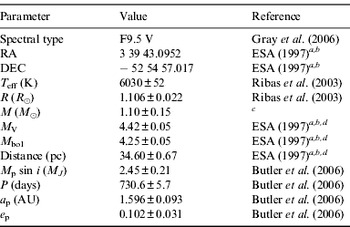
HD 23079 has been monitored as part of the Anglo-Australian Planet Search (AAPS) programme (Tinney et al. Reference Tinney, Butler, Marcy, Jones, Penny, McCarthy and Carter2002) that is able to perform extrasolar planet detection and measurements with a long-term, systematic radial velocity precision of 3 m s−1 or better. HD 23079 was identified to host a Jupiter-type planet in a relatively large and nearly circular orbit. HD 23079 is an inactive main-sequence star; Gray et al. (Reference Gray, Corbally, Garrison, McFadden, Bubar, McGahee, O'Donoghue and Knox2006) classified it as F9.5 V (see Table 1; all parameters have their usual meaning), an updated result compared to Houk & Cowley (Reference Houk and Cowley1975) who found that HD 23079 is intermediate between an F8 and G0 star. Its stellar spectral type corresponds to a mass of M=1.10±0.15 M ⊙. The stellar effective temperature and radius are given as T eff=6030±52 K and R=1.106±0.022 R ⊙, respectively (Ribas et al. Reference Ribas, Solano, Masana and Giménez2003). Thus, HD 23079 is fairly similar to the Sun, though slightly hotter and slightly more massive. The detected planet (HD 23079 b) has a minimum mass of M p sin i=2.45±0.21 M J. Furthermore, it has a semimajor axis of a p=1.596±0.093 AU and an eccentricity of e p=0.102±0.031 (Butler et al. Reference Butler2006), corresponding to an orbital period of P=730.6±5.7 days. The original results by Tinney et al. (Reference Tinney, Butler, Marcy, Jones, Penny, McCarthy and Carter2002) indicated very similar planetary parameters.
Stellar and Planetary Parameters

Note. a Data from SIMBAD, see http://simbad.u-strasbg.fr. bAdopted from the Hipparcos catalogue. cBased on spectral type. dBased on parallax 28.90±0.56 mas.
The orbital parameters of HD 23079 b are relatively similar to those of Mars, implying that HD 23079 b is orbiting its host star in or near the outskirts of the stellar HZ; see the discussion below. The existence of HD 23079 b, a planet even more massive than Jupiter, makes it difficult for a terrestrial planet to orbit HD 23079 at a similar distance without being heavily affected by the giant planet; see the results from previous case studies by Noble et al. (Reference Noble, Musielak and Cuntz2002) and Yeager et al. (Reference Yeager, Eberle and Cuntz2011) who focused on the dynamics of HD 20782, HD 188015 and HD 210277. Concerning HD 23079, a previous investigation pertaining to habitable terrestrial Trojan planets was given by Dvorak et al. (Reference Dvorak, Pilat-Lohinger, Schwarz and Freistetter2004).
Method of integration
For our simulations of the HD 23079 system, we consider both the observed giant planet and a hypothetical terrestrial planet of one Earth-mass, i.e. 3.005×10⁻⁶M ⊙, which allows us to execute a grid of model simulations. The method of integration uses a fourth-order Runge–Kutta integration scheme (Garcia Reference Garcia2000). The code has been extensively tested against known analytical solutions, including the two-body and restricted three-body problem (see Noble et al. Reference Noble, Musielak and Cuntz2002; Cuntz et al. Reference Cuntz, Eberle and Musielak2007; Eberle et al. Reference Eberle, Cuntz and Musielak2008, for detailed results). In the framework of our simulations that we limit to 106 years, we apply a time-step of 10−4 years for the integration scheme that is found to be fully appropriate. In that regard, we pursued test studies comparing the planetary orbits based on three different integration time-steps: 10−3, 10−4 and 10−5 years. In particular, we evaluated ΔR ij, i.e. the magnitude of the difference between the position of the planet when different step sizes of 10−i and 10−j were used. We found that there is no significant change in outcome between models with time-steps of 10−4 and 10−5 years.
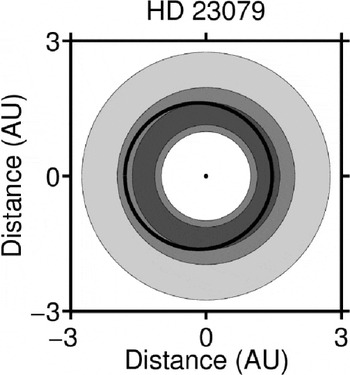
The initial conditions (i.e. starting velocities) for the orbits of the Earth-mass planets were chosen such that the planet was assumed to start at the midpoint of the stellar HZ (1.4779 AU) and to be in a circular orbit about the star, although it is evident that it will be significantly affected immediately by the gravitational pull of the giant planet, which will prevent the planet from continuing a circular motion. For each set of models, defined by sets of values for the semimajor axis a p and eccentricity e p, given as 1.503, 1.596, 1.689 AU and 0.071, 0.102, 0.133, respectively, eight different configurations are considered. They are defined by the eight different starting (phase) angles for the Earth-mass planet, which were varied in increments of 45° noting that 0° corresponds to the 3 o'clock position. Moreover, the starting position of the Jupiter-type planet (HD 23079 b), for which we assume its minimum mass value of 2.45 M J, was varied between its periastron and its apastron position. Therefore, a total of 144 initial configurations has been considered. Note that the Jupiter-type planet was always started at the 3 o'clock position, which after adjusting the orbital layout of the giant planet always coincided with its periastron (see Fig. 1) or apastron position depending on the type of model.
Extent of the HZ for HD 23079, defined by its conservative limits (dark grey) and generalized limits (medium grey). In addition, we depict the outer limit of an extreme version of the generalized HZ (light grey) following the work by Mischna et al. (Reference Mischna, Kasting, Pavlov and Freedman2000), although this limit may be unrealistic based on subsequent studies. The orbit of HD 23079 b, a Jupiter-type giant planet, is depicted by a thick solid line.

Stellar habitable zone
The extent of the HZ of HD 23079 has been calculated following the formalism by Underwood et al. (Reference Underwood, Jones and Sleep2003) based on previous work by Kasting et al. (Reference Kasting, Whitmire and Reynolds1993). Underwood et al. (Reference Underwood, Jones and Sleep2003) supplied a polynomial fit depending on the stellar luminosity and the stellar effective temperature that allows one to calculate the extent of the conservative and the generalized HZ. Noting that HD 23079 is more luminous than the Sun, it is expected that its HZ is more extended than the solar HZ, for which the inner and outer limits of the generalized HZ were given as 0.84 and 1.67 AU, respectively (Kasting et al. Reference Kasting, Whitmire and Reynolds1993). The generalized HZ is defined as bordered by the runaway greenhouse effect (inner limit), where water vapour enhances the greenhouse effect thus leading to runaway surface warming, and by the maximum greenhouse effect (outer limit), where a surface temperature of 273 K can still be maintained by a cloud-free CO2 atmosphere. The inner limit of the conservative HZ is defined by the onset of water loss, i.e. the atmosphere is warm enough to allow for a wet stratosphere from where water is gradually lost by photodissociation and subsequent hydrogen loss to space. Furthermore, the outer limit of the conservative HZ is defined by the first CO2 condensation attained by the onset of formation of CO2 clouds at a temperature of 273 K.
For HD 23079, the limits of the conservative HZ are given as 1.1378 and 1.6362 AU, whereas the limits of the generalized HZ are given as 0.9896 and 1.9662 AU (see Fig. 1). The limits of the generalized HZ are those employed in our numerical planetary studiesFootnote 1. The underlying definition of habitability is based on the assumption that liquid surface water is a prerequisite for life, a key concept that is also the basis of ongoing and future searches for extrasolar habitable planets (e.g., Catanzarite et al. Reference Catanzarite, Shao, Tanner, Unwin and Yu2006; Cockell et al. Reference Cockell2009). The numerical evaluation of these limits is based on an Earth-type planet with a CO2/H2O/N2 atmosphere.
We point out that concerning the outer edge of habitability, even less conservative limits have been proposed in the meantime (e.g. Forget & Pierrehumbert Reference Forget and Pierrehumbert1997; Mischna et al. Reference Mischna, Kasting, Pavlov and Freedman2000). They are based on the assumption of relatively thick planetary CO2 atmospheres and invoke strong backwarming that may further be enhanced by the presence of CO2 crystals and clouds. However, as these limits, which can be as large as 2.4 AU in the case of the Sun, depend on distinct properties of the planetary atmosphere, they are not relevant for our study. Nevertheless, we convey this type of limit for the sake of curiosity (see Fig. 1), noting that it has properly been adjusted to 2.75 AU in consideration of the radiative conditions of the planetary host star, HD 23079. Moreover, the significance of this extreme limit has recently been challenged based on detailed radiative transfer simulations (Halevy et al. Reference Halevy, Pierrehumbert and Schrag2009).
Results and discussion
Case studies of habitable Trojan planets
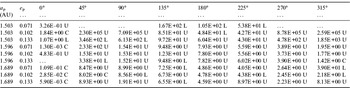
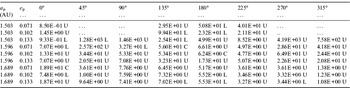
Tables 2 and 3 summarize the time the Earth-mass planet remains within the stellar HZ, i.e. before exiting the stellar HZ or being permanently ejected from the system. Of the 144 total considered initial configurations, 13 survived at least 1 million years, 93 crossed the upper limit of the HZ, 28 crossed the lower limit of the HZ, and 10 collided or may have had a very close approach with the giant planet. Some of those who crossed the HZ at the lower or upper limit as first exit from the HZ may also have had a very close approach with the giant planet, resulting in destruction while entering the Roche limit (Williams Reference Williams2003) or in a collision with the giant planet, at a later time. Of the 13 survivors, 12 are Trojan types, that is they exist in stable orbits around the equilateral equilibrium positions much like demonstrated in Dvorak et al. (Reference Dvorak, Pilat-Lohinger, Schwarz and Freistetter2004).
Time of first exit (or ejection) of the Earth-mass planet from the HZ (in years)

Note. The total time of simulation is 106 years. The Jupiter-type planet started at the periastron position and the initial velocity of the Earth-mass planet was computed to begin a circular motion about the star. U means that the Earth-mass planet crosses the upper limit of the HZ given as 1.9662 AU, whereas L means that the Earth-mass planet crosses the lower limit of the HZ given as 0.9896 AU. C means that the Earth-mass planet has a close encounter with the giant planet, possibly resulting in a collision; therefore, the simulation was discontinued. If no data are given, the simulation lasted beyond 106 years without the Earth-mass planet exiting the HZ.
Time of first exit (or ejection) of the Earth-mass planet from the HZ (in years)

Note. The total time of simulation is 106 years. The Jupiter-type planet started at the apastron position and the initial velocity of the Earth-mass planet was computed to begin a circular motion about the star. For further information, see the notes of Table 2.
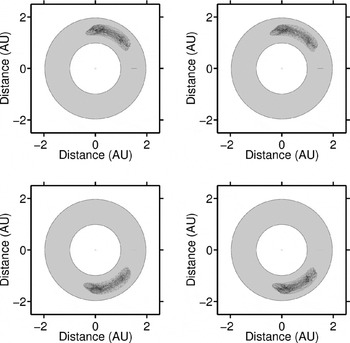
In the cases where the giant planet is initially in the periastron position, only models with the smallest considered semimajor axis and eccentricity combination, which are a p=1.503 AU and e p=0.071, result in habitable Trojan planets (see Fig. 2). In this case, four different starting positions (phase angles) appear to be consistent with long-term stability (see Table 2). It is clear that the Earth-mass planet is safely inside of the stellar HZ but it is a snug fit. For the next larger eccentricity considered, which is 0.102, there are various cases where the Earth-mass planet stays within the HZ for some hundred thousand years before finally crossing the upper limit of the HZ. When the eccentricity of the giant planet is increased to 0.133, the Earth-mass planet remains within the HZ at best for only a few hundred years.
Orbital stability simulations with HD 23079 b initially placed at periastron with a p= 1.503 AU, e p = 0.071 and the Earth-mass planets placed at four different starting angles, which are 45° (top left), 90° (top right), 270° (bottom left) and 315° (bottom right). Using a rotating coordinate system, HD 23079 b moves along the thin line. The Earth-mass Trojan planets, which give rise to the ‘banana-shaped’ area at L4 or L5, remain within the HZ for at least 106 years.

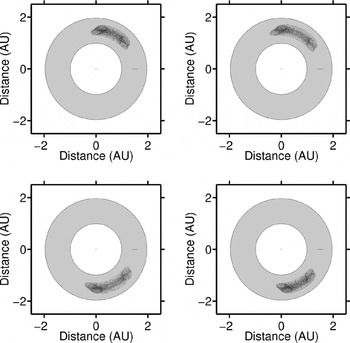
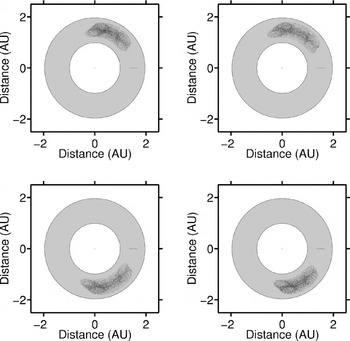
The situation is, in principle, similar for the cases where the giant planet is initially placed at the apastron position. In this case, for a p=1.503 AU, the Earth-mass planet remained in the stellar HZ for at least a million years for two eccentricity simulations, which are e p=0.071 and 0.102 (see Figs. 3 and 4, respectively). Comparing Fig. 4 to Fig. 3, it is clear that the Earth-mass planet moves in a wider area and approaches the edges of the HZ for the larger eccentricity, thus illustrating how the planet remained in the HZ for such a long time before exiting in the periastron case with the same parameters. In some of those latter cases, we found that the planet was outside the HZ for a brief time (i.e. considerably less than a planetary orbit), but most likely without losing its habitability. This conclusion is motivated by the previous study of Williams & Pollard (Reference Williams and Pollard2002) that showed that brief excursions from the HZ are insufficient to nullify planetary habitability because the latter is expected to mainly depend on the average stellar flux received over an entire orbit, rather than the length of the time spent within the HZ.
Orbital stability simulations with HD 23079 b initially placed at apastron with a p= 1.503 AU, e p = 0.071 and the Earth-mass planets placed at four different starting angles, which are 45° (top left), 90° (top right), 270° (bottom left) and 315° (bottom right). Using a rotating coordinate system, HD 23079 b moves along the thin line. The Earth-mass Trojan planets, which give rise to the ‘banana-shaped’ area at L4 or L5, remain within the HZ for at least 106 years.

Orbital stability simulations with HD 23079 b initially placed at apastron with a p= 1.503 AU, e p = 0.102 and the Earth-mass planets placed at four different starting angles, which are 45° (top left), 90° (top right), 270° (bottom left) and 315° (bottom right). Using a rotating coordinate system, HD 23079 b moves along the thin line. The Earth-mass Trojan planets, which give rise to the ‘banana-shaped’ area at L4 or L5, remain within the HZ for at least 106 years.

Note that Figs. 2 and 3 display models of orbital stability for the Earth-mass planet in a synodic (rotating) coordinate system. Thus, the ‘banana-shaped’ areas correspond to the domains about L4 or L5, where stability for the Earth-mass planet is encountered. The thin line at the 3 o'clock position corresponds to the motion of the giant planet due to its slightly elliptical orbit. Clearly, only Earth-mass planets placed at phase angles of 45°, 90°, 270° and 315° have a reasonable chance to develop into Trojan planets, whereas for other starting angles ejections from the HZ, and usually also from the star–planet system, will occur due to gravitational interaction with the giant planet. If the Earth-mass planet was initially placed at an angle of 60° or 300°, it can be expected that it will continue to remain a Trojan planet.
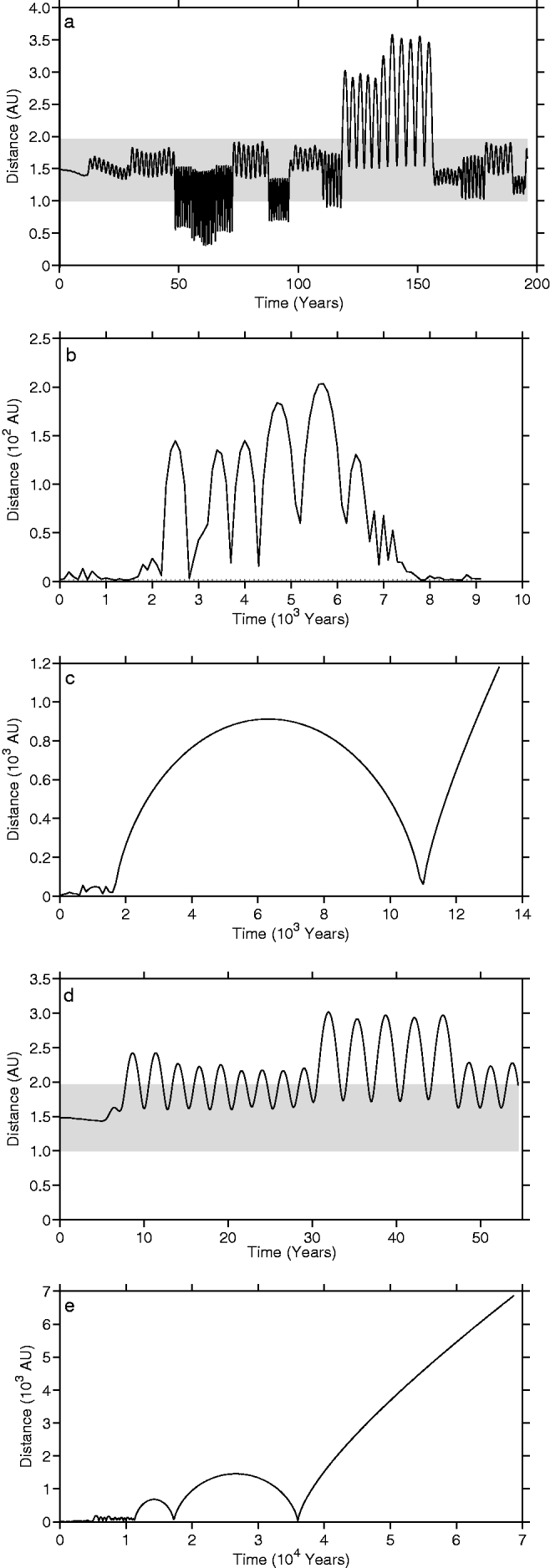
For the sake of curiosity, we also evaluated various cases where the Earth-mass planet never had a chance of becoming habitable. Hence, we chose five cases of different semimajor axes and eccentricities for the giant planet. In all cases the giant planet started at the periastron position and the initial phase angle of the Earth-mass planet was chosen as 180°. The simulations are depicted in Fig. 5. In Fig. 5(a), with a p=1.503 AU and e p=0.102, the system experiences a relatively long period during which the Earth-mass planet first exits the HZ at 48.4 years. This event is preceded by a close approach with the giant planet. The simulation is terminated at 195.9 years due to an expected collision with the giant planet.
Orbital stability simulations with HD 23079 b initially placed at periastron for Earth-mass planets placed at starting angles of 180°. The model simulations differ regarding the selected values for the orbital parameters a p and e p of the giant planet HD 23079 b (see also Table 2 for further information). The respective value pairs (a p, e p) are (1.503, 0.102), (1.596, 0.071), (1.596, 0.102), (1.596, 0.133) and (1.689, 0.102) for panels (a)–(e), respectively, with a p in AU. The grey domains (only visible in panels (a) and (d)) depict HD 23079's stellar HZ; see Table 2 for the times of first exit of the planet from the HZ. Note the vast differences in the extent of the x and y axes.
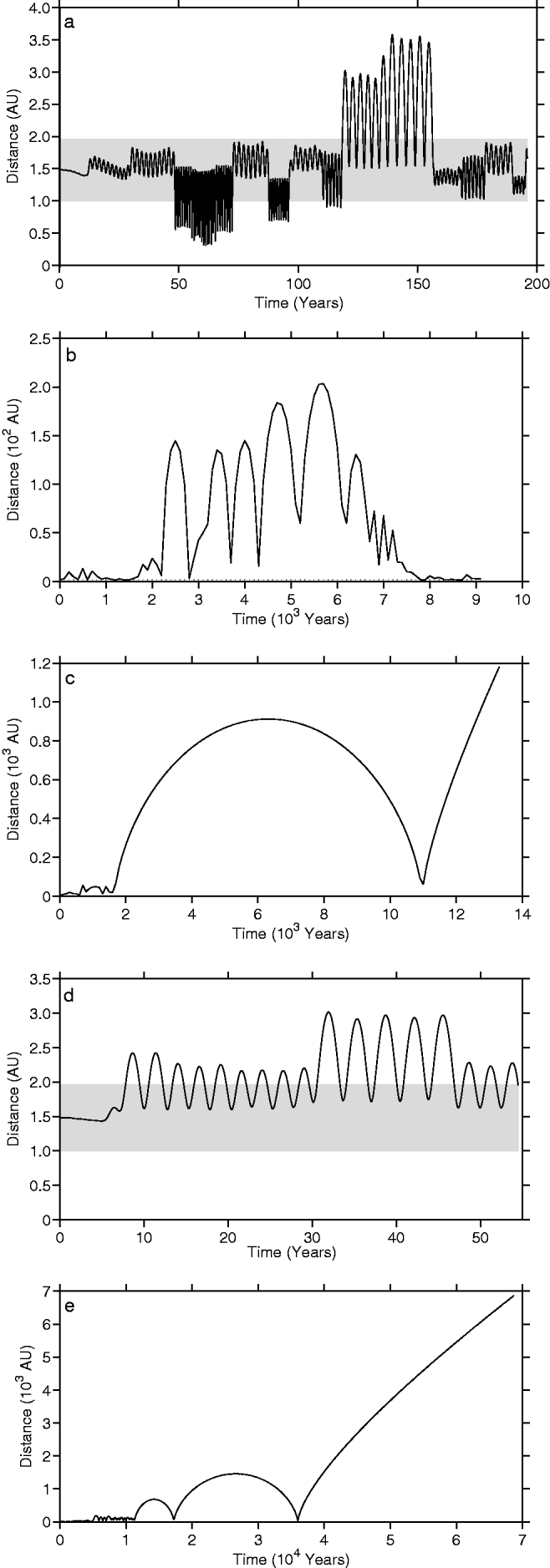
Figures 5(b)–5(d) are all based on a p=1.596 AU, but the depicted simulations assume different eccentricities for the giant planet, which are e p=0.071 0.102, and 0.133, respectively. In Fig. 5(b), the system experiences a short period during which the Earth-mass planet first exits the HZ at 7.93 years. This event is again preceded by a close approach with the giant planet. The simulation is terminated at 9112 years due to the expected collision with the giant planet. In Fig. 5(c), the system experiences a short period during which the Earth-mass planet first exits the HZ at 7.80 yrs. This event is preceded by a close approach with the giant planet. The simulation is terminated at 13 400 years considering that the Earth-mass planet is ejected from the system. Habitability is ultimately prevented as the Earth-mass planet becomes ‘free-floating’. Free-floating planets have previously been observed in the case of the Trapezium cluster (Lucas & Roche Reference Lucas and Roche2000); note that planetary ejections due to orbital instabilities are an important candidate process for this finding.
In Fig. 5(d), with a p=1.596 AU and e p=0.133, this system experiences a short period during which the Earth-mass planet first exits the HZ at 7.82 years. It is re-entering and exiting the HZ several times. However, the simulation is terminated at 54.60 years due to an expected collision with the giant planet. In case of Fig. 5(e), with a p=1.689 AU and e p=0.102, the system again experiences a short period during which the Earth-mass planet first exits the HZ at 4.78 years. This event is preceded by a close approach with the giant planet. Eventually, the planet also becomes free-floating; the simulation is terminated at 7×10⁴ years. Figures 5(a) and (d) show oscillatory behaviours regarding the orbital motion of the Earth-mass planet. Noting that the Earth-mass planet starts at a phase angle of 180°, it initially orbits the star. However, when it approaches the giant planet, its orbit is being perturbed causing the loops. Thus, the Earth-mass planet exits and re-enters the HZ multiple times until the end of the simulation.
On the possibility of habitable moons
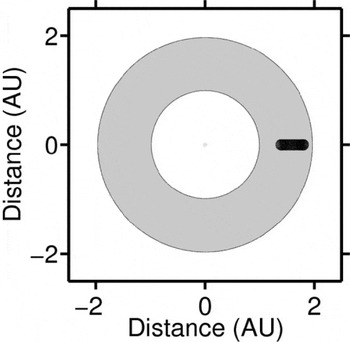
Our set of model simulations reveals a considerable variety in the dynamics of the Earth-mass planet. The most surprising case is the following: For a p=1.596 AU and e p=0.133 (see Fig. 6) with the Jupiter-type planet initially placed at periastron position and the Earth-mass planet placed at 0°, it was found that the latter never crosses the inner or outer limit of the stellar HZ during the simulation time of 106 years. However, it is found to orbit the giant planet in a retrograde orbit (relative to the orbital motion of the giant planet about the star). In this case, the Earth-mass planet is captured by the giant planet and becomes a habitable moon, which occurs almost immediately after the start of the simulation.
Orbital stability simulations with HD 23079 b initially placed at periastron with a p=1.596 AU, e p= 0.133 and the Earth-mass planet placed at a starting angle of 0°. The Earth-mass planet remains within the HZ for at least 106 years. However, during that time it was captured by the giant planet and thus became a natural satellite (moon) of that planet, resulting in the small black area. Also note the absence of the ‘banana-shaped’ area at L4 or L5.

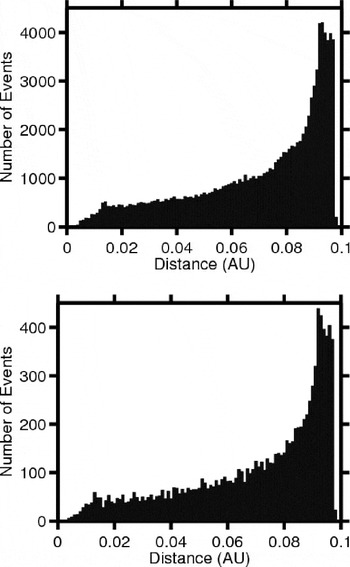
The analysis of its orbital data shows that the moon's semimajor axis concerning its motion about the giant planet is a moon≃0.051 AU. Its eccentricity is e moon≃0.8 entailing a perigee and apogee of 0.0034 and 0.098 AU, respectively. Thus, with a uniform data sampling rate, the moon is most likely to be recorded at or near apogee. From Fig. 7 it is evident that there is also a precession of the perigee in a retrograde sense with a period of approximately 30 years. Figure 8 shows two histograms regarding the time-dependent distance of the moon from the giant planet, which reconfirms the moon's highly eccentric orbit. The existence of a habitable moon in the HD 23079 system is also consistent with the criterion of Hill stability as pointed out by e.g. Donnison (Reference Donnison2010). This study explores dynamic Hill stability for a large variety of three-body systems considering moon/planet mass ratios of 0.1, 0.01 and 0.001.
Using the giant planet as reference and origin of the coordinate system, we measure the angle θp of the captured terrestrial planet, which thus became a moon, in a sidereal frame (with θp=0° corresponding to the 3 o'clock position). With a uniform data sampling rate, the moon will be more likely recorded at or near apogee. Since the orbit of the moon is highly eccentric, there are many more points when the moon is near apogee compared to when it is near perigee.

Histogram displaying the time-dependent distance between the moon and the giant planet. Top: simulation with an elapsed time of 1000 years and a data sampling period of 0.01 years. Bottom: simulation with an elapsed time of 1×10⁶ years and a data sampling period of 100 years. The comparison between both figures shows that there is little, if any, evolution of the system over the total time of simulation.

There is a persistent interest in the study of habitable moons with respect to extrasolar giant planets orbiting host stars in the stellar HZs. Previous studies of habitable moons in systems akin to HD 23079 have been given by Williams et al. (Reference Williams, Kasting and Wade1997), Barnes & O'Brien (Reference Barnes and O'Brien2002) and others. The study by Williams et al. (Reference Williams, Kasting and Wade1997) did not include HD 23079b as this star-planet system was unknown at the time when this study was pursued. However, by targeting the companions of 16 Cyg B and 47 UMa, Williams et al. (Reference Williams, Kasting and Wade1997) investigated appropriate orbital parameters of possible moons, and pointed out that the moons need to be large enough (i.e. >0.12M ⊕) to retain a substantial and long-lived atmosphere, and furthermore would need to possess a significant magnetic field to prevent its atmosphere from being sputtered away by the ongoing bombardment of energetic ions from the planet's magnetosphere, if existing. Another study of possible moons, which is fully applicable to the HD 23079 star–planet system, has been given by Barnes & O'Brien (Reference Barnes and O'Brien2002). They concluded that Earth-like moons of a Jovian planet like HD 23079 b would be able to exist for at least 5 Gyr considering that the stellar mass of HD 23079 exceeds 0.15 M ⊙.
Conclusions
The aim of our study was to add to the investigation of habitable Trojan planets in the HD 23079 star–planet system. This system consists of a main-sequence star slightly hotter than the Sun. Additionally, it contains a Jupiter-type planet with a minimum mass of 2.45 M J that is orbiting the star in a slightly elliptical orbit that is positioned within the stellar HZ. The main goal of our study was to explore if Earth-mass habitable Trojan planets can exist in this system.
As the centrepiece of our study, we calculated a total of 144 orbital stability simulations for the Earth-mass planet by choosing different starting positions (phase angles) as well as placing the Jupiter-type planet either at periastron or apastron position. The attainment of habitability solutions was found to critically depend on various parameters, which include the orbital parameters of the giant planet (semimajor axis, eccentricity) and the initial condition (phase angle) of the theoretical Earth-mass planet. We encountered a variety of different outcomes, which include (1) ejection of the Earth-mass planet from the system, (2) engulfment of the planet by the star (or possible destruction in accord with the Roche limit criterion), (3) capture of the planet, thus becoming a habitable moon, or (4) remaining within the stellar HZ. The latter case was only attained in models where the orbit of the giant planet had a relatively low eccentricity (but still within its observationally given uncertainty), which however may be partially due to the implemented choice of planetary starting positions. Concerning the latter case, there were also cases (not shown in detail) where the planet took short-term excursions from the HZ (i.e. considerably less than the orbital period of HD 23079 b, which is about 730 days), which should be insufficient to nullify its habitability because the latter is expected to mainly depend on the average stellar flux received over an entire orbit, rather than the length of the time spent within the HZ (Williams & Pollard Reference Williams and Pollard2002), although the ultimate effect of temporarily leaving the zone of habitability will still partially depend on the atmospheric thickness, structure and composition (e.g. Dressing et al. Reference Dressing, Spiegel, Scharf, Menou and Raymond2010).
Moreover, we note that our study is supplementing previous work by Schwarz et al. (Reference Schwarz, Dvorak, Sűli and Érdi2007), who concluded that a Trojan planet in the HD 23079 star–planet system will only spend 35% of its time in the stellar HZ. However, this estimation was based on a considerably narrower zone of habitability than used in the present study. Another, albeit minor, difference is that Schwarz et al. (Reference Schwarz, Dvorak, Sűli and Érdi2007) used slightly different orbital parameters for HD 23079 b than in the current study. In conclusion, it can be argued that the system of HD 23079 is very well suited for the existence of habitable Earth-type Trojan planets, and thus deserves serious consideration in ongoing and future planetary search missions.
Acknowledgements
This work has been supported by the U.S. Department of Education under GAANN Grant No. P200A090284 (J.E. and B.Q.), the SETI institute (M.C.) and the Alexander von Humboldt Foundation (Z.E.M.).