1. Introduction
Despite its roots in underground dance music, electronica’s experimental fringes now increasingly overlap with Western art music in terms of complexity, aesthetics, technology, tools and techniques. New cultural architectures are eroding established boundaries and power structures (Chadabe Reference Chadabe2000: 9–11) and require new interdisciplinary approaches to describe and reconcile them.
This article gives context to and defines emerging avant-garde electronica or ‘experimental dance music’ aesthetics within the context of electroacoustic music. This is achieved though a structured analysis that integrates aspects of genre and artistic practice with social, financial and technological capital. This analysis builds on aspects of David Brackett’s genre level model, a method of clarifying discourse by reducing complex genre networks into flexible, manageable sets of relationships. Section 1 introduces and contextualises the material though a personal anecdote. Section 2 examines the concept of ‘experimental dance music’ in a broader electronic music context – specifically though the introduction and integration of the genre level model with Bourdieu’s concept of cultural capital. Section 3 identifies characteristic features of the avant-garde in electronica and its associated subgenres. These features are identified by examining areas of convergence with aesthetic and technological aspects of electroacoustic and Western art music traditions. In order to maintain a continuous thread throughout the article, Amon Tobin and Robert Normandeau are often cited as musical examples. Their compositional output spans a similar period roughly 1990 to present and they are each characteristic representatives of their respective fields.
The goal of this article is not to suggest that ‘experimental dance music’ and acousmatic/electroacoustic music are identical, or that one is somehow derivative from or superior to the other. Rather, it seeks to clarify the discussion surrounding a significant, influential and rapidly expanding area of the electronic music field where aesthetics, technology and technique coalesce.
The information in this article is based on a mixture of scholarly and popular sources. It also draws on personal experiences and observations as a composer/practitioner straddling the academic and ‘experimental dance music’ fields.
1.1. Personal anecdote and context
During my time as a composer, researcher and instructor working at Montreal’s McGill University between 2006 and the present, I witnessed a remarkable shift. A generation of electroacoustic composers began trickling into the university and conservatory systems, bringing inclusive, pragmatic views concerning music technology as well as considerable sound design experience. From a formative age, these composers and researchers had cut their teeth on powerful, commercially available audio production software aimed at the dance music and home audio production market. When introduced to the specialised artistic research equipment, tools and software associated with electroacoustics, these tools were readily absorbed into an already diverse creative palette. Some (myself included) were unwilling to abandon the versatility and functionality of familiar commercial tools. This was despite admonitions from professors concerning the aesthetic limitations and artistic pitfalls surrounding the application of ‘experimental dance music’ production practices in an electroacoustic context.
Boundaries between technology worthy of research creation and the tools for dance music production were rapidly being eroded by technological democratisation. The fidelity, feature and functionality gap had narrowed and chimera works began to emerge.
Of course there were eyebrow-raising moments where overtly pulse-driven ‘musique dj’ made its way into acousmatic concerts. These works were greeted by healthy, animated discussions about the aesthetic gulf between ‘pop’ and the acousmatic tradition, about freedom from pulse and limitations of standardised practice, popular forms and financial viability (Senécal Reference Senécal2014). At this point I realised that there was a startling disconnect between my understanding of ‘experimental dance music’ and what was being described as ‘pop’. How could an obscure and alienating genre of terrorcore be so casually lumped into the same artistic territory as a pop radio single? The former seemed so much closer to the subversive aesthetic threads that ran though the modern and postmodern traditions.
Then came the works that engage elements from both electroacoustic and electronica spheres, effectively bridging the aesthetic gulf while displaying a command of technology, materials and technique from both fields. These difficult to categorise, carefully crafted works occupy a growing space between ‘experimental dance’ music and Western art music’s electroacoustic tradition. Interestingly these hybrid works are just as likely to be produced within the hyper conscious, self-aware climate of the university system as the experimental fringes of a dance music scene. Understanding and navigating the relationship between these two fields became a necessary obsession as it came to define my artistic practice.
2. Genre Level and Electronica
2.1. Definitions
Clarifying the terms avant-garde or experimentalism pose an interesting challenge when said terms are most often found prepended to wide-ranging genre descriptors that encapsulate diverse and fragmented musical practices. So what is ‘experimental dance music’? The answers to this question are as diverse as the subgenres communities, institutions and scenes whose artistic practice evolves though experimentation. An aesthetic breath of fresh air in one community, scene or genre may be considered stale, outdated banality by another. Identifying points of convergence within this myriad of intersecting claims at avant-garde status necessitates not only a structured analysis, but also clear definitions as a point of departure.
Briefly, and for the purposes of this discussion, electroacoustic music can be defined as a metagenre of electronic music encompassing acousmatic, live electronic, computer music and other electronic musics with origins in the Western art music traditions and to varying degrees the subsidised research institutions around which they flourish. Electroacoustic music will be used as a functional term within the context of this article referring to music that:
-
∙ exists primarily within a subsidised Western art music context;
-
∙ remains independent from mainstream music industry;
-
∙ has no set formal or stylistic parameters;
-
∙ divides into live electronic, acousmatic, computer music and other subfields;
-
∙ practitioners consider themselves to be ideologically and aesthetically distinct.
Functional definitions of avant-garde electronica in this text are based on comparative cultural studies and musicological definitions. In her 2010 text Listening Though the Noise, Johanna Demers (Reference Demers2010: 167) introduces a set of electronic music super-genres, what she refers to as metagenres. In this model, acousmatic, electroacoustic and live electronic audiences and practices are grouped according to their affiliation with subsidised institutions, creating points of departure for areas of convergence and divergence. The definition of electronica in Demers’s text is as follows:
Electronica: Electronic music that flourishes primarily outside of academia but also claims some independence from the mainstream music industry. Electronica is split between dance genres such as house or techno and non-dance-oriented music such as drone, ambient, or glitch. No specific formal stylistic parameters govern what counts as electronica; the one common factor seems to be a sense among artists and listeners that electronica is ideologically distinct from both mainstream culture and institutional electronic music. The term began to appear in the 1990s as a music-industry tool to brand what had become an explosion of niche EDM subgenres such as acid house and jungle. Along with electroacoustic music and electronic sound art, electronica is one of three metagenres of recent electronic music. (Demers Reference Demers2010: 167)
While the term electronica carries negative connotations among fans and artist practitioners due to associations with industry appropriation in the late 1990s, it remains a functional term within the context of this article when discussiing electronic music that:
-
∙ exists primarily outside a subsided or Western art music context;
-
∙ remains independent from mainstream music industry;
-
∙ has no set formal or stylistic parameters;
-
∙ divides into dance genres vs listening genre;s
-
∙ practitioners consider themselves to be ideologically distinct.
2.2. Genre level: introduction
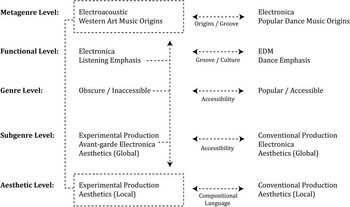
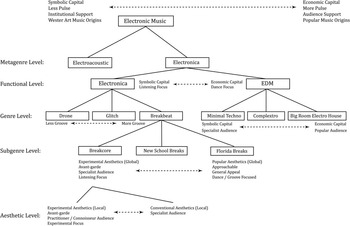
With established boundaries and a narrowed scope, it is possible to more carefully examine the subtle internal relationships that govern electronica as a metagenre of electronic music. A more precise analysis of electronica and its areas of convergence require a more detailed model. This genre level-inspired approach based on work by David Brackett identifies and categorises the context in which genre descriptors are used. In other words, the term electronica can most accurately be expressed as a flexible multilevel schema that visualises and integrates multiple perspectives. While these simplified dialectical pairs are not exhaustive, they offer a solid framework for relevant discourse surrounding electronica and electroacoustic music and can be represented as in Figure 1.
Electronic music genre level diagram (general).

Figure 1 shows a multilevel continuum on which works within the electronica metagenre can be contextualised and dissected. Each genre level represents a dialectical pair with its own aesthetic and cultural discourse. The genre levels are indicated on the left of Figure 1, continuing horizontally across the schema, with horizontal arrows denoting a spectrum on which compositions, albums or artists can be placed. The dashed vertical arrows represent a continuum of potential aesthetic overlap between experimental electronica and the Western art music tradition. Genre levels can be added or removed to clarify a discussion, depending on the context.
2.2.1. Metagenre Level
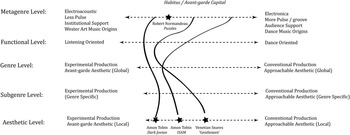
In Figure 1, the Metagenre Level describes a genre continuum relating to music composed through electronic means. The left side of the figure indicates listening oriented, groove-free electronic music of Western electroacoustic/acousmatic origins, the right side being groove-based electronic music with popular music origins (Neill Reference Neill2002: 3–6). Electronic music composed within the Western art music tradition or electronica metagenre can be expressed as a point on this line. The arrow refers to the spectrum of groove, compositional practices, tools and techniques. This genre level provides a point of reference for discourse on electroacoustic versus popular dance music, as described by Demers (Reference Demers2010: 15), Neill (Reference Neill2002), Chadabe (Reference Chadabe2000), Reynolds (Reference Reynolds2012), Tagg (Reference Tagg1982), Normandeau (Sénecal 2014) and others. This level is informed by academics, researchers and composer practitioners with institutional affiliation seeking to distinguish the Western cannon from popular sources (Tagg Reference Tagg1982). For example, at this genre level, Stockhausen’s famously clinical Electronic Study no.2 would fall on the far left. Robert Normandeau’s 2003 work Puzzle with its rhythmic loops of human utterances falls left of centre. Unapologetically danceable, Disco House sits on the far right with less dance-dominated rhythmic works by artists such as Venetian Snares smearing though the electronica spectrum to the arrhythmic textural stasis of Amon Tobin’s Dark Jovian (see Figure 2 for more detailed examples that will be clarified in further sections).
Electronic music genre level diagram (capital details).

2.2.2. Functional Level
The Functional Level provides an electronica specific genre continuum. At this level, electronica divides between dance-oriented electronic music on the right and more experimental, listening-focused music on the left. Electronica, avant-garde electronica and EDM (Electronic Dance Music) are distributed across this spectrum depending on their rhythmic elements, groove, cultural and genre affiliations. This level provides a framework for academics, fan-critics, concert promoters and electronica insiders to discuss aesthetics and ideology surrounding dance-oriented vs listening-oriented electronic music, scenes and production practices. In this continuum BJ Nilsen’s deep listening remains on the extreme left. Artists with varying adherence to groove-based production practices spread out from the middle with producers such as Dominik Eulberg (minimal techno) populating the extreme right. Amon Tobin’s 2011 album ISAM as well as Tipper’s 2014 album Forward Escape reside in the middle, fluctuating between groove-oriented and gestural listening-focused materials.
2.2.3. Genre Level
The Genre Level encompasses works within the major genres of electronica and how they compare in terms of accessibility and relatedness to popular music production practices. Major categories include techno, house, breakbeat, experimental and ambient. Scholars, audience members and practitioners are able to discuss electronica at this genre level with relative confidence as the terms have stabilised somewhat over the last two decades. While functional and meaningful in context, terms such as house have relaxed into vague generalisations and tempi due to expanding subgenres, shifting chronology and geographically dependent terminology. The compositional features of the works encapsulated within these genres are related but highly varied. For example, within the breakbeat genre, breakcore veteran Venetian Snares sits on the left, pushing extremes in tempo, texture and complexity. Florida breaks producers such as Huda Hudia produce music from similar base materials for use as party music. Both artists produce breakbeats and share similar stylistic origins and production techniques, but their aesthetics are polarised.
2.2.4. Subgenre Level
The Subgenre Level presents an aesthetic continuum where electronica is described according to experimental and conventional production practices as well as aesthetics at a global level. This level encompasses the varying ideologies, stylistic elements, popular audience, age demographics, regional variations and histories that inform a subgenre’s discourse. This lower level, detailed genre level requires intimate knowledge of a specific genre or subgenre of electronica and is typically the domain of musicologists, producer/practitioners, dedicated fans and DJs. The horizontal arrow presents the spectrum of electronica subgenres and their relative accessibility compared to global aesthetics.Footnote 1 For example, a producer working within a subgenre that defines itself through avant-garde experimentalism could find their works drifting towards the Conventional Production Practices side of the schema (Figure 1). This aesthetic drag is a result of the passage of time as trends change higher up on the genre level diagram. For example, early hardcore and drum and bass productions from UK hardcore label Knite Force have been aggressively nudged to the right of the diagram from the 1990s until present. This is due to increasingly aggressive and uncompromising subgenres that continuously redefine conventional production aesthetics on the global scale.
For example, between the mid-1990s and 2015, Amon Tobin’s new musical output resisted aesthetic drag and drifted from the mid-right to the left of the subgenre continuum with increasingly experimental production methods and abstract aesthetic directions. His latest project, Dark Jovian, pushes further towards the electroacoustic metagenre, evoking familiar acousmatic concepts such as ‘cinema for the ear’, as well as directly citing the ‘contemporary classical’ composer György Ligeti as a source of inspiration (FactMag Reference FactMag2015).
2.2.5. Aesthetic Level
In Figure 1, the Aesthetic Level represents a genre, or subgenre, scene or field as a continuum of aesthetic practices at a local level. At this level, the aesthetic continuum identifies the avant-garde or experimental character of a work according to local, genre-specific production practices. For example, a producer may be expanding the boundaries of the complextroFootnote 2 genre and be considered an experimental pioneer according to local production aesthetics. However, as their work moves upwards in the genre level schema, it may drift from the left to the right, as local experimental production aesthetics consolidate into narrow portions of broader larger continua.
Amon Tobin’s ISAM and Dark Jovian projects remain on the aesthetic fringes of Figures 1 and 2. However, as these albums are examined at higher genre levels, they follow the outer edge of the experimental side of the genre level. The work’s position shifts to the right as it approaches the metagenre level. At this level, material that was once considered breakbeat aesthetic level avant-garde narrows and is nudged towards the right. This is due to the presence of groove and production practices associated with dance genres. ISAM sits further to the right of Dark Jovian because of its clearer associations with dance music production methods. Dark Jovian has shed almost all groove-based compositional practices, placing it in an aesthetic space where it would be less shocking in an acousmatic concert than the electronica venues where it is performed.
3. Areas of Convergence
3.1. Aesthetic convergence
Recontextualisation, noise, minimalism, complexity and technology are substantial areas of shared artistic practice regardless of field or metagenre. This section examines relevant points of stylistic overlap, or shared points of departure. That is to say, the way similar artistic ideals and approaches manifest themselves in differing communities and areas of practice.
3.1.1. Cultural production and capital exchange
According to Bourdieu’s The Field of Cultural Production (Reference Bourdieu1993), the success of a musician depends on their ability to effectively situate musical works within the social conditions of their production, circulation and consumption. The mutually understood invented value of an artistic product can be understood as a form of symbolic capital. In other words, artistic works with no physical value require the cultivation of artistic credibility within a community – each with a set of accepted practices or habitus. This network of symbolic, financial and social capital informs power structures within the field. This process can take many forms and varies depending on communities, habitus and methods of consumption. For example, an electroacoustic composer’s musical output at acousmatic concerts, artistic integrity, education and prestige within the electroacoustic community combine in the form of symbolic capital that can be exchanged for financial capital through a paid position as an instructor or researcher.
For an avant-garde electronica producer, the conditions of their field differ considerably, so too do their methods of generating symbolic, cultural and financial capital. However, there are growing areas of convergence. In the absence of subsidised institutions to broker symbolic and financial capital, electronica producers rely on traditional exchange. These exchanges take the form of music downloads, streaming, licencing, CD and record sales. Despite its adherence to standard financial models, electronica’s disavowal of financial capital mirrors the rhetoric of avant-garde experimentalism. In other words, electronica producers get ahead by selling music without ‘selling out’. However, with dwindling CD sales and niche market downloads rapidly losing financial viability, electronica producers and associated record labels are turning to state subsidy, crowd funding and monthly donations for support. Examples in respective order include the Canada Council for the Arts Music Production Grant, Kickstarter and Patreon. The social conditions are changing and impacting the cultural economy. This is an example of what Bourdieu describes as a shift in habitus. These shifting technological and market forces place some avant-garde electronica producers in a similar position as electroacoustic composers, that is, applying for grants and convincing government arts agencies of the validity of their work.
Both of these transaction scenarios require the transfer of symbolic for financial capital and are heavily dependent on the intersection of experimental aesthetics, reputation and social status; in other words, avant-garde capital. In this context avant-garde capital describes a form of symbolic capital relating to accepted norms, experimentalism, originality and taste within a specific community. The following sections are examples of aesthetic convergence where similarities and differences within avant-garde capital exchange can be more easily observed.
3.1.2. Recontextualisation vs quotation
Manipulating and recontextualising fragments of existing music is a practice as old as the Western musical tradition itself, as in mediaeval cantus firmus based on quotation, and melodic manipulations in modal counterpoint, from Bach to Beethoven to Berio’s Sinfonia, and from Oswald’s Plunderphonics to Madeon’s Pop Culture. Manipulating familiar musical materials – symbolic, physical or digital – not only serves as a tangible connection to a musical legacy, but also draws in listeners familiar with the material being manipulated.
Avant-garde electronica and electroacoustic music both span the gamut from self-conscious hyper-awareness of material and narrative via direct quotation, to completely stripping sounds of all meaning and context and using sound as raw material to create larger structures. In electronica production, an intuitive form of Schaeffer’s reduced listening naturally occurs when a musical whole is constructed from sampled audio materials. Employing aspects of Smalley’s gestural surrogacy for aesthetic effect is standard practice and depends a great deal on extrinsic factors. In other words, both avant-garde electronica and acousmatic music strive to manipulate listener perception and recognition as part of the compositional process.
Notions of avant-garde capital in this case can be understood as a function of multiple elements:
-
∙ The clever selection and informed quotation of culturally significant source materials, pushing a polemic concept or political agenda.
-
∙ The artful, indiscriminate sampling and micro-montage of materials stripped of any meaning.
-
∙ Any combination of materials stripped of and imbued with meaning, generating interest from the interplay between each of these practices.
A loss of avant-garde capital is a function of the appropriation of audio in poor taste or a lack of technical sophistication with regards to technique in the form of micro-montage. However, taste in sampling technique varies depending on field, genre and community. In this case, genre level and capital allow for more precise comparisons, highlighting specific similarities between electronica and acousmatic music. For example, like Oswald, Cascone and other post-digital electroacoustic composers – Crystal Castles, Oval and other electronica producers respectively – revel in the audible pops and clicks of abruptly cut sampled materials. They consciously choose to rebel against pristine audio fidelity and to highlight imperfections and artefacts introduced through sampling leverages avant-garde capital in their respective fields and across many genre levels.
While the aesthetics vary depending on their positioning within the genre level diagram, both avant-garde electronica and electroacoustic producers share similar mechanisms for leveraging avant-garde capital though the use and manipulation of sampled materials.
3.1.3. Organised sound
In his 1913 letter The Art of Noises: Futurist Manifesto, Luigi Russolo introduces noise as a compositional element, demanding that sounds of the modern world take their rightful place alongside pitch, a premonition of sampling and the techno-industrial aesthetic that informs avant-garde electronica (Cox and Warner Reference Cox and Warner2009: 10–14). In 1923, László Moholy-NagyFootnote 3 suggested that new composition paradigms will arise through developments in turntable technology and the etching of sound directly into records, foreshadowing modern audio editing and digital audio workstations (ibid.: 328–31).
John Cage’s The Future of Music: Credo (ibid.: 25–8), Edgard Varèse’s The Liberation of Sound (ibid.: 17–21) and Henry Cowell’s The Joys of Noise (ibid.: 22–4) each examine the musical potential of structured noise. These polemicists, pioneers and practitioners paved the way for current generations of acousmatic and electroacoustic musicians that revel in field recording, synthesis and improvisation.
In avant-garde electronica and Western art music contexts relating to noise, avant-garde capital is gained through extreme volumes and dynamic shifts, subtle and aggressive timbre, novelty and creativity. As outlined in Bourdieu’s The Field of Cultural Production (Reference Bourdieu1993), the less the music adheres to conventional musical norms, as defined by the Western art music and electronica fields, the more potential for massing avant-garde capital it gains. The use of noise elements and their ability to generate avant-garde capital depends on its position within the genre level diagram. For example, the title track from Amon Tobin’s Dark Jovian project traces its origin to the aesthetic fringes of breakbeat subgenres. Its radically experimental tone represents a shocking artistic departure at the aesthetic level. In other words, Amon Tobin’s core audience and community were intrigued by arrhythmic noise. Conversely, as Dark Jovian is placed on higher genre levels and critiqued by noise or electroacoustic music practitioners, its avant-garde capital diminishes. This is due to a shift in habitus and direct comparisons with works whose aesthetic point of origin is arrhythmic.
Both avant-garde electronica and acousmatic fields leverage the alienating properties of noise for avant-garde capital. The inherent value of noise as a form of avant-garde currency varies widely depending on context and subtle differences in cultural economy.
3.1.4. Minimalism
In the 1960s and 1970s, La Monte Young, Terry Riley, Steve Reich and Philip Glass introduced the Western music world to music without narrative, where gradually evolving processes became the focal points for the listener. The minimalist school and minimalism in general conceptually overlap with large areas of the electronica field. Cyclical repetitions and gradual transformations form the backbone of many electronica genres including house, techno, trance and breakbeat. Motivic fragments and pulsing percussion patterns increase tension through layering and slowly evolving processes. Other forms of minimalism create a sense of stasis achieved through the use of sustained tones and/or sparse, slowly evolving arrhythmic material. Ambient, minimal, drone, chillout, soundscape and other electronica genres fall into this stylistic subcategory.
As with minimalism in the Western concert music tradition, some forms of electronica minimalism are widely appealing, soothing and enjoyable for a broad audience. According to Bourdieu, this popular appeal undermines its perceived artistic integrity or symbolic capital within an avant-garde context. That is, the approachable and financially viable aspects of minimalism undermine its avant-garde capital within the art music community. Furthermore, more extreme and alienating forms of minimalism maintain a stronger claim to traditional notations of avant-garde, whether in Western art music or electronica.
Robert Normandeau’s Puzzle presents an interesting example. Puzzle’s artful use of evolving, cyclical rhythmic materials provides a refreshing contrast to gestural works that typically dominate electroacoustic concert programmes. As theorised by Bourdieu, in this case artistic capital increases with an aesthetic shift away from established norms at the aesthetic level. Normandeau describes the work in the following way.
This music has been composed, as its title suggests, as a succession of small pieces made to fit with one another. But unlike the traditional game, here the pieces of music can be organized in any order. In other words, in regards to the temporal and timbral aspects, the sonorities used have been tuned in such a way that they can be superimposed or juxtaposed in a thousand different ways. (Normandeau Reference Normandeau2005)
In this liner note excerpt, Normandeau describes the fundamental construction principles of a majority of the electronica metagenre presenting an interesting point of convergence. Using the puzzle metaphor and carefully selected vocabulary, Normandeau at the same time distances himself from associations with electronica while exploring related aesthetic territory. Associations with electronica and the potential to undermine avant-garde capital are mitigated though careful positioning. Alternatively, Amon Tobin’s Dark Jovian and ISAM defy aesthetic level conventions on the genre level diagram through the temporary disavowal of familiar rhythmic practices. The Dark Jovian example presents a related opposite to Normandeau’s Puzzle, with avant-garde capital being gained though the elimination of cyclical rhythmic patterns in favour of a more gestural language. In both cases, avant-garde electronica and the electroacoustic traditions converge on related aesthetic territory by disavowing familiar elements.
3.1.5. Complexity
Subtle and extreme complexity have long been used as a method for leveraging avant-garde capital. From the clockwork intricacy of the Baroque, and the New Complexity of Brian Ferneyhough, to the deceptive internal complexities of the classical period and spectralism, artistic capital flows from detailed arrangements of musical materials. The relationship between avant-garde status and varying flavours of complexity shift depending on habitus and position within the genre diagram.
Like electroacoustic music and baroque music, electronica typically gains avant-garde capital through audible sophistication. For example, breakcore artist Venetian Snares creates extremely intricate, aggressive rhythmic works from limited audio materials. His aesthetic extremes are the natural result of artists straining against aesthetic level conventions and producing increasingly intricate micro-montage.
The finale of Gentlemen from the 2008 album Detrimentalist provides a characteristic example of this process of aesthetic progression. Electronica’s ongoing attempts to leverage avant-garde capital though complexity has resulted in a multitude of subgenres breaking off and re-forming on the aesthetic fringes of the subgenre level. Complextro, neurofunk, speedcore, breakcore, American dubstep, each create remarkably intricate and structured sound worlds from the tools and techniques of dance music. However, the appreciation of the complexity of these works is limited by a lack of symbolic representation or notated scores. The lack of a notated score means the work must be appreciated directly and that any complexity in the structural or conceptual underpinnings cannot be appreciated when separated from the music unless explicitly explained by the composer/producer or a musicologist.
Exceptions exist in the form of embedded imagesFootnote 4 revealed though spectrogram and visualisation software, as is the case with Aphex Twin’s Equation from the 1999 album Window Licker, or works whose appreciation requires the understanding of specific hardware constraints. For example, works performed on unique and challenging interfaces such as dot matrix printers and hard drives where the complexity of the work is appreciated visually.
Avant-garde electronica and electroacoustic music both struggle with the limits of perception when revealing intricately structured complexity in real time and sometimes rely on visualisations and listening guides to reveal hidden internal structures. Both fields exchange artistic capital through high attack density, intricate micro-montage and elegant transformations of material. Whether these compositional elements are exchangeable for avant-garde capital depends less on the nature of the material itself than on its vertical placement on the genre level diagram.
Electronic music genre level diagram (avant-garde trajectories).

3.2. Technological convergence
The flow of innovative technologies and aesthetic practices has typically radiated outwards from specialised research institutions to be absorbed and implemented by product manufacturers, software developers, eventually reaching the hands of producers in the form of polished professional products. However, after decades of technological dissemination, the balance of technological capital allows influence to flow in both directions, sometimes though surprising channels. Circuit bent toys, vintage analog synthesisers and DJ-oriented production tools have carved out a space alongside acousmatic music in many electroacoustic programs. Examples include De Montfort University’s Dirty Electronics Ensemble, McGill University’s Expanded Performance Trio and any number of performances at INA/GRM’s Présences Électronique or Montréal’s électrobuzz and Akousma series. These combinations of electroaoustic compositional aesthetics and avant-garde electronica performance practices result in interesting points of convergence through technology. Most significantly for the thrust of this article is the emergence of avant-garde electronica as an influential aesthetic in its own right along with the explosion of the bedroom electronica producer and its effect on the music technology marketplace.
3.2.1. Technological capital
Electroacoustic, acousmatic and live electronics composers affiliated with subsidised research institutions enjoy privileged early access to prototype technologies, facilitating the creation of groundbreaking compositions. According to Bourdieu’s model, this is an example of a network of financial, symbolic and cultural capital resulting in novel forms of artistic practice. That is to say, financial capital is exchanged for avant-garde capital though the acquisition of technological capital. IRCAM, CCRMA, ZKM, BEAST, CIRMMT and other academic research institutions are able to bring together the funds, technology and expertise to create unprecedented electroacoustic works.
For example, the Columbia Princeton Music Center’s RCA Victor Mark II synthesiser, a costly technological marvel in 1957 made possible from the Rockefeller foundation, allowed for the realisation of complex serial works such as Philomel by Milton Babbit and the Pulitzer Prize winning work Time’s Encomium by Charles Wuorinen. However, due to technological capital’s fleeting nature, it drains away with progress and the passage of time. The RCA Mark II was obsolete within ten years. It was overshadowed by the proliferation of solid-state subtractive synthesisers manufactured by Moog, Buchla and others (Manning Reference Manning2003: 95–8). This type of democratisation among others began the gradual process of eliminating high technological capital investment as a barrier of entry to electroacoustic music.
From Kraftwerk’s vocoders to Amon Tobin’s custom-built KymaFootnote 5 interfaces, the quest for uncharted areas of audio production is an established part of both electronica and electroacoustic narratives. Some electronica artists have created bespoke tools for music making, performance and distribution – Tim Exile, Bjork, Amon Tobin, Robert Henke, The Black Dog and others. However, unlike electroacoustic music, the electronica community is typically decoupled from formal research.
3.2.2. Post-digital trends
Initially avant-garde electronica and acousmatic music experienced technological capital from different perspectives. Yet, due to democratisation of technology and the rise of post-digital aesthetic trends, boundaries have blurred and areas of convergence are increasing. High-quality audio equipment remains important, but the conversion rates between technological and avant-garde capital are shifting. Evidence for this can be traced to the roots of the post-digital movement itself. That is, when pristine audio quality and powerful, transparent sound shaping tools become ubiquitous, Bourdieu’s model suggests that avant-garde capital can be earned though the re-adoption of imperfections and limitation. Renewed interest in analogue synthesisers and the tactile world of vintage technologies is a testament to Bourdieu’s theories.
Depending on a work’s position within the genre level diagram, the role of obsolete technology varies drastically. Instead of older technologies signalling a decline into irrelevance, with the correct habitus older technologies may represent quality, rarity and an expanded, diverse sonic palette. Examples include the ensembles and concert series mentioned in section 3.2, the work of composer Nicole Lizée as well as my own work Metatron, for percussion ensemble, Rhodes piano, analogue drum machines and modular synthesiser. Metatron explicitly explores subtle variations in the sounds of technology associated with specific eras: 1920, 1950, 1975, 1980 and 2015 respectively.
These shifts in habitus recharge the depleted technological capital associated with desirable equipment, transforming it into a form of vintage technological capital. While not consistent across the board, an interest in post-digital aesthetics and vintage technological capital represents yet another point of convergence between electroacoustic and avant-garde electronica.
3.2.3. Common platforms
Writings on ‘experimental dance music’ or avant-garde electronica emphasise democratisation as essential part of the emergence of the dance music genre. However, modestly funded electroacoustic composers regularly benefit from the same transformative technologies as independent dance music producers. For example, Yamaha’s 1983 DX7 FM synthesiser keyboard and later the 1987 TX802 FM rack mount synthesiser were mainstays of 1980s and early 1990s electroacoustic music studios. These units now abandoned in back storerooms represent an important point of convergence.
In the 1980s and 1990s, dance music producers took advantage of the same effective technologies for their own purposes, shaping characteristic FM sounds into punchy solid FM bass tones, glassy pads and morphing soundscapes. The same revolutionary feature set attracted electroacoustic composers. When loaded with meticulously constructed microtonal bell tones and morphing percussive patches, these commercially available FM units offered access to previously cost-prohibitive forms of synthesis available only to the largest research institutions. Mid-level electroacoustic studios with limited budgets and aging subtractive synthesisers were able to create sounds hitherto beyond their reach.
Listening in hindsight, much of the electroacoustic music, dance music and avant-garde electronica of the 1980s and 1990s is coloured with an FM signature that subconsciously shapes aesthetics, despite divergent artistic goals. This does not intend to imply that earlier technologies did not impart an audible signature, the previous generation of subtractive synthesisers and tape recorders had a similarly identifiable sound. Rather, affordable FM synthesis modules provide an early example of ubiquitous access to transformative technology across the electronic music field. Access to sophisticated FM synthesis and other digital tools ushered in a period of convergence that ends with the mid-2000s now ubiquitous laptop, virtualised studio, audio interface and studio monitors. This period of technological convergence has resulted in a common compositional platform that facilitates drift between technologies and tools typically associated with either electroacoustic music or dance music production, laying the foundation for critical shifts in discourse surrounding the difference between professional and amateur software tools.
3.3. Convergence in software
Electronica’s practitioner base has grown to such an extent that its influence bleeds into the electroacoustic communities not only as an aesthetic in itself, but also as a market force; for example, the commercialisation of technologies and software tools though partnerships such as Cycling 74’s partnership with Ableton Live, Emagic and Camel Audio’s acquisition by Apple, more recently IRCAM’s technological partnership with FLUX – all examples of increased accessibility for not only bedroom studio producers but also electroacoustic studios looking to access familiar software with a stable, polished user-friendly interface. With these user-friendly interfaces come idioms and features that cater to dance music production, further facilitating aesthetic drift and cross-pollination.
For example, Camel Audio, Audio Damage, Native Instruments and Image Line have all developed fully featured additive synthesis software instruments with interfaces catering to electronica producers accustomed to a specific set of features, that is, features based on subtractive synthesis and loop-based composition among others. In this way, like FM synthesis in the 1980s and 1990s, commercial additive synthesis software acts as a bridge with its idiomatic interface design choices, signal path and sonic character subtly infiltrating electroacoustic and avant-garde electronica respectively. In other words, inevitable moments of sonic convergence occur when electronica producers and acousmatic composers are drawing from an increasingly interpenetrating pool of software resources.
4. Conclusions
A systematic examination of avant-garde electronica and Western art music’s electroacoustic tradition has identified significant areas of aesthetic and technological convergence. Tracing the concept of avant-garde aesthetics as a form of symbolic capital within Bourdieu’s comprehensive ‘theory of society’ provides a method for unravelling relationships and power structures between electronica and electroacoustic genres. Recontextualisation, noise, minimalism and complexity each offer insights into similarities and differences in the way avant-garde capital is managed within disparate artistic communities. Further analysis reveals that while aesthetics differ to varying degrees among individual works and genres, many strategies for generating avant-garde capital mirror one another – most notably, the effective placement of musical works within the social conditions of their production, circulation and consumption. This artistic habitus or set of socialised aesthetic norms has more to do with community-specific power structures than the inherent aesthetic properties of the works themselves. Both electroacoustic music and avant-garde electronica disavow and embrace associations with dance music to varying degrees, in different contexts and trace different trajectories across the genre level schema. Both metagenres artfully recontextualise and manipulate sampled audio materials, embrace the alienating powers of noise and engage in aesthetic struggles with minimalism and complexity.
Due to technological democratisation, convergence and shared software platforms, both avant-garde electronica and electroacoustic music are at the same time able to strive for cutting-edge technology and rediscover their analogue past. This convergence of tools is gradually altering electroacoustic and electronica’s habitus, shifting power structures built up around symbolic capital. In other words, shifting technology from a form of capital to an aesthetic choice.
Groove remains a point of divergence in terms of avant-garde capital. For the majority of avant-garde, electronica reliance on groove as an aesthetic device remains at the heart of its artistic habitus. Its absence becomes a powerful generator of avant-garde capital when needed, affording exciting contrasts and musical tension. Correspondingly, a default lack of pulsed rhythmic materials sits at the heart of the majority of electroacoustic compositional practice – and as a complementing opposite to avant-garde electronica, groove-based materials can have a powerful aesthetic impact and on its avant-garde capital. The healthy tension that exists between these two fields of cultural production and their fascinating areas of convergence will no doubt continue to open new possibilities and opportunities for composers and producers alike.