



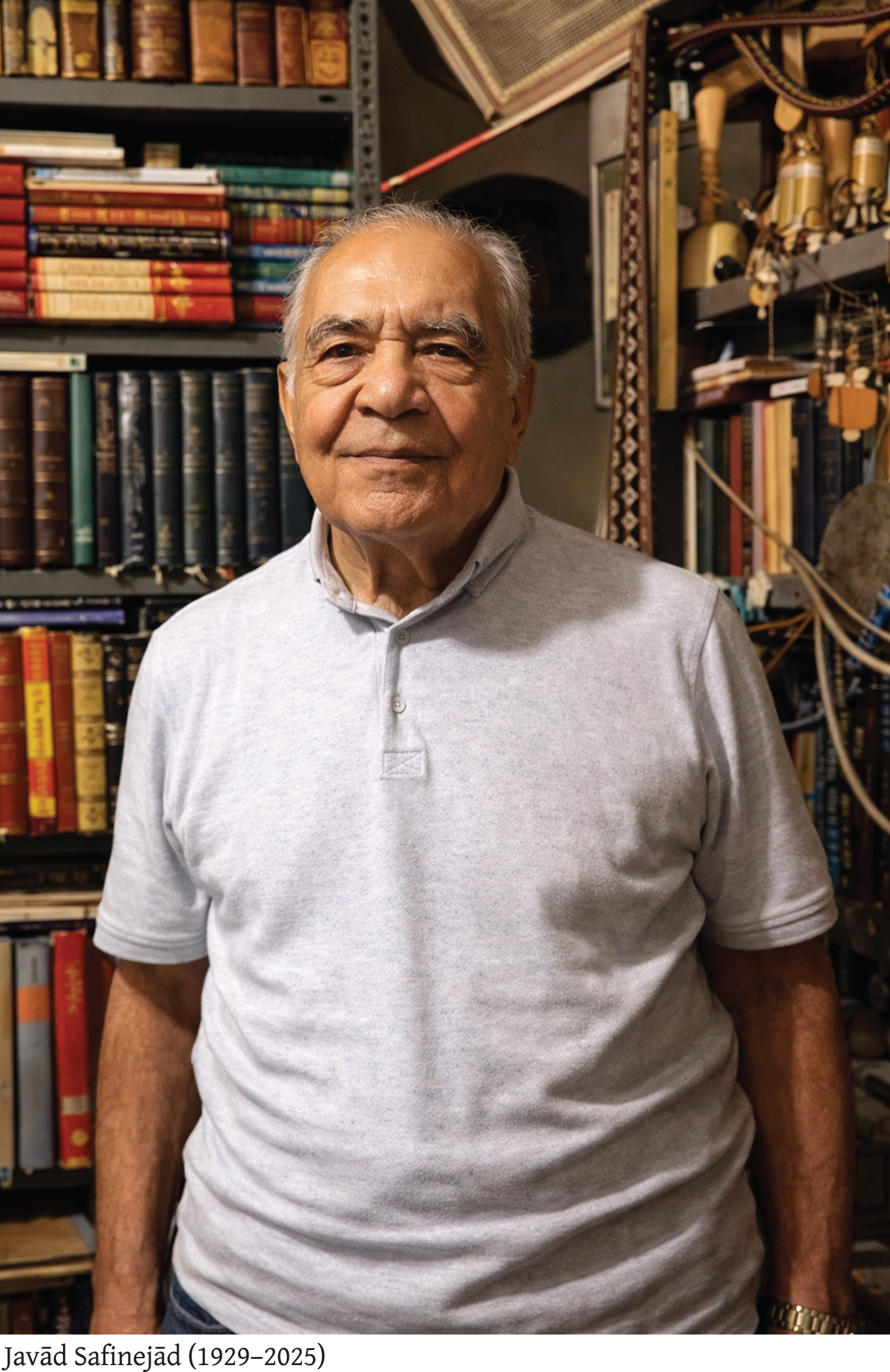
Javād Safinejād was a distinguished anthropologist and geographer whose scholarship significantly advanced the study of nomadic communities, traditional agricultural systems, and water management technologies in Iran. Widely regarded as the “father of modern qanāt studies” in Iran, he devoted more than six decades to field research, teaching, and writing on the ethnographic and environmental dimensions of rural life. His numerous monographs and his exemplary mentorship left a lasting impact on generations of scholars working on rural Iran.
Safinejād was born in the Hāshemābād neighborhood of Rey, south of Tehran, into a family of Bakhtiari Lur origin. After completing his early education in Rey, he entered the University of Tehran in 1953 to study history and geography. He received his bachelor’s degree in 1957 and, in the following year, began his long association with the Institute for Social Studies and Research at the same university. He completed his master’s degree in social sciences in 1961 with a thesis on the sacred sites in Rey under the supervision of the eminent geographer Mohammad-Hasan Ganji (1912–2012).
Safinejād spent the greater part of his academic career at the University of Tehran, where he taught at the Faculty of Social Sciences. In 1966, under the direction of Nāder Afshār-Nāderī (1916–1979), and together with colleagues including Amir-Houshang Keshāvarz-Sadr (1933–2013), Safinejād helped to establish an academic unit dedicated to tribal studies—an important institutional development that strengthened scholarly engagement with Iran’s tribal and pastoral communities. His early research focused on ethnographic surveys among the Turkmen and Shāhsevan. From 1967 onward, the unit concentrated its work on the Kohgiluyeh region, particularly on the Boyer-Ahmad.
Throughout his career, Safinejād combined his academic research and teaching with extensive field research on several Iranian tribal and nomadic communities, including the Lur, Qashqāʾi, and those already mentioned above. His studies documented patterns of social organization, seasonal migration, land use, and agricultural practices, preserving invaluable data during a period of rapid socioeconomic transformation. At a time when many in academia—particularly younger scholars—were increasingly drawn to abstract theoretical frameworks, Safinejād remained firmly committed to empirical inquiry. He consistently emphasized, and practiced, sustained fieldwork as the foundation of meaningful scholarship. In this sense, his form of what might be called a “Persian exceptionalism” lay not in grand theoretical claims but careful attention to detail and direct documentation.
Safinejād achieved particular distinction through his pioneering research on qanāts (or kārizs)—underground irrigation channels that have sustained Iranian agriculture for centuries. His landmark work, Qanāt (Kāriz) in Iran and Traditional Methods of Its Utilization (new edition, 2017), offers a comprehensive analysis of their historical development, engineering techniques, and socioeconomic structures.
His most influential contribution lay in his radical reflections on the many dimensions of the qanāt system. As well as its function as an ingenious hydraulic technique, Safinejād demonstrated its vital contribution to a complex institution embedded in networks of ownership, cooperation, and authority. He showed that the management and distribution of water were not merely technical practices but central mechanisms through which power and hierarchy were structured in rural society. In many contexts, control over water entailed control over land and labor; access to water was thus inseparable from broader relations of power.
By elevating the qanāt from an engineering structure to a sociological category, Safinejād placed traditional irrigation systems at the center of rural studies and development discourse. His work anticipated contemporary debates on sustainable resource management by emphasizing that environmental and technical solutions must be understood within their historical and social contexts.
Beyond water systems, Safinejād devoted considerable attention to land tenure and agrarian relations, including the boneh (collective farming unit). He analyzed the arbāb–raʿīyat (landlord–peasant) system not merely as an economic arrangement but as a complex web of obligations, patronage ties, and ritual practices. His studies of post-Land Reform rural Iran offered a nuanced understanding of structural change, demonstrating that legal transformations did not automatically dismantle entrenched hierarchies; rather, many patterns were reshaped and reproduced in new institutional forms.
Safinejād also explored rural ritual life, agricultural calendars, and the roles of local authorities such as the kadkhodā (village headman) and the mirāb (water master). He showed how communal ceremonies and religious practices reinforced social cohesion and mediated conflict, offering a multidimensional portrait of rural Iranian society that integrated economic, social, and cultural analysis.
As a teacher, Safinejād was deeply committed to mentorship. For many years he taught rural anthropology, ethnography, and research methodology—primarily at the University of Tehran—emphasizing the importance of fieldwork and direct engagement with rural communities. Many of his students went on to become established scholars in anthropology and development studies, carrying forward his field-oriented legacy.
His publications remain foundational references in the study of Iranian rural society and continue to inform research in anthropology, environmental studies, and development planning. His work received national recognition, including first prize at the 10th Fārābi International Festival (2019), and his book Qanāt in Iran was selected as Iran’s Book of the Year in the same year.
Safinejād also maintained a strong interest in books on Iranian ethnography and historical geography, assembling a significant personal library over the years through close relationships with specialized booksellers in Tehran, including, among others, the bookstore of Khalil Mostowfi (1941–2020) on Shāhābād Avenue and that of Sayyed ʿAbdol-Ghaffār Tahuri (1923–1995) opposite the University of Tehran.
Javād Safinejād passed away in Tehran on December 22, 2025 at the age of ninety-six and was buried at Behesht-e Zahra Cemetery. His passing marks the end of an era in Iranian rural studies, but his intellectual legacy has lost none of its relevance. At a time when Iran faces pressing environmental and water-related challenges, his insistence on the inseparability of technical systems and social structures remains poignantly relevant.


