‘The Italian opera will mould the musical cultivation of the nation.’ K.P.
‘We all live in Paparrigopoulos’ world’, it has been said of our national historiographer.Footnote 1 Although these words may sound excessive, it is agreed that Paparrigopoulos’ historical theory moulded Greek ideology on the evolution of Hellenism, regarding Greek history as a unity from the ancient time with a new, less negative, picture of Byzantium. Paparrigopoulos’ History of the Greek Nation, wrote Paschalis M. Kitromilides, ‘could be characterized without serious risk of exaggeration as the most important intellectual achievement of nineteenth-century Greece’.Footnote 2 The book would probably have not been written if Jakob Philipp Fallmerayer had not claimed that modern-day Greeks had nothing whatsoever to do with the Greeks of the fifth century BC. Since the various peoples who had passed through the area in the intervening centuries had diluted and denatured its Greek element, as a result there was no longer a blood link with the Greeks of antiquity. Though the German historian's theory was based on scant evidence, he raised fundamental issues relating to the ethnic identity of the Greeks which could not go unanswered, and which would exert a decisive influence on Paparrigopoulos’ subsequent writings.
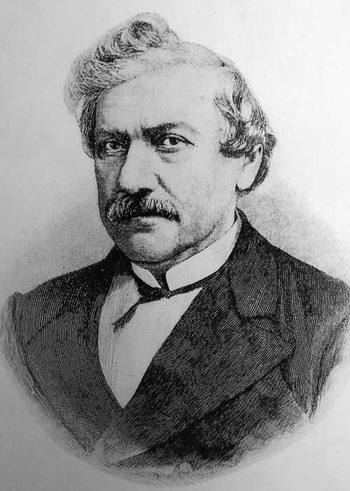
Konstantinos Paparrigopoulos. Frontispiece of K.T. Dimaras, Konstantinos Paparrigopoulos (Athens, 1986)

A series of texts, along with the seven-volume History of the Greek Nation (which the historian wrote between 1860 and 1874), would refute Fallmerayer's arguments with evidence and a bibliography, while simultaneously forming the official national Greek historiography. The Greek historian's response was essentially rooted in the belief that the Greek element, far from vanishing, had actually prevailed. In the first edition (1853) of his History, Paparrigopoulos laid down language as a core criterion of Greekness (‘All the people who speak the Greek language as their mother tongue are together called the Greek nation’).Footnote 3 The motto he chose for the political and literary newspaper he would publish five years later (O Ellin [The Greek], 1858–59) was Isocrates’ maxim: ‘The title Hellenes is applied rather to those who share our culture.’ For Paparrigopoulos, Greekness was a cultural, not a racial, issue.
The Greeks, until recently, enslaved and with the memory of centuries of Ottoman rule and the bloody struggle for independence still fresh, desired to build a society modelled on neoclassical Europe which, as a conduit for the civilization of ancient Greece, was always destined to be their sole point of cultural reference. An ideology that the spring waters of ancient Greek culture had flowed westwards during the centuries of Ottoman rule on Greek soil, where they evolved into modern European culture – the natural evolution of the ancient Greek culture – was prevalent among the recently liberated Greeks, who viewed all things eastern as symbols of their protracted slavery.Footnote 4 This inevitable turn to the West could not have failed to embrace opera, the cultural product par excellence of this cultural exchange and a powerful symbol of bourgeois European society. The Greek war of independence against the Turks, after three and a half centuries of oppressive occupation, the creation of the modern Greek state and its subsequent induction into Europe were inevitably posing issues relating to the identity of the modern Greeks, especially in the nineteenth century, the era that witnessed the emergence of the nation state.
Much ink has been spilt on the matter, which has proved a bone of contention among contemporary historians, many of whom call into question Paparrigopoulos’ views on the unbroken continuity of Hellenism since antiquity. Whether we agree or disagree with the intensely ideological views of our national historian (who expressed his opinion spurred on by Fallmerayer's anti-Greek publications), there is no denying that the Greeks of the nineteenth century – or, at least, the majority of them – believed, felt and wanted themselves to be known as the modern-day descendants of the ancient Greeks. That the Greeks of Paparrigopoulos’ era espoused these views is something we cannot ignore; on the contrary, it is the prism through which we should view the incorporation of opera into Greek society. Opera was a product of European culture that was brought into being by efforts to revive ancient tragedy. Thus we find our ultimate example of a cultural re-borrowing: the Greek renaissance brought about by the 1821 Revolution marked the hour when the products of ancient Greek culture that had decamped to Europe came back home. Europe's new state wanted its cultural capital back, and with interest. The moment had come for the European social model to be applied in Greece, too, where in the case of opera, it would also serve as a bearer of musical education to the people. How sensible or otherwise this choice proved to be could, perhaps, be sought in the audience's response to opera, whose utter domination of the social life in Greece's cities throughout the nineteenth (and first decades of the twentieth) century leaves no room for doubt.
This paper focuses on musical events in the free Greece of the era, what is now Central Greece, Evia, the Peloponnese and some islands in the Aegean. We will not refer to the musical scene on the Ionian Islands, which had been mainly under Italian rule for a considerable length of time. There the situation was very different and the islanders had been familiar with the genre since 1733, when the San Giacomo opera house of Corfu opened its doors to the public. This choice was made for practical reasons: the two areas – Athens and the Ionian Islands – would clearly demand different approaches, and the situation in the Greek capital was the result of purely Greek activity and will, independent of the Italian influences then prevalent in the Ionian.
Many years before Paparrigopoulos engaged seriously with history, the capital of Greece welcomed the genre of music-theatre that dominated the musical and social life of nineteenth-century Europe. Even though a few individuals had the wherewithal to travel beyond the Ottoman empire to Europe or the Ionian Islands, few Greeks had been exposed to opera while subjugated under the Turks, and the public's first contact with the lyric theatre had essentially taken place, from the late eighteenth century on, in the pages of contemporary publications. Apart from the Ephemeris [Journal], the first Greek newspaper, which circulated in Vienna (1790–97) and contained some interesting information on opera, the most important source of information on the lyric theatre for Greek-speaking readers were references made to it in books and translations of libretti into Greek. Such references were numerous, and while they were essentially restricted to the written word, they do seem to have prepared the way for the actual arrival in Greece of opera, which began to be performed on a regular basis in 1840, just a few years after the emergence of an independent Greek state.
A theoretical knowledge of opera gleaned through reading and the exceptional experiences of those with the wherewithal to visit opera houses abroad were not, of course, enough. Konstantinos Koumas, in his Syntagma Philosophias [Compilation of Philosophy] (Vienna, 1818–20), a work he wrote for his students at the Smyrna Gymnasium, notes that: ‘We cannot all but be well aware that theatrical singing is not something our nation as yet possesses.’Footnote 5 The words ‘as yet’, written as they were prior to the outbreak of the Greek Revolution, can only declare a desire for opera to be practically present in the lives of the Greeks. As it turned out, such a practical experience of opera would not be long in coming. In 1837, just seven years after the Greek state won its independence, an Italian theatre company performed Gioacchino Rossini's Barbiere di Siviglia in the Greek capital. This first truncated performance of the work as part of a beneficial gala staged on 30 May 1837, would be followed on 5 August of the same year by the first complete performance of the opera. It was – to the best of our knowledge – the first full opera performance in the newly established Greek state and, as was only natural, the event did not go unnoticed: ‘The theatre was packed, the audience applauded the singers justly and repeatedly, and the performance ended around 11 o'clock, having made the most favourable of impressions on the large audience, who opined on their way out that the theatre was absolutely essential in our society!’Footnote 6
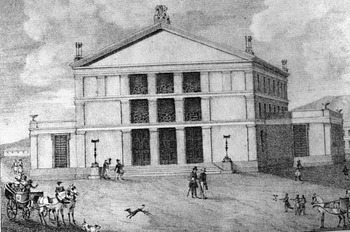
Although this first encounter between the Athenian public and opera proved a success, and despite discussion in the contemporary press of upcoming productions both of Bellini's Norma and Rossini's Italiana in Algeri, the capital's operatic activity was limited to another beneficial gala at which extracts were played, once again, from Rossini's Barbiere di Siviglia, along with arias and duets from Bellini's I Capuletti e I Montecchi and Rossini's Tancredi on 12 September that same year (1837). And despite efforts made by various impresarios to stage new operatic productions, the Athens public had to wait another two years to enjoy the strains of Italian opera once more. It would seem that the conditions were right by 1840 – a suitable theatrical venue had also been built in the meantime – for the newly established European capital to receive a series of Italian opera productions which would mark the start of the genre's constant presence in Greece. Thus, on 6 January 1840, with the Greek state – which barely covered a third of the area of modern-day Greece – now having enjoyed 10 years of liberty, it was the melodies of Lucia di Lammermoor that would first grace the newly built Athens Theatre.
Athens Theatre, lithography of 1840. National Archives

Donizetti's opera was followed by Luigi Ricci's Chiara di Rosembergh, Rossini's Barbiere di Siviglia, Bellini's Norma, Pietro Antonio Coppola's Nina, ossia pazza per amore, Donizetti's Belisario and Bellini's Sonnambula.Footnote 7 In the space of six months, the Athenian public was given the opportunity to acquaint itself with seven works from the Italian repertoire, four of which continue to hold pride of place in opera lovers’ affections to this day.
The fact that a new artistic genre had been accepted by Greek audiences, who had not yet had a chance to acquire even the most rudimentary musical and theatrical education, encouraged the 20-year-old Konstantinos Paparrigopoulos (1815–1891) to write a series of six reviews on the performances accompanied by a text examining the history and aesthetics of opera, with a view to making Athens’ newly-initiated opera-goers as receptive to opera as possible. Although Paparrigopoulos was not alone in reviewing these performances (the other reviews are also extremely interesting), the series of articles in the bilingual (Greek/French) newspaper, Ellinikos Tachydromos [Hellenic Messenger], stand out for the quality of their criticism and the knowledge they evince of music and its history. They also signify an attempt to induct opera into Greek society with a view to providing the nation with a musical education. Although most of these articles were published unsigned, the initials K.P. (C.P. in French) at the end of the article entitled ‘What is Opera and What are its Origins?’ (‘De l'opéra et de son origine’) – Konstantinos Paparrigopoulos’ initials – led to the conclusion (which was also backed up by the stylistic consistency of the pieces) that the other articles in this series were also Paparrigopoulos’ work. The author's identity was uncovered by Konstantinos Sabanis, who located information to this effect in the Vlachogiannis Collection (General State Archives of Greece), wherein the unsigned review of Norma is attributed to Konstantinos Paparrigopoulos.Footnote 8
By journalism, we do not mean, as most do, the public pillorying of personages and decrying of situations, but rather the logical, learned, often profound, sometimes trenchant but always seemly discussion of principles and practices. Journalism of this sort can rise to the level of one of the state's main estates, perhaps rendering it the most important estate of them all.Footnote 9
Thus wrote Konstantinos Paparrigopoulos in 1847 in the press, whose social significance and power he had grasped most firmly, having taken to the ramparts of journalism early on in his career. He would never cease to write for the press until the end of his life; as K.T. Dimaras has aptly noted: ‘A well-founded organic impulse kept him close to what was, above all else, the symbol or bearer of public opinion: the press.’Footnote 10 Journalism – whose thematic range was not limited to historical issues – would engage the young Paparrigopoulos for many years prior to his decision to concern himself with the history of the Greek nation, though there can be no doubting that K.P. – as he often signed the articles he wrote for the daily and periodical press – ‘was a born historian’.Footnote 11 His historical awareness and concern that public opinion should be correctly guided early on showed him the route he would later follow, when he would impact on the flow of Greek historiography.
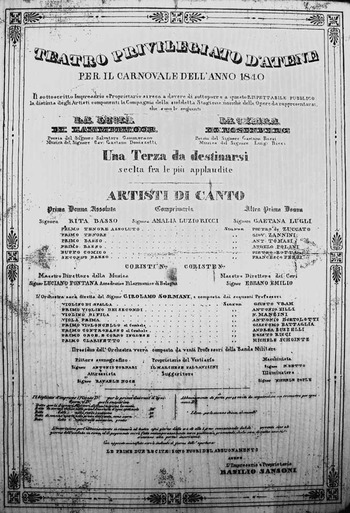
The Italian company's performances began on Epiphany (6 January 1840) with Lucia di Lammermoor, which ‘aroused a fitting enthusiasm’ and pleased the ‘Greek people's well-known love of beauty’, according to the journalist from the Ellinikos Tachydromos, who considered that ‘musical settings of this sort are best suited to introducing Italian music into modern Greece, functioning as preludes to other, more artistically elevated, works which, if introduced to us without such preparation, might not be suitably appreciated’.Footnote 12
The playbill of the first performance in the Athens Opera House, 1840. National Archives

The reviewer, who does not conceal his fear that an initially bad experience on the public's part could ‘deprive us of our only means of seeing opera presenting to us its magical influence’, was enthusiastic both with the choice of opera and with its rendering on stage. His review includes a thorough dramaturgical analysis of the work, its plot and characters as well as the points at which Salvatore Cammarano's libretto departs from the Walter Scott novel on which it is based (and a familiarity with which he assumes on the part of his readers). It also discusses Donizetti's music, which successfully conveys the heroine's inner anguish: ‘Herein, the composer captures the torture suffered by her soul and conveys it to us in a torrent of harmony’.Footnote 13 The artists were a match for the difficulties presented by their roles, which demanded both technical and acting abilities, thereby eliciting the ‘enthusiasm’ and ‘unwavering attention’ of the audience. Despite his exhaustive account of the performance and its interpreters, Lucia di Lammermoor would also engage the critic in the next edition of the same newspaper, which contains some very interesting suggestions relating to the translation into Greek of various musical terms,Footnote 14 as well as Greek translations of several arias, presented in the hope that the artists would sing them on stage in Greek. This is indicative of a desire to rapidly assimilate – one might also say to Hellenize – opera, which was certainly not restricted to Paparrigopoulos. It is noteworthy that the Athenian audience seems to have left its first encounter with opera infused with a desire to familiarize itself with – and assimilate – this new and alluring performance art; that a bilingual edition of the libretto of the second opera staged in Greece, Chiara di Rosembergh by Luigi Ricci, should have been prepared, printed and available for purchase in the foyer on the production's opening night is certainly significant.Footnote 15
The effusively positive critical response to Lucia di Lammermoor was not repeated in the case of the second opera staged at the Athens theatre: Chiara di Rosembergh ‘gave rise to an impassioned debate on which musical genre, once imported, could best attract its audience’. However, as the author argues, it is not a musical problem, but rather ‘a matter of art's ultimate aim … which is the quest for beauty’.Footnote 16 Luigi Ricci's opera, though practically unknown to audiences today, enjoyed huge success in its day – after its premiere in 1831 at La Scala, it was repeated 70 times until 1838.Footnote 17 Its success in Italy explains the fact that Chiara, not only was staged in Corfu by 1834, but also was the first opera to be performed in Zante (1835), Cefalonia (1837) and Syros (1840).Footnote 18 Despite its great success at the time, Chiara di Rosembergh provided a counter-example of the opera which, according to K.P., could become the appropriate model to provide inexperienced Greek audiences with an ideal experience of the genre, because ‘hearing these fragmentary melodies, one might think they were extracts from disparate works which were later joined together at random to produce the whole in question’. The choice of this opera for performance in Athens spurred K.P. to ponder the suitability of different works as a means of familiarizing Athens audiences with opera, and to express his own aesthetic views on opera, theatre and art in general: ‘Process can never replace inspiration’; as in poetry and painting, so in music: the ‘heavenly’ source of beauty, the majesty and simplicity of the laws of nature, will never be surpassed by the innovations of the ‘lovers of excess.’ In relation to music in particular, the author notes that ‘those Italians that spend their every day labouring at and, if you will excuse the expression, consuming music, have lost their every trace of inspiration’, as a result of which ‘they dismember the works of the great masters of the past’ or ‘set about parroting endless details and chattering trivial tunes with childish profundity’, though ‘this method cannot produce anything great and sublime’. Indeed, K.P. goes on to compare this cheapening of musical creation with the situation then prevalent in French literature, which he labels ‘easy’, while proposing the term ‘difficult music’ for works which devotees ‘dogmatically declare have to be heard at least thirty times on the trot if the harmony of the opera set to music using this system is to be understood’, thereby turning the theatre into a ‘school’. Even if this work stands out for its ‘craft of instrumental music’, it is only relevant to the very few, while K.P. is interested in works that communicate on an artistic level with every member of the audience. Since the genre belongs to the category of the ‘most learned’ music creation unsuited to Athens’ unseasoned opera-goers, the critic wonders ‘for whom and why must this stage music be composed; what, generally speaking, should the aim be of staged performances?’ The young critic's answer to this most fundamental of questions concerning the cultural life of the new Greek state is this: ‘the great works of the great composers’.Footnote 19
Lucia di Lammermoor and Chiara di Rosembergh, two unequal operas, provided the Ellinikos Tachydromos’ young music critic with the impetus to tackle two issues: the need for music education in Greece, and how suited certain works were to shouldering the serious task of providing an audience, as yet lacking in musical cultivation, with a grounding in opera. The choice of repertoire and of the artists who introduced Athenians to opera in 1840 would play a critical role in opera's subsequent presence in the Greek capital. Similarly, it does not seem to have been a matter of chance that the work the critic considers unsuitable should have been poorly received by audiences, while an opera of Lucia di Lammermoor's indubitable artistic stature should have scored an instant triumph. Thus, following on from these lengthy references to what might be called paradigms of operas suitable and unsuitable for the situation pertaining in Greece at the time, the critic seems to have considered it necessary to write a theoretical text on opera to precede his review of the Greek capital's next – its third – opera production: the Barbiere di Siviglia. In ‘What is Opera and What are its Origins?’, K.P. (the text is signed for the first time) decides to present certain core principles of aesthetics along with a history of opera, the genre which ‘has permeated the society of Athens in its entirety’.Footnote 20
Thus opera is, according to K.P., ‘the richest and most varied product of the fine arts’, because it consists of three core elements: drama, vocal music and instrumental music. It is interesting to note that the critic divides opera into three components, rather than two. Apart from drama, ‘the finest artistic depiction of social life, human passions and emotions’, opera includes both vocal and instrumental music, each of which plays a different role in the opera: thus, while instrumental music ‘lies at the very apex of the natural arts, none of which can match it for the ease with which it communicates its message and the powerful impression it makes’, vocal music is ‘the very peak of the spoken word, its most powerful and richest form of expression, which speaks not to the speakers of one nation's language nor to one social class, but to all nations and to all classes’. It is the combination of these three that makes opera ‘the most intoxicating elixir Man's genius and art have wrought; a banquet to which Man is invited to partake of a luxurious and beneficial feast’.
Opera owes its position at the very top of K.P.'s hierarchy of the arts to two factors. The first relates to the aesthetic stance of the author, who considers this genre, which combines art and the intellect so perfectly, to be Man's supreme achievement. We could say that this view of opera developed out of the theory of music he had expounded five years earlier in a text which has not yet come to light, but which, as Haris Xanthoudakis speculates, could well have been his first publication.Footnote 21 The article in question was entitled ‘Music, Church Music At That’, signed K.P. and published in the Athena newspaper on 30 November 1835 (no. 294). Commenting on the contentious issue of church music in Greece – an issue which went far beyond aesthetics – the piece expressed its support for the Russian school (a school with which K.P. was highly familiar, thanks both to his schooling in Odessa and the time he subsequently spent in the schools of Aegina, as we shall see below), with Paparrigopoulos presenting an aesthetic approach to music which had much in common with the content of his reviews. He therefore admits that the power of music is ‘above all study and edification’, and that ‘it exerts a forceful and powerful influence on even the simplest heart’. He also argues that ‘the mother and the source [of art in general] is always nature’. Faith in ‘a heavenly source of beauty, in the majesty and the simplicity of the laws of nature’, which may be the most fundamental principle underlying the aesthetics K.P. espoused, has evolved from the aesthetics of music he laid out in 1835 to the aesthetics of opera he presented in 1840; music in both its forms combined with drama conspire in the creation of the ‘most intoxicating elixir’ ever made by Man.
This, at first glance romantic, view which exalts music to the heavens is tempered by his faith in the classical concept of order and unity which probably is the most fundamental to Paparrigopoulos’ aesthetics. Many of these views on music are to be found in Melchior Grimm's ‘Poème Lyrique’ entry in the Encyclopédie: the imitation of nature, the universal – and supranational – power of music which K.P. describes in his text are also commented on by Grimm (‘La langue du musicien a sur celle du poète l’ avantage qu’ une langue universelle a sur un idiome particulier; celui-ci ne parle que la langue de son siècle et de son pays, l’ autre parle la langue de toutes les nations et de toutes les siècles’),Footnote 22 along with the direct impact music has on the human soul (‘La langue universelle frappant immédiatement nos organes et notre imagination est aussi par sa nature langue du sentiment et des passions. Ses expressions allant droit au cœur sans passer pour ainsi dire par l'esprit…’).Footnote 23 But the universality of music was of emblematic importance to the Romantics, while Johann Gottfried Herder dreamed of an all-encompassing artwork in which all arts would be combined, inevitably calling Richard Wagner's views to mind. This makes it difficult to search for a single trend or school of thought behind Paparrigopoulos’ views on music. ‘I have never been and, God willing, will never be a blind adherent of any musical system,’ he wrote in his review on Chiara di Rosembergh, and the phrase could stand for his aesthetics in general.
A similar picture emerges from other texts in which he expresses views on aesthetics: his commentary on the university poetry competitions of 1858 and 1859, for example.Footnote 24 These texts also contain definitions and axioms which are highly reminiscent of those he expressed in 1840: ‘Language is the most admirable of all the products of the human spirit’, he notes in his verdict of 1858, while he remains, like the other members of the competition jury a supporter of Katharevousa, the purist form of Greek, instead of Demotiki, the popular idiom, as one would expect from an adherent of Romanticism. And while he has no qualms about criticizing, as well as praising, aspects of the Romantic schoolFootnote 25 in his History of the Greek Nation, Paparrigopoulos defends Greece's Romantic poet par excellence, Dionysios Solomos: ‘Is there anyone who would not admit that Solomos’ hymn to Freedom is one of the most aspirant endeavours of modern Greek poetry?’Footnote 26 Along with reference to the national Greek poet, Paparrigopoulos makes an interesting remark on the national Greek composer and his music on Solomos’ poem: ‘heroically composed by the other Ionian, Manzaros, it echoes every day in our squares, in our streets, in our houses, and above all, in our hearts’.Footnote 27 While Manzaros’ music composed with the principal goal of serving the needs of a national hymn, the composer had also set the same poem to music, using more sophisticated techniques.Footnote 28
In his commentary of 1859, he seems to have moved still closer to the rules of Classicism. Along with a non-original but typical reference to Aristotle and his views on probability and necessity, there is a definition of lyric poetry: ‘There are three main elements to lyric poetry: emotion, imagination and language’; for its part, dramatic poetry consists of these three ingredients plus the ‘consistency of things’. These definitions are strongly reminiscent of the constituents of opera and typical of Paparrigopoulos’ mindset, but they do not help us discern specific theories beneath the heavy cloak of his personal aesthetics and ideology. Dimaras, discussing his historiographical work, notes that he is not a romantic historian, but rather a historian who lived through the era of Romanticism; a faith in tradition and the established order are both evident in his writings, though ‘he knew how to draw from the Romantic source all of its elements that matched the Greek theory as he had formulated it’.Footnote 29 Let us not forget that the lines of demarcation between artistic trends have always been fluid, and that this fact had been acknowledged in our writer's time. Paparrigopoulos’ friend and fellow traveller, Alexandros Rizos Rangavis, proposed the term ‘classical–romantic’ to describe Goethe.Footnote 30
But what were Paparrigopoulos’ sources? What had he read? Can one make out the fundamentals of his education behind these views? Although we have little by way of detailed biographical information about Paparrigopoulos, a number of studies have focused on the years of his schooling.Footnote 31 We thus know that he attended the Lycée Richelieu in Odessa for eight years (1822–30), and that he completed his schooling at the Central School on Aegina (1830–33), though he did not receive a leaving certificate: ‘I have no diploma, be it from a high school or university, Greek school or correspondence course … apart from the academic certificate awarded to me by the University of Munich.’Footnote 32 At the Lycée Richelieu, he was taught inter alia Russian, Latin and Greek literature, general and Russian history, Italian and French, which is to say he left that institution with a knowledge of ancient Greek, Latin, French, Italian and Russian in addition to his mother tongue, which would have given him access to a wide-ranging bibliography. He would quickly add German and English to his linguistic arsenal; combined with his love of learning, this would lead him to engage with many different fields of knowledge. Nonetheless, his school education remained fundamentally French (which would explain why K.P. opted to use French musical terms in his texts). As Dimaras notes with reference to his Odessa schooling: ‘The French nature of the education provided at this school would leave its mark on both the form and the mien of his intellect.’Footnote 33 Still, it remains extremely hard to pick out specific works he must have read during his studies. The answer could be provided by a study of his personal library and papers, but since neither has as yet come to light, the research will have to remain on a hypothetical footing.
Paparrigopoulos’ evolving, maturing theory forms an aesthetic which one can discern in many of his subsequent texts and even in his History of the Greek Nation. His faith in simplicity and naturalness and the prioritizing of inspiration over ‘process’, which Paparrigopoulos puts forward as basic principles of art in these reviews, along with the concept of unity, which also figures in these early texts, are all values that clearly underlie his every aesthetic stance. But then, in his theory of history, too, the unity and continuity which Paparrigopoulos the aesthete seeks in the arts are consistent with the theory of continuity Paparrigopoulos the historian would propound a few years later in his history of Hellenism. Staying with his History, one example will suffice from the section in which Paparrigopoulos questions the view that the Homeric epics were not created by Homer, but were actually the work of a number of different poets: ‘How can we accept that any number of craftsmen painted this image one after the other, given the harmony of its conception, its art and its style?’Footnote 34 There are also a number of stylistic similarities between it and the texts from 1840: the question we encounter as a chapter heading in the music reviews (‘What is Opera and What are its Origins’), for instance, is also a frequent feature in the first edition of the History – in the introduction: ‘What is a history of the Greek nation?’, ‘What should we be taught along with history?’; in Chapter One: ‘What did the Greeks have to say about these ancient times?’, ‘How did the world, the gods and men come into being?’Footnote 35 These similarities provide further support for the hypothesis that Paparrigopoulos is the K.P. of the reviews.
As far as Paparrigopoulos’ musical knowledge is concerned, his avowal in the 1835 text on church music to the effect that ‘the author happened to have sung, in his youth, in a Russian church choir’ should probably be interpreted as a reference to his time in Odessa (rather than to his probable participation in a choir on Aegina, which is highly likely but too proximate (1830–33) to the period in which the text was written (1835) to justify the use of the phrase ‘in his youth’). On Aegina, as Paparrigopoulos notes in the same text, ‘certain attempts were made to introduce Russian music, which were successful up to a point’, though no further information is provided. As a supporter of this system, Paparrigopoulos considers it to be ‘entirely adaptable to Greece’, ending the text on this note. We should therefore take it as given that K.P.'s education had furnished him with a knowledge of music, almost certainly as a young boy in Odessa. As for the nature of this musical education, though we cannot know if he played an instrument, his singing in a church choir makes a knowledge of the rudiments of music a certainty. His texts testify to his knowledge of music theory.
As we have noted, K.P. appended a short history of opera to his reviews in 1840. His historical survey of the genre reveals something interesting: amidst his references to names and dates (Vincenzo Galilei, Giulio Caccini, Dafne (1597) by Ottavio Rinuccini and Jacopo Peri, Orazio Vecchi's Amphiparnasso etc.), the author also refers to productions of a number of pastoral dramas – one of the ancestors of opera – including Giovanni Battista Guarini's Pastor Fido, and notes that the work has been translated into Greek, ‘because our own Greek literature has occasionally been enriched (the book was published in the year 1804) by such translations’. This decidedly early reference to the translation of Guarini's work may well be the first, and is certainly the first to have been included in a text on the history of opera. This is significant, as the reference underscores the author's constant contact with Western culture. It is certainly significant that the work in question was performed in 1611 in Handaka, Crete,Footnote 36 in a production including a number of musical elements that must have had a great deal in common with performances of what is generally meant by opera. The translator, whom Paparrigopoulos does not name, was Georgios N. Soutsos, who most probably also translated a two-volume edition containing six plays by Pietro Metastasio in Greek (Venice, 1779), a milestone in the history of the modern Greek theatre which marked the first concerted attempt on the part of a publisher to acquaint the Greek public with the European Enlightenment through the libretti of the Caesarian poet; Soutsos’ translation of Guarini's work was the third into Greek.Footnote 37
The 1840 text contains one other noteworthy reference. Discussing Emilio da Cavallieri, who is considered ‘the inventor of the so-called melodic dialogue (recitative)’, K.P. notes that this dialogue ‘is now, as the reader will already know, pitched recitation without regard for the metrical rules’. That the phrase ‘as the reader will already know’ is not present in the French text (although the two reviews include the same information, they are not identical) cannot be dismissed as coincidental. Rather, it must relate to the preceding reference to the translation of Guarini's work, and to K.P.'s desire to stress Hellenism's continuous and uninterrupted contact with Western culture; as such, it performs the same function as the other ‘as the reader will already know’ to which attention was drawn above in relation to Walter Scott's novel.
The author's pro-Western stance brings us closer to the second reason why Paparrigopoulos considers opera to be the supreme art form and the highest manifestation of human creativity. This reason is not – in my opinion – aesthetic, but rather relates to K.P.'s social quests and to his concern for the future of his fellow countrymen. The fact that opera transcended class and could serve as a means of providing Athens’ fledgling audiences with an education in the arts made the new genre supremely important for Greece and justified the author's impassioned determination to contribute, through his reviews, to its being properly received by his countrymen and taking the place it warranted in Greek society. As K.T. Dimaras has aptly argued, Paparrigopoulos ‘could not have distinguished in his head his work as a historian from his work as a teacher, the teacher of the nation’;Footnote 38 the truth of this statement becomes clear when we consider Paparrigopoulos’ activities as a whole. Apart from his journalism, his educational work – he was, it should be remembered, a school teacher before he became a university professor – and, of course, his authoring of the History of the Greek Nation, Paparrigopoulos also organized public lectures which sought to educate the general public. It would not be an exaggeration to argue that these activities all shared a basic aim: ‘the cultivation of the nation’. And this is why he chose opera, an art form that can touch ‘every nation’ and ‘every class’, as his vehicle for educating the Greeks in music. His gaze fixed on Europe, Greece's national historian envisioned a new flowering of the ‘Greek people's well-known love of beauty’.Footnote 39
Paparrigopoulos believed that ‘nations create History, not History nations’,Footnote 40 which is why he invested so much in educating the nation, and its young people in particular. The positive response of the Greeks towards the opera is proven and the desire of Paparrigopoulos, as far as the cultivation of the ‘Greek people's well-known love of beauty’ by means of opera was concerned, was fulfilled: the new genre won a place in the hearts of all that heard it, irrespective of their social class. As a result, the majority of Greeks were considerably more cultivated musically in the nineteenth century than they are today.
We could call 1840 a landmark year in the musical life of the new Greece, both because it marked the start of opera's steady and powerful presence in Greece (Syros, the little island of Aegean, also welcomed the opera in 1840), and because it witnessed the appearance and establishment of music criticism in Greece, where it would also make considerable progress in the years to come. A decade later, Eirinaios Asopios, an associate of Alexander Dumas, would write music criticism of a luminous brilliance, while the art would culminate at the end of the nineteenth century with a musicological duel in Syros between Ioannis Foustanos and Dionysios Kladis. The study of music criticism in Greece could provide a concrete example capable of demolishing the myth that everything that happens in Greece happens late.Footnote 41 The Athenian public was granted the opportunity to read opera reviews just days after the genre's Athenian premiere (and had been treated to a theoretical discussion on opera even before that premiere). Although K.P.'s reviews do contain comments on the singers’ interpretations and artistry, their primary focus is neither technical nor musicological. Reviews of that sort would have been entirely out of place at the given moment for the audience in question. (We should remember that music criticism of that sort was slow to make an appearance in Western Europe, too, where conditions were considerably more mature and readers more receptive to writing of that sort). Instead, the texts of the historian – and, in this case, music critic – Konstantinos Paparrigopoulos were written with a specific goal in mind: that of familiarizing the public with the new genre and acquainting it with the theory and history of the vehicle that would bring ‘musical cultivation’ to the nation. For this reason, any evaluation of K.P.'s work as a music critic and the man who introduced opera into the Greek periodical press, should not seek to compare it with what was being written in the West at this time; rather, it should be assessed on the basis of Greece's needs at the time, and of the conditions that had shaped these needs. Because, as Paparrigopoulos notes in his History: the events of the past ‘must not be judged absolutely, but in terms of the times, circumstances and needs that brought them about’.Footnote 42