Introduction
Over the past decade, interest and knowledge regarding the theoretical and empirical applicability of the concept of psychopathy in children and adolescents has expanded at a fast pace (Kotler & McMahon, Reference Kotler and McMahon2005; Salekin et al. Reference Salekin, Leistico, Trobst, Schrum and Lochman2005). Strong links between psychopathic personality traits with antisocial behavior and violence in the adult literature have prompted interest in the further understanding of psychopathic personality traits in youths (Moffitt et al. Reference Moffitt, Caspi, Dickson, Silva and Stanton1996). Investigators hope that the construct of psychopathy may help to identify the select group of youth with serious conduct problems who will mature into adults with psychopathic personality disorder (Lynam, Reference Lynam1996, Reference Lynam1997, Reference Lynam1998; Frick, 1998). It is thought that to prevent serious negative outcomes associated with psychopathic personality, the early identification of psychopathic traits is crucial because attempts to alleviate and treat psychopathy in adulthood have been unsuccessful in the past (Hart et al. Reference Hart, Kropp and Hare1988; Lynam, Reference Lynam1996, Reference Lynam1997). Thus far, there has been little research on the genetic and environmental etiology of psychopathic traits especially in children. The present study aims to investigate and identify the underlying dimensions of psychopathic traits in pre-adolescent youth, to determine the extent of genetic influences on these traits in boys and girls and whether both shared and non-shared environmental influences also play a significant role.
A number of assessment instruments have been constructed to assess psychopathic traits in adolescence and childhood (Frick et al. Reference Frick, O'Brien, Wootton and McBurnett1994; Lynam, Reference Lynam1997; Forth et al. Reference Forth, Kosson and Hare2003). Each instrument represents a ‘downward developmental translation’ of what is arguably the ‘gold standard’ for the assessment of psychopathy in adulthood – the Hare Psychopathy Checklist – Revised (PCL-R; Hare, Reference Hare1991). Initial work with these instruments focused on recreating the nomological network of adult psychopathy in juveniles. With few exceptions, research has generally supported the idea that child/adolescent psychopathy resembles adult psychopathy (see Lynam & Gudonis, Reference Lynam and Gudonis2005). It bears the expected relations to offending (Edens et al. Reference Edens, Skeem, Cruise and Cauffman2001; Salekin et al. Reference Salekin, Leistico, Neumann, DiCicco and Duros2004), provides concurrent and short-term predictive utility above and beyond other relevant constructs (Lynam, Reference Lynam1997; Piatigorsky & Hinshaw, Reference Piatigorsky and Hinshaw2004) and predicts psychopathy in adulthood (Lynam et al. Reference Lynam, Caspi, Moffitt, Loeber and Stouthamer-Loeber2007). Child/adolescent psychopathy has also been found to relate generally, as predicted, to constructs that do not involve offending, such as personality, cognitive processing and other forms of psychopathology (O'Brien & Frick, Reference O'Brien and Frick1996; Blair & Coles, Reference Blair and Coles2000; Ridenour et al. Reference Ridenour, Marchant and Dean2001; Lynam & Gudonis, Reference Lynam and Gudonis2005; Salekin et al. Reference Salekin, Leistico, Trobst, Schrum and Lochman2005).
One major research focus in both the adult and youth psychopathy areas has been on the underlying factor structure of these traits. There is ongoing debate as to whether psychopathic traits are underlaid by two, three or four factors (see Cooke & Michie, Reference Cooke and Michie2001; Vitacco et al. Reference Vitacco, Rogers, Neumann, Harrison and Vincent2005), but at least two broad correlated factors have been identified in the adult psychopathy literature using the PCL-R (Hare, Reference Hare1991, Reference Hare2003). The two factors tap into ‘affective-interpersonal’ features (e.g. glibness, superficial charm, lack of empathy; factor 1) and ‘socially deviant life-styles and behaviors’ (e.g. impulsivity, sensation seeking, irresponsibility, poor behavioral control; factor 2) (Harpur et al. Reference Harpur, Hakstian and Hare1988; Hare, Reference Hare1991, Reference Hare2003; Lynam, Reference Lynam1997).
A study conducted on 6- to 13-year-olds found a two-factor solution to be optimal, much like in the adult literature (Frick et al. Reference Frick, O'Brien, Wootton and McBurnett1994). The first factor was associated with impulsivity and conduct problems, while the second factor was related to interpersonal and motivational aspects of psychopathic traits (callous/unemotional; Frick et al. Reference Frick, O'Brien, Wootton and McBurnett1994). Other studies have also explored the factor structure of psychopathic traits on adolescent samples (Forth, Reference Forth1995; Brandt et al. Reference Brandt, Kennedy, Patrick and Curtin1997) and have also found a two-factor structure for psychopathic traits, similar to what has already been found with adult psychopaths (Hare, Reference Hare1991). In more recent studies, however, three- or four-factor models have been found to be more appropriate for examining psychopathic traits in children and adolescent samples (Frick et al. Reference Frick, Bodin and Barry2000; Cooke & Michie, Reference Cooke and Michie2001; Forth et al. Reference Forth, Kosson and Hare2003; Kotler & McMahon, Reference Kotler and McMahon2005). As a result, there is still uncertainty regarding the underlying factor structure of psychopathic traits, especially in youth.
The ability to recreate the findings surrounding adult psychopathy using youth measures suggests that the field is ready to answer more basic etiologic questions about the construct of psychopathy. One of the first questions concerns the genetic and environmental etiology of psychopathic personality traits and their function as a risk factor for early emerging antisocial behavior. To the authors' knowledge, there has been only one study that has explored the heritability of psychopathic traits in young children. Viding et al. (Reference Viding, Blair, Moffitt and Plomin2005) explored the heritability of extreme callous/unemotional traits in 7-year-old twin boys. They found a 67% heritability estimate for callous/unemotional traits in children, although they did not explore any sex differences in heritability of these psychopathic traits (Viding et al. Reference Viding, Blair, Moffitt and Plomin2005).
There have been four additional studies that have investigated the etiology of psychopathic personality traits (some in terms of broad-sense personality); however, all have been conducted on adolescents and young adults (and predominantly on males). Findings from these studies converge to demonstrate that psychopathic personality traits are at least moderately heritable (with estimates ranging from 30–53%) even when utilizing various different measures for assessing psychopathic personality traits (Blonigen et al. Reference Blonigen, Carlson, Krueger and Patrick2003, Reference Blonigen, Hicks, Krueger, Patrick and Iacono2006; Taylor et al. Reference Taylor, Loney, Bobadilla, Iacono and McGue2003; Larsson et al. 2006). Additionally, these studies demonstrated that psychopathic personality traits were also significantly influenced by non-shared environmental effects, with no significant shared environmental influences affecting psychopathic personality. Moreover, the study conducted by Larsson et al. (2006), which utilized a sample of males and females, did not find any quantitative sex differences in their adolescent to young adult sample (Larsson et al. 2006). To the best of our knowledge, no study has yet explored the genetic and environmental covariance between the two factors of psychopathy in pre-adolescent boys and girls. Thus, there is still paucity in the literature and a need to gain a better understanding of the genetic and environmental etiology of psychopathic traits, particularly in children. Since the present study utilizes a sample of both males and females, it also aims to bridge the gap in the literature and contribute to a better understanding of sex differences in the etiology of psychopathic personality traits.
This study explored the fundamental factor structure of psychopathic traits and examined the underlying genetic and environmental influences on these traits in pre-adolescent twin boys and girls. The aims of the present study were: (1) to help clarify the underlying structure of psychopathic personality traits in children; (2) explore sex differences in these traits and, importantly; (3) examine the genetic and environmental etiology of psychopathic-like traits in a community sample of children; (4) investigate the extent of the genetic and environmental covariance among these traits. Evidence suggests that there are significant genetic and unique environmental influences on psychopathic-like traits in children and adolescents (Viding et al. Reference Viding, Blair, Moffitt and Plomin2005; Larsson et al. 2006), but the genetic and environmental covariance among these traits has not yet been explored in young boys and girls. Specifically, we investigated whether the same fundamental factor structure found in the adolescent and adult psychopathy literature holds true in a sample as young as 9 and 10 years old. Importantly, the present study also investigated the extent to which genetic and environmental factors play a role in children's psychopathic personality traits and whether the etiology of psychopathic traits is comparable for young boys and girls.
Method
Participants
Participants were recruited from Los Angeles County and are part of the Southern California Twin Project (Baker et al. Reference Baker, Jacobson, Raine, Lozano and Bezdjian2007). The total sample consisted of 605 sets of 9- and 10-year old twins and triplets (total N=1219 children) and their primary caregivers. The mean age for the total sample of children in the study was 9.60 years (s.d.=0.60). The mean age for the caregivers in the sample was 40.14 years (s.d.=6.61). Among the 1219 child participants, there was approximately equal sex distribution with 48.7% boys (n=594) and 51.3% girls (n=625). Caregivers were primarily female (94.2%) and were the biological mothers of the twins. Only caregiver reports of the twins' behavior were used in the present study.
Twins were recruited primarily through local schools in Los Angeles and the surrounding communities. Interested families were contacted and invited to participate in the study. (For a more detailed description of the study sample, design and procedures, see Baker et al. Reference Baker, Barton, Lozano, Raine and Fowler2006, Reference Baker, Barton and Raine2007.) The ethnic distribution of the sample is comparable to that of the greater Los Angeles area and thus provides a diverse community sample, representative of a large urban area both ethnically and socio-economically (Baker et al. 2002).
The zygosity of each twin pair was determined through DNA microsatellite analyses. (For a full review of zygosity determination procedures, see Baker et al. Reference Baker, Jacobson, Raine, Lozano and Bezdjian2007.) The following is a breakdown of the zygosity groups used in the present study: monozygotic (MZ) males (n=138 pairs), MZ females (n=139 pairs), dizygotic (DZ) males (n=84 pairs), DZ females (n=97 pairs) and DZ opposite sex pairs (n=147 pairs).
Procedure
Subjects and their caregivers were invited to the Twin Project laboratory at the University of Southern California (USC) for a full day of assessments. The caregivers were administered self-report questionnaires and interviewed about their twins' behavior at home and in school. The present study is part of a larger longitudinal twin study on risk factors for aggressive and antisocial behaviors (see Baker et al. 2002).
Testers and examiners consisted of full-time staff members as well as USC graduate and undergraduate students. All examiners were comprehensively trained on all testing procedures. Training included inter-examiner reliability checks, videotaped monitoring to ensure strict adherence to standardized testing protocols and supervised training sessions for all aspects of testing.
Measures
Psychopathic personality traits
Psychopathic personality traits were measured using an extended version of the Child Psychopathy Scale (CPS; Lynam, Reference Lynam1997, Reference Lynam2002; see also Falkenbach et al. Reference Falkenbach, Poythress and Heide2003). (Subscales and items for the CPS – revised extended are provided in Appendix 1.) The CPS is a well-validated instrument measuring psychopathic personality traits in children and adolescence (see Lynam, Reference Lynam1997). The CPS comprises 14 subscales (based on 58 yes or no items, scored 1=no; 2=yes; a list of the subscales can be found in Appendix 1). The CPS was administered in interview form. For the present study, caregiver reports of the twins' behaviors were used to ensure comprehensibility of the targeted complex behaviors (Lyons et al. Reference Lyons, True, Eisen and Goldberg1995; Lynam, Reference Lynam1997). The internal consistencies for the CPS scales ranged from α=0.33 (for failure to accept responsibility) to α=0.75 (for behavioral dyscontrol). The 3–6 month test–retest correlations for the CPS items were r=0.87. The CPS total score demonstrates moderate to strong correlations with caregiver reports of children's aggressive and antisocial behaviors (see Baker et al. Reference Baker, Jacobson, Raine, Lozano and Bezdjian2007; Bezdjian et al. 2010).
The CPS was primarily developed to operationalize, in childhood and adolescence, the personality traits found in the PCL-R (Hare, Reference Hare2003). Two PCL-R items, criminal versatility and juvenile delinquency, were not included so that the CPS might serve as a pure measure of personality uncontaminated by antisocial behavior (see Lynam & Gudonis, Reference Lynam and Gudonis2005. Further details and validation of the instrument are provided in Lynam Reference Lynam1997).
Exploratory and confirmatory factor analysis
Due to the dyadic nature of the twin data, two independent groups were formed (using the total N=1219 sample) by randomly selecting one member of each twin pair [using the random number generator in SAS random=ranuni (−1)] (‘group 1’; n=607) and assigning the remaining co-twin from each pair to ‘group 2’; n=612). Exploratory factor analysis (EFA) was conducted on group 1 and confirmatory factor analyses (CFA) were conducted on group 2 using EQS 6 software (Bentler, Reference Bentler2002) to test for the adequacy of fit for factor/component structures obtained in the EFA of group 1.
Several goodness-of-fit indices were reported to assess the fit of the models: χ2 statistic; Akaike's Information Criterion (AIC; Akaike, Reference Akaike1987); the root mean squared error approximation (RMSEA) index (McDonald, Reference McDonald1989); the comparative fit index (CFI; Bentler, Reference Bentler1990). Direct comparisons were made between the one-, two- and three-factor models through comparisons in the fit statistics presented.
Structural equation modeling was used to perform the genetic model-fitting analyses on the two derived composite factors in Mx (Neale, Reference Neale1997). The fit of the genetic models was assessed with χ2 difference tests, which is the difference between −2 log likelihood, degrees of freedom (df) and AIC. Lower AIC values are indicative of better fitting, parsimonious models (Akaike, Reference Akaike1987).
Genetic analyses
Twin methodology capitalizes on the difference in genetic relatedness between MZ and DZ pairs of twins and estimates the relative genetic and environmental contributions to a phenotype. Twin correlations and genetic model-fitting analyses were used to investigate the etiology of psychopathic traits in children. We used the structural equation-modeling program, Mx (Neale, Reference Neale1997), to assess and conduct multivariate genetic analyses of psychopathic traits found in our sample (for a full description of biometric modeling, see Plomin et al. Reference Plomin, DeFries, McClearn and Rutter1997, Reference Plomin, DeFries, McClearn and McGuffin2001; Posthuma et al. Reference Posthuma, Beem, de Geus, van Baal, von Hjelmborg, Iachine and Boomsma2003; Krueger & Tackett, Reference Krueger, Tackett, Robins, Fraley and Krueger2007).
Bivariate genetic models were fit to the two CPS composite factors computed from the subscales. Models fit included saturated covariance models to estimate the phenotypic means and variance–covariance matrices within each of the five zygosity groups and more constrained models to determine the magnitude and significance of genetic (A), shared twin environment (C) and non-shared environment (E) variance for each factor, as well as to understand the nature of the covariance between each factor, i.e. the extent to which genetic and environmental aspects may influence the shared genetic and environmental influences between the factors. In particular, we fit bivariate Cholesky decompositions in which correlated genetic and environmental effects were included for both psychopathic personality factors, underlying the two psychopathic personality factors, in addition to genetic and environmental influences specific to each factor.
Results
EFA and CFA
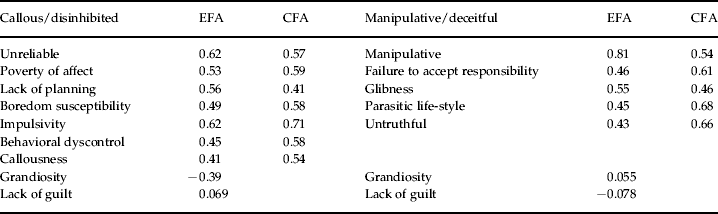
EFA conducted on the first independent half of the total sample (group 1) revealed an optimal two-factor phenotypic solution for the CPS subscales. Specifically, a principal axis factor analysis was conducted, with factors rotated using an oblimin oblique rotation. Kaiser's criterion indicated three factors, but this solution lacked simple structure and, in addition, one factor was defined by only one scale (lack of guilt). Furthermore, the only factor intercorrelation that was higher than 0.2 was between factors 1 (callous/disinhibited) and 2 (manipulative/deceitful) (with r=0.43, p<0.01). Accordingly, analyses were repeated to explore a two-factor solution. Two subscales (grandiosity and lack of guilt) failed to load consistently with either factor and were thus dropped from further analyses. The factor loadings for the simplest and most interpretable EFA two-factor solution of the remaining 12 CPS subscales are reported in Table 1. Inspection of the loadings suggested a first factor of callous/disinhibited traits (with loadings ranging from 0.41 to 0.62) and a second manipulative/deceitful factor (with loadings ranging from 0.43 to 0.81). Additionally, means and standard deviations for males and females for the two factors were (mean=1.25, s.d.=0.18 in boys and mean=1.19, s.d.=0.15 in girls for the callous/disinhibited factor) and (mean=1.30, s.d.=0.18 in boys and mean=1.27, s.d.=0.18 in girls for the manipulative/deceitful factor).
Factor structure and loadings

Exploratory factor analyses (EFA) were conducted on the first independent half of the sample (group 1; n=607). Confirmatory factor analyses (CFA) were conducted on the second independent half of the sample (group 2; n=612). The subjects in the two groups comprised only one co-twin randomly selected from each twin pair.
Factor 1 (callous/disinhibited) has loadings from seven subscales, including unreliability, poverty of affect, boredom susceptibility, impulsivity, lack of planning, callousness and behavioral dyscontrol. Factor 2 (manipulative/deceitful) had loadings from five subscales, including glibness, manipulative, parasitic lifestyle, untruthfulness and lack of responsibility (see Table 1).
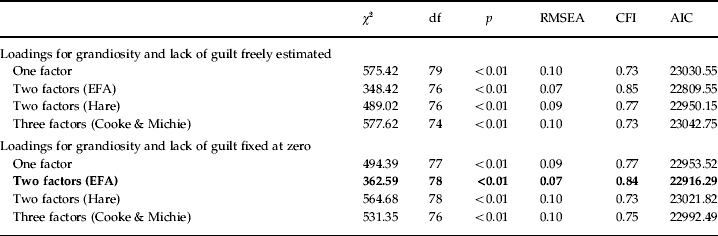
Next, CFA conducted on the second, independent half of our sample (group 2) tested whether this two-factor model could be substantiated. Given that CPS subscale items were selected based on previous psychopathy literature and theories (see Lynam, Reference Lynam1997), CFA was also used to test alternative two- and three-factor models based on Hare et al. (Reference Hare, Forth, Hart and Yuille1989) and Cooke & Michie (Reference Cooke and Michie2001), as well as a one-factor model. Specifically, the ‘two factors (Hare)’ in Table 2 refers to Hare's factor 1 (interpersonal-affective) and factor 2 (life-style-antisocial); the ‘three factors (Cooke & Michie)’ refers to the theoretical model proposed by Cooke & Michie (Reference Cooke and Michie2001). All models were fit including and excluding the poorly loading grandiosity and lack of guilt subscales (see Table 2) – loadings for these subscales were either freely estimated for their specified factors or set to zero in order to compare the fit of the models with and without these two problematic subscales. The comparison of all three fit indices (AIC, CFI, RMSEA) between the one-, two- and three-factor models revealed a better fit for the current study's two-factor solution (AIC=22916.29, CFI=0.84, RMSEA=0.07). The two-factor solution, including the freely estimated subscales, grandiosity and lack of guilt, yielded negative loadings below 0.30. Thus, the more interpretable and best-fitting solution was the current study's two-factor EFA with grandiosity and lack of guilt set to zero (see Table 2). In addition to being the more parsimonious and better fitting model, this two-factor structure revealed by EFA and confirmed by CFA in the present study also falls in line with the psychopathy literature (PCL-R; Hare, Reference Hare1991, Reference Hare2003; Lynam, Reference Lynam1997), in that it includes distinguishable, albeit correlated, factors reflecting an impulsive and dysregulated component, as well as a component reflecting deceitful manipulation of others. Interestingly, in the present child sample, the affective component in the CPS aligns with the dysregulated factor, rather than with the manipulative and deceitful factor, which may suggest some developmental differences in the factor structure of psychopathy. Composite scores for the two factors were thus created and used for all subsequent (genetic) analyses. The internal consistencies (based on items comprising scales within the two factors) were adequate with Cronbach's α of 0.79 for the callous/disinhibited factor and 0.77 for the manipulative/deceitful factor.
Model-fitting indices for confirmatory factor analyses

df, Degrees of freedom; RMSEA, root mean squared error approximation; CFI, comparative fit index; AIC, Akaike's Information Criteria; EFA, exploratory factor analysis.
Values for best-fitting and most interpretable model are shown in bold.
Genetic analyses
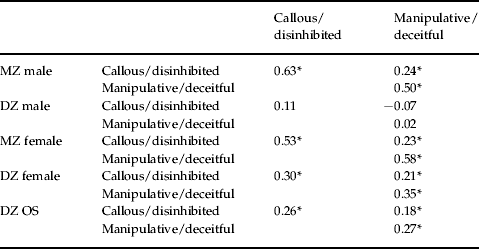
Twin correlations for the two CPS composite factors derived from their respective highly loading subscales are reported in Table 3 for each of the five-zygosity groups. The twin correlations are consistently higher for MZ pairs (both boys and girls) than for DZ pairs, suggesting the presence of a genetic influence (A) in the CPS factors. The twin correlations are mostly moderate, except for DZ males, where the correlations are anomalously low and non-significant. There is also a suggestion of dominance effects in the males, where the MZ correlations are greater than twice the DZ correlations, although this effect is not observed in the females. Genetic effects were confirmed in multivariate genetic models, as described below.
Intraclass and cross-twin cross-trait correlations between the two Child Psychopathy Scale factors

MZ, Monozygotic; DZ, dizygotic; OS, opposite sex.
* p<0.05.
Various multivariate genetic models were fit to the data, including a fully saturated covariance model and a biometrical sex limitation model. Among the types of models fit in which biometrical parameters in males (m) and females (f) were allowed to differ (m≠f), the bivariate Cholesky decomposition for the two CPS factors (callous/disinhibited and manipulative/deceitful) with no shared environmental (C) influences provided the best fit to the data (Δχ2=46.56, Δdf=38, AIC=−29.44, p=0.16).
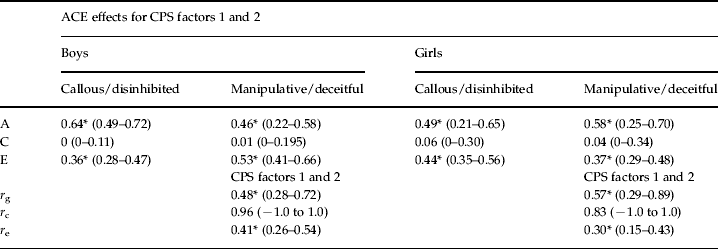
The full model ACE estimates for both boys and girls are provided in Table 4. As can be seen, there are significant genetic as well as unique environmental effects for both CPS factors 1 and 2 in both boys and girls. Shared environmental effects were small and non-significant (ranging from 0 to 0.06). Heritability estimates for CPS factors 1 and 2 were h2=0.64 and h2=0.46, respectively, in boys and h2=0.49 and h2=0.58, respectively, in girls. The unique environmental effects for both factors 1 and 2 were e2=0.36 and e2=0.53, respectively, in boys and e2=0.44 and e2=0.37, respectively, in girls.
ACE estimates and genetic and environmental correlations for Child Psychopathy Scale (CPS) factors (for both boys and girls separately)

r g, genetic correlation between CPS factors 1 and 2; r c, common environmental correlation between CPS factors 1 and 2; r e, unique (or unshared) environmental correlation.
* Parameter is significant at the 0.05 level. 95% confidence intervals are shown in parentheses.
Bivariate analyses reveal the contributions of genetic and environmental factors to the covariance between the two traits; that is, they reveal the degree to which the relation between traits (callous/disinhibited and manipulative/deceitful) is due to common genetic or common environmental influences. Genetic analyses conducted on the two CPS composite factors revealed significant correlations between genetic (r g=0.48 for boys; r g=0.57 for girls) and non-shared (r e=0.41 for boys; r e=0.30 for girls) environmental factors (see Table 4). The common or shared environmental (r c=0.96 in boys; r c=0.83 in girls) correlation was not significant in either boys or girls (see Table 4), which is not surprising given the non-significant C values for either factor shown in Table 4. Additionally, 65% of the phenotypic correlation between the two CPS factors (r p=0.46, p<0.001) was attributed to common genetic effects in girls, while 59% of the correlation was attributed to genetic effects in boys. The proportion of the phenotypic correlation due to non-shared environmental factors was 40% for boys and 26% for girls. The proportion attributed to shared environmental influences was 9% in girls, but trivial in boys.
Discussion
The aims of the present study were to investigate the fundamental factor structure of psychopathic personality traits in a community sample of children and to examine the extent to which genetic and environmental factors influence these traits. EFA and CFA were performed to investigate the underlying factor structure of the data. Consistent with previous literature, our results revealed a two-factor solution to be the best fitting for psychopathic personality traits within our sample. This two-factor structure was confirmed on our pre-adolescent sample using 12 of the 14 CPS subscales. Two subscales, grandiosity and lack of guilt, were dropped due to lack of clear factor loadings.
These results fall in line with previous studies that have also found a two-factor structure to account for psychopathic traits in children and adolescents (Frick et al. Reference Frick, O'Brien, Wootton and McBurnett1994; Brandt et al. Reference Brandt, Kennedy, Patrick and Curtin1997; Salekin et al. Reference Salekin, Rogers and Machin2001). The present study found and confirmed a two-factor structure that is somewhat different from the factor structures obtained in the adult literature (Hare, Reference Hare1991; Cooke & Michie, Reference Cooke and Michie2001). Hare's (Reference Hare1991) two factors comprise ‘affective-interpersonal’ features (e.g. glibness, superficial charm, lack of empathy; factor 1) and ‘socially deviant life-styles and behaviors’ (e.g. impulsivity, sensation seeking, irresponsibility, poor behavioral control; factor 2). The first factor identified in the present study, the callous/disinhibited factor, includes characteristics and traits such as behavioral dyscontrol, callousness and lack of empathy, while the second factor, the manipulative/deceitful factor, includes characteristics such as glibness and untruthfulness. Differences in the factor structures – notably the alignment of the callous and poverty of affect subscales with the factor reflecting behavioral dyscontrol instead of the more interpersonal one reflecting manipulative deceit of others – may be due to the fact that the sample comprises a young, pre-adolescent community sample that has yet to experience the influences of others, including peers. Differences may have also arisen due to changes in development. One might not necessarily expect to find identical factor structures in adults and in children at such a young age (Salekin, Reference Salekin and Patrick2006). Adult psychopathy may be confounded by the fact that adult psychopaths have experienced years of drug abuse, multiple incarcerations and physical fighting (Hare, Reference Hare1983), whereas in children we can ‘observe the development of the disorder before it has had an opportunity to destroy its host’ (Lynam, Reference Lynam1997, p. 434). It is also possible that the differences in factor structure may be specific to the CPS instrument, which was essentially created as a downward extension of an adult construct. Perhaps a different approach to developing an instrument designed to assess affective, interpersonal and dysregulated behaviors specifically in children might yield a factor structure more closely aligned to Hare's conceptual framework in adults.
Subsequent genetic analyses conducted on the two psychopathic personality dimensions (composite factors) demonstrated significant heritable as well as unique environmental effects of psychopathic personality traits, with significant differences between boys and girls. Specifically, heritability estimates for factor 1 (callous/disinhibited) were 0.64 in boys and 0.49 in girls, whereas for factor 2 (manipulative/deceitful), 0.46 of the variance was due to genetic effects in boys and 0.58 in girls. No significant shared environmental influences were found in psychopathic personality traits within our child sample.
These results are consistent with those found in previous twin studies assessing psychopathic traits in children and adolescents, which have also found strong genetic and unique environmental influences, but no significant shared environmental effects (Taylor et al. Reference Taylor, Loney, Bobadilla, Iacono and McGue2003; Viding et al. Reference Viding, Blair, Moffitt and Plomin2005; Blonigen et al. Reference Blonigen, Hicks, Krueger, Patrick and Iacono2006; Larsson et al. 2006). However, those studies either did not explore sex differences or did not find any sex differences within their samples. The present findings revealed significant genetic influences on both callous/disinhibited and manipulative/deceitful traits in both girls and boys just prior to adolescence.
Furthermore, the relationship between the callous/disinhibited and manipulative/deceitful traits in both boys and girls was mediated by both genetic and environmental factors common to both traits. Specifically, the bivariate genetic correlation between the two factors was r g=0.48 in boys and r g=0.57 in girls. The unique environmental correlations were r e=0.41 in boys and r e=0.30 in girls. Two traits may be related because they share genetic or environmental influences. Nonetheless, both the genetic correlation and the unique environmental correlation were significantly less than 1.0, indicating a less than complete overlap in the etiologies of callous/disinhibited and manipulative/deceitful traits. These results give further support to the notion of a two-factor structure underlying psychopathic traits in children and highlight the significant overlap (as well as distinctions) in the etiologies of these two emerging factors.
The results of the present study were consistent with a recent study conducted by Viding et al. (Reference Viding, Blair, Moffitt and Plomin2005) on the genetic effects of psychopathy in 7-year-olds. Viding et al. found a significant heritability for their assessment of callous/unemotional psychopathy traits in children (h2=0.67). However, they did not look to see whether there were any significant sex differences in their data. Our heritability results of the callous/disinhibited factor were comparable to those of Viding et al. (h2=0.64) in the boys, but not in the girls (h2=0.49). However, when the sexes are combined in our sample, our callous/disinhibited factor yields a heritability of approximately 60%.
Given the fact that psychopathy is mostly studied in adult males (Hare, Reference Hare1991; Lalumiere et al. Reference Lalumiere, Harris and Rice2001) and not much is known about the core construct of the disorder in children (Cruise, 2003), the present study's demonstration of significant genetic and unique environmental effects of psychopathic traits in both young boys and girls may be a considerable break-through or finding for the advancement of psychopathy research. However, we did not find any significant shared environmental influences in psychopathic personality traits. This could be due to the fact that DZ male correlations are anomalously low, perhaps due to biases in caregiver reports.
The present study found and confirmed a two-factor solution for children's psychopathy traits. This is consistent with the fact that Salekin et al. (Reference Salekin, Rogers and Machin2001) also found a two-factor solution for psychopathy in children, but inconsistent with other studies that have also found a three-factor structure in children's psychopathic traits (Frick, 1998; Frick et al. Reference Frick, Bodin and Barry2000). This could be due to the fact that we split our twin sample into two to both explore and confirm our factor structures, whereas Frick et al. did not have a twin sample. It could also be due to the fact that their sample contained children who were a bit older.
Study strengths and limitations
Several factors must be considered when interpreting these results. First, the study used only caregiver reports of the twins' psychopathic-like behavior, whereas the use of other raters, including self-reports, might yield different results. Child self-reports of behaviors might also be used in a multi-rater approach in future studies to help corroborate the observed and reported psychopathic personality behaviors. However, studies that employ children's self-reports could be affected by social desirability, poor reading skills and a general lack of comprehension, which may occur in children (Lyons et al. Reference Lyons, True, Eisen and Goldberg1995). Caregivers may be able to comprehend difficult and complex behaviors and constructs, such as psychopathy, better than children (Lyons et al. Reference Lyons, True, Eisen and Goldberg1995; Lynam, Reference Lynam1997).
Second, the examination of psychopathic traits in children could also be questioned. It has been argued that it might not be developmentally appropriate to diagnose this syndrome in children and adolescents (Vincent & Hart, 2002). However, there is evidence that psychopathic personality traits are developmental and may be found in child samples (Lynam, Reference Lynam1997; Viding et al. Reference Viding, Blair, Moffitt and Plomin2005). Finally, one may question the occurrence of low DZ male correlations in our sample. This might be due to some bias in the mother reports of the CPS or perhaps due to non-additive or dominant genetic effects. However, comprehensive model fitting analyses of the data revealed that an AE (AIC=−29.44) model fit the data better than a model taking dominance effects into account. Even though the low DZ male correlation might suggest dominant genetic effects at work in the boys, the moderate resemblance among DZ opposite sex pairs suggests otherwise.
Another limitation might be due to the fact that lack of guilt and grandiosity, which may be considered to be ‘core’ traits of psychopathy did not load well onto either factor in this child sample. This may be due to the fact that these traits might not properly or fully develop until later adolescence or adulthood and might not be present in children as young as 9 and 10 years old. Some aspects of psychopathy may be unsuitable or developmentally unbefitting for children (Salekin et al. Reference Salekin, Rogers and Machin2001).
Conclusions
The present study provides substantial evidence for a genetic liability of psychopathic traits in a diverse community sample of both boys and girls during childhood. However, these results in no way imply that children are not capable of change or that they are impervious to intervention and prevention methods. Gaining a better understanding of the etiology of psychopathic traits in children may assist in developing early effective intervention programs so that we can better combat different forms of antisocial or criminal behaviors. Future studies from this sample might investigate whether the twins identified as possessing psychopathic-like traits during childhood also showcase these traits as they develop and grow into adulthood.
Acknowledgments
The authors wish to thank the USC Twin Project staff for assistance in data collection and scoring and the twins and their families for their participation in this research. This study was supported by grants to Serena Bezdjian from NIMH (F31 MH068953) and NIDA (T32 DA07313), to Laura Baker from NIMH (R01 MH58354) and to Adrian Raine from NIMH (Independent Scientist Award K02 MH01114–08).
Declaration of Interest
None.
Appendix 1
Child Psychopathy Scale subscales and items

Scales dropped from analyses due to poor loadings

R, reverse-scored item.