Introduction
Social inequalities in health and wellbeing at older ages are well documented (e.g. Avendano et al. Reference Avendano, Glymour, Banks and Mackenbach2009; Banks et al. Reference Banks, Marmot, Oldfield and Smith2006; Knesebeck et al. Reference Knesebeck, Wahrendorf, Hyde and Siegrist2007; McMunn et al. Reference McMunn, Breeze, Goodman, Nazroo, Marmot and Wilkinson2006), but the explanations proposed so far are less convincing. In particular, the question how conditions during earlier stages of the lifecourse, such as work and employment, help to explain inequalities in older age is still unclear (Elder and Johnson Reference Elder, Johnson and Settersten2002; Siegrist and Marmot Reference Siegrist and Marmot2006), as most existing studies are restricted to working populations. This, with some noticeable exceptions (Breeze et al. Reference Breeze, Fletcher, Leon, Marmot, Clarke and Shipley2001; Melchior et al. Reference Melchior, Berkman, Kawachi, Krieger, Zins, Bonenfant and Goldberg2006; Platts et al. Reference Platts, Netuveli, Webb, Zins, Goldberg, Blane and Wahrendorf2013; Wahrendorf et al. Reference Wahrendorf, Blane, Bartley, Dragano and Siegrist2013; Westerlund et al. Reference Westerlund, Kivimaki, Singh-Manoux, Melchior, Ferrie, Pentti, Jokela, Leineweber, Goldberg, Zins and Vahtera2009; Wiggins et al. Reference Wiggins, Erzberger, Hyde, Higgs and Blane2007), contrasts sharply with the increasing importance of the lifecourse in social epidemiology (Blane Reference Blane, Marmot and Wilkinson2006; Power and Kuh Reference Power, Kuh, Siegrist and Marmot2006), and also with the importance of working conditions for health during mid-life (Marmot, Siegrist and Theorell Reference Marmot, Siegrist, Theorell, Marmot and Wilkinson2006). It can be assumed that older people with poor health and low wellbeing in later life had particular employment histories and thereby more disadvantaged working conditions that had effects beyond working life.
Links between working conditions and health are well established for midlife and there are several reasons why specific types of employment histories may be accompanied by favourable working conditions with long-term consequences for health and wellbeing. First, work (and in particular continued employment) is the major determinant of financial circumstances after retirement (Bartley and Plewis Reference Bartley and Plewis2002; Cambois and Jusot Reference Cambois and Jusot2011; Kahn and Pearlin Reference Kahn and Pearlin2006; Schröder Reference Schröder2013; Smith et al. Reference Smith, Hart, Blane, Gillis and Hawthorne1997), through its role in the level at which a pension will be set. Second, in most countries the employment record influences access to good standards of medical care in later life (van Doorslaer, Koolman and Jones Reference van Doorslaer, Koolman and Jones2004). Continued work and employment also play a major part in access to favourable housing conditions (Schikowski et al. Reference Schikowski, Sugiri, Reimann, Pesch, Ranft and Kramer2008). Further, people with continued employment usually experience lower levels of occupational hazards as compared to people with precarious employment (Eurofound 2012), where levels of physical and chemical hazards are higher. Links between these exposures at work and health are well established (Arndt et al. Reference Arndt, Rothenbacher, Daniel, Zschenderlein, Schuberth and Brenner2005; Schwatka, Butler and Rosecrance Reference Schwatka, Butler and Rosecrance2012), and recent evidence shows their long-term consequences for wellbeing in later life (Platts et al. Reference Platts, Netuveli, Webb, Zins, Goldberg, Blane and Wahrendorf2013). The employment history may also be related to health-risk behaviours (Domenighetti, D'Avanzo and Bisig Reference Domenighetti, D'Avanzo and Bisig2000; Ferrie et al. Reference Ferrie, Shipley, Marmot, Stansfeld and Davey Smith1998), in particular, in the case of unstable careers of men (Head, Stansfeld and Siegrist Reference Head, Stansfeld and Siegrist2004; Messing et al. Reference Messing, Punnett, Bond, Alexanderson, Pyle, Zahm, Wegman, Stock and de Grosbois2003).
In addition to these rather plausible mechanisms, work (and in particular continued employment) provides important options to meet basic psycho-social needs, such as a sense of belonging to a social network (Berkman and Glass Reference Berkman, Glass, Berkman and Kawachi2000; Krause Reference Krause2004), a sense of control and autonomy (Haidt and Rodin Reference Haidt and Rodin1999) and a sense of reward (Siegrist Reference Siegrist2005). These aspects are at the core of existing theoretical models of work stress (see Siegrist Reference Siegrist, Cartwright and Cooper2009 for a detailed description), and their relation with health and wellbeing during working life is well established (e.g. Antoniou and Cooper Reference Antoniou and Cooper2005; Schnall, Dobson and Rosskam Reference Schnall, Dobson and Rosskam2009; Siegrist and Marmot Reference Siegrist and Marmot2004; Stansfeld and Candy Reference Stansfeld and Candy2006; Steptoe and Kivimaki Reference Steptoe and Kivimaki2012). Recent findings illustrate their long-term consequences for wellbeing after labour market exit (Wahrendorf et al. Reference Wahrendorf, Sembajwe, Zins, Berkman, Goldberg and Siegrist2012, Reference Wahrendorf, Blane, Bartley, Dragano and Siegrist2013). It thus may be assumed that continuous employment promotes opportunities of meeting psycho-social needs, while precarious and unstable careers may be accompanied by the recurrent experience of psycho-social stress, with adverse consequences for health and wellbeing (Chandola, Brunner and Marmot Reference Chandola, Brunner and Marmot2006; Wahrendorf et al. Reference Wahrendorf, Blane, Bartley, Dragano and Siegrist2013). Notably, research shows that employment histories and levels of exposure (but also their health-related effects) differ between men and women (Messing et al. Reference Messing, Punnett, Bond, Alexanderson, Pyle, Zahm, Wegman, Stock and de Grosbois2003). Men tend to work in sectors with more strenuous jobs and different levels of exposures (e.g. higher levels of physical exposures) and in higher-skilled occupational positions compared to women (Eurofound 2012). Furthermore, some studies show that health-related effects of stressful working conditions are particularly great for men (Stansfeld et al. Reference Stansfeld, Fuhrer, Shipley and Marmot1999; Wahrendorf et al. Reference Wahrendorf, Blane, Bartley, Dragano and Siegrist2013), suggesting a higher significance of the work role for men compared to women, or the availability of alternative roles (e.g. family) among women. For these reasons, the following analyses will be conducted for men and women separately.
Aside the above-mentioned small number of studies linking working conditions with health and wellbeing beyond working life, a second shortcoming of current knowledge refers to the measurement of work-related factors. In most studies, information about work and employment is restricted to one single time-point, which is then linked with later outcomes (e.g. Kivimaki et al. 2012). This neither considers the length of a specific state (e.g. length of unemployment) nor does it take into account when this period occurred within the working life, with probably different consequences for wellbeing (e.g. beginning versus end of working life). This conflicts with an important idea of the lifecourse perspective, which is not to isolate single events from larger histories (Elder, Johnson and Crosnoe Reference Elder, Johnson, Crosnoe, Mortimer and Shanahan2003; Sackmann and Wingens Reference Sackmann, Wingens, Heinz and Marshall2003), but to consider both length and embeddedness in larger time-frames. It is thus important to consider employment histories as a whole, and thus, to integrate information about length and timing.
Taken together, studies studying long-term consequences of work and employment conditions are still rare and the measurement of work-related factors needs to be improved, by considering entire employment histories rather than single events only. Along these lines, this paper follows two aims. First, to summarise employment histories of men and women in their entirety using annual information on occupational situation from age 30 to 65. To do so, sequence analyses are applied (Abbott Reference Abbott1995; Aisenbrey and Fasang Reference Aisenbrey and Fasang2010), which allow an in-depth description of entire employment histories (see ‘Measurements’ within the Methods section for details) and then similar histories may be regrouped into empirically distinct clusters.
As a second aim, associations between employment histories and quality of life after labour market exit will be analysed. It is assumed that people with histories of continuous paid employment (ending in late retirement) have higher quality of life after labour market exit as compared to people with unstable histories, not only through better material circumstances in later life, but also by offering opportunities for fulfilling non-material needs. Because of previously documented differences between men and women, this may be particularly the case for men. To avoid the risk that existing findings are attributable to reverse causation (where poor health leads to disadvantaged employment histories and to poorer quality of life in later life), analyses are restricted to individuals without poor health prior to and during their working life, and a number of important confounders in the analyses are considered (e.g. social position prior to working life and family arrangements).
Methods
Data sources
Data from the third wave of the Survey of Health, Ageing and Retirement in Europe (SHARE) were used, where information on employment histories has been collected (Börsch-Supan et al. Reference Börsch-Supan, Brandt, Hank and Schröder2011), together with information on quality of life assessed in Wave 2. SHARE is the first cross-national research project collecting data on a variety of sociological, economic and health-related topics among older adults in Europe. The survey started in 2004–05 in 11 countries (Sweden, Denmark, Germany, Netherlands, Belgium, France, Switzerland, Austria, Italy, Spain and Greece), with on-going waves of data collection at two-year intervals. Two new countries joined SHARE in wave two (Czech Republic and Poland). In each country, samples consist of a probability household sample, with individuals aged 50 years or older plus their (possibly younger) partners being interviewed using Computer Assisted Personal Interviews (CAPI). New cohorts (so called ‘refreshers’) are added subsequently to maintain population representation. In contrast to Waves 1 and 2, the third wave of SHARE was conducted as a distinct survey to collect retrospective data on respondents' lifecourse (also called SHARELIFE). This included detailed information on employment histories. With regard to survey participation, response rates of SHARE are generally above average compared to other European Surveys (Börsch-Supan and Jürges Reference Börsch-Supan and Jürges2005). At study onset, the household response rates were 61 per cent for the total sample ranging from 81 per cent in France to 39 per cent in Switzerland, with rates above 50 per cent in eight countries. With respect to attrition between Waves 2 and 3, the percentage of respondents lost varied between 34 per cent (Austria) and 14 per cent (Switzerland), with rates below 20 per cent in seven countries (Schröder Reference Schröder2011). Details about the entire SHARE project are available at www.share-project.org. By using data from the third wave, it is possible to analyse previous employment histories across 13 European countries, ranging from Northern Europe (Denmark, Sweden), Western Europe (Germany, Netherlands, Belgium, France, Switzerland, Austria), Southern Europe (Italy, Spain and Greece) to Eastern Europe (Czech Republic and Poland).
Subjects
The analyses focus on employment histories from age 30 to 65, thus excluding men and women below 65 at Wave 3. This restriction serves the aim of exploring the relevance of previous employment histories for the post-employment period of life.
Furthermore, three important restrictions were necessary to avoid the studied career sequences being biased and to minimise the effect of ill-health causing both specific employment histories and the report of poor wellbeing in later life. First, people who had difficulties in responding to the retrospective questionnaire or that reported themselves as ‘retired’ before the age of 45 were not considered. Second, people that reported ‘poor self-reported health’ during childhood were not included either, because they may have both specific employment histories and impaired health in later life. Third, all men and women who reported a period of ‘long-term sickness absence’ during working ages (lasting six months or longer between the ages of 15 and 65) or who stated having been ill or with disabilities most or all of their working lives were not part of the sample either (irrespective of any labour market involvement).
To study associations between career sequences and quality of life (not collected in SHARELIFE), data were further linked with Wave 2 data (2006–07). This resulted in a sample of 3,914 women and 3,836 men (N=7,750) with full available data on both waves and a sample with full data on employment histories for 4,907 women and 4,808 men (N=9,715).
Measurements
The life-grid approach
The third wave of SHARE contains a detailed module on individual employment history. In this module, information is collected retrospectively on an annual basis using the so-called ‘life-grid approach’, where data collection is supported by a graphical representation of the respondent's life. The lifegrid is filled in the course of the interview, resulting in information for each age of the respondent. In addition to employment histories, it also covers individuals' partnership and children history. To help the respondents to fill the life grid, the interview starts with events that they are very likely to remember (birth dates of children). From there the lifecourse is reconstructed bit by bit, where it is also possible to switch from one dimension to another during the interview to facilitate data collection (e.g. job start before or after the birth of the first child). Furthermore, in case a respondent is not sure about a date, so-called ‘landmark events’ (prominent events) are available for each year (e.g. before or after death of J. F. Kennedy). The life-grid method was developed first for use in the Boyd Orr Cohort as a self-completion questionnaire (Blane Reference Blane1996) with subsequent development of a CAPI version by the UK National Centre for Social Research (Scholes et al. Reference Scholes, Medina, Cheshire, Cox, Hacker and Lessof2009) which was adopted for SHARELIFE (Schröder Reference Schröder2011). Several advantages of this method were described compared to prospective data collections. On the one hand, retrospective data collection is a fast and less expensive method for obtaining longitudinal information. On the other hand, the life-grid approach assures that comparable information (referring to different time-points) is collected, without missing data due to drop-out during follow-up periods of a prospective survey. Certainly, in some cases the collection for each age prevents a nuanced inspection (e.g. precise date of retirement). In addition, recall bias is one disadvantage as opposed to prospective data collection (specifically when asking about previous attitudes or emotions). Yet, studies show that the accuracy of recalled information is high when asking about socio-demographic conditions (Berney and Blane Reference Berney and Blane1997; Havari and Mazzona Reference Havari and Mazzona2011) and there is good reason to believe that the measurement of previous employment histories is reliable as well (Baumgarten, Siemiatycki and Gibbs Reference Baumgarten, Siemiatycki and Gibbs1983; Bourbonnais, Meyer and Theriault Reference Bourbonnais, Meyer and Theriault1988).
Employment histories
In SHARELIFE, the employment module collects, on an annual basis, details on each job a respondent had during his or her working career and on each period when the respondent was not employed (if the respective period lasted six months or longer). Information on jobs includes the starting and ending date, an indicator of the occupational position (first digit of the International Classification of Occupation (ISCO)) and whether the job was part-time or full-time. Information on periods when the respondent was not in paid employment for six months or longer includes a description of the situation, including retirement, domestic work, unemployment, full-time education or a period of sickness absence. By combining these data, a detailed description of previous employment histories for each individual aged 65 or older, in terms of the occupational situation for each year of age between 30 and 65, can be provided. For the purpose of the analyses, existing information on gaps, jobs and retirement were considered, and distinguished between five states: (1) work full-time ‘W’, (2) work part-time ‘w’, (3) domestic work ‘D’, (4) unemployed ‘U’ and (5) retired ‘R’. Given that the number of possible sequences grows rapidly with the number of states, this helps to focus and simplify the measurement as far as possible, without losing the information of interest (only 1% that were still in full-time education at the age of 30 were lost). Full-time work was assumed if a person was in paid employment 35 hours or longer during the week (part-time less than 35 hours). By combining two common criteria to define retirement (Ekerdt and Deviney Reference Ekerdt and Deviney1990), ‘retired’ was measured in terms of labour market exit, when respondents left their last gainful job, and when they consider themselves as ‘retired from work’. In contrast to other measures of retirement (e.g. receiving state pension), this may be less confounded by country-specific policies.
Quality of life in older ages
To capture wellbeing, a measure of quality of life specifically designed for early old age was used, which is widely used in international ageing surveys, the CASP-12 questionnaire. One of the innovations of SHARE is the inclusion of this measure – a psychometrically validated short version of the original 19 item version (CASP-19) (Hyde et al. Reference Hyde, Wiggins, Higgs and Blane2003; Wiggins et al. Reference Wiggins, Netuveli, Hyde, Higgs and Blane2008). An important characteristic of this instrument is that it does not focus on respondents' self-evaluation of quality of life. Rather, it refers to the existing literature of ageing and identifies aspects that are thought to be specific to quality of life in early old age (Hyde et al. Reference Hyde, Wiggins, Higgs and Blane2003), first, the new opportunities of the third age compared to former stages in life (Laslett Reference Laslett1996), and second, the literature of Giddens (Reference Giddens1991) and the role of older people in a rapidly changing society. On this basis, four domains are used: control (C), autonomy (A), self-realisation (S) and pleasure (P). The experience of these aspects (over the past four weeks) is measured with 12 questionnaire items (three for each domain) which are scored on a four-point Likert scale. A summary measure of the 12 items is used to assess quality of life in this study where the total sum score ranges from 12 to 48, with higher scores indicating better quality of life. Psychometric properties of CASP-19 are fully described elsewhere (Hyde et al. Reference Hyde, Wiggins, Higgs and Blane2003).
Additional variables
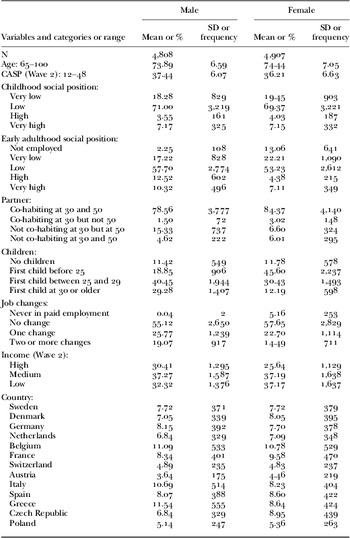
In addition to age and sex, a number of additional individual measures were included, mainly as control variables in analyses testing associations between employment histories and later quality of life. First, two measures of respondents' social position before or at the beginning of his or her working career were used, one measuring the occupational position of the main breadwinner at the age of ten, and another describing respondents' own occupational position held between ages 20 and 30. In both cases, occupational positions were assessed according to the ten main occupational groups of the ISCO. For the analyses, previous procedures (Wahrendorf, Dragano and Siegrist Reference Wahrendorf, Dragano and Siegrist2013; Wahrendorf et al. Reference Wahrendorf, Blane, Bartley, Dragano and Siegrist2013) were followed, and groups were reduced to the four different skill levels representing the broad hierarchical structure of ISCO (very low: first skill level; low: second skill level, high: third skill level; very high: fourth skill level). In the case of the second indicator (occupational position between 20 and 30), the available skill levels for each year were summed up and divided by the number of years in employment and respondents were regrouped to the four skills levels (by rounding up or down the resulting score). If respondents had not been working, they were categorised as ‘not employed’. A second set of indicator relates to the circumstances during working life: respondents' partnership (co-habitation), parental situation (children) and number of job changes. In the case of parental history, four-categorical variable was used based on the age at the birth of the first child (or adoption of the first child), categorised into ‘no child’, ‘first child before 25’, ‘first child between 25 and 30’ and ‘any child after 30’. With regards to living arrangements, information was combined on whether the respondents lived with a partner at the age of 30 and 50 (without considering the marital status), resulting in a four categorical variable. Job changes were regrouped into ‘never in paid employment’, ‘no changes’, ‘one change’ and ‘two or more changes’. Finally, income was included to investigate to what extent an association between working career and quality of life can be explained by current financial circumstances. Information is based on the total annual household income composed of the sum of different income components that were assessed in Wave 2. In cases where income components were missing, information was obtained through imputation (Paccagnella and Weber Reference Paccagnella, Weber, Börsch-Supan, Brugiavini, Jürges, Mackenbach, Siegrist and Weber2005). To adjust for household size, the value of income was divided in accordance with the Organisation for Economic Co-operation and Development equivalent-scale and thereafter categorised into country-specific ter Otiles (low income, medium income, high income). An overview of all used variables is provided in Table 1.
Sample description for men and women

Note: SD: standard deviation.
Statistical analyses
Two sets of analyses were conducted. The first set investigated employment histories for men and women using sequence analyses. The second set tested associations between employment histories and quality of life in older ages using multi-level regression models.
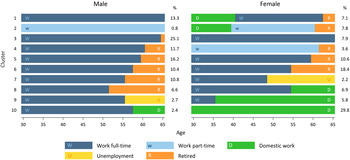
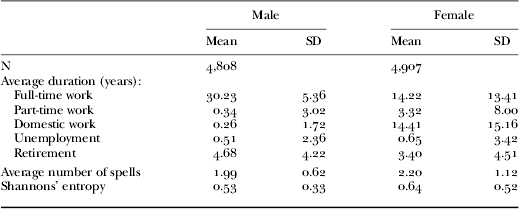
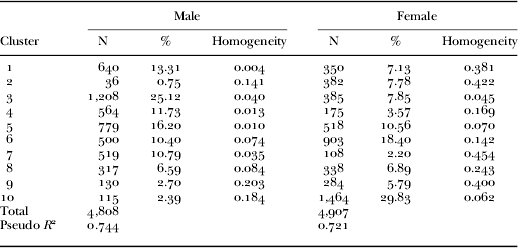
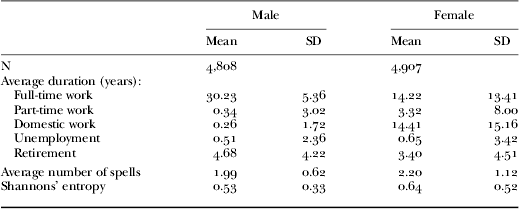
With regard to the first set, this began with a general overview of employment histories for men and women, by listing the average years spent in the five different occupational situations (cumulative state duration), the mean number of spells (consecutive runs of the same occupational situation) and an indicator to describe the general heterogeneity of employment histories (Shannon's relative entropy) (Shannon Reference Shannon1948; Widmer and Ritschard Reference Widmer and Ritschard2009), based on the cumulated duration in the different states. In addition, Figure 1 presents the prevalence of occupational situations by age (so-called chronograms). Next, individual sequences were compared and the differences of each single sequence to another were calculated, again for men and women separately. To this aim, several techniques or ‘distance measures’ exist, where differences are calculated in terms of specific ‘costs’ to turn one sequence into another. These costs increase by substituting one state with another (substitution cost) or deleting and/or inserting one state into a sequence (indel costs) (see Halpin Reference Halpin2012 for an overview of different approaches). For the analyses, Lesnard's dynamic hamming distances were used (Lesnard Reference Lesnard2010). This considers the time dimension or ‘calendar’ in the data, where specific occupational situations and the transitions from one state to another vary over time (e.g. lower probability of moving from full-time employment to retirement in younger years). More specifically, ‘costs’ are defined on the basis of transition rates for each time-point (age) separately (and not defined and fixed by the researcher) (Abbott and Tsay Reference Abbott and Tsay2000; Aisenbrey and Fasang Reference Aisenbrey and Fasang2010). As a test of robustness, supplementary analyses were conducted and results were compared to alternative distance measures (optimal matching and traditional hamming). After calculating the distances, cluster analysis (Ward's linkage) was used to regroup similar sequences. Different cluster solutions were compared and it was decided to present a ten-cluster solution both for men and women in the results. This allowed identification of meaningful clusters (construct validity) and direct comparisons between men and women. Clusters are presented in Table 3, where frequencies and a measure of homogeneity (mean distance to the cluster centre) are presented for each cluster. In addition, a Pseudo R 2 is listed describing the extent to which the chosen cluster solution explains variations between sequences (Studer et al. Reference Studer, Ritschard, Gabadinho and Muller2011). In addition, Figure 2 presents the so-called ‘medoid sequence’ for each cluster, which is the sequence closest to the cluster centre. All calculations and figures were done with STATA and the ‘sadi’ package developed by Brendan Halpin, and the ‘sq’ package (Brzinsky-Fay, Kohler and Luniak Reference Brzinsky-Fay, Kohler and Luniak2006).
Employment situation by age for men (N=4,808) and women (N=4,907).

Prototypes of employment histories for men (N=4,808) and women (N=4,907) and frequencies (%).

In the second set of analyses, the associations between employment histories and quality of life in older ages were tested. For this, multi-level linear regression models (random intercept) to predict quality of life were calculated, with individuals (level 1) nested within countries (level 2) (Skrondal and Rabe-Hesketh Reference Skrondal and Rabe-Hesketh2010). Employment histories were included as categorical variables, where cluster membership was broken down in a set of dummy variables. Using multi-level modelling allows for accurate adjustment for country affiliation, because the constant is allowed to vary across countries. This is important for the analyses, because of previously reported variations of quality of life between countries (Knesebeck et al. Reference Knesebeck, Wahrendorf, Hyde and Siegrist2007). In addition, it offers the opportunity to study variations in quality of life between and within countries. Likelihood ratio tests were performed comparing the multi-level models to ordinary linear regression (ordinary least-squares) and revealed better model fits in all cases. In addition to the empty model, results of three consecutive models are presented. The empty model contains a constant term only whose function is the estimation of the distribution of variance between each level. Model 1 includes career sequences and adjusts for age, age square and the two indicators of previous social position. Model 2 additionally includes lifecourse factors. Finally, in Model 3, current income is included. The respective tables present estimated regression coefficients together with standard errors and level of statistical significance. For the random components the variability parameter between and within countries is estimated. In addition, the log likelihood, the Akaike Information Criterion (AIC) and the Bayesian Information Criterion (BIC) statistics are given, and the proportional reduction of variance explained at each level (R 21, R 22) is reported using Pseudo R 2 statistics (Snijders and Bosker Reference Snijders and Bosker1994). These later measures allow quantification of the extent to which variations in quality of life at each level can be explained by the considered variables. Again, all calculations were done with STATA 12 based on the ‘xtmixed’ procedure.
Results
Descriptive findings
There were slightly more women participating (N=4,907) than men (N=4,808), with a mean age of 74 years for both sexes at the time of the SHARELIFE interview. The average number of observations across countries was 377 for women and 370 for men, with smallest number for both sexes in Austria (219 women and 175 men). The large majority lived in a partnership throughout adulthood, had their first child in early adulthood (before 30), and had one or two jobs during their working life (see Table 1 for details).
Table 2 gives a first description of employment histories between ages 30 and 65. During this period (lasting 36 years) men spent on average 30.2 years in full-time work and women 14.2 years. For both sexes, time spent in part-time work was very low, with slightly higher values for women (3.3 years). Notably, while women spent most of their time in domestic work (14.4 years), men spent almost no time in this state (0.3 years). Overall, the mean time spent in retirement ranged from 4.7 years for men to 3.4 years for women. Both sexes spent less than a year in unemployment throughout their working life. However, given that only significant spells were recorded (six months or longer), this may be underestimated. With regard to the reported standard deviations, the average numbers of distinct spells and Shannons' entropy, findings indicate that employment histories are more diverse between women and more similar between men. This is also apparent in Figure 1, which displays the percentage of persons in the five states by age. In the case of men, high rates of full-time employment and increasing rates of retirement in later ages are mainly observed, while rates of part-time employment and domestic work are apparent for women throughout all ages. Next, results of the sequence analyses comparing individual sequences as a whole and regrouping similar sequences into clusters are presented.
General characteristics of working career sequences for men and women
Note: SD: standard deviation.
Types of employment histories
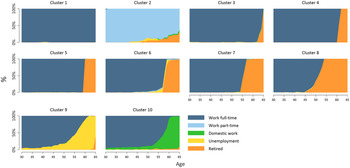
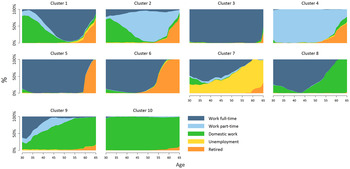
Which types of employment histories can be distinguished among men and among women? Figure 2 gives answers to this question, presenting prototypes for the identified clusters and the prevalence of cluster membership for men and women separately. In addition, Table 3 informs how homogeneous or similar the sequences are within each cluster and to what extent the ten-cluster solutions allow their variations to be explained. Chronograms of the clusters can be found in Figures 3 and 4 for men and women, respectively.
Employment situation by age and cluster for men (N=4,808).

Employment situation by age and cluster for women (N=4,907).

Prevalence of ten-cluster solutions and measures of homogeneity for men and women
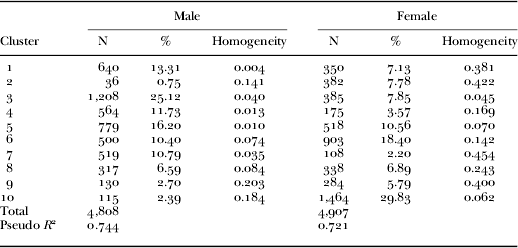
Clusters for men can be summarised as follows: clusters are very homogeneous and the ten-cluster solution explains almost three-quarters of the variations between employment histories (Pseudo R 2: 0.74). Notably, as can be seen in Figure 2, for men all clusters start with a long spell of employment and clusters are characterised by one or two states only. For instance, in the first two clusters the employment spell lasts until the end of the observed period. In these cases cluster membership differs according to full-time employment (cluster 1) or part-time employment (cluster 2). For most clusters the long periods of employment (full-time) end in retirement (clusters 3–8), where the moment of retirement matters for cluster membership, with latest retirement in cluster 3 (at 65 or shortly before) and earliest retirement in cluster 8 (before 55). In contrast, members of the two remaining clusters have been in unemployment (cluster 9) or domestic work (cluster 10) at the end of their employment history. These two latter clusters (together with cluster 2 of a constant part-time employment) may be seen as exceptional employment histories, because the large majority of men (more than 94%) belong to one of the ‘regular’ employment histories, with a long period of full-time employment, that either lasts till the end (cluster 1) or is followed by retirement (clusters 3–8). Turning to the career sequences of women, the picture is not as simple and sequences are different and more diverse; though the cluster solution again allows explanation of almost three-quarters of the differences between women (Pseudo R 2: 0.72). Importantly (in contrast to male histories), not all sequences start with a long period of paid employment, but women in clusters 1 and 2 have a period of domestic work at the beginning, which is followed by employment (either full-time (cluster 1) or part-time (cluster 2)) and retirement after the age of 60. These later clusters may be called ‘mixed’ histories. Clusters 3–6 correspond to the ‘regular’ histories described above for men (employment at the beginning, ending in retirement). Though, these types of sequences only cover around 40 per cent of women's employment histories (94% in the case of men). In the remaining four clusters, there can be observed a sequence of full-time employment that does not end in retirement but in a period of unemployment (cluster 7) or in domestic work (cluster 8). Finally, clusters 9 and 10 are clearly dominated by domestic work, either preceded by a short period of full-time employment (cluster 9) or throughout the working life (cluster 10). These two later clusters, or ‘home-maker’ histories, cover about 35 per cent of women's employment histories.
Associations between previous employment histories and quality of life in older ages
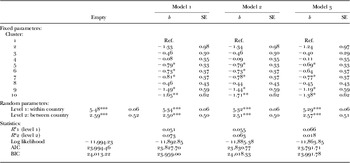
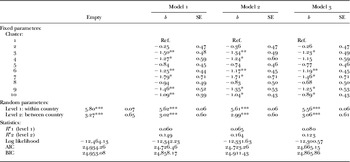
To study the second research question (associations between employment histories and quality of life), the results of the multi-level models testing effects on quality of life for men (Table 4) and for women (Table 5) using respective clusters of employment histories as independent variables (broken into dummies) are examined.
Multi-level estimates for quality of life (CASP): regression coefficients and standard errors (SE) for men

Notes: N=3,836. Model 1: adjusted for age, age square and previous social position (occupational position of main breadwinner at age ten and occupational position between 20 and 30). Model 2: Model 1 plus lifecourse factors (job changes, co-habitation and children).
Model 3: Model 2 plus current income. Ref.: reference category. AIC: Akaike Information Criterion. BIC: Bayesian Information Criterion.
Significance levels: * p<0.05, ** p<0.01, *** p<0.001.
Multi-level estimates for quality of life (CASP): regression coefficients and standard errors for women

Notes: N=3,914. Model 1: adjusted for age, age square and previous social position (occupational position of main breadwinner at age ten and occupational position between 20 and 30). Model 2: Model 1 plus lifecourse factors (job changes, co-habitation and children). Model 3: Model 2 plus current income. Ref.: reference category. AIC: Akaike Information Criterion. BIC: Bayesian Information Criterion.
Significance levels: * p<0.05, ** p<0.01, *** p<0.001.
Before turning to the associations between cluster membership and quality of life, the results for the random parameters of the multi-level models are described briefly. For both men and women, variations of quality of life are more pronounced within countries than between countries. Respective intra-class correlations (ICC) indicate that more than three-quarters of the total variance of quality of life can be attributed to the individual level (ICC for men: 0.18, women: 0.24). In other words, less than 25 per cent of total differences in quality of life are related to differences between countries.
Three observations deserve attention in the case of men (Table 4). First, men with a continuous full-time employment during working life (reference category) had the highest quality of life amongst all clusters. Similar quality of life was found among men with a long spell of full-time employment and retirement after the age of 60 (clusters 3 and 4). Second, while men with retirement between 55 and 60 had significantly lower quality of life after 65, no support that retirement prior to the age of 55 was negatively associated with later quality of life was found. Third, that a working career of full-time employment ending in unemployment or domestic work was associated with poor quality of life (slightly stronger in the case of domestic work) was strongly supported.
The picture is different in the case of women and three important observations are made. First, quality of life was best amongst females in clusters 1 and 2 (mixed histories) and significantly lower if women were continuously employed full-time or had a long period of employment ending in retirement (clusters 4–6). Second, while women who ended up unemployed (after a long spell of full-time employment) had significantly lower quality of life, no such association was found in the case of domestic work (in contrast to men). The third observation is that if histories of women were dominated by domestic work (home-maker histories), they had significantly lower values in quality of life in older ages compared to clusters 1 and 2 (mixed histories).
For both men and women, reported associations were significant after controlling for respondents' social position prior to age 30 (Model 1), as well as variables related to partnership history (co-habitation) and parental history (Model 2). In addition, when including current income in Model 3, it can be seen that estimates are generally attenuated, though remain statistically significant. Importantly, this indicates that the reported association between employment histories and quality of life can only partly be explained by current income circumstances.
Turning back to the random parameters, the Pseudo R 2 statistics of the final model suggest for both men and women that all variables included in the analyses explain in the present sample up to 8 per cent of the variation at the individual level. In additional analyses, the variance explained just by the used clusters of employment histories (not reported in the table) was estimated, which was close to 1 per cent for men and women. This is comparable to the variance explained by current income when being included in Model 3. Regarding the country level, no substantive reduction in the case of men was found, but around a 15 per cent reduction in between-country variations in the case of women. This latter finding suggests that differences between countries in the quality of older women's lives can to some extent be explained by different previous employment histories.
Discussion
This paper investigated previous employment histories and the quality of life of older Europeans aged 65 or older. By using sequence analysis, first employment histories spanning from age 30 to 65 were described and then similar career sequences were regrouped into clusters. Secondly, the associations between previous employment histories and the quality of life at older ages were tested.
The main findings can be summarised as follows. With regards to the first research question, there was solid evidence that the employment histories of women were different and more diverse compared to those of men. For men, careers were dominated by long spells of employment in the first half of their career. In most cases (95% of men's careers) this period either ended in retirement or lasted till 65. In other words, at age 30 most men had started to work and ended sooner or later in retirement (regular histories), with the only exception of a few men ending up in unemployment or domestic work at the end of their career (5%). In the case of women, regular histories accounted for less than half of the cases (40%) and were supplemented by two notable career patterns, with women either involved in domestic work before having a long spell of employment ending in retirement (15%, mixed histories), or where women's careers were dominated by domestic work throughout their working life (35%, home-maker histories). Finally, as for men, a few cases showed a long spell of employment ending either in unemployment or domestic work (10%). The use of sequence analysis made it possible to derive these types of employment histories empirically and helped to identify differences between men and women.
The second set of findings concerns the association between employment histories and quality of life (the second research question). It became apparent that specific types of employment histories are associated with lower quality of life in later life. In the case of men, it was found that men with regular employment histories and late retirement (after 60) had the highest quality of life in later life. In contrast, men who retired earlier had significantly lower quality of life, with the notable exception of those who retired prior to 55. Poor quality of life was found among those who ended up in unemployment or, in particular, in domestic work. In the case of women, the best quality of life was found among those with a period of domestic work followed by employment and late retirement (mixed histories), whilst continued employment with late retirement (regular histories) had an even lower quality of life. Additionally, women had significantly lower quality of life in later life if their previous employment histories were dominated by domestic work only (home-maker histories). In other words, women whose employment histories were either dominated by employment or by domestic work had a lower quality of life in later life. Finally, women had a lower quality of life for if they ended up in unemployment (similar to men), but not in domestic work (different to men) after a long period of employment. Importantly, all associations remained stable after adjusting for social position prior to working career and lifecourse factors (as well as age and job changes). Further, associations were still statistically significant after the inclusion of current income.
In sum, the findings show that continuous employment histories are more likely to be associated with later quality of life – an association that was particularly pronounced in the case of men. This association could only partly be explained by current income in the analyses.
Discussion of results
How do these findings fit into the existing literature? At the descriptive level of employment histories, the findings are in line with previous findings that showed that working conditions and labour market involvements vary between men and women (Eurofound 2012; Lyberaki, Tinios and Papadoudis Reference Lyberaki, Tinios and Papadoudis2013). By considering and describing entire working histories rather than single-point measures or single characteristics (e.g. length of full-time employment), the results add to existing research. In particular, a greater complexity of employment histories in the case of women was found, agreeing with the existing literature (Macmillan Reference Macmillan2005; Widmer and Ritschard Reference Widmer and Ritschard2009).
With regard to the investigated associations between employment histories and quality of life, the results support previous findings of an increased risk of mental disorders among older people who previously had adverse work and employment conditions, either in terms of poor psycho-social working conditions (Stansfeld and Candy Reference Stansfeld and Candy2006; Stansfeld et al. Reference Stansfeld, Shipley, Head and Fuhrer2012; Wahrendorf et al. Reference Wahrendorf, Blane, Bartley, Dragano and Siegrist2013) or general labour market disadvantage. Yet, in contrast to previous findings, the present results were not based on single-point measures or on specific characteristics of employment history (e.g. involuntary job losses, frequent job changes or periods of unemployment) (Bambra and Eikemo Reference Bambra and Eikemo2009; Bartley, Ferrie and Montgomery Reference Bartley, Ferrie, Montgomery, Marmot and Wilkinson2006; Schröder Reference Schröder2013; Thomas, Benzeval and Stansfeld Reference Thomas, Benzeval and Stansfeld2005; Wahrendorf et al. Reference Wahrendorf, Blane, Bartley, Dragano and Siegrist2013). Rather, the focus was on entire employment histories where length and embeddedness of five different occupational situations were explicitly considered. As such, the results supplement previous findings and underline the importance of continuous employment for health and wellbeing in later life, at least for men. Further, the results underline that working conditions and their health-related consequences do differ between men and women (Messing et al. Reference Messing, Punnett, Bond, Alexanderson, Pyle, Zahm, Wegman, Stock and de Grosbois2003; Stansfeld et al. Reference Stansfeld, Fuhrer, Shipley and Marmot1999).
Limitations and further research
When interpreting these findings, several aspects for possible extensions and limitations must be discussed. First, the result of a higher significance of the work role for men compared to women requires elucidation of circumstances during the working life in more detail, in particular for women. Women may have had other significant roles beyond work as well (e.g. family) with equivalent importance for their wellbeing (Moen, Dempster-McClain and Williams Reference Moen, Dempster-McClain and Williams1992). Similarly, they may have had specific jobs during their working career (i.e. lower-skilled occupational positions), which may explain why long phases of full-time employment were not associated with higher quality of life in the case of women. Future analyses may thus combine other histories (e.g. family histories) with employment histories (Aassve, Billari and Piccarreta Reference Aassve, Billari and Piccarreta2007) and include measures of occupational position. There is increasing evidence that women who integrate both employment and domestic work are healthier in later life compared to women who focus on either work or on domestic work only (McMunn, Bartley and Kuh Reference McMunn, Bartley and Kuh2006). Second, although the multi-level analyses indicate that the individual level matters more than the country level, important country differences exist that are related to work and employment conditions and to their associations with later wellbeing. In fact, a growing body of research investigates whether health differences between countries (e.g. the ‘health disadvantage’ of the United States of America; Avendano and Kawachi Reference Avendano and Kawachi2011) can be explained through particular social and labour market policies that shape individuals' working life, and which in turn exert effects on wellbeing (Börsch-Supan et al. Reference Börsch-Supan, Brandt, Hank and Schröder2011; Dragano, Siegrist and Wahrendorf Reference Dragano, Siegrist and Wahrendorf2011; Gallie Reference Gallie2007). Future analyses may address this question in more detail, in particular to elaborate on policy measures and societal circumstances shaping employment histories, including cultural values, gender specificities and the significance assigned to employment (and family) in each country (e.g. more pronounced ‘male breadwinner’ system in ‘bismarckian’ welfare states or higher importance of the family in southern countries; Crompton Reference Crompton2006). Similarly, one may also ask to what extent the present results are restricted to the sample under study (born between 1908 and 1943) only, and future analyses could additionally compare associations between different cohorts (e.g. baby-boomers compared to the war generation).
Another question is how do the results help to explain inequalities of health and wellbeing in later life. In this regard, it is surely necessary to extend the conducted analyses in two ways. First, albeit quality of life may be seen as an indicator that does not merely focus on the absence of disease or infirmity, and thus may follow the World Health Organization definition of health, future analyses may, on the one hand, invest other dimensions of health as well (e.g. disability and chronic diseases); or, on the other hand, the different dimensions of quality of life included in this study may be analysed more specifically. In fact, additional analyses (not shown in detail) reveal that the reported effects of employment histories in this study were particularly pronounced in the case of the two dimensions of the CASP questionnaire that were related to a sense of self for older people, in terms of self-realisation and pleasure (Giddens Reference Giddens1991). Second, although adjustments were made in the analyses for social position during childhood and prior to the invested working career, the question as to what extent employment histories mediate an association between social position and health need to be explored in more detail. In that respect, the complex interrelations between social position over the lifecourse and specific types of employment histories (e.g. more continuous careers among high occupational positions) need further investigation or specific work and employment conditions need to be considered when defining occupational states (e.g. job industry, work stress or occupational position itself). In doing so, however, the use of sequence analysis (and its interpretation) becomes very complex, since the number of possible sequences grows extensively with the number of states (Brzinsky-Fay, Kohler and Luniak Reference Brzinsky-Fay, Kohler and Luniak2006). Thus, while the possibility of summarising entire employment histories must be considered as an important strength of sequence analyses, the identified types (and the used cluster variables in the regression analyses) may nevertheless bypass relevant aspects of the histories with relevance to quality of life in older ages. These ideas are further supported by the result that all the variables under study only explained a small proportion of the variance at the individual level (8%) and that only a minor part (1%) could be attributed to the employment histories as they were captured by the typologies in the analyses.
Three final limitations must be mentioned at the methodological level. First, while it was decided to use the factual transition rates to calculate the distances between each individual sequence in the analyses, other distance measures may have produced different results (Halpin Reference Halpin2012). Yet, additional analyses using two alternative distance measures (optimal matching and traditional hamming with different substitution and indel costs) showed similar results. Second, since data were available on an annual basis only and spells were recorded if they lasted at least six months, the diversity of employment histories (number of distinct spells) may have been underestimated, including the occurrence of short spells (e.g. spells of short-term unemployment). Third, albeit the sample was restricted to individuals without poor health problems prior to and during their working life, health selection cannot be ruled out as a partial explanation of the results, where healthier people have longer spells of employment and better quality of life in later life. Similarly, the definition of retirement used does not consider sources of income after leaving the labour market, and thus, one may assume that some of those who retired early did so in poor health and received disability benefits. Yet, when considering income sources in additional analyses, no disability retirement in the sample was found. In addition, few would argue that early retirement due to disability is the dominating factor explaining the results, in particular for women, where the best quality of life was notably not found among those with continuous employment during their working life. Because a rather healthy sample was chosen, there may even have been an underestimation of the prevalence of unfavourable employment histories with less stable working careers in the case of men and conservative estimates of the association between employment histories and quality of life.
These limitations are balanced by several strengths. First, the SHARE study meets high-quality standards of data collection, specifically a vigorously controlled study protocol, the application of validated questionnaires (e.g. CASP), and the observation of standard procedures of translating the measures into different languages and of collecting and controlling the data (Börsch-Supan and Jürges Reference Börsch-Supan and Jürges2005). Second, as far as known, this is the first study that uses sequence analyses to investigate employment histories and their relation to quality of life in older ages. This approach enabled the complexity of employment histories to be reduced in a meaningful way and to derive specific types of employment histories. Third, a theoretically grounded approach helped to understand and explain the findings.
In conclusion, the results of this study allowed new insights in the description of employment histories and existing differences between men and women. Furthermore, the results support that previous employment histories are associated with quality of life in older ages, pointing to the importance of a continuous employment history for later quality of life, in particular in the case of men.
Acknowledgements
This paper uses data from SHARELIFE release 1, as of 24 November 2010, or SHARE release 2.5.0, as of 24 May 2011. The SHARE data collection has been primarily funded by the European Commission through the Fifth Framework programme (project QLK6-CT-2001-00360 in the thematic programme Quality of Life), through the Sixth Framework programme (projects SHARE-I3, RII-CT-2006-062193, COMPARE, CIT5-CT-2005-028857, and SHARELIFE, CIT4-CT-2006-028812) and through the Seventh Framework programme (SHARE-PREP, 211909 and SHARE-LEAP, 227822). Additional funding from the US National Institute on Aging (U01 AG09740-13S2, P01 AG005842, P01 AG08291, P30 AG12815, Y1-AG-4553-01 and OGHA 04-064, IAG BSR06-11, R21 AG025169) as well as from various national sources is gratefully acknowledged (see www.share-project.org for a full list of funding institutions). The present research is indebted heavily to members of the ESRC International Centre for Life Course Studies in Society and Health, in particular David Blane, Melanie Bartley, Rebecca Lacey, Anne McMunn and Amanda Sacker. This research was conducted in the frame of a post-doctoral fellowship of the German Research Foundation (Deutsche Forschungsgemeinschaft), Germany (project number Wa 3065/1-1).