Introduction
Insects, while communicating, often rely on a combination of different sensory channels, such as visual, chemical or mechanical (e.g. Skals et al., Reference Skals, Anderson, Kanneworff, Löfstedt and Surlykke2005). These channels mediate both intra- and inter-specific behaviours, for example courtship (e.g. Zefa et al., Reference Zefa, Martins and Szinwelski2008) and foraging (see Chittka & Thompson, Reference Chittka and Thompson2001), respectively. The different modalities employed by the animal, and the relative prevalence of each during communication, are influenced by constraints on the signal emitter and receiver and the environment through which the message is transported (see Greenfield, Reference Greenfield2002).
In parasitic wasps (Hymenoptera), chemical signals have been described to play an important role in inter-sexual recognition and selection (Swedenborg et al., Reference Swedenborg, Jones, Liu and Krick1993; Syvertsen et al., Reference Syvertsen, Jackson, Blomquist and Vinson1995, reviewed by Ayasse et al., Reference Ayasse, Paxton and Tengö2001). Long-distance pheromones emitted by the female elicit male upwind flight (see Quicke, Reference Quicke1997), while short-distance pheromones stimulate male courtship behaviour (McNeil & Brodeur, Reference McNeil and Brodeur1995; Marchand & McNeil, Reference Marchand and McNeil2000; McClure et al., Reference McClure, Wisthlecraft and McNeil2007). Furthermore, parasitic wasps may also use mechanical signals while communicating with sexual partners (Miller & Tsao, Reference Miller and Tsao1974; van den Assem & Putters, Reference van den Assem and Putters1980; Sivinski & Webb, Reference Sivinski and Webb1989; Čokl & Virant-Doberlet, Reference Čokl and Virant-Doberlet2003; Casas & Magal, Reference Casas, Magal, Drosopoulos and Claridge2006; Danci et al., Reference Danci, Takács, Schaefer and Gries2010). Chemical and acoustic signalling are not mutually exclusive (Joyce et al., Reference Joyce, Hunt, Bernal and Vinson2008), as has been described for several parasitoid families such as Braconidae and Pteromalidae (e.g. Miller & Tsao, Reference Miller and Tsao1974; Sivinski & Webb, Reference Sivinski and Webb1989).
Aphid parasitoids are among the smallest extant wasps, with body lengths often shorter than two millimeters (Quicke, Reference Quicke1997). Signals produced by such small animals have physical restrictions for their propagation over long distances (Bennet-Clark, Reference Bennet-Clark1971, Reference Bennet-Clark1998; Markl, Reference Markl, Huber and Markl1983). Alternatively, these small insects could transmit the signals through the substrate (Drosoupolos & Claridge, Reference Drosopoulos and Claridge2006) or utilize air-borne signals for communicating in the near-field range, defined as few body-length distances between the signaller and the receiver. Near-field communication often exploits the insect's flight machinery (Bennet-Clark, Reference Bennet-Clark1971). Communication through wing fanning during courtship has been documented as one of the mechanisms of airborne signalling in small insects such as flies (von Schilcher, Reference von Schilcher1976a) and parasitic wasps (e.g. Danci et al., Reference Danci, Takács, Schaefer and Gries2010).
In the aphid parasitoid Aphidius ervi Haliday (Hymenoptera: Braconidae), wing fanning has been reported as a crucial component of male courtship display, which is followed by female acceptance or rejection of the courting male (Mackauer, Reference Mackauer1969; Battaglia et al., Reference Battaglia, Isidoro, Romani, Bin and Pennacchio2002; Villagra et al., Reference Villagra, Vásquez and Niemeyer2005). Since females mate only once, wing fanning may correspond to a crucial selective filter. We hypothesize that male wing fanning generates mechanical stimuli that trigger behavioural changes in females related to the acceptance of the male. We recorded and analysed the airborne part of the vibrations produced by males of A. ervi during courtship and also conducted manipulative experiments to evaluate the role of wings as the organ that generates these acoustic signals. Furthermore, we tested the role of this mechanical vibration as a courtship signal by performing sound playback experiments, including experiments with white noise. In these experiments, we evaluated changes in female behaviour and male copulation success in response to these manipulations. Our findings contribute to the understanding of the acoustic dimension of the sensory modalities employed by this aphid parasitoid in sexual signalling.
Materials and methods
Experimental subjects
A. ervi parasitoid wasps were obtained from a culture maintained on pea aphids (Acyrthosiphon pisum Harris) feeding on potted broad bean plants (Vicia faba L.) and kept in environmental chambers at 21±1°C, 65% relative humidity and 14 h:10 h L:D photoperiod. Aphid carcasses containing parasitoid pupae (aphid ‘mummies’) were detached from the plant surface and placed individually in Petri dishes with moistened filter paper lining the inner bottom surface. A small cotton ball soaked with a droplet of 20% aqueous honey solution was placed on the filter paper surface. Experimental subjects were individuals collected from laboratory stocks as soon as they ecloded from pupae; they were subjected to behavioural testing before having completed 15 h as adults. The subjects were anaesthetized with small puffs of CO2 before being subjected to experimental procedures. Females were first anesthetized and allowed to fully recover in the test chamber. After that, anesthetized males were introduced in the chamber. Testing was initiated when both individuals were awake.
Experimental arena
All experiments described below were performed inside a sound attenuating booth (340×340×260 cm) having 4-mm-thick steel external walls and inner walls lined with 50-cm-high pyramidal foam wedges to minimise sound reflection. The experimental subjects were tested inside cylindrical Plexiglas® test chambers (20 mm diameter, 6.5 mm height), having their upper surfaces sealed with a 0.5-mm plastic mesh, to allow ventilation and sound recording.
Courtship behaviour
The behaviour of intact female and male parasitoids inside the test chamber (n=40 pairs) was videotaped using a digital video recorder (Sony DCR-HC62, at 25× magnification) during a 6-min observation period. Behavioural data were acquired and analysed with JWatcher software 1.0® (Blumstein et al., Reference Blumstein, Evans and Daniel2000). Courtship duration was defined as the time interval from the onset of male wing fanning and pursuit of the female until either the initiation of copulation or the rejection of the male by the female upon which the male ceased to fan its wings. The rank sum test was used to compare the wing fanning rate (number of wing fanning events per courtship duration) between males that achieved copulation and those that did not. For replicates in which the male was rejected by the female, courtship duration was taken as 6 min, i.e. the duration of the entire observation period.
Recording of the song produced by males
The sounds emitted by males from the three treatment groups described below were recorded with a tie-clip omnidirectional microphone (Sennheiser MKE 2, 20–20,000 Hz) positioned 1–2 mm away from the plastic mesh of the test chamber and connected to a digital tape recorder (Sony TCD-D10 PROII). Given the size of the test chamber, the distance between the microphone and the parasitoid as it moved within the chamber ranged from ca. 8 to 12 mm. The recording system was calibrated at the beginning of each experimental session by fitting the microphone into a sound calibrator (Brüel & Kjaer 4230). The 1-kHz tone produced by this instrument was recorded at a level that was kept constant during the subsequent experimental session. The amplitude of this tone, having a 93.8 dB sound pressure level (SPL) (root-mean-square (RMS) fast time weighting, linear frequency weighting), provided a calibration signal to measure the absolute SPLs of the sounds recorded during the experimental session. The recordings of the sound generated by male wing fanning were digitised with a Macintosh G4 Power PC using the software Peak 2.52 at a 44.1 kHz sampling rate, a 22 kHz cut-off anti-aliasing filter (FT6-2, Tucker-Davis Technologies, Alachua, FL, USA) and an analog-digital interface (Motu 828). The temporal and spectral characteristics of the signals recorded were analysed with the Signalyze 3.12 software.
Wing length and copulation occurrence
Three groups of males (n=20 for each treatment) were established as follows: (i) males with intact forewings (intact males), (ii) males with their forewings cut transversally at half their length using a fine razorblade (half-dealated males) and (iii) males with their forewings cut at the insertion point (dealated males). Males were individually placed in a test chamber containing a virgin female. The occurrence of copulation during a 6-min period was recorded and compared between treatments using a χ2 test. Two-way ANOVA, followed by Holm-Sidak post-hoc tests, was used to assess the effect of wing size (intact and half-dealated males) and copulation occurrence (copulating and non-copulating males) on wing fanning rate determined during the courtship period. Two-way ANOVA, followed by Holm Sidak post-hoc tests, was also used to assess the effect of wing size (intact and half-dealated males) and copulation occurrence (copulating and non-copulating males) on the duration of courtship.
Male wing fanning sound and behaviour of isolated females
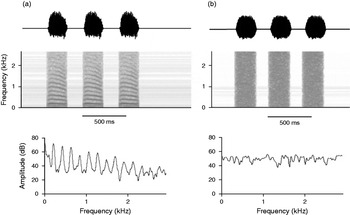
A synthetic signal was constructed which mimicked a natural pulse, thus providing a more schematic signal relative to an entire sequence of a recorded natural signal and avoiding evoked responses which could be affected by peculiarities of a natural sound. The playback stimulus was generated using the Soundmaker 1.0.4 software. The template used was a pulse of the wing fanning sound, which was produced by a male that had achieved copulation, had a good signal-to-noise ratio and was considered by inspection to be representative of the wing fanning sound of the species. The pulse had a duration of 225 ms and a harmonic structure with a fundamental frequency of 180 Hz. The complete synthesised stimulus consisted of three repetitions of this pulse with inter-pulse intervals of 200 ms. This stimulus was played back repetitively with an interval of 1000 ms between repetitions throughout the 6-min observation period.
A white noise signal with similar characteristics (envelope and pulse and interpulse durations) as the synthesised signal described above was generated using Adobe® Audition® 3 software. Both signals were played back at a level of 45 dB RMS fast SPL, measured 20 cm away, at the point where the center of the test chamber was to be placed. This level was typically measured in preliminary recordings of intact males during courtship, using the relationship between the amplitude of wing fanning sounds recorded in the test chamber and the amplitude of the 1-kHz calibration tone.
The synthesised stimulus and the white noise were played back using a portable CD player (Sony D-E356CK) whose output was fed into an amplifier (NAD C320 BEE) connected to a two-way loudspeaker (Dynaudio BM-6, frequency response 38–20,000 Hz, 17 cm woofer, 28 mm tweeter). The loudspeaker was positioned on a stand at a distance of 20 cm from the center of the test chamber and the intensity of the stimulus was adjusted using a sound level meter (Brüel & Kjaer 2238) positioned 1–2 mm away from the upper surface of the test chamber and facing the loudspeaker.
The behaviour of females (three groups, each consisting of ten isolated virgin females) exposed to wing fanning playback, silence or white noise were video recorded for 6 min in a test chamber. The proportion of total time spent in different behaviours (antennation, running, grooming and remaining quiescent – see Results section) were compared using two-way ANOVA on ranks followed by Holm-Sidak post-hoc tests. The proportions of time devoted to grooming were compared (rank sum test) between females which had been exposed to males but had not achieved copulation and females exposed to wing fanning playback stimulus, and also between females which had copulated and females exposed to wing fanning playback stimulus.
Results
Observations of male and female behaviours inside the test chamber
As soon as an intact male became aware of the close presence of a female, he started pursuing the female with the antennae held forward at approximately right angles relative to the body and the wings spread out horizontally, performing a characteristic wing fanning display. Meanwhile, the female became engaged in antennation, running, grooming and also spent time remaining quiescent. Finally, mounting took place and the male beat the female's antennae with his own antennae. This behaviour has been reported to sooth and entice the female to accept copulation (Battaglia et al., Reference Battaglia, Isidoro, Romani, Bin and Pennacchio2002). Following this, the male engaged its genital claps with the female genitalia and copulation took place. Males did not perform wing fanning after copulation.
Thirty-two of the 40 couples tested achieved copulation during the 6-min observation period. The mean duration of courtship was (mean±SE) 92.9±13.7 s. The wing fanning rate was higher for males that achieved copulation relative to those that did not (mean±SE: 0.78±0.06 and 0.20±0.10 fanning events for copulating and non-copulating males, respectively; T=60, P<0.001).
Sounds emitted by males
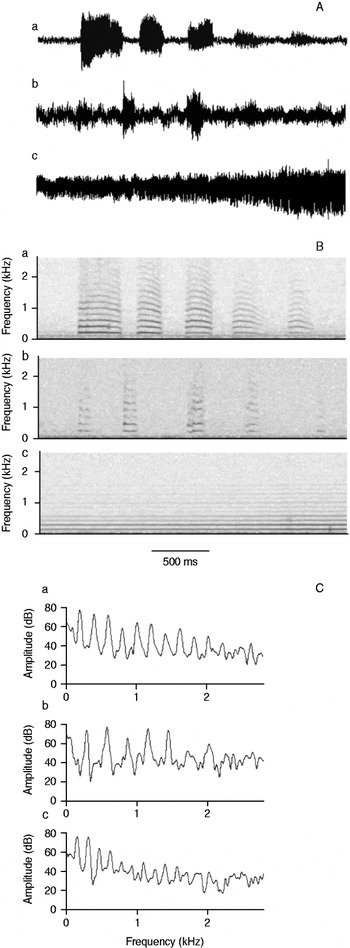
Intact males of A. ervi produced sequences of sound pulses lasting about 200 ms with inter-pulse intervals of similar duration. The pulses had a harmonic spectral structure with a fundamental frequency of about 180 Hz (fig. 1). In general, the sequence of pulses was initiated by a pulse having the highest amplitude, followed by 3–4 pulses of decreasing amplitude. The SPLs of the sound produced were about 45 dB SPL. Half-dealated males produced pulses having a fundamental frequency of about 280 Hz and dealated males produced no recordable sounds.
(A) Oscillograms, (B) sonagrams and (C) power spectra of sounds produced by (a) intact, (b) half-dealated and (c) dealated Aphidius ervi males inside the test chamber.

Effect of male wing length on copulation occurrence
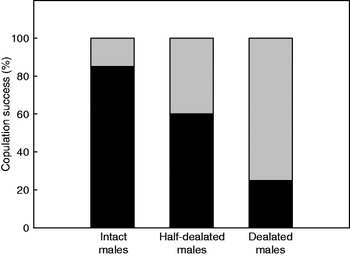
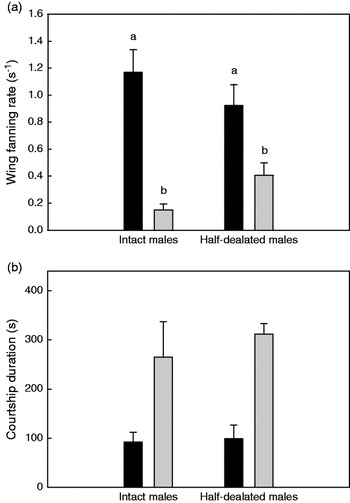
Differences were observed among wing length treatments in the occurrence of copulation (χ2=7.818, P<0.02) (fig. 2). The wing fanning rate was significantly associated with the performance of males (copulating, non copulating) (F=20.299, P<0.001) but not with wing length (intact and half-dealated males; fig. 3a) or with the interaction between both factors (F=0.001, P=0.980 and F=2.167, P=0.152, respectively). Courtship duration differed only between males that copulated and males that did not (P<0.05), and there were no differences between intact and half-dealated male treatments (fig. 3b).
Number of Aphidius ervi males achieving mating or failing to copulate in treatment groups (intact males, half-dealated males and dealated males). Different letters indicate significant differences within each category (▪, copulating;  , not copulating).

(a) Wing fanning rate (number of wing fanning events/sec) and (b) courtship duration for intact Aphidius ervi males and half-dealated males. Different letters indicate significant differences at the intra-treatment level (▪, copulating; , not copulating).

Effect of male wing fanning sound playback on the behaviour of isolated females
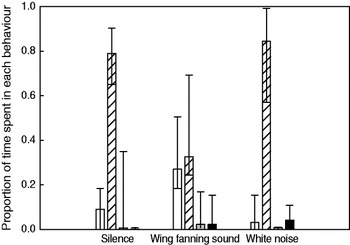
The oscillogram, sonogram and power spectrum of the synthetic stimulus used in the playback experiments are shown in fig. 4. When the three groups (females exposed to playback stimulus, silence or white noise) were compared using two-way ANOVA on ranks, both behaviour and the interaction of behaviour×treatment showed significant effects (F=40.257, df=3, P<0.001 and F=3.943, df=3, P=0.01, respectively). The proportions of time spent running, remaining quiescent or antennating were not significantly different in any of the female treatment groups (P>0.05). However, the proportion of time spent grooming was significantly higher in females exposed to the wing fanning acoustic stimulus compared with the other two treatments (P<0.05) (fig. 5).
Oscillogram, sonogram and power spectrum of the (a) wing fanning and (b) white noise synthetic stimuli.

Proportion of times spent in different behaviours (median and interquartile ranges) by isolated Aphidius ervi females exposed to wing fanning playback, silence and white noise stimuli. Tests lasted 6 min. Letters on top of bars indicate significant differences in inter-treatment comparisons within each behaviour (□, Grooming;  , Running; , Quiescent; ▪, Antennation).

In among treatment comparisons, females exposed to silence showed a marked tendency to run inside the test chamber (fig. 5), the proportion of time devoted to this behaviour significantly differing from those devoted to antennation, remaining quiescent or grooming (P<0.05). Comparisons among other behaviours did not show significant differences (P>0.05 for all comparisons). Females exposed to white noise playback showed the same pattern of differences as females exposed to silence (fig. 5).
The proportion of time devoted to grooming in females exposed to wing fanning playback was significantly higher than in male-exposed females that did or did not achieve copulation (T=611, P<0.05 and T=71, P<0.05, respectively).
Discussion
The study of courtship behaviour and the results from the manipulative experiments suggest that the mechanical vibrations generated by wing fanning A. ervi males during the persecution of a female represent a courtship signal; this signal contributes to the acceptance of a mating partner by the female and, hence, is a key stimulus for the occurrence of copulation. The role of wing fanning sound as a part of the courtship display was supported by the finding that males that achieved copulation corresponded to those that expressed wing fanning more frequently (fig. 3). Moreover, the proportion of successful copulation decreased when the length of the sound-producing forewings of males was experimentally reduced, despite the fact that these males continued the pursuit of the female. Since wing fanning display may also constitute a visual stimulus inducing changes in the behaviour of the female, a wing fanning sound playback experiment was performed which supported the role of wing fanning as an acoustic courtship signal (see below).
Wing fanning sounds have been intensively studied in fruit flies (Ewing & Bennet-Clark, Reference Ewing and Bennet-Clark1968; Sivinski, Reference Sivinski1988; Hoikkala et al., Reference Hoikkala, Kaneshiro and Hoy1994; Ritchie et al., Reference Ritchie, Halsey and Gleason1999; Rybak et al., Reference Rybak, Aubin, Moulin and Jallon2002) and shown to correspond to courtship songs using, among other techniques, playback experiments with synthesised stimuli. These experiments have also shown the importance of sound attributes, such as amplitude thresholds and amplitude shape, and rhythmicity in male-female interactions (Crossley et al., Reference Crossley, Bennet-Clark and Evert1995; Eberl et al., Reference Eberl, Duyk and Perrimon1997; Ritchie et al., Reference Ritchie, Halsey and Gleason1999). In a series of experiments with Drosophila (Diptera: Drosophilidae) that included playback and male wing removal, von Schilcher (Reference von Schilcher1976a,Reference von Schilcherb) demonstrated that females increased their sexual receptivity after experiencing the sine song from male wing fanning.
A role for wings during courtship has also been hypothesised and tested for other parasitic wasps (Miller & Tsao, Reference Miller and Tsao1974; van den Assem & Putters, Reference van den Assem and Putters1980; Sivinski & Webb Reference Sivinski and Webb1989; Danci et al., Reference Danci, Takács, Schaefer and Gries2010). In Nasonia vitripenis (Hymenoptera: Pteromalinae), Miller & Tsao (Reference Miller and Tsao1974) found that a larger proportion of females enclosed with dealated males remained virgin relative to females enclosed with intact males. These experiments suggested that dealated males were unable to court, mate or inseminate the female properly; however, the authors did not perform further experiments to discriminate between these alternatives. Using the same species, van den Assem & Putters (Reference van den Assem and Putters1980) developed preliminary experiments to detect the sound emitted by N. vitripennis males during wing fanning and reached the controversial conclusion that males were able to produce recordable sounds even after having their wings excised; contrastingly, the present results indicate that the wings are the organs responsible for the sounds recorded in the aphid parasitoid A. ervi (Hymenoptera: Braconidae). Sivinski & Webb (Reference Sivinski and Webb1989) described the sounds produced by courting males of three braconid parasitoid wasps and suggested a role as courtship song in Diachasmimorpha longicaudata (Hymenoptera: Braconidae) based on sexually dimorphic responses to the broadcast song. A recent report showed that male wing fanning sound playbacks elicited an increase in the frequency of grooming in females of Glytapanteles flavicoxis (Hymenoptera: Braconidae) and that females after being exposed to the playback stimulus attracted fewer males than females exposed to silence, suggesting that grooming altered pheromone emission (Danci et al., Reference Danci, Takács, Schaefer and Gries2010). Our data supports this interpretation. Thus, an increase was observed in the proportion of time devoted to grooming in wing fanning playback stimulated females compared with females that achieved copulation when exposed to males; moreover, time devoted to grooming increased in wing fanning playback stimulated females compared with females exposed to silence or white noise. The interpretation may be suggested that a female, upon hearing the wing fanning sound stimulus of the male, increases grooming in order to release short range pheromones attracting the male (Farish, Reference Farish1972; Howard & Blomquist, Reference Howard and Blomquist1982; McClure et al., Reference McClure, Wisthlecraft and McNeil2007), thus being able to better evaluate his quality as a potential mate. Also supporting the idea that grooming constitutes an important trait during the reproductive process is the fact that only the sound of a successful male (that achieved copulation) but not of white noise or silence elicited an increase of this behaviour.
The nature of the receptors involved in the detection of these acoustic signals in A. ervi is currently unknown. In other hymenopterans, such as the honeybee, Dreller & Kirchner (Reference Dreller and Kirchner1993) demonstrated the existence of an antennal chordotonal organ (Johnston's organ: Johnston, Reference Johnston1855, reviewed by Frings & Frings, Reference Frings and Frings1958) involved in mechanical communication at short distances. Johnston's organ has recently been shown to participate in sexual recognition through wing fanning in mosquitoes (Warren et al., Reference Warren, Gibson and Russell2009). Alternatively, although not exclusively, wing fanning sounds may be detected by mechanosensitive sensilla present along the insect body (Bailey, Reference Bailey1991; Yager, Reference Yager1999, reviewed by Jarman, Reference Jarman2002). Further studies are necessary to identify the organs used in the detection of wing fanning sounds involved in the courtship interactions described herein.
The present study strongly suggests the importance of the acoustic channel among the range of sensory modalities used by A. ervi in intra-specific communication; previous reports pointed mainly to the involvement of chemical cues (Glinwood et al., Reference Glinwood, Du and Powell1999; Villagra et al., Reference Villagra, Vásquez and Niemeyer2005).
Acknowledgements
We thank Marcela Cordero for help with rearing the insects, David Rojas-Camaggi for help with the experiments, Kevin Rowe for valuable suggestions and comments on the manuscript, and two anonymous reviewers for their generous and constructive criticisms.