Balloon-expandable transcatheter heart valves are engineered to perform optimally at their manufacturer-specified nominal dimensions. In clinical practice, however, clinicians may deliberately under- or overexpand these valves to address specific challenges. Reference Hascoet, Martins and Baho1–Reference Sathananthan, Sellers and Barlow3 The Edwards SAPIEN 3 transcatheter heart valve, originally developed for aortic valve replacement, has been used for almost a decade in CHD as an alternative to the Melody valve—primarily in the pulmonary position and, in selected paediatric patients, at smaller diameters in the atrioventricular positions where surgery is not feasible and catheter-based therapy offers the only viable option. Reference Maschietto, Prakash, Del Nido and Porras2 Similarly, the newer MyVal OCTACOR transcatheter heart valve, with its distinct frame design, demonstrates comparable performance and potentially greater suitability for the paediatric population. Reference Al Nasef, Erdem and Aldudak4,Reference Haddad, Ciobotaru, Hascoët and Fraisse5 In this study, we aimed to assess the effects of under- and overexpansion of these transcatheter heart valves beyond their labelled diameters using an ex vivo bench model to address an unmet clinical need in paediatric cardiology.
Methods
Study valve characteristics
The Edwards SAPIEN 3 transcatheter heart valve features a cobalt-chromium frame with a hybrid four-row design, consisting of smaller cells on the three inflow rows and larger cells on the upper outflow row. Reference Ohno, Tamburino and Barbanti6 According to the manufacturer, wide strut angles and a four-column arrangement between the commissures provide high radial strength, ensuring optimal circularity and resistance to fatigue. The valve is equipped with trileaflet bovine pericardial leaflets treated with the Carpentier-Edwards ThermaFix process. Its inflow portion is lined with an internal polyethylene terephthalate skirt, and the outer one-third of the valve is additionally covered with polyethylene terephthalate.
The newer MyVal OCTACOR transcatheter heart valve features a cobalt-alloy frame with bovine pericardial leaflets treated using Meril’s proprietary tissue and anti-calcification technology. The first row of cells is fully covered by an internal polyethylene terephthalate skirt and complemented by a taller external polyethylene terephthalate skirt. Its frame departs from traditional multi-row designs, adopting two stacked rows of tessellating, geometrically identical octagons that form an integrated rhombus body, providing columnar strength. Reference Kilic, Coskun, Mirzamidinov, Yilmaz, Yavuz and Sahin7
In vitro bench testing protocol
In an experimental catheterisation laboratory, one balloon-expandable Edwards SAPIEN 3 transcatheter heart valve (labelled diameter 23 mm, expanded height 18 mm) and one MyVal OCTACOR transcatheter heart valve (labelled diameter 21.5 mm, expanded height 18.35 mm) were tested in 3D-printed silicone tubes using a low-pressure, water-perfused simulator equipped with 2D and Doppler ultrasound and high-definition video monitoring. The decision to select two valves with different nominal sizes for direct comparison, despite the availability of equivalent 23 mm valves, was primarily driven by device availability for this in vitro study. Based on our previous results with the OCTACOR transcatheter heart valve, Reference Haddad, Ciobotaru, Hascoët and Fraisse5 we hypothesised that a smaller OCTACOR valve, which is expected to perform efficiently when underexpanded, could achieve the same overexpansion as a SAPIEN valve of the next consecutive nominal size, due to differences in their structural design.
Using semi-compliant mid-pressure AltoSa-XL balloons (AndraTec, Germany) with nominal diameters increasing in 2 mm increments from 18 to 30 mm, the valves were initially underexpanded below their recommended diameters, then incrementally expanded, with inflation pressures recorded at each step. If the target diameter was not achieved, resulting in valve instability within the silicone tube, and a persistent “dumbbell” configuration remained at 1 atm below the rated burst pressure, high-pressure non-compliant Atlas Gold balloons (BARD, USA) of 24 or 26 mm were used until either the inflation limit was reached or the balloon ruptured. Higher-pressure inflations at larger diameters were not possible, as non-compliant balloons with diameters above 26 mm are not available in the European armamentarium.
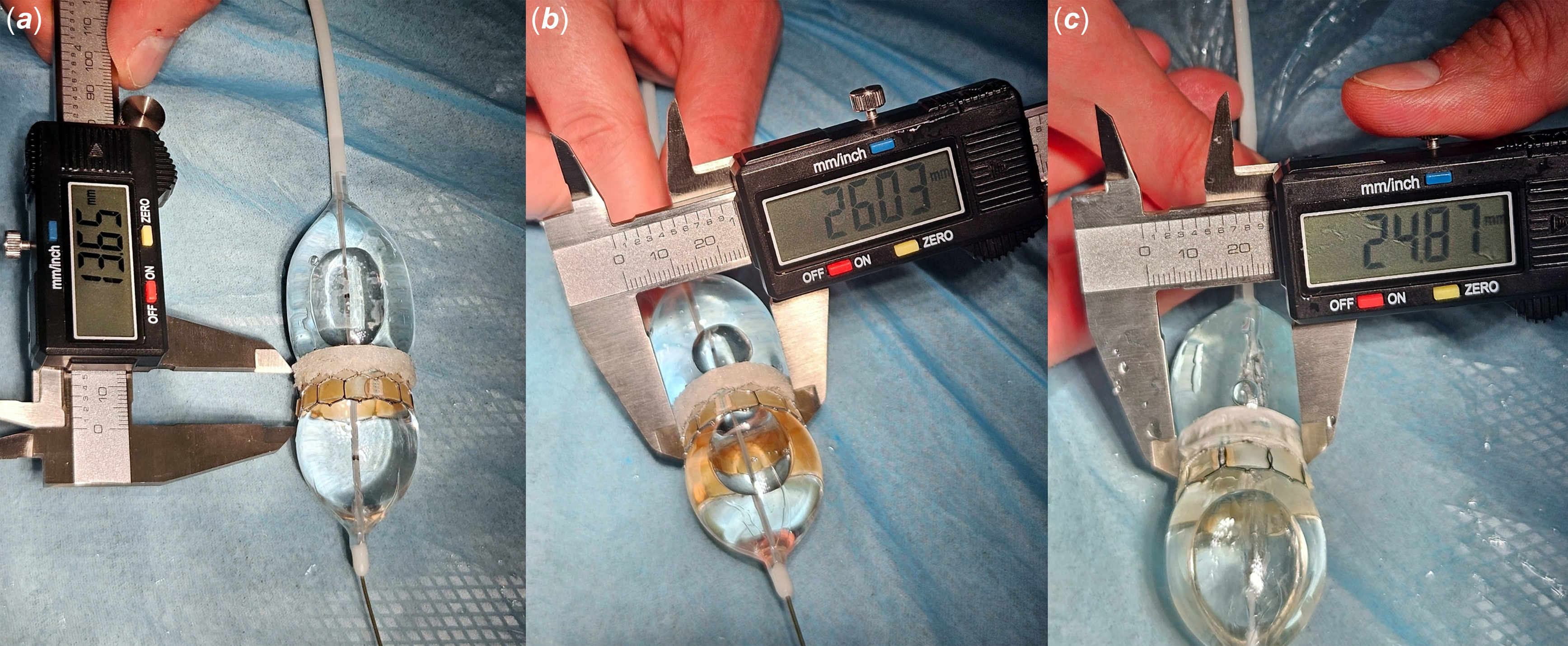
Valves underwent careful visual inspection at each incremental step, assessing the integrity and damage of the frame and leaflets, with measurements performed at every step using a digitally calibrated scientific calliper (Figure 1). Leaflet motion was recorded on video and 2D ultrasound, and transvalvular Doppler flow was assessed. Durability was not evaluated.
Direct measurement and inspection of ( a , b ) SAPIEN 3 23 mm and ( c ) MyVal OCTACOR 21.5 mm valves after expansion with a 26 mm Altosa-XL balloon, following removal from the silicone tube.

Results
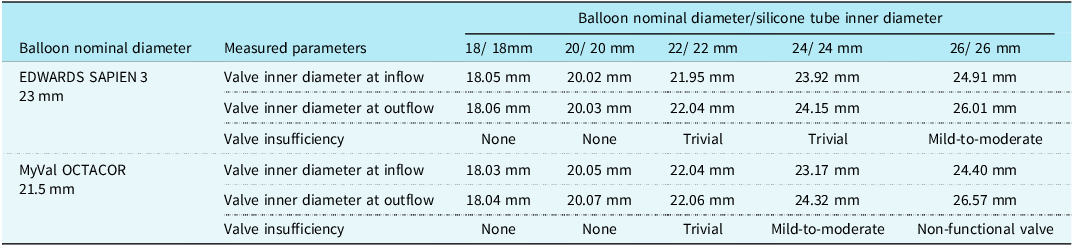
Both valves were easily inflated from 18 to 24 mm with 2–3 atm inflation pressures and required 5.5 atm and 7 atm, respectively, to reach an inner diameter of 26 mm at the outflow level for the SAPIEN 3 and OCTACOR transcatheter heart valves. No further expansion beyond 26 mm was achievable for either valve using 28 mm or 30 mm single mid-pressure balloons inflated until rupture or to 8–9 atm with “under tension dumbbell” appearance (Figure 1).
At 18 mm, both valves showed asymmetric leaflet opening with preserved laminar flow and no visible coaptation, with the OCTACOR transcatheter heart valve demonstrating a larger effective orifice area. Circular frame geometry improved at 20 mm, with the SAPIEN 3 transcatheter heart valve displaying more symmetrical leaflet motion. By 22 mm, frame geometry normalised for both valves, with fully symmetrical leaflet function. At 24 mm, the SAPIEN 3 transcatheter heart valve demonstrated trivial central regurgitation, whereas the OCTACOR transcatheter heart valve exhibited a central coaptation defect with mild-to-moderate regurgitation (Vid. 1).
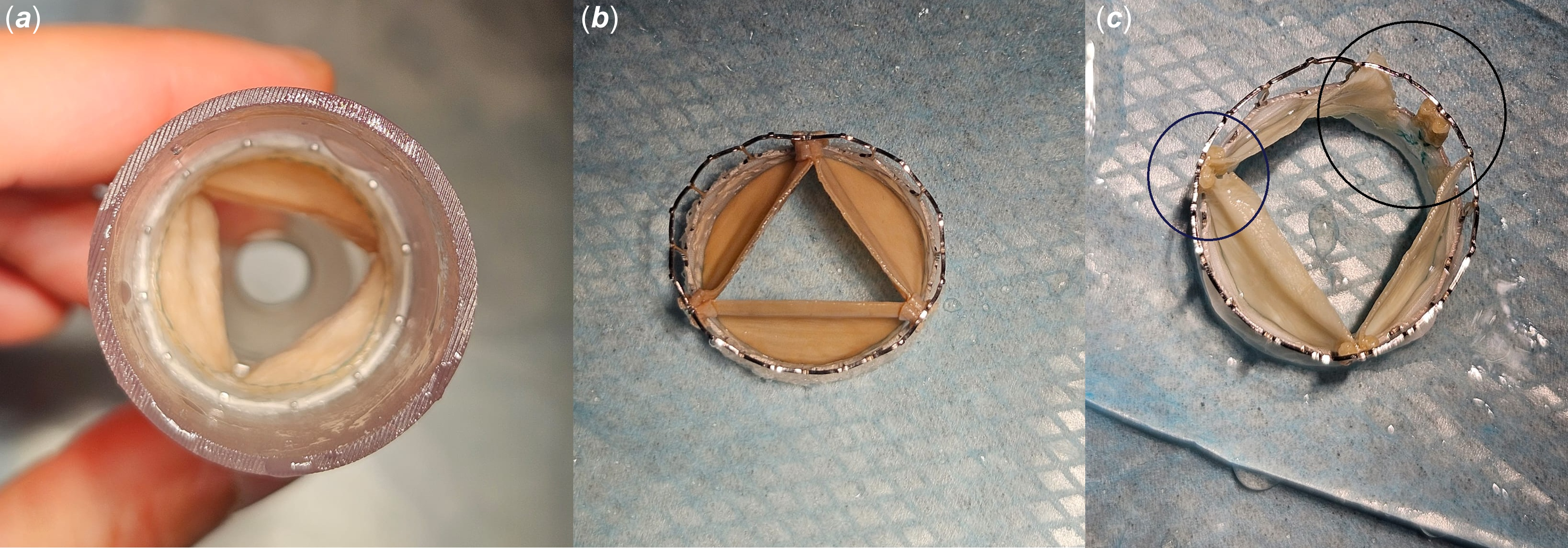
At 26 mm inflation, the SAPIEN 3 transcatheter heart valve had an inner diameter of 26 mm at the open-cell outflow level and 24.91 mm at the inflow skirt level, with a valve height of 13.65 mm. The leaflets were maximally stretched without tearing (Figure 2 a , b ) but remained functional with a central mild-to-moderate regurgitation (Vid. 1).
( a ) Inflow view of a SAPIEN 3 23 mm valve expanded inside a 26 mm silicone tube. ( b ) Outflow view of the same valve showing the leaflets fully stretched. ( c ) Outflow view of a MyVal OCTACOR 21.5 mm valve expanded to 26 mm. Note that two adjacent leaflets are completely ruptured and detached from their shared attachment point on the frame (black circle), while the third leaflet shows a partial tear at its attachment site (smaller blue circle).

The OCTACOR transcatheter heart valve had an inner diameter of 26.57 mm at the open-cell outflow level, 24.4 mm at the inflow skirt level, and a valve height of 14.9 mm. The octagonal cell shape deformed into a rectangular configuration. Two adjacent leaflets were completely ruptured and detached from their shared attachment point on the frame, while the third leaflet exhibited a partial tear at its attachment site (Figure 2 c ). All three leaflets were non-functional (Vid. 1).
No further expansion of the inflow portion beyond the diameters reported in Table 1 was achievable using high-pressure 26 mm balloons.
Valve dimensions and insufficiency at incremental balloon inflations

Discussion and limitations
This bench study demonstrates that balloon-expandable Edwards SAPIEN 3 and MyVal OCTACOR transcatheter heart valves can be implanted at smaller diameters and tolerate stepwise dilation up to their nominal size. Both valves also permit limited overexpansion, up to 3 mm for the 23 mm SAPIEN 3 transcatheter heart valve (+13% overexpansion) and 4.5 mm for the 21.5 mm MyVal OCTACOR transcatheter heart valve (+20.9% overexpansion) at the outflow sections. Interestingly, this comparable degree of overexpansion was achieved with the smaller OCTACOR transcatheter heart valve, likely due to its frame geometry, characterised by larger overlapping cells and smaller strut angles, which enhance radial adaptability. Reference Kilic, Coskun, Mirzamidinov, Yilmaz, Yavuz and Sahin7
In a lifelong transcatheter management strategy, selecting a smaller transcatheter heart valve with the intent of future overexpansion may represent a safer and more versatile approach than implanting a larger valve at reduced deployment pressure. Fully and over-expanded transcatheter heart valves typically achieve a more circular geometry, potentially enhancing long-term durability, whereas underexpanded valves may exhibit suboptimal leaflet motion and increased leaflet–frame interaction, factors known to accelerate structural deterioration. Reference Sathananthan, Sellers and Barlow3,Reference Haddad, Cément, Belli and Sébastien8
Semi-compliant balloons achieved greater dilation at the uncovered bare-metal outflow, while the inflow remained restricted by the reinforced annular frame and fabric sealing skirt, which were unaffected even by high-pressure inflations. Expansion beyond 24.91 mm (SAPIEN 3) and 24.4 mm (OCTACOR) at the inflow, and beyond 26 mm at the outflow for both valves, was not possible due to the mechanical limits imposed by the stent frame and sealing skirt designs. The clinical significance of this mild diameter asymmetry for valve performance and durability is uncertain. However, larger diameters are rarely required in practice.
At maximal overexpansion, distinct mechanisms were observed: the 23 mm SAPIEN 3 transcatheter heart valve developed restricted leaflet motion but remained partially functional, while the 21.5 mm MyVal OCTACOR transcatheter heart valve exhibited acute leaflet tearing and became non-functional. This could stem from variations in leaflet transcatheter heart valve thickness, tissue quality, and attachment to the stent frame, features that are proprietary and not publicly disclosed. However, in children, mechanical expansion limits are more critical than the precise threshold for leaflet dysfunction, as valve-in-valve procedures are generally anticipated as the child grows. Importantly, the difference in baseline nominal valve sizes (23 mm vs 21.5 mm) may also explain such differences. Under optimal clinical conditions and without accounting for potential valve degeneration over time, the findings suggest that the SAPIEN 3 transcatheter heart valve can remain partially functional, although probably over the minimum acceptable ISO 5840-3:2013 guidelines of 15% transvalvular regurgitant fraction, as already shown. Reference Sathananthan, Sellers and Barlow3
For the 21.5 mm MyVal OCTACOR transcatheter heart valve, although the leaflet tearing would make it non-functional, this represents an overexpansion of 20.9%, as compared to only 13% for the 23 mm SAPIEN 3 transcatheter heart valve when considering measurements at the outflow level of the valve. This advantage is of relevance in paediatric patients, allowing for future redo valvulation at larger diameters. Although we cannot speculate on the function of a similar 23 mm MyVal OCTACOR transcatheter heart valve at 26 mm, the overexpansion of the 21.5 mm MyVal OCTACOR transcatheter heart valve at 24 mm (+11.7% overexpansion) showed a functional valve with a central mild-to-moderate regurgitation, similar to the 23 mm SAPIEN 3 transcatheter heart valve at 26 mm (13% overexpansion). Ideally, a dedicated bench comparison between OCTACOR and SAPIEN 3 transcatheter heart valves, both with nominal diameters of 20 mm, would be required for a truly equivalent assessment. Nevertheless, it appears unlikely that the SAPIEN 3 transcatheter heart valve could withstand expansion to 26–27 mm, as observed with the 20 mm OCTACOR transcatheter heart valve in our previous study. Reference Haddad, Ciobotaru, Hascoët and Fraisse5
It should also be emphasised that ex vivo findings may not perfectly predict in vivo behaviour within degenerated or heavily calcified native annuli or surgical bioprostheses, highlighting the need for clinical validation. Nonetheless, these insights are valuable for guiding transcatheter strategies in challenging paediatric scenarios where surgical options are limited. While short-term outcomes of transcatheter heart valve under- or overexpansion have been reassuring, the long-term implications for hydrodynamics and durability remain uncertain. Such compromises may be acceptable in older adults with limited life expectancy but are far less tolerable in children and young adults, where valve longevity is paramount. In paediatric patients, under- or overexpansion should remain an exception, reserved for compelling clinical situations, and surgery should remain favoured whenever feasible.
Conclusion
These findings reinforce our previous observations that the OCTACOR transcatheter heart valve exhibits a substantial potential for overdilatation, enabling revalvulation at larger diameters, an attribute of particular importance in paediatric applications. While the SAPIEN 3 transcatheter heart valve also allows for some degree of overdilatation, its capacity appears more limited. Further bench testing should also assess the recently introduced Meril OCTAPRO transcatheter heart valve in Europe with reduced frame foreshortening at nominal diameter and may therefore offer an even greater potential for redilatation.
Supplementary material
The supplementary material for this article can be found at https://doi.org/10.1017/S1047951126113146.
Acknowledgements
We thank Pr. Sébastien HASCOËT and Dr Vlad CIOBOTARU for their significant contribution to the organisation, planning, and conduct of the bench tests.
Financial support
This research received no specific grant from any funding agency, commercial, or not-for-profit sectors.
Competing interests
None.
Ethical standard
This research does not involve human or animal experimentation.