


Social scientists tend to ignore religion in the processes of post-Enlightenment modernization. In individual cases and events, the role of religious actors is clear—especially in the primary documents. Yet in broad histories and comparative analyses, religious groups are pushed to the periphery, only to pop out like a jack-in-the-box from time to time to surprise and scare people and then shrink back into their box to let the important historical changes be directed by “secular” actors and forces (Butler Reference Butler2004). Yet integrating religious actors and motivations into narratives about the rise and spread of both Western modernity and democracy helps solve perennial problems that plague current research.
In fact, most research on democracy and other macro historical changes has not made the cultural turn that has revolutionized studies of social movements and other more micro processes (Slater Reference Slater2009). Most theories about democracy emphasize the material interests of different social classes and either ignore or minimize the role of cultural and religious interests (e.g., Acemoglu and Robinson Reference Acemoglu and Robinson2005; Boix Reference Boix2003; Reuschemeyer, Stephens, and Stephens Reference Rueschemeyer, Stephens and Stephens1992). However, religious, moral, and cultural factors shape human behavior, in addition to material self-interest maximization (Smith Reference Smith2003; Reference Smith2010), or in Weberian terms, humans follow both “value-rationality” and “instrumental-rationality.” If our understanding of human motivation is oversimplified, our models will be oversimplified as well. Theories based on more accurate views of human nature reflect history more precisely and produce more powerful statistical models.
Of course, scholars could adjust both rational-choice models and post-Marxian class analyses to account for religious motivations and religious actors, but few do so. This article demonstrates the costs of this oversimplification. Many of the major historical and statistical arguments about the rise and spread of democracy collapse when we account for religious factors in a historically sensitive way.
More broadly, this article challenges many aspects of traditional modernization theory (i.e., that liberal democracy and other social transformations traditionally associated with “modernity” developed primarily as the result of secular rationality, economic development, urbanization, industrialization, the expansion of the state, and the development of new class structures). Although all these elements may matter, they are not the only causes. Moreover, those “causes” must be explained. I argue that Western modernity, in its current form, is profoundly shaped by religious factors, and although many aspects of this “modernity” have been replicated in countries around the world, religion shaped what spread, where it spread, how it spread, and how it adapted to new contexts.
In particular, conversionary Protestants (CPs)Footnote 1 were a crucial catalyst initiating the development and spread of religious liberty,Footnote 2 mass education, mass printing, newspapers, voluntary organizations, most major colonial reforms, and the codification of legal protections for nonwhites in the nineteenth and early twentieth centuries. These innovations fostered conditions that made stable representative democracy more likely—regardless of whether many people converted to Protestantism. Moreover, religious beliefs motivated most of these transformations. In this blunt form, without evidence or nuance, these claims may sound overstated and offensive. Yet the historical and statistical evidence of CPs’ influence is strong, and the cost of ignoring CPs in our models is demonstrably high.
In statistical analyses, Protestant missions explain about half the variation in democracy in Africa, Asia, Latin America, and Oceania and make most of the variables that dominate current research statistically insignificant. Thus, even if one does not believe the causal arguments made in this article, current research must be reevaluated either because it does not account for the historical prevalence of CPs or because it does not account for the omitted variable(s) that drive the association between CPs and education, printing, civil society, economic development, and ultimately democracy.
Previous quantitative research consistently suggests that countries with more Protestants are more democratic and have more stable democratic transitions (Bollen and Jackman Reference Bollen and Jackman1985; Hadenius Reference Hadenius1992; Treisman Reference Treisman2000; Tusalem Reference Tusalem2009). However, this earlier research measured Protestant influence less precisely and more recently than my study (i.e., after CP-initiated behavior spread to other groups and become institutionalized) and thus found results less dramatic than those in this article.
Current statistical evidence of an association between Protestantism and democracy matches historical evidence that Protestantism facilitated the development of modern representative democracy (e.g., Bradley and Van Kley Reference Bradley and Van Kley2001; Clarke Reference Clarke1994; Witte Reference Witte2007). For example, stable democracy first emerged in Protestant Europe and British-settler colonies, and by World War I every independent, predominantly Protestant country was a stable democracy—with the possible exception of Germany.Footnote 3 Less stable versions of democracy developed in Catholic areas with large Protestant and JansenistFootnote 4 minorities, such as France (Anderson Reference Anderson2004; Philpott Reference Philpott2004; Woodberry and Shah Reference Woodberry and Shah2004). However, democracy lagged in Catholic and Orthodox parts of Southern and Eastern Europe where Protestants had little influence. A similar pattern existed outside Europe (Woodberry Reference Woodberry2004c).
Of course, the relationship between Protestantism and democracy has never been automatic or uncomplicated.Footnote 5 The Dutch Reformed Church generally supported apartheid in South Africa, many German Protestants supported Nazism, white settlers throughout the world typically fought extending democratic rights to nonwhites, and Africa, Asia, and Latin America have had their share of Protestant dictators (e.g., Frederick Chiluba in Zambia, Syngman Rhee in Korea, and Ríos Montt in Guatemala).
Moreover, the religious landscape is changing. Since the 1970s the Catholic Church has often promoted democratization (Philpott Reference Philpott2004; Woodberry and Shah Reference Woodberry and Shah2004), and more recently some Muslim and Buddhist groups have done so as well. In addition, states increasingly provide education and businesses increasingly dominate the printing and newspaper industries, thus CPs have often withdrawn from these industries to focus more directly on mission work. CPs cannot tax or mobilize as many resources as can governments or for-profit companies. In the twentieth century, educational expectations grew and tensions increased between conservative Protestants and some segments of academia, and many CPs found less theological justification for financing education at the highest levels. Thus despite the strength of the statistical association between Protestantism and democracy and despite the intriguing historical patterns, the relationship between Protestantism and democracy is probabilistic (not deterministic) and must account for historical change.
In fact, some argue that the association between Protestantism and democracy is spurious, even historically (Moore Reference Moore1966; Rueschemeyer, Stephens, and Stephens Reference Rueschemeyer, Stephens and Stephens1992; Swanson Reference Swanson1967). For example, in Europe, pre-Reformation class structures, land-holding patterns, and political conditions may have influenced both the spread of Protestantism and the later development of democracy, thereby creating a deceptive association.
Unfortunately, differentiating cultural and instrumental causes is always difficult. In any given context, possible causes are so enmeshed that they are difficult to untangle. For every proposed cultural or religious “cause,” scholars can find an alternative economic or political “cause,” and vice versa. To escape this swamp of indeterminate causality I use several approaches: (1) observing the consistent association between Protestantism and democracy in regions with histories and class structures radically different from those of Europe; (2) showing historically that CPs had a unique role in spreading mass education, printing, civil society, and other factors that scholars argue fostered democracy; and (3) demonstrating statistically that the historic prevalence of Protestant missionaries strongly predicts democracy in 142 non-European societies using (a) controls for alternative explanations and (b) instrumental variable estimation. These different analyses consistently demonstrate a strong link between CPs and democracy, making it extremely difficult to find a consistent alternative explanation.
I discuss the following arguments in more detail in the history section, but in brief, CPs such as Protestant missionaries wanted people to be able to read the Bible in their own language and wanted to facilitate lay religious involvement. Thus, as CPs tried to spread their faith, they catalyzed mass education, mass printing, and civil society—hampering elite attempts to monopolize these resources. Protestants themselves did not always provide the most educational, printing, and civil society resources, but Protestant initiatives spurred others to invest heavily in these areas and to pressure governments to create schools that restricted Protestant content. These resource transfers to non-elites helped alter the class structure, fostered the rise of political parties and nonviolent political movements, and facilitated broader political participation.
In addition, Nonconformists (i.e., non-state-supported Protestant denominations) historically suffered from discrimination and persecution by governments and state churches. Thus they fought for religious liberty and against state interference in civil society. In addition, both Evangelicals in state churches and Nonconformists wanted a “converted clergy.” Thus in the eighteenth through early twentieth centuries, CPs generally sided with Enlightenment elites against state churches and their conservative allies. When they lacked this religious support, Enlightenment elites had a small power base and typically set up either autocratic or unstable and illiberal democratic regimes.
Finally, nonstate missionaries moderated colonial abuses, particularly when abuses undermined conversions and in British colonies (where CPs had greater influence). To reach their religious goals, nonstate missionaries punished abusive colonial officials and counterbalanced white settlers, which fostered the rule of law, encouraged less violent repression of anticolonial political organization, and facilitated peaceful decolonization. Of course, Protestant economic and political elites were as selfish as anyone else. Protestant slave owners fought slave literacy, and Protestant settlers exploited indigenous people; however, when missionaries were financially independent of the state, of slave owners, and of white settlers, missionaries undermined these elite co-religionists in ways that fostered democracy.
To make these arguments I combine historical and statistical research. I completed the historical analyses first, and the statistics confirm what the historical analyses revealed. However, neither the history nor the statistics should be evaluated in isolation. Each mitigates weaknesses in the other approach. The history helps make the strong statistical results plausible, and the statistics help demonstrate that the historical section is not a selection of unrepresentative stories.
The rest of this article is organized as follows. The next section shows the consistent association between Protestantism and democracy across contexts. The third section outlines historical evidence for conversionary Protestantism's direct and indirect influences on democracy; the fourth presents the data and methods. The fifth section tests the association between missions and democracy statistically. The final section summarizes the evidence and highlights theoretical implications.
CONSISTENT ASSOCIATION BETWEEN PROTESTANTISM AND DEMOCRACY
As mentioned previously, Protestantism is associated with stable, representative democracy in Western Europe (Context 1), although many argue that this association is spurious (Moore Reference Moore1966; Rueschemeyer, Stephens, and Stephens Reference Rueschemeyer, Stephens and Stephens1992; Swanson Reference Swanson1967). Because Protestantism spread to many contexts with different class structures, land-holding patterns, and the like, these varying pre-Protestant conditions can be used to help adjudicate between theories. If the association between Protestantism and democracy remains consistent regardless of context, the claim that the association is caused by these pre-Protestant conditions becomes less plausible. We now turn to four other contexts.
Context 2: Among European-settler colonies, “Protestant-based” United States, Canada, Australia, and New Zealand have been more democratic than “Catholic-based” Argentina, Chile, Uruguay, and Costa Rica. Both sets of countries had similar precolonial conditions (e.g., temperate climates, communal land holding, and small indigenous populations), which weakens theories that climate or pre-Protestant class conditions caused the Protestantism–democracy association. Differences between Protestant- and Catholic-settler colonies after the arrival of white-settlers may be influenced by religion and thus be intervening mechanisms rather than competing explanations. Context 2 also weakens theories that secularization causes democracy (e.g., the United States is far more religious than Uruguay). Still, all predominantly “Protestant” areas were British colonies, and all “Catholic”Footnote 6 areas were Spanish colonies. Thus colonial institutions may be the crucial factor. Yet whatever the mechanisms are, they seem to be transportable from Europe to other countries.
Contexts 3 and 4: After the fall of communism, Eastern European Catholic and Protestant countries (Poland, Hungary, East Germany, Slovakia, Slovenia, the Czech Republic) had earlier, more stable democratic transitions than did Orthodox Christian and Muslims ones (Albania, Romania, Bulgaria, Serbia, Bosnia). Similarly, Protestant and Catholic former Soviet republics (Latvia, Lithuania, Estonia) had earlier, more stable transitions than did Orthodox and Muslim ones (Anderson Reference Anderson2004; Woodberry Reference Woodberry2000). None of these countries were British colonies or had mass immigration from Northwest Europe; this weakens nonreligious explanations for the Protestantism–democracy association in Context 2.
Moreover, all the countries in Contexts 3 and 4 had similar pre-transition institutions and entered a similar international environment. All had large secular populations and comparable exposure to Marxist and Enlightenment ideas via monopoly state education. In addition, communists eliminated historic differences in land holdings. Yet in both Contexts 3 and 4, religious differences predict both who mobilized against communism and how smoothly states made the transition to democracy. Catholic and Protestant countries became similarly democratic, but the transitions occurred after the Catholic Church's rapprochement with democracy and in areas where Protestants and Catholics had competed for centuries. “Nonreligious” explanations for the pattern—such as the legacy of Ottoman colonization—might work for Eastern Europe, but not for the former Soviet Union or for Contexts 1, 2, and 5 (see Tables 18 and 19 in the supplemental Online Appendix available at http://www.journals.cambridge.org/psr2012005). Nor is it clear that the Ottoman “influence” was not related to religion.
Context 5: Finally, if we exclude all European countries and all Protestant European-settler colonies from the sample (i.e., Contexts 1–4) and analyze the remaining countries in Africa, Asia, Latin America, and Oceania, we still find a statistical association between Protestantism and democracy. Thus in at least five distinct contexts the Protestantism–democracy association holds. None of these tests are decisive, and it is possible to think of ad hoc alternative explanations in each context. Yet the consistent association between Protestantism and democracy across all five contexts strengthens the plausibility of causation. It is not clear if any competing theory works in all five contexts or why we should prefer inconsistent explanations over a consistent one.
Contrary to what many theories of “secular modernity” argue, democracy was not a triumph of secularism over religion. From the seventeenth through the mid-twentieth centuries, activist Protestants instituted and spread many of the reforms that made modern representative democracy more likely (see the section, Historical Evidence). Although we cannot measure the historic prevalence of CPs in Contexts 1–4 statistically, we can measure CPs’ influence in Context 5 via the historic prevalence of Protestant missionaries. The section, Statistical Evidence, demonstrates that the historic prevalence of Protestant missionaries explains the variation in democracy better than either the prevalence of the nonreligious or of generic Protestants. Moreover, Protestant missions predict democracy, whereas Catholic missions do not. Yet there is no evidence that land-holding patterns (or other theories used to discount the Protestantism–democracy association in Europe and the Americas) shaped the spread of Protestant missionaries but did not shape the spread of Catholic missions (e.g., see Tables 20 and 21 in the supplemental Online Appendix).
Some may argue that the influence of missionaries was too anemic to foster democracy, but before the mid-twentieth century, missionaries were the main source of information about life in the colonies (Fairbank Reference Fairbank, Wilson Barnett and Fairbank1985; Hutchison Reference Hutchison1987, 1; Tudesco Reference Tudesco1980, 56). Moreover, missionaries constituted one of the largest and most educated groups of Westerners in the non-Western world—most had college degrees when few others had them (Daughton Reference Daughton2006; Hutchison Reference Hutchison1987). In the Anglo-Protestant world, missionary organizations dwarfed labor unions and other nongovernmental organizations (NGOs).Footnote 7 In fact, in the nineteenth century in the United States, the largest mission organizations outstripped all but a few commercial banks in size and financial resources (Chabbott Reference Chabbott, Boli and Thomas1999, 226–31; Hall Reference Hall1994; Hutchison Reference Hutchison1987). Yet, scholars often argue that labor unions, NGOs, and financial interests influenced democracy. Moreover, as we see later, Protestant missions powerfully predict democracy and are amazingly robust to controls and other methods of mitigating omitted variable bias.
HISTORICAL EVIDENCE
This section outlines the historical evidence that CPs influenced democratic theory and institutions and expanded mass printing, mass education, civil society, and the rule of law. This dispersion of power and resources increased GDP, expanded the middle class, and forced most “Protestant” colonizers to devolve power to non-Europeans via elections earlier than “Catholic” colonizers had to. These conditions altered elites’ incentives and engendered both party systems and electoral experience before independence, thereby increasing democratic stability after independence.
Wherever possible, I present these arguments first in Europe and North America and then in Africa, Asia, Oceania, and Latin America. The European and North American evidence is crucial because both representative democracy and the intermediate mechanisms that this article emphasizes first developed there. If conversionary Protestantism creates conditions favorable to democracy, we must find plausible links between CPs and each mechanism in the places where the mechanism first appeared: Europe and North America. The non-European evidence strengthens the plausibility of causation because it undermines alternative theories proposed for Europe (i.e., claims that the association between Protestantism and democracy in Europe is caused by preexisting differences in class structure, land-holding patterns, etc.), whereas Protestant missions spread to areas with completely different precolonial class structures, land-holding patterns, and methods of governance. If Protestant missionaries consistently promoted democracy-friendly institutions in these new contexts, and other groups from Protestant societies usually did not (i.e., settlers, business people, and colonial officials), then it suggests that explanations for European democratization that ignore religious factors are either wrong or insufficient.
THE ORIGIN OF DEMOCRATIC THEORY AND INSTITUTIONS
Those who doubt the religious roots of democracy typically overemphasize its Athenian, Enlightenment, and Deist roots. However, religious factors are also important. Modern democracy differs greatly from Athenian democracy,Footnote 8 and Enlightenment theorists incorporated many legal and institutional innovations from earlier religious movements (Berman Reference Berman1983; Nelson Reference Nelson2010; Waldron Reference Waldron2002; Witte Reference Witte2007). In fact, arguments for political pluralism, electoral reform, and limitations of state power were originally framed in religious terms (Bradley and Van Kley Reference Bradley and Van Kley2001; Clarke Reference Clarke1994; Ihalainen Reference Ihalainen1999; Lutz Reference Lutz1988; Reference Lutz1992; Nelson Reference Nelson2010; Witte and Alexander Reference Witte and Alexander2008).
For example, Calvinists tried to reconstruct states along “godly” lines and limit sinful human institutions. Perhaps as a result, most Enlightenment democratic theorists came from Calvinist families or had a Calvinist education, even if they were either not theologically orthodox or personally religious (e.g., John Locke, Rousseau, Hugo Grotius, Benjamin Franklin, John Adams, Patrick Henry, James Madison, and Alexander Hamilton),Footnote 9 and they secularized ideas previously articulated by Calvinist theologians and jurists (Hutson Reference Hutson1998; Lutz Reference Lutz1980; Reference Lutz1988; Nelson Reference Nelson2010; Witte Reference Witte2007).Footnote 10 For example, Hobbes’ and Locke's social contracts are secular versions of Puritan and Nonconformist covenants, and Locke's ideas about the equality of all people are explicitly religious (Waldron Reference Waldron2002; Woodberry and Shah Reference Woodberry and Shah2004).
Although stated in secular form, the U.S. Constitution and Bill of Rights derive most directly from earlier colonial covenants, compacts, and bills of rights that were generally justified explicitly in biblical and theological terms; many were written before Hobbes and Locke expounded their ideas. Only 7 of the 27 rights enumerated in the U.S. Bill of Rights can be traced to major English common law documents (Lutz Reference Lutz1980; Reference Lutz1988; Reference Lutz1992; Witte Reference Witte2007). Even between 1760 and 1805, political writings quoted the Bible more often than either Enlightenment or classical thinkers (34% versus 22% and 9%, respectively; Lutz Reference Lutz1984).
Furthermore, the strength of Calvinism and Nonconformism better predicts where democracy emerged than does the strength of Greek and Enlightenment influence. Greek classics were most consistently available in the Eastern Mediterranean and the Muslim world, but democracy did not thrive there; the Roman Empire circled the Mediterranean, and the Renaissance flourished in Southern Europe, but democracy did not thrive in those places either. The “Athenian seed” germinated only after 2,100 years in alien soil: Northwest Europe and North America. Thus, areas with later and weaker exposure to Greek thought would have to have had “stronger pro-democratic effects.” At a minimum, some additional catalyst seems likely.
Moreover, the religious context influenced whether Enlightenment-linked revolutions gave birth to stable democracy. The Protestant English and Scottish Enlightenments were not anti-Christian, and where they spread, democracy flourished. The “Catholic” French Enlightenment was virulently anti-Christian (particularly anti-Catholic), and where it spread, stable democracy did not. The French Revolution devolved into violence and inspired both totalitarianism and democracy (Talmon Reference Talmon1970). Similarly, anticlerical Enlightenment governments formed in virtually every independent Catholic country in Europe and Latin America, but did not lead to stable democracy (at least not without many decades of instability; Helmstadter Reference Helmstadter1997). Some anticlerical Enlightenment governments clung to power for almost a century before democratizing (e.g., Mexico, Uruguay). Similarly, Freemasons promoted Enlightenment ideas and spread in most colonies, but remained elitist allies of imperialism and did not disperse power to nonwhites or the poor (Daughton Reference Daughton2006, 87–97; Fredrickson Reference Fredrickson2002; Harland-Jacobs Reference Harland-Jacobs2007; Rich Reference Rich1991). Even in independent Latin America—where Masons fought old hierarchies—membership in the Masons was limited to men with property and “honorable” professions, hampering power dispersion (Solano Reference Solano and Bastian1990).
In fact, careful historical work suggests that religious factors were crucial to the emergence and stabilization of democracy in Europe and North America (Capoccia and Ziblatt Reference Capoccia and Ziblatt2010, 946–47; Ertman Reference Ertman2010; Gould Reference Gould1999; Kalyvas Reference Kalyvas1996; Rokkan Reference Rokkan1970). For example, even in nineteenth-century Great Britain, expansions of suffrage and reforms of the electoral system were directly tied to pressure by Evangelical Anglicans and Nonconformists—in this case, including nonstate Catholics (Ertman Reference Ertman2010).Footnote 11 Similarly, in Sweden, Norway, and the Netherlands, competition between religious groups with Evangelicals, Nonconformists, and Enlightenment elites on one side and conservative defenders of the state church on the other, spurred expansion of suffrage to the lower classes and facilitated democratic consolidation (Ellens Reference Ellens1994; Gould Reference Gould1999; Machin Reference Machin1977; Madeley Reference Madeley and Berger1982; Stephens Reference Stephens1979; Thung, Peelen, and Kingmans Reference Thung, Peelen, Kingmans and Berger1982). Different religious cleavages fostered the origin, expansion, and stability of democracy elsewhere in Europe (Bradley and Van Kley Reference Bradley and Van Kley2001; Gould Reference Gould1999; Van Kley Reference Van Kley1996).Footnote 12
Thus modern democratic theory and institutions are a confluence of streams, not a uniquely Athenian or Enlightenment creation. Although Enlightenment and Greek thought were important, they are not a sufficient explanation for liberal democracy. Religious ideas, institutions, conflicts, and social bridging were also important. In summary, the ideas that shaped the first successful democratic movements were heavily influenced by Protestantism, not just by “secular” classical and Enlightenment thought. Moreover, ideas are not enough. Without conditions that dispersed power beyond a small elite and prevented life-and-death struggles between secular and religious forces, democracy did not last. In the next subsections I discuss how CPs fostered greater separation between church and state, dispersed power, and helped create conditions under which stable democratic transitions were more likely to occur.
PRINTING, NEWSPAPERS, AND THE PUBLIC SPHERE
One mechanism through which CPs dispersed power was massively expanding access to printed material and news. Scholars often claim that printing and capitalism birthed the public sphere and that the public sphere in turn enabled democracy (Habermas Reference Habermas, Burger and Lawrence1989; Zaret Reference Zaret2000). CPs greatly accelerated the development of mass printing, newspapers, and the public sphere for several reasons. First, CPs changed people's ideas about who books were for. According to CPs, everyone needed access to “God's word”— not just elites. Therefore, everyone needed to read, including women and the poor. Moreover, books had to be inexpensive and in language that was accessible to ordinary people, not in foreign languages or classical versions of local languages. Second, CPs expected lay people to make their own religious choices. They believed people are saved not through sacraments or group membership but by “true faith in God”; thus, each individual had to decide which faith to follow.Footnote 13 CPs used printed material to try to convert people, which forced other groups to use such materials to compete for ordinary people's allegiance. This competition helped give rise to mass printing.
CPs’ catalytic effect on printing is clear from the shifts in the printing centers of Europe. Before the Reformation, Italy had the largest printing industry, but Protestantism made little headway there and printing did not increase rapidly or birth either an early public sphere or mass literacy (Graff Reference Graff1987, 112–19). In contrast, England initially had little printing activity (Graff Reference Graff1987, 115), but CPs used printing to mobilize ordinary people, forcing their elitist enemies to respond in kind. This activity spurred the growth of newspapers, printed debates, and an early public sphere (Zaret Reference Zaret2000). CPs had similar effects in continental Europe (e.g., Germany, France, Switzerland, and the Netherlands; Eisenstein Reference Eisenstein1979, 312–452; Febvre and Martin Reference Febvre and Martin1976, 287–319; Melton Reference Melton, Bradley and Van Kley2001). However, nonstate Protestants were weaker there, and extended religious wars destroyed their early gains. Still, from the 1600s on, even in continental Europe, Protestant areas consistently printed more books per capita and exported more printed material per capita than Catholic areas (Eisenstein Reference Eisenstein1979, 403–23).
In the West, the development of CP movements also predicted many of the major advancements in the quantity and techniques of printing. For example, CP Bible and tract societies helped spark a nineteenth-century printing explosion. Their drive to print mass quantities of inexpensive texts preceded major technological innovations and helped spur technological and organizational transformations in printing, binding, and distribution that created markets and facilitated later adoption by commercial printers (Bayly Reference Bayly2004, 357; Bradley Reference Bradley2006, 38–39; Brown Reference Brown2004; Howsam Reference Howsam1991; Nord Reference Nord2004).Footnote 14 Before this printing explosion, commercial publishers generally fought mass printing to keep prices high, even in Great Britain (St. Clair Reference St. Clair2007). Thus although markets and technology are important, they are not sufficient to explain the timing or locations of major increases in printing.
The importance of CPs to the growth of printing is even clearer outside Europe. Through several mechanisms, religion influenced both whether countries engaged in printing and whether printing led to mass literacy, newspapers and a public sphere. First, religion influenced whether elites valued printing. Christians, Jews, and Mahayana Buddhists adopted printing without CP competition (none were primarily monastic, and all had long, nonpoetic religious texts that are difficult to memorize). However, Muslim, Hindu, Theravada Buddhist, and other societies in Asia and North Africa were exposed to printed books and printing presses by Chinese, Mongols, Jews, Asian Christians, Catholic missionaries, and European trading companies for hundreds of years before they printed any books. By the 1600s, Europeans had created accurate fonts for most major Asia languages and exported texts in them. The Portuguese even gave the Moghul emperor a printing press and fonts in the early 1600s, but no one used them (Woodberry Reference Woodberry and McCleary2011c). Yet, many Asian economies rivaled or surpassed Europe through the late eighteenth century (Maddison Reference Maddison2001), so the delay in printing books was not caused by lack of exposure, technology, markets, or economic development.
To most elites, printing seemed ugly, it spread books to those “not qualified to interpret them,” and it undermined elite status/control. Jews, Eastern Christians, and trade companies only printed materials for their own consumption (mostly in “foreign” languages), and Catholics printed few texts (not mass propaganda). This limited printing activity did not threaten local elites’ ability to control public discourse or overwhelm their ability to respond orally or with manuscripts. Thus, Muslim, Hindu, and Theravada Buddhist elites resisted change.
When Muslims, Hindus, and Theravada Buddhists engaged in printing, it was usually a response to mass printing by Protestant missionaries or by those trained by them (e.g., Lebanon, Syria, Sudan, Persia/Iran, Malaysia, India, Burma, Sri Lanka, Thailand; Green Reference Green2009; Woodberry Reference Woodberry and McCleary2011c).Footnote 15 CPs printed so many vernacular texts that it forced elite response. For example, within 32 years of importing a press to India in 1800, three British missionaries printed more than 212,000 copies of books in 40 languages and, along with other missionaries, created the fonts and paper that dominated South Asian printing for much of the nineteenth century (Ghosh Reference Ghosh2003, 27; Khan Reference Khan1961; Ross Reference Ross1999, 40–77, 118). This spurred both Hindus and Muslims to respond, but the earliest Indian printers learned their skills at mission presses, and most early non-Christian Indian imprints were religious—often rebuttals to missionary tracts (Aggarwal Reference Aggarwal1988, 2; Ghosh Reference Ghosh2003; Khan Reference Khan1961; Robinson Reference Robinson2000, 77; Shaw Reference Shaw, Eliot and Rose2007). In fact, in most Asian societies early indigenous printers gained their skills and equipment from Protestant missionaries (Green Reference Green2009; Woodberry Reference Woodberry and McCleary2011c).
Conversionary Protestantism also shaped printing's “consequences.” If printing was a sufficient cause for mass literacy, newspapers, and the public sphere, then we would expect these developments to have originated in China, Korea, or Japan, but they did not. Printing occurred in China, Korea, and Japan 600–800 years earlier than in Europe. China and Korea had movable-font metal type before Europe; Japan had movable-font metal type starting in 1590; and Korea and Japan had phonetic alphabets, which facilitated literacy and made moveable font efficient. All three countries had a high level of economic development and thriving mercantile classes. However, until CPs arrived in the nineteenth century, printing never supplanted handwritten manuscripts, newspapers did not develop, and literacy remained primarily the prerogative of elite men (Davis Reference Davis1994; Duchesne Reference Duchesne2006, 82–83; Reed Reference Reed2007; Su Reference Su1996).
In Asia Protestant missionaries and their local associates consistently spurred the growth of mass education, mass printing, social movement organizations (SMOs), and public debates, which gave rise to a public sphere (Asia: Lent Reference Lent1981; China: Dunch Reference Dunch2001; Zhang Reference Zhang2007; Korea: Choi Reference Choi1997; Davis Reference Davis1994; Japan: Altman Reference Altman1966; Huffman Reference Huffman1997). Protestant missionaries printed the first East Asian newspapers (in Chinese);Footnote 16 Chinese reformers copied them (Dunch Reference Dunch2001, 78; Zhang Reference Zhang2007), as did Japanese and Koreans, who read mission publications in Chinese and visited missionaries while their countries were still closed to Westerners (Altman Reference Altman1966, 23–27, 37, 41–42; Inglehart Reference Inglehart1959, 40; Lutz Reference Lutz2008, 92–96; K. Shin Reference Shin1999; Y.-H. Shin Reference Shin1984). Christian converts published the first privately printed Japanese- and Korean-language newspapers (Davis Reference Davis1988; Huffman Reference Huffman1997, 30–31, 410).Footnote 17 Protestant missionaries also reintroduced movable-font metal type (which Asians had abandoned) and developed the fonts and techniques that dominated nineteenth- and early-twentieth-century printing throughout East Asia (Altman Reference Altman1966, 100–7; Lutz Reference Lutz2008, 173–75; Su Reference Su1996; Zhang Reference Zhang2007). Similarly, Protestant missionaries initiated newspapers in most other non-European societies (Woodberry Reference Woodberry and McCleary2011c).
Technological know-how is necessary, but not sufficient for the development of printing, newspapers, and the public sphere. CPs were also important because they transformed who books were for and printed content that threatened elites’ control of religious interpretation, spurring reaction. Other mechanisms may be possible,Footnote 18 but societies that excluded CPs started mass printing later and expanded it more slowly. In fact, as we see in the statistics section, the historic prevalence of Protestant missionaries strongly predicts cross-national variation in per capita newspaper circulation throughout the twentieth century.
CPs were not perpetually necessary to sustain a print revolution (markets took over), but they were a crucial catalyst. Thus, to the extent that both a vital public sphere and a broad, non-state-controlled printing industry and news media promote stable democracy, we would expect greater democracy in areas in which CPs had longer and more pervasive influence.
Education
Another mechanism through which CPs dispersed power was through spreading mass education. Much statistical research suggests that formal education increases both the level of democracy and the stability of democratic transitions (Barro Reference Barro1999; Bollen Reference Bollen1979; Gasiorowski and Power Reference Gasiorowski and Power1998).Footnote 19 CPs catalyzed the rise of mass education all around the world.
CPs advocated mass literacy so that everyone could read the Bible and interpret it competently. Their attempt to convert people through education threatened other elites and spurred these elites to also invest in mass education. In contrast, high education rates among nonconversionary religions (i.e., Jews after the second century CE) did not evoke a similar response. CPs’ centrality to the spread of mass education is demonstrated by (1) who advocated and resisted educational expansion, (2) when education expanded, (3) which regions got more education, and (4) which type of individuals received more education.
Before the late nineteenth century, economic elites throughout Europe resisted educating women and the poor because they feared it would undermine stability (Graff Reference Graff1987 153, 174–75, 230–31, 247, 269, 315, 362; Vincent Reference Vincent2000, 26, 77, 80). Countering this elite pressure, religious groups (particularly CPs) educated women and the poor and developed techniques that made mass schooling possible, such as teacher training, child-focused texts, dividing students into age/ability groups, etc. (Bacchus Reference Bacchus, Tulasiewicz and Brock1988; Bradley Reference Bradley2006; Graff Reference Graff1987, 152, 162–63, 231, 246–47, 315–17; Vincent Reference Vincent2000, 38–48). Even when European governments formed state school systems, they often merely nationalized religious schools (Bebbington Reference Bebbington, Gillery and Stanley2006; Graff Reference Graff1987).
Education expanded rapidly after the Reformation and similar religious revival movements. In contrast, education rates did not increase with the advent of printing, the Renaissance, the Enlightenment, or the Industrial Revolution—at least not in the short term (Graff Reference Graff1987;Footnote 20 Johansson Reference Johansson1977; Vincent Reference Vincent2000, 28–32). Economic development does not seem to have spurred early mass literacy either. The earliest places with near universal literacy (Scandinavia, Iceland, New England, Protestant cantons in Switzerland, Puritan parts of England, and lowland Scotland) were typically economic backwaters, but had Protestant-sponsored literacy campaigns (Graff Reference Graff1987, 13, 246, 292–93; Johansson Reference Johansson1977).
Before the twentieth century, countries with more Protestants had higher literacy rates, provinces with more Protestants typically had higher literacy rates, and Protestant individuals in the same country had higher literacy than their Catholic counterparts. Educational differences between Protestants and others were especially apparent among women and non-elites, not among the aristocracy or wealthy merchants. The Catholic Church invested heavily in education where it competed with CPs (i.e., Ireland, North America, and British colonies) or in a secularizing state (France), but not in areas with a Catholic monopoly (e.g., Spain, Portugal, and Italy) or Orthodox/Muslim competition (e.g., Eastern Europe and the Balkans; Graff Reference Graff1987;Footnote 21 Higgs Reference Higgs1971; Houston Reference Houston2002, 157–62; Johansson Reference Johansson1977; van de Walle Reference Van de Walle1980; Vincent Reference Vincent2000, 8–11; Woodberry Reference Woodberry2004c). Recent statistical work using historical data from Germany shows that the relationship between Protestantism and education is very robust and holds up even after the authors used instrumental variable regression in an attempt to remove omitted variable bias from the Protestant coefficient (Becker and Woessmann Reference Becker and Woessmann2009).
However, although the association between Protestantism and education is extremely consistent, it may still be spurious because the spread of Protestantism in Europe was socially caused (i.e., endogenous). Fortunately, again, the relationship between Protestantism and education is testable through examining the missionary movement. Some areas in which missionaries settled were already colonized, whereas others were not, but regardless of where Protestant missionaries went they started schools soon after arrival. Even colonizer-financed education generally resulted from missionary lobbying (Ingham Reference Ingham1956, 11, 59; Smyth Reference Smyth2004; Sundkler and Steed Reference Sundkler and Steed2000, 637, 643; Woodberry Reference Woodberry2004c). Other religious groups did not emphasize mass literacy prior to Protestant competition in Africa (Clarke Reference Clarke1997, 152; Sundkler and Steed Reference Sundkler and Steed2000, 286), Latin America (Gill Reference Gill1998), Asia (Drummond Reference Drummond1971, 313; Dunch Reference Dunch2001, 3; James Reference James and Powell1987; Reference Estelle1989; Reference James1993), the Caribbean (Bacchus Reference Bacchus, Tulasiewicz and Brock1988), or the Middle East (Tejirian and Simon Reference Tejirian and Simon2002).Footnote 22 See Woodberry (Reference Woodberry2004c) for more details.
Context and theology also mattered. Calvinists typically emphasized higher education more than other CPs and Pentecostals less than other CPs. Moreover, in Asia and the Middle East—where CPs tried to convert an already educated elite—they invested in university education, whereas in Africa, Oceania, Latin America, and among indigenous communities most CPs focused on elementary education, Bible schools, and church-based education programs.
However, non-missionaries invested little in education regardless of the colonizer. Most whites wanted a small indigenous elite they could control and thus wanted most education to be limited to manual training (Southeast Asia: Kelly Reference Kelly2000; Africa: Manning Reference Manning1998, 98–99; Sundkler and Steed Reference Sundkler and Steed2000, 636–45; North America: McLoughlin Reference McLoughlin1990; Caribbean: Bacchus Reference Bacchus, Tulasiewicz and Brock1988; India: Ingham Reference Ingham1956, 56–61; Worldwide: Mackenzie Reference Mackenzie1993; Woodberry Reference Woodberry2004c). Thus statistically, the prevalence of Protestant missionaries strongly predicts both historic and current education rates and removes the impact of many other factors. Moreover, the association between Protestant missions and education is consistent both in cross-national analyses and in subnational analyses in sub-Saharan Africa, India, and China (Bai and Kung Reference Bai and Kai-Sing Kung2011; Gallego and Woodberry Reference Gallego and Woodberry2010; Lankina and Getachew n.d.; Nunn Reference Nunn2010; Woodberry Reference Woodberry2004c).
Religious variation in education level between individuals in the same countries further reveals missions’ importance. Data from Africa, Asia, and Oceania consistently suggest that Christians (especially Protestants) are disproportionately educated and have higher educational expectations for their children than non-Christians (East Asia: Roemer Reference Roemer2008; Zhai and Woodberry Reference Zhai and Woodberry2011; South Asia: Ingleby Reference Ingleby2000, 284, 311; Middle East: Prasad Reference Prasad1999, 26; Sharkey Reference Sharkey and Farhardian2012, 14; Africa: Blunch Reference Blunch2008; Sundkler and Steed Reference Sundkler and Steed2000, 650–54; Worldwide: Woodberry Reference Woodberry2004c). In Latin America, Protestants are disproportionately poor, yet still seem to put a greater emphasis on education than their non-Protestant neighbors (Annis Reference Annis1987; Brusco Reference Brusco1995; Robbins Reference Robbins2004; Sherman Reference Sherman1997—although see Steigenga Reference Steigenga2001).
Elites all over the world received good educations regardless of their religion. Yet only some religious groups educated non-elites sufficiently to alter class structure (particularly activist Protestants and religious groups competing with them). Religious beliefs that required everyone to have access to God's word undermined the ability of elites to maintain large educational barriers between themselves and others. Over time, differences within individual societies dissipate because of religious competition, state education, and diffusion of ideas. For example, in the United States Protestants do not have an educational advantage over other religious groups.Footnote 23 Moreover, by the twenty-first century, most religious traditions and governments value mass education—reducing historical cross-national differences as well. Still, early educational investors reaped disproportionate rewards. Building new educational systems takes resources (trained teachers, books, school buildings, as well as educational expectations), and societies that started the process of mass education earlier have more educational resources to facilitate future educational expansion. In addition, ex-colonies often created state schools by nationalizing mission schools (Sharkey Reference Sharkey and Farhardian2012; Woodberry Reference Woodberry2004c). Thus religion seems to influence the distribution of education. To the extent that mass education promotes democracy, CPs may have indirectly influenced democratization.
Civil Society
CPs also dispersed power by developing and spreading new organizational forms and protest tactics that allowed non-elites, early nationalists, and anticolonial activists to organize nonviolent political protests and, in British colonies, form political parties prior to independence. Many scholars argue that this type of organizational civil society helps foster democracy (Fung Reference Fung2003; Putnam Reference Putnam1993).
In Europe, pre-Reformation Catholics founded and expanded the legal space for humanitarian organizations (Berman Reference Berman1983; Lynch Reference Lynch2003); subsequently Protestants systematized and laicized these organizations (Gorski Reference Gorski2003). Calvinists and Nonconformists did the most of any religious group to expand legal protection for NGOs and popularize the acceptance of organizational pluralism (Bradley Reference Bradley2005; Clarke Reference Clarke1994; Hamburger Reference Hamburger2002; Ihalainen Reference Ihalainen1999; Witte Reference Witte2007). Protestant reformers were also the first to use mass publicity and petitions for political campaigns (Walzer Reference Walzer1971; Zaret Reference Zaret2000).
In the late eighteenth and early nineteenth centuries, new modular forms of social protest and special purpose organizations emerged in Great Britain and North America, crystallizing in the 1820s and 1830s (Tarrow Reference Tarrow1998; Tilly Reference Tilly1995). Not surprisingly, these two countries had the greatest concentration of Nonconformist Protestants. Although Tarrow and Tilly claim that urbanization, expansion of the state, and emerging markets spurred these changes, even in Europe, Nonconformist and Evangelical Protestants (i.e., CPs)Footnote 24 pioneered most of the nonviolent tactics and organizations they describe—boycotts, mass petitions, and signed pledges (Bradley Reference Bradley2006; Morris Reference Morris1990; Tarrow Reference Tarrow1998, 39–41).Footnote 25 In addition, CPs disproportionately mobilized and signed petitions (Anstey Reference Anstey1975; Bradley Reference Bradley1990; Drescher Reference Drescher1986), and they organized and led virtually all the organizations and movements that formalized these tactics in the early 1800s (Bradley Reference Bradley2006; Drescher Reference Drescher1986; Morris Reference Morris1990).
CPs also developed and popularized these new organizations and tactics in the United States. Both the leadership and supporters of abolition, temperance, and the other early social reform movements were closely linked to missions. Moreover, these new organizations and tactics emerged concurrently in both the urban Northeast and rural Western frontier (Hall Reference Hall1992, 33–36; Masters and Young Reference Masters and Young2007; Young Reference Young2006). Because the Western frontier had little urbanization or state penetration, Tarrow and Tilly's theories do not generalize well in North America (Young Reference Young2006).
Similarly, in India these new organizations and tactics crystallized in the 1820s and ‘30s. They were initiated by Protestant missionaries and copied by those reacting to them (Ali Reference Ali1965; Oddie Reference Oddie1969; Reference Oddie1978; Woodberry Reference Woodberry2004c). Yet, these organizations and tactics did not emerge in France or Northern Europe until the 1840s or in Southern Europe until much later (Tilly Reference Tilly1995, 15). Thus, Tarrow and Tilly's theories about the rise of social movement organizations (SMOs) and modular, cross-regional, nonviolent protest do not generalize well internationally. The levels of state penetration and capitalist development do not seem to have been consistently higher in Great Britain, the Western frontier of North America, and Calcutta than in continental Europe and East Asia. Conversely, CPs were active in all the places where early SMOs emerged and were restricted in the places where they lagged. Moreover, CPs were disproportionately represented among both the leaders and supporters of the earliest SMOs (Woodberry Reference Woodberry2004c). Thus the prevalence of CPs seems important to the rise of SMOs and nonviolent protest.
In addition, there are theoretical reasons to expect a close link between CPs and the rise of SMOs and nonviolent protest. Because they do not have the ability to tax their members, nonstate religious groups had to instill voluntarism and charity in their congregants to survive. In the process of running religious organizations, ordinary people (and especially women) gained habits, skills, and networks that they could use for other types of social movements. Conversionary groups also developed techniques for mass propaganda and for precipitating changes in behavior for large numbers of people—for example, tracts, rallies/revivals, pledges, public repentance from individual sin and social sins such as slavery (e.g., Young Reference Young2006; also see Robbins Reference Robbins2004; Smith Reference Smith1996; Verba, Schlozman, and Brady Reference Verba, Schlozman and Brady1995). Revival movements, denominations, and missions organizations linked people over broad geographic areas and pioneered techniques for organizing, financing, and sustaining long-term religious movements. Nonconformist religious groups also fought for the rights of organizations to function outside state control, partly as a way to defend themselves from discrimination and government interference.
Moreover, religious movements linked CP elites with ordinary congregants. When CP elites decided to fight slavery and open colonial territories to Protestant missions, they lacked the power to institute reforms without popular backing, yet feared that popular agitation would spawn chaos. Thus they borrowed SMO forms and tactics from CP religious organizations and promoted nonviolent tactics to prevent the social chaos these elites feared (Bradley Reference Bradley2006, 122–38; Woodberry Reference Woodberry1996; Young Reference Young2006). Some CPs also had theological reasons for nonviolence (e.g., Quakers). However, once CPs used these forms and tactics politically, others learned and developed them without the need for religious connections.
Missionaries spread SMO forms and tactics internationally. Early Protestant missionaries tried to reform what they considered abuses in other societies (e.g., foot binding, female genital cutting, widow burning [sati], and consummating marriage before age 12; Woodberry Reference Woodberry2004c). Both their conversionary and reform activities sparked reaction. Other religious groups copied their SMO forms and tactics—e.g., petitions, weekly meetings, boards of directors, traveling speakers, and newsletters—to fight for or against mission-initiated reforms (India: Oddie Reference Oddie1978; van der Veer Reference van der Veer2001; Zavos Reference Zavos2000, 44–7; China: Dunch Reference Dunch2001; Welch Reference Welch1968; Xu Reference Xu2010; Sri Lanka: Gombrich and Obeyesekere Reference Gombrich and Obeyesekere1988; James Reference Estelle1989, 289–318; Middle East: Sharkey Reference Sharkey2003; Tejirian and Simon Reference Tejirian and Simon2002; Korea: Grayson Reference Grayson2002; Kang Reference Kang1997; Kim Reference Kim2003; Japan: Drummond Reference Drummond1971; Hane Reference Hane1982; James Reference Estelle1989, 61–83; Worldwide: Woodberry Reference Woodberry2004c).
These organizations and tactics had no precedent internationally (Anheier and Salamon Reference Anheier and Salamon1998, 14–15). Thus societies that were the first to experience religious liberty and had more Protestant missionaries have more vital voluntary sectors regardless of their current religious makeup (James Reference Estelle1989; Reference James1993; Woodberry Reference Woodberry2004c; Reference Woodberry2011b), and those who studied at Protestant missionary schools that emphasized indigenization were far more likely to form NGOs and SMOs (Cook Reference Cook, Range and Weller1975; Woodberry Reference Woodberry2011a). In fact, the connection between Protestant missions and NGOs is so pervasive that NGO scholar Estelle James (1989) writes, “[A] similar institutional form may not exist in economies that do not have a colonial missionary background” (291).
Current data on both civil society organizations and individuals reflect these CP origins. Wherever we have statistics, Christians—especially nonstate Protestants—are the most active creators of organizational civil society, and Protestant or mixed Protestant/Catholic countries and regions have the highest levels of voluntary association involvement (Anheier Reference Anheier and Estelle1989; Boli, Loya, and Loftin Reference Boli, Loya, Loftin, Boli and Thomas1999; Chabbott Reference Chabbott, Boli and Thomas1999; Curtis, Baer, and Grabb Reference Curtis, Baer and Grabb2001; Grabb and Curtis Reference Grabb and Curtis1992; Hall Reference Hall1992, 33–36; James Reference James and Powell1987; Salamon and Anheier Reference Salamon and Anheier1997). Even after controls, Christians (particularly Protestants) are the most likely to volunteer and give both formally and informally (Bekkers and Schuyt Reference Bekkers and Schuyt2008; Chang Reference Chang2006; Ecklund and Park Reference Ecklund and Park2007; Kim Reference Kim2003; Trinitapoli Reference Trinitapoli2007; Uslaner Reference Uslaner2002). The consistency of these findings around the world and across levels of analysis (i.e., between countries, regions, and individuals) suggests the association is causal.
Religious civil society is crucial for dissipating elite power because the poor are generally as involved in religious groups as are the wealthy (unlike with other civil society promoters, such as education; Verba, Schlozman, and Brady Reference Verba, Schlozman and Brady1995, 309–20). Moreover, because religious groups are not primarily political, they are more likely to spread and survive during authoritarian regimes (Smith Reference Smith1996, 1–25). Thus to the extent voluntary organizations and nonviolent social movement organizations promote stable democracy, we would expect greater democracy in areas where CPs had longer and more pervasive influence.
COLONIAL TRANSFORMATION
CPs also dispersed power by publicizing colonial abuses, advocating for changes in colonial policy, and transferring ideas, skills, and networks that helped colonized people organize anticolonial and nationalist movements. Some scholars suggest that British colonialism fostered democracy (e.g., Bollen and Jackman Reference Bollen and Jackman1985; Midlarsky Reference Midlarsky1998), but this may be because CPs had greater influence in British colonies. CPs forced the British to allow religious liberty, but were not able to do this in historically Catholic regions. Religious liberty increased the flow of Protestant missionaries to British colonies, heightened competition between religious groups, and freed missionaries from direct state control. Missionaries were then better able to limit colonial abuses and spur mass printing, mass education, and organizational civil society. Religious liberty also made it easier for local people to organize early nonviolent anticolonial and nationalist organizations.
In contrast, all historically Catholic colonizers (France, Spain, Portugal, Italy, and Belgium) and all postcolonial Latin American states controlled religious groups in their midst. These Catholic states appointed or approved bishops, paid priests’ salaries, and excluded or severely restricted the activity of CPs (Helmstadter Reference Helmstadter1997; Tudesco Reference Tudesco1980; Woodberry Reference Woodberry2004c). Although most historically Catholic states were led at times by anticlerical governments, anticlericals did not foster religious liberty. In the colonies, they either continued pro-Catholic/anti-Protestant policies or imposed draconian restrictions on both Protestants and Catholics.
Initially the British acted similarly; they funded Anglican priests to serve whites and restricted the activities of missionaries. In Asia, Protestant missionaries retreated to Danish colonies, and in the Caribbean they had no legal right to work with slaves. However, in 1813 CP lobbying blocked approval of the British East India Company (BEIC) charter, forcing the BEIC to make three concessions: It would permit missionaries to enter BEIC territories, finance education for non-Europeans,Footnote 26 and allow anyone to be involved in trade—not just employees of the monopoly BEIC (i.e., thereby initiating the beginnings of free trade in British colonies). Over time, CP lobbying further expanded education and missionaries’ independence from colonial control (Helmstadter Reference Helmstadter1997; Turner Reference Turner1998; Walls Reference Walls1996, 241–54). The United States, Australia, and New Zealand instituted similar religious freedom in their colonies, but the Dutch did not. Until 1935, the Protestant Dutch controlled missionaries in their colonies (Neill Reference Neill1966, 170–202; Van den End Reference Van den End and Grand Rapids2001). Thus I expect Dutch colonies to have similar democratic outcomes to Catholic ones.
Under conditions of religious liberty, nonstate missionaries were able to moderate colonial abuses because of their unique bridging position and incentives. Indigenous peoples were hurt most by colonial abuses, but had little power in colonizing states. Colonial officials, businesspeople, and settlers had the power, but benefited from the abuses and lacked incentives to fight them.
However, missionaries were different. First, many nineteenth- and early-twentieth-century Protestant missionaries came from politically activist traditions. In much of Northwest Europe and in English-settler colonies (excluding slave-holding U.S. states), the Protestant missions movement was closely tied to social reform movements such as abolition and temperance. Thus many missionaries perceived societal reform as a natural extension of their faith (Etherington Reference Etherington2005; Masters and Young Reference Masters and Young2007; Young Reference Young2006). Second, the abuses made mission work more difficult because they angered indigenous people, turning them against Christianity, which many indigenous people associated with the colonizers. Finally, missionaries had the power to fight abuses because they wrote regularly to supporters in colonizing states. During the nineteenth and early twentieth centuries Europeans and North Americans got most of their news about colonized territories from missionary periodicals, which encouraged people to care about distant people they otherwise could have ignored (Miller and Stanczak Reference Miller and Gregory2009; Stamatov Reference Stamatov2010; Woodberry Reference Woodberry2004c; Reference Woodberry2006a; Reference Woodberry2006b).
In British and American colonies, religious liberty and private mission financing weakened officials’ ability to punish missionaries and freed missionaries to critique abuses (Greenlee and Johnston Reference Greenlee and Johnston1999, 34–38), while popular support allowed missionaries to punish colonial officials and settlers. For example, colonial magistrates and governors were reprimanded or removed, military officials were put on trial for murder, confiscated land was returned to indigenous people, and so on (Etherington Reference Etherington2005; Hincks Reference Hincks2009, 181; Oddie Reference Oddie1978; Reference Oddie, Bickers and Seton1996; Stocking Reference Stocking1987, 240–54, 272; Turner Reference Turner1998; Woodberry Reference Woodberry2004c). Thus, Protestant missionaries spurred immediate abolitionism (Stamatov Reference Stamatov2006; Woodberry Reference Woodberry2004c; Reference Woodberry2006a; Reference Woodberry2006b), as well as movements to protect indigenous land rights, prevent forced labor, and force the British to apply similar legal standards to whites and nonwhites (Chaudhuri Reference Chaudhuri1998; Clements Reference Clements1999; Etherington Reference Etherington2005; Gladwin Reference Gladwin2007; Grant Reference Grant2005; Knaplund Reference Knaplund1953; Oddie Reference Oddie1978; Turner Reference Turner1998; Woodberry Reference Woodberry2004b; Reference Woodberry2004c; Reference Woodberry2006b; Reference Woodberry2011a). Although others participated in these movements, it was the missionaries who provided detailed information and photographs that documented atrocities. Missionaries also provided emotional connections to distant people and mobilized large groups through church talks and mission presses. Without missionaries, mobilizing mass protests would have been difficult (Grant Reference Grant2005; Etherington Reference Etherington2005; Stamatov Reference Stamatov2010; Woodberry Reference Woodberry2004b; Reference Woodberry2004c; Reference Woodberry2006a; Reference Woodberry2006b). The missionary-enabled mobilization made it more difficult for the British to sustain colonial violence or to apply different legal standards to whites and nonwhites. It helped create a cocoon in which nonviolent, indigenous political movements could develop and increased the incentives for colonial officials to allow gradual democratization and decolonization.
Protestant missionaries also transferred ideas, skills, and networks that made nonviolent, indigenous anticolonial, nationalist, and pro-democracy movements easier to develop and sustain. In addition, a significant minority of Protestant missionaries directly promoted democracy and equality through their teaching, translation, and support of nationalist organizations (Dunch Reference Dunch2001, 22–24; Drummond Reference Drummond1971, 152–55; Fairbank Reference Fairbank, Wilson Barnett and Fairbank1985; Frykenberg Reference Frykenberg and Hastings1999, 183–84; Ingleby Reference Ingleby2000, 327; Mackenzie Reference Mackenzie1993; Robert Reference Robert2000; Reference Robert2002; Stanley Reference Stanley1990, 133–55; van der Veer Reference van der Veer2001, 36; Woodberry Reference Woodberry2004c; Reference Woodberry2011a).
Moreover, after 1813 when the mission lobby blocked the BEIC charter, the British could not ban Protestant missionary printing, education, or SMOs because of the risk of a political backlash in Parliament. Concurrently, the British needed the cooperation of Hindu, Muslim, and other elites to run the colonies and thus could not easily ban Hindus, Muslims, and others from printing and organizing SMOs in response to CPs (e.g., Frykenberg Reference Frykenberg2008; Woodberry Reference Woodberry2004c). This put “religious liberty colonizers” in a quandary. Once vernacular printing flourished, it became difficult to control and spurred political organization/agitation. Thus religious liberty colonies had a more vital indigenous press, and as we see later, countries in which more Protestant missionaries worked continue to have larger newspaper circulations than those with fewer Protestant missionaries.
Similarly, British colonial subjects received more education than those in other colonies (Brown Reference Brown2000; Clarke Reference Clarke1997; Kamens Reference Kamens1988), but Protestant missionaries initiated education for non-elites, pressured the government to fund it, and spurred others to copy their efforts. British colonies have no educational advantage once Protestant missions are statistically controlled (Woodberry Reference Woodberry2004c). In turn the presence of large mission-educated populations motivated the British to hire more non-Europeans, who thereby gained skills running bureaucratic institutions prior to independence. This increased postcolonial stability and state capacity (Lipset Reference Lipset1994; Smith Reference Smith1978).
British colonies also had a stronger civil society than other colonies, which again was fostered by CPs. In British Africa and Oceania virtually all of the early political organizations were formed by Protestants—often by Protestant ministers. Even in “Catholic” Africa, Protestants disproportionately formed political organizations (Robert Reference Robert2000; Reference Robert2002; Stanley Reference Stanley1990; Sundkler and Steed 2001: 320–21, 654, 972–73, 985; Woodberry Reference Woodberry2004c; Reference Woodberry2011a).
In Asia and the Middle East conversion to Protestantism was less common, but Protestants spurred others to form voluntary and political organizations and Protestants formed a far higher proportion of voluntary and political organizations than their proportion of the population (Deol Reference Deol2000; Drummond Reference Drummond1971, 152–55; Dunch Reference Dunch2001; Fairbank Reference Fairbank, Wilson Barnett and Fairbank1985; Grayson Reference Grayson2002, 160–62; Ingham Reference Ingham1956; Kang Reference Kang1997; Robert Reference Robert2000; Reference Robert2002; Stanley Reference Stanley1990; Woodberry Reference Woodberry2004c; Xu Reference Xu2010). When Protestant missionaries tried to reform local customs, local elites reacted by forming their own organizations and copying missionary tactics. At first these SMOs were not anticolonial and so the British allowed them to thrive. However, as these organizations developed cross-national networks, resources, newspaper readerships, and experienced, publically recognized leaders, they became increasingly anticolonial. Nationalists deployed these resources to resist colonialism and form political parties; for example, in India, many leaders of the Indian National Congress Party and Rashtriya Swayamsevak Sangh (RSS)Footnote 27 got their start in SMOs originally developed in reaction to the activities of Protestant missions (Deol Reference Deol2000; Frykenberg Reference Frykenberg2008, 284; Prasad Reference Prasad1999; van der Veer Reference van der Veer2001; Zavos Reference Zavos2000).
When these religious SMOs became anticolonial they were too powerful to crush easily. They forced the British to gradually transfer power and allow indigenous people to run political parties and participate in elections before decolonization (Woodberry Reference Woodberry2004c). Thus, in most British colonies, political parties developed without ties to a revolutionary army. This made it harder for early political leaders to crush political opposition with the military after independence. Moreover, the civil society that developed during the colonial period generally continued after independence. In fact, the historic prevalence of Protestant missionaries continues to predict the strength of civil society cross-nationally (Woodberry Reference Woodberry2011b), and countries that had multiple political parties and elections before independence were more likely to have stable transitions to democracy (Lai and Melkonian-Hoover Reference Lai and Melkonian-Hoover2005; Wilkinson Reference Wilkinson2008).
Of course, missionaries committed their own abuses, and some were even racist.Footnote 28 Moreover, they often did not oppose abuses as quickly or as strongly as nationalists would have liked. Missionaries had to balance outrage with pragmatism to prevent the imposition of restrictions and expulsions by both governments and white settlers. Because most missionaries viewed conversion as their primary goal, they often ignored abuses that did not hamper it (Miller and Stanczak Reference Miller and Gregory2009; Woodberry Reference Woodberry2004c). Moreover, when colonial officials selected missionaries or paid their salaries, missionaries generally did not protest abuses. Finally, during the Cold War, communism moderated CPs’ willingness to criticize colonial abuses (communist regimes tended to expel missionaries), and independence often created a situation where missionaries no longer served as a bridge between rulers and those being abused. Still, missions initiated most of the reforms that occurred during the colonial period and popularized the idea of “trusteeship” —that the only justification of colonization was the “social uplift” of colonized people (Bradley Reference Bradley2006; Etherington Reference Etherington2005; Porter Reference Porter2004; Woodberry Reference Woodberry2004c). Although missionaries were often paternalistic, colonization would have been far worse without them. To the extent that either colonialism or the process of decolonization influenced democracy, we would expect greater democracy in former colonies where nonstate Protestant missionaries had more influence.
Catholic Missionaries
Catholic missionaries also opened schools and printing presses—some earlier than Protestants. However, their educational effort and printing activity were initially limited and elite-focused. These efforts did not threaten local elites’ ability to control texts or education, and thus did not spur powerful reactions from other religious groups like Protestant education and printing did. Catholic missionaries also protested colonial abuses, especially members of religious orders in the fifteenth, sixteenth, and late twentieth centuries (e.g., Dominicans and Jesuits). However, these fifteenth- and sixteenth-century protests did not engender long-term change because they took the form of personal appeals to aristocrats, not of organized pressure groups that outlasted sympathetic individuals (Stamatov Reference Stamatov2006). Moreover, “Catholic” colonies maintained tight control over missions and punished priests and other religious personnel who complained about abuses. From the late eighteenth to the mid-twentieth century the Catholic Church struggled incessantly with Enlightenment elites throughout continental Europe and Latin America, typically aligning with conservative forces to demonstrate its value to colonial states. During this period, Catholic missionaries seldom protested colonial abuses even when Protestant missionaries did, as in the Belgian Congo (Hastings Reference Hastings1994; Hochschild Reference Hochschild1998, 134, 216–18, 242–44, 252, 264; Rosenberg, Weisfelder, and Frisbie-Fulton Reference Rosenberg, Weisfelder and Frisbie-Fulton2003, 552; Woodberry Reference Woodberry2004b; Reference Woodberry2004c; Reference Woodberry2011a). After World War II, and particularly after Vatican II (1962–65), this changed, and Catholic missionaries became among the most vocal critics of abuses (Philpott Reference Philpott2004; Woodberry Reference Woodberry2011a). However, this article focuses on the legacy of missions before 1965.
Historical Summary and Foundations for Statistical Models
Calvinists and Nonconformists contributed to democratic theory and institutions out of a concern to limit state power, to guard against the corruptibility of all humans and human institutions, and to justify rebellion against rulers who restricted their activities. Later democratic activists used some of these ideas and institutions to establish representative democracy (Anderson Reference Anderson2004; Witte Reference Witte2007; Woodberry and Shah Reference Woodberry and Shah2004). In Protestant Europe, conflict between CPs and defenders of state churches divided economic and political elites and created incentives for these elites to extend voting rights to previously excluded groups. Because of this close historical connection between CPs and democracy, most CPs did not consider democracy a threat to their religion and many actively promoted it. Moreover, CPs helped foster conditions that facilitated democracy— by spurring religious liberty; by dispersing mass education, printing, and organizational civil society; and by restricting the extralegal use of violence, forced labor, and land confiscation in colonial territories. These reforms undermined elites’ attempts to monopolize resources and increased their incentives to allow democracy. Figure 1 outlines these arguments visually and underlies the statistical models, which attempt to demonstrate a causal association between Protestant missions and democracy, but do not test which mechanism is most important.
Theorized Mechanisms through Which Conversionary Protestants Influenced Democracy

STATISTICAL ANALYSIS
This section discusses the variables used to analyze the association between missions and democracy in a sample of 142 countries in Africa, Asia, Latin America, and Oceania. The sample excludes Europe, the United States, Canada, Australia, and New Zealand. Because of the strong association between Protestantism and democracy in these Western countries, the following regressions are a conservative test of CP influence.
Dependent Variable
Democracy. Democracy is measured in two ways. The main measure is each country's mean democracy scores from 1950–94 using data from Bollen (Reference Bollen2001) and Paxton (Reference Paxton2002; hereafter, BP).Footnote 29 BP's variable has many advantages: it (1) includes more countries than most variables; (2) has a range of 0–100, which allows the use of ordinary least squares (OLS); and (3) minimizes rater bias (many other democracy scales systematically favor particular types of countries; Bollen and Paxton Reference Bollen and Paxton1998; Reference Bollen and Paxton2000; Treier and Jackman Reference Treier and Jackman2008). To minimize rater bias, BP combines information from multiple scales. Still, to ensure robustness, I reran the models using the mean Polity IV score from 1955–2007.
Independent Variables
Mission Variables. Two variables measure the impact of Catholic missions—Foreign Catholic Priests per 10,000 Population in 1923 and Years Exposure to Catholic Missions. Other variables measure the impact of Protestant missions: Protestant Missionaries per 10,000 Population in 1923 and Years Exposure to Protestant Missions. These variables come from Woodberry (Reference Woodberry2004c) and Woodberry et al. (Reference Woodberry, Esparza Ochoa, Porter and Lu2010). A final variable, Percent Evangelized by 1900, comes from Barrett, Kurian, and Johnson (Reference Barrett, Kurian and Johnson2001) and estimates the percent exposed to Christian witness by 1900. Although I use this variable as a measure of Protestant missionary influence, its interpretation is less clear than the first two measures of Protestant missions, because it is a retrospective estimate and includes both Europeans and Catholics—not only indigenous people exposed to Protestant missions.
Other Means of Diffusion. Western democracy may have diffused internationally via either European settlers or particular types of colonization rather than via Protestant missionaries. Earlier research consistently suggests that former British colonies are more democratic (e.g., Bollen and Jackman Reference Bollen and Jackman1985; Midlarsky Reference Midlarsky1998) and have more stable democratic transitions than other non-European countries (Clague, Gleason, and Knack Reference Clague, Gleason and Knack2001; Treisman Reference Treisman2000). Other scholars suggest that British colonialism's impact was greater when the British used direct colonial rule or forced settlement (Lange Reference Lange2009; Owolabi Reference Owolabi2010). This article controls for these alternative theories using the following variables. Percent European circa 1980 is derived from Barrett (Reference Barrett1982), supplemented for post-1982 countries with Barrett, Kurian, and Johnson (Reference Barrett, Kurian and Johnson2001).Footnote 30 Colonial powers were divided into five groups: British Colony, Other Religious Liberty Colony (colonies of the United States, Australia, New Zealand, and South Africa),Footnote 31Dutch Colony (a Protestant religious restriction colony), Catholic Colony (colonies of France, Spain, Portugal, Belgium, and Italy), and Non-colony. France and Belgium were democracies, but their colonies are not more democratic than other Catholic colonies; therefore, all “Catholic” colonies are grouped together. “Catholic” colonies are the reference category.Footnote 32 I measure British direct colonial rule using Lange's (Reference Lange2009) measures, Percentage of Court Cases Decided in Customary Courts and Number of Colonial Police Officers per 1,000 Population. I reconstruct the variable Forced Settlement Colony to match Owolabi (Reference Owolabi2010).
Measured “Exogenous” and Precolonial Condition. Many scholars argue that oil resources, geography, climate, and European-settler mortality influenced the development of democracy (Acemoglu, Johnson, and Robinson Reference Acemoglu, Johnson and Robinson2001; Reference Acemoglu, Johnson, Robinson and Yared2008; Clague, Gleason, and Knack Reference Clague, Gleason and Knack2001; Engerman and Sokoloff Reference Engerman and Sokoloff2008; Hadenius Reference Hadenius1992; Ross Reference Ross2001). However, because climate, geography, and mortality might also channel the flow of missionaries, we must control these variables to isolate the effect of missions. Latitude is each country's mean latitude. Island Nations are countries surrounded by water, plus Haiti, the Dominican Republic, and Papua New Guinea. Landlocked Nations lack access to the ocean. Major Oil Producers produce as much or more oil per capita than Algeria. Results were similar using OPEC member instead of Major Oil Producer as a measure of oil wealth's influence on democracy. Literate Culture before Missionary Contact indicates countries that had written languages prior to missionary contact. These variables and eleven additional geoclimatic controls are from Woodberry (Reference Woodberry2004c) and Woodberry et al. (Reference Woodberry, Esparza Ochoa, Porter and Lu2010). “Settler” Mortality Rate data are from Acemoglu, Johnson, and Robinson (AJR 2001), Life Expectancy in 1940 from Acemoglu and Johnson (Reference Acemoglu and Johnson2007), and Urbanization in 1500, and Population Density in 1500 from AJR (2002).
Other Factors That Influenced Colonizers and Missionaries. Some factors that influenced colonizers and missionaries are difficult to measure directly, and so I measure them indirectly via behavior. Date Country 1st Sighted by Europeans after 1444 measures when Europeans first sighted each “country” and thus when colonization or missions became possible. Gap between Sighted and 1st Missionaries measures how promising missionaries considered each country relative to the cost of entry. Gap between Sighted and Colonized measures how valuable colonizers considered a country relative to the cost of colonization. Disease and powerful militaries made entry more costly: Disease prevalence is related to distance from the Equator (bacteria and mosquitoes thrive in hot climates that never freeze), and military strength is related to written communication before missionary contact (societies with a written language usually had more sophisticated technology). Thus, Interaction of Missions Gap and Latitude, Interaction of Missions Gap and Pre-mission Literacy, Interaction of Colonial Gap and Latitude, and Interaction of Colonial Gap and Pre-mission Literacy attempt to measure delayed entry because of disease or military strength. In addition, Number of Times a Territory Switched Colonizers measures the value of colonies because only valuable colonies are worth fighting over. If Protestant colonizers wrested the most valuable colonies from Catholic colonizers, then both colonial and mission coefficients could be biased. Thus I also measure “Protestant” Colonizer Took Colony from “Catholics.”
Endogenous and Intervening Variables. Some proposed causes of democracy result from social processes (i.e., are endogenous), and thus, their distribution must be explained. In this article they can either be interpreted as alternative theories or intervening mechanisms between missions and democracy (see Figure 1). These proposed causes of democracy include economic development (Bollen and Jackman Reference Bollen and Jackman1985; Geddes Reference Geddes1999), education (Barro Reference Barro1999; Bollen Reference Bollen1979), Islam, Protestantism, and secularism (e.g., Barro Reference Barro1999; Clague, Gleason, and Knack Reference Clague, Gleason and Knack2001; Midlarsky Reference Midlarsky1998). Natural Log GDP per Capita: Mean 1960–1994 come from the World Bank (2002). Mean Secondary Education Enrollment Rate: 1960–1985 and Earliest Available Secondary Education Enrollment Rate come from Barro and Lee (Reference Barro and Lee1994). Data begin in different years so models also control for Year of First GDP Data and Year of First Education Data (coefficients not shown to save space). Percent Muslim, Percent Protestant, and Percent Non-religious in 1970 are from the World Religion Database (2011).Footnote 33
Descriptive Statistics and Methods
Table 1 lists descriptive statistics for the main variables in the analysis. Several are skewed, which can magnify the effect of influential cases and bias standard errors, but two approaches mitigate this problem. One approach is to take the natural log of skewed variables, but doing so changes the functional form. If the impact that a one-step change in an independent variable (IV) has on the dependent variable (DV) is either constant or becomes greater at higher values of the IV, the natural log inappropriately forces the one-step change to have less impact on the DV at higher values of the IV—masking the true association.
Descriptive Statistics for Key Variables

Taking the natural log of the Catholic missionary variables does not improve their association with democracy. Taking the natural log of Years Exposure to Protestant Missions and Protestant Missionaries per 10,000 Population in 1923 makes them insignificant in most models because their association with democracy increases at higher levels of these variables (See Table 24 in the supplemental Online Appendix).Footnote 34 This suggests that logging these variables forces an inappropriate functional form. Moreover, the greater influence of missions at higher levels of the variables makes theoretical sense. For example, Protestant missions’ influence on British colonial policy was greater in the early nineteenth century than later (Lester Reference Lester and Etherington2006), and countries in which missionaries entered later were disproportionately Muslim or colonized by Catholic powers (i.e., where Protestant missions were strictly controlled).
A second approach to dealing with a skewed IV is to use robust regression, which minimizes the impact of influencial cases/outliers and calculates standard errors using the pseudovalues approach described by Street, Carroll, and Ruppert (Reference Street, Carroll and Ruppert1988). It allows us to use a more appropriate functional form, while minimizing the potential dangers of skewed variables. Moreover, if the significance of the Protestant mission coefficients was driven either by influential cases or biased standard errors, than we would not expect the Protestant mission coefficients to either have a large R-squared or remove the statistical impact of most other variables (as we will see they do).
Table 1 also reveals that Protestant missions began more than one hundred years earlier in Dutch colonies than elsewhere and that although there are 50 British colonies in the dataset, there are only 5 Other Religious Liberty Colonies, 2 Dutch colonies, and 11 countries with no significant colonization. This is an additional reason to use robust regression.Footnote 35
This article uses two statistical approaches to test missions’ relationship to democracy. The first approach is to carefully theorize historically plausible alternative explanations and statistically control for them. If Protestant missions significantly predict democracy after these other explanations are controlled, then they may influence democracy. However, we can never know whether some unmeasured factor explains the associations we find (i.e., omitted variable bias). The second approach is instrumental variable regression. If (1) we find a variable that is caused externally to the system we are analyzing and it strongly predicts Protestant missions, but does not influence democracy through any mechanism not in the regression, (2) we predict Protestant missions using this instrument, and (3) we use these predicted values for missions in the regression, then we have removed omitted variable bias and can make causal claims. However, we can never prove we have an appropriate instrument (Deaton Reference Deaton2010). Both approaches have unprovable assumptions, but these assumptions differ. Fortunately, both methods produce similar results, which strengthen the plausibility of causation. Tables 2–5 control for alternative theories using robust regression (Stata Reference Stata2007, 205–10). Table 6 uses instrumental variable estimation of a nonrecursive causal analysis. Additional regressions are reported in the supplemental Online Appendix.
Robust Regression Predicting Democracy in “Non-Western” Societies: Mean Level of Democracy from 1950–1994

+ ≤ .1, * ≤ .05, ** ≤ .01, *** ≤ .001; two-tailed test. Constant not shown in table to save space.
Note: Regressions also control for Year of 1st Democracy Data and Post-1976 Democracy Data Only.
Coefficients, standard errors and R2 from robust regression (rreg in Stata), Adjusted R2 from OLS.
Robust Regression Controlling for the Process of Colonization

+ ≤ .1, * ≤ .05, ** ≤ .01, *** ≤ .001; two-tailed test. Constant not shown in table to save space.
Robust Regression Predicting Democracy in “Non-West”: Mean Level of Democracy from 1950–1994

+ ≤ .1, * ≤ .05, ** ≤ .01, *** ≤ .001; two-tailed test. Constant not shown in table to save space. Coefficients and standard errors from robust regression (rreg in Stata),
a “Dutch colony” dropped because one case (Indonesia) insufficient for robust regression.
b “Percent Evangelized by 1900” dropped because of collinearity.
Mechanisms by Which Protestant Missions May Have Influenced Democracy (OLS)

+ ≤ .1, * ≤ .05, ** ≤ .01, *** ≤ .001; two-tailed test. Constant not shown in table to save space.
a Also controls for year GDP data first available. b Also controls for year education data first available. c Control for Dutch Colonialism dropped due to insufficient N.
LIML Instrumental Variable Regression with Robust VCE Predicting Democracy in “Non-Western” Societies: Mean Level of Democracy from 1950–94

+ ≤ .1, * ≤ .05, ** ≤ .01, *** ≤ .001; two-tailed test. Constant not shown. Also controls “Year of 1st Democracy Data” and “Post-1976 Democracy Data Only.” Results consistent without VCE (robust) and with 2SLS and GMM.
RESULTS
Table 2 shows that Protestant missions strongly predict democracy. The first regression (column 1) is similar to previous studies and does not control for missions. British colonies are 14.61 points more democratic than former “Catholic” colonies on a 100-point scale (i.e., British colonies are more democratic than French, Spanish, Portuguese, Belgian, and Italian colonies); Other religious liberty colonies (i.e., United States, Australian, New Zealand, and South African) are about 25 points more democratic than Catholic colonies. Dutch colonies and Non-colonies are similar to Catholic ones. Countries that are islands, have high latitude, have more Europeans, are not landlocked, have fewer Muslims, or have no written language prior to missionary contact are also more democratic.
Model 2 adds three variables related to Protestant missions, and all three strongly predict democracy. This consistent association strengthens the plausibility of causality. Each variable comes from different sources and is unlikely to share measurement error. Reverse causation is also unlikely given the dearth of democracy in the sample before 1923.Footnote 36
Moreover, all previously significant associations disappear. Variables related to missionary access and mortality (latitude, island, landlocked), alternative means of transmission (percent European, colonizers), and resistance to mission influence (percent Muslim, written language prior to mission contact) no longer have an effect. In addition, the changing colonial coefficients match colonizers’ policies on religious liberty. Initially, all religious liberty colonies were more democratic (i.e., colonies of the British and the United States/Australia/New Zealand/South Africa), but the religiously restrictive Dutch were not—despite being Protestant and democratic. After controlling for Protestant missions, religious liberty colonizers are similar to Catholic colonies, and the Dutch are less democratic (the Dutch had early Protestant missionaries but controlled them in a similar manner to Catholic powers).Footnote 37 The insignificant control variables are not caused by collinearity: When Protestant mission variables are added, the standard errors for the other variables typically become smaller.
The changes in adjusted R-squared between models 1, 2, and 4 also highlight missions’ importance. When we control for Protestant missions, adjusted R-squared jumps from .354 to .450. If we drop all variables except Protestant missions and Dutch colonization, adjusted R-squared increases to .452. This result implies that the variables in model 1 add little predictive power to the Protestant mission regression.
The interpretation of Percent Evangelized by 1900 is ambiguous (because it contains both Protestants and Catholics, Europeans and non-Europeans), but the direct measures of Catholic missions and percent European do not predict democracy after controlling for Protestant missions (see model 3). These insignificant Catholic variables make it harder to argue that the association between Protestant missions and democracy is spurious. The numbers of Protestant and Catholic missionaries are positively correlated (.428, p ≤ .000), as are the lengths of Protestant and Catholic missionary activity (.237, p ≤ .005). Ease of access, disease, and local receptivity presumably influenced Protestants and Catholics similarly, and omitted variable bias should spread to both. In fact, Tables 20 and 21 show that the factors that influence where Protestant and Catholic missionaries went are very similar (supplemental Online Appendix; also see Tables 13 and 15; Nunn Reference Nunn2010).
Table 20 in the Online Appendix compares electoral districts in India and shows there were more Protestant and Catholic missions per 10,000 people in costal districts and in districts with less rainfall. However, land tenure system, caste structure, temperature, British colonial rule, and percent Muslim do not influence the distribution of either Protestant or Catholic missionaries. Table 21 compares countries and shows that Protestant and Catholic missionaries were more prevalent in countries that are not near the Equator, are islands, or are landlocked; had more Europeans and fewer Muslims; and had no written language prior to missionary contact. R-squareds range from .439 to .849, suggesting that the models predict the distribution of missionaries well. In both tables, the sign and significance levels of coefficients predicting the prevalence of Protestant and Catholic missionaries are almost always consistent, except for variables related to colonizers. Protestant missions had greater prevalence in “Protestant” colonies, and Catholic missionaries had greater prevalence in “Catholic” colonies.Footnote 38
Moreover, scholars do not use the factors that influenced missionaries’ spread to explain democracy in Western Europe, Eastern Europe, or the former Soviet Union (Contexts 1, 2, and 4), and only use one factor (British colonialism) to explain differences in democracy between British-settler colonies and Spanish-settler colonies (Context 2). Thus, omitted variables from the mission regressions are unlikely to explain the association between Protestantism and democracy in these other four contexts.
In addition, there is substantial statistical evidence that Protestant missions are significantly and robustly correlated with the intermediate mechanisms outlined in the historical section. Protestant missions are associated with higher educational enrollments in both cross-national (Woodberry Reference Woodberry2004c) and subnational analyses (Bai and Kung Reference Bai and Kai-Sing Kung2011; Gallego and Woodberry Reference Gallego and Woodberry2010; Lankina and Getachew n.d.; Nunn Reference Nunn2010; Woodberry Reference Woodberry2004c). Protestant missions are also associated with high newspaper circulation (Table 22), more organizational civil society (Woodberry Reference Woodberry2011b), greater economic development (Bai and Kung Reference Bai and Kai-Sing Kung2011; Woodberry Reference Woodberry2004a), stronger protection of private property, greater rule of law, and lower levels of corruption (Woodberry Reference Woodberry2006c).
Finally, the association between Protestant missions and democracy is so strong that if omitted variable bias caused it, the omitted variable(s) must powerfully predict both democracy and Protestant missions (but not Catholic missions). Tables that follow test several possibilities.
First, perhaps colonialism's influence was measured incorrectly, which biased the mission coefficients. Of course, results do not change if we use length of colonization, log length of colonization, main colonizer, or last colonizer, but perhaps the crucial factor is how drastically the British replaced preexisting institutions, not how long they stayed. Lange (Reference Lange2009) argues that in British colonies greater direct rule fostered democracy. He measures direct rule with (1) proportion of cases decided in British courts vs. customary courts and (2) the number of colonial police per 1,000 people. Yet, if we limit the sample to British colonies and control for Protestant missions, the positive association between direct rule and democracy disappears. Conversely, controlling for direct rule does not reduce the missionary coefficients, and the prevalence of Protestant missions “explains” more than half the variation in democracy among different British colonies (Table 8, supplemental Online Appendix).
Similar to Lange (Reference Lange2009), Owolabi (Reference Owolabi2010) argues that countries that experienced forced settlement (i.e., imported colonial slavery) are now more democratic than other colonies because slavery destroyed both tribalism and preexisting institutions—enabling a more complete transfer of European democratic institutions. However, Table 9 (supplemental Online Appendix) demonstrates that controlling for forced settlement does not diminish the Protestant mission coefficients either. Moreover, forced settlement only predicts greater democracy in places with a long history of Protestant missions. Thus, slavery may have opened nonwhites to mission influence and prevented the Protestant tendency for vernacular education from accentuating tribal divisions (because slavery obliterated tribal distinctions and languages). But slavery per se does not seem to promote democracy. Historical analysis of slave colonies suggests that white settlers fought to prevent nonwhites from gaining freedom, education, land rights, independent political organizations, and voting rights, whereas Protestant missionaries fought for nonwhites to gain access to all these things (e.g., Dick Reference Dick2002; Turner Reference Turner1998; Woodberry Reference Woodberry2004c; Reference Woodberry2006a; Reference Woodberry2006b; Reference Woodberry2011a). Thus, the influence of Protestant missionaries seems to be a plausible explanation for Owolabi's findings as well. How drastically colonizers restructure society does not matter after we control for Protestant missions.
Second, perhaps geography and climate are not sufficiently controlled, and this biases the mission coefficients. However, the prevalence of Protestant missions still predicts democracy even if we add 11 geographic and environmental conditions to the model (i.e., temperature in coldest month, freezes during year, temperature in hottest month, annual precipitation, high temperature * precipitation, percent wetlands, percent mountains, percent with river access, mean distance to coast, mean elevation, and malaria endemic; Table 11, supplemental Online Appendix). Thus, disease prevalence, geography, and climate do not seem to remove missions’ effect either.
Third, perhaps unmeasured factors related to either ease of access or perceived desirability of countries to missionaries or colonizers create a spurious association between missions and democracy. Presumably, Europeans more quickly colonized countries they considered valuable, and missionaries more quickly entered countries they considered to be inviting. To the extent that they chose more favorable places, variables related to the length of colonization or missions may be biased. Furthermore, Catholic colonizers restricted Protestant missionaries, channeling Protestants to Protestant colonies. Because Protestant colonization developed after Catholic colonization, Protestant countries either colonized areas that Catholic countries ignored (e.g., North America and parts of Africa and Oceania) or invaded Catholic colonies. Because the Protestant British and Dutch developed better navies than the Catholic Spanish, Portuguese, French, Belgians, or Italians, Protestant colonizers could usually take the territories they considered most valuable. If so, Protestant missionaries might have flowed to already advantaged areas. Unless we control for this selection process, we may credit either Protestant missionaries or Protestant colonizers for creating preexisting conditions.
Table 3 controls for (1) historic ease of access from Europe (measured by date of “discovery”); (2) the perceived value of each territory to missionaries (measured with three variables), and (3) the perceived value of each territory to colonizers (measured with five variables).Footnote 39 However, neither ease of access, perceived value to missionaries, nor perceived value to colonizers removes the mission coefficients. Despite 25 controls, the mission coefficients barely budge. However, the significant coefficients related to the process of colonization in Table 3 suggest that previous research about colonization's impact is biased because it treats both the length of colonization and the identity of colonizers as exogenous—which they are not.
Fourth, Acemoglu, Johnson, and Robinson (AJR) argue that European mortality accentuated how exploitive European colonizers were and thus undermined the rule of law in high-mortality countries (2001).Footnote 40 If European mortality also influenced the spread of Protestant missionaries, this might bias results. Thus, Table 4 controls for both European-“settler” mortalityFootnote 41 and life expectancy in 1940. However, settler mortality data are sparse, and the sample size plummets to 58; thus insignificant variables were dropped to minimize collinearity. Model 1 shows the Protestant mission coefficients in the full sample (N = 142); model 2 in the sample without Dutch colonies, and model 3 in AJR's sample (N = 58) without controlling for settler mortality. Adding settler mortality shrinks adjusted R-squared and has no effect on the mission coefficients (models 4 and 5). Similarly, Life Expectancy in 1940 neither affects democracy nor diminishes the mission coefficients (model 9).Footnote 42 These regressions challenge previous research about mortality's effect on political institutions; settler mortality does not influence democracy after controls for Protestant missions.
Elsewhere, AJR (2002) argue that Europeans instituted forced labor and extractive institutions in societies with high urbanization and population density before 1500. Thus, they claim that countries that were better off before colonization are worse off now. Precolonial urbanization and population density might also channel Protestant missionaries, thereby biasing mission coefficients. However, Table 4 removes this concern as well. Reducing the sample to the 86 countries with AJR population density data makes the variable, Protestant missionaries in 1923, insignificant, but the other mission variables remain highly significant (model 6). Controlling for Population Density in 1500 does not influence the missionary coefficients and reduces adjusted R-squared. Similarly, controlling for Urbanization in 1500 reduces the sample to 35, causing problems with collinearity (thus, one of the three missionary variables was dropped), but has no influence on the missionary coefficients, and adjusted R-squared decreases (model 8).
Fifth, some research suggests that socially caused/endogenous factors such as secularization, education, and economic development promote democracy. To the extent these endogenous factors are correlated with missions, but caused by something other than missions, this could bias mission coefficients. However, these socially caused factors are measured after the missions variables are measuredFootnote 43 and could also be ways in which missions influenced democracy. Table 5 suggests that countries with a higher percent nonreligious in 1970 are significantly less democratic, although the coefficient becomes insignificant after controlling for Protestant missions. This suggests that secularization does not foster democracy.
The insignificant coefficient for percent Protestant suggests that the effect of Protestant missions on democracy is not primarily exerted through converting people to Protestantism.Footnote 44 By 1970, religious competition may have already diffused democracy-friendly behaviors to others, religion may be crucial primarily when institutions first form, religion's influence may be slow to develop, or the types of Protestantism that spread in the twentieth century may have a less robust association with democracy.
Similarly, ln GDP per capita is insignificant and does not diminish Protestant mission coefficients. Using different functional forms of the GDP variable does not change the results. Reducing the sample from 142 to 85 to match the education sample makes the variable, Protestant missionaries in 1923, insignificant. Yet controlling for education does not remove missions’ association with democracy. Of course in these regressions, GDP, education, and religion are measured concurrently with democracy, which can cause problems with bidirectional causation. Thus, these regressions are not a definitive test of the influence of GDP, education, or religion on democracy. Still, Protestant missions are robust to even these controls.
Sixth, perhaps unmeasured factors related to a particular region bias the association between missions and democracy. However, Protestant missions are associated with greater democracy in most regions of the world (i.e., in Asia, Oceania, and sub-Saharan Africa, although not in the Americas; Table 10, supplemental Online Appendix). Controlling for region also does not remove the direct measures of Protestant missions (Table 17, Online Appendix). Similarly, dropping societies with large Eastern Orthodox Christian populations, countries colonized by the Ottoman Empire, Caribbean islands, and predominantly Muslim countries does not change the results (Tables 18 and 19, Online Appendix). This consistency across very different samples increases the plausibility of causality. Perhaps some omitted variable exists in all these contexts that is powerful enough to create the strong association between Protestant missions and democracy, but it becomes harder and harder to state concretely what that omitted variable might be.
Seventh, perhaps Bollen and Paxton's democracy measure (BP) is flawed. To test this, I reran the regressions using mean democracy scores from Polity IV (1955–2007). However, Polity includes 24 fewer countries than BP. If we use BP's democracy measure in the Polity sample, the same three mission variables are significant without controls, and two of the three are significant with controls. If we switch the dependent variable to Polity IV, the pattern of significant missionary coefficients is identical (Table 7, Online Appendix). Switching democracy measures does not influence Protestant missions’ association with democracy. Thus, BP's measure is preferable because it has a larger sample and minimizes rater bias (e.g., see Treier and Jackman's [Reference Treier and Jackman2008] critique of Polity and praise of BP).
Finally, another approach to omitted variable bias is instrumental variable estimation, and there are several plausible excluded instruments: e.g., Latitude, Landlocked, Mean Temperature in Coldest Month, Mean Temperature in Hottest Month, and Percent Mountains. These variables (1) predict Protestant missions; (2) are likely to influence democracy only through mechanisms controlled for in the regression (e.g., missions, colonization, percent European, or disease prevalence); and (3) are sufficiently distinct that if they influence democracy, the mechanisms are likely to be different (i.e., latitude and temperature are related to disease and landlocked and percent mountains are related to access). Moreover, to further minimize the risk of correlation with the error, I added geoclimatic controls (i.e., included instruments) related to disease: Percent of Country That Freezes during Year and Malaria Endemic, plus Mean Temperature in Coldest Month, Mean Temperature in Hottest Month, and Percent Mountains when they are not used as excluded instruments.
Moreover, we can test the assumption that the excluded instrument is uncorrelated with the error in three ways: (1) We can use two excluded instruments in the instrumental variable regression and run over-identification tests; (2) we can rotate the excluded and included instruments and check if the formerly excluded instruments predict democracy when the missions variable is instrumented in a different way (e.g., first using latitude as the excluded instrument while including minimum temperature and landlocked; then using minimum temperature and landlocked as the excluded instruments while including latitude); and (3) we can compare mission coefficients using different excluded instruments. If the excluded instrument(s) have different undetected associations with democracy in the different instrumental variable regressions, then the mission coefficients in the second-stage regressions should change size and significance. If the coefficients remain relatively consistent, it suggests that either (a) the prevalence of missions has a causal association with democracy or (b) the excluded instruments all have a comparable undetected association with democracy. If either the mechanisms linking the excluded instruments to democracy differ or the associations between excluded instruments and a mechanism differ, then possibility (b) is unlikely.
All models presented use the limited-information maximum likelihood estimator (LIML) because theoretical and Monte Carlo exercises suggest it yields coefficients with less bias and confidence intervals with better coverage rates (Poi Reference Poi2006; Stock, Wright, and Yogo Reference Stock James, Wright and Yogo2002). All models also use robust variance-covariance matrix estimation (VCE). However, results are identical using Polity IV, two-stage least squares (2SLS), or generalized methods of moments (GMM) estimators, or without using robust VCE.
Table 6 shows two sets of instrumental variable regressions for each Protestant mission variable. Table 12 and 14 in the supplemental Online Appendix show additional instrumental variable regressions, and Tables 13, 15, and 16 show the first-stage regressions for these models. Protestant Missionaries in 1923 has weak instrument problems in most regressions, but the other mission variables do not.Footnote 45 In all models Protestant missions significantly predict greater democracy. Moreover, all tests suggest that the excluded instruments are uncorrelated with the error (i.e., the over-identifying tests are never significant, formerly excluded instruments do not predict democracy in second-stage regressions when included as explanatory variables,Footnote 46 and the Protestant mission coefficients are extremely consistent across instrumenting strategies—particularly Years of Protestant Missions and Percent Evangelized by 1900). Finally, all tests of endogeneity suggest that both Years of Protestant Missions and Percent Evangelized by 1900 are exogenous and thus the OLS estimator is most efficient.
None of the instrumental variable regressions is decisive individually. For any excluded instrument, it may be possible to posit an alternative way that it influenced democracy without leaving traces in the over-identification tests or second-stage regressions. However, the consistently significant mission coefficients regardless of instrumenting strategy make this contention harder to sustain. There would need to be an alternate story for each instrumental variable regression with a comparably large undetected influence on democracy. Moreover, the historical evidence and OLS regressions already make a strong case that Protestant missions influenced democracy. The instrumental variable regressions supplement this previous evidence.
DISCUSSION AND CONCLUSION
Both historical and statistical evidence suggest that CPs promoted democracy, although often through indirect means. In all five contexts analyzed—Western Europe, Eastern Europe, the former Soviet Union, European-settler colonies, and mission territories—Protestantism is associated with democracy. Comparative historical analyses show that CPs consistently initiated and spread factors that past research suggests promote democracy: mass printing, mass education, civil society, and colonial rule of law. In cross-national statistical analysis Protestant missions are significantly and robustly associated with higher levels of printing, education, economic development, organizational civil society, protection of private property, and rule of law and with lower levels of corruption (Woodberry Reference Woodberry2004a; Reference Woodberry2004c; Reference Woodberry2006c; Reference Woodberry2011b; Reference Woodberry and McCleary2011c; and Table 22, Online Appendix). Moreover, wherever they have been tested, these patterns repeat at the subnational level (Bai and Kung Reference Bai and Kai-Sing Kung2011; Gallego and Woodberry Reference Gallego and Woodberry2010; Lankina and Getachew n.d.; Nunn Reference Nunn2010; Woodberry Reference Woodberry2004a). Finally, statistical analysis suggests that Protestant missions are strongly and robustly associated with democracy. In fact, missions seem to explain about half the variation in democracy outside Europe and survive dozens of controls and robustness checks.
If omitted variable bias caused the entire association between Protestant missions and democracy, the omitted variable(s) would need to be strongly correlated with both democracy and Protestant missions, but not correlated with Catholic missions (even though Protestant and Catholic missions are highly correlated). More concretely, the cumulative correlation between Protestant missions and democracy is .707.Footnote 47 If Protestant missions did not cause democracy, then in a properly specified model the correlation would be zero, and the .707 correlation would be the product of the omitted variable(s)'s correlation with democracy and the omitted variable(s)'s correlation with Protestant missions. This requires a mean correlation of .841 with each (.841 * .841 = .707). If true, the omitted variable(s) should be nameable because it would virtually dictate both democracy and Protestant missions. None of the variables used in this article have correlations close to .841 except for the two measures of democracy used in Table 7 (BP and Polity IV), which have a correlation of .844. The three measures related to Protestant missions have correlations with each other of between .332 and .390. Thus, the omitted variable(s) would have to be as correlated with democracy as another measure of democracy is and simultaneously far more correlated with Protestant missions than any of the other measures of Protestant missions are. That seems highly unlikely.
In addition, the relationship between Protestant missions and democracy holds in widely different samples (i.e., sample sizes vary between 26 and 142). The relationship holds if we change regions of the world, if we limit the sample to British colonies, if we drop Muslim societies and Caribbean islands, if we change measures of democracy, or if we do instrumental variable estimation in nine different ways. Moreover, the Protestant mission coefficients are extremely consistent between models, even using different excluded instruments (especially the coefficients for Years of Protestant Missions and Percent evangelized by 1900). This implies that the omitted variable(s) has little correlation with any of the 52 control variablesFootnote 48—which makes it hard to imagine what the omitted variable(s) might be. It also implies that the excluded instruments all have comparable undetected influence on democracy, which is easy to imagine if the excluded instruments have little or no correlation with the error term and hard to imagine otherwise.
Although any piece of this evidence can be critiqued, the cumulative evidence makes finding a consistent alternative explanation extremely difficult. If alternative explanations are not consistent between contexts and methods, it is not clear why we should prefer them over an explanation that works consistently across such a wide variety of contexts and methods.
Additionally, controlling for Protestant missions removes the effects of most variables that dominate current statistical research about democracy. Even if one still thinks that the relationship between CPs and democracy is caused by omitted variable bias, the associations highlighted in most published research suffer from the same problem—either because they do not control for Protestant missions or because they do not control for the omitted variable(s) that causes the missions–democracy relationship. Either way, much of what we think we know about the roots of democracy needs reevaluation.
The historic prevalence of CPs is not the only cause of democracy, but CPs seem both important and neglected in current research. This does not mean that CPs consistently directly supported democracy nor is mass conversion to Protestantism necessary. Yet in trying to spread their faith, CPs expanded religious liberty, overcame resistance to mass education and printing, fostered civil society, moderated colonial abuses, and dissipated elite power. These conditions laid a foundation for democracy and long-term economic growth. Once CPs catalyzed these transformations and others copied them, CPs' unique role diminished. Eventually other traditions justified religious liberty, mass literacy, and the like and began promoting conditions that foster democracy on their own (e.g., the Catholic Church after Vatican II, which ended in 1965). Thus, in countries with a long history of religious liberty and religious competition (such as the United States), contemporary CPs do not seem unusually supportive of democracy, education, or the other intervening mechanisms outlined in this article. However, the culture and institutions of the United States already carry the residual influences of CP competition.
That said, conversionary, nonstate religions seem particularly able to undermine elite social reproduction. Elites can monopolize economic, educational, and political resources, but not souls. Even marginalized people retain the power of private belief. Elites may restrict public alternatives, but when religious options emerge, marginalized people disproportionately convert (for example, African Americans disproportionately convert to Islam in the United States and indigenous minorities convert to Protestantism in Asia and Latin America). If one religious group provides resources to non-elites, the dominant group must respond or risk losing converts. For instance, in the Indian subcontinent, high-caste Hindus did not organize to assist dalits (i.e., untouchables) before the mass conversion of dalits to Christianity (Frykenberg Reference Frykenberg2008; Oddie Reference Oddie1978; van der Veer Reference van der Veer2001).
Similarly, Protestant inroads in Latin America helped trigger Catholic mobilization on behalf of indigenous peoples (Smith Reference Smith1991; Trejo Reference Trejo2009). Trejo's research on Mexico (2009) shows that in areas with successful Protestant missions, both conservative and liberal bishops expanded education and organized indigenous communities politically; elsewhere they did not. Because the Catholic Church has far more resources and personnel in Mexico than do Protestants, Catholics provided more educational and political resources than Protestants did—but Protestant missions were the catalyst.
Moreover, the Catholic Church provided far more education and created more organizational civil society in countries where it competed with CPs (e.g., the United States, Ireland, and India), than in places it historically could block competition (e.g., Mexico, Spain, and Italy). As in Mexico, CPs did not always provide more educational and political resources to non-elites than did dominant religious groups. Yet CP initiatives consistently threatened dominant religious groups and triggered these groups to transfer resources to non-elites. Widespread education and dispersed organizational resources diminish power distinctions and undermine elite social reproduction. Therefore, religious competition and conversion often anger elites, but benefit the poor and marginalized. Effective threats to elite power could be nonreligious, but in the cases I analyzed, few were.
Nonconversionary religious pluralism, exposure to new ideas, and retarded economic development were not sufficient to spur mass education, printing, etc., in the regions and periods I studied; elites had to feel their local religious position threatened before transferring resources to non-elites in a way that might undermine their grasp on power. Religious incentives had to overcome their long-term economic and political incentives to maintain power. For example, most South Asian and Middle Eastern societies knew about printing for centuries, had religious pluralism and active markets, and recognized Europe's economic and military prowess. Yet until CPs printed masses of conversionary literature, indigenous elites did not print books or newspapers.Footnote 49 Similarly, broad male literacy financially benefited Jews in Europe, North Africa, and Asia (Botticini and Eckstein Reference Botticini and Eckstein2005), but Jews did not use education to proselytize and their financial success did not spur imitation; CP education did.
However, not all religious competition is the same. Historically, CP competition spurred mass education, mass printing, and civil society, whereas earlier Catholic, Muslim, Hindu, and Buddhist missions did not—at least before the mid-twentieth century. Because different types of religious competition generate different outcomes, cultural analysis is necessary. Cultural beliefs and interests vary between people and societies, so it is not possible to model behavior in the abstract via formal modeling without first doing historical or other grounded analyses to determine the main actors and their range of motivations.
This article is not the place to outline a full theory of culture, but CPs’ consistent behavior across hundreds of contexts, denominations, and years challenges theories that emphasize cultures’ incoherence and detachment from values. CPs’ consistency suggests an internal cultural logic, rather than grabbing whatever cultural tool is at hand. Religious imperatives to convert individuals and have these individuals read the Bible in their own language spurred CPs to consistently create new cultural tools for mass education and text distribution.
Still, regardless of the details of cultural theory, social scientists should take culture and religion more seriously. Religious groups are not merely interchangeable with any other organization: Distinct theologies and organizational forms lead to distinct outcomes. Thus, if new forms of Protestantism put less emphasis on education than previous versions (e.g., Pentecostals), competition with these groups is less likely to spur an educational response.
Moreover, many assume class structure, education, and “material” factors are “hard” and determine “malleable” culture. Thus, scholars often give “hard” factors pride of place. If religion is associated with an outcome, many assume it is “really” caused by omitted “hard” variables, but if income inequality is associated with this outcome, they do not assume it is “really” caused by omitted cultural variables. Yet, CP religious competition seems to have influenced class structure by dispersing education to women and the poor, making texts widely available, spawning civil society among non-elites, and moderating abuses of power—with demonstrable economic and political consequences. Although class structure may shape elites’ economic and political incentives, it is not as solid or foundational an explanation as it seems. In fact, class structure is caused, partially by religion. Like yin and yang, material and cultural factors continually influence each other.
A century ago Max Weber (Reference Weber1958; Reference Weber1968) argued that Protestantism helped spur the rise of capitalism. Some of his causal mechanisms may be wrong, but his main intuition seems right: Religious beliefs and institutions matter. What we consider modernity was not the inevitable result of economic development, urbanization, industrialization, secularization, or the Enlightenment, but a far more contingent process profoundly shaped by activist religion.
 because
 . Also see model 2, Table 4, which excludes the control for Dutch colonialism and has an R2 of .498; thus r = .706.
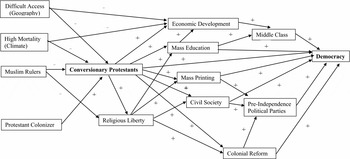
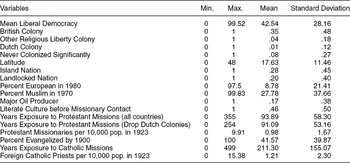
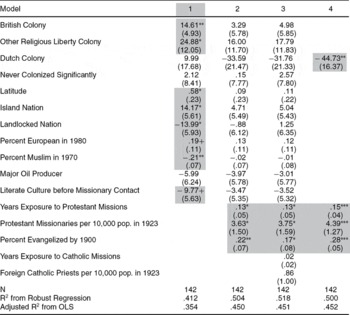
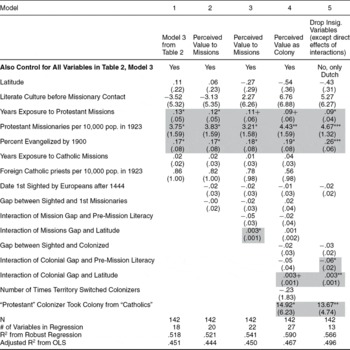
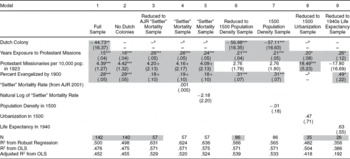
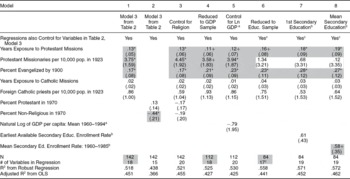
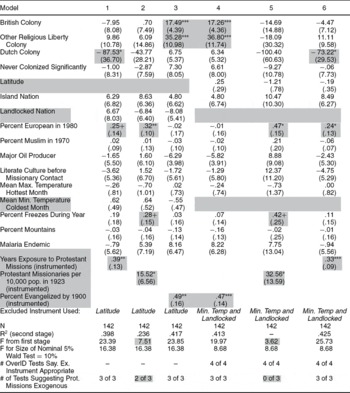




Comments
No Comments have been published for this article.