


Introduction
Crime affects anyone; it is widely reported in the UK, with over 13% of media outputs being dedicated to the topic (Curran, Salovaara-Moring, Coen and Iyengar, Reference Curran, Salovaara-Moring, Coen and Iyengar2010) and it is of major national interest in light of recent civil disturbance. The behavioural and psychological changes that victims experience following a crime may be devastating: 51% of people may avoid going out alone following a “common” crime (such as mugging, burglary or criminal damage) and 14% of all victims report feeling depressed (Morrall, Marshall, Pattison and Macdonald, Reference Morrall, Marshall, Pattison and Macdonald2010).
A reasonable awareness of crime may be adaptive, but when these fears become irrational they create a problem, with people feeling isolated and vulnerable (Moore and Trojanowicz, Reference Moore and Trojanowicz1988). The quality of life of older adults may be disproportionately affected (Age Concern, 2003), with the 2001 British Crime Survey counting 43% of older adults as considering themselves “very likely” to be burgled in the following year (Age Concern, 2002). Older victims of crime may be particularly vulnerable to the effects of crime because of concurrent major life events such as family bereavements, physical ill health and financial difficulties often associated with retirement (Jackson, Reference Jackson2009). Cognitive models of trauma suggest that distress following adverse events such as crime may be more marked in people with vulnerability and inadequate social or family support due to related negative coping responses (Bifulco and Brown, Reference Bifulco and Brown1996).
Our society is ageing: the number of people aged 85 or over is estimated to reach 3.2 million by 2033 in the UK (Office of National statistics, 2009) and the number of older victims of crime is also likely to increase. However, the amount of information available on older victims of crime is very limited, especially when considering common crimes. For older people who have been victims of violence, significant symptoms of depression and moderate levels of anxiety and post-traumatic stress disorder (PTSD) have been found (n = 36) at variable times (1–10 years) before evaluation (Gray and Acierno, Reference Gray and Acierno2002). Also among 2321 older adults surveyed, those who had experienced a violent crime were at a significantly increased risk of being placed in a care home (OR = 2.1; 95% CI = 1.0–4.6), even after controlling for other predictive effects (Lachs et al., Reference Lachs, Bachman, Williams, Kossack, Bove and O’Leary2006). For older victims of burglary, in one study of 215 older adults, 9% had enough symptoms for a categorical diagnosis of PTSD one month later, reducing to 2.3% at 3 months (Thornton et al., Reference Thornton, Hatton, Malone, Fryer, Walker and Cunningham2003), and in another study 25 and 13% respectively of 84 older adult burglary victims experienced depression and anxiety following the incident (McGraw and Drennan, Reference McGraw and Drennan2006). In a further study into the consequences of burglary, older victims were found to be 2.4 times more likely to have died or been moved into a care home than their non-victimized neighbours within 2 years of the event (Donaldson, Reference Donaldson2003). Intervention studies in this population are few; there was a single, small controlled study in anxious or depressed older victims that has shown that a video-based intervention produced no significant benefit (Acierno, Rheingold, Resnick and Stark-Reimer, Reference Acierno, Rheingold, Resnick and Stark-Reimer2004).
Data provided by the Metropolitan Police (personal communication, 29 March 2011) indicates that in the boroughs selected for the present study, over 26,000 people aged over 55 years reported being victims of a common crime in the years 2009–2010, although this figure is likely to be considerably higher as the 2000 British Crime Survey suggests that over 60% of all crimes go unreported (MacDonald, Reference Macdonald2002). In addition, only a small proportion of crime victims actually use help offered by formal support agencies, with most relying purely on informal networks of family and friends (McCart, Smith and Sawyer, Reference McCart, Smith and Sawyer2010). Together these data suggest that there may be a large group of individuals who never receive help following a crime.
Aims
We aimed to investigate the impact of common crime on functioning and mental health in older people. This feasibility work required the development and use of new ways to identify, recruit and assess a London-based sample of people aged 55 years or more who were victims of “common” crime. We also wanted to explore the feasibility of performing a randomized controlled trial in this group using our CBT-based victim improvement package (VIP) that was specifically developed for the project, so as to inform a future large scale trial of the VIP in older victims of crime.
Method
Sample and diagnostic procedure
The study was undertaken across 7 London Boroughs. People aged 55 years or more who were victims of common crime reported to the police between January 2009 and April 2010 were contacted by letter within one month of the incident (n = 21,230), or by phone (n = 366) via Victim Support (a national charity for victims of crime in England and Wales) or the Metropolitan Police. Of these 1058 (4.9%) responded.
Screening
Initially a 13-point cut on the Kessler-6 (K6; Kessler et al., Reference Kessler, Barker, Colpe, Epstein, Gfroerer and Hiripi2003) was used to determine possible inclusion. However, at interview over the phone, people seemed more clinically and emotionally distressed than indicated by this particular measure, so three additional tools were added to enhance capture: the Primary-Care Post-Traumatic Stress Disorder Screen (PC-PTSD; Prins et al., Reference Prins, Ouimette, Kimerling, Camerond, Hugelshofer and Shaw-Hegwer2004), the Generalized Anxiety Disorder Scale (GAD-2; Kroenke, Spitzer, Williams, Monahan and Lowe, Reference Kroenke, Spitzer, Williams, Monahan and Lowe2007), the Patient Health Questionnaire (PHQ-2; Kroenke, Spitzer and Williams, Reference Kroenke, Spitzer and Williams2003). Participants were contacted and screened again at 3 months post crime, and if they were cases on any of the scales, they were offered a diagnostic interview, and if they were cases on this they were then asked to consider consenting for the pilot trial.
Diagnostic interview and selection criteria for the pilot trial
Inclusion criteria: (a) diagnostic: depressive and/or anxiety disorder and/or PTSD or sub-threshold PTSD, using a shortened version of the Structured Clinical Interview for DSM-IV Axis I Disorders: Non-Patient Edition (SCID-I/NP); (b) distress identified by participants as directly related or substantially worsened by the crime.
Exclusion criteria: (a) <25 on the Mini Mental State Examination (MMSE; Folstein, Folstein and McHugh, Reference Folstein, Folstein and McHugh1975); (b) intense suicidal ideation; (c) a SCID-I/NP diagnosis of alcohol misuse or drug dependence; (d) a history of bipolar affective disorder; (e) the presence of hallucinations or delusions; (f) receipt of CBT within the last year; (g) insufficient English to engage in CBT, (h) if on neuroleptic medication then the dose not being stable for at least 2 months prior to randomization.
Pilot trial
Participants were randomized and stratified by age using a separate telephone service operated by the Centre for Healthcare Randomized Trials (CHaRT), University of Aberdeen. Group allocation was notified to an independent administrator, and assessors were blind to participant group until all follow-up periods had ended.
The primary outcome measure was the World Health Organization Disability Assessment Schedule II (WHODAS-II), a broad measure of disability associated with physical and mental disorders (Chwastiak and Von Korff, Reference Chwastiak and Von Korff2003). Secondary outcome measures were: (a) the Beck Depression Inventory II (BDI-II; Beck, Steer and Brown, Reference Beck, Steer and Brown1996); (b) the Beck Anxiety Inventory (BAI; Beck and Steer, Reference Beck and Steer1990); (c) the Post-Traumatic Stress Diagnostic Scale (PDS; Foa, Cashman, Jaycox and Perry, Reference Foa, Cashman, Jaycox and Perry1997).
Interventions
Treatment as Usual (TAU)
Any intervention relevant to a participant's health. CBT from another source could not be withheld for ethical reasons, although any receipt of CBT would be documented.
TAU plus the Victim Improvement Package (VIP)
Up to ten sessions of a specifically developed CBT-based manualized treatment (Serfaty, Ohlin and Blanchard, Reference Serfaty, Ohlin and Blanchard2013) was delivered over 3 months, by a therapist accredited by the British Association for Behavioural and Cognitive Psychotherapies. The manual consisted of three sections devised through feedback from older victims of crime: (i) information about crime, its effects, therapist issues and adaptions of the therapeutic work for older victims of crime; (ii) the structure of the specific cognitive and behavioural interventions and lifestyle issues, which were broadly as follows: Session 1: gathering a victim narrative of the crime and details of depressive, anxiety and PTSD symptoms. Session 2: psycho-education about crime and an introduction to the CBT model. Sessions 3–8: mood diaries identifying negative thinking and unhelpful behaviours, guided discovery to challenge beliefs about fear of crime, personal vulnerability and safety, and behavioural experiments to challenge unhealthy avoidances related to the crime. Sessions 9–10: relapse prevention work. (iii) materials that can be used for the intervention.
Qualitative feedback of VIP:
Semi-structured recorded interviews were conducted on all participants who had received the VIP. The areas covered included: helpfulness of therapy and therapist, enactment of techniques, satisfaction and recommendations for improvement, and blocks to receiving the VIP. At the end of the intervention period, the researcher sign-posted relevant local services to participants, including contact with general practitioners where necessary.
Statistics and analysis
Data were explored and analyzed using SPSS 20. Where appropriate, normally distributed data were analyses using the unpaired t-test and for categorical and skewed data the chi-squared and Wilcoxon rank sum test were used respectively. The mean WHODAS II scores in primary care for people with anxiety and depression is 11.55 (SD 4.69) (Means-Christensen, Sherbourne, Roy-Byrne, Craske and Stein, Reference Means-Christensen, Sherbourne, Roy-Byrne, Craske and Stein2006). For a full trial at 90% power, p<.05, we predicted that 84 would be required in each group (assuming 0.5 SD change in mean score is regarded as clinically significant). Median scores and quartile ranges for our outcome measures for paired data (baseline and postintervention) only in the pilot RCT are presented, but between group comparisons would not be appropriate because of the small sample size
Results
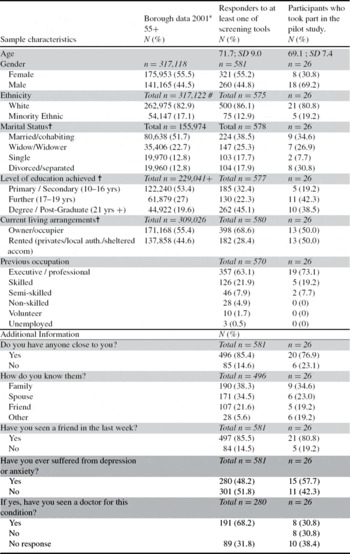
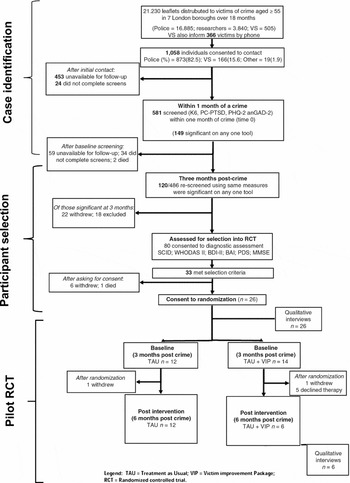
Of the 1058 participants who initially responded to our approaches, 581 agreed to be screened and 26 participated in a pilot RCT. Participant flow is shown in Figure 1. The demographic characteristics of responders and participants who took part in the pilot RCT are presented in Table 1. Only completer data for each item are presented. The demographic characteristics of these responders were compared with people aged 55 years or more in representative census data for the seven London boroughs (Office of National Statistics, 2001a, b). As shown in Table 1, we had similar numbers of ethnic minorities, fewer married people, and more people from tertiary education, owner occupiers and skilled people. Nearly half our responders had suffered from anxiety or depression on an occasion before the crime and of these nearly 70% had sought help for this in the past.
Demographic characteristics 581 out of 605 who responded to at least one of screening tools (K6, PC-PTSD, GAD-2, PHQ-2) at one month after crime compared with borough census data for similar aged matched controls and demographic data for participants who took part in the pilot study.

✝p<.001; non responders were excluded from analysis
* source: http://www.nomisweb.co.uk/ standard tables for seven boroughs
# source: www.lho.org.uk
+ borough data for those aged 55–74 only
Participant flow

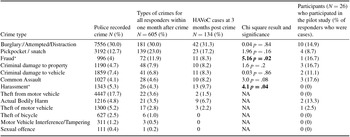
Table 2 shows that of the crimes experienced, 367 (60.7%) were against property, 76 (12.6%) against the person and 162 (26.8%) against both, with data comparing responders by type of crime, and with police recorded crime.
Police recorded crimes (n = 25,175) by type, compared with HAVoC responders within one month (n = 605), and HAVoC screened cases at 3 months (n = 134). Note that 581/605 completed screening tools within one month of the crime and 486/576 at 3 months. Chi square comparison compares Police recorded crime and HAVoC cases at 3 months

*indicates significant difference; Chi Square not applicable (NA) because of small cell size
Of the 605 responders, 581 provided screening information within a month of a crime, 486/581 (84%) responded again. A detailed breakdown of screened cases at the two times is given in Table 3. Of those who were cases at baseline, there was no reduction in caseness at 3 months for those positive on the PHQ-2 and GAD-2. Of those who responded, 268/412 (65.0%) felt that the crime continued to affect their daily life and 320/430 (77.7%) had never been a victim of crime before.
Screening tool scores within a month and at 3 months post crime

K6 = Kessler-6; PC-PTSD = Primary-Care Post-Traumatic Stress Disorder Screen; PHQ-2 = Patient Health Questionnaire-2; GAD-2 = Generalizd Anxiety Disorder Scale
Of those who were rescreened at 3-months 134/486 (27.6%) were cases on one of the measures. Of these, 80/134 (59.7%) agreed to diagnostic assessment and 33/80 (40%) met DSM-IV criteria for a mental health disorder as a result of the crime. Of these, 18 were co-morbid for two or more disorders: 7/18 for a depressive disorder and sub-threshold PTSD; 4/18 for an anxiety disorder and sub-threshold PTSD; 4/18 for a depressive disorder and PTSD; 3/18 for an anxiety disorder and PTSD. Of the remaining 15/33, 8/15 only met criteria for sub-threshold PTSD; 5/15 for an anxiety disorder; 1/15 for a depressive disorder and 1/15 for mixed anxiety-depressive disorder.
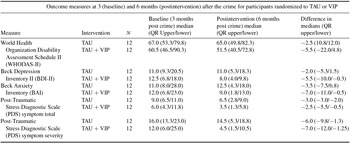
Of the 134 participants who were positive on at least one of the screening tools (K6, PHQ-2, GAD-2 or PTSD), there were no differences in scores on these screening tools between those who participated in the trial (n = 26) and those who did not (n = 108). Twelve were allocated to TAU, and 14 allocated to the VIP, 2 withdraw before being notified of their group allocation and 3 refused therapy. Of the 12 allocated to the VIP and agreeable to follow-up, 9 took up at least one VIP session. Of those who received at least one session of VIP, a mean of 6.9 (SD = 2.9) out of 10 sessions were taken up. Although improvement was observed in all measures, remarkably there was a trend for greater improvement in all measures, except the PTSD diagnostic scale, in those receiving VIP (Table 4).
Outcomes for pilot RCT

TAU = Treatment As Usual; VIP = Victim Improvement Package; QR = Quartile Range
Qualitative feedback about VIP
The qualitative interviews suggested that although participants did not know what CBT was at the start of the study, they found therapy empowering, gained confidence, liked the here and now approach, and benefited from writing things down. They found the establishment of a link between thoughts, feelings and behaviours useful. The option of therapy in their own home was appreciated. Only one participant commented on the number of sessions available and would have liked more. Appreciation of the CBT approach and the therapist was not universal; one participant was opposed to CBT from the outset. People indicated CBT had helped to reduce anxiety and enabled them to view their experience from a different perspective and behave in a more constructive way. Views about the usefulness of the written materials were mixed. People also expressed some concern about the stigma of receiving therapy.
Discussion
This is the first study with older people to investigate the psychological impact of common crimes, the feasibility of recruitment into a randomized controlled trial testing and refining a CBT intervention. We found that of those who completed the two screenings, 27% continued to have significant psychological symptoms 3 months after the crime. One third of those interviewed met DSM-IV diagnostic criteria for a mental health disorder that they attributed to or felt had been significantly worsened by the crime. It was feasible to deliver a CBT-based intervention to these older victims, and outcomes indicated a trend towards a reduction in scores on all measures except PTSD-diagnosis. Quantitative data suggested that the VIP appears to be a promising intervention for anxiety and depression and qualitative interviews indicated that the intervention was well received.
As the response rate to our survey was low, caution is required when interpreting the data. Our population was not wholly representative when compared to 2001 census data (Office of National Statistics, 2001a, b) with which some equivalence may be expected. There were fewer people from ethnic minorities, fewer married and more single people, more graduates and post-graduate professionals and more owner-occupiers in this study. There also appears to be a cohort of older people with previous psychological problems for which they have sought help from mainstream services. Levels of depression, anxiety disorder and PTSD among the older crime victims appear to be greater than among an aged matched English older population (McManus, Meltzer, Brugha, Bebbington and Jenkins, Reference McManus, Meltzer, Brugha, Bebbington and Jenkins2009). These findings are consistent with existing data. Selection bias would explain demographic differences. Ethnic minorities and those with higher education are less and more likely respectively to access services and engage in research. There is also the likelihood that common crime has a significant impact in this vulnerable population. It is also notable that there was little change in these high levels of depression and anxiety over the 3 months after the crime, and although PTSD symptoms improved, they were still considerably higher (20.9%) than the general population.
Older people who responded to our survey and experienced, fraud or harassment were more likely to be distressed, suggesting that crimes that are a direct threat or deceit are associated with greater distress. Generally it is known that only 40–60% of crimes are actually reported to the police (MacDonald, Reference Macdonald2002; Government of Canada, 2011) and there is evidence that older victims are more likely to blame themselves than younger ones and not to report crime (Acierno et al., Reference Acierno, Brady, Gray, Kilpatrick, Resnick and Best2002), so any work in this area that depends upon reported crime is likely to be an underestimate.
Although in depth qualitative interviews suggested that our intervention was acceptable and could be delivered, more information about therapists’ adherence to the VIP would have been helpful. Whilst an adherence checklist was included in the VIP manual, this was used purely to help guide the therapist in this feasibility study as it would be difficult to interpret findings on adherence given the small sample – in a larger trial we would collect these data. Only 2 people felt that they needed to take up all 10 therapy sessions. In a larger trial we would also recommend collecting independent ratings of therapy using the Cognitive Therapy Scale-Revised (Blackburn et al., Reference Blackburn, James, Milne, Baker, Standart and Garland2001).
Older people appear to be psychologically affected by common crime and it is concerning that without treatment there was little improvement in outcome measures 3 months and 6 months after the crime. It remains unclear whether a trans-diagnostic approach is better than an intervention targeting a specific diagnosis. On balance, targeting the main diagnostic problem provides a framework for treatment, although if participants had comorbidity, elements of different interventions, for example PTSD and depression, could be used at the therapists’ discretion.
Improving recruitment:
Only 4.9% of older victims responded to leaflets about the study distributed by the police and victim support. While this is a very small response it is not untypical in UK studies on crime victims and mental health (Bebbington, Marsden and Brewin, Reference Bebbington, Marsden and Brewin1997; Rose, Brewin, Andrews and Kirk, Reference Rose, Brewin, Andrews and Kirk1999). Better results were obtained by informing crime victims of the study over the phone (135/366, 36.8%). Data protection laws prevented the police and VS from passing on details of crime victims directly to the research team, and this impeded recruitment. In our reappraisal of the recruitment methods and following negotiations with the Research Ethical Committee and the Metropolitan Police, officers from two Safer Neighbourhood Teams (SNTs) in one borough had an excellent response rate, with 59/65 (90.8%) of the older victims they encountered over 8 weeks agreeing to be screened for psychological distress. A potential 36,000 participants could provide data over 18 months if all 138 SNTs in seven boroughs were involved. The four screening tools and demographic questionnaires were distributed directly by the three SNT officers as part of their routine interactions with those aged 55 or over who had been a victim of crime in the last month. Signposting of relevant local services was offered through information leaflets and the researcher's contact details were given. Twenty-three out of 59 (39%) who provided data were cases on any one of the screens K6 = 9 (15.2%); PC-PTSD = 17 (28.8%); PHQ-2 = 6 (10.2%); GAD-2 = 13 (22.0%). Seventy-eight percent lived in rented accommodation and 29% classed themselves as minority ethnic, quite a different population from leaflet responders. This method of data collection could therefore yield a larger, more representative sample if used in a future study.
Conclusions and direction for future research
This study suggests that the VIP can feasibly be delivered to this population, and the number of sessions taken up is consistent with other data (Serfaty et al., Reference Serfaty, Haworth, Blanchard, Buszewicz, Murad and King2009). Although care is required when extrapolating results, this tailored intervention appears promising and realistic, for anxiety and/or depressive symptoms; a post hoc analysis suggests that in order to detect a “true” average difference of 0.5 on a standardized joint scale of the BDI-II and BAI, with 90% power at p<.05 (2-sided), requires a total sample-size (N) of 168 participants for a full trial. However, trauma related symptoms appear particularly difficult to treat (Foa, Keane, Friedman and Cohen, Reference Foa, Keane, Friedman, Cohen, Foa, Keane, Friedman and Cohen2009) and more sessions for this condition, as advocated by NICE (NICE, 2005), may be required.
A future RCT to demonstrate the clinical and cost effectiveness of the VIP could realistically be achieved. This is particularly relevant because of the reported increased risk of entering residential care among older victims of common crime. If effective, this approach could then be rolled out as part of a health detection and treatment strategy, with SNTs actively screening for psychological distress and significant cases being offered evidence- based intervention. These developments would also be consistent with initiatives for improved care for victims and the integration of services (Casey, Reference Casey2011).
Significant outcomes
-
• Police Safer Neighbourhood Teams are a useful way to identify and assess older victims of crime for psychological distress - a difficult to access population.
-
• Anxiety, depression and PTSD are more frequent than in a similar aged matched population.
-
• It is possible to recruit older victims of crime into a randomized controlled trial and deliver a CBT based intervention.
-
• Preliminary evidence suggests that such an intervention may improve levels of depression and anxiety.
Limitations
-
• The group of older people identified was not wholly representative of the general population so further work on prevalence is required.
-
• This was a pilot study so effectiveness of the intervention remains to be fully established.
Declaration of interest
Anthony Kessel is also Director of International Public Health and Responsible Officer, Public Health England. The views expressed in this paper are the author's own and do not necessarily represent the views of the PHE.
The funders had no input into study design, collection, analysis, interpretation of data, the writing of the report or the decision to submit the paper for publication.
Acknowledgement
This paper presents independent research commissioned by the National Institute for Health Research (NIHR) under its Research for Patient Benefit (RfPB) Programme (Grant Reference Number: PB-PG-0407–13110). The views expressed are those of the authors and not necessarily those of the NHS, the NIHR or the Department of Health.
Statistical input was provided by Khadija Rantell and John Woods, Medical Statistician at University College London. The HAVoC team wishes to thank Kevin Rogers, Amanda Newell and Davinia Darch from the Metropolitan Police for their invaluable help and support throughout the entire process. Thanks also to Chris Hay, Martin Morley and Pete Singer from Camden Safer Neighbourhood Teams. Thanks to all the staff at seven police borough offices for sending out nearly 17,000 leaflets and to Angela Antonatos and Lisa Collins from Victim Support London. Finally, we would like to thank all of the participants.




Comments
No Comments have been published for this article.