What is it like to be Muslim in post-September 11, 2001 America? Although only a handful of radicals committed the atrocious acts for which we remember that fateful day, are Muslims deemed guilty by association, increasingly scrutinized and under attack? How prevalent are perceptions of discrimination and anxiety about their status in the post-September 11, 2001 United States? Does this vary by subgroup? Overall, how do these perceptions affect Muslim-Americans politically?
Using a telephone survey of a random sample of Muslim-Americans, this article first explores factors related to differing perceptions of treatment and discrimination, linking these views to current levels of political participation. The second part assesses how these opinions shape participation. Do negative assessments and experiences cause one to become more politically interested and active? This is discerned through in-depth interviews of Muslims residing in St. Louis, Missouri. Substantial portions of Muslim-Americans are indeed anxious and report personal and group discrimination. However, this is guided by many factors including religious salience, age, education, political attentiveness, native born status, and years lived in the United States. Heightened anxiety and awareness of group discrimination correlate with greater political activity. Personal experiences with discrimination, however, do not. Overall, in spite of or perhaps because of elevated anxiety, Muslim-Americans are highly functional in the political sphere. Many are now more active in politics than prior to September 11, 2001.
MUSLIM-AMERICANS — FINDINGS FROM THE LITERATURE
Since the U.S. Census does not ask respondents about religion, the number of Muslims in the United States is debated. Some estimates are as high as six to eight million (Ba-Yunus and Kone Reference Ba-Yunus, Kone and Bukhari2004; Nimer Reference Nimer, Bukhari, Nyang, Ahmad and Esposito2004). However, national surveys based on sounder scientific methodology suggest a more conservative estimate of about two million (Stone Reference Stone and Haddad1991, 414).Footnote 1 Nevertheless, Muslims are increasing in numbers. It is in the nation's interest to achieve a greater understanding of Muslim-Americans, even more imperative in the aftermath of September 11, 2001 since they have been negatively targeted by various policies including the Patriot Act (Afridi Reference Afridi2001). With the recent availability of national survey data, scholars can systematically analyze perceptions of their status among various Muslim subgroups.Footnote 2 However, even these data leave significant gaps in understanding how perceptions of treatment in the post-September 11, 2001 environment affect their political behavior.
Most research on Muslim-Americans is associated with Islamic and religious studies (Esposito Reference Esposito2004; Haddad Reference Haddad1991; Smith Reference Smith1999; Reference Smith2007).Footnote 3 Scholarship is qualitative, focusing on religious values and practices within specific Muslim communities, immigration patterns, demographics, identity formation, and assimilation within the larger American Judeo/Christian culture.Footnote 4 Muslims represent a mosaic of race, ethnicity, religious beliefs, and practices (Haddad Reference Haddad1991; Smith Reference Smith1999). A trend toward more scientific study began prior to September 11, 2001 with the formation of project Muslims in the American Public Square (MAPS), which tackled subjects similar to those already established within religious studies (Khalidi Reference Khalidi and Bukhari2004; Jackson Reference Jackson and Bukhari2004; Ansari Reference Ansari and Bukhari2004). However, an explicitly political line of research has developed focusing on the increased political mobilization of Muslims (Khan Reference Khan2002; Nimer Reference Nimer, Bukhari, Nyang, Ahmad and Esposito2004; Afridi Reference Afridi2001). Various commercial polling firms have aided scholars by conducting systematic polls. With project MAPS, Zogby International conducted the first major scientific poll of Muslim-American attitudes and participation in 2001 followed by another in 2004. Among many findings, Muslim-Americans are highly politically active (Ayers and Hofstetter Reference Ayers and Hofstetter2008).Footnote 5
Anxiety induces individuals to seek new information and fuels political participation (Marcus, Neuman, and MacKuen Reference Marcus, Neuman and MacKuen2000). Since Muslim-Americans have greater anxiety in the post-September 11, 2001 environment, their political attentiveness and subsequent participation may have increased. The 2004 Zogby data indicate that high levels of Muslim anxiety and alienation are indirectly associated with greater political participation via heightened political interest (Ayers and Hofstetter Reference Ayers and Hofstetter2008, 20). Important gaps in knowledge remain. Ayers and Hofstetter (Reference Ayers and Hofstetter2008) analyze levels of anxiety in relation to current participation rates; claims of increased participation since September 11, 2001 are unsubstantiated. A comparison of attitudes about political behavior before and after September 11, 2001 is necessary. Since Zogby data on Muslims prior to September 11, 2001 are non-existent and respondents have not been probed about their prior patterns, exploration of changes requires original research. Moreover, factors associated with negative perceptions among Muslims in the first place are not examined. The Muslim population is diverse in terms of race/ethnicity, gender, age, immigrant status, and religious salience and practices (Leonard Reference Leonard2003), which one may expect will lead to different perceptions and actions.
HYPOTHESES
As stated above, affective intelligence theory (Marcus, Neuman, and MacKuen Reference Marcus, Neuman and MacKuen2000) posits that elevated anxiety induces individuals to seek new information, heightening political participation. If certain groups are disproportionately negatively targeted, this could increase their political participation.
H1:
Groups reporting more negative views on current status and religious discrimination will have higher rates of political participation.
Hypothesis 1 will extend differently to various groups. Social identity theory posits that people have numerous reasons for identifying with and acting as part of groups (Tajfel and Turner Reference Tajfel, Turner, Austin and Worchel1979). Given Muslim diversity, four main ethnic/racial groups are investigated: South-Asians, Middle-Easterners, African-Americans, and Bosnians. The first three represent the largest portions of Muslim-Americans (Leonard Reference Leonard2003) yet have had potentially varied experiences in the post-September 11, 2001 environment. The inclusion of Bosnians sheds light on the relationship between prior religious persecution and current perceptions of treatment.
Visible minorities identify vastly more instances of discrimination than similarly situated whites (Reitz and Banerjee Reference Reitz and Banerjee2005; Banerjee Reference Banerjee2006). Those strongly identifying with ethnic or social subgroups, particularly historically stigmatized ones, are more apt to believe they have been discriminated against (Sellers and Shelton Reference Sellers and Shelton2003). Group identification heightens sensitivity to mistreatment (Crocker and Major Reference Crocker and Major1989) although discrimination likely strengthens group identification because it acts as a coping mechanism (Sellers and Shelton Reference Sellers and Shelton2003).
The “terrorist other” stereotype is replete with racial/ethnic, religious, and gendered constructions (Kim et al. Reference Kim, Kourosh, Huckerby, Leins and Narula2007). South-Asian and Middle-Eastern Muslim men are disproportionately stereotyped as terrorists. While this clearly preceded September 11, 2001 (Suleiman Reference Suleiman1999), it escalated in the aftermath of the attacks. Both groups have faced the brunt of restrictive policies passed after September 11, 2001. Of the approximately 20 immigration policy changes, nearly all primarily target Middle-Easterners and they comprise the vast majority of “War on Terror” detainees (Cainkar Reference Cainkar2002, 26–27). South-Asians are at high risk for detention and have been in immigration limbo for years (Kim et al. Reference Kim, Kourosh, Huckerby, Leins and Narula2007). Both groups are heavily profiled because they have “Muslim sounding” surnames (Cainkar Reference Cainkar2002, 26–27) and are likely more anxious.
H2:
Middle-Easterners and South-Asians will be apt to report experiences with Muslim discrimination and view their place in America less favorably than others. Because of their heightened anxiety, Middle-Easterners and South-Asians are also more politically involved.
At approximately 30 to 40 percent of the Muslim population in the United States, African-Americans currently comprise the largest portion of Muslim-Americans.Footnote 6 Most are Muslim converts (Leonard Reference Leonard2003). Profoundly shaped by race and class struggles, their Islamic identities were forged as an alternative to the Christian white dominated structure. African-Americans did not voluntarily come to the United States for greater opportunity. Even after the abolition of slavery, racial discrimination relegating them to second-class status persisted. However, native-born status has benefits including relatively less prominent religious targeting (Leonard Reference Leonard2003). Since most are converts, they often lack official Muslim surnames (Jamal Reference Jamal2005) making them less vulnerable to profiling. However, racial discrimination is rampant (Farley Reference Farley1996; Sears et al. Reference Sears, Hetts, Sidanius and Bobo2000) and African-Americans are more likely to report racial discrimination than members of other visible minority groups (Banerjee Reference Banerjee2006). Since they are a historically stigmatized group, this could heighten their perceptions of religious discrimination and negative views. However, their racial and religious identities may conflict. They have simultaneously distanced themselves from immigrant Muslim communities and have been marginalized by these groups (Ansari Reference Ansari and Bukhari2004). They may have stronger racial ties with African-Americans than other Muslims, decreasing the salience of religious discrimination (Bobo and Johnson Reference Bobo, Johnson, Bobo, Oliver, Johnson and Valenzuela2000; Sears et al. Reference Sears, Fu, Henry and Bui2003).
H3:
African-Americans will be less prone to report religious discrimination and view their status as Muslims in America more positively. Since their participation already generally lags behind other groups (Rosenstone and Hanson 1993) their limited anxiety will further depress their participation.
Bosnians represent only a fraction of Muslim-Americans. Thousands of Bosnians escaped genocide in Yugoslavia in the 1990s and settled as refugees around the world including the United States.Footnote 7 Having fled this context, it is especially valuable to see how Bosnians perceive their status. Among the foreign born subgroups examined, Bosnians have the shortest histories in the United States, many living here for less than a decade. Many are not yet American citizens.Footnote 8 Bosnians are white Europeans, thus are racially privileged (Colic-Peisker Reference Colic-Peisker2005). As a result, similar to African-Americans, they are not generally conspicuously Muslim and may not perceive negative treatment as religious discrimination (Sellers and Shelton Reference Sellers and Shelton2003). As they came to the United States to flee religious genocide, any current discrimination may pale in comparison and not have a perceptible impact relative to other groups.
H4:
Bosnians will be less apt to perceive any negative treatment as religious discrimination than other ethnic and racial groups. They will also be less participatory.
Muslims differ in religiosity (Haddad Reference Haddad1991; Smith Reference Smith1999), which entails multiple dimensions including belief and commitment. Also termed religious salience, the belief dimension is the extent to which respondents identify with their faith (Wald, Kellstedt, and Leege Reference Wald, Kellstedt, Leege, Leege and Kellstedt1993). Those with higher religious salience are more apt to acknowledge religious persecution and increase sensitivity to targeting (Crocker and Major Reference Crocker and Major1989; Sellers and Shelton Reference Sellers and Shelton2003). Discrimination may increase religiosity because it serves as a coping mechanism (Sellers and Shelton Reference Sellers and Shelton2003), which is evident among Muslim-Americans (Abdo Reference Abdo2006, 3). Religious commitment is gauged by participation in religious activities and is considered particularly relevant to political participation (Jamal Reference Jamal2005; Ayers and Hofstetter Reference Ayers and Hofstetter2008). Resources necessary in each domain are mutually reinforcing. Similar to other religious congregants (Verba et al. Reference Verb, Schlozman and Brady1995; Wuthnow Reference Wuthnow, Skocpol and Fiorina1999) mosque attendees have higher rates of civic and political participation (Bagby Reference Bagby2004; Jamal Reference Jamal2005).Footnote 9 Ayers and Hofstetter (Reference Ayers and Hofstetter2008) also find increased religious commitment associated with higher political participation.Footnote 10 However, those with higher religious salience are less politically active.
H5:
Respondents with higher levels of religious salience are more apt to acknowledge religious persecution but do not have higher levels of political participation. Those with greater levels of religious participation will be more prone to participate in politics.
Younger Muslims are gravitating toward a deeper connection with their faith than their parents since September 11, 2001 (Ayers and Hofstetter Reference Ayers and Hofstetter2008). Many increasingly adhere to various Islamic practices including the wearing of hijab (headscarf) by women (Ali Reference Ali2005). Heavily represented by children of immigrants, this generation has negotiated identities that include an awareness of the spiritual and intellectual aspects of Islam (Abdo Reference Abdo2006, 5–6). They are likely integrated within networks openly acknowledging religious persecution and possess greater awareness of civil rights abuses than their parents' generation, leading to more negative perceptions. Young Muslim males also fit the prevailing terrorist stereotype (Abdo Reference Abdo2006; Ansari Reference Ansari and Bukhari2004). Young people display low levels of participation in traditional forms like voting (Rosenstone and Hansen Reference Rosenstone and Hansen1993), but lead in “engaged citizenship” activities such as protesting (Dalton Reference Dalton2009). Their greater fluency in web based technology also makes them a prime constituency for emailing public officials (Dalton Reference Dalton2009).
H6:
Younger respondents may more often report discrimination and negative outlooks on Muslim treatment. They will also be more active than their older counterparts in engaged citizenship activities.
Immigrants may be more visible as Muslims and thus easy targets, but could gloss over negative treatment. As many are still in the process of obtaining legal citizenship, they could be hesitant to speak ill of their American experiences. Comparing their status in their home countries, they might consider their current standing more positively. The number of years lived in the United States is crucial to consider. With the passing of time, one is more likely to increase one's awareness of rights and to become more comfortable to raise criticisms (Banerjee Reference Banerjee2006). Recent immigrants are less likely to perceive discrimination than those that have been in the country longer (Banerjee Reference Banerjee2006, 21). Whether or not they do at levels greater than natives is unclear, although this has been confirmed in other research (Banerjee Reference Banerjee2006). Years spent in the country also affect political participation. Exposure theory argues that length of time in the new context is most crucial to political participation since it requires greater knowledge of and habituation to the new country (Ramakrishnan and Espenshade Reference Ramakrishnan and Espenshade2001, 277).
H7:
Foreign born respondents living in the United States longer may be more apt to have negative views of their status and report discrimination than recent immigrants. Immigrants living in the United States for longer periods will be more participatory.
Gender differences are also likely. Men, particularly young and of Middle-Eastern and South-Asian descent, are primarily stereotyped as terrorists and comprise the largest proportion of government detainees (Cainkar Reference Cainkar2002). Beyond voting, women in the larger American population tend to lag behind men in many forms of participation, although these differences have generally narrowed over time (Conway, Steuernagel, and Ahern Reference Conway, Steuernagel and Ahern2005).
H8:
Men will be more susceptible to discrimination and anxious about their status. They will also participate at higher rates than women.
Consistent with affective intelligence theory, respondents' greater attention to politics and public affairs will be linked to negative assessments of discrimination and treatment and fuel their participation (Marcus, Neuman, and MacKuen Reference Marcus, Neuman and MacKuen2000). Those attuned to politics also participate more than others (Rosenstone and Hansen Reference Rosenstone and Hansen1993).
H9:
Respondents' greater attention to politics and public affairs will be linked to more negative assessments of discrimination and treatment. They will also be more participatory.
Several studies confirm that educated respondents are more apt to report discrimination and have negative views of their treatment, due to their greater expectations of equity, ambition, and knowledge of equality issues (Forman, Williams, and Jackson Reference Forman, Williams and Jackson1997; Kessler, Mickelson, and Williams Reference Kessler, Mickelson and Williams1999; Banerjee Reference Banerjee2006). They also participate at higher levels (Rosenstone and Hansen Reference Rosenstone and Hansen1993).
H10:
More educated respondents will be apt to report discrimination, have negative views of their treatment, and participate more in politics.
METHODOLOGY
To investigate these hypotheses, I analyze data from the Zogby International telephone survey of a random sample of 1,847 Muslims living in the United States conducted August 5 through September 15, 2004. Sampling lists were generated from lists of common Muslim surnames in areas with higher Muslim population densities and mosques, but not lists of mosque members. Since bypassing converts who do not adopt Muslim surnames (and thus African-Americans) is a concern, they are over-sampled.Footnote 11 The margin of error is ±2.3 percent and higher for subgroups. A weight variable provides a slight correction to make ethnic groups more proportional to their representation in the larger population.Footnote 12
The first set of regressions examines perceptions of discrimination and treatment. The second links perceptions to political participation. To assess views of anxiety and discrimination, responses to three questions are analyzed, comprising separate dependent variables. Following Ayers and Hofstetter (Reference Ayers and Hofstetter2008), to investigate levels of anxiety, I focus on responses to: Is this a good or a bad time to be a Muslim in America? (0-Good Time, 1-Bad Time). The second and third models analyze personal and third party experiences with religious discrimination: Have you personally experienced discrimination since the September 11 attacks? (0-No, 1-Yes). Have your friends or family personally experienced discrimination since the September 11 attacks? (0-No, 1-Yes). There is a discrepancy between personal and group discrimination; members of targeted groups generally perceive a higher degree of discrimination at the group rather than individual level (Taylor, Wright, and Ruggiero Reference Taylor, Wright and Ruggiero2001). However, both shed light on potential anxiety and alienation. I omit unsure responses, resulting in dichotomous dependent variables, necessitating logistical regression. While it is tempting to treat the unsure as an intermediate category, there is no theoretical justification for this (Berinsky Reference Berinsky2002). This results in the omission of 13 percent of respondents for the first question, though few respondents register uncertainty about either personal or third party discrimination (1 percent and 2 percent, respectively).
Independent variables include gender, ethnicity/race, religious salience, age, native born status, attentiveness to governmental affairs, and education. Income is unincorporated because of its high correlation with education and large number of respondents refusing to divulge this information.Footnote 13 Gender is coded as a dummy variable (Gender 0-male, 1-female). Ethnicity/Race is a series of dummy variables (South-Asian 0-no, 1-yes; African-American 0-no, 1-yes; Middle-Eastern, includes Arabs and Iranians-0-no, 1-yes). Bosnians are analyzed solely in the qualitative section given their low numbers. Unfortunately, a measure tapping strength of group identification does not exist. Based on Banerjee (Reference Banerjee2006), I examine whether the respondent was born in the United States (0-no, 1-yes), followed by length of time in the country. Recent immigrants came to the United States between 1990 and 2004(0-no, 1-yes). Attentiveness to governmental affairs is gauged by responses to: How often do you follow what's going on in governmental and public affairs? (1-hardly at all, 2-only now and then, 3-some of the time, 4-most of the time).Footnote 14 Religious salience is based upon personal importance of faith: Would you say the role of Islam in your life is very important, somewhat important, or not very important? (1-not, 2-Somewhat, 3-Very). Education is coded on a four-point scale (1-Some High School, 2-High School degree, 3-Some College, 4-College Degree or Higher). Age is a continuous variable.
The second set of regressions model political participation as the dependent variable, which is comprised of responses to the following: Have you ever: attended a rally in support of a politician or a cause (No = 0, Yes = 1); called or written the media or politician on a given issue, or have you signed a petition? (No = 0, Yes = 1); given a contribution or volunteered your time or services to a political candidate? (No = 0, Yes = 1); visited a political website? (No = 0, Yes = 1). Responses are summed in an additive measure ranging from 0 through 4 with 4 indicating the highest participation rate. Voting is omitted given the large number of non-citizens in this sample. Linear regression is utilized since values are on a four point scale.
Independent variables are the same as before with the addition of religious commitment, discerned through participation in three activities-prayer, formal mosque prayers, and other mosque involvement. Derived from three questions, responses are standardized to a four point scale and averaged to form a religious participation index (4-high, 3-medium, 2-low, 1-none).Footnote 15 An additional independent variable is also included in each model, corresponding to the dependent variables in the first set — anxiety, personal discrimination, and group discrimination, allowing us to see how each independently affect rates of participation. Since these variables are highly correlated with one another, their inclusion in one model is problematic.
FINDINGS
Muslim Anxiety Cross-Tabulations
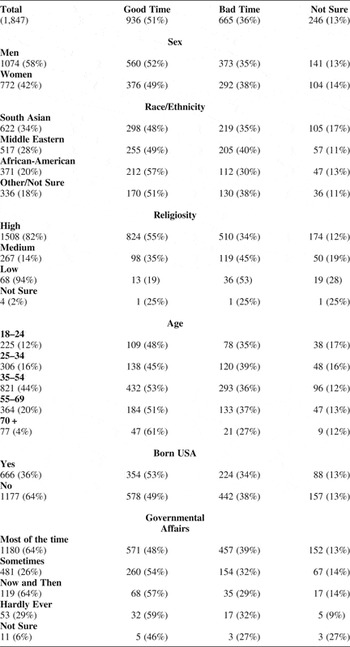
First, simple observations about the sample and cross tabulations are made. A bare majority of respondents are not anxious, slightly over one-third are, while the remainder are unsure. Women are more anxious than men (see Table 1). African-Americans are the least anxious, while Middle-Easterners are most anxious, followed by South-Asians who are also the least certain. A majority of highly religious respondents are not anxious. As expected, the oldest segment is least anxious. 25–34 year olds are the most anxious, not the youngest group. The foreign-born are more anxious than natives, although both groups are more positive overall. Respondents more attentive to governmental affairs are more anxious. While cross tabulations are instructive, it is necessary to control for varying factors.
Muslim anxiety cross-tabulations is it a good or a bad time to be Muslim in America?

Regression of Anxiety and Discrimination on Selected Predictors
Regressions show support for hypotheses 6, 7, 9, and 10. Older respondents, the native born, and more recent immigrants to the United States are less anxious, while the more politically attuned and educated are more anxious. Hypotheses 2, 3, 5, and 8 are not confirmed.Footnote 16 Respondents with higher religious salience are less anxious, women are more anxious, and race/ethnicity is not statistically significant.
Muslim Personal and Group Discrimination Cross-Tabulations
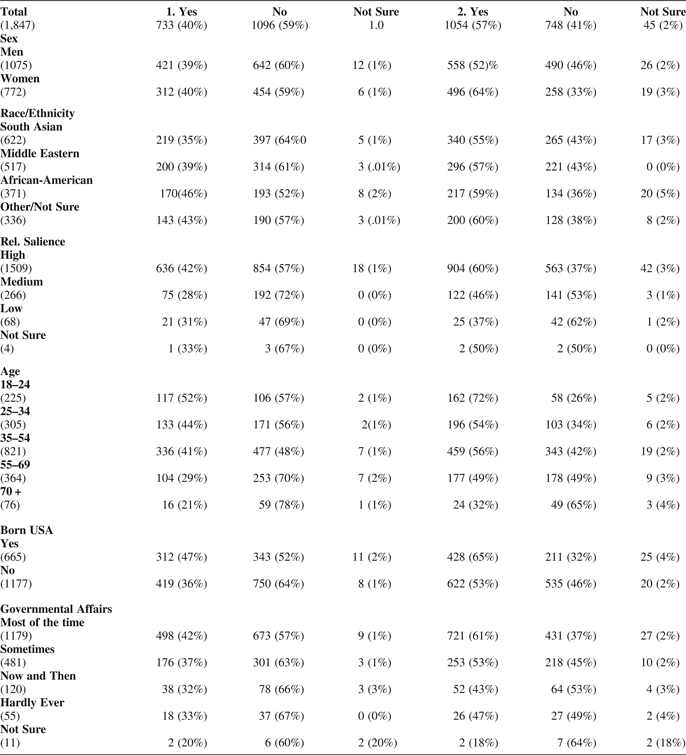
Discrimination is very prominent among the entire sample, 40 percent have personally experienced religious discrimination while 57 percent personally know others who have (see Table 2). Muslim-Americans provide further evidence of the personal/group discrimination discrepancy (Taylor, Wright, and Ruggiero Reference Taylor, Wright and Ruggiero2001). While there are no gender differences in direct experiences, greater percentages of women report group discrimination. African-Americans are most likely to face personal discrimination, followed by Middle-Easterners and South-Asians. Similar percentages of African-Americans and Middle-Easterners know victims of discrimination, while slightly fewer South-Asians do. However, African-Americans register a bit more uncertainty about this question than do South-Asians and Middle-Easterners.
Muslim personal and group discrimination cross-tabulations (1) have you personally experienced anti-Muslim discrimination since September 11? (2) have your friends/family experienced anti-Muslim discrimination since September 11?
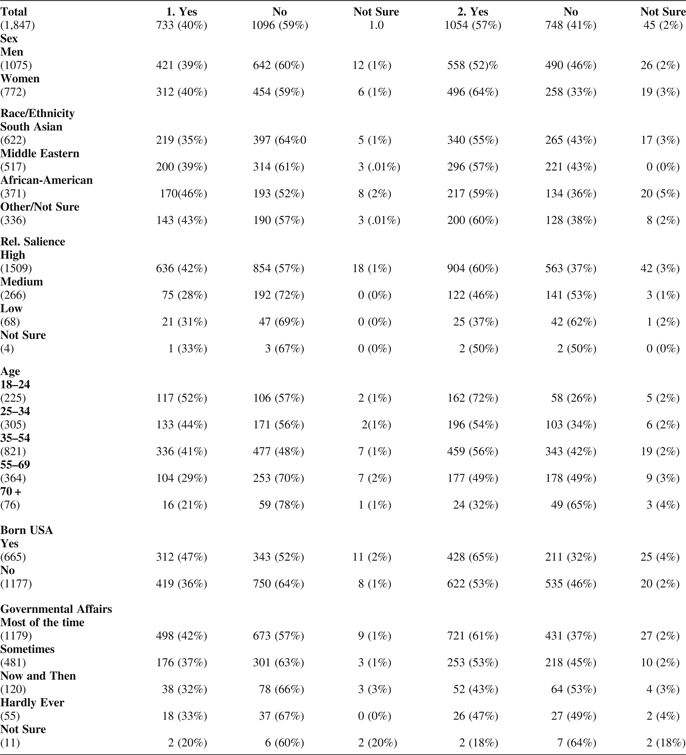
As expected, respondents with high religiosity are substantially more likely to report both direct and group discrimination. 18 to 24 year olds are most liable to report both types while 55–70 year olds are least apt to. American-born respondents are also less likely to perceive either type of discrimination. The more politically attentive are more likely to report direct and indirect discrimination.
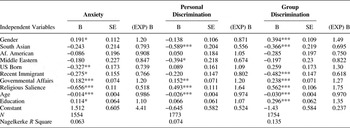
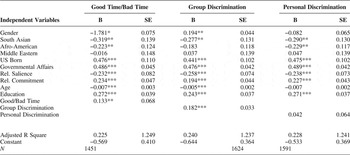
In analyzing regression results, as projected, the politically attuned and those with higher religious salience are more prone to report personal and group discrimination (see Table 3). Older respondents are significantly less apt to register either type than their younger counterparts. There are mixed findings regarding education, native born status, and years in the United States. While these variables are irrelevant to perceiving personal encounters with discrimination, Muslims with higher levels of education, immigrants, and longer United States residents are more likely to report group discrimination. Gender is unrelated to personal discrimination but women are substantially more likely to report group discrimination. Surprisingly, South-Asians are less apt to disclose both personal and group discrimination while Middle-Easterners are less prone to report personal discrimination.
Logistical regressions 1–3. Regression of anxiety and discrimination on selected predictors

Numbers in cells are regression coefficients and associated standard errors, followed by odds ratios.
*p < 0.10; ** p < 0.05; *** p < 0.01.
Anxiety: Is this a good or bad time to be a Muslim in America? (0 = Good Time,1 = Bad Time).
Personal Discrimination: Have you personally experienced discrimination since the September 11 attacks? (0 = No, 1 = Yes).
Group Discrimination-Have your friends and family experienced discrimination since the September 11 attacks? (0 = No, 1 = Yes).
The politically attuned are consistently anxious as are the educated who also report more indirect experiences with discrimination. This possibly relates to their superior knowledge of equity issues and expectations of fair treatment. Since both political attention and education are statistically significant, each exerts an independent impact on perceptions. Native respondents and immigrants who have been in the country for shorter periods of time appear less anxious and prone to discrimination. Many burdensome policies implemented post-September 11, 2001 directly impact Muslim immigrants (Kim et al. Reference Kim, Kourosh, Huckerby, Leins and Narula2007). Understandably, immigrants are both more anxious and apt to perceive discrimination than the natives who do not have to face such restrictive policies. However, living in the United States longer facilitates greater awareness of rights than among those who have not even achieved citizenship (Banerjee Reference Banerjee2006). Further, earlier immigrants lived in the United States prior to September 11, 2001 and can more readily identify obvious encroachments. As expected, stronger Islamic identifiers are more liable to perceive discrimination targeting them and fellow Muslims. However, this does not translate into elevated anxiety. Did some respondents develop stronger Islamic identities after September 11, 2001 and does this foster comfort rather than anxiety? This can be explored in the qualitative portion.
Thus, hypotheses 5, 6, 7, 9, and 10 are all at least partially confirmed, while 2 through 3 and 8 are not. Contrary to expectations, women are more anxious about Muslims' status than men. Although no more likely to suffer personal discrimination, they are substantially more apt to know victims of discrimination. Explaining their stronger connection with group discrimination is difficult although it reinforces findings from the personal/group discrimination discrepancy literature. While minority women are more likely than minority men to minimize personal discrimination, they perceive even more group discrimination (Ruggiero Reference Ruggiero1999). Surprisingly, race/ethnicity is seldom significantly related to anxiety or discrimination. Perhaps Muslims in the post-September 11, 2001 context have developed stronger Islamic identities ultimately superseding racial and ethnic divides. Their standing as Muslims unites them as “the enemy.”
Muslim Participation Cross-Tabulations
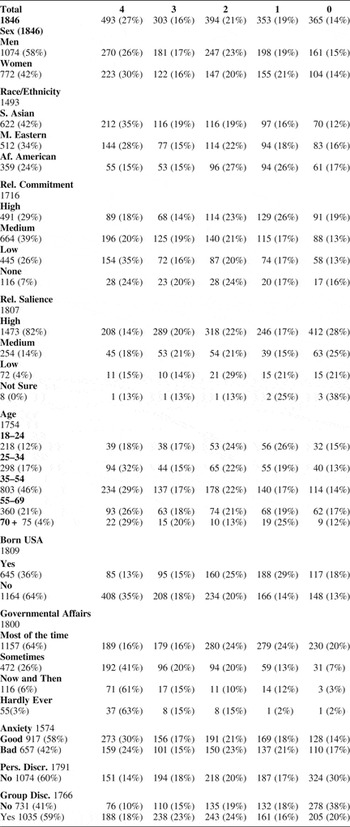
As already mentioned, political participation measures participation in diverse political activities (see Table 4). Slightly over one-quarter participate in at least four, the highest level. The next largest portion participates in two (21 percent) while large portions participate in either three activities or just one activity (16 percent and 19 percent, respectively) activities. Only 14 percent do not engage in any. There is no statistically significant correlation between gender and political participation. However, South-Asians take the clear lead in participation compared to all other racial/ethnic subgroups. Thirty-five percent engage in four activities and 19 percent in three. Only 12 percent participate in none. Middle-Easterners still have impressive portions engaging in four activities, 28 percent, although they trail behind South-Asians. African-Americans are least active; particularly at the highest levels although about one-quarter participate in one or two activities, respectively. As suspected, those possessing greater religious salience are least apt to participate. However, while respondents with higher levels of religious commitment are more participatory, those having medium and low commitment are most active. Findings regarding age vary, although 35–54 year olds appear most active. Surprisingly, immigrants are more inclined to participate in at least four activities than natives. Respondents attentive to governmental affairs only sometimes engage in more political acts than others. The less anxious are actually slightly more apt to engage in at least four activities, although few differences appear at the other levels of participation. Finally, those not reporting either personal or group discrimination are less likely to participate.
Participation in political activities

Muslims' Perceptions of Discrimination and Treatment and Participation
Most expectations are confirmed across all three models (see Table 5). More religiously active, attentive to politics, and highly educated respondents are also more politically participatory. Older respondents, immigrants especially new to the United States and displaying more religious salience are less active. Thus, while religious salience is significantly related to perceptions of discrimination, stronger Islamic identifiers are constrained in political participation. While it may seem surprising that young Muslims are more active than their elder counterparts, this was expected. Not only are they more assimilated than their parents, but forms of participation examined are consistent with higher rates of youth participation (Dalton Reference Dalton2009). Thus, the remaining parts of hypotheses 5, 6, 7, 9, and 10 are confirmed.
Linear regressions 1-3. Regression of political participation on anxiety and discrimination

Numbers in cells are regression coefficients and associated standard errors. *p<0.10; ** < 0.05; ***< 0.01. Independent variables: Anxiety: Is this a good or bad time to be a Muslim in America? (0 = Good Time, 1 = Bad Time). Personal Discrimination: Have you personally experienced discrimination since the September 11 attacks? (0 = No, 1 = Yes). Group Discrimination: Have your friends and family experienced discrimination since the September 11 attacks? (0 = No, 1 = Yes). Dependent Variable: Additive measure ranging from 0 through 4, based on responses to: Have you ever: attended a rally in support of a politician or a cause (No = 0, Yes = 1); called or written the media or politician on a given issue, or have you signed a petition? (No = 0, Yes = 1); given a contribution or volunteered your time or services to a political candidate? (No = 0, Yes = 1); visited a political website? (No = 0, Yes = 1).
Contrary to expectations, men are less participatory than women. However, this corresponds somewhat with the changing tide of participation among women in the United States. This strongly challenges the notion of passivity of Muslim women and should be a subject of special concern for subsequent studies. There are mixed findings regarding race and ethnicity. Being Middle-Eastern has no bearing on political participation, contradicting research suggesting they are more participatory (Bagby Reference Bagby2004; Jamal Reference Jamal2005). However, across all three models, South-Asians are significantly less participatory. This inactivity is largely consistent with the literature (Jamal Reference Jamal2005) although why this is so remains unexplained. South-Asians are less likely to perceive personal or group discrimination, perhaps limiting participation. African-Americans are also less active, although this does not persist when controlling for group discrimination. A lower rate of participation among African-Americans is the norm (Bagby Reference Bagby2004, Jamal Reference Jamal2005) and probably a manifestation of patterns among the larger population rather than anything unique to African-American Muslims. Therefore, hypotheses 2, 3, and 8, once again, are unconfirmed.
Rather than demobilizing Muslims, those reporting elevated levels of anxiety and group discrimination are indeed more participatory, confirming Hypothesis 1. Although anxious, they are highly functioning in the current political landscape. Further, anxiety remains statistically significant when political attentiveness is controlled for; both factors independently influence political participation. Surprisingly, there is no relationship between perceptions of personal experiences with discrimination and political participation. It is tempting to conclude that personal discrimination has no relationship to political participation. However, some suggest that personal discrimination is also generalized to the group (Taylor, Wright, and Ruggiero Reference Taylor, Wright and Ruggiero2001) heightening the group discrimination effect on participation.Footnote 17 Personal discrimination should not be discounted.
Three important facts have been established: (1) large portions of Muslim-Americans are anxious and report personal and group discrimination; (2) those who are more anxious and report group discrimination are significantly more politically active than others; and (3) both perceptions and participation vary among specific Muslim subgroups. Muslims are not a monolith. All or nearly all aspects of hypotheses 1, 5, 6, 7, 9, and 10 are confirmed while 2, 3, and 8 are not. Thus, findings are generally in line with expectations.
Unknown still is whether anxiety and perceptions of discrimination cause some Muslims to increase their political participation. Further, what other impacts has September 11, 2001 had? What goes into someone's beliefs about whether it is a good or bad time to be Muslim? What types of discrimination are experienced? Why are religious respondents less anxious although significantly more apt to report discrimination? Did September 11, 2001 increase religiosity among some Muslims? Why are women more anxious and more apt to report group but not personal discrimination? Do any substantial race/ethnic differences surface? In depth interviews shed light on these and other lingering questions.
Description of Qualitative Analysis and Findings
St. Louis is an ideal setting for this study because of its large and diverse Muslim population of approximately 70,000 including people of Bosnian, South-Asian, Middle-Eastern, African and African-American descent.Footnote 18 I conducted field work in four mosques — two primarily comprised of South-Asian/Middle-Eastern followers, two dominated by Bosnians and African-Americans, respectively, which illustrates the typical pattern of ethnic/racial mosque domination mosques (Leonard Reference Leonard2003). Forty-five interviews were conducted between February 2006 and November 2007. Given the more open nature of the questioning process, a deeper examination of Muslims' perceptions and reactions was possible than might otherwise have been obtained. I center questions on perceptions and experiences with religious discrimination but also possible political changes.
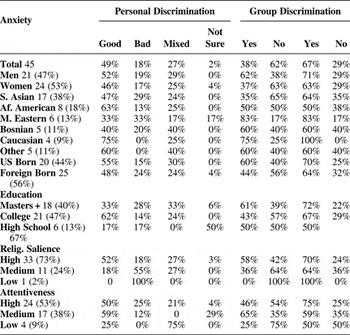
Cross-Tabulations, St. Louis Sample
Beginning with anxiety, I asked if this is a good or bad time to be a Muslim in the United States. Zogby only allows respondents to select from three options — good, bad, or unsure. In contrast, I also provided respondents with options of mixed or neither. There are few differences between the national and local sample in the percentage considering it a good time (51 percent and 49 percent, respectively). However, several local respondents go further to say it is always a good time or even the best time (see Table 6). This was a frequent response for strong religious identifiers. However, as speculated, the greater challenges create an opportunity to become closer to their faith in the first place. This suggests that religious group targets, like victims of racial discrimination, find comfort in stronger identification with their group (Sellers and Shelton Reference Sellers and Shelton2003). Middle-Easterners are most apt to consider it a bad time and African-Americans are most likely to think it a good time, consistent with expectations. Given the small sample size of subgroups, it is difficult to draw many meaningful conclusions.
Cross − tabulations − St. Louis sample

Large portions of the national and local sample believe it is a good time but why? Several respondents feel that the current attention to Muslims fosters awareness of Islam in mainstream society and their participation. A 40 year old Indian-American doctor stated:
We have gone through the worst we can possibly go through after September 11 and seem to have survived and (it) actually seems like Muslims are more involved in politics and public activities since September 11. What we tried to push at the Council on American Islamic Relations (CAIR) was to get Muslims to be involved in social activities to prove that they were important to the community and involved in politics and the media. And slowly I see that happening. And I don't think there was that emphasis pre-September 11. We just kind of existed in our own little lives.
Although some acknowledge times are difficult, their religious faith allows them to persevere, including a 55 year old African-American male convert, currently working on a Masters Degree:
It's a good time to be a Muslim anytime…We have to deal with our reality. And the reality of being a Muslim in America, we have been given a very harsh reality, which I never dreamed would happen in my lifetime. Well so be it. Because in our teachings, the persecution for your faith is a great honor. So it's a good time to be a Muslim if you believe in Islam. If you don't, then you shouldn't be a Muslim, because it's going to get worse.
A 50 year old African-American woman who grew up Muslim observed:
I think it's the best time. Because it's important to just stand firm in what you believe. No matter. I would say the best time and I would say that at anytime to be a Muslim. Allah has chosen Muslims to be in our positions. That's what we strive for…and practice on a regular basis regardless of what's going on around us. Whether we go to work or school or whatever. If we are Muslim we should be Muslims and represent ourselves as such.
A 51 year old female Bosnian immigrants also believed it overall to be a positive time:
It's a hard time, but again, thank God, I mean it's still a good place to live for the Muslims because we have our freedom. The ones who practice Islam still can be a Muslim and be proud of (it) if there is a struggle. Nothing comes easy in life. Our aim, at least mine, I want a jinnath (Heaven). You can't get nothing in this worldly life without a struggle. How can you get something so beautiful? It's not a struggle. It's a hardship but not enough hardship for what I'm working for. It's not a big price to pay for what I want.
Faith in Islam simultaneously allows a greater awareness of injustice but also reduces their anxiety. This helps explain earlier findings that respondents with higher religious salience were also least anxious. Believing the attention Muslims are receiving now is for the best, some use this spotlight to actively promote their greater understanding, which was the case for a 30 year old Syrian woman born in the United States:
I think it is a good time, because people are asking about us. There might be 7 million Muslims. If you get 1,000 of them put in jail that's not a lot. I look at everything in terms of dawah-changing people's hearts, either by becoming Muslim or just to be a friend of Muslim. I can change their hearts.
A myriad of reasons are offered regarding why some feel it a bad time. A 36 year old Indian-American male stated:
It's a bad time to be a Muslim. Because of the world politics, at the center stage of a Muslim country or a Muslim guy who's blowing himself up, that's all we tend to see. We're at the center, I think, of negative press.
A Bosnian homemaker in her 50s said:
It showed me how ignorant people can be. It showed me the true colors also of some people and it's very sad that the ignorance prevails in the world at this time and age. We should be a lot more educated than what we are because you don't judge a book by its cover. And this is how I feel that the Muslims are being judged. Just because they are Muslim. For no other reason. Because I'm an American citizen like everyone else.
An Indian-American female in her 30s commented:
When they play the terrorism card, that just comes back and causes a backlash. The War on Terrorism isn't going to end any time soon…I am not really worried for myself…I'm educated, I have a future. I have come this far, and it is not likely to get too much worse. But for those who don't get an education, they could be isolated in ghettos like in Europe.
A 62 year old African-American male convert also thought it a bad time:
It's a bad time. Because of the ignorance of the faith itself and the deal that happened in New York.
Far more respondents in the national sample than the local consider it a bad time (36 percent versus 18 percent). It is likely that more varied selections allow respondents to offer more complex views than by the Zogby survey, reducing the percentage of “bad time” and “unsure” responses, which were high in the national survey (36 percent and 13 percent, respectively). In fact, only 2 percent of the local sample was unsure while 27 percent believe it is both bad and good or neither. A 33 year old Pakistani male commented:
Neither bad or good, but for a little while bad balances the good. Which is Muslims have become a little more aware that — hey we do have extremists in our religion — so the bad of September 11 has been accompanied by more self awareness that there's something wrong that needs to be fixed someplace.
A 35 year old Egyptian-American female lawyer said:
I think we are Muslims in America for good, for bad, for neither. It is what it is… It's tough. It's not easy but I don't think it was ever easy to be a Muslim here. I think for so long we were quiet and unknown. And frankly, my parents didn't want me advertising that we were Muslims. It was sort of “don't talk about these things. It's not appropriate.” We were so different in so many ways yet we couldn't really discuss it.
A 27 year old South-Asian-American housewife observed:
I think it's a little bit of both. I think that it's a good time for us to stand up and to take this opportunity that we have and to make, make people, give them an education, you know… I think the bad part is that I feel bad for the Muslims who have been pulled away from homes, family, and not given a fair trial and defense and to talk about what happened.
A 21 year old male student born to Pakistani parents replied:
Good and Bad. People my age — first generation Americans — we can show people we are just like everyone else.
Therefore, findings regarding anxiety are highly nuanced than previously thought.
Paying particular attention to September 11, 2001 impacts, the vast majority reported personal and political effects (78 percent and 69 percent, respectively). Personally, several feel increased suspicions directed at them because of their religion, making them more anxious with non-Muslim interactions. A 50 year old Arab-American thinks people panic when they hear his Muslim name:
Right away that is their first impression. They panic. The terrorist is amongst us. He is one of them — not one of us. That's been my experience and feeling. It's not perception. It's reality since September 11.
A 40 year old Indian-American male offer similar sentiments:
(After September 11) I didn't feel American anymore. I felt very alone because I felt like a Muslim in a country where I was not welcome and I was under suspicion.
A 39 year old Pakistan-American homemaker said:
I just feel people are more cautious than they were before around Muslims you know. I'm sure internally they have negative feelings but they cannot come out and say anything. They probably hold a grudge against us for what happened.
A 19 year old Bosnian woman offered this assessment:
People look at you differently. You know…Think you're a hijacker or something.
As discussed earlier, personal effects include becoming more religious. Some women started wearing the hijab only after September 11, 2001 with the specific aim of disproving Muslim stereotypes. A 30 year old Syrian woman who said:
Whatever I do affects how everybody thinks and if everybody I affect affects others, in a year's time, I could affect 100,000 people… Everyday is a new challenge. Every day somebody asks you about it (headscarf). It (headscarf) is a conversation piece and if people have questions you can explain it and you can see the differences; otherwise I would look like everyone else.
In this way, the act of wearing the hijab becomes a form of political participation (Ali Reference Ali2005). However, the goal of setting the record straight about Islam is echoed by many who did not become increasingly religious after September 11, 2001, but now work on behalf of educating others about Islam including an Arab woman in her thirties, who told me:
Wherever I go, I'm a Muslim. I represent the Islamic community much more. Before I was dormant…The community has changed out of necessity. [It] lost the luxury of just being able to blend. We never did blend in. That's a fallacy. If we're not going to represent ourselves, somebody else is, and I won't let Fox news represent me.
Only one respondent, a 31 year old Pakistan immigrant currently working in Information Technology, talked of being a person of interest for the government. A month following the September 11, 2001 attacks, he was interviewed by an FBI agent at work. However, he greatly downplayed its effects:
It (September 11) hasn't affected me personally very much. The only thing that I got was an interview with the FBI… they just asked me everything — where I've been, when I arrived, what I've done where I've worked, where I've lived, all my addresses. What kind of family I have, am I religious, do I know of any terrorist groups. Just kinds of questions like that. It was fine actually, after the first shock.
In a way, this occurrence provided the respondent some relief since he was anticipating this happening and now could put it behind him. It thus ultimately lowered his level of anxiety.
After that I was actually relieved, because I was kind of apprehensive that they were going to come to talk to me and I didn't know if what, whether they were going to handcuff me and take me or whether they were going to shine the light in my eye and stuff like that. But they were pretty nice about it. It lasted 25 minutes. They seemed very satisfied that I am not a threat in any way shape or form and that was it. After that I was kind of relieved.
Central to this study, personal experiences with discrimination were mentioned frequently, and affected 38 percent of the sample similar to the national average (40 percent). Reports of group discrimination were higher (67 percent) even greater than in the national sample (57 percent). While race/ethnicity did not register many differences nationally, there are some wider differences in St. Louis. Similar to national findings, South-Asians are less prone to be victims of discrimination (38 percent). However, 64 percent know victims, which is the largest personal/group discrepancy. In fact, other racial/ethnic groups show no personal/group gap. Fifty percent of African-Americans, 60 percent of Bosnians, and 83 percent of Middle-Easterners report personal and group discrimination. However, this is likely due to the small number of respondents comprising each subgroup. Still, various narratives shed light on how various group members perceive and are impacted by religious discrimination.
For example, although 60 percent of Bosnians reported personal discrimination, their views are quite distinct from other interviewees. Based on their horrific experiences with genocide in the former Yugoslavia, they put their treatment in America in a larger perspective, viewing their current obstacles as much less formidable. One young woman told of nearly her entire family being killed and her village destroyed. When asked about her treatment in America, she responded: “In high school there were a lot of comments about Muslims, like you know, ‘get out of here.’ It doesn't matter, I've lived through worse.” Bosnians greatly underplayed their personal experiences with discrimination, as expected.
On the other hand, some of the most vivid accounts were given by Middle-Easterners who also seemed profoundly affected by these encounters: A Lebanese man employed by the state recounted the most overt discrimination. As an office manager, he was victimized by some of his employees who posted anti-Muslim flyers in his building shortly after September 11, 2001. “I'm the manager, I'm the guy in charge. And I walk in the office and see a flyer that says these people are the enemies. We should annihilate them all.” When he alerted his own supervisor about the treatment, he was subsequently demoted and his victimizers went unpunished. He ultimately filed a religious discrimination lawsuit. While he was extremely politically active prior, he switched party allegiances from being a strong Republican to being a supporter of Democratic candidates.
However, beyond these main ethnic/racial groups, others were also targeted. A 28-year-old female immigrant from Malaysia currently working on a graduate degree was victimized multiple times. She had a sticker with Arabic writing on her apartment door that someone tried to burn down. When she contacted the police, they did not take her seriously. She wears the hijab and is thus identifiable as Muslim. She was verbally harassed on a bus on the anniversary of September 11, 2001. Since then, she is afraid to leave home on that day but her religious faith helps her persevere:
I have this anxiety that ok-maybe I should not go to school on that day. Maybe I should not go to any public places on that day. Maybe a day after or a day before that. It makes me feel really conscious about that. It was tough at the beginning. But again, I got the benefits from going to the Islamic circle when you feel more empowered. What I learn is Allah will take care of you…Even if say I have a class on September 11, that ok should I call my professor and can I be excused from class today because I don't feel like going to public places on that day. I can't be afraid of these people. I'm afraid of Allah. Basically I have to constantly think Allah can take care of me. These people can't harm me if Allah takes care of me.
This anxiety affects the behavior of respondents. In fact, most common are everyday social encounters. A routine trip to the grocery store or walk in the neighborhood elicits hateful comments or stares. Several mentioned being told to “go back to your own country,” which never occurred before September 11, 2001. Many of these people are indeed American-born but feel as though they are suddenly not American. Says a Pakistani-American professional in his 40s:
It (September 11) was traumatic for me because for the first time in my life I didn't feel American anymore. I felt very alone because I felt like a Muslim in a country where I was not welcome and I was under suspicion…especially at the airport and stuff. And I didn't like…I mean I haven't really heard anti-Muslim stuff but now I see it in the media and stuff and just people's attitudes. It's just very anti-Muslim and I think that made me for a while feel like I'm not comfortable in America and before I wasn't comfortable anywhere but.
Several also discuss recent troubles in air travel, directly connecting this to being Muslim. Women wearing hijabs are particularly vulnerable to discrimination. While some did not start wearing hijab until after the attacks, one has since stopped observing the practice because she felt discriminated against. Another wants to wear it but fears retaliation: A white convert to Islam in her 30s commented “I'm too fearful to [wear it] because I've seen people yell at women wearing the hijab and making rude and nasty and impolite comments about them.” Perhaps this helps explain women's greater tendency to report group discrimination than men.
As stated, there are many factors related to someone perceiving negative treatment as discriminatory. Findings from these interviews suggest that many second-guess whether personal discrimination actually occurred or if it was “just in their heads.” Regardless of the true intentions of others, this constant second guessing affects the daily lives of many. While more subtle encounters are less obviously hostile, they perpetuate anxiety. Further, increased reports of Muslim discrimination are verified both nationally and in St. Louis.Footnote 19
As mentioned, 67 percent report group discrimination. A Syrian woman's brother took a college chemistry class and asked the professor how a certain chemical worked. The professor responded — “no young Middle-Eastern man, you cannot make a bomb.” He complained to the Dean and the professor issued a public apology. A 50 year Arab-American noted discrimination against coworkers:
I have two other Arab-American engineers in my office. They tell they have experienced discrimination in the office and in the building. When they walk in the building they are looked at as terrorists. For example, one day, one employee reported that he had seen two suspicious guys speaking Arabic outside of the building. Now these guys have been employees with the department for more than 10 years and they take breaks, smoke breaks. They go out behind the building and they smoke and of course since they are Arab they speak Arabic. But yet, when somebody walked by, they heard them speaking Arabic they thought there was a conspiracy to blow up the building by coworkers.
A female Caucasian convert in her 30s told the following story:
My friend who is Middle-Eastern has an Arabic name, a Muslim name. He's always, whenever he travels at the airport, he's always pulled aside and, you know, investigated whereas me, I'm a Muslim but my name, my ethnicity doesn't show it and I'm always let through.
Negative targeting of Muslims is a major issue for interviewees, regardless of personal experiences with discrimination. An astounding 40 percent cite discrimination and unfair treatment as the most important issue facing Muslims today including a 50 year old African-American male:
I think functioning as Muslims without fear of reprisal or discrimination or even outright attack because of this situation fighting terrorism. You know. I don't think it's going to get any better any time soon. I think we're going to be in this struggle for a while.
Do these negative views and experiences lead to increased interest in politics and mobilization (Ayers and Hofstetter Reference Ayers and Hofstetter2008)? Findings suggest so. Forty percent report sharpened political interest, particularly among South-Asian and Middle-Eastern respondents and those possessing higher levels of education. Increased attention frequently translates into heightened activity. For example, a 39 year old female Indian-American pharmacist became a delegate to the Democratic convention in 2004 although she was generally inactive. Further, not only did she become more participatory, but she also mobilized fellow Muslims:
The last election, the Bush-Kerry election, I thought I just couldn't sit back and lose hope. Defeating Bush was a priority and that's when I started going to meetings and got elected as a delegate and got other Muslims involved. I got more involved because here were groups in our country that wanted to isolate Muslims and I think we were starting to become a cohesive voice. Not any big voice, but we were getting a little bit of political strength and clout.
While the respondent above spent most of her life in the United States and is relatively young, some respondents mentioned increased participation of their parents who never engaged politically until after September 11, 2001 including a 40 year old South-Asian male:
I mean my mom never really wanted to be involved, even though she's lived all but 19 years in the U.S. and now I can actually get her to stuff envelopes in a candidate's office whereas before I don't think she would want to be seen there.
A bare majority (53 percent) cite no alteration in interest. However, half of these respondents were very interested in politics already, leaving little room for increases. Also, several respondents already interested in politics are more aware of the negative treatment of Muslims, making them more anxious. This opens up the possibility that the relationship between anxiety and information can also work another way — anxiety causes people to become more informed and those who are more informed can experience heightened anxiety. Only rarely does this lead them to eventually tune out of the news altogether. A Pakistani born 27 year old female raised in the United States commented “Ever since September 11 I don't watch the news because I think it is just lies.”
Very few in the local sample note a decreased interest in politics (7 percent). Ninety percent of those eligible voted in the 2004 presidential elections.Footnote 20 A shift from Republican to Democratic affiliations is quite striking. Nearly one-quarter (22 percent) note a recent change in party affiliation, almost exclusively from Republican to Democrat.Footnote 21 Moreover, several (50 percent) were strong Republicans prior. South-Asians or Middle-Easterners made all Republican to Democrat shifts. African-Americans have almost exclusively remained Democrats and Bosnians in this sample have not developed party ties. While one cannot firmly conclude that heightened anxiety is responsible for this change, these interviews provide mounting evidence (see also Jalalzai Reference Jalalzai2009).
Finally, these findings echo previous ones that young Muslims are especially politically active, particularly children of immigrants who routinely mention they have greater political knowledge than their parents, allowing for superior participation including protesting or contacting public officials. Further, the number of years spent in the United States also appears to be relevant. Several say that they wish they could be more involved but are hampered by their lack of citizenship. Beyond voting, which is obviously not yet an option, some are hesitant to partake in other activities until they obtain citizenship. A Pakistani man in his 30s still waiting for his citizenship to come through said “One thing that has always stopped me a little bit from contacting a public official is that I am not a citizen.” Still, nearly all say they will become politically active once they get citizenship and that the need for this is sharpened by the September 11, 2001 fallout.
Although a small sample, findings reinforced those from more representative ones that although Muslims are often anxious about their current status and treatment, they continue to function politically. Further, these interviews provide original evidence that they have been inspired to increase their presence in the political sphere because of this anxiety. The complex interaction between high degrees of religiosity and views of Muslim's status in the United States is also clearer, as suggested, but not affirmed, in the quantitative analysis.
CONCLUSION
Overall, this work contributes to the burgeoning scholarship on Muslims and political behavior and broader literatures. Large portions of Muslim-Americans are anxious and report personal and group discrimination. Those who are more anxious and report group discrimination are significantly more politically active than others who are more positive and do not perceive discrimination. Both perceptions and participation vary among specific Muslim subgroups. Muslims are not a monolith. All or nearly all aspects of hypotheses 1, 5, 6, 7, 9, and 10 are confirmed while 2, 3, and 8 are not. Thus, findings are generally in line with expectations, though with clear exceptions.
Findings reinforce the personal/group discrimination literature. Similar to other minorities, Muslim-Americans perceive more discrimination directed at the group than individual level. It also strengthens evidence of the importance of recognizing different dimensions of religiosity. Most importantly, it tackles the specific political impacts of September 11, 2001. Narratives indicate that several increased their rates of participation and political interest since the War on Terror. This also coincided with several changing their partisanship away from the Republican Party. Overall, there is a silver lining to the increased persecution of Muslims — they are raising their voices in the political sphere and this voice is more unified than ever.
Several questions remain, however. Why are women more anxious about Muslims' status? Why is race/ethnicity seldom significantly related to anxiety and perceptions of discrimination? Has Islamic identity now superseded racial and ethnic divides? Since questions only asked respondents to share their race or ethnic background and did not ask them how closely they identify themselves with these groups, this is a major shortcoming that must be addressed. The one ethnic group that tended to show distinct patterns was South-Asians. Why are they less prone to report discrimination and not as participatory? To answer these important questions, more research on Muslim-Americans combining quantitative and qualitative techniques is necessary.