Introduction
In 1903 the Wright brothers amazed the world with their invention of the heavier-than-air flying machine. Their achievement immediately inspired many imitators and competitors who together, rapidly advanced aviation technology. Indeed, within a few years inventors in America and Europe, especially France, surpassed every aspect of the Wright brothers’ technological achievement. The primary impetus for this was that flying machines had captured the imagination of the world like nothing had before. The public developed an instant obsession with aviation that seemed boundless. People everywhere not only demanded to see these fabulous flying machines with their own eyes but also eagerly sought to watch them break records for speed, altitude and duration. In the course of giving the public what it wanted, individual inventors, associations like the venerable Aero Club de France, sponsors of lucrative prizes and contests, wealthy ‘sportsmen’ and entrepreneurs – not governments – advanced aviation technology and in many cases made money as well.
Indeed, aviation could lead to great profit in more ways than one. In August 1909, a month after Louis Blériot stunned the world by flying from France to England, the city of Rheims in the heart of Champagne and French vintners who wished to promote its sparkling beverage, financed the first international Grande Semaine d'Aviation or Great Week of Aviation, a great flying competition. European society in all its finery arrived to watch. The most renowned aviators from America and Europe, including Blériot, came to compete for rich prizes. The Rheims week of aviation was an extravaganza and a great success. Afterwards, promoters on both sides of the Atlantic rushed to organise their own aerial competitions: Berlin, 26 September to 3 October; Juvisy, near Paris, 3–17 October; Doncaster, in the English midlands, 15–23 October; and Los Angeles, 10–20 January, 1910. Moreover, the success of Rheims was not unnoticed elsewhere. South of Europe, across the Mediterranean, it caught the attention of a group of businessmen in Egypt.
The Idea of a Great Week of Aviation in Egypt
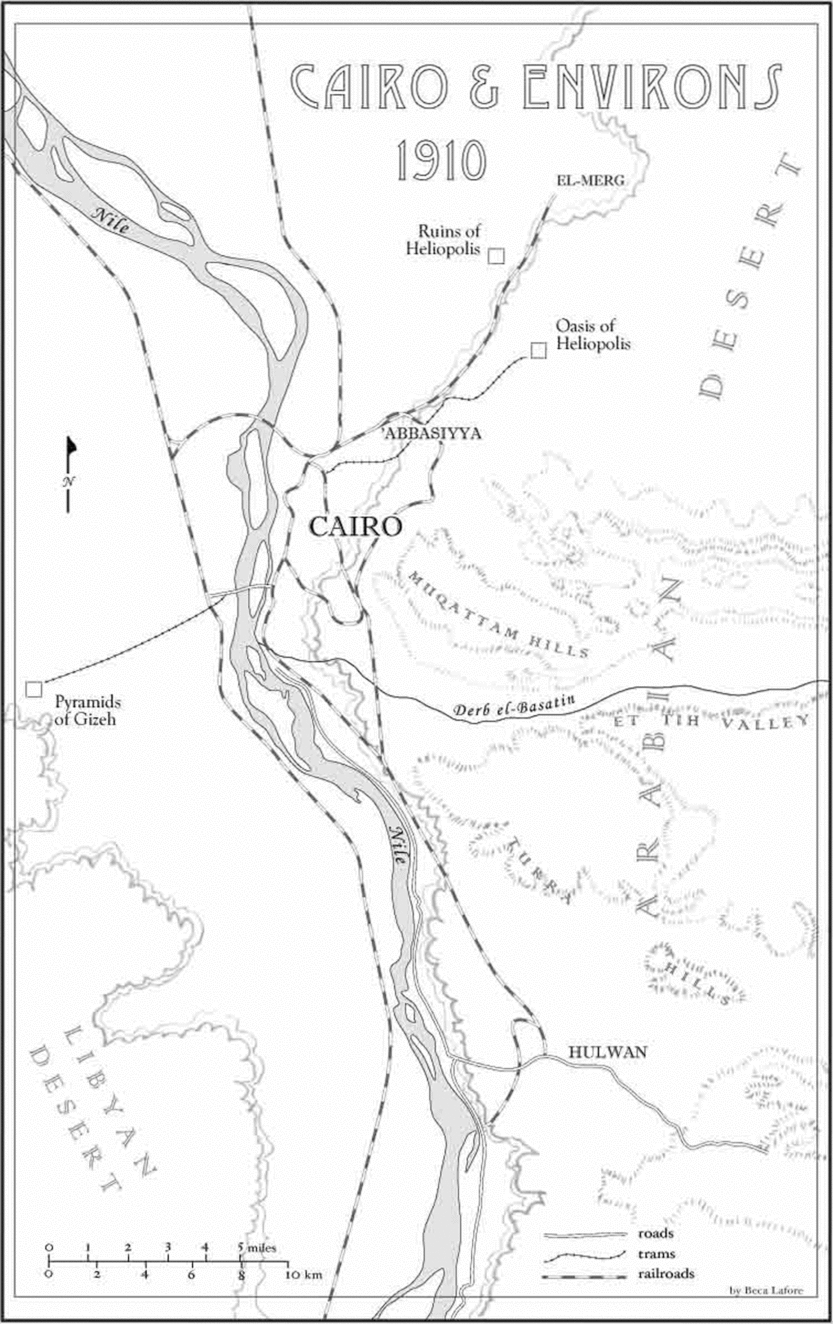
About twenty kilometres northeast of Cairo on the edge of the desert bordering the Nile Delta lie the ruins of Heliopolis, the City of the Sun. At the turn of the twentieth century, this ancient cult centre of the sun god, the hawk-headed Rē-Harmachis, was an easy day trip for tourists from Cairo. A visitor from the capital would have seen nothing of interest en route via the railway line, or main road, except an ostrich farm established by an enterprising Frenchman at the village of Maṭariyya.Footnote 1 The desert to the east would have drawn no more than a glance. By 1910, however, much of this empty land was undergoing a dramatic transformation, and for a few weeks in February it became the focus of international attention.
In 1904 Édouard Empain (1852–1929), a Belgian colonial entrepreneur, arrived in Egypt which had been occupied by the British since 1882. He headed a consortium of Belgian companies that had constructed urban tram lines in Europe, Russia, China, the Belgian Congo, and Cairo. His task was to win the contract for a railway line on the eastern branch of the Nile. He lost the contract but remained in Egypt to pursue other commercial ventures.Footnote 2
Empain was introduced to Boghos Nubar Pasha, the son of Nubar Nubarian, the prime minister to several of the khedives, the titular rulers of Egypt.Footnote 3 Boghos gave Empain entrée to the court of Khedive ‘Abbās Ḥilmī II (r. 1892–1914) and served as an intermediary between the Khedive and Sir Reginald Oakes, a civil engineer and partner of Empain who had good relations with British colonial officials. When Empain proposed that his consortium build a new suburb of Cairo, Boghos facilitated his acquisition from the colonial government of 6,000 faddāns (25 square kilometres) of desert eight kilometres northeast of Cairo, about half way between Cairo and Heliopolis, for one Egyptian pound per faddān. In return, Boghos became a director of the new Cairo Electric Railway and Heliopolis Oasis Company, of which Oakes was president and director general, established on 23 January 1906.Footnote 4
Map: Cairo & Environs, 1910.

Empain and his backers immediately began the construction of a city of luxury and pleasure laid out on a European model. Indeed, this would be primarily a city for wealthy Europeans, a winter resort for the months of January through to March. It was called the ‘Oasis of Heliopolis’, in Arabic ‘Ayn Shams (the Spring of the Sun) or Miṣr al-Jadīda (New Cairo). There was actually no oasis at the site. This description was simply part of ‘marketing’. In any case, the new city would have all the modern conveniences plus a race course, golf links, an elaborate amusement park, and two magnificent hotels, the Palace Hotel and Heliopolis House, which would rival the best in Egypt.Footnote 5 In 1909, as construction, especially infrastructure, rapidly progressed, the Empain group sought a means to promote their development that would give it headlines in Europe and the rest of the world.Footnote 6 With all humanity, not to mention the press, captivated by the astonishing feats of the newly-invented flying machines, they quickly seized on the idea of holding a competition of these machines, a ‘Great Week of Aviation’, at the Oasis of Heliopolis.
By November 1909, barely three months after the week of aviation at Rheims, notices began to appear in the western press announcing an aviation meet during 6–13 February 1910 at Heliopolis. Preliminary prize money was announced and leading aviators were encouraged to participate. The Aero Club of Egypt was established to plan the event and the Automobile Club of Egypt was to assist it. More important, the meet was to be held under the auspices of the Aero Club de France, which gave it legitimacy. In January, a month before the meet, the Aero Club de France sent a delegation to oversee preparations.Footnote 7
Advertising and promotion of the event soon intensified. The French steamship company Messageries Maritimes, which served Alexandria twice a week from Marseille, offered cheap round-trip tickets for the event that were good for forty days beginning 23 January, the height of the tourist season. Indeed, Messageries Maritimes provided the transportation for most of the flyers and their aircraft. The Italian newspaper Figaro went so far as to complain that:
The organisation of the Heliopolis Aviation Meeting has been a fresh success for French aviation. Although Egypt has become more and more an English possession, it is the Aerienne Company of Paris that has taken the material sporting organisation in hand, and it is the Messageries Maritimes Company that has been entrusted with the transport of the Aeroplanes and Aviators.Footnote 8
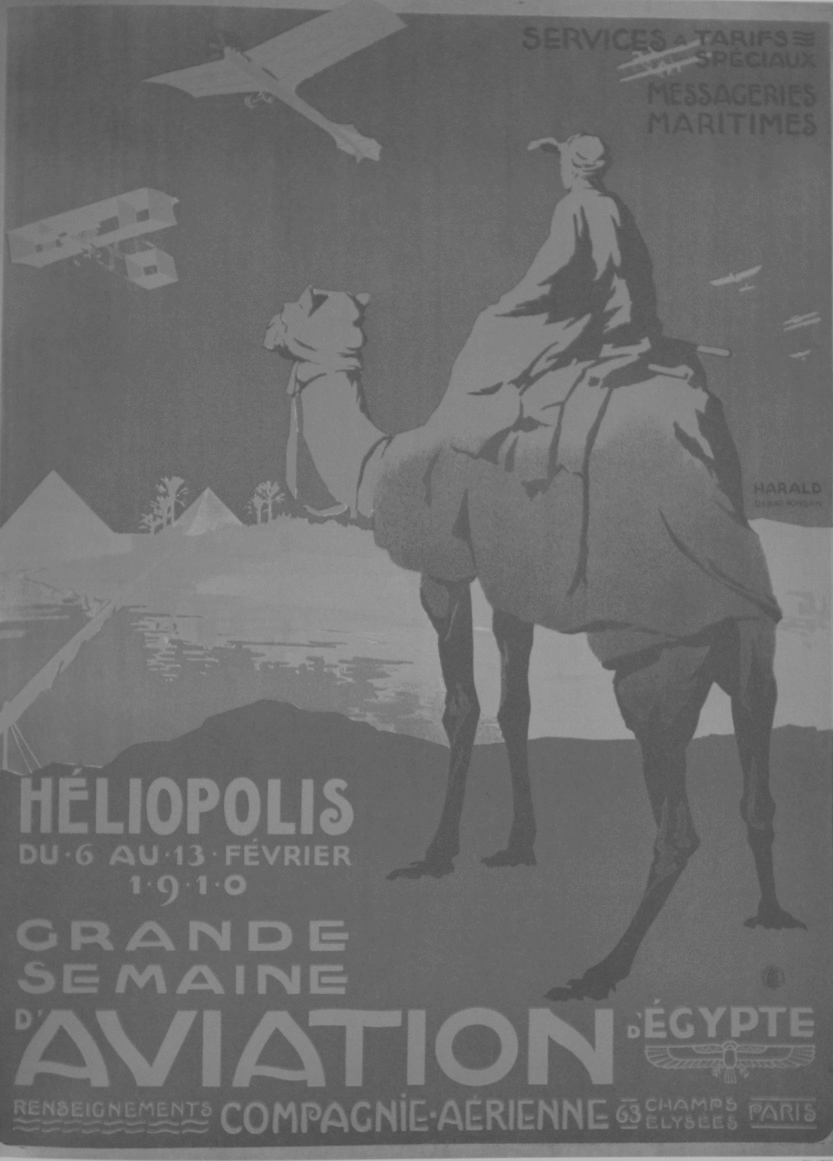
Poster: Heliopolis, Grande Semaine d'Aviation. Courtesy of Bill Allen, Allen Airways Flying Museum.

It was not long before various businesses in Egypt began to capitalise on the meet and promote it at the same time. Hotels and restaurants in Cairo benefitted from the additional influx of tourists. On a more popular level, Messrs Walker & Meimarachi Ltd. in Cairo, for example, reserved a special selection of “D'en cas, motor veils, scarves, etc. and necessities for sport meetings”; and its Heliopolis branch planned to have a complete stock of wine, beers, soda waters, groceries and provisions for the Week of Aviation. The Malkonian cigarette factory offered cartons of cigarettes for sale in which free tickets to the meet were randomly inserted. Countless souvenir postcards were of course produced showing the new buildings of Heliopolis with planes superimposed overhead.Footnote 9
As the advertising campaign moved forward and various prizes totalling more than 200,000 francs were announced, an increasing number of flyers, almost all Europeans, declared that they would participate. A few began to arrive as early as December 1909. On 27 November a Blériot Type XI aircraft was placed on exhibit in one of the halls of Jardin Rosetta in Alexandria. This may have been the first aircraft to reach Egyptian shores. It was the same model that Blériot had flown on his celebrated flight from Calais to Dover. Advertisements for the exhibit declared that this craft would take part in the Week of Aviation, but no pilot was mentioned. As we will see, both Jacques Balsan and Hubert Le Blon flew Blériots in the meet. This exhibit attracted a large crowd. The Egyptian Gazette even stated, “we should like to express our satisfaction at having seen such a large number of ladies present among the spectators, showing that scientific interest in aviation has penetrated even the drawing room”. The ladies were, of course, from the European community in Alexandria, which constituted 48,000 of the city's population of 377,000. Most were Greek or Italian, but there were also many French and Austrians.Footnote 10
The First Flights in Egypt
On 11 December, a pilot arrived in Alexandria who was determined to fly in Egypt, but not in the meet. This was the Belgian Baron Pierre de Caters who had come by ship from Constantinople. Fresh from making the first demonstrations of flight in the capital of the Ottoman Empire, his current goal was apparently to be the first to fly in Egypt.Footnote 11 De Caters was an independently wealthy ‘sportsman’ whose father had worked on the Suez Canal under Ferdinand de Lesseps. He had won considerable fame on the continent in various flying competitions and was on a promotional tour. He arrived with an entourage that included the Polish Prince Lubomirski and his own press agent, Herr Ohl, the Brussels correspondent of the Hamburger Nachrichten, who was the first man in Germany to fly as a passenger in an aeroplane. De Caters' presence caused great excitement among the large European community in Cairo. He took a room at the Shepherd's Hotel, just in time for a Tuesday night dance at which he was the toast of both the resident and the wintering European society.Footnote 12
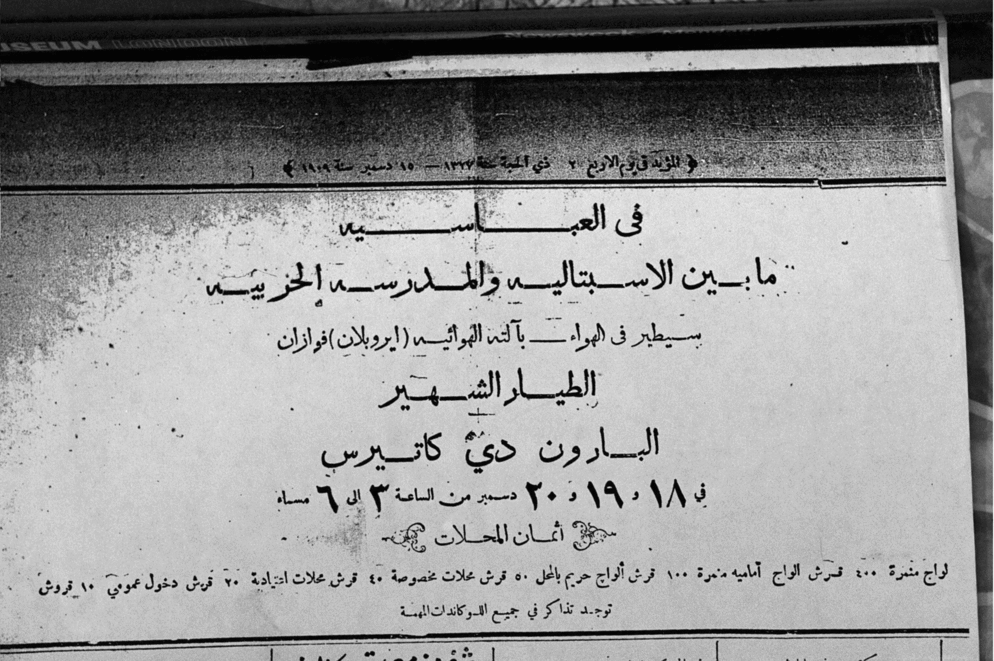
Advertisement in al-Mu'ayyad 15 December 1909, for de Caters’ demonstrations of flight at ‘Abbāsiyya.

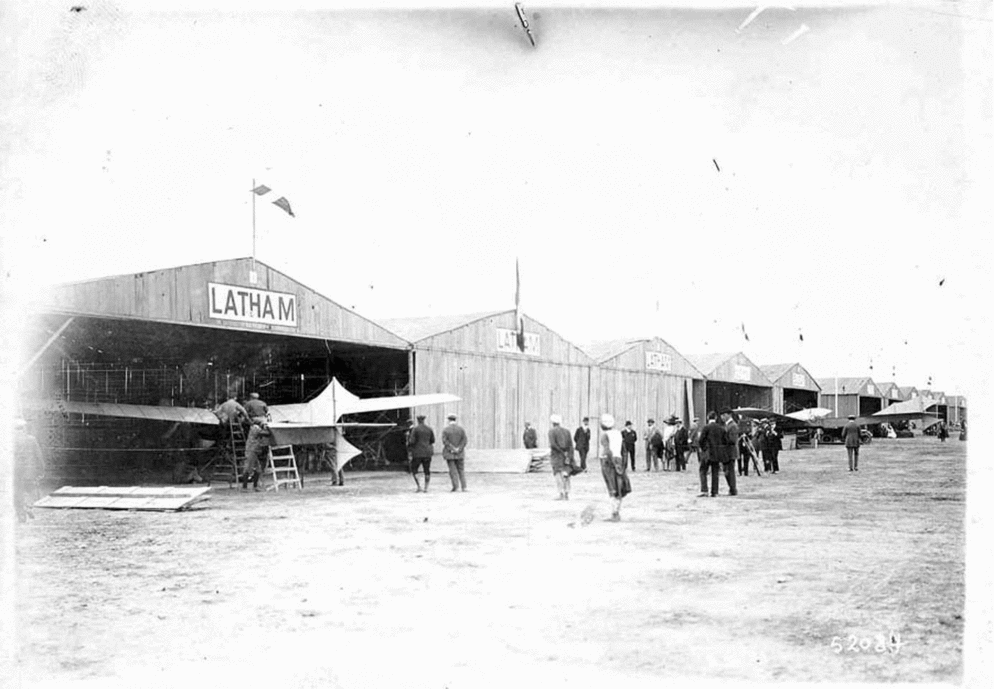
The sheds housing the aircraft of Hubert Latham at Heliopolis. Photo courtesy of Stephen H. King.

De Caters had arranged with the colonial government to use an open field, the old parade ground, in the suburb of ‘Abbāsiyya as the place to make a demonstration of flight. It was located on the north-eastern edge of Cairo in the direction of Heliopolis and was well connected to the city by tram. One condition of this arrangement was that part of the gate would go to the British Military Hospital and the British Soldiers and Sailors Families Association.Footnote 13
On Wednesday 15 December de Caters flew his Voisin biplane at ‘Abbāsiyya before a specially invited group of spectators. They included Lady Gorst, the wife of Sir Eldon Gorst, the British Consul-General; Ronald Graham, the Counsellor at the British Agency and Secretary-General to Gorst; Ronald Storrs, Gorst's Oriental Secretary; Sir Reginald Oakes; and other British notables, military as well as civilian. It seems that no leading Egyptian officials were present. The Khedive, whom de Caters had met in Antwerp, was out of the country on pilgrimage to Mecca. At 4.00 pm de Caters was ready to fly, but the wind was a bit too strong. While he waited for better conditions, he and Prince Lubomirski described various points of the aeroplane to their guests. Meanwhile, the Continental Hotel arranged a buffet near an enclosed space that served as the shed for the plane. A kite was raised having a small square indicator that travelled along its line showing the force of the wind.
At 4.30 the Baron gave the word and his aircraft emerged from its enclosure to the open space in front. In the fading light the Voisin was pointed in the direction in which it was supposed go. The back of the plane was anchored to a spring balance attached to an iron bar driven into the ground. An assistant set the engine in motion and the propeller revolved at such a speed that it raised a great cloud of dust that briefly hid the plane from view. The aircraft strained to break lose from its leash. Suddenly, however, the engine stopped. Something was wrong. De Caters explained that the propeller did not work properly; it would not make the hand of the spring balance point to the proper mark on the dial. He ordered a new propeller to be quickly attached to the aeroplane. At 5.00 everyone stood clear as the engine was started again. In an instant, with a rush and whirr, the man-made bird with the Baron inside was streaking across the field. The spectators watched breathlessly. Then, at about 200 metres, the machine swayed to the right on one wheel and a wing almost touched the ground. The Baron struggled to right it. A lady shouted “Why, it is really rising!” There was a general exclamation of wonder “more modified than when a rocket bursts at the Crystal Palace”. The Baron was indeed flying. He made two circuits of about a kilometre each and landed after three minutes in the air. Thus occurred the first flight of an aeroplane in Egypt. Unfortunately, it was too dark for photographs.Footnote 14
Notices soon appeared in Cairo newspapers stating that de Caters would make demonstrations of flight for the public on 18, 19, and 20 December between 3.00 pm and 6.00 pm at ‘Abbāsiyya. Seats went for various prices, from 10 piastres for general admission to 400 piastres for reserved loges. There were special loges for women, which might suggest that Egyptian ladies were expected. Tickets were sold at all the major hotels.
On 18 December, strong winds blew up. Consequently, the spectators had to wait for two hours until the Baron could get off the ground. He remained in the air only three minutes, but confirmed that he could really fly. On 19 December, he made two flights beginning at 3.50 pm. He conducted three circuits of his aerodrome in four minutes on the first flight. On the second, he tried to spiral up to 100 metres, but his engine stopped at 40 or 50 metres forcing him to glide to earth.
On 20 December, the Baron made three additional flights. On the first, he remained aloft for 7.5 minutes at a height of 10 metres (al-Jarīda says 6 minutes, 20 metres) and flew three circuits. On the second, he took a passenger along, an Austrian lady named Karri Benedict. She was therefore the first woman to fly in a plane in Egypt. This flight lasted only a few minutes. On the last flight, de Caters took another lady aloft, Princess Avierino Wizniewski. This flight too lasted only a couple of minutes. It is not possible to determine from the press the number of people who watched de Caters’ flights. An Arab reporter for al-Jarīda who was on site was greatly impressed. He says that an Englishman standing next to him was speechless and could not move when the Baron rose from the ground. Finally, with British understatement, the Briton is reported to have said “That is very neat”.Footnote 15 The same reporter for al-Jarīda published a description of de Cater's aircraft:
We do not wish to go into a detailed description of its structure because whatever we say we cannot hope to bring a full picture of it to the mind of readers. It suffices to say that it is a vehicle of two wings, a tail, and a ‘motor’. The two wings are composed of two parallel horizontal planes, one above the other. They are made of impregnated linen stretched over wooden cross beams. Behind them is the ‘motor’. It is like what is in an automobile. When it operates, it moves the propeller behind it. The propeller spins with frightening speed and generates a stream of air that flows over the two wings and the aircraft rises by the power of this flow. When that happens, the two wings remain motionless contrary to the wings of a bird. The rear end resembles the wing in its shape and composition. In the middle of it is an apparatus used for steering the aircraft in the air as the rudder steers the ship at sea.Footnote 16
The press did not report any Egyptian reaction to de Caters’ flights, or even if any Egyptian spectators were present, although some certainly must have witnessed his ascents.
De Caters soon departed Egypt. When he returned to Brussels at the end of January, journalists interviewed him about his flights in Constantinople and Cairo:
Of his actual flying the Baron does not say much, but as regards the effect that his attempts had on the unsophisticated native he was quite eloquent. “The Turks and Egyptians”, remarked the Baron, “amused me much. Ah! The noble fellows. The Koran says that God alone can raise himself above men; you can imagine then how frightened they were when they saw me planing over Constantinople. They considered me as a demi-god; and as to my bi-plane, they dared not to approach it and made numerous salamliks to it”.
There is no evidence for this ‘native’ reaction in Constantinople or Cairo. Perhaps de Caters was playing to the press or simply expressing a European imperial attitude.Footnote 17
While de Caters was making these flights, an American, Hayden Sands, arrived in Cairo with an Antoinette monoplane. At first taking a room at the Shepherd's Hotel, he then moved to the Mena House Hotel near the Pyramids at Gizeh and stated that he planned to fly around the Pyramids from the hotel racecourse. No such flight was reported in the press, although somewhat later it was reported that Sands had an accident on a trial flight but the location was not specified.Footnote 18 A few days after Sands arrived at the Mena House, a certain Gustav Bruchner reportedly planned, over a period of three days, to fly from there as well in a Blériot. The Egyptian Gazette announced that he planned to fly on New Year's Day and the following day. On 3 January, the same paper stated that while making tests with his Blériot at the Pyramids, he crashed from a height of 15 metres, seriously damaging his flying machine but escaping injury.Footnote 19 There was clearly some prestige, and great publicity, to be had from being the first to fly over and around the Pyramids, but neither Sands nor Bruckner was successful. There is no report of crowds or journalists on hand to watch.
The Press Lead Up to the Great Week of Aviation
De Cater's demonstrations of flight, and perhaps those of Sands and Bruckner as well, served to stimulate the reading public's interest in aviation and encourage enthusiasm for the coming Great Week of Aviation. During the weeks immediately preceding the meet, the Egyptian newspaper that appears to have provided the most background on recent developments in flight was al-Jarīda. On 17 January, it published a fairly long article on controlled flight, beginning with dirigibles and leading to aeroplanes. It described how planes were fabricated and powered. Furthermore, it speculated on the future consequences of these machines. It hoped that aircraft would soon be used for excursions, if not for transporting people and freight, noting that this was contingent on the perfection and safety of these machines. It also cautioned that many of the consequences of this revolutionary invention could be negative. Aeroplanes could, for example, facilitate tax evasion, smuggling, and drug running.Footnote 20
On 23 January, the same newspaper provided more details on how aeroplanes fly, especially the function of the propeller, and noted that much of the power of the motors was not efficiently used. It also noted that Gabriel Voisin, the inventor of the aeroplane which was named after him, was on his way to Heliopolis from France. Attending as well was Mr Aman, the head of the firm that built Antoinettes, and eight of his engineers who planned to observe the flying of Hubert Latham, who had been Blériot's most determined competitor in the race to be the first to fly across the English Channel.Footnote 21
On 25 January, al-Jarīda, on its front page, began building excitement for the Heliopolis event:
The dream that we have dreamed in our youth and which every other person has dreamed before and after us has now come to reality. Is there anyone who has not dreamed that he was flying in the air and then awoke wishing that the dream had come true? People have watched birds soaring in the air and going wherever they wished, and they wanted to emulate them. From ancient times, master craftsmen have tried to find a way to fly. It is said that some of them actually flew but there is no proof that anyone accomplished this aspiration before [Otto] Lilienthal, who flew [with a glider] a bit but then died [in 1896] a martyr to flight.
We live today in a time of marvellous accomplishments, a time of realising our aspirations and dreams. The period in which mankind has done this has witnessed more than what could have been hoped for or expected – the exploitation of steam and electricity, the sending of messages around the world in a few minutes, sending the spoken word hundreds of miles, illuminating the darkness of night with electricity, extracting power from bituminous coal and falling water, and of course inventing the means of flying, which was the most difficult of the aforesaid accomplishments. In fact, some mathematicians had said that it was virtually absurd and that eagles and vultures were the largest animals that could easily fly. Thus, we are impatient in this country to see the first people to fly, just as others are impatient. When the Voisin biplane [dhāt al-saṭḥayn]Footnote 22 was tested a month ago [i.e., de Caters’ fights], we hastened to witness it and make a close inspection of it. We could not believe that we saw with our own eyes what people had so much wanted to see for thousands of years. Then, when this aircraft [ṭayyāra] was ready for flight and it threw up dust with its propeller [fan, mirwaḥa], it took off with a passenger in it and it travelled on a specific course and it went to the end of the field in which the test took place and circled around it and then returned to where it had been. Then it circled a second time and we applauded when it came by and we said it was not absurd to have such high ambitions.
All of us are now eager to see the other aircraft coming to this country, those having two planes [biplanes] and one plane [monoplanes] – especially the hundreds and thousands of those who have seen [pictures of] the first aircraft or who have read or heard about them. There is no doubt that this spectacle will be joyous and marvellous and something that everyone will remember for the rest of his life, and he will tell his children about it and say to them, “I saw the test of the first aircraft that were brought to this country and they flew before me in such a manner and we were a large throng of people”.
Then the article stated somewhat ominously:
European governments are now starting to take an interest in the subject of flying as they did in casting artillery, building warships, and training soldiers, because they know that if they facilitate the perfection of aircraft so that it will be as easy to travel in them in the air, as it is for autos to travel on the ground, then they can dispense with the great expense of building warships – because for two million pounds they could build 500 aircraft armed with dynamite instead of a warship.Footnote 23
Concerning the military use of aircraft, al-Jarīda may have been echoing an editorial in the Egyptian Gazette of 25 January which stated:
. . . some alarming information from America. An officer of the United States Army has been experimenting from an aeroplane with pseudo-bombs. At a height of 250 feet he threw sand bags, representing packets of dynamite, at a mark which was only missed by a few yards. Another well known aviator at Los Angeles a few days ago stated that he could as conveniently carry 375 lbs of dynamite as one passenger. As he truly remarked, what would be left of a town or fortification if this amount of explosive was let fall from an airship? The idea is appalling. But there it is.
On 30 January, al-Jarīda, in a long essay on the front page, declared:
Within a few days, Egypt will witness one of the greatest and most important sights in the history of mankind and the most brilliant manifestation of the ability of man will be revealed. And there will be realized in the land of the pharaohs the dreams that have come to mind since childhood. Our ultimate desire was to have wings with which to soar in the sky like birds and to learn what secrets the skies have hidden from us. In this respect this is clear evidence that there is no limit to what can be done, and that if man really and sincerely puts his mind to something there is no doubt that he will achieve it. What were the many events that spurred those who have devoted themselves to work continuously for the progress of the human community and its happiness? Their actions were but evidence of the sincerity of those people and their self-sacrifice in realizing their hopes by means of pure will. Today, the weakness in the body has been overcome by the power of the mind, which has overcome the three elements: land, water, and air. Overcoming the latter, however, was testimony that man was restricted to travel on the ground and so he looked to the sky. This will change the face of the civilized world. It will turn upside down many of our systems. Some countries will increase in power and some will decrease depending on how they take to flight; and the victory will go to those who are first in flight.
The writer went on to state that he found people as optimistic as they were hopeful for humanity regarding this invention. He also found pessimists who had great forebodings and warned of the evil that would arise from the flying machine that the inventors had not anticipated. In any case, it remained to be seen whether the benefits would outweigh the negative consequences of the wonder of the age. The writer could not imagine that aeroplanes would one day replace trains and ships and become the sole means of transportation. But he could imagine carrying out warfare from the air and air combat. There was no doubt that the importance of warships would greatly decrease. Flying machines would be able to reconnoitre enemy forces, their headquarters, and strongholds, which up to now could not be known. They would also facilitate the capture of strong fortresses that could not be destroyed from the ground. Fewer men would be needed in the armed forces, and equipment would be less expensive because aircraft would be a deterrent to such costly items as battleships. Finally, he urged his countrymen to go to Heliopolis:
The Egyptian must hasten to see the wonder of the present age and the one on which the glory of many nations will be built – with these aircraft are their owners who will race against each other at Heliopolis. This is the place where people from throughout the world will gather to stand in humility before this conquering sultan, the sultan of knowledge. For 40 centuries Heliopolis has been in ruins, but today it will rise again as a result of the sultan's appearance there.Footnote 24
On 5 February, the day before the event, al-Mu'ayyad added to the excitement by announcing:
The Week of Aviation is upon us. In a few days you will see in Egypt itself at a distance of a few minutes from the capital what has never been seen and what people have never dreamed of seeing up to now. The people of Egypt will see an amazing sight. They will see that humble humans have taken control of the air and have mocked the winds at will. They have begun to move about the kingdom of the air as they move about dry land and on the sea.Footnote 25
The same issue included an article by the well-known scholar of Arabic and Arabic literature Aḥmad Taymūr (1871–1930), in which he described an Arab inventor in medieval Muslim Spain who had attempted to fly. In the ninth century Ibn Firnās supposedly dressed himself in feathers, fabricated wings, and flew a long distance. Unfortunately, when he landed, he injured his back because he did not make a tail for himself! Taymūr was trying to show, of course, that the Arabs too had made attempts at human flight.Footnote 26
The Competitors Arrive
Probably the most celebrated aviator to come to Egypt for the meet was the Frenchman Hubert Latham, who, as mentioned above, had been a rival of Blériot. He arrived in Alexandria on a Messageries Maritimes steamer on 25 January. The voyage had been rough. He had departed Marseille with three Antoinette monoplanes. One was destroyed in a storm and the other two were damaged but repairable.Footnote 27 Upon reaching Cairo, Latham set up operations at Heliopolis and began making trial flights. On 27 January he rose to a height of 45 metres when a sudden gust of wind hurled his aircraft to the ground. Although he had been tied to his seat, he was thrown out. Fortunately, he suffered only minor scratches and bruises. He later speculated that if he had been a little higher when struck by the wind he would have been killed. His plane was wrecked.Footnote 28 This was an inauspicious prelude to his performance in the meet.
Postcard showing Latham in his Antoinette at Heliopolis. Courtesy of Stephen H. King.

More unfortunate than Latham was the Englishman Mortimer Singer, the son of the inventor of the Singer sewing machine, who also registered for the meet. Staying at the Savoy in Cairo, he too announced that he wished to fly over the Pyramids. Singer was new to flying. He had acquired the latest Farman and began flying with little more than one lesson from the well-known French aviator Louis Paulhan.Footnote 29 His lack of experience was his undoing. On 29 January, Singer made a trial flight at Heliopolis during which his engine stopped and he floated to the ground. The engine was repaired, but when he attempted to fly again he struck a mound and shattered his propeller. On 31 January, he succeeded in getting airborne, but he suddenly fell out of the sky from 20 metres. Suffering a fractured leg, he was rushed to hospital. As a result of his injuries, he was forced to withdraw from the competition.Footnote 30
By the end of January there were daily advertisements in the foreign and Arabic press for the upcoming week of aviation. And the pilots who had registered for the meet were making daily test flights at Heliopolis. Some even ventured beyond the limits of the enclosure. Curiously, there is no press report of spectators. Perhaps none were allowed. During the evenings, the pilots enjoyed the high season of banquets, dinners, dances, and other social events at the great hotels.
In any case, at the end of January the programme was completed and the competitors, including many luminaries, were announced as follows: from France Hubert Latham (Antoinette monoplane), Henri Rougier (Voisin biplane), Jacques Balsan, who was from a family of industrialists (Blériot monoplane), Hubert Le Blon (Blériot monoplane), Jean Gobron (Voisin biplane), Hauvette Michelin, the nephew of the founder of the Michelin tire company (Antoinette monoplane), Réné Metrot, who had made the first flight in Algeria (that is, Africa) the previous October (Voisin biplane), and ‘Baroness’ (Mademoiselle) Raymonde de Laroche, a former actress, who, taught by Charles Voisin himself in France the previous October, was the first woman to pilot an aircraft (Voisin biplane). The well-known French pilot Léon Delagrange had also planned to participate, but he was killed in a crash at Pau, France, on 4 January 1910. From the Netherlands came Frederick van Riemsdyk or de Reimsdyk (Curtiss biplane); from Germany Hans Grade, who had made the first flight there in an aircraft of his own construction (Grade monoplane); and from America (also described as from France or Belgium) Arthur Duray, who was a well-known racing car driver and had held several land speed records (Farman biplane).Footnote 31 Some of the pilots, like Latham, brought more than one aircraft, but always of the same type. In some cases their flying machines differed in the power of their engines.
Prize money totalling 212,000 francs was to be awarded among several categories of competition. The Baron Empain Prize, the first prize for the greatest distance in one flight without touching the ground, was 50,000 francs. Second prize was 10,000 francs offered by the Automobile Club of Egypt. Third prize was 5,000 francs given by the Società del Risotto. Fourth and fifth prizes were 2,500 francs each offered by the Cairo Tramways Company. And sixth prize was 1,000 francs. The Heliopolis Prize, the first prize for the highest altitude above 100 metres, was 50,000 francs. It was given by the Cairo Electric Railway and Heliopolis Oasis Company. Second prize of 10,000 francs was offered by Messrs. Walker and Meimarachi, Cicurel, Flash and Chemla Frères. And third prize of 5,000 francs was given by Cercle Hellènique. The Grand Prize of Egypt (Grand Prix d'Égypte), for the greatest total distance of all the registered flights of any aviator, was 25,000 francs. It was offered by the Association Égyptienne pour Favoriser le Tourisme, the hotels of Cairo and Hulwan, and the Mena House. Second prize of 10,000 francs was given by the Club Mohammed Aly. Third prize of 5,000 francs was offered by the Suez Canal Company. The Boghos Nubar Pasha Cup was given for the fastest time from Heliopolis aerodrome to the Pyramids, around the Great Pyramid of Cheops, and back to Heliopolis (descents authorised). This prize was an ‘Arabic objet d'art’ valued at 2,000 francs plus 10,000 francs in cash. According to al-Ahrām, there were two cups, each made of silver and gold. One was in fourteenth-century Arab style and was donated by Prince Aḥmad Fu'ād Pasha, the president of the Aero Club of Egypt, and the other was a copy of an ancient Egyptian glass found at Bubastis, near Heliopolis, and dated from the reign of Ramses II (r. 1279–1213 bce). It was donated by Boghos Nubar Pasha. Furthermore, there were daily prizes for altitude, 10,000 francs from La Grande Fabrique S. Stein; for distance, 1,000 francs from the Ligne Nationale Aerienne; and for speed, 1,000 francs from the Compagnie des Messageries Maritimes.Footnote 32 Altogether it was to be a rich competition indeed.
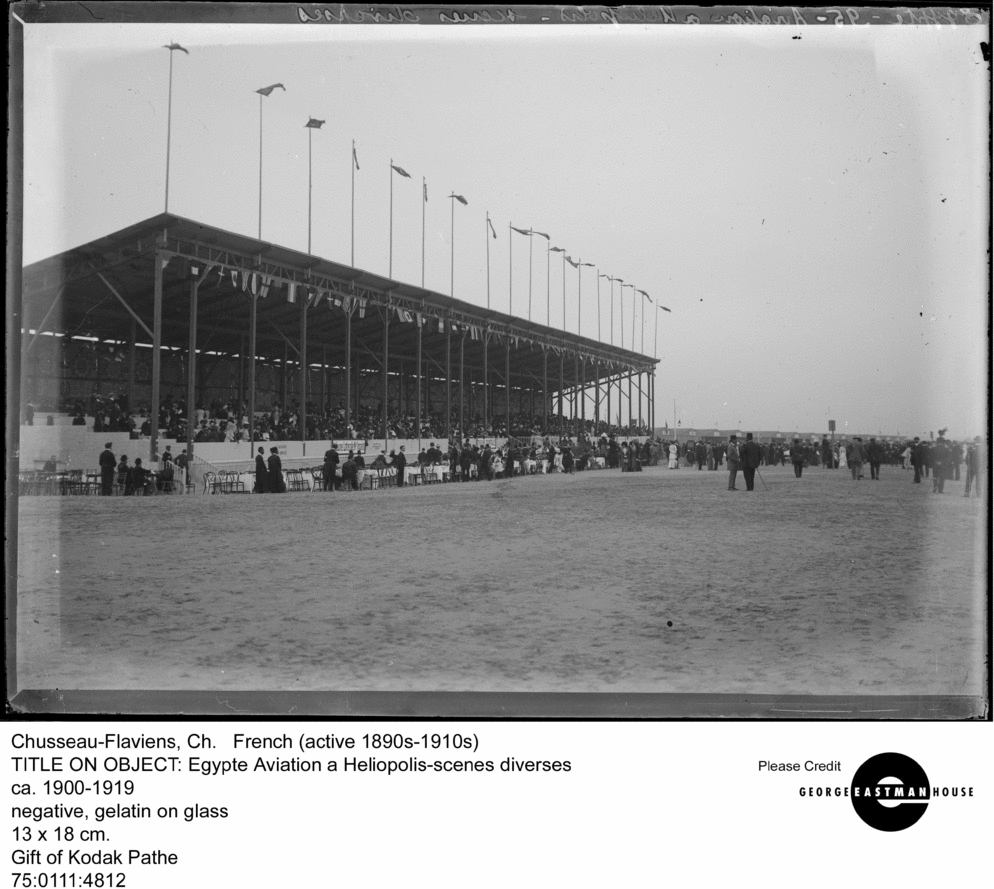
The grandstand at Heliopolis for viewing the Great Week of Aviation. Photo courtesy of George Eastman House.

The Stage is Set
The facilities built for the competition and the spectators were very impressive and comparable to those at Rheims. An aerodrome, an open field with a circumference of five kilometres was staked out at the northern edge of the Oasis of Heliopolis. This served as the course for the competition. A wooden wall encircled the field. Inside the wall on the east was a very large roofed grandstand or tribune for first-class ticket holders. It included sections reserved for women and for the Khedive and his entourage. On the west side was an area set aside for the general public. Here were also fifteen wooden sheds built for the flying machines, including three for Latham.Footnote 33
On 5 February, the day before the competition, a reporter for al-Mu'ayyad, a certain Salīm, visited the grounds at Heliopolis and had a look at the aircraft housed in the sheds. He later described several of the flying machines as follows:
Then I saw with my own eyes the air vessel or the carpet of the wind that I had long read about. I first looked at Metrot's vessel. It is composed of a bicycle possessing three wheels. Sitting on it is a long cross beam divided into four sections. Above the front single wheel is the seat of the flyer. At each side are two wings. At the back is the sākīna [?] that moves the vessel [presumably this refers to the box-kite tail, but it would not have moved the aircraft].
Then there is van Riemsdyk's vessel. It is like the previous one. It has a wide axle at the back.
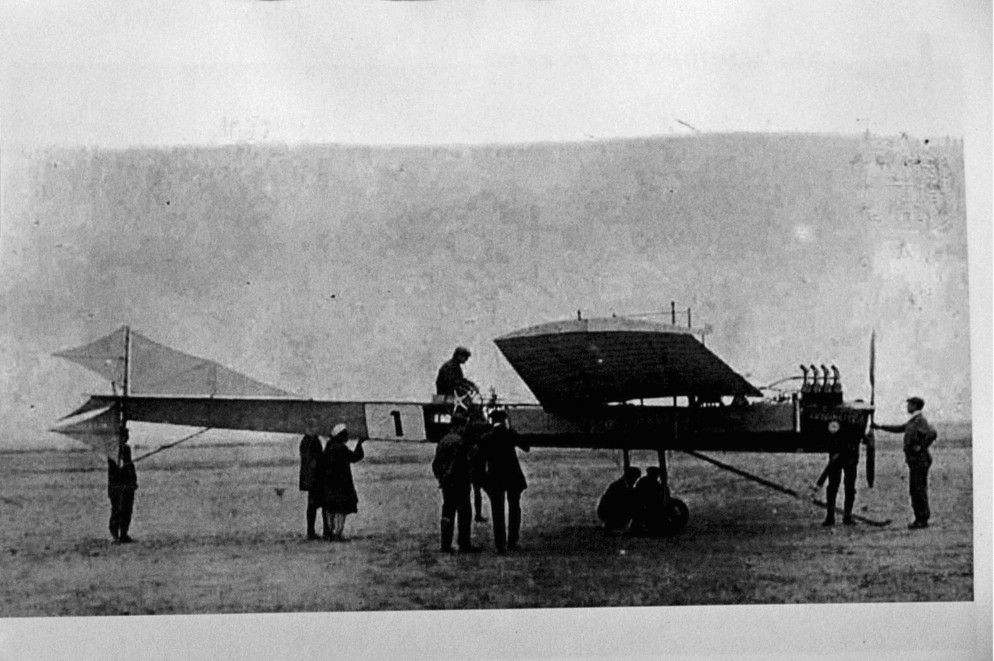
Then there is Michelin's vessel. It is composed of a long narrow boat sitting on two wheels. In the front are two oars of copper. On each side are two long wide wings of wood, cloth, and wire. It has a tail like that of a fish.Footnote 34
In the centre of the course was a small white building that served as a signal tower. It raised a white flag to indicate that flying was possible, a red one to indicate that flying was imminent, and a black one to indicate that there would be no flying. Each aviator was assigned various symbols for identification. Composed of white, black, and red circles, cones, and squares, a given combination, one over the other, indicated a certain flyer. And an ambulance brigade was provided in case of an accident.Footnote 35
The prices of admission were set at 10, 25, and 100 piastres per day. There was a 50 per cent reduction for soldiers and children. Some of the large private schools, such as the Italian, planned to send all their children. One could subscribe for the entire eight-day affair for 400 piastres. Spectators could also reserve places and boxes at various prices in the grandstand. As mentioned, there was separate seating for women, so they would not have to mix with men.Footnote 36
The Savoy Hotel set up a daily buffet at the grandstand while Restaurant Hermès organised a restaurant and buffet near the course. The Italian community orchestra of Alexandria agreed to play throughout the week. A post office, which issued special stamps, and a telegraph office were also established near the course. The state railways offered a 50 per cent reduction for all those with tickets to the event and special trains were scheduled for three days from Alexandria to Cairo. From Cairo, special tram service was provided to Heliopolis. In addition, a special service of motor buses was arranged to transport spectators from the Continental and Savoy hotels to the site. Tickets were sold in Cairo at the major hotels, at the bank Comptoir Nationale d'Escompte de Paris, at the Cinematograph Pathé, at the office of the committee that arranged the meet, which was located on Qaṣr al-Nīl Street in the centre of Cairo, and at all principal railway stations in Egypt.Footnote 37
The Great Week of Aviation
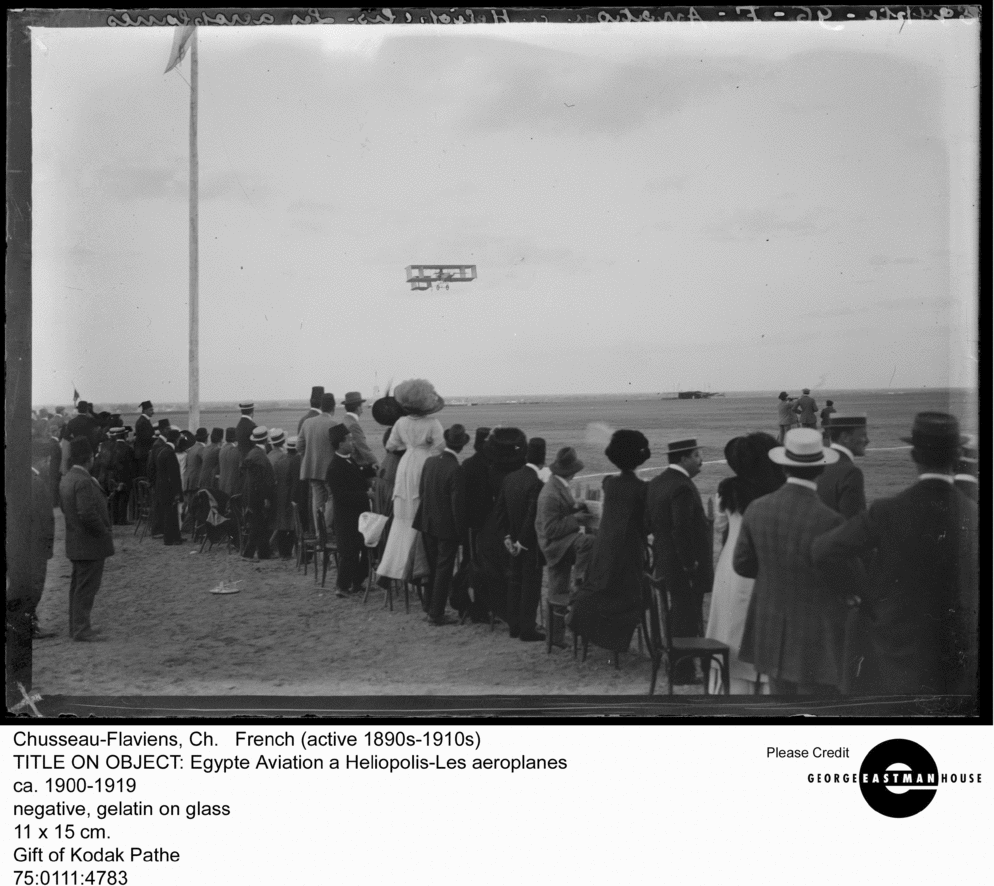
Sunday, 6 February, was a clear still day at the Oasis of Heliopolis, perfect for flight. The competition did not begin until 2.00 pm, but a sea of surging people, pushing and shoving, began to flow toward the site shortly after dawn. The spectators arrived in conveyances of all kinds, from motor cars to horse cabs. All trams were packed. Ramshackle buses did a good business despite charging high prices. In fact, transportation was in such demand that some people were forced to walk. Upon reaching the oasis, the visitor found that cafes and restaurants along the route to the aerodrome had surpassed themselves in an attempt to cater to pedestrians by placing tables and chairs on both sides of the road. Approaching the aerodrome, the visitor discovered every window and roof of the nearby buildings filled with people staring at the sky. Indeed, every mound and rise on the ground around the aerodrome was covered with people who lacked tickets to the enclosure. Altogether attendance was estimated at 40,000.Footnote 38
Shortly after 2.00 pm, a deafening roar of the engines announced that flying was about to begin. Balsan immediately took off, to the wonder of the crowd, and made two circuits. Duray attempted to follow him. He rose 50 metres, but was forced to glide to the ground. A pair of mules then towed his aircraft back to its shed. Then Rougier made a trial ascent and landed for repairs. Meanwhile Balsan seemed to sputter and rapidly descended to earth. While the eyes of the people were transfixed on the aircraft in the sky, there was suddenly a great commotion on the ground. A Mr Tarihaki was run over by a soldier's horse that was apparently frightened by the noise of the aircraft. The ambulance on standby for injured pilots rushed him to hospital.
Rougier took off again. Turning, twisting, and diving like the wind, he soared to 104 metres. There was a storm of applause and shouts of acclamation, wonder, and joy. By then a half hour had passed and the spectators were eager to see other planes. They were especially anxious to watch Latham, who was renowned as the ‘King of the Sky’ because of his many remarkable aerial accomplishments, including prize-winning flights, in Europe. They strained their necks to follow his every move on the ground, but he could not get airborne.Footnote 39
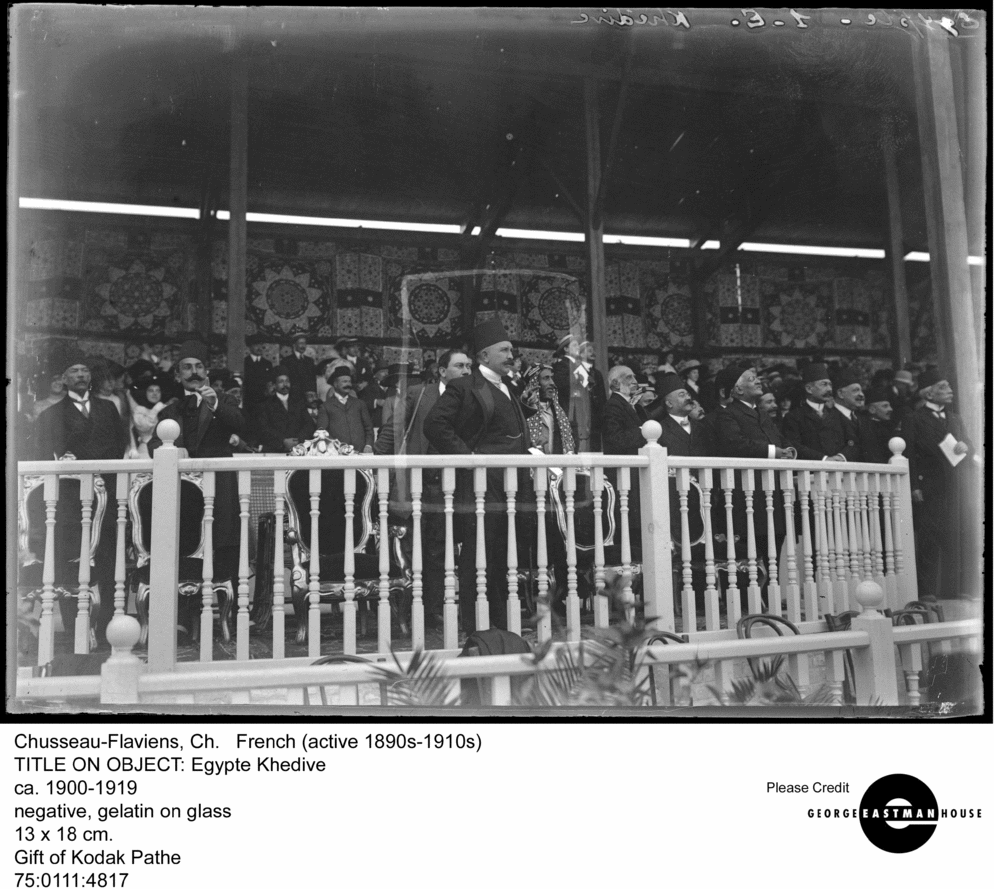
At 3.50 pm Khedive ‘Abbās, who had recently returned from the pilgrimage, arrived with his retinue. He was attended also by a British officer. The British 7th Dragoon Guards struck up his anthem as he took his place in the grandstand. There, members of his family, all the Egyptian ministers, and other officials – including Boghos Nubar Pasha – received him. The Khedive then acknowledged the crowd and paid his respects to Lady Gorst and Lady Maxwell, wife of General Maxwell, commander of the army of occupation. Afterwards Mr Chasseaud, who had helped with the arrangements for the meet, pointed out for him the main features of the course.Footnote 40 Curiously, there is no mention in the press of the presence of Baron Empain.
A few minutes later, Rougier attempted to win the daily prize for altitude. He reached 115 metres and was almost lost from sight. He then landed to great applause. Metrot followed by trying to win the Empain Prize for duration. He made four circuits and buzzed the grandstand, but only remained aloft for 21 minutes. Duray took off again but soon landed with mechanical problems. At 4.38 pm Rougier went up again, trying to win all three daily prizes for altitude, distance, and speed. He made a beautiful series of circles and the crowd cheered each time he neared the grandstand. Gobron, Balsan, Grade, and van Riemsdyk soon followed. The crowed was awestruck as the sky was filled with aircraft piercing the air like birds of prey “as if each one sought blood vengeance from the other”.
Then, as Gobron flew past the further side of the course, the crowd watched in horror as his plane burst into a mass of flames and dropped below the horizon. Smoke billowed into the sky and caused hearts to tremble. A car emerged from the crowd, then a truck, and then many horses as the ambulance brigade rushed to the crash site. Thanks to the telephone system that circled the course, the crowd was soon informed that Gobron was not injured. In fact, a few minutes later he arrived in a car at the grandstand and tipped his hat to the crowd who cheered him. The Khedive invited him to his box and congratulated him on his escape from injury.
No sooner had Gobron got to his feet than a mysterious biplane, with the letter ‘S’ instead of a number painted on the fuselage, appeared overhead, made several circles, and disappeared. The spectators looked in wonder and asked each other who it could be. By then the light was failing and one by one the flyers began to land. And what of Latham? From time to time the crowd watched him intensely as he worked on his aircraft in the field. Plagued by mechanical problems, he only managed a short glide a few metres above the ground.Footnote 41
At 6.00 pm the Khedive took tea and spoke with his ministers and other notables, including Sir Eldon Gorst. Then he and his entourage visited the flyers at their sheds. He inspected their aircraft; and each flyer explained how his machine was built. Afterwards he returned to the Qubba Palace. Meantime, the assembled crowd broke up. The rush from the aerodrome to conveyances resulted in a massive traffic jam. Trams and trains operated past midnight before the area cleared. Rougier won the daily prizes for altitude and speed. Balsan won for distance.Footnote 42
The second day of the festival, 7 February, was also clear, but in the afternoon the wind came up. Flying was postponed until almost 4.00 pm. The crowd, as large as that of the previous day, was entertained by the Italian orchestra. Before the spectators could begin to grumble, the white flag was raised and Balsan took off, but he crashed after three circuits. Rougier flew again and thrilled the crowd. Grade and Michelin also briefly took to the air. Balsan managed to recover from his crash, but fell again. Latham spent another day trying to get one of his aircraft to operate. The crowd watched him hopefully but nothing came from his engine but spasmodic and deafening explosions. In an increasingly bad temper, he finally ordered his engineers to tow his aircraft away.Footnote 43
On the third day, 8 February, high winds caused a minor sand-storm. From time to time it was not possible see more than a stone's throw. Nevertheless, a large crowd arrived. Many people had bought tickets specifically for that day. But no aviator ventured to take off except the intrepid Balsan. He had barely flown 1,000 metres when, just opposite the grandstand, his machine suddenly plunged to the ground. Balsan rolled out of the cockpit uninjured, but his aircraft was badly damaged.Footnote 44
On the fourth day, 9 February, good flying weather returned. There was bright sunshine, blue sky, and almost no wind. An enormous crowd again converged on Heliopolis, occupying all parts of the desert in and around the town. They were hoping for a day of dazzling aerial performances and they were not disappointed. The first to ascend was, in fact, Latham. He managed a short flight and then landed. All the other pilots, except Baroness de Laroche and Le Blon, followed him. Even the mystery plane with the letter ‘S’ on its fuselage reappeared. It was reported that it belonged to Hayden Sands, who had registered too late for the beginning of the competition.Footnote 45 Before long, the sky was swarming with buzzing aircraft, swooping, diving, or spiralling to the heavens. The performances surpassed those of the first day. The spectators alternately cheered and stared in awe at the sight. The only accident occurred when Michelin fell to earth suddenly and nearly collided with the sheds. Luckily he escaped injury. At the end of the afternoon, Latham took off again. With all eyes glued to him, he soared beautifully to 52 metres, winning the daily prize for altitude. Metrot won for distance, 85 kilometres, and Duray for speed, 5 kilometres in 4 minutes and 12.8 seconds, a world's record.Footnote 46
The fifth day, 10 February, was equally beautiful and both the viewing area and the oasis were once more filled to capacity with expectant spectators. Among various notables, Sir Eldon Gorst and his family made a repeat visit. The flyers did not, however, make noteworthy performances. Latham managed to take off around 5.00 pm, but almost immediately went down “like a duck or Fayyūmī hen”. Afterwards his machine produced only loud noise. Latham, the ‘King of the Sky’, was becoming a flop. People speculated about his inability to live up to his reputation. Was he saving himself for the last day? Was he trying to negotiate a large payment for a grand performance? Did he lack the tools to repair his aircraft? In any case, only Rougier, Le Blon, and Sands flew before darkness fell. Rougier rose to 225 metres to much applause.Footnote 47
The press did not give an explanation for the lack of flying on day five. It may be related to the apparent confusion about competing for the Boghos Nubar Pasha Prize for the fastest time flying from Heliopolis to the Pyramids at Gizeh and back. They reported that on the day in question all the preparations were in place for this race, about a 50 kilometre round trip. Signallers were stationed at certain locations en route to guide the aviators. There was even one on the top of the Great Pyramid. Moreover, word had spread throughout greater Cairo that the race would indeed take place on the fifth day. Consequently, an enormous number of excited Egyptians flocked to Gizeh for the free show. Even the Khedive set out for the Pyramids. This mass of humanity converged on the Great Pyramid, transforming it into the largest ‘grandstand’ in the world and completely obscuring it from view. It was estimated that more people rushed to the Great Pyramid than had gone to Heliopolis! Unfortunately, for reasons that were not given in the press, the great race was cancelled, a bitter disappointment for those who had hastened to Gizeh.Footnote 48
Given the ‘temperament’ of the aircraft, there would have been some risk in flying 50 kilometres, especially over Cairo where there would have been no place to make an emergency landing. Circumventing Cairo would have added considerable distance to the route. Presumably the aircraft were to fly around the Great Pyramid rather than over it. Being 147 metres in height, the Great Pyramid presented a formidable obstacle to the competing aircraft which would have had to ‘spiral’ to fly over it.
On the sixth day, 11 February, there was seemingly excellent flying weather, but the officials believed the wind to be hazardous. Thus, little flying occurred until the afternoon. In the morning at 8.30, Metrot flew one circuit carrying a certain Mademoiselle Solange Parenty. Later, at 3.00 pm Le Blon took off and flew 20 kilometres. At 4.30 pm he flew again, about 18 kilometres. In the course of this, he broke the world's speed record, 5 kilometres in 4 minutes 5.2 seconds. At 5.35 pm he went up once more and broke his own record, 5 kilometres in 4 minutes and 2 seconds. Grade, Rougier, and Sands also got into the air, as did Metrot again. Rougier rose gracefully to 255 metres, which proved to be the highest altitude for the meet. Latham could not get off the ground. His aircraft would not budge.Footnote 49
On the seventh day, 12 February, the wind blew up dust and sand that darkened the sky. There was no flying. Nevertheless, people continued to arrive at the aerodrome until late in the day. They were, of course, disappointed. Some vented their exasperation by grumbling that Latham in particular had flown in worse weather in Europe.Footnote 50
Sunday, 13 February, was the last day of the Week of Aviation. Good weather returned and with it came the largest crowd of the week. Rumours and exaggerated stories swept Cairo that there would be phenomenal flying on the last day. And of course, those who had not yet seen any flying realised that this would be their last chance. The competition began with a promising start. Latham took off late in the morning and circled above the aerodrome for more than an hour, demonstrating his skill for the first time. The crowd cheered and applauded his performance. Most of the other pilots followed him. Only Sands seems not to have flown. Several pilots made more than one flight. In addition to Latham's ascent, one of the highlights of the day occurred when Grade dashed for the high heavens around 6.00 pm and attempted to win the daily prize for altitude. This provoked Rougier to challenge him. “Darting from his lair. . . his great Voisin buzzing like a dragon chasing a bumble bee”, he surpassed Grade by 20 metres. Latham made a second flight, but it proved to be abortive.Footnote 51 A final highlight occurred at dusk when Baroness de Laroche flew for the first time. She only managed to rise a few metres above the ground, but she did travel three circuits. She greatly impressed the crowd, especially the Egyptian reporters, and they cheered her wildly. As a result of her flying at Heliopolis, she became the first woman to pilot an aircraft in Egypt.Footnote 52
The final results of the Great Week of Aviation were as follows. The Baron Empain Prize for the longest distance without landing: first Metrot, 85 kilometres; second Rougier, 65 kilometres; third, Le Blon, 57 kilometres; fourth Balsan, 44 kilometres; fifth van Riemsdyk, 24 kilometres; and sixth, Grade, 20 kilometres. The Heliopolis Prize for the highest altitude: first, Rougier, 255 metres; second, Grade (altitude not given). The Grand Prize of Egypt for total distance: first, Rougier, 220 kilometres; second, Le Blon, 179 kilometres; third, Balsan, 175 kilometres. Rougier won the lion's share of the various daily prizes.Footnote 53
Epilogue
The Week of Aviation at Heliopolis, like the meet at Rheims, played a noteworthy role in the development and promotion of aviation. Its rich prizes spurred the competitors to push beyond the existing limits of speed, altitude, and duration. Indeed, several world records were set. It also brought together some of the world's leading aviators and aircraft builders who inevitably compared and discussed the designs, construction, and engines of their different machines. All of this helped to maintain the dynamics of the advancement of aviation technology. Moreover, the Week of Aviation demonstrated, on a large scale, the capabilities of aircraft for the first time to a large audience outside Europe and America. In fact, it proved to be the only major demonstration of this fabulous new invention ever held outside Europe and America. As a result, certain implications of this invention were of immediate concern to the Egyptians in particular, and to their occupiers.
What was the effect of the Week of Aviation on the Egyptians? This event, like the flights of de Caters, was clearly arranged with wealthy Europeans in mind. It was not intended for the edification of the Egyptians. The price of the cheapest tickets, 10 piastres, not to mention the cost of transportation, even within greater Cairo, and meals, was well beyond the means of the vast majority of Egyptians. Judging from the photographs of the crowd – that is, what one can deduce from the overwhelming presence of European dress – there seem, in fact, to have been few Egyptians, apart from officials, present.Footnote 54 Still, Egyptian newspaper reporters were on the scene and they described the flying machines, the feats of the pilots, the reactions of the crowds, and their own impressions of aviation in considerable detail for the Arabic-reading public.Footnote 55 On the whole, the Egyptian reporters were very impressed, if not awestruck, by what they had witnessed.
The excitement and enthusiasm over flight, as well as optimism about its long-term consequences, were voiced by one Tawfīq al-Shihābī in al-Jarīda. He stated in part:
No sooner did the first brave king of the sky fly than thousands of eyes stared at him and hearts went with him and pounded. Those who were overjoyed with the occurrence of these marvels were equally intoxicated with hope, and those who were afraid feared that what they saw was a dream or that the flyers would crash despite the fact that hearts were filled with exaltation.Footnote 56
He went on to say that flight would lead to brotherhood among all peoples:
The Kurd will become the brother of the American, the Persian the brother of the German, and the Arab the brother of the Englishman, and the European the brother of the African. Thus, difficulties and strife will be resolved despite the differences among peoples. Borders will disappear. Aircraft will scoff at them from above. Friendly relations will increase among peoples and so will the binding of their technological, commercial, and social relations. In short, the world will see a new golden age.Footnote 57
Finally, he urged his Egyptian countrymen to become as knowledgeable as possible about flying machines.
With greater circumspection, however, one Hātif in al-Mu'ayyad expressed serious reservations about the new invention. He stated:
The question that occupies all the great scientists today is taking control of the air, as was previously done on land and sea, so that it would be possible to travel through it.
This issue is not limited to scientists. Indeed, it has become the greatest cause of alarm for the leading European states, especially for states that have mastered the sea with ships and installations, and states that have concentrated their power in fortresses and organized their armies to march between valleys and over the tops of mountains.
Today the whole world is watching aircraft from the perspective of the researcher and spectator, but only God knows what will come of this in the future. Is it a blessing for humanity or will it be a misfortune that will lead his creatures to destruction?
This week Egyptians are hastening to Heliopolis to observe this Western discovery, which has surpassed all Oriental work with respect to the difference between the striving [jihād] of Easterners and Westerners in their activities and life.
The Orientals have been indolent. They have slept and have become submissive while the Westerners have gone to the opposite condition to the extent that they are starting to take control of the sky and bother the birds in their vast expanse just as they drove them yesterday from their nests.
Chasing birds through the sky, which has been extolled [by various people] over the centuries, is not something that one would enjoy. We don't know where you will find after today in this empty vastness freedom from the evil of humans.Footnote 58
These sentiments were seconded by another editorial by someone who appears to have been a government official. He says, in part:
Europe and America have the most abundant share of science and the scientific method and have left us behind so that we can hardly distinguish between them in their accomplishments. We do not understand as much science as they do. Yesterday they employed steam to traverse great distances and save time, money, and effort. Then they connected [countries] to each other with telegraph wires and with wireless radios and telephone lines. And they expanded the production of electricity for their needs, so that this is what we see of the consequences of established civilisation.
When they had become confident of what they had made on earth regarding conveniences and inventions and the means of comfort and prosperity, they envied the birds in their kingdom in the sky and they began to set up the nets to seize this kingdom and occupy it and colonise it. . ..
Before today the strata of the sky were a place free from the harm of man except for his smoke, but after a while the trees absorbed it.
But it will no longer be this way. He will establish borders in it and claim mastery over states and he will hear the sound of cannon fire from flying warships.
The issue today is that of colonialism in Africa and Asia, but the issue tomorrow will be that of seizing control of the air. . ..
In the Week of Aviation the position of the Oriental before these Europeans who are passing through the strata of the sky is a melancholy one, because it is the position of the ignorant before the learned, the position of the weak next to the strong, the position of the defenceless in the hands of those bristling with arms.Footnote 59
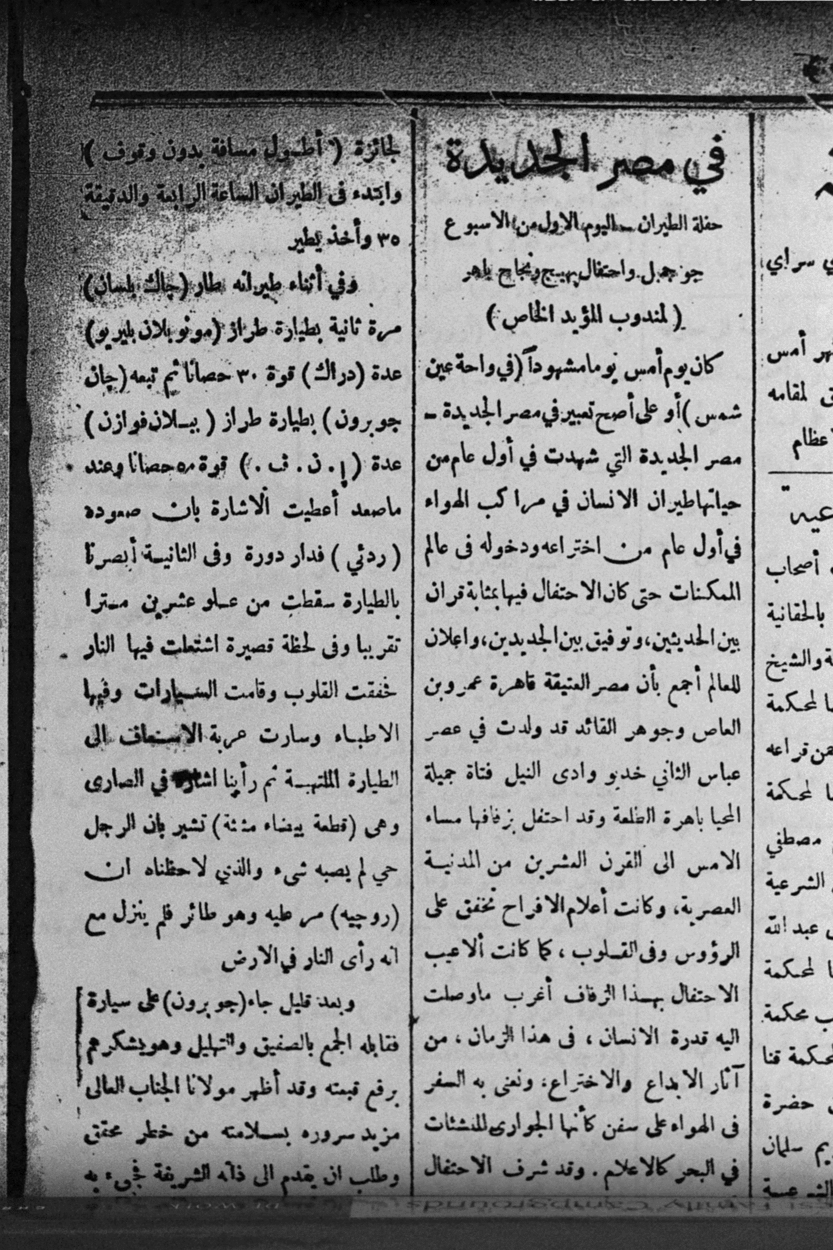
Description of the events of the first day of the Great Week of Aviation at Heliopolis in al-Mu'ayyad, 7 February 1910.

Khedive ‘Abbās Ḥilmī II, centre, in the grandstand at Heliopolis. To the left of him is his younger brother Muḥammad ‘Alī Tawfīq Rushdī Pasha. Photo courtesy of George Eastman House.

Implicit, if not explicit, in this editorial was the belief that Europeans would use the invention of the flying machine to expand, or strengthen their hold on, their colonial empires. The telegraph, railroad, tram, wireless, telephone, all these western inventions had, indeed, brought many benefits to humanity. But western powers had also used them to abet their imperial ambitions. In Egypt, all mechanical means of communication were under European, mainly British, control, even the Suez Canal. The British could be expected to control, or otherwise regulate, aviation in Egypt as well. Thus, Egypt would also be subjected to colonialism from the air. It is worthy of note that in February 1910, at the time of the Week of Aviation at Heliopolis, the British and Colonial Aeroplane Company was founded in Bristol and the following December it demonstrated several aircraft in India for the British Army.
On 20 November 1913, Jules Védrines landed at Heliopolis after departing from Nancy, France, thus making the first flight, in several stages, from Europe to Egypt. Following the outbreak of the First World War in 1914, the British took full control of Heliopolis, stationing a large number of troops there and using part of it for a prisoner of war camp for Turks. The British also turned the Palace Hotel at Heliopolis into a military hospital and then into a flying school.Footnote 60
A Voisin biplane in flight at Heliopolis. Photo courtesy of George Eastman House.

After the war, Britain continued to maintain control of Heliopolis as Egypt's primary aviation centre. In 1921, the Royal Air Force established an air route for mail from Heliopolis (Cairo) to Baghdad. In 1926 British Imperial Airways took over this link and made Heliopolis the hub of a system of air routes that soon extended east to Calcutta and south to Cape Town. It was from Heliopolis that aviation first connected the world-wide British Empire. It became the aviation equivalent of the Suez Canal as a critical node in Britain's imperial lifeline.Footnote 61 In 1932 the British grudgingly allowed the creation at Heliopolis of a tiny Egyptian Air Force, but it remained under British control and used British aircraft. The following year the British permitted, again with British aircraft, the establishment at Heliopolis of an Egyptian airline, Misr AirWork, which later evolved into Egyptian Airlines. Thus the Great Week of Aviation at Heliopolis, a European endeavour and financial ploy, contributed at first only to the strengthening of the British Empire, including British control of aviation in Egypt and subsequently in much of the Arab World. Egypt did not benefit until much later, and indirectly, from the Great Week of Aviation. This resulted from the British introduction of modern aviation and its necessary infrastructure, which was in place when the British finally left Egypt after the Suez War of 1956. By then Heliopolis had evolved into Cairo's first modern airport, Almazah.
Most of the flyers who participated in the meet soon faded from the headlines. A few of them met violent deaths. Baroness de Laroche was killed on 18 July 1919 in the crash of an aeroplane in which she was a passenger. On 2 April 1910, Le Blon was killed in a crash at sea. On 13 May 1910, Michelin was killed in a crash at Lyon. And on 25 June 1912, Latham was apparently killed by a water buffalo while hunting in Africa. Balsan, on the other hand, went on to help establish the Lafayette Escadrille, the squadron of the French Air Service in the First World War composed mostly of American volunteers.
And what of Baron Empain and the Heliopolis Oasis Company? For them the Week of Aviation at Heliopolis was an unqualified success. As they had hoped, this event attracted international attention, not only to wonderful feats of aviation but also to the company's development plans. This was evidenced by both the international press coverage and the presence of tens of thousands of spectators who were drawn to the emerging suburb. To be sure, the two large, luxurious, newly-opened hotels did a brisk business. But more important, large numbers of Europeans, both resident and non-resident, were introduced to the new development, and they began to purchase an increasing number of lots. In 1913, they purchased 99. In 1918, after the hiatus of the First World War, they bought 127. In 1913 Empain went so far as to build a cathedral in Heliopolis and arranged for the appointment of a Catholic bishop for the European residents!Footnote 62