Introduction
Severe sepsis and septic shock are common, expensive, and often fatal.Reference Adrie, Alberti and Chaix-Couturier1-Reference Martin, Mannino, Eaton and Moss4 Annually, approximately 750,000 cases occur in the United States at an associated estimated cost of $16.7 billion.Reference Angus, Linde-Zwirble and Lidicker5 Since 2001, there has been wide recognition of the importance and impact of early interventions in the treatment of septic patients. A systematic treatment protocol termed Early Goal Directed Therapy (EGDT), has conferred a 16% reduction in mortality when compared with usual care.Reference Rivers, Nguyen and Havstad6 The use of the EGDT is approaching the “standard of care” status for septic patients.Reference Dellinger, Carlet and Masur7, Reference Dellinger, Levy and Carlet8
Numerous hospital systems have developed protocols for out-of-hospital providers to alert teams in the emergency departments when they are transporting patients who will require prompt attention and numerous resources, such as patients with multiple injuries, stroke, or patients with myocardial infarctions.Reference Le May, So and Dionne9, 10 Improved recognition of sepsis may not only decrease time to treatment, but also may allow for advance notice to be provided to the receiving emergency department.
The Prehospital Sepsis Project is a multifaceted study that aims to improve the out-of-hospital care of patients with sepsis by means of knowledge translation and enhancement of skills. The objective of the Project was to assess the knowledge and attitudes in the principles of diagnosis and management of sepsis in a cohort of out-of-hospital care providers in United States.
Methods
This was a cross-sectional study. A 15-item survey was administered via the Web and e-mailed to multiple EMS list-servers. The evaluation consisted of four clinical scenarios as well as questions on the basics of sepsis. To test intra-rater reliability, the first and the fourth scenarios were identical.
A focus group was convened to develop survey items and the content of clinical scenarios. Factorial analysis was utilized in an effort to measure and equally distribute the weight of difficulty of each scenario in the pre- and post-intervention assessment. For intra-rater correlation, the first and fifth scenarios were identical in the long-term follow-up questionnaire.
Descriptive statistics and confidence intervals were used to present group characteristics. Chi-square testing and Fisher's exact testing were used to assess associations for categorical variables, along with the paired Student's t-test for continuous variables. Odds ratios were used as the measure of strength of association among these variables. Levine's Test for equality of variances was used to assess homogeneity of variance for continuous variables, and Student's t-test was used for the assessment of associations between these variables. Statistical significance was set at .05, and all P values are two-tailed. All analyses were performed with JMP IN for Windows Standard version (1989-2003, SAS Institute Inc., Cary, North Carolina USA).
Results
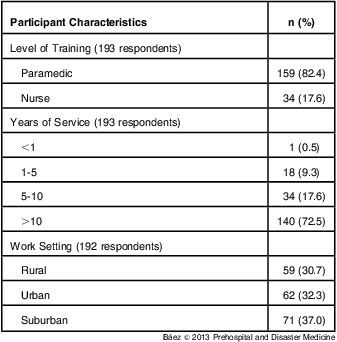
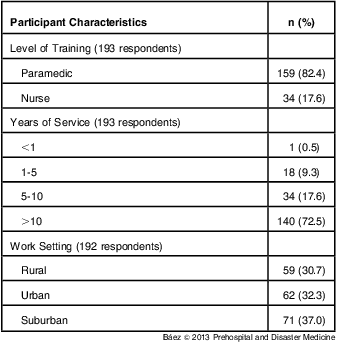
A total of 226 advanced EMS providers participated, with an 85.4% (n = 193) completion rate. Participants were from 32 states and 192 (99.5%) answered the question regarding work setting. Of these respondents, 30.7% (59 out of 192) worked in rural settings, 32.3% (62 of 192) in urban settings, and 37.0% (71 of 192) suburban settings.
The characteristics of the participants are described in Table 1. Of the respondents, 82.4% were paramedics and 72.5% had worked in EMS >10 years. Only 19 (11 paramedics and 8 nurses) of the 193 (9.8%) correctly responded to all scenarios correctly and only 57 (29.5%) participants scored both of the duplicate scenarios similarly, demonstrating limited understanding and great intra-rater unreliability. Only 47.7% (92 of 193) understood the differences between the Systemic Inflammatory Response Syndrome (SIRS) and sepsis.
Survey Participant Characteristics
The level of training was not a predictor of correctly scoring the scenarios (P = .71, RR = 1.25, 95% CI = .39-4.01), nor were years of service (P = .11, RR = 1.64, 95% CI = 0.16-1.21). Only 64.4% understood the clinical relevance of an elevated lactate level, whereas 73.2% believed that prehospital point of care lactate meters would be helpful to their practice. Additionally, 97.3% agreed that a brief Web-based teaching tool would be useful.
Discussion
While EMS providers realize that sepsis is an important disease process, and would like to learn more, <10% of respondents provided correct answers to questions on four clinical scenarios. Their levels of training and number of years on the job did not correlate with their performance in this Web-based module, indicating that further education on sepsis is needed widely.
Knowledge of sepsis is relevant to the EMS provider in that the prehospital team has first contact with the patient, and depending upon the system, is given variable leeway in triaging the patients to the appropriate care facility.Reference Mulholland, Cameron and Gabbe11 Improved recognition of the sepsis syndrome not only would allow the EMS team to appreciate a patients’ acuity, and presumably, lead to a more informed decision, but also would allow for improved communication between the crew and medical control or the receiving facility. As sepsis has been increasingly recognized by the medical community as an illness that requires immediate treatment and a large amount of resources, advance notification from EMS providers that they are transporting a septic patient may allow the receiving hospital to prepare for their arrival.
Furthermore, increased awareness of sepsis and its treatment could allow EMS providers to intervene earlier, and perhaps, more aggressively, by giving fluids and increasing the frequency of monitoring. These interventions are likely to be even more significant in the suburban or rural populations, in which transport times are longer than in urban setting.Reference Grossman, Kim and Macdonald12-Reference Gonzalez, Cummings and Phelan14
Numerous communities have invested in educating out of- hospital providers about chest pain, myocardial infarction, trauma, and stroke care, which allows for the development of advanced clinical protocols that begin in the prehospital setting.Reference Brice, Evenson and Lellis15, Reference Myers16 Teaching EMS providers about sepsis could allow for similar progress to be made in prompt recognition and treatment of this syndrome. Educational programs for EMS providers are effective at maintaining and improving knowledge and skills.Reference De Lorenzo and Abbott17, Reference De Lorenzo and Abbott18
An Internet-based teaching module is an effective tool for adult professional education. Online lectures previously have been used successfully to teach paramedic students.Reference Hubble and Richards19 Given that this study has demonstrated that providers of all training levels and from varied settings require more education on sepsis, a Web-based training module is a universal need.
Nearly all respondents expressed a desire to learn more about sepsis; an Internet-based teaching tool could improve knowledge and ultimately enhance clinical performance.
The limitations of this study include potential for self selection bias, in that participation in the study was voluntary, and only 85% of providers completed the modules. Data accuracy may have been affected.
Conclusions
Poor understanding of the principles of diagnosis and management of sepsis was observed in this cohort. This suggests a need for enhancement of education. Survey items will be used to develop a focused, interactive, Web-based learning program.
Abbreviations
- EMS:
Emergency Medical Services
- EGDT:
Early Goal Directed Therapy