INTRODUCTION
Concepts of food security have evolved over recent decades, from global issues to household and individual livelihood perspectives, and from a focus on hunger and macronutrient provision towards health and micronutrient sufficiency (Maxwell Reference Maxwell1996; Negin et al. Reference Negin, Remans, Karuti and Fanzo2009; Miller & Welch Reference Miller and Welch2013). The prevailing understanding adopted by major international organizations is that food security prevails ‘when all people at all times have access to sufficient, safe, nutritious food to maintain a healthy and active life’ (FAO 2015; WHO 2015).
It has been argued that sustainability, in addition to the concepts of availability, accessibility and utilization, should be explicitly included as a pillar of food security (Berry et al. Reference Berry, Dernini, Burlingame, Meybeck and Conforti2015). Particularly in fragile environments such as the Sahel region, where the effects of climate change are likely to impact severely on poor populations, the contribution of biodiversity to food systems and sustainability needs to be identified, preserved and strengthened (Arnold et al. Reference Arnold, Powell, Shanley and Sunderland2011; Sunderland Reference Sunderland2011; IPCC 2014; Townsend et al. Reference Townsend, Jaffee, Hoberg, Htenas, Shekar, Hyder, Gautam, Kray, Ronchi, Hussain, Elder and Moses2016).
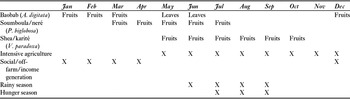
In the Sahel, woodlands and tree foods have the potential to contribute towards food security, livelihoods, and social and political security (Owusu et al. Reference Owusu, Abdulai and Abdul-Rahman2011; Nanama & Frongillo Reference Nanama and Frongillo2012; Ickowitz et al. Reference Ickowitz, Powell, Salim and Sunderland2014), adding to agricultural production at important times during the annual calendar of livelihood activities (Table 1).
Annual calendar for major tree crops, seasons and livelihood activities in Burkina Faso. Sources: Agence de Promotion de Produits Forestiers Non Ligneux (undated); Tincani (2012); and own elaboration.

Land tenure is an important determinant of livelihood strategies: traditionally, in Burkina Faso, land is distributed according to ethnicity (Brasselle et al. Reference Brasselle, Gaspart and Platteau2002). At a village level, the land chief is responsible for allocations to each clan head, who distributes the parcels among his people. Within the family, the head of the compound allocates usufruct rights to his wives and sons. Traditional tenure still precedes in importance the current legislative framework (Réorganisation Agraire et Foncière) dating from the 1990s, implementation of which has been delayed and is still limited (Cotula et al. Reference Cotula, Toulmin and Hesse2004; LeFaso.net 2012).
Much remains to be discovered about the gendered dimensions of tree management in Burkina, and of the dynamics underlying inter- and intra-household decision making about access to, harvesting and utilization of tree products in the household diet and economy. Whereas consumption of tree foods is viewed generally as a food insecurity coping strategy, the reality is complex: understanding the ecological, economic and social environments that drive people's decision making becomes paramount to the success of any initiative aimed at enhancing utilization of tree foods. In particular, women's access to land and economic roles in Burkina have been shown to be complex and nuanced (Kevane & Gray Reference Kevane and Gray1999), with more knowledge needed to guide policy interventions.
Burkinabé cuisine consists of cereal dishes and sauces based on diverse plant species. Meals with traditional sauces are relatively rich in important micronutrients (Avallone et al. Reference Avallone, Brault, Mouquet and Trèche2007). Shea fruit is rich in macronutrients (Teklehaimanot Reference Teklehaimanot2004) and many other trees are seen as key sources of food, nutrition and health (Glew et al. Reference Glew, Vanderjagt, Lockett, Grivetti, Smith, Pastuszyn and Millson1997; Gustad et al. Reference Gustad, Dhillion and Sidibé2004; Arnold et al. Reference Arnold, Powell, Shanley and Sunderland2011). Baobab is known for its versatility with a high nutritional content in the fruit, leaves, seeds and kernels, notably of calcium, lipids, dietary fibre and vitamins B and C (Chadare et al. Reference Chadare, Linnemann, Hounhouigan, Nout and Van Boekel2008). The flour produced from néré seeds is rich in macronutrients. The main product, soumbala, is often used in sauces. The tree is also valued for its contribution to soil fertility and the medicinal properties of the fruit, bark, roots and leaves (Tomlinson et al. Reference Tomlinson, Teklehaimanot, Traoré and Olapade1995; Teklehaimanot Reference Teklehaimanot2004; Leakey et al. Reference Leakey, Tchoundjeu, Schreckenberg, Shackleton and Shackleton2005).
Understanding household context, composition and decision making is critical for policies to enhance food security (Poole et al. Reference Poole, Chitundu and Msoni2013 a). In Burkina, household decision making is also strongly influenced by social and political mechanisms which mediate differential access to natural resources (Brasselle et al. Reference Brasselle, Gaspart and Platteau2002). In this paper, the Mooré term zaka has been translated as ‘compound’ and ‘complex household’ (French concession). A single compound can contain up to 40 people living within individual conjugal units. These conjugal units correspond to the ‘household’ (French ménage). A compound may comprise up to seven or more such ‘households’ or ménages, characterized by a hierarchy of age, gender and idiosyncratic factors. For this study, the single conjugal household has been analysed as the basic social, productive and reproductive unit.
Various modelling approaches have been developed to handle the complexities of intrahousehold relationships and decision making, to illuminate likely power, gender and intergenerational relations, and to explain management and decision making about ownership of, access to, and utilization of natural resources and products (Becker Reference Becker1976; Haddad et al. Reference Haddad, Hoddinott and Alderman1997; Beckett Reference Beckett2013). Empirical evidence in Burkina (L. Tincani, unpublished data 2012) has suggested a dynamic of negotiation and renegotiation by household members of entitlements to food and other resources with considerable differentiation between and within households in respect of gender responsibilities and seasonal food provisioning through farm production, food purchase and collection of tree foods.
This paper adopts an interdisciplinary livelihoods approach, drawing on both ecology and socio–economic concepts. It explores the interrelationship between the use of tree products and intrahousehold dynamics including gendered roles and responsibilities, and seeks further evidence for the hypothesis of negotiation as the household decision making model. We documented the current patterns of access to primary resources, the utilization of tree products for household consumption and sale, and resource conservation practices. The intention was to add new knowledge about the roles and responsibilities of members of the conjugal households for decision making about the tree resources, and to identify implications for policy approaches towards natural resources that can sustain and enhance the contribution of tree resources to food security and livelihoods. The research focused on products of three of the most important tree species in Burkina: baobab (Adansonia digitata), shea (Vitellaria paradoxa) and néré (Parkia biglobosa).
METHODS
There were two principal data collection methods: firstly, a questionnaire was designed based on themes emerging from a review of the literature; and secondly, focus group discussions were held at validation workshops. Key informant discussions were also held with local experts with whom the questionnaire was revised following testing.
Three contrasting areas of Burkina Faso were selected to capture agro–ecological and economic variation principally determined by different rainfall regimes and differential exposure to markets and trade in agrifood products. The first was in the drier northern region, more remote from national markets, with ten villages purposively selected in Passoré province. Similarly, ten villages were selected from four communes in Zoundwéogo and Nahouri provinces in the wetter southern part of the country, close to Ghana, with significant cross-border trade; ten villages were also chosen in eastern Burkina, in Gourma province.
Purposive sampling as the framework for research design imposes analytical limitations. However, it was considered to be the appropriate method for the exploratory approach, being an efficient and more certain means in an insecure environment (especially closer to the northern border with Mali) to ensure that villages, households and individuals interviewed could provide rich and relevant data about the tree resources and particular intrahousehold management and decision making phenomena. Selection of villages within the communes was based on information from key local informants to ensure the presence of the selected trees (baobab, shea, néré). Households were also purposively selected from among those involved in a group activity or an association that collects and transforms the specific tree products, in order to understand collective behaviours in tree resources management and to consider the impact of community-level interventions promoting conservation.
Respondents were female heads of households, in order to secure a gendered perspective on tree resources and intrahousehold management.
The questionnaire was structured in six sections with both closed and open questions: household social characteristics including education, age and gender structure; household assets and access to services and infrastructure; access to agricultural land and trees; utilization of products of baobab, shea and néré respectively, focusing on the roles and responsibilities of different household members and patterns of decision making; norms for harvesting, processing, consumption, access to markets and sale of tree products, and use of income; and tree management, replanting and regeneration practices.
Data were collected between October–December 2013. Enumerators were recruited from three partner organizations: SEMUS in the northern town of Yako (Passoré), NATURAMA in the southern town of Nobéré (Zoundwéogo/Nahouri) and AGED in the eastern town of Fada N'Gourma (Gourma). The final questionnaire, prepared in French, was administered in Mooré. Responses were recorded in French, translated to English and analysed in Excel. Triangulation and validation of results were conducted at two regional workshops in February 2014. Workshop data were recorded in note form in French and analysed by content and compared with the questionnaire data.
Data in the east were incomplete due to problems faced by the local enumerator in the field-level implementation of the questionnaire. After cleaning, descriptive statistics in the following results refer to 180 respondents (north = 100, south = 80). Percentage figures occasionally refer to a smaller total where there were missing data. Participants from the east were included in the southern validation workshop and their views have been represented in the discussion, and were found to be consistent with those from Zoundwéogo/Nahouri.
RESULTS
Household demography and assets
Respondents’ ages ranged from 20 to 70 years (mean = 39; SD = 10.8), with nine respondents in the north and six in the south without husbands.
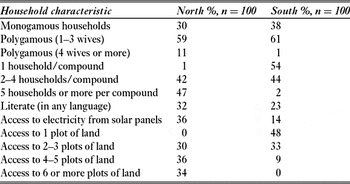
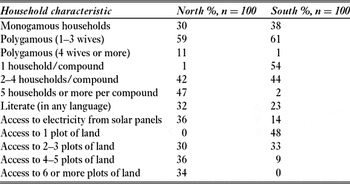
There were differences between northern and southern sites in respect of household structure (Table 2): compounds in the northern sample were larger in terms of number of households (Pearson Chi-Square p < 0.0001) and were more polygamous (Pearson Chi-Square p < 0.05) than in the south. Patterns of land ownership were more fragmented in the north.
Household demography and asset characteristics: summary descriptive statistics for northern and southern sites.
Women's access to land was through assignment of individual plots by their husbands (64%) or through various authority structures such as the lineage chief, land chief, village chief or head of the compound (32%). Only one woman said she had chosen the plot by herself. All other respondents reported that they had discussed and negotiated access with their co-wives and compound head.
Tree resources by household
In the north, where agriculture is more constrained by harsh climatic conditions, the women exploited products from a greater range of trees than women in the south, in terms of quantity harvested as well as diversity of products. Access to trees was usually mediated by husbands. A consensus was evident at the validation workshop in the south that the so-called ‘traditional’ social customs of male control were declining, leaving women with more freedom to exploit resources and market opportunities.
Baobab
Access and collection
Collection and utilization of baobab products differed between the northern and southern regions because of contrasting contexts. Household entitlements to land, and trees were generally mediated by men, but were not rigidly controlled: outsiders were able to negotiate access to products of private trees in order to feed their families, but not for the purpose of making commercial sales of the harvested products. Baobab on common land was for all community members on a first-come first-served basis. In the south, women were mainly responsible for leaves and fruit collection, with 78% of the respondents and 48% of their co-wives involved.
In the north, few respondents (20%) mentioned collecting the scarce baobab products. Secondly, in this area the participants commented that baobab is still a ‘man's tree’: in the north, almost all women (98%) stated their need to ask for their husband's or chief of household's permission to collect fruit, whereas in the south, only 58% of women asked for permission before collecting.
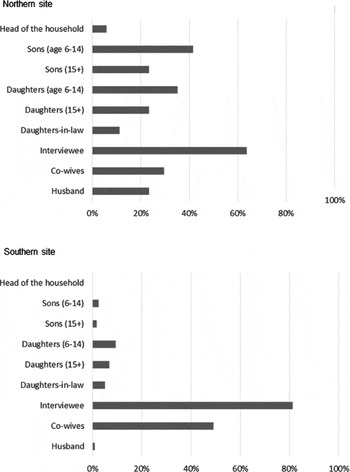
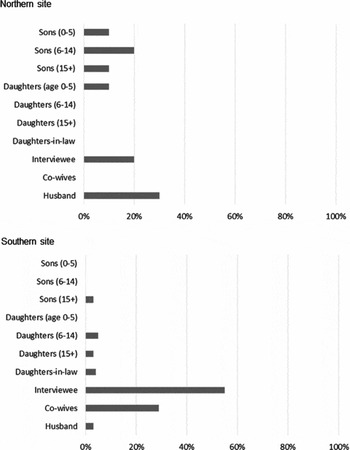
It is evident that all household members in the north, including men and boys, were involved in baobab collection. By contrast, in the south the harvesting responsibility was primarily that of adult women, with help from young daughters (Fig. 1).
Percentage participation by different household members and age groups by years in collection of baobab products in northern and southern sites.

During the workshops, it emerged that in the north baobab fruit and leaf collection was considered to be a man's task since the trees are tall and fruit collection by climbing was said to be dangerous and undignified for women.
Utilization
In the south, all households consumed baobab, compared to only 60% in the north, due to scarcity. Again in the south, cooking and processing the products was an activity exclusively for women, either undertaken by the respondents or their co-wives, daughters-in-law or young girls. About one-third of households in both sites sold baobab leaves and pulp, either dried or fresh.
The transformation process in the north was carried on by women, (according to 84% of the respondents), along with 42% of their co-wives, while 36% of the husbands were involved in the commercialization of baobab, especially when they faced cash needs.
Men were more involved in marketing in the north than in the south, because northern markets were more remote and transport was difficult. Most respondents (over 80%) agreed that sales usually followed shortly after collection. The respondents (44%) as well as their co-wives (44%), daughters-in-law (62%) and older daughters (aged 15 or more, 25%), with help from husbands (25%), decided together how much product to keep or sell.
Overall, the evidence suggested that income was kept by the male head of the household, but used towards common needs; only 17% of the women kept the money themselves. It was made clear by the women that nobody forced them to give the cash to their husband. Income was used to buy more product to process and resell (especially shea nuts, but also baobab fruits and néré powder), to start improvement works in the compound, and for general household expenses.
Replanting and regeneration
In the north, few respondents (9%) stated that they or someone in their compound had replanted baobab. In the north, this was for the most part a matter of custom: baobab trees were said to be sacred trees that ‘communicate with the land genii’. Trees should be planted by men only, and only following a specific rite. Moreover, entitlements were a matter of private property such that trees were not planted in the parklands. They were said to be difficult to grow from seed, and needed constant protection from people and animals. If women were allowed to support assisted natural regeneration (ANR) until the tree was strong enough, the husband or the owner of the field would subsequently assume responsibility.
The ubiquitous nature of baobab in the south meant that replanting and ANR were unnecessary.
Shea
Shea is one of the major rural income-generating products. Ownership of the tree was usually considered to be a matter of private property, and rights therefore were linked to the ownership of the land on which the tree was found. The use of fruits (the fleshy pericarp) was subject to little control: fruits were for anyone to consume as long as they left the nut (the oil-rich seed) on the ground. In both north and south, collection and processing of shea nuts were women's responsibilities almost entirely – respondents said that they shared the task with their co-wives. Although shea was said to be a ‘woman's tree’, workshop participants in the south commented that male participation in the utilization of the shea nuts – primarily for highly commercializable butter – was increasing.
Access and collection
Only three respondents out of 180 said that they did not collect shea products to sell or consume at home. The fruits were consumed during the soudure season before the onset of the rains, when agricultural tasks incurred major energy expenditure and when the stores of the previous year's cereals were low or exhausted. It was reiterated during the workshops that shea product handling is a women's activity and that men took no part. However, in the southern region, it was reported that men still had a role in tree management, as nearly 90% of the respondents had to ask permission from their husbands before collecting fruits.
Processing
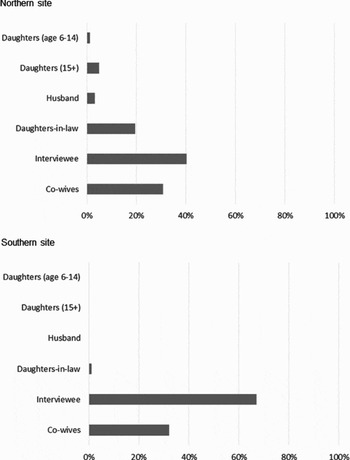
Transforming nuts into shea butter is almost exclusively a female activity. More than 90% of the respondents undertook the processing themselves, and in the south this was undertaken by respondents alone (67%) or with help from co-wives (32%) (Fig. 2). In the north respondents received help from co-wives (31%), daughters-in-law (19%), from daughters aged 6 and over (6%), and very occasionally, husbands (3%).
Percentage participation by different household members and age groups by years in shea processing in northern and southern sites.

Sales
The same women responsible for processing undertook the selection and sales of the finished product. Women included in a group or organization would sell the better product and keep the rest for home consumption. Money from sales was said to be more important than home consumption as the cash generated could contribute to the overall household wellbeing. Respondents reported that together with their co-wives, and sometimes with oldest daughters and daughters-in-law, they decided when to sell the finished product, either butter or soap.
In the north, it was evident that whenever it was necessary to travel, men were more involved in product transport, partly due to limited access to bicycles and partly because women were more likely to remain close to the compound to manage household tasks and children. Sales in the north were also made directly to itinerant traders. By contrast, women in the south frequently visited the local markets, and travelled to Ouagadougou and even into Ghana (91% of respondents and 45% of their co-wives).
In the southern area all respondents said that they either kept all the money or shared it with co-wives or daughters-in-law. In the north, income distribution was more fragmented: all of the women kept at least part of the income, but they shared it with their co-wives (64%), daughters-in-law (40%), daughters (4%) and husbands (3%).
Shea income, like baobab income, was invested in improvements in the compound, clothes, medicine and other household expenditures. However, during the workshop most women agreed that since they were the keepers of the shea income, they chose often to reinvest in kernels for further commercialization, or household utensils.
Replanting and regeneration
Replantation is important to maintain access to shea products, maintain tree cover and diversity, and to slow soil erosion. Whoever planted a shea tree retained specific rights to its products, both non-timber products and fuel wood. Just over half (52%) of the women from the northern area stated that they, or someone in their compound, had planted a shea tree in the past two years. In the north, 71% of respondents planted shea in the household field, therefore obviating the need for permission.
Women from the south commented that there is an abundance of shea trees and fruit and that replantation was unnecessary. Thus only 20% of respondents stated that they, or someone in their compound, had planted a shea tree in the past two years. The few women who had replanted had asked for permission of their husbands (12%) or negotiated access to land with their co-wives (50%).
Planting permissions were related to land ownership: it was reiterated that property rights were linked to where the trees are planted, as anyone who wants to plant a tree needs to inform the landowner. In fact, all the replanted trees were set in someone's personal field. Workshop participants insisted that this was not a question of definition of private property but a matter of maintaining harmonious relations with neighbours.
Néré
Access and collection
The néré tree has important cultural specificities. Workshop participants commented that it was a symbol of land ownership, strongly linked to male control. In the north it still plays a central role in customary laws on tenancy. Traditionally, planting a néré tree means wanting to own the land, and such an action might be followed by sanctions, misfortune and death. However, the discussions suggested that the increasing economic, geographical and climatic constraints, the new national laws adopted over recent years and the impact of foreign projects were leading to a progressive modification of the local tenurial and other customs.
Néré fruit was highly prized, and all the women were conscious of the importance of the fruit from a nutritional – or at least culinary – perspective. Nevertheless, in the north use of néré trees was rare: only 9% of respondents were said to collect néré products, and none of them would sell it due to the small quantity harvested. Where it was collected, the task was primarily a responsibility of women, but men and boys participated.
By contrast, in the south, 93% of the respondents collected néré products, and 40% of them sold néré at local markets (Fig. 3). There was negligible involvement by men and boys in the south.
Percentage participation by different household members and age groups by years in the collection of néré in northern and southern sites.

Processing
During the dry season, soumbala provides a rich substitute for other foods. Processing the seeds of néré into soumbala and cooking or integrating it into a sauce was undertaken exclusively by women (co-wives, daughters-in-law), who also decided how much would be kept or sold. The percentage of husbands helping was lower than 5%, due to social and cultural reasons and also to the division and management of household chores.
Sales
All of the women from the south stated that néré was kept and sold when either prices were higher or when the household needed cash. Women were responsible for that decision, and they claimed that they knew market prices well. They were accustomed to go to market with co-wives and daughters-in-law, walking or by bicycle; néré was sold at the local village market (57%), at another village market (48%), even to distant villages or larger towns (12%). Women were able to keep this income, sharing it with the co-wives when they were part of the process, and usually reinvesting it in daily household expenses and improvements to the compound.
Replanting and regeneration
Only 5% of respondents in the north – or someone in their household – had replanted a néré tree; by contrast, 30% had replanted trees in the south. When asked about the replantation rate during the workshops, women agreed that they had not mastered the technique and usually failed when trying to replant from seeds; moreover, a lack of nursery facilities was reported. The various organizations working in the area concentrated on replanting shea, baobab and trees other than néré.
While co-wives and daughters-in-law were responsible for replantation, 24% of the husbands were involved, and it was they who gave permission to replant (95%), and decide where the tree must be replanted (90%). The principal household field was the replanting site for 75% of respondents. Everyone who replanted a tree was positive about having specific rights to its products, fruits, leaves, bark and wood.
DISCUSSION
The results are supportive of the literature that sees its people and skills as the chief resource of the Sahel (Mortimore Reference Mortimore2010), able to adapt to environmental challenges and successfully negotiate traditional norms of entitlements. Significant gender differences were rooted in cultural norms for different tree species.
Stakeholder discussions highlighted the important contribution of tree products to food security during the soudure season when granaries are empty and the new harvest is awaited, and how tree product utilization by women serves as a mechanism for managing exchange, marketing and consumption through the seasons.
Entitlements to trees are linked to land in complex ways. Traditional patterns of male control of tenure and practices for tree management and product commercialization are influential in the north, but some gender roles are changing, particularly in the south, where economic opportunities are increasing.
Unitary concepts of household decision making do not apply in such complex household structures, and there was no evidence of non-cooperative bargaining. Consensus building was achieved through negotiation, between husbands and wives, among co-wives, and between households and the wider community (Haddad et al. Reference Haddad, Hoddinott and Alderman1997).
The results draw attention to the indigenous skills needed to manage complex social, economic and environmental interactions. Contrary to the poverty–environment discourse that starts from the premise that poor people cause environmental degradation, local people contribute significantly to the conservation and contribution of natural resources and to sustainable rural livelihoods (Kristensen & Lykke Reference Kristensen and Lykke2003; Gray & Moseley Reference Gray and Moseley2005; Reij et al. Reference Reij, Tappan, Smale, Spielman and Pandya-Lorch2009). They show how the different tree products are utilized for food security and culinary purposes as well as income generation (Avallone et al. Reference Avallone, Brault, Mouquet and Trèche2007; Coulibaly-Lingani et al. Reference Coulibaly-Lingani, Tigabu, Savadogo, Oden and Ouadba2009).
Evidence from the workshops suggested that there are unexploited opportunities for enhanced woodland management through domestication and ANR, but also that these opportunities are circumscribed by cultural norms, or ‘social conservatism’ (Bernard et al. Reference Bernard, Collion, de Janvry, Rondot and Sadoulet2008). This is true especially in the north where the need for sustainable exploitation is greater due to more severe ecological conditions and where tree products are also more vital to diets and livelihoods. Thus the ‘social conservatism’ narrative is consistent with the statistically significant differences found between compound and household structures in the north and south.
The importance of studying tree resources and utilization in the less-favoured northern site illustrates the contrast with, for example, the richer agricultural south-west of Burkina, where utilization of the wide range of available trees is limited to only a few species, and conservation practices have been found to be minimal (Augusseau et al. Reference Augusseau, Nikiéma and Torquebiau2006). Also, the potential for collective organization of womens’ activities demonstrated elsewhere is endorsed here (Kent et al. Reference Kent, Bakaweri and Poole2014; Sidibé et al. Reference Sidibé, Vellema, Dembélé, Témé, Yossi, Traoré and Kuyper2014).
Nested within complex and idiosyncratic household structures, gender and age factors strongly influence collaborative responsibilities and patterns of utilization. Authority structures and intrahousehold interactions govern the collection, processing, marketing and conservation practices for the different species in different ways and in different regions.
Implications
Policies and project interventions need to take into account a series of implications. Primarily, the complexity of human relationships is evident at multiple scales: between regions; at the community level where local authorities exercise a degree of control over natural resources; within a typical compound of households; among men and women within and between the constituent households; and where not just gender but also age defines productive roles and responsibilities. Above all, the consensual basis for community and household decision making provides a fertile environment for intervention and innovation.
Development initiatives should build on womens’ agency and capacities to incorporate tree resources in their food and livelihood strategies. While women's other household responsibilities constrain collective enterprise, interventions such as conservation initiatives as well as product processing and marketing need a gendered and tree-specific approach in order to build on local norms and capacities (Kevane & Gray Reference Kevane and Gray1999). Development initiatives should recognize the agency of local people in land management and their capacity to adapt livelihood strategies to changing agro–ecological and institutional environments (Gray & Kevane Reference Gray and Kevane2001; Cotula et al. Reference Cotula, Toulmin and Hesse2004).
Selective involvement of young girls – and even boys – in some of the activities is notable, with important implications for socialization generally. In particular, there are opportunities for awareness raising, for example in local schools, about the interrelationships between natural resources, conservation management, food security and economic dimensions of livelihoods (Poole et al. Reference Poole, Alvarez, Vazquez and Penagos2013 b).
Enhancing tree product utilization is most important where tree resources are least rich but dependence is greatest for sustaining food security. Each of the three species studied has significant nutritional and commercial potential, somewhat underexploited, and highly seasonal, with imperatives for conservation and multiplication, and greater employment creation and income-earning opportunities, especially for women.
Above all, there is a need for domestication and dissemination of planting and regeneration technologies, especially in the north despite – even because of – the ecological constraints (Poole Reference Poole2004). The potential for integrating woodland and agriculture can also be exploited (Wilson et al. Reference Wilson, Brook and Tomlinson1998). While land tenure arrangements in Burkina are complex, and while the traditional village order prevails (Brasselle et al. Reference Brasselle, Gaspart and Platteau2002), ANR is a viable way of leveraging the local social norms and constraints attached to tree planting and land ownership. Thereby, local skills and knowledge can be employed to enhance agro–ecological management in fragile environments (Mortimore Reference Mortimore2010). ANR still has to be negotiated with the primary landowner (husband, chief of household, lineage, land, village), but women are for the most part allowed to protect naturally-grown trees. Landowners do not see ANR as a threat because the land genii ‘allowed the tree to be born in their land’, and thus nobody planted it in order to claim the land for him or herself.
Considering the significance of néré, there is a need to research and expand the conservation, multiplication and dissemination of the tree.
Limitations and further research
The sampling limitations suggest caution in generalizing the findings. Survey data collection took place over a two-month period and the validation workshops within one week, outside the main harvesting seasons. The reliance on recall by respondents for data about highly seasonal and sometimes idiosyncratic phenomena means that some relevant information is likely to have been missed. Overall, comments from key informants and the results of the validation workshops suggest that there can be substantial confidence in the representativeness and validity of the data.
Modelling decision making about consumption and sale of highly seasonal tree products requires more, and more sensitive, data. Livelihood concepts were limited to natural resource-based dimensions and have not covered the diversity of strategies, including labour, migration and use of remittances which are increasingly important in Burkina, but were beyond the scope and intention of this paper.
ACKNOWLEDGEMENTS
The research was partially funded by the Food and Agriculture Organization of the United Nations (FAO). It was part of an initiative by the Trade and Markets Division of the FAO to analyse patterns of smallholder market participation. Thanks for assistance in data collection are due to M. Inoussa Savadogo (Passoré), M. Halidou Sawadogo (Zoundwéogo and Nahouri), and M. Yves Basson (Gourma). Thanks are also due to El Mamoun Amrouk and Jamie Morrison of FAO who provided guidance on the methodological framework.