Introduction
This paper suggests an appropriate framework for making inferences from econometric models prepared for of antidumping, countervailing duty, and safeguard investigations (trade remedy investigations) in the US. This approach is also appropriate for econometric models in other legal proceedings or even general research. For example, the approach could be used for econometric models that have been designed to provide evidence of conspiracy, the presence of market power, the nature or relevant markets, the likelihood of anticompetitive effects, the fact of injury, and the quantification in antitrust proceedings.Footnote 1
‘Injury’ in trade remedy investigations is defined by the laws governing the investigation. For antidumping and countervailing duty investigations, ‘material injury’ is defined as ‘harm which is not inconsequential, immaterial, or unimportant’.Footnote 2 The law directs the US International Trade Commission (USITC) to consider (1) the volume of imports of the subject merchandise, (2) the effect of imports of that merchandise on prices in the United States for domestic like products, and (3) the impact of imports of such merchandise on domestic producers of domestic like products in the context of production operations within the United States.Footnote 3 Global safeguards require that the injury or threatened injury be ‘serious’ and that the increased imports must be a ‘substantial cause’ (important and not less than any other cause) of the serious injury or threat of serious injury.Footnote 4 Consequently, this paper will focus on the impact of changes in imports on the price for which the domestic good is sold, one of several possible proxies for injury.
Inferences made from these models in many cases have been limited to testing whether coefficients are statistically different from zero and using point estimates in simulations. For example, Prusa and Sharp (Reference Prusa and Sharp2001) infer that the impact of subject imports on the price of domestically produced cold-rolled steel is close to zero because their estimate of the impact is not statistically different from zero. However, a standard two-tailed confidence interval constructed from their estimates is so wide that little about the magnitude or even the sign of true parameter can be inferred from their estimate.
This paper suggests an approach to inference that accounts for the precision of the estimate by reporting confidence intervals and p-values. With this approach, estimates which are found to be statistically insignificant are not discarded or ignored and ones which are found to be significant are not necessarily treated as precise estimates.
Typical use of inference
Incorporating standard errors into inference is typically done using hypothesis tests or confidence intervals. A hypothesis test uses a parameter's point estimate and standard error to test whether the true value of the parameter is different from a hypothesized value.Footnote 5 The most typical hypothesis test is whether the true value of the parameter is equal to zero, commonly, but loosely, referred to as the test for statistical significance. Results from a hypothesis test can be reported either by assuming a level of significance and reporting whether or not the hypothesis is rejected or by reporting the p-value, which is the lowest significance level at which the hypothesis could be rejected. A confidence interval uses the parameter's point estimate and standard error to construct a range of probable values of the true parameter value.
Confidence intervals and p-values are more flexible uses of inference than testing whether a hypothesis is rejected or not at a fixed level of significance. P-values assume a hypothesis, but can be evaluated at various levels of confidence, while confidence intervals use a fixed level of confidence, but can be used to evaluate various hypotheses. The ABA Section of Antitrust Law (2005) indicates that courts should avoid relying solely on sharply defined statistical tests since there is some arbitrariness in choosing a hypothesis.Footnote 6 Instead, they encourage reporting the p-value or a confidence interval over reporting whether a hypothesis has been rejected or not because it conveys useful information to courts regardless of whether the hypothesis is rejected.Footnote 7
The usual test for statistical significance is an example of a two-tailed test because the null hypothesis can be rejected by observing values that are either sufficiently greater or sufficiently smaller than zero. A one-tailed tailed test, on the other hand, seeks to reject the null with an alternative that the true parameter differs in a particular direction – positive or negative – and is conducted by asking whether the estimate is, respectively, sufficiently greater or sufficiently smaller than the value in the null hypothesis. An example of a one-tailed test would be testing whether a parameter is positive. Although not used as commonly as one-tailed hypothesis tests, one-sided confidence intervals that focus on whether the true parameter value is positive or negative can also be constructed.Footnote 8 Since economic theory usually suggests the sign of the impact of a potential cause of injury, one-tailed hypothesis tests are usually appropriate for making inferences about injury analysis.Footnote 9
Much economic research makes inferences based on whether a point estimate is statistically significant. Zilak and McCloskey (Reference Ziliak and McCloskey2004) finds that most articles – published in one of the top journals in economics (the American Economic Review) during the 1980s and 1990s – do not distinguish between statistical and economic significance. They point out that even though statistical significance is neither necessary nor sufficient for a finding to be economically important, an overwhelming majority of economists believe that statistical significance is necessary and that a majority believe it is sufficient.
Typical models of injury
It is important to understand the structure of a typical model of injury when making inferences. Typically, a price, volume, or profit margin has been used as the proxy for the effect of subject imports, while the proxy for the domestic like products is typically the price of the domestically produced good. Most models also include control variables for other factors affecting imports, including prices of substitute goods and downstream goods, general economic conditions, input prices, and capacity utilization. Some papers formally derive either reduced form or structural supply and demand equations, while others assume linear or log-linear supply and demand equations. For example, Charles Rivers Associates (2000) estimate a reduced form equation where the price of domestically produced Expandable Polystyrene Resins (EPS) depends on a one-month lag of the prices of US produced, subject imports, and non-subject imports of EPS; a one-month lag of the price of styrene, and residential construction activity.Footnote 10
It is not clear what the proxy for imports should be in safeguard investigations, since factors such as demand may affect imports. Some indicate that the total change in imports should be considered when estimating the impact of imports, while others indicate that only changes in imports resulting from the change in foreign excess supply should be used. For example, Pindyck and Rotemberg (Reference Pindyck and Rotemberg1987) include all changes in imports when estimating injury, while Grossman (Reference Grossman1986) measures imports as any exogenous shift in foreign excess supply, ignoring changes in import supply resulting from changes in price in the US or other factors inside the US market that may affect import demand.Footnote 11
The appropriate test for injury depends on the statute governing the investigation. In antidumping and countervailing duty investigations in the US, the relevant standard is that the impact from subject imports rises to the level of material injury. Since material injury is not quantitatively specified by statute, some impacts greater than zero could be found to not be injurious. Therefore, confidence intervals allow for flexibility in determining how large the impact from subject imports is. For global safeguard investigations in the US, the relevant standard is that injury from imports is important and not less than any other cause of injury (this is also referred to as serious injury). Therefore, it seems to be appropriate to test both whether the estimated injury attributed to imports is important and whether it is greater than the estimated injury attributed to other potential causes of injury in safeguard investigations, as Grossman (Reference Grossman1986) does.
Examples of inference of injury
Some models prepared for trade remedy investigations use p-values or confidence intervals in analyzing injury. For example, Grossman (Reference Grossman1986) uses p-values in making inferences on the impact of several potential causes of injury for the US steel industry and finds that the impact is sensitive to the period examined.Footnote 12 He finds that there is less than a 1% probability that employment losses attributable to import competition are greater than those attributable to a general secular trend between 1976 and 1983, but that the probability that these losses are greater increases to more than 20% between 1979 and 1983.Footnote 13 Therefore, we would expect other analyses of injury that focus on data for 1976 to 1978 to provide better evidence of injury than analyses that focuses on data for 1979 to 1983.
Inferences for models prepared for many other trade remedy investigations rely on whether a particular hypothesis is rejected or not at a fixed level of significance. For example, Prusa and Sharp (Reference Prusa and Sharp2001) indicate that both the statistical insignificance and the small magnitude of their estimate of the impact of the price of subject imports on the price of domestically produced cold-rolled steel is evidence that subject imports did not injure the domestic industry.Footnote 14 Their point estimate implies that a 10% decrease in the price of subject imports would lower prices for domestically produced cold-rolled steel by about 0.2%. However, the estimated coefficients and standard errors indicate that their model does not estimate either the sign or magnitude of the coefficients with a high level of confidence, adding a great amount of uncertainty to their estimated impact of subject imports.
Confidence intervals and p-values for econometric estimates of injury
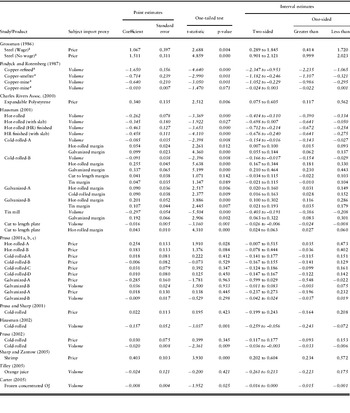
Table 1 reports estimates from a variety of models prepared for trade remedy investigations. Typically these models used the price of the domestically produced product as the proxy for injury. Assuming that subject imports and the domestically produced product are substitute products to some extent, increases in the price of subject imports should increase the price of the domestically produced product, while an increase in the volume of subject imports should decrease the price of the domestically produced product. Increases in the profit margin for upstream goods should increase the price of the domestically produced product (and also the price of subject imports). Therefore, coefficients of the effect for subject import prices and profit margins of upstream goods on the domestic price are expected to be positive and coefficients for subject import volumes are expected to be negative.
Summary of point estimates and standard errors from selected econometric modelsFootnote 1

Notes: Interval estimates and p-values were calculated at a 95% level of confidence by the author from coefficients, standard errors, and t-statistics provided in each of the studies. Injury proxies that are expected to have an inverse relationship with the dependent variable are in italics. The one-tailed test is a test of whether the actual coefficient has the expected sign; positive when the subject import proxy is price or a profit margin and negative when the subject import proxy is volume. The two one-sided confidence intervals range from the ‘greater than’ value to +∞ and from −∞ to the ‘less than’ value with a 95% level of confidence.
1 The proxy for injury (dependent variable) is the price of domestically produced good unless otherwise noted.
2 The proxy for injury (dependent variable) is employment.
3 The proxy for injury (dependent variable) is output.
In addition to showing the reported estimated coefficients and standard errors, Table 1 also provides the test statistic for the test that the coefficient is positive (for estimates that should be positive) or negative (for estimates that should be negative), and my calculations for the p-value of this hypothesis and both one-sided and two-sided confidence intervals at the 95% level of confidence.Footnote 15 Both one-sided and two-sided confidence intervals show that even for estimates that are significantly different from zero, the width of the confidence interval can vary widely. The widths of these confidence intervals imply that any simulation using these estimates may also vary widely when the standard errors are accounted for. For example, the coefficient which has the highest t-statistic (5.638) in Table 1 (the impact of the hot-rolled margin on the price of domestically produced cold-rolled steel (‘B’ specification)) for Hausman (Reference Hausman2001) has a two-sided confidence interval which varies from 0.167 to 0.344.
Table 1 demonstrates that statistically significant estimates can sometimes be stronger evidence that the impact is smaller than estimates that are not statistically significant. For example, even though the estimated impact of subject imports from Carter (Reference Carter2005) is statistically significant while a similar estimate from Tilley (Reference Tilley2005) is not, the much smaller standard error for the Carter (Reference Carter2005) estimate yields stronger evidence that the impact of imports is small.Footnote 16 The Carter (Reference Carter2005) estimate indicates that there is a 95% chance that the actual impact of a 1% increase in subject imports of frozen concentrated orange juice is a decrease in the futures price by less than 0.015% (from −0.015% to +∞), while the estimate from Tilley (Reference Tilley2005) indicates that a 1% increase in subject imports would lower the futures price by less than 0.223% (from −0.223% to +∞), with 95% confidence.
Table 1 also demonstrates that more precise estimates sometimes provide stronger evidence of small impacts than smaller point estimates with larger standard errors. For example, consider elasticities from Prusa and Sharp (Reference Prusa and Sharp2001) and Prusa (Reference Prusa2002) which both estimate the impact of the price of subject imports on the US cold rolled steel industry. Despite having both a larger estimated coefficient and t-statistic, the estimate from Prusa (Reference Prusa2002) can be used to say that actual elasticity is less than 0.153 (from −∞ to 0.153), with 95% confidence, while the estimate from Prusa and Sharp (Reference Prusa and Sharp2001) only indicates that the actual elasticity is less than 0.208 (from −∞ to 0.208), with the same level of confidence.
Accounting for standard errors in simulations
It is important to report any simulations using confidence intervals and p-values, since relying solely on point estimates provides a false sense of precision. Simulations using point estimates for the 2002 cold-rolled steel antidumping investigation produced very different simulation results. Hausman (Reference Hausman2002) found that the increase in the volume of subject imports between 1999 and 2001Footnote 17 caused 41.2% of the decline in the price of US produced cold-rolled steel. On the other hand, Prusa (Reference Prusa2002) found that the increase in the volume of subject imports between 1996 and 2001Footnote 18 caused the average domestic price of cold-rolled steel to decrease by less than $1 per ton or less than 1%.Footnote 19 Prusa (Reference Prusa2002) also found that the decrease in the price of subject imports caused the price of domestically produced cold-rolled steel to fall by less than $3 per ton during the same period. It is not surprising that their simulation results are different since each study defined imports of cold-rolled steel differently, specified different models, used different sample periods for model estimation, and used different time periods for their simulations.Footnote 20
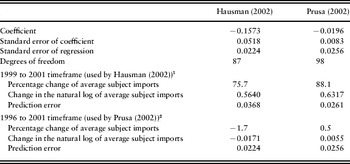
Table 2 compares the point estimates, standard errors, and change in imports used by Hausman (Reference Hausman2002) and Prusa (Reference Prusa2002) to simulate the impact of changes in the volume of subject imports.Footnote 21 The point estimate for Prusa (Reference Prusa2002) is much smaller than the one for Hausman (Reference Hausman2002), although both are significantly different from zero at the 95% significance level. Table 2 shows that subject imports increase by more during the 1999 to 2001 timeframe than the 1996 to 2001 timeframe. The 75.7% increase in subject imports as defined by Hausman (Reference Hausman2002) was a 1.7% decrease during the 1996 to 2001 timeframe used by Prusa (Reference Prusa2002). The 0.5% increase in subject imports as defined by Prusa (Reference Prusa2002) was a 88.1% increase during the 1999 to 2001 timeframe used by Hausman.
Estimated effect of subject import volumes on the domestic price of cold-rolled steel

1 Notes: Change in average subject imports between November 1999 to March 2000 and April 2000 to May 2001.
2 Change in average subject imports between 1996 to 1997 and 2000 to 2001.
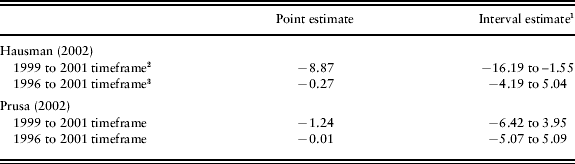
Table 3 shows that the probability that subject imports have a negative impact on the US price (p-value) is higher for each of the models when the 1999 to 2001 timeframe used by Hausman (Reference Hausman2002) is applied. The probability of subject import volumes having at least some negative impact on the domestic price is 99% and 68% for the Hausman (Reference Hausman2002) and Prusa (Reference Prusa2002) models respectively when using the 1999 to 2001 timeframe, which decrease to 45% and 50% respectively using the 1996 to 2001 timeframe. Therefore, there is little evidence of a negative impact from subject imports using the 1996 to 2001 timeframe with both models, and at least some evidence of a negative impact with both models using the 1999 to 2001 timeframe.
P-value of subject imports having a negative impact on the price of cold-rolled steel

Notes:1 Change in average subject imports between November 1999 to March 2000 and April 2000 to May 2001.
2 Change in average subject imports between 1996 to 1997 and 2000 to 2001.
Table 4 reports confidence intervals for the simulated impact of subject imports using estimates from both models and during both the 1996 to 2001 and 1999 to 2001 timeframes. Focusing just on the point estimate reported in the first column of the table, it seems that the Prusa (Reference Prusa2002) estimate shows a very small impact from imports for both timeframes and the Hausman (Reference Hausman2002) estimate shows a very small impact for the 1996 to 2001 timeframe and a much larger impact for the 1999 to 2001 timeframe. The two-sided confidence interval for the simulations using the Prusa (Reference Prusa2002) model indicates that the impact varies from a 6% negative impact on price to a 5% positive impact on the price with 95% confidence. This implies that even using the 1996 to 2001 timeframe, the estimates suggest an impact of up to as much as $24 per ton with 95% confidence, compared to the impact of less than $1 per ton calculated from their simulation using only the point estimate.
Simulated impact of subject imports on the price of cold-rolled steel (percentage change)
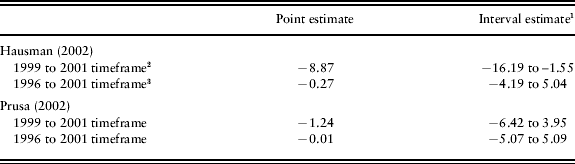
Notes:1 Two-sided 95% confidence interval estimate.
2 Change in average subject imports between November 1999 to March 2000 and April 2000 to May 2001.
3 Change in average subject imports between 1996 to 1997 and 2000 to 2001.
The impacts also vary for the Hausman model, from about a 16.19% decline to a 1.55% decline for the 1999 to 2001 timeframe, and a 4.19% decline to a 5.04% increase for the 1996 to 2001 timeframe. If it is assumed that the point estimate of −8.87 represents an impact of 41.1% of the change in the price of cold-rolled steel,Footnote 22 then the confidence interval indicates that subject imports of cold-rolled steel explain anywhere from about 7% to 75% of the change in the price for cold-rolled steel.
It is clear that differences between the estimates from the two models are not due to inference as much as they are due to the difference in the estimated coefficients and time periods used in their simulations. However it is also true that relying entirely on the point estimates provides a false sense of precision.
Conclusion
Reporting confidence intervals and p-values provides a guide to the inferences that can be made from econometric models of injury. In some cases, estimates that are statistically significant provide more compelling evidence of a small impact than less precise estimates that are not statistically significant. Also, larger point estimates that are more precisely estimated can provide stronger evidence that the impact is small than estimates with smaller point estimates and larger standard errors. Accounting for the standard error will also provide a sense of how precise estimates are. In some instances this may indicate that any inference from the estimates is inconclusive, but in other instances it will provide additional confidence that the estimates are precisely estimated.
The ABA Section of Antitrust Law (2005) indicates that most useful econometric analyses do not reach definitive conclusions on the ‘cosmic’ issues such as defining the relevant market or determining if a merger is likely to be anticompetitive, but instead shed light on these ‘cosmic’ issues.Footnote 23 Likewise, econometric models prepared for trade remedy investigations would have more of an impact on USITC determinations if they used confidence intervals and p-values to identify insights and data patterns important to injury analysis rather than attempting to make definitive conclusions about injury based on statistical significance.