Introduction
Thyroid hormone (TH) plays an essential role in brain development and is important for regulating several fundamental neurobiological processes (e.g., neurogenesis, neuronal migration, synaptogenesis, and myelination; Bernal & Nunez, Reference Bernal and Nunez1995). If the brain is exposed to insufficient TH, transcription of TH-dependent genes will be altered leading to structural and functional abnormalities in specific brain regions (Bernal, Reference Bernal2007; Zoeller & Rovet, Reference Zoeller and Rovet2004). One structure that is especially vulnerable to TH deficiency is the hippocampus (Gilbert & Paczkowski, Reference Gilbert and Paczowski2003), which is essential for learning and memory (Eldridge, Knowlton, Furmanski, Bookheimer, & Engel, Reference Eldridge, Knowlton, Furmanski, Bookheimer and Engel2000). Animal models of TH deficiency during different gestational periods show abnormalities in neurogenesis, neuronal migration, and synaptic function within the hippocampus, as well as learning and memory impairments (Ausó et al., Reference Ausó, Lavado-Autric, Cuevas, Escobar del Rey, Morreale de Escobar and Berbel2004; Berbel et al., Reference Berbel, Navarro, Ausó, Varea, Rodríguez, Ballesta and Morreale de Escobar2010; Reid, Kim, Page, O'Mara, & O'Hare, Reference Reid, Kim, Page, O'Mara and O'Hare2007).
In humans, it is well established that the hippocampus plays a major role in memory encoding and retrieval due to its unique capacity to bind distinct pieces of information into a coherent representation for later recollection (Eichenbaum & Bunsey, Reference Eichenbaum and Bunsey1995; Ranganath, Reference Ranganath2010). The ability to retrieve autobiographical memories (AM), especially vivid contextual details from past events, appears to be particularly sensitive to hippocampal damage and dysfunction (Moscovitch et al., Reference Moscovitch, Rosenbaum, Gilboa, Addis, Westmacott, Grady and Nadel2005; McAndrews, Reference McAndrews2012). Recent research on typically developing children and adults shows that AM consists of two distinct components: (1) episodic AM or memory for events within a specific time and place, and (2) semantic AM or memory of facts or knowledge unrelated to a specific event (Levine, Svoboda, Hay, Winocur, & Moscovitch, Reference Levine, Svoboda, Hay, Winocur and Moscovitch2002; Willoughby, Desrocher, Levine, & Rovet, Reference Willoughby, Desrocher, Levine and Rovet2012). Importantly, findings from neuroimaging and lesion studies of hippocampal damage indicate the hippocampus appears to be more critical for episodic AM than for semantic AM (Addis, Moscovitch, & McAndrews, Reference Addis, Moscovitch and McAndrews2007; Rosenbaum et al., Reference Rosenbaum, Moscovitch, Foster, Schnyer, Gao, Kovacevic and Levine2008; Steinvorth, Levine, & Corkin, Reference Steinvorth, Levine and Corkin2005; St-Laurent, Moscovitch, Levine, & McAndrews, Reference St-Laurent, Moscovitch, Levine and McAndrews2009). Although several studies of TH deficiency have revealed various memory deficits suggestive of hippocampal damage (e.g., Oerbeck, Sundet, Kase, & Heyerdahl, Reference Oerbeck, Sundet, Kase and Heyerdahl2005; Wheeler, Willoughby, McAndrews, & Rovet, Reference Wheeler, Willoughby, McAndrews and Rovet2011), no study to date has evaluated AM in individuals with early TH deficiencies.
Two clinical populations known to experience early TH deficiency are children born to women who were hypothyroid during pregnancy (HYPO) and children with congenital hypothyroidism (CH). In the first half of gestation, the fetus is entirely dependent on the maternal TH supply because the fetal thyroid gland is not sufficiently developed to secrete its own TH until the second trimester and is not fully functional until birth (Calvo et al., Reference Calvo, Jauniaux, Gulbis, Asuncion, Gervy, Contempre and Morreale de Escobar2002). Although fetal production of TH increases over the course of gestation, maternal TH continues to play a supplementary role in late gestation that compensates for any fetal TH insufficiencies (Morreale de Escobar, Obregon, & Escobar del Rey, Reference Morreale de Escobar, Obregon and Escobar del Rey2004). However, in cases of maternal hypothyroidism, the fetus receives insufficient maternal TH, which can impact on the developing fetal brain (Zoeller & Rovet, Reference Zoeller and Rovet2004). CH, by contrast, arises from a structural or functional defect of the fetal thyroid gland (Zoeller & Rovet, Reference Zoeller and Rovet2004). Children with CH typically receive sufficient maternal TH in early gestation; however, they become TH-deficient in late gestation as the maternal contribution wanes (Vulsma, Gons, & de Vijlder, Reference Vulsma, Gons and de Vijlder1989) and they remain TH-deficient until diagnosed and treated postnatally. Studies of children with CH show that they have verbal and visuospatial memory impairments (Oerbeck et al., Reference Oerbeck, Sundet, Kase and Heyerdahl2005; Rovet, Reference Rovet1999; Song, Daneman, & Rovet, Reference Song, Daneman and Rovet2001) and reduced hippocampal size (Wheeler et al., Reference Wheeler, Willoughby, McAndrews and Rovet2011) relative to controls. Although children born to hypothyroid women (HYPO) exhibit similar visuospatial impairments as CH (Man, Brown, & Serunian, Reference Man, Brown and Serunian1991; Mirabella et al., Reference Mirabella, Westall, Asztalos, Perlman, Koren and Rovet2005), no study has yet examined verbal episodic memory or hippocampal volumes in HYPO. Importantly, no study has specifically examined episodic AM in either CH or HYPO.
Accordingly, this study sought to evaluate AM in TH-deficient children relative to controls using a new tool developed in our lab, the Children's Autobiographical Interview (CAI; Willoughby et al., Reference Willoughby, Desrocher, Levine and Rovet2012). The CAI is a modified version of the Autobiographical Interview (AI) for adults (Levine et al., Reference Levine, Svoboda, Hay, Winocur and Moscovitch2002), which separately assesses episodic and semantic AM within a single autobiographical narrative. The CAI is particularly useful for studying AM in children because it: (a) provides an objective and reliable measure of episodic AM (i.e., total number of details recalled), (b) subdivides episodic AM details into specific subcategories for further investigation, and (c) allows for the examination of different levels of retrieval support (Levine et al., Reference Levine, Svoboda, Hay, Winocur and Moscovitch2002). Numerous studies using the AI have shown that adult patients with hippocampal damage exhibit impairments in episodic AM, but not semantic AM (Addis et al., Reference Addis, Moscovitch and McAndrews2007; Rosenbaum et al., Reference Rosenbaum, Moscovitch, Foster, Schnyer, Gao, Kovacevic and Levine2008; Steinvorth et al., Reference Steinvorth, Levine and Corkin2005; St-Laurent et al., Reference St-Laurent, Moscovitch, Levine and McAndrews2009). However, no study has examined both episodic and semantic AM in children exposed to TH deficiency. Thus, the goal of the current study was to compare AM performance in CH, HYPO, and controls. Based on studies of adults with hippocampal damage, we expected that relative to controls, CH and HYPO would exhibit weaknesses in episodic but not semantic AM. In addition, to investigate whether children who experienced more severe TH deficiency exhibit poorer episodic AM, we examined whether abnormal TH values during gestation for HYPO and at birth or diagnosis for CH, predicted recollection of fewer episodic AM details.
Method
Participants
Eighty-five children (47% male) between the ages of 9 and 14 years (M = 10.44; SD = 1.10) participated in this study. They included 26 CH, 27 HYPO, and 32 controls, most of whom were participants in a larger longitudinal study of a cohort followed since birth.
The CH group was recruited from our longitudinal study (N = 15), other recent studies in our lab (N = 2), or from the Endocrine Clinic at The Hospital for Sick Children (SickKids) (N = 9). All CH participants except one were diagnosed through the Ontario newborn TSH screening program. The exception was a male born outside of Canada and diagnosed at 15 days of age. The CH group included 9 children with athyrosis (absent thyroid gland), 14 with ectopic (abnormally located) glands, and 1 with dyshormonogenesis (defect in TH synthesis), which concurs with most estimates of the distributions of etiologies (Stoppa-Vaucher, Van Vliet, & Deladoëy, Reference Stoppa-Vaucher, Van Vliet and Deladoëy2011). Two CH had unknown etiologies because the child was diagnosed abroad or the parents refused the technetium scan to determine etiology. One CH participant had both a learning disability and ADHD, two had a learning disability, and one had ADHD.
The HYPO group was recruited entirely from the longitudinal study. Most mothers were originally solicited during pregnancy from local endocrinologists or obstetricians, while the remainder were recruited from the Sickkids’ Motherisk program. Eighty-three percent of mothers had pre-existing hypothyroidism before pregnancy and 17% were diagnosed during pregnancy. One HYPO participant had both a learning disability and ADHD, while two others had ADHD.
Controls were recruited from the longitudinal study (88%) or recent studies in our lab. For all participants, exclusionary criteria were prenatal exposure to alcohol or other teratogens, head injury, chronic medical condition, IQ score < 80, or a psychiatric diagnosis other than ADHD. Additional exclusionary criteria for controls were a learning disability and ADHD. Data from four HYPO participants were excluded because one had a frontal dysembryoplastic neuroepithelial tumor and three had mothers who had normal TH values throughout pregnancy. Two controls with either a learning disability or ADHD were also excluded. Thus, the final sample consisted of 79 participants (47% male) with a mean(SD) age of 10.48(1.12) years, including 26 CH, 23 HYPO, and 30 controls. All participants were fluent in English. Family Hollingshead SES scores (Hollingshead, Reference Hollingshead1975) ranged from 26 (low income) to 76 (high income; M = 50.02, SD = 10.00).
General Procedure
All parents provided written consent for participation in this study while participants provided verbal assent. Participants were tested individually in the Psychology Department at SickKids over 2 days, separated by 4.5 months. On Day 1, intelligence was assessed and on Day 2, AM was assessed using the Children's Autobiographical Interview (CAI). One examiner (K.W.) conducted all interviews except one CH participant who was interviewed by a second trained examiner. Upon completion of the study, participants received a certificate of participation and two movie gift certificates; and parents were compensated for transportation. All procedures were approved by SickKids’ Research Ethics Board and University of Toronto's Office of Research Ethics.
Biomedical Information on Participants
The two TH indices assessed were total thyroxine (T4), produced by the thyroid gland, and thyroid stimulating hormone (TSH), produced by the anterior pituitary gland. TSH functions via a negative feedback loop known as the hypothalamus-pituitary-thyroid axis (Bernal & Nunez, Reference Bernal and Nunez1995). Normally, if TH levels are low, the hypothalamus stimulates the pituitary gland to release TSH, which stimulates the thyroid gland to produce T4 (Bernal & Nunez, Reference Bernal and Nunez1995). In hypothyroidism; however, thyroid gland production of T4 is impaired, causing an accumulation of TSH. Because elevated TSH is typically a more sensitive and reliable measure of thyroid dysfunction than circulating T4 levels, the TSH blood test has become the gold standard for diagnosing hypothyroidism (Glinoer & Spencer, Reference Glinoer and Spencer2010). In the current study, the following data were available: TSH and T4 at diagnosis in CH, maternal TSH in each trimester in HYPO, and newborn screening TSH levels in both groups. TH information was obtained from medical health records at SickKids for CH and from the participants’ family physicians for HYPO.
Demographic Information and Intelligence
Demographic information was obtained from a parental report questionnaire collecting information on child's age, sex, primary language, overall health, learning and behavior, and family SES. Intelligence was assessed using the Vocabulary and Matrix Reasoning subtests of the Wechsler Abbreviated Scale of Intelligence (WASI; Wechsler, Reference Wechsler1999), which yields an estimate of Full Scale IQ.
Children's Autobiographical Interview
To assess episodic and semantic AM using the CAI, participants recalled two specific AMs that occurred within the last 3 years but not within the past month (see Appendix A for instructions). To assist with memory retrieval, participants were shown a list of 18 sample events (see Appendix B). The CAI has three distinct phases: free recall, general probe, and specific probe. In the free recall phase, participants described as many details as they could remember until either the end of their description was reached or 5 min had elapsed. Then, general probes were given to encourage greater recall of details or to narrow down overly-general or multiple-event descriptions. Finally, participants answered a series of standardized questions/probes that served to promote retrieval of any episodic details that were not recalled in the previous phases (e.g., “When did this event take place?”). To prevent the specific probe process from contaminating recall of the second event, specific probing was administered after both events were described in free recall and general probe phases.
Scoring Protocol for the Children's Autobiographical Interview
Each participant's tape-recorded interview was transcribed and scored according to the Autobiographical Interview Scoring Manual (Levine et al., Reference Levine, Svoboda, Hay, Winocur and Moscovitch2002). The text was segmented into two categories of details: episodic (internal) and non-episodic (external). Details were defined as episodic if they were directly related to the event described, specific in time/place, and conveyed a sense of episodic re-experiencing. These details were then assigned to one of five episodic detail subcategories: event, place, time, perceptual, and emotion/thought (see Appendix C for an example). The perceptual detail subcategory was further subdivided into visual (e.g., colors, objects not directly involved in the event, and object characteristics) and non-visual (e.g., sounds, smells, tastes, tactile sensations, body position, location of objects, etc.) detail categories. The remaining details were considered non-episodic and assigned to one of four non-episodic detail subcategories: semantic facts, unsolicited repetitions of previously recalled details, other metacognitive statements, and external event details unrelated to the main event recalled (see Appendix C).
For each episodic and non-episodic subcategory, details were tallied and summed to form total episodic and non-episodic composite scores for each phase of the CAI. Each AM was also assigned qualitative experimenter ratings assessing episodic richness, time, place, perception, emotion/thought, and time integration (see Levine et al., Reference Levine, Svoboda, Hay, Winocur and Moscovitch2002, for further descriptions). An experimenter-rating composite was created by summing the five ratings pertaining to episodic re-experiencing (e.g., episodic richness, time, place, perception, and emotion/thought). The time integration rating, reflecting one's ability to integrate the event into a larger time scale or life history, was assessed separately. For each participant, AM detail scores and experimenter ratings were averaged across their two AMs.
All memories were first scored by K.W. To assess reliability, 38% of the AMs were randomly selected from within each group and re-scored by a second trained individual. Both scorers were masked to participants’ group, age, and sex. Inter-rater reliability was assessed using intra-class correlations (one-way random effects model; McGraw & Wong, Reference McGraw and Wong1996) and coefficients for total episodic/non-episodic details were 0.99/0.80 for free recall, 0.97/0.97 for general probe, and 0.91/0.72 for specific probe. Coefficients for the episodic subcategories ranged from 0.71 to 0.95 and for the non-episodic subcategories, 0.70 to 0.84. Discrepancies between raters were resolved by discussion.
Data Analysis
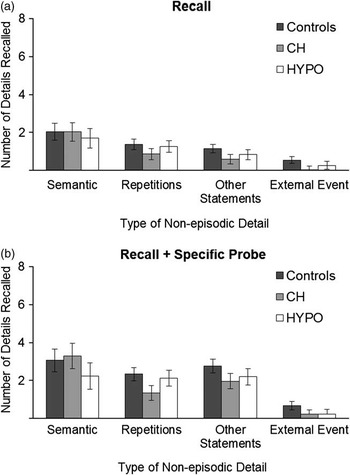
Given that few details were recalled during the general probe phase, details from the free recall and general probe phases were combined to form a single “Recall” condition. This condition was analyzed separately from a “Recall + Specific Probe” condition, which consisted of participants’ cumulative scores across all three phases of the CAI. All variables of interest were examined for outliers (i.e., >3 SD) and any found were replaced with the highest or lowest score from that group (e.g., CH, HYPO, CON) using Winsorization. All variables were examined for deviations in skewness and kurtosis and any variable that exceeded the cutoff (±2) was corrected using log10 transformation. Only one variable, external event details from the Recall condition, exceeded the cutoff for skewness and kurtosis after transformation. Because most participants recalled very few external event details in the Recall condition (see Figure 3.5a), this variable was excluded from the analyses.
Group differences in sex distribution were analyzed via chi-square while age and SES were examined using univariate analyses of variance (ANOVAs). IQ was compared using univariate analyses of covariance (ANCOVAs) with age and sex as covariates. AM scores were assessed using separate mixed-factor ANCOVAs (applying Greenhouse-Geisser correction), which combines between-subjects and repeated-measures variables. The between-subjects variable was group (CH, HYPO, CON) and, the repeated-measures variable was either detail category (episodic/non-episodic) or detail subcategory (event, place, time, perceptual and emotion/thought for episodic details; or semantic details, repetitions, and other statements for non-episodic details). Covariates were age, sex, and retention interval (M = 1.12 years; SD = 0.73 years; averaged across the two AMs). Separate analyses were conducted for Recall and Recall + Specific Probe conditions. Group differences in visual versus non-visual episodic details and in experimenter ratings were explored using ANCOVAs with age, sex, and retention interval as covariates.
Finally, hierarchical linear regressions were used to determine whether elevated maternal TSH values for HYPO and elevated TSH values at birth or at diagnosis for CH significantly predicted total episodic details, after controlling for age, sex, and retention interval. All analyses were performed in SPSS version 17. The overall significance level was set at p < .05 and effect sizes are reported as partial eta squared (ηp2).
Results
Demographic and Biomedical Data
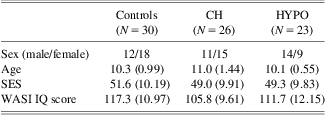
Demographic data are presented in Table 1. Groups did not differ in SES or sex; however, significant differences were found in age, F(2,76) = 4.73; p = .012; ηp2 = 0.11, and IQ, F(2,74) = 6.82; p = .002; ηp2 = .16. Post hoc comparison revealed that CH were significantly older than HYPO, F(1,47) = 7.40; p = .009; ηp2 = 0.14, and controls, F(1,54) = 4.59; p = .037; ηp2 = 0.08, and had lower IQ scores than HYPO, F(1,45) = 4.16; p = .047; ηp2 = 0.09, and controls, F(1,52) = 15.36; p < .001; ηp2 = 0.23 (see Table 1 for group means). HYPO did not differ from controls in IQ (p = .128).
Frequency scores, group means, and standard deviations (in parentheses) for demographic measures and intelligence
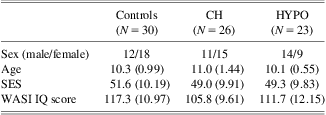
Note: WASI = Wechsler Abbreviated Scale of Intelligence.
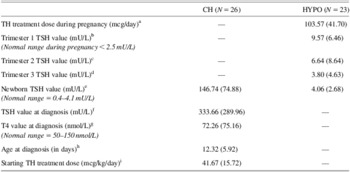
As shown in Table 2, CH participants had elevated TSH values at birth and at diagnosis. Most CH participants also had T4 values below the normal range. In the HYPO group, all mothers had TSH values above the trimester-specific cutoff during at least the first two trimesters of pregnancy, with highest TSH values observed in the first trimester, most likely due to inadequate TH treatment or lack of treatment in de novo cases. Finally, the majority of HYPO participants had newborn TSH values within the normal range, signifying they experienced prenatal, but not postnatal TH deficiency. Although TSH values were slightly elevated in six HYPO cases (M = 6.38 mU/L), none were considered high enough to warrant diagnosis of CH.
Group means (standard deviations) for early thyroid stimulating hormone (TSH) values and thyroid hormone (T4) values

Note: TSH = thyroid stimulating hormone; higher TSH levels indicate more severe TH deficiency; T4 = thyroxine; lower T4 levels indicate more severe TH deficiency.
aNine missing cases.
bFour missing cases; 95% of cases were elevated above 2.5 mU/L.
cFive missing cases; 78% of cases were elevated above 2.5 mU/L.
dSeven missing cases; 56% of cases were elevated above 2.5 mU/L.
eSix missing CH cases and 7 missing HYPO cases.
fTwo missing cases.
gSix missing cases.
hOne missing case.
iTwo missing cases.
Group Differences in AM in the Recall Condition
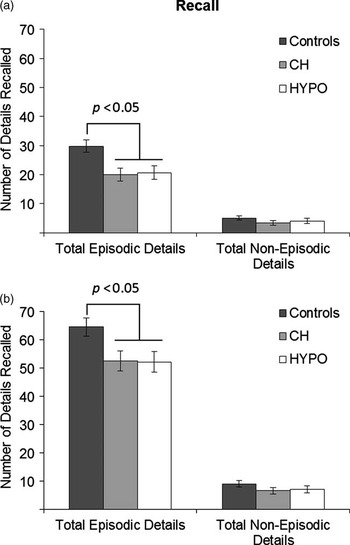
First, groups were compared for total episodic and non-episodic details in the Recall condition (see Figure 1a for group means). Results revealed a significant effect of group, F(2,73) = 5.85; p = .004; ηp2 = 0.14, and a significant group-by-detail category interaction, F(2,73) = 6.11; p = .004; ηp2 = 0.14. Post hoc ANCOVAs indicated that controls recalled more episodic details than CH, F(1,51) = 9.06; p = .004; ηp2 = 0.15, and HYPO, F(1,48) = 6.16; p = .017; ηp2 = 0.11 (CON M = 30.00; CH M = 21.04; HYPO M = 19.22). CH and HYPO groups did not differ in episodic details (p = .640) and all groups reported a similar number of non-episodic details (p = .366)
Group means for the number of total episodic and total non-episodic details recalled across the two conditions: Recall (a) and Recall+Specific Probe (b). Error bars indicate standard error of the mean and group means reflect values after controlling for age, sex, and retention interval.

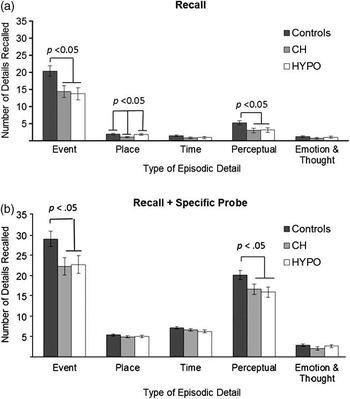
Next, group differences in the episodic details subcategories were examined (see Figure 2a). Results indicated a significant main effect of group, F(2,73) = 5.61; p = .005; ηp2 = 0.13, and a significant group-by-detail subcategory interaction, F(2,73) = 4.12; p = .011; ηp2 = 0.10. Post hoc ANCOVAs indicated that controls recalled more event details than CH, F(1,51) = 5.90; p = .019; ηp2 = 0.10, and HYPO, F(1,48) = 5.80; p = .020; ηp2 = 0.11 (CON M = 20.42; CH M = 14.73; HYPO M = 13.09), as well as more perceptual details than CH, F(1,51) = 4.39; p = .041; ηp2 = 0.08, and HYPO, F(1,48) = 4.33; p = .043; ηp2 = 0.08 (CON M = 5.12; CH M = 3.31; HYPO M = 2.80). In addition, CH recalled fewer place details than controls, F(1,51) = 7.34; p = .009; ηp2 = 0.13, and HYPO, F(1,44) = 6.51; p = .014; ηp2 = 0.13 (CON M = 1.93; CH M = 1.29; HYPO M = 1.70). No other significant group differences were found in the episodic subcategories. Finally, group differences in the non-episodic detail subcategories were examined (see Figure 3a); however, no significant effects were found.
Group means for the number of details recalled in each episodic detail subcategory across the two conditions: Recall (a) and Recall+Specific Probe (b). Error bars indicate standard error of the mean and group means reflect values after controlling for age, sex, and retention interval.

Group means for the number of details recalled from each non-episodic detail subcategory across the two conditions: (a) Recall and (b) Recall + Specific Probe. Error bars indicate standard error of the mean and group means reflect values after controlling for age, sex, and retention interval.

Group Differences in AM in the Recall + Specific Probe Condition
Examination of group differences in total episodic and non-episodic details in the Recall+Specific Probe condition revealed a significant effect of group, F(2,73) = 3.92; p = .024; ηp2 = 0.10, and a significant group-by-detail category interaction, F(2,73) = 4.28; p = .017; ηp2 = 0.11 (see Figure 1b). Post hoc analyses indicated that controls recalled more episodic details than CH, F(1,51) = 5.58; p = .022; ηp2 = 0.10, and HYPO, F(1,48) = 5.48; p = .023; ηp2 = 0.10 (CON M = 65.10; CH M = 52.67; HYPO M = 50.85). There was no significant difference between CH and HYPO for episodic details (p = .533) and groups did not differ in non-episodic details (p = .299).
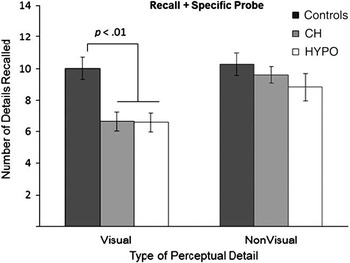
For the episodic details subcategories in the Recall + Specific Probe condition, results indicated a significant main effect of group, F(2,73) = 4.43; p = .015; ηp2 = 0.11, and a significant group-by-episodic detail subcategory interaction, F(2,73) = 2.76; p = .040; ηp2 = 0.07 (see Figure 2b). Post hoc ANCOVAs indicated that controls recalled more event details than CH, F(1,51) = 4.89; p = .032; ηp2 = 0.09, and HYPO, F(1,48) = 4.39; p = .041; ηp2 = 0.08 (CON M = 29.35; CH M = 22.38; HYPO M = 22.04), as well as more perceptual details than HYPO, F(1,48) = 4.60; p = .037; ηp2 = 0.09, and at a trend-level, CH, F(1,51) = 3.50; p = .067; ηp2 = 0.06 (CON M = 20.35; CH M = 16.52; HYPO M = 15.48). When the perceptual detail subcategory was subdivided into visual and non-visual details, a significant group difference was found for visual details, F(2,73) = 7.22, p = .001; ηp2 = 0.17, but not for non-visual details (p = .514; see Figure 4). Post hoc ANCOVAs indicated that controls recalled more visual details than CH, F(1,51) = 9.01; p = .004; ηp2 = 0.15, and HYPO, F(1,48) = 9.12; p = .004; ηp2 = 0.16, (CON M = 10.02; CH M = 6.77; HYPO = 6.59). CH and HYPO did not significantly differ in any of the episodic subcategories, and all three groups did not differ in the non-episodic detail subcategories (see Figure 3b).
Group means for the number of visual and non-visual details recalled in the Recall+Specific Probe Condition. Error bars indicate standard error of the mean and group means reflect values after controlling for age, sex, and retention interval.

Finally, group differences were examined for the experimenter rating composite and time integration rating. Groups did not differ significantly on either rating score; however, controls had slightly higher scores than CH and HYPO for both the experimenter rating composite (CON M = 16.47; CH M = 15.87; HYPO M = 15.76) and time integration (CON M = 2.60; CH M = 2.52; HYPO M = 2.35).
Effects of TH Deficiency Severity on Episodic AM
Hierarchical linear regressions revealed no significant relation between TSH values in CH and HYPO groups and total episodic details recalled in the Recall + Specific Probe condition.
Discussion
This study represents the first investigation of episodic and semantic AM in children with early TH deficiency. Relative to controls, CH and HYPO groups both exhibited weaknesses in episodic, but not semantic, AM. This finding is consistent with the adult literature showing impaired episodic AM but preserved semantic memory in patients with developmental amnesia (Rosenbaum et al., Reference Rosenbaum, Carson, Abraham, Bowles, Kwan, Köhler and Richards2011; Vargha-Khadem et al., Reference Vargha-Khadem, Gadian, Watkins, Connelly, Van Paesschen and Mishkin1997, Reference Vargha-Khadem, Salmond, Watkins, Friston, Gadian and Mishkin2003) or temporal lobe epilepsy (St-Laurent et al., Reference St-Laurent, Moscovitch, Levine and McAndrews2009; Viskontas, McAndrews, & Moscovitch, Reference Viskontas, McAndrews and Moscovitch2000). Thus, early TH deficiency appears to have a similar detrimental impact on episodic AM as seen in other conditions associated with hippocampal damage.
In particular, children with early TH deficiency had specific weaknesses in recalling event and perceptual details from past events, especially within the visual domain. Interestingly, St-Laurent et al. (Reference St-Laurent, Moscovitch, Levine and McAndrews2009) also found poor recollection of perceptual/visual details in adult patients with temporal lobe epilepsy and significant hippocampal atrophy. These findings correspond with evidence indicating that the hippocampus plays an important role in visual imagery and rich perceptual re-experiencing of past events (Gilboa, Winocur, Grady, Hevenor, & Moscovitch, Reference Gilboa, Winocur, Grady, Hevenor and Moscovitch2004; Rubin & Greenberg, Reference Rubin and Greenberg1998). Previous research on children with TH deficiency has shown that visuospatial impairments are consistently observed in both CH and HYPO groups (Man et al., Reference Man, Brown and Serunian1991; Mirabella et al., Reference Mirabella, Westall, Asztalos, Perlman, Koren and Rovet2005; Oerbeck et al., Reference Oerbeck, Sundet, Kase and Heyerdahl2005; Rovet, Reference Rovet1999). Thus, our results suggest that early TH deficiency may impair the ability to encode and/or retrieve visual information. However, our results also indicate that the impairment associated with TH deficiency is not just confined to impoverished visual memory, given that both CH and HYPO showed significant difficulty recalling the main event details. As in other cases of hippocampal damage, this effect appears to reflect a more general adverse effect on the ability to retrieve (and perhaps encode) highly contextualized information. Clearly, further investigation and replication of these data are required.
Interestingly, CH and HYPO participants showed no significant benefit from the provision of retrieval support in that their weaknesses in episodic AM were similar across both Recall and Recall+Specific Probe conditions. This finding is consistent with studies using the AI in adult patients with hippocampal damage, who also show no benefit of retrieval support (Rosenbaum et al., Reference Rosenbaum, Moscovitch, Foster, Schnyer, Gao, Kovacevic and Levine2008, Reference Rosenbaum, Carson, Abraham, Bowles, Kwan, Köhler and Richards2011; Steinvorth et al., Reference Steinvorth, Levine and Corkin2005; St-Laurent et al., Reference St-Laurent, Moscovitch, Levine and McAndrews2009). In contrast, patients with damage to the prefrontal cortex do show a benefit from retrieval support (in the form of specific probing), presumably because they have difficulty engaging in strategic retrieval operations (McKinnon et al., Reference McKinnon, Nica, Sengdy, Kovacevic, Moscovitch, Freedman and Levine2008; Svoboda et al., Reference Svoboda, Hynes, Campbell, Dade, Moscovitch and Levine2002). Thus, our results suggest that the episodic AM weaknesses observed in children with early TH deficiency are more closely aligned with retrieval deficits associated with medial temporal, rather than prefrontal, dysfunction.
Despite the fact that CH and HYPO participants experienced slightly different periods of TH deficiency (i.e., prenatal for HYPO, and late prenatal/early postnatal for CH), they showed similar AM performance, with one exception. Specifically, the HYPO group was indistinguishable from controls in recalling place details, whereas the CH group recalled fewer place details than both groups. This finding warrants further investigation particularly since animal models show that the hippocampal dentate gyrus, which is important for spatial learning (Gilbert & Sui, Reference Gilbert and Sui2006), is particularly vulnerable to late prenatal and early postnatal TH insufficiency (Gilbert & Paczkowski, Reference Gilbert and Paczowski2003; Rami, Rabie, & Patel, Reference Rami, Rabie and Patel1986). Our finding that CH and HYPO both exhibit similar weaknesses in AM may seem surprising, given that different structural abnormalities within the hippocampus have been associated with different timing of TH insufficiency in rodents (Ausó et al., Reference Ausó, Lavado-Autric, Cuevas, Escobar del Rey, Morreale de Escobar and Berbel2004; Berbel et al., Reference Berbel, Navarro, Ausó, Varea, Rodríguez, Ballesta and Morreale de Escobar2010; Gilbert & Paczowski, Reference Gilbert and Paczowski2003). However, animal models of CH and HYPO have shown that both conditions result in similar abnormalities in synaptic function and memory performance (Liu et al., Reference Liu, Teng, Shan, Yu, Gao, Wang and Zhang2010; Reid et al., Reference Reid, Kim, Page, O'Mara and O'Hare2007). In addition, human studies have shown that CH and HYPO groups exhibit similar visuospatial impairments (Man et al., Reference Man, Brown and Serunian1991; Mirabella et al., Reference Mirabella, Westall, Asztalos, Perlman, Koren and Rovet2005; Oerbeck et al., Reference Oerbeck, Sundet, Kase and Heyerdahl2005). Here, we show for the first time that CH and HYPO groups also exhibit similar weaknesses in episodic AM. Further research is needed to ascertain whether this pattern extends to other forms of episodic memory, since the literature on adults with temporal lobe epilepsy indicates that the AM retrieval deficit is not affected by factors such as timing (i.e., for events before vs. after onset of recurrent seizures) or degree of hippocampal insult (e.g., pre- vs. post-excision of the hippocampus), which can influence other aspects of episodic memory (McAndrews, Reference McAndrews2012).
This study has important implications for the treatment of both maternal and congenital hypothyroidism. Our findings of significant episodic AM weaknesses in children born to treated hypothyroid women and children with early-treated CH suggest that both conditions were inadequately treated and required more vigilant and frequent monitoring of TH levels. Fortunately, new guidelines for the management of maternal hypothyroidism (De Groot et al., Reference De Groot, Abalovich, Alexander, Amino, Barbour, Cobin and Sullivan2012; Stagnaro-Green et al., Reference Stagnaro-Green, Abalovich, Alexander, Azizi, Mestman, Negro and Wiersinga2011) and CH (American Academy of Pediatrics, 2006) have recently been published.
Although the present study provides critical new insights into the effects of early TH deficiency on episodic AM, it has several limitations. First, we could not verify the details of each AM to assess the accuracy of participants’ recollections. However, an investigation of children's AM using a staged autobiographical event that allowed for independent verification of AM details has shown similar results as the present study across CH, HYPO, and control groups (Willoughby, Reference Willoughby2011). Second, it was not possible to determine whether the episodic AM weaknesses in HYPO and CH reflect: (a) poor encoding of contextual details at the time of the event, (b) poor retrieval of these details at the time of testing, or (c) a combination of these two impairments. At least some evidence in the literature on AM deficits in adults suggest that retrieval must play a prominent role, as such deficits are found for experiences that clearly predate onset of certain neurological conditions such as epilepsy (Viskontas et al., Reference Viskontas, McAndrews and Moscovitch2000), stroke (Steinvorth et al., Reference Steinvorth, Levine and Corkin2005), and Alzheimer's Disease (Seidl, Lueken, Thomann, Geider, & Schröder, Reference Seidl, Lueken, Thomann, Geider and Schröder2011). Given that this type of analysis cannot be done in a neurodevelopmental disorder, further investigation is required to examine the effects of early TH deficiency on various memory processes. Third, we did not include a measure of verbal ability, which could have influenced the breadth of responses. However, verbal ability would not be expected to differentially influence episodic versus semantic AM, nor the specific detail subcategories that differentiated the groups.
Fourth, early TH deficiency impairs neurobiological processes within several other brain regions that are central to the AM neural network (Bernal & Nunez, Reference Bernal and Nunez1995; Chan & Rovet, Reference Chan and Rovet2003), and damage to these regions may have contributed to the episodic AM weaknesses observed in CH and HYPO. Fifth, our CH and HYPO participants were recruited from several different sources and their TH values were obtained from different laboratories, and physicians which may have introduced variability within each group and led to our inability to detect an association between AM and TH. Sixth, a few CH and HYPO participants had learning disabilities or ADHD. We chose not to eliminate these children from the analyses because these features are inherent to the phenotype of each condition (e.g., Haddow et al., Reference Haddow, Palomaki, Allan, Williams, Knight, Gagnon and Klein1999; Wheeler et al., Reference Wheeler, Willoughby, McAndrews and Rovet2011). Importantly, when we reanalyzed our data without these subjects there was no significant change in the reported results. Seventh, a few CH participants had missing TH values and several mothers of the HYPO group did not have values from every trimester of their pregnancy. Thus, the analysis between TH deficiency severity and episodic AM did not involve the full set of cases, which may have reduced our ability to detect significant relations. Importantly in a follow-up study where 95% of the participants were from the present study, we found that higher maternal TSH levels during the third trimester in HYPO and higher TSH values at birth in CH significantly predicted lower AM accuracy scores (i.e., the proportion of accurately recalled episodic AM details), but not fewer total episodic AM details (Willoughby, Reference Willoughby2011). In addition, smaller hippocampal volumes significantly predicted lower AM accuracy scores, but not fewer episodic details, in CH and HYPO (Willoughby, Reference Willoughby2011). Thus, the lack of a significant correlation between TH and episodic AM details in the present study may be due to our inability to assess AM accuracy, which controls for verbal ability and may be a particularly sensitive measure of episodic AM impairment and hippocampal dysfunction in clinical pediatric populations (Willoughby, Reference Willoughby2011).
Finally, our participants exhibited elevated IQ levels, particularly HYPO and controls, suggesting our sample may be unrepresentative. While it is possible that families with higher functioning children were more likely to continue participating in our longitudinal study, it is also possible that the high IQ values reflect upward drift since normalization of the WASI (Flynn, Reference Flynn1984) or the possibility that Canadian children perform better on the WASI than Americans, on whom the Wechsler tests were standardized (Saklofske, Hildebrand, Reynolds, & Wilson, Reference Saklofske, Hildebrand, Reynolds and Wilson1998; Weiss, Skofske, Pritfiter, Chen, & Hildebrand, Reference Weiss, Skofske, Pritfiter, Chen and Hildebrand1999). Importantly, we found no significant correlation between IQ and episodic AM, and both HYPO and CH exhibited similar episodic AM weaknesses despite having significantly different IQ scores. However, any conclusions based on our results should be interpreted with these limitations in mind and replication of our results with larger sample sizes would be beneficial.
In summary, the present study provides important new evidence that early TH deficiency has significant long-term effects on episodic but not semantic AM. Our findings, which correspond to those found in adult patients with hippocampal damage using the AI, suggest that the CAI is an effective tool for assessing episodic AM in children with hippocampal abnormalities. Given that other work from our lab has shown that children with CH exhibit reduced hippocampal volumes (Wheeler et al., Reference Wheeler, Willoughby, McAndrews and Rovet2011) and altered hippocampal activation during episodic tasks (Wheeler, McAndrews, Sheard, & Rovet, Reference Wheeler, McAndrews, Sheard and Rovet2012), further investigations using functional MRI would be beneficial for understanding how early TH deficiency affects hippocampal function during episodic AM retrieval. Overall, this study serves to increase awareness about the effects of early TH deficiency on long-term memory function so that earlier diagnosis and more aggressive treatment programs for maternal hypothyroidism and CH may one day attenuate the memory weaknesses currently associated with these two conditions.
Acknowledgments
We thank Anishka Leis for recruiting participants, Rosie Bell for assistance with conducting the study, and Dr. Sarah Wheeler, Dr. Erin Sheard, and Dr. Brian Levine for their invaluable help and guidance for the present study. We also thank the many volunteers who helped with transcribing the AM interviews. Finally, we are most grateful to the many parents/caregivers and their children for their participation in this study. This work was supported by a Canadian Institutes of Health Research Grant (MOP 49488) to J.R. and M.P.M.; and K.W. was supported through an Ontario Graduate Scholarship and a Hospital for Sick Children RESTRACOMP scholarship. The authors have no conflicts of interest to disclose.
APPENDIX A
Instructions for the Children's Autobiographical Interview From Study I
“I am going to ask you to tell me about two events that have happened to you in the past. Here is a list of some events that might be of help. You can choose two events from this list or you can choose two different events that are not on this list. There are three rules to follow when you are choosing your two events. First, you can pick an event from any time in your life, as long as it happened more than 1 month ago because I don't want you to describe something that just happened (i.e., a very recent event). The second rule is that the events that you choose have to be ones where you were personally there and you took part in what happened. Do not pick events that you have only heard about from your parents, family, or friends, or only saw in a photograph, they must have happened to you. Finally, the third rule is that I want you to pick an event that happened at a specific time and place. You should pick an event that happened within a couple hours or one day at the most. For example, I don't want you to describe a 3-week long vacation because that is not specific enough, however, you could tell me about something that happened on one day during your vacation. I will ask you to describe one event first, then the other one. Then I will ask you some questions about both events. I would like you to give me as much detail about what happened as you can. I am not interested in which events you choose, but I am interested in how you tell the event to me. So, try and pick events that you feel comfortable describing to me in detail. To help me remember what you said, I will be audiotaping your description of the event and your answers to the questions. Because your name is not on the tape it will be completely confidential and it will be stored in a locked cabinet so that no one else has access to it. Is that okay? Do you have any questions?”
APPENDIX B
Sample Autobiographical Events Provided to Participants to Facilitate AM Retrieval
Choose events that happened to you in a specific time and place more than one month ago.
For example, you could choose…
• Your last birthday
• A school trip
• A sporting event
 $$$\raster="fx1"$$$
• Halloween
• Getting your first pet
• Your first sleepover
• Winning an award
• Going to a concert
• First time on a plane or a train
• Something that happened on one day of a vacation
• A wedding
• Your first time riding a bike
• Moving to a new home
• Your graduation
• A school party or dance
• A boat ride
• A holiday party
• Your performance in a play, recital, or band

APPENDIX C
Scoring Example Using the Autobiographical Interview Scoring Manual
Event Place Time x 2
“We went white water rafting in B.C. in August, 2008. The
Perceptual Emotional
water was freezing. I was really nervous because I had never
Semantic Other
done it before. I can't remember the name of the river, I was
Repetition External Event External Event (Time)
so nervous. We went rafting again last summer.
Composites:
Episodic Details (i.e., sum of Event, Place, Time, Perceptual, Emotional details)
Non-episodic Details (i.e., sum of Semantic Facts, Other Metacognitive Statements, Repetitions, External Event details)