Introduction
Major depression is serious health problem. Its lifetime prevalence is 16.2% and the 12-month prevalence is 6.6% (Kessler et al. Reference Kessler, Berglund, Demler, Jin, Koretz, Merikangas, Rush, Walters and Wang2003). The probability of relapse increases with every depressive episode (Eaton et al. Reference Eaton, Shao, Nestadt, Lee, Bienvenu and Zandi2008). Consequently, the development of effective strategies to prevent relapse is very important. The usual treatment offered is antidepressant medication, which often yields unwanted side effects, compromising patient compliance (Hollon et al. Reference Hollon, Muñoz, Barlow, Beardslee, Bell, Bernal, Clarke, Franciosi, Kazdin and Kohn2002, Reference Hollon, DeRubeis, Shelton, Amsterdam, Salomon, O'Reardon, Lovett, Young, Haman and Freeman2005).
Mindfulness-based cognitive therapy (MBCT) is an alternative, psychological intervention designed for prevention of relapse in recurrent depression. It is a group-based, 8-week training (Segal et al. Reference Segal, Williams and Teasdale2002), consisting of meditation exercises combined with cognitive behavioural techniques. Mindfulness-based approaches have been successfully applied to a broad range of health and stress-related problems (Kabat-Zinn et al. Reference Kabat-Zinn, Massion, Kristeller, Peterson, Fletcher, Pbert, Lenderking and Santorelli1992; Hofmann et al. Reference Hofmann, Sawyer, Witt and Oh2010). In patients with three or more previous depressive episodes, Teasdale et al. (Reference Teasdale, Segal, Williams, Ridgeway, Soulsby and Lau2000) showed that MBCT resulted in a 40% relapse rate in the year following the intervention compared with 66% in the treatment as usual (TAU) condition (intention to treat analysis). These results were replicated in a second study (Ma & Teasdale, Reference Ma and Teasdale2004). In contrast with the above-mentioned studies, Bondolfi et al. (Reference Bondolfi, Jermann, van der Linden, Gex-Fabry, Bizzini, Rouget, Myers-Arrazola, Gonzalez, Segal and Aubry2010) did not show MBCT to be superior to TAU alone for patients with recurrent depression. Explanations offered for this discrepancy are the possible differences in the standard of TAU or the level of experience of the MBCT trainers. Kuyken et al. (Reference Kuyken, Byford, Taylor, Watkins, Holden, White, Barrett, Byng, Evans, Mullan and Teasdale2008) showed that MBCT was as effective as maintenance antidepressant medication (m-ADM) in preventing relapse in patients with three or more previous depressive episodes (Kuyken et al. Reference Kuyken, Byford, Taylor, Watkins, Holden, White, Barrett, Byng, Evans, Mullan and Teasdale2008). Patients receiving MBCT reported less depressive symptoms and higher quality of life. This finding of MBCT being equally effective as m-ADM was recently confirmed by Segal et al. (Reference Segal, Bieling, Young, MacQueen, Cooke, Martin, Bloch and Levitan2010) in a trial showing equal reduction in relapse risk for m-ADM and MBCT; however, only in unstable remitters.
In addition to preventing relapse of depression, several preliminary, mostly uncontrolled studies have shown MBCT to be efficacious in reducing depressive symptoms per se (Finucane & Mercer, Reference Finucane and Mercer2006; Kenny & Williams, Reference Kenny and Williams2007; Kingston et al. Reference Kingston, Dooley, Bates, Lawlor and Malone2007; Eisendrath et al. Reference Eisendrath, Delucchi, Bitner, Fenimore, Smit and McLane2008; Barnhofer et al. Reference Barnhofer, Crane, Hargus, Amarasinghe, Winder and Williams2009). This research extends the founding inception of MBCT, namely, that the programme was developed with the purpose of preventing remission of depression and considered unsuitable for acute depression. Symptoms such as difficulty with concentration and intensity of negative thinking were hypothesized to preclude the acquisition of attention control skills central to the training (Segal et al. Reference Segal, Williams and Teasdale2002). For this reason, patients with recurrent depression not in remission were indeed excluded from previous studies (Teasdale et al. Reference Teasdale, Segal, Williams, Ridgeway, Soulsby and Lau2000; Ma & Teasdale, Reference Ma and Teasdale2004).
The aim of this study was to examine the efficacy of MBCT in a more representative sample of patients with recurrent depression, including those using antidepressant medication or with previous cognitive behavioural therapy or meditation experience. We also wanted to examine whether MBCT was effective for patients with or without a current depressive episode. Finally, we wanted to investigate rumination, worry and mindfulness skills as possible mediators for the reduction of depressive symptoms in the MBCT condition. We expected increased mindfulness skills, such as ‘act with awareness’, would increase insight into the patients' own maladaptive cognitive, affective and behavioural processes, reducing the likelihood of repeated depressive episodes (Teasdale et al. Reference Teasdale, Segal and Williams1995).
Method
Design
A randomized, controlled design was used comparing MBCT plus TAU with TAU alone. Patients in the TAU condition participated in the MBCT training after a 3-month waiting list period. In order to investigate the stability of the effects of MBCT, patients in both conditions were followed for 1 year after completing MBCT. The results at 1-year follow-up will be presented separately.
As the studies of Teasdale et al. (Reference Teasdale, Segal, Williams, Ridgeway, Soulsby and Lau2000) and Ma & Teasdale (Reference Ma and Teasdale2004) only included patients with a Hamilton Rating Scale for Depression (HAMD; Hamilton, Reference Hamilton1960) score of <10, randomization of the current trial was stratified according to a HAMD score <10 or ⩾10. Block-randomization was used, with block size of 12 for HAMD <10 and block size of four for HAMD ⩾10. A list of random numbers was generated for both groups. Assignment to groups was conducted by an independent researcher.
Participants
The study population consisted of patients with three or more previous depressive episodes according to DSM-IV criteria. Patients using antidepressant medication were required to be on a stable dose for at least 6 weeks and were asked to maintain this dosage for the study period. Exclusion criteria for the study were: (1) one or more previous (hypo)manic episodes according to DSM-IV criteria; (2) current alcohol and/or drug abuse; (3) urgent need for psychiatric treatment, for example, suicidality or psychotic symptoms; (4) problems impeding participating in a group, such as severe borderline personality disorder; (5) problems impeding completing the questionnaires, such as cognitive dysfunctions.
Procedure
Patients were referred by their general practitioners or psychiatrists and psychologists in and around the city of Nijmegen. Alternatively, they were self-referred, informed by local and national advertisements. Patients were then screened by telephone and, if applicable, invited for a research interview including the Mini-International Neuropsychiatric Interview (MINI) (Sheehan et al. Reference Sheehan, Lecrubier, Sheehan, Amorim, Janavs, Weiller, Hergueta, Baker and Dunbar1998; van Vliet et al. Reference van Vliet, Leroy and van Megen2000), including the section on recurrent depression according to the Structural Clinical Interview for DSM-IV Axis I Disorders (First et al. Reference First, Spitzer, Gibbon and Williams1995; Groenestijn et al. Reference Groenestijn, Akkerhuis, Kupka, Schneider and Nolen1999). The interviews were used to confirm inclusion and exclusion criteria and were conducted by a psychologist or psychiatrist in training, supervised by an experienced psychiatrist.
For the MBCT condition, questionnaires were administered at the time of the research interview and after the last MBCT session. For the TAU condition, questionnaires were administered at the time of the research interview and before their first MBCT session. After completing MBCT, all patients were reassessed at 3, 6, 9 and 12 months follow-up.
The study was approved by the Medical Ethical Committee of local hospitals in Nijmegen, the Netherlands. After complete description of the study to the subjects, written informed consent was obtained.
Mindfulness-based cognitive therapy
MBCT was delivered according to the guidelines of Segal et al. (Reference Segal, Williams and Teasdale2002). Training consisted of eight weekly sessions of 2.5 h and a silent day of 6 h meditation. In addition to the group sessions, participants were instructed to practise 6 days per week for approximately 45 min per day. Compliance was assessed by attendance and weekly homework diaries. To support home practice, patients received CDs with guided meditations and exercises. Group size varied between eight and 14 participants. After completing MBCT, participants were invited to attend monthly 1-h booster sessions and silent days of consecutive MBCT groups.
Three different MBCT instructors participated in the study: (1) a psychiatrist and cognitive behavioural therapist; (2) a clinical psychologist; (3) an occupational therapist. All had received at least 1.5 years of training in MBCT and were experienced in working with patients with a wide range of psychiatric problems and groups. Trainers were also experienced meditators, with meditation practice ranging between 2 and 20+ years.
Measures
As a primary outcome measure, HAMD was used. The HAMD is a standardized 17-item interview to measure number and severity of depressive symptoms on a 0–52 score range (Hamilton, Reference Hamilton1960; Bech et al. Reference Bech, Kastrup and Rafaelson1989). The HAMD has good psychometric properties (Morriss et al. Reference Morriss, Leese, Chatwin and Baldwin2008).
In addition, the following questionnaires were administered:
1. Beck Depression Inventory (BDI), a 21-item self-report questionnaire to measure depressive symptoms, score range 0–63 (Beck et al. Reference Beck, Ward, Mendelson, Mock and Erbaugh1961; Bouman et al. Reference Bouman, Luteijn, Albersnagel and van der Ploeg1985). The BDI has shown good psychometric properties (Beck et al. Reference Beck, Steer and Garbin1988).
2. Rumination on Sadness Scale (Dutch translation), a 13-item, 5-point scale, self-report questionnaire designed to measure ruminative thought, (imagining) when one feels ‘sad, down or depressed’ (Raes et al. Reference Raes, Hermans and Eelen2003).
3. Penn State Worry Questionnaire, a 16-item, 5-point scale, self-report questionnaire, designed to measure the concept of worry (Meyer et al. Reference Meyer, Miller, Metzger and Borkovec1990; van Rijsoort et al. Reference van Rijsoort, Emmelkamp and Vervaeke1999).
4. Kentucky Inventory of Mindfulness (KIMS) is a 39-item, 5-point scale self-report questionnaire, developed to measure the level of proficiency in different mindfulness skills (Baer et al. Reference Baer, Smith and Allen2004, Reference Baer, Smith, Hopkins, Krietemeyer and Toney2006). It covers four domains: observe; describe; act with awareness; accept without judgement. Recently, it has been shown that the KIMS has good psychometric properties for clinical samples (Baum et al. Reference Baum, Kuyken, Bohus, Heidenreich, Michalak and Steil2010).
5. The World Health Organization Quality of Life, self-report questionnaire, constructed to measure subjective experienced quality of life (de Vries & van Heck, Reference de Vries and van Heck1996). This version is a 26-item, 5-point scale covering four domains: physical; psychological; social; environment. Only the first three domains are presented.
Statistical analysis
All analyses were carried out using the intention to treat sample. As <3% of the data was missing, reported results are based on complete data. Sensitivity analysis based on worse case imputation revealed no difference in direction nor significance for all outcomes.
Post-measurement scores were compared between the two groups, controlling for baseline depression levels. Additional analyses were performed within subgroups with and without a current depressive episode. To account for possible differences between therapy groups, we added a random group effect. All analyses were performed using linear mixed models including an exploratory moderation analyses. A Cohen's d effect size was calculated based on the complete group (n=205) baseline standard deviation to avoid a contamination of standard deviation due to therapy effects.
Additional information about reliable change for the HAMD scores is provided, calculated and visually presented based on the work of Jacobson & Truax, (Reference Jacobson and Truax1991), using test–retest reliability to correct for measurement errors of the HAMD, again using the complete group baseline standard deviation.
For the mediation analysis, we followed the recommendations of Preachers and Hayes for multiple mediation models (Preacher & Hayes, Reference Preacher and Hayes2008). In all mediation analyses, HAMD post-measurement scores were controlled for baseline depression by using pre-measurement HAMD scores as a covariate. Residual change scores for all potential mediators were calculated (MacKinnon, Reference MacKinnon2008). To explore whether the mediators (partly) effected the relation of condition on post-treatment depression levels, the model including the potential mediators was compared with the model without mediators for both univariate and multivariate models. An advantage of a multivariate model over several univariate models is the possibility of determining the relative contribution of each indirect effect in relation with the other mediators (Preacher & Hayes, Reference Preacher and Hayes2008). Subsequently, 95% bias corrected and accelerated confidence intervals (95% CI) were calculated to explore the contribution of each individual mediator and the group of mediators in total. SPSS macro command sets for indirect mediation were downloaded from http://www.comm.ohio-state.edu/ahayes. SPSS package 17.0 and R 2.9.1 (R Development Core Team, 2009) were used for analyses and graphs.
Results
Study population
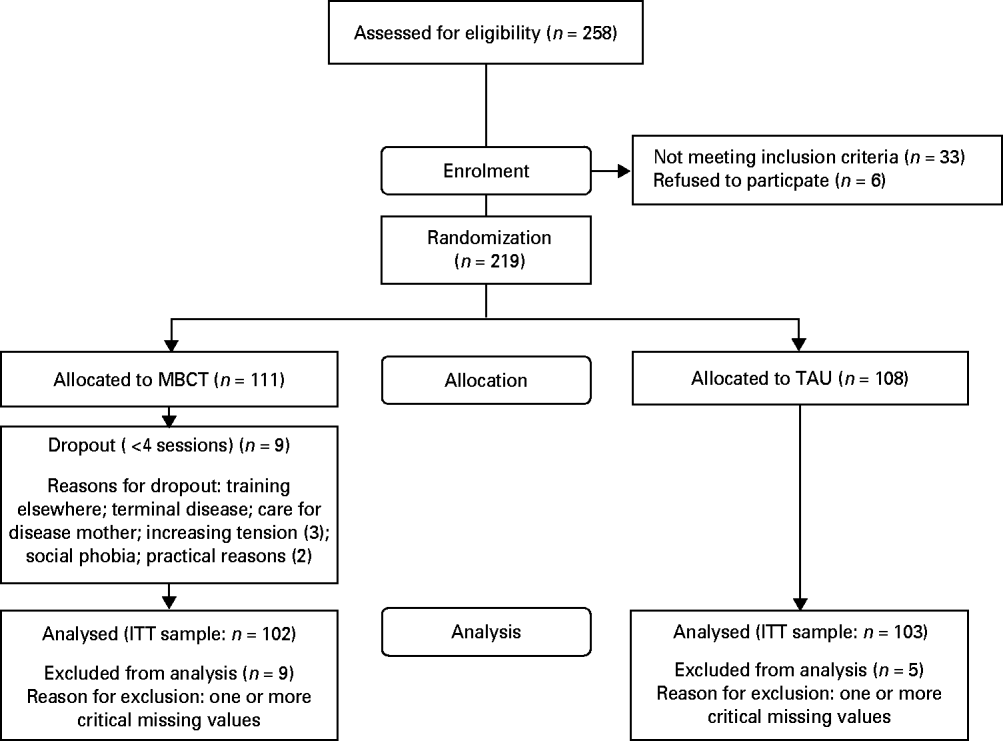
Of the 258 patients interviewed, 33 were excluded and six refused to participate. Reasons for exclusion were: (1) not having three or more previous depressive episodes (n=19); (2) change in medication within 6 weeks before the start of the study (n=4); (3) previous (hypo)manic episodes (n=2); (4) current substance abuse (n=3); (5) acute need of psychiatric treatment (n=2); (6) problems to participate in a group therapy (n=2); (7) cognitive impairments (n=1).
A total number of 219 patients were included and eventually 205 patients were analysed (MBCT n=102; TAU n=103), see Fig. 1 for a detailed description of the patient flow. Within each condition, the groups were divided into subgroups with and without a major depressive episode based on the MINI interview. As a result of incomplete or missing MINI interviews, for 20 patients the diagnosis of current depression was based on the available clinical information. For four patients it was impossible to do so and they were excluded from the study. Another 10 patients were excluded from analysis due to one or more other missing critical values.
CONSORT flow diagram.

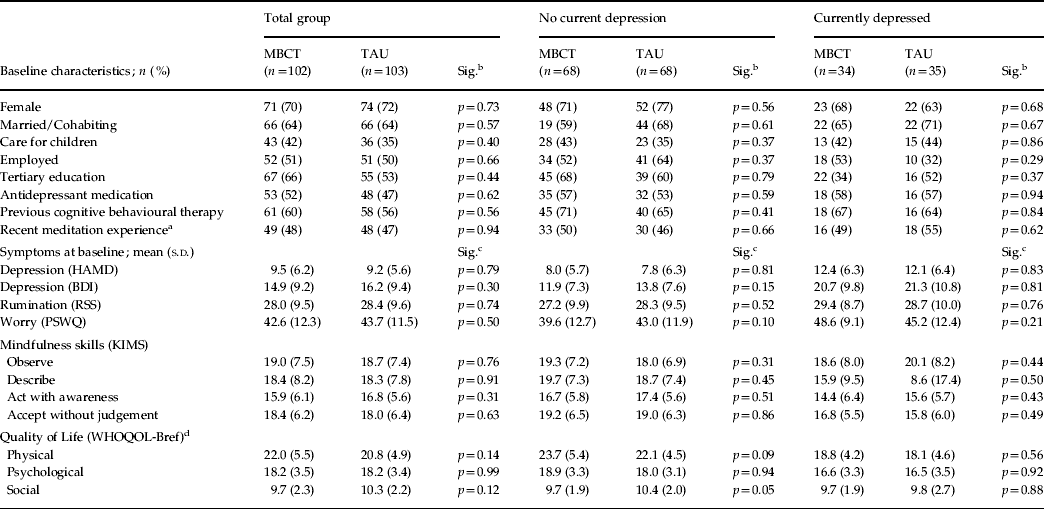
There were no baseline differences between the groups with regard to age [MBCT: mean=47.3 (s.d.=11.5) years; TAU: mean=47.7 years (s.d.=11.1)] or other sociodemographic or clinical characteristics (see Table 1).
Baseline characteristics of mindfulness-based cognitive therapy (MBCT) and treatment as usual (TAU) conditions for the total group of participants and the two subgroups without and with a current depressive episode

HAMD, Hamilton Rating Scale for Depression; BDI, Beck Depression Inventory; RSS, Rumination on Sadness Scale; PSWQ, Penn State Worry Questionnaire; KIMS, Kentucky Inventory of Mindfulness; WHOQOL-Bref, World Health Organization Quality of Life, self-report questionnaire.
a Meditation and/or body focused experience <6 months ago.
b χ2 tests.
c Independent sample t tests.
d Measured in a subsample: MBCT [n=89 (non-depressed, n=59; depressed, n=30)]; TAU [n=74 (non-depressed, n=51; depressed, n=23)].
The mean number of depressive episodes for the complete sample was 7.4 (s.d.=7.0, modal number of episodes=3) with no differences between the MBCT and TAU conditions, t(195)=−0.61, p=0.54. Mean age at onset of the first depressive episode was 23.8 years (s.d.=11.2, modal age of onset=20 years), with a slightly higher age of onset in the MBCT than in the TAU condition [MBCT, t(195)=−1.98, p<0.05]. When taking the three most severe depressive episodes into account, the mean time between the last episode and the start of the study for the non-depressed patients was 28 months (s.d.=48.0, median=8 months).
During MBCT, nine patients (8.8%) dropped out (less than four sessions MBCT), for the following reasons: training elsewhere; terminal disease; care for sick mother; increasing tension (three); social phobia; for practical reasons (two).
A subsample of the MBCT group (n=94) was asked to fill out homework diaries during the training, of whom 77 (82%) patients handed them in. The average number of days patients practised was 30 (s.d.=10.2; range 0–42 days). A modest correlation was found between formal practice (e.g. sitting meditation) and change of depression level during MBCT, r=0.26, p<0.05.
The period between baseline and end of treatment/waitlist assessment was significantly longer in the TAU [mean=83 days (s.d.=33.9)] than in the MBCT [mean=59 days (s.d.=12.9); t(175)=6.4, p<0.01)] condition.
Efficacy of MBCT
Depressive symptoms
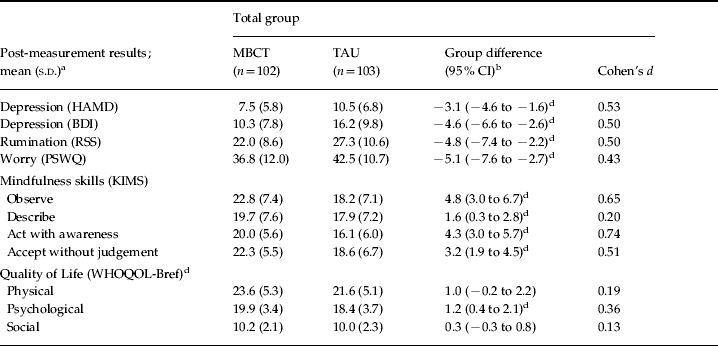
At the end of the treatment/waiting period, patients in the MBCT condition had significantly less depressive symptoms than those in the TAU condition according to both HAMD [F(1, 202)=15.9, p<0.001] and BDI [F(1, 44.8)=20.9, p<0.001] (see Table 2). Controlling for baseline scores did not result in a change of differences between the intervention and control groups. Adding a random effect for the different therapy groups did not result in changes of outcome for any of the models.
Depressive symptoms, rumination, mindfulness skills and quality of life at post-treatment of mindfulness-based cognitive therapy (MBCT) and treatment as usual (TAU) conditions, controlling for baseline levels of symptoms

HAMD, Hamilton Rating Scale for Depression; BDI, Beck Depression Inventory; RSS, Rumination on Sadness Scale; PSWQ, Penn State Worry Questionnaire; KIMS, Kentucky Inventory of Mindfulness; WHOQOL-Bref, World Health Organization Quality of Life, self-report questionnaire.
a Unadjusted condition means and standard deviations (s.d.).
b Differences between conditions, corrected for baseline values.
c Measured in a subsample: MBCT [n=89 (non-depressed, n=59; depressed, n=30)]; TAU [n=74 (non-depressed, n=51; depressed, n=23)].
d Statistical significant difference for p<0.05.
Exploratory moderation analyses were carried out for the complete sample with a selection of baseline variables: number of depressions; age of onset of the first depression; all baseline variables listed in Table 1 except quality of life. Only previous meditation experience in the last 6 months prior to the study significantly moderated post-measurement levels of depression [F(1, 192.0)=6.92, p<0.01]. Within the MBCT condition, patients without meditation experience showed lower end of treatment levels of depression compared with patients with recent meditation experience [F(1, 96)=4.29, p<0.05].
Rumination, worry and mindfulness skills
End of treatment/waiting period levels of rumination and worry were significantly lower in the MBCT condition than in the TAU condition [F(1, 44.3)=13.4, p<0.01 and F(1, 83.2)=17.5, p<0.001, respectively]. Both showed a moderate effect size (see Table 2). Moreover, all mindfulness skills showed significant increased levels: observe [F(1, 49.8)=27.7, p<0.001]; act with awareness [F(1, 47.4)=39.5 p<0.001]; describe [F(1, 49.0)=6.6, p<0.05]; accept without judgement [F(1, 192.0)=22.9, p<0.001]. Except for describe, all domains showed moderate to large effect sizes (see Table 2).
Of the quality of life scores, only the psychological domain showed a significant increase in the MBCT condition compared with the TAU condition [F(1, 153)=9.2, p<0.01].
Differences between patients with and without a current depressive episode
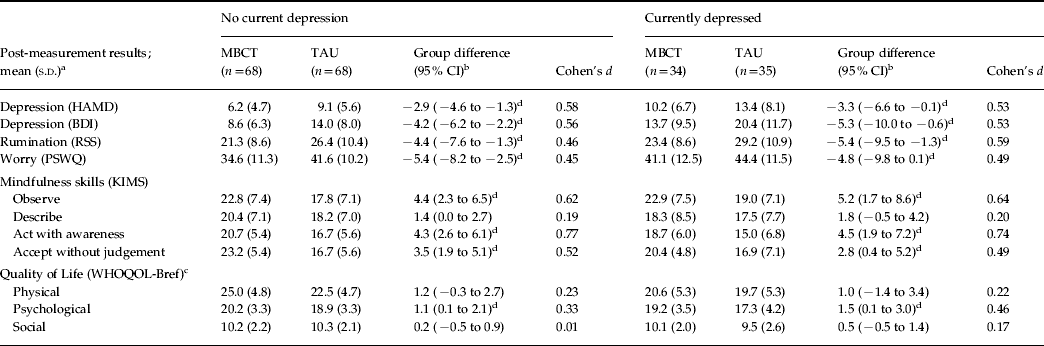
Split-file analyses for patients with and without a current depressive episode showed overall comparable results with the complete sample analysis (see Table 3). Rumination and the mindfulness subscale ‘describe’ did not differ significantly within the group without a current depressive episode in contrast with the group having a current episode. Also, psychological improvement of quality of life was only significantly different in the depressed group. Cohen's d effect sizes were comparable with the complete sample effect sizes. The depression-related variables ‘rumination’ and ‘worry’ showed even higher effect sizes in the subgroup analyses, possibly due to smaller standard deviations.
Depressive symptoms, rumination, mindfulness skills and quality of life at post-treatment of mindfulness-based cognitive therapy (MBCT) and treatment as usual condition (TAU), controlling for baseline levels of symptoms, for both subgroups without and with a current depressive episode respectively

HAMD, Hamilton Rating Scale for Depression; BDI, Beck Depression Inventory; RSS, Rumination on Sadness Scale; PSWQ, Penn State Worry Questionnaire; KIMS, Kentucky Inventory of Mindfulness; WHOQOL-Bref, World Health Organization Quality of Life, self-report questionnaire.
a Unadjusted condition means and standard deviations (s.d.).
b Differences between conditions, corrected for baseline values.
c Measured in a subsample: MBCT [n=89 (non-depressed, n=59; depressed, n=30)]; TAU [n=74 (non-depressed, n=51; depressed, n=23)].
d Statistical significant difference (p<0.05).
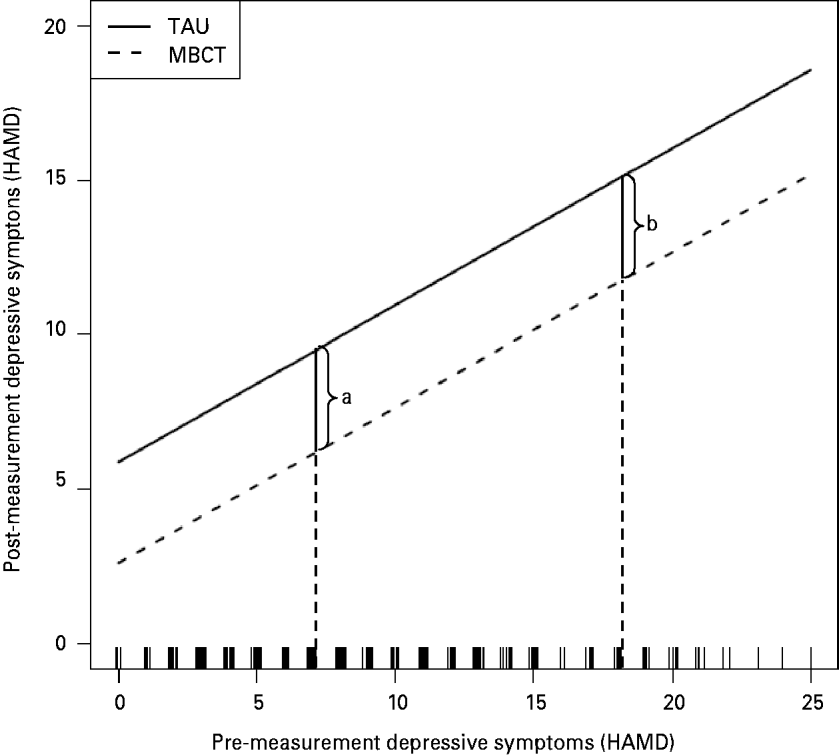
To further investigate whether depressive symptoms at baseline influenced the efficacy of MBCT, we performed an interaction analysis adding an interaction term between baseline depression levels (HAMD) and condition. We found no significant interaction for any of the outcome variables, indicating that the efficacy of MBCT is independent of baseline level of depression. Using split-file analyses for patients with and without a current depressive episode, no significant interactions were found between baseline depression levels (HAMD) and any of the outcome measures. The result for the interaction analysis between baseline depression levels and end of treatment levels of depression (HAMD) is graphically presented in Fig. 2, showing baseline and end of treatment levels of depression in both conditions. From this figure it becomes apparent that the reduction of depressive symptoms as a result of MBCT is independent from the baseline level of depression.
Interaction plot for pre- and post-measurement depression levels [Hamilton Rating Scale for Depression (HAMD) scores] of Mindfulness-based Cognitive Therapy (MBCT) and treatment as usual (TAU) condition. The short vertical lines depicted on the x-axis represent the distribution of pre-measurement depression scores (HAMD; range 0–25). Note that independent of the pre-measurement level of depression, the post-measurement depression score difference between the MBCT and TAU condition is constant (for example ‘a’=‘b’).

Clinically significant change
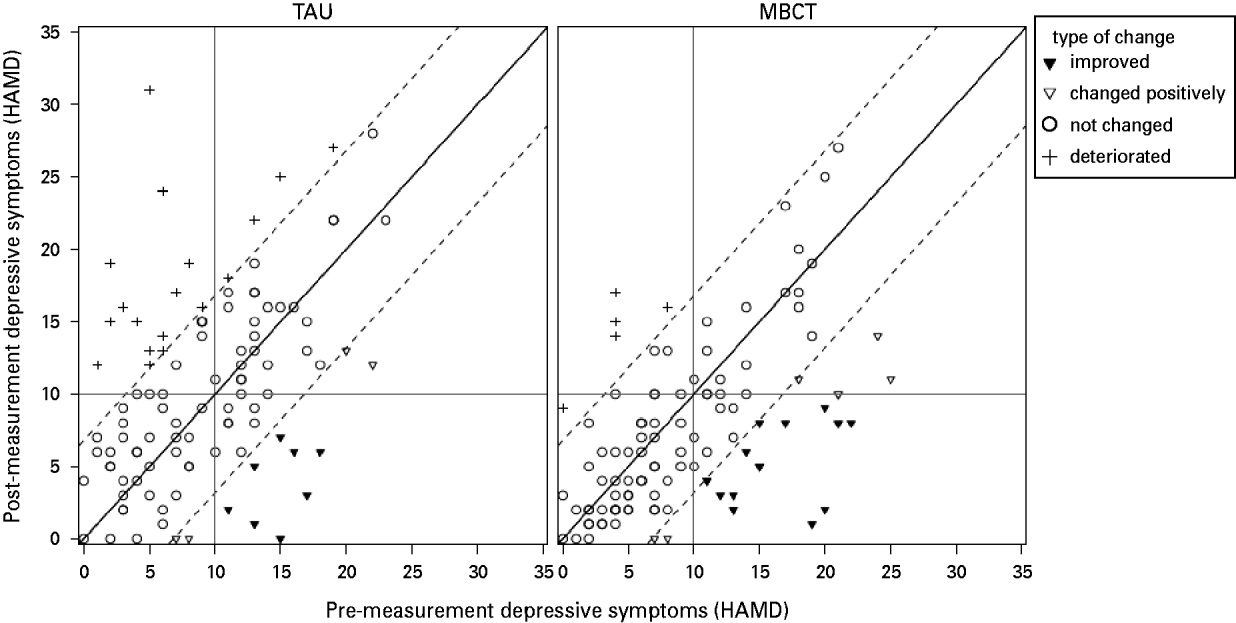
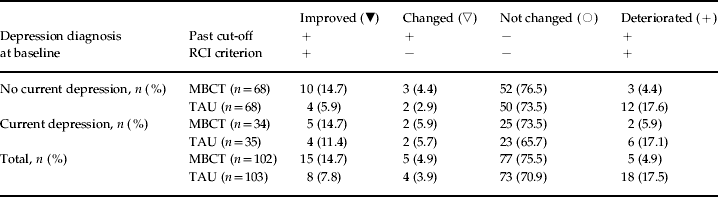
A clinically significant change of the HAMD scores, the primary outcome measure, is presented in Table 4, using both the Jacobson–Truax reliable change index and the absolute cut-off level of HAMD 10 as criteria (Jacobson & Truax, Reference Jacobson and Truax1991), also illustrated in Fig. 3. If improvement is defined by a HAMD score <10 and having a reliable positive change in depression scores, Table 4 illustrates that, in the MBCT condition, patients more frequently improved than in the TAU condition (15 v. 8). It also demonstrates that more patients in the TAU condition deteriorate than in the MBCT condition (5 v. 18). Overall, the MBCT condition significantly differs from the TAU condition in terms of individual change scores [χ2(3)=9.69, p<0.05].
Change in depression scores between pre- and post-measurement based on Hamilton Rating Scale for Depression (HAMD) scores for treatment as usual (TAU) and mindfulness-based cognitive therapy (MBCT) conditions. The diagonal line represents ‘no pre-post measurement HAMD change’ and the dashed upper and lower lines represent the bounds of the 95% CI of the Jacobson–Truax Reliable Change Index. The horizontal and vertical grey lines represent the HAMD cut-off score of 10. Improvement is defined as a pre-HAMD score >10 and a post-HAMD score <10 combined with meeting the criterion for reliable change. See Table 3 for accompanying numbers and percentages. (Figure inspired by Evans et al. Reference Evans, Margison and Barkham1998.)

Numbers and percentages of depression change based on the Jacobson–Truax Reliable Change Index (RCI), calculated for HAMD scores, pre- and post-measurement of the MBCT and TAU conditions, stratified for amount of depressive symptoms, also displayed in Fig. 3

HAMD, Hamilton Rating Scale of Depression; MBCT, mindfulness-based cognitive therapy; TAU, treatment as usual.
Mediation analysis
Rumination, worry and the four separate mindfulness skills were expected to be mediators between the MBCT training and post-measurement levels of depression (HAMD). Predicted mediators were first analysed using a univariate model and, if shown to be a contributing factor, were entered into a multivariate model.
The main analyses revealed that all the suggested mediators were related to condition (MBCT versus TAU). However, post-measurement depression level was only related to rumination [β=1.46, t(192)=3.64, p<0.001], worry [β=1.68, t(196)=4.31, p<0.001] and the mindfulness skill ‘accept without judgement’ [β=−1.18, t(194)=−2.85, p<0.01]. The relationship between condition and post-measurement levels of depressions, without a mediator, yielded β=−2.81, t(192)=−3.58, p<0.001. Adding the mediators in three separate analyses showed a partial mediation effect for all, meaning smaller β's and still significant but larger p values compared to the model without the mediator: rumination [β=−2.00, t(192)=−2.53, p<0.05], worry [β=−2.00, t(196)=−2.60, p<0.01] and the mindfulness skill ‘accept without judgement’ [β=−2.20, t(194)=−2.68, p<0.01].
Bootstrapping the indirect effect of condition on post-treatment level of depression with 5000 samples showed significant indirect effects for the mediators in the three univariate models: rumination (point estimate=−0.85, 95% CI −1.66 to −0.36); worry (point estimate=−0.94; 95% CI −1.68 to −0.41); ‘accept without judgement’ (point estimate=−0.74; 95% CI −1.48 to −0.20).
With the multivariate model, after including rumination, worry and mindfulness skill ‘accept without judgement’, the relationship between condition and post-measurement level of depression was no longer significant [β=−1.41, t(190)=−1.76, p=0.08]. Bootstrapping showed that the total indirect effect of all mediators together was significant (point estimate=−1.40, 95% CI −2.30 to −0.69). Rumination (point estimate=−0.54, 95% CI −1.30 to −0.06) and worry (point estimate=−0.77, 95% CI −1.42 to −0.27) made independent and significant contributions to the mediation relationship between condition and post-measurement levels of depression. Mindfulness skill ‘accept without judgement’ did not make such an individual contribution (point estimate=−0.09, 95% CI −0.69 to 0.49). The indirect effect of ‘accept without judgement’ did not significantly differ from the indirect effects of worry and rumination, respectively.
Exploring relationships between the different mediators showed that both rumination (r=−0.56, p<0.001) and worry (r=−0.47, p<0.001) were negatively correlated with ‘accept without judgement’.
The same analyses for the subgroups with and without a current depressive episode showed comparable direction of the outcomes, but mostly non-significant results due to small sample sizes.
Discussion
This study shows that, for patients with three or more previous depressive episodes, MBCT results in a decrease of depressive symptoms, worry and rumination and improvement in mindfulness skills. Most importantly, we found no differences between patients with and without a current depressive episode in terms of reduction of depressive symptoms. The amount of formal practice seems to have some relation with decrease in depressive symptoms. The results suggest that post-measurement levels of depressive symptoms were mediated by a decrease in worry and rumination.
This study presents the first large-scale, randomized, controlled study showing MBCT to be efficacious in reducing depressive symptoms for patients with recurrent depression suffering from a current depressive episode. These results are in line with previous studies including one randomized, controlled [Barnhofer et al. Reference Barnhofer, Crane, Hargus, Amarasinghe, Winder and Williams2009 (n=28)], one controlled but not randomized study [Kingston et al. Reference Kingston, Dooley, Bates, Lawlor and Malone2007 (n=19)] and three uncontrolled studies with a range of 13 to 79 participants (Finucane & Mercer, Reference Finucane and Mercer2006; Kenny & Williams, Reference Kenny and Williams2007; Eisendrath et al. Reference Eisendrath, Delucchi, Bitner, Fenimore, Smit and McLane2008). These studies showed that patients with current depressive symptoms might also benefit from MBCT. Note that the effect sizes found in our study were smaller than in the study by, for example, Barnhofer et al. (Reference Barnhofer, Crane, Hargus, Amarasinghe, Winder and Williams2009). One explanation for the reduced effect sizes study might be the inclusion of patients with recent meditation experience, since this was shown to be a moderating variable.
The fact that recent meditation experience was shown to moderate the level of depressive symptoms supports the idea that the meditation component plays a key role in the effects of MBCT but this has yet to be proven (Williams et al. Reference Williams, Russell, Crane, Russell, Whitaker, Duggan, Barnhofer, Fennell, Crane and Silverton2010).
Additional analyses and figures, especially Fig. 3, illustrate that not only more patients improved, but also fewer patients deteriorated in the MBCT condition compared with TAU alone. This is congruent with the prophylactic results of MBCT for depression shown in previous studies (e.g. Ma & Teasdale, Reference Ma and Teasdale2004; Kuyken et al. Reference Kuyken, Byford, Taylor, Watkins, Holden, White, Barrett, Byng, Evans, Mullan and Teasdale2008).
Our finding that patients without a current depressive episode also showed reduced levels of depressive symptoms is encouraging, considering the clinical relevance of residual symptoms in the prediction of relapse and recurrence of depression. Kennedy et al. (Reference Kennedy, Abbott and Paykel2004) showed that subsyndrome levels of depression are common and persistent after severe episodes of depression. Residual depressive symptoms have been repeatedly shown as a predictor of depressive relapse (e.g. Paykel et al. Reference Paykel, Ramana, Cooper, Hayhurst, Kerr and Barocka1995; Rush et al. Reference Rush, Trivedi, Wisniewski, Nierenberg, Stewart, Warden, Niederehe, Thase, Lavori and Lebowitz2006; Hardeveld et al. Reference Hardeveld, Spijker, de Graaf, Nolen and Beekman2010). This may contribute to the efficacy of MBCT preventing relapse.
The exploratory mediation analysis lends valuable insights towards a better understanding of the working mechanism of MBCT. Congruent with our hypotheses, it seems that the efficacy of MBCT compared with TAU in reducing post-measurement levels of depression is mediated by a decrease in worry, rumination and an increase in the mindfulness skill ‘accept without judgement’. Our results are in line with the findings of Kuyken et al. (Reference Kuyken, Watkins, Holden, White, Taylor, Evans, Byford, Radford, Teasdale and Dalgleish2010), who showed that 1-year follow-up levels of depression were mediated by mindfulness skills and self-compassion. Additionally, the relationship between cognitive reactivity and levels of depression was moderated by change in self-compassion during MBCT, suggesting that mindfulness training changes the way one relates towards vulnerability for depression. In addition, we found a negative relationship between rumination and mindfulness skill acceptance, which might implicate that acceptance decreases the space for ruminative thoughts as suggested by the designers of MBCT (Teasdale et al. Reference Teasdale, Segal and Williams1995). Based on our results, further questions can be generated, such as the relationship in time between mindfulness skill ‘accept without judgement’, worry and rumination. However, these results must be interpreted with care. As a result of the cross-sectional nature of the findings, no firm conclusions can be made in terms of causality (Kraemer et al. Reference Kraemer, Wilson, Fairburn and Agras2002; Kazdin, Reference Kazdin2007). For that purpose, future studies should use designs with repeated assessments, for example, a midpoint assessment at session 4.
Although this study provides several important findings, there are a number of limitations to be considered. The design of this study was a pragmatic, randomized, controlled trial. There might be a negative effect as a result of randomization in the TAU condition instead of MBCT, resulting in higher post-measurement symptom levels in the TAU condition. Based on the results of this trial, we do not know how MBCT compares with alternative active treatment conditions for recurrent depression, such as cognitive behavioural therapy to prevent relapse (Bockting et al. Reference Bockting, Schene, Spinhoven, Koeter, Wouters, Huyser and Kamphuis2005). Also, the influence of peer support cannot be ruled out, since the TAU condition was not group based. Furthermore, the results are limited to direct post-measurement results, although it is also important to investigate whether currently depressed patients also benefit in the long term. As most of the patients were self-referred, the results of the study may have been influenced by selection bias. Participants of this study might have been better informed and more motivated compared with other patients receiving general mental health care. On the other hand, inclusion was not restricted to patients without antidepressant medication, previous cognitive behaviour therapy and/or meditation experience. In this regard, our study population was more representative of routine clinical practice than some of the previous studies (Teasdale et al. Reference Teasdale, Segal, Williams, Ridgeway, Soulsby and Lau2000; Ma & Teasdale, Reference Ma and Teasdale2004).
Conclusions
The greatest merit of this study is that it shows that MBCT is also efficacious in recurrent depressive patients with a current depressive episode. The study also gives some directions toward a better understanding of the mechanisms of action of MBCT. However, the exploratory nature of this justifies further investigation.
Acknowledgements
We thank the trainers Noud de Haas and Hetty Janssen for providing the MBCT training, Cobie Wijsman, Dorien Verplak and Geert Schattenberg for their help with the data collection and Poppy Schoenberg for her comments. We also thank the following students for their contribution to the study: Lissy van de Laar; Tom Wingens; Robert de Boer; Milou Johan; Gitte Janssen Steenberg; Karlijn Peffer; Sara Al Shamma; Joëlle Terlouw; Tessa Bronkhorst. Finally, we are grateful to the patients for their willingness to participate in the study. (The trial is registered at Clinical Trials.gov; ID: NCT01038765.)
Declaration of Interest
The corresponding author is financial supported by Fonds Psychische Gezondheid; Grant Number: 2005 6028 and part of the Spinoza prize 2002 of Professor H. P. Barendregt.