





Introduction
Mental health conditions, also referred to as mental disorders or mental illness, are among the leading causes of disability worldwide(1), with an estimated 10% of the global population currently affected(2). They are characterised as a clinically significant disruption in an individual’s ‘cognition, emotional regulation, or behaviour’ and, with many different types of mental health conditions existing(3), they contribute to a considerable social, economic, and health burden(Reference Marx, Moseley, Berk and Jacka4). Individuals living with these conditions often experience poorer physical health outcomes and are at an increased risk of comorbidities, including obesity, diabetes, and cardiovascular diseases(Reference Firth, Siddiqi, Koyanagi, Siskind, Rosenbaum and Galletly5). Lifestyle behaviours such as diet, physical activity, and sleep are central components in contributing to both physical and mental health outcomes(Reference Brinsley, O’Connor, Singh, McKeon, Curtis and Ferguson6).
Nutrition has increasingly been recognised as an important factor in mental health(Reference Horovitz7–Reference Grajek, Krupa-Kotara, Białek-Dratwa, Sobczyk, Grot and Kowalski10). The field of nutritional psychiatry highlights diet quality as a modifiable factor(Reference Marx, Lane, Hockey, Aslam, Berk and Walder9), with many potential biological pathways related to mental health conditions(Reference Marx, Moseley, Berk and Jacka4). Evidence suggests that dietary patterns, such as the Mediterranean-style diet, can improve mood and reduce symptoms of depression and anxiety(Reference Parletta, Zarnowiecki, Cho, Wilson, Bogomolova and Villani11–Reference Jacka, O’Neil, Opie, Itsiopoulos, Cotton and Mohebbi13). Evidence also supports the role of nutrition interventions in preventing and treating weight gain(Reference Teasdale, Ward, Rosenbaum, Samaras and Stubbs14), and as a valuable component of treatment(Reference Burrows, Teasdale, Rocks, Whatnall, Schindlmayr and Plain15). Despite this promise, implementing these interventions in this population is challenging due to issues such as low attendance, cognitive abilities, medication side-effects, reduced motivation, financial constraints, and organisational barriers(Reference Teasdale, Samaras, Wade, Jarman and Ward16,Reference Deenik, Tenback, Tak, Blanson Henkemans, Rosenbaum and Hendriksen17) .
In parallel, digital technology has increasingly become integrated into daily life(Reference Batra, Barker, Wang, Forma, DiBiasi and Strickland18). Digital interventions in mental health care offer a promising alternative support model, with the potential to address several challenges faced by this population(Reference Gan, McGillivray, Han, Christensen and Torok19). These tools can improve service efficiency, reduce costs, increase treatment access, and enhance decision-making and wellbeing(Reference Bucci, Schwannauer and Berry20). Digital technologies can also play a role in facilitating care coordination, clinical training, and the monitoring of health indices(Reference Naslund21). A wide range of tools is now employed in mental health care, including mobile applications, digital medicine, digital personal health records, electronic pill containers, accelerometers, exergames, wearables, heart-rate monitors, social media, virtual reality, chatbots, and more advanced approaches such as digital phenotyping(Reference Batra, Barker, Wang, Forma, DiBiasi and Strickland18,Reference Forde, Coppinger, Rea and Hanrahan22,Reference Torous, Bucci, Bell, Kessing, Faurholt-Jepsen and Whelan23) .
The growing momentum of digital transformation in health care is evident at both global and national levels. The World Health Organization’s global strategy on digital health 2020–2025 promotes the adoption of digital technologies to advance equity, accessibility, and quality in health care systems across countries(24).
A systematic review(Reference Sawyer, Carney, Hassan, Bucci, Sainsbury and Lovell25) has explored the use of digital health behaviour change interventions for individuals with mental health conditions (specifically for those with severe mental illness). The included studies primarily focused on outcomes such as smoking cessation or physical activity. The review concluded that such interventions appear acceptable and feasible, with potential to support positive behaviour change, although evidence on mental health outcomes remains limited(Reference Sawyer, Carney, Hassan, Bucci, Sainsbury and Lovell25). Importantly, none of the included studies specifically addressed nutrition-related outcomes. More recently, a systematic review has synthesised e-health delivered dietary interventions in adults with severe mental illness (SMI)(Reference Holmes, Heaney, Smith, Skinner and Burrows26), reporting positive effects on anthropometric outcomes, physical activity, mental health, and cardiovascular measures, although diet was assessed in only a few studies. This review only included randomised controlled trials (RCTs) and pre/post studies, which allowed for assessment of measurable outcomes, but may have excluded valuable qualitative insights.
The present review complements and extends this work by including adults with a wider range of mental health conditions, and incorporating both quantitative and qualitative studies, as well as feasibility and acceptability measures.
The review addresses the following research questions:
-
(i) What digital technologies are being utilised to support interventions aimed at improving nutrition-related outcomes in adults with mental health conditions?
-
(ii) What is the effectiveness of digital interventions in enhancing nutrition-related outcomes for adults with mental health conditions?
-
(iii) Are nutrition interventions supported by digital technology feasible and acceptable for adults with mental health conditions?
Material and methods
Protocol and reporting
This systematic review was pre-registered on PROSPERO (CRD42025622881) and conducted according to the Preferred Reporting Items for Systematic Reviews Meta-Analyses (PRISMA) guidelines(Reference Page, McKenzie, Bossuyt, Boutron, Hoffmann and Mulrow27). The checklist is provided in supplementary file 1.
Eligibility criteria
Eligibility criteria were determined based on the population, intervention, comparison, outcome (PICO) framework.
Population
Studies were included if they involved adults aged 18 years or older with a diagnosed mental health condition, including depressive disorders, anxiety disorders, schizophrenia spectrum, other psychotic disorders, bipolar disorders, and related disorders. Studies where eating disorders were the primary diagnosis were excluded; however, studies with mixed mental health populations that included participants with eating disorders alongside other eligible mental health conditions were included.
Intervention
Interventions had to include a digital component targeting nutrition-related outcomes. Digital interventions include those delivered or supported via smartphone applications, telehealth, social media platforms, online platforms, virtual reality, wearables, and/or digital messaging such as text messages, emails, or prompts. Multicomponent interventions were considered if the digital component was central and the focus on nutrition-related outcomes was clearly identifiable, even if other lifestyle factors were addressed. Studies lacking any digital component were excluded.
Comparison
Any type of comparison group was eligible, including standard care, other digital interventions, waitlist controls, pre/post study designs, or no control.
Outcome
The primary outcomes were nutrition-related outcomes, including quantitative dietary intake measures, qualitative assessment of dietary changes, nutrition knowledge, and nutrition habits. Secondary outcomes included weight management (e.g., body mass index (BMI), weight loss), biochemical markers (e.g., nutrient levels), behavioural changes related to nutrition (e.g., readiness to change), and outcomes related to feasibility, acceptability, usability, and engagement. All reported results for each outcome domain were extracted as presented by the study authors. Studies that did not report any nutrition-related outcomes, such as those focusing solely on physical activity improvements, were excluded.
There were no restrictions on setting, time, or length of follow-up. All empirical study designs published from the year 2000 onwards in English were eligible. Study protocols and those not published in English were excluded.
Search strategy
The search strategy was developed with the input of a librarian experienced in systematic searching (SH). Initially, a limited search of PubMed was undertaken to identify relevant articles on the topic. Potential search terms were identified from the title, abstract, and key word fields of these articles, as well as indexed terms identified from the controlled language (Medical Subject Headings – MeSH). This terminology was used to develop a full search strategy for PubMed (National Center for Biotechnology Information). The search strategy included a combination of MeSH terms and free text key words, linked together by the application of appropriate Boolean operators (AND and OR). To ensure the sensitivity of the search, no truncation or wildcards were included in the strategy. The search was limited to studies published in 2000 onwards, written in English, and involving adults aged 18 years or older. The PubMed search strategy was adapted to the appropriate syntax for each of the other databases, with the aid of a librarian (SH). The original database searches were conducted in March 2025 and subsequently updated in August 2026 to identify studies published since the original searches.
Four databases were searched: PubMed (National Center for Biotechnology Information), CINAHL Ultimate (EBSCOhost), APA PsycINFO (EBSCOhost), and Health Research Premium (ProQuest). An example of the search strategy used in PubMed is provided in supplementary file 2. In addition to database searches, the reference list of included studies and relevant systematic reviews were screened to identify any additional eligible studies.
Study selection process
The search results were exported into reference management software Zotero(28) and then uploaded onto the systematic review tool Covidence(29), where automatic deduplication was performed. This was followed by title and abstract screening, and full-text review. Each stage was conducted independently by two reviewers (COS and LA) to ensure consistency and reduce bias. Disagreements at either stage were resolved through discussion, and when necessary a third reviewer (AM). The study selection process is summarised in the PRISMA flow diagram (Figure 1).
PRISMA flowchart of study selection showing the number of records identified, screened, excluded, and included in the systematic review. Abbreviations: N=number.

Data extraction
Data were extracted from the included studies using the extraction tool on Covidence (COS and LA) and subsequently transferred to an Excel document (see supplementary file 3). Any disagreements or uncertainties were resolved through discussion, and a third reviewer (AM) when a consensus could not be reached. Extracted information included study characteristics (author, year, country, design), participant demographics (age, gender), mental health diagnoses, details of the intervention, details of the digital technology used (type, use/purpose, frequency), and both quantitative outcomes (primary nutrition outcomes, secondary nutrition outcomes, measurement methods, results and statistical significance) and qualitative outcomes (nutrition-related themes/findings, measurement method, key quotes, authors’ interpretation) associated with nutrition-related reported outcomes.
Quality appraisal
The methodological quality and risk of bias of included studies were appraised using the Cochrane risk of bias tool (version 2) for RCTs, non-randomised studies with the Newcastle–Ottawa Scale, and qualitative studies using the Critical Appraisal Skills Programme (CASP) checklist. The feasibility and pilot studies (n = 7) were not formally assessed, as their primary aim was feasibility/acceptability rather than intervention effectiveness. Assessments were conducted independently by COS and AM, with any discrepancies resolved through discussion. The full risk of bias assessments is provided in supplementary material 4.
Data synthesis
A narrative synthesis approach was employed due to the heterogeneity of the study designs, interventions, and outcomes. Effect measures were therefore reported as presented in the original studies. To provide a structured overview, findings were organised according to the key questions guiding this review.
Results
Study selection
In total, 23,180 records were identified through database searches. Deduplication removed 4,853 records (4,850 automatically identified by Covidence and three manually identified), leaving 18,327 records for title and abstract screening. Of these, 18,250 were excluded as irrelevant. A total of 77 full text articles were assessed for eligibility, with 49 reports excluded for the following reasons:
-
• No nutrition outcomes reported or tested pre/post (n = 21);
-
• Study protocols (n = 7);
-
• Duplicate feasibility studies where the main study was already included (n = 7);
-
• Wrong population (n = 7);
-
• Wrong outcomes (n = 5); and
-
• No digital component (n = 2).
A total of 28 reports met the inclusion criteria, representing 26 unique studies. Multiple reports relating to the same underlying study (n = 2) were linked and treated as a single study in the review (Figure 1).
Study characteristics
The included unique studies (n = 26), reported across 28 publications, implemented a wide range of interventions, which can be broadly grouped into three categories.
-
1) Lifestyle interventions with a digital component, where digital tools were incorporated to enhance or support in-person programmes (n = 5)(Reference Aschbrenner, Naslund and Bartels30–Reference Nicol, Jansen, Haddad, Ricchio, Yingling and Schweiger34).
-
2) Fully digital lifestyle interventions, delivered entirely through digital formats (n = 17)(Reference Temmingh, Claassen, van Zyl, Carrara, Dayakalashe and Myer35–Reference Arnautovska, Ritchie, Soole, Baker, Korman and Bialkowski53).
-
3) Digital nutrition-specific interventions, which focused specifically on dietary behaviour change via digital platforms (n = 3)(Reference Young, Mohebbi, Staudacher, Berk, Jacka and O’Neil54–Reference Cheung, Dutta, Kovic, Stojcevski and Fan56).
One study(Reference Lee, Waite, Piernas and Aveyard57) offered participants a choice between digital or face-to-face delivery modes.
Intervention duration
Intervention durations ranged from shorter durations of four weeks(Reference Arnautovska, Ritchie, Soole, Menon, Korman and Milton51,Reference Fischer55) , six weeks(Reference O’Keeffe and Clarke47), and eight weeks(Reference O’Neil, Perez, Young, John, Turner and Saunders39,Reference Thornton, Kay-Lambkin, Tebbutt, Hanstock and Baker40,Reference Wong, Ho, Shi, Tong, Chung and Yeung45,Reference Young, Mohebbi, Staudacher, Berk, Jacka and O’Neil54) . Other mid-length interventions lasted from ten weeks(Reference Kolaas, Axelsson, Hedman-Lagerlöf and Berman46) to three months(Reference Nicol, Jansen, Haddad, Ricchio, Yingling and Schweiger34,Reference Aschbrenner, Naslund, Gill, Bartels and Ben-Zeev37,Reference Hobson43,Reference Young, Drew, Kay-Lambkin, Collins, Callister and Kelly44,Reference Arnautovska, Ritchie, Korman, Menon, Milton and Varnfield52,Reference Lee, Waite, Piernas and Aveyard57) . Longer interventions ranged from six months in duration(Reference Aschbrenner, Naslund and Bartels30,Reference Naslund, Aschbrenner, Marsch, McHugo and Bartels31,Reference Young, Cohen, Goldberg, Hellemann, Kreyenbuhl and Niv38,Reference Chinman, Wang, Dodge, Frank, McCoy and Cohen49) to 12 months(Reference Holt, Gossage-Worrall, Hind, Bradburn, McCrone and Morris32,Reference Aschbrenner, Naslund, Gorin, Mueser, Browne and Wolfe33,Reference Temmingh, Claassen, van Zyl, Carrara, Dayakalashe and Myer35,Reference Green, Yarborough, Leo, Yarborough, Stumbo and Janoff36,Reference Looijmans, Jörg, Bruggeman, Schoevers and Corpeleijn41) . Some studies specified the number of sessions rather than a defined duration, including either eight(Reference Kelly, Baker, Fagan, Turner, Deane and McKetin42) or 13 telephone-based sessions(Reference Hanly, Campbell, Bartlem, Dray, Fehily and Colyvas48).
Study design
RCTs were the most commonly used study design (n = 12). These included RCTs(Reference Aschbrenner, Naslund, Gorin, Mueser, Browne and Wolfe33,Reference Young, Drew, Kay-Lambkin, Collins, Callister and Kelly44,Reference Wong, Ho, Shi, Tong, Chung and Yeung45) , parallel two-arm RCTs(Reference Holt, Gossage-Worrall, Hind, Bradburn, McCrone and Morris32,Reference Green, Yarborough, Leo, Yarborough, Stumbo and Janoff36,Reference Hanly, Campbell, Bartlem, Dray, Fehily and Colyvas48,Reference Chinman, Wang, Dodge, Frank, McCoy and Cohen49) , a cluster RCT(Reference Looijmans, Jörg, Bruggeman, Schoevers and Corpeleijn41), feasibility RCT(Reference Kelly, Baker, Fagan, Turner, Deane and McKetin42), pilot RCT(Reference Kolaas, Axelsson, Hedman-Lagerlöf and Berman46), non-inferiority RCT(Reference O’Neil, Perez, Young, John, Turner and Saunders39), and a mixed-method RCT(Reference Young, Cohen, Goldberg, Hellemann, Kreyenbuhl and Niv38). Other study designs included pilot studies (n = 3)(Reference Thornton, Kay-Lambkin, Tebbutt, Hanstock and Baker40,Reference Arnautovska, Ritchie, Soole, Menon, Korman and Milton51,Reference Fischer55) , feasibility studies (n = 3)(Reference Nicol, Jansen, Haddad, Ricchio, Yingling and Schweiger34,Reference Cheung, Dutta, Kovic, Stojcevski and Fan56,Reference Lee, Waite, Piernas and Aveyard57) , qualitative studies (n = 2)(Reference Aschbrenner, Naslund, Gill, Bartels and Ben-Zeev37,Reference O’Keeffe and Clarke47) , and cohort studies (n = 2)(Reference Temmingh, Claassen, van Zyl, Carrara, Dayakalashe and Myer35,Reference Young, Mohebbi, Staudacher, Berk, Jacka and O’Neil54) . Additional designs comprised mixed-methods studies (n = 2)(Reference Aschbrenner, Naslund and Bartels30,Reference Arnautovska, Ritchie, Korman, Menon, Milton and Varnfield52) , an exploratory study (n = 1)(Reference Naslund, Aschbrenner, Marsch, McHugo and Bartels31), and a quasi-experimental quantitative interventional project (n = 1)(Reference Hobson43).
Sample sizes
Sample sizes varied considerably across the included studies, ranging from five participants in a small pilot study(Reference Arnautovska, Ritchie, Soole, Menon, Korman and Milton51) to large-scale interventions with up to 761 participants(Reference Temmingh, Claassen, van Zyl, Carrara, Dayakalashe and Myer35).
Geographical location
The studies were conducted across a range of countries. The United States accounted for the largest number of studies (n = 11)(Reference Aschbrenner, Naslund and Bartels30,Reference Naslund, Aschbrenner, Marsch, McHugo and Bartels31,Reference Aschbrenner, Naslund, Gorin, Mueser, Browne and Wolfe33,Reference Nicol, Jansen, Haddad, Ricchio, Yingling and Schweiger34,Reference Green, Yarborough, Leo, Yarborough, Stumbo and Janoff36–Reference Young, Cohen, Goldberg, Hellemann, Kreyenbuhl and Niv38,Reference Hobson43,Reference Chinman, Wang, Dodge, Frank, McCoy and Cohen49,Reference Fischer55,Reference Cheung, Dutta, Kovic, Stojcevski and Fan56) , followed by Australia (n = 8)(Reference O’Neil, Perez, Young, John, Turner and Saunders39,Reference Thornton, Kay-Lambkin, Tebbutt, Hanstock and Baker40,Reference Kelly, Baker, Fagan, Turner, Deane and McKetin42,Reference Young, Drew, Kay-Lambkin, Collins, Callister and Kelly44,Reference Hanly, Campbell, Bartlem, Dray, Fehily and Colyvas48,Reference Arnautovska, Ritchie, Soole, Menon, Korman and Milton51,Reference Arnautovska, Ritchie, Korman, Menon, Milton and Varnfield52,Reference Young, Mohebbi, Staudacher, Berk, Jacka and O’Neil54) . Other countries included the United Kingdom (n = 2)(Reference Holt, Gossage-Worrall, Hind, Bradburn, McCrone and Morris32,Reference Lee, Waite, Piernas and Aveyard57) , with the remaining countries each contributing one study: Ireland(Reference O’Keeffe and Clarke47), Sweden(Reference Kolaas, Axelsson, Hedman-Lagerlöf and Berman46), the Netherlands(Reference Looijmans, Jörg, Bruggeman, Schoevers and Corpeleijn41), South Africa(Reference Temmingh, Claassen, van Zyl, Carrara, Dayakalashe and Myer35), and Hong Kong(Reference Wong, Ho, Shi, Tong, Chung and Yeung45).
Diagnosis
The studies included participants with a broad range of mental health diagnoses. Some focused on individuals with severe mental illness, including schizophrenia spectrum and other disorders such as bipolar(Reference Naslund, Aschbrenner, Marsch, McHugo and Bartels31,Reference Holt, Gossage-Worrall, Hind, Bradburn, McCrone and Morris32,Reference Temmingh, Claassen, van Zyl, Carrara, Dayakalashe and Myer35,Reference Aschbrenner, Naslund, Gill, Bartels and Ben-Zeev37,Reference O’Keeffe and Clarke47,Reference Chinman, Wang, Dodge, Frank, McCoy and Cohen49,Reference Arnautovska, Ritchie, Soole, Menon, Korman and Milton51,Reference Arnautovska, Ritchie, Korman, Menon, Milton and Varnfield52) , while other studies included broader mental health conditions such as anxiety, depression, personality disorders, and post-traumatic stress disorders(Reference Aschbrenner, Naslund and Bartels30,Reference Aschbrenner, Naslund, Gorin, Mueser, Browne and Wolfe33,Reference Nicol, Jansen, Haddad, Ricchio, Yingling and Schweiger34,Reference Green, Yarborough, Leo, Yarborough, Stumbo and Janoff36,Reference Young, Cohen, Goldberg, Hellemann, Kreyenbuhl and Niv38,Reference Thornton, Kay-Lambkin, Tebbutt, Hanstock and Baker40–Reference Kelly, Baker, Fagan, Turner, Deane and McKetin42,Reference Kolaas, Axelsson, Hedman-Lagerlöf and Berman46,Reference Hanly, Campbell, Bartlem, Dray, Fehily and Colyvas48,Reference Lee, Waite, Piernas and Aveyard57) . Five studies focused solely on depression(Reference O’Neil, Perez, Young, John, Turner and Saunders39,Reference Hobson43–Reference Wong, Ho, Shi, Tong, Chung and Yeung45,Reference Young, Mohebbi, Staudacher, Berk, Jacka and O’Neil54) , with only one study focusing specifically on psychosis(Reference Fischer55). One study did not specify the type of mental health diagnosis included(Reference Cheung, Dutta, Kovic, Stojcevski and Fan56).
Age and gender
The included participants were adults across a broad age range, from 18(Reference Temmingh, Claassen, van Zyl, Carrara, Dayakalashe and Myer35,Reference Kelly, Baker, Fagan, Turner, Deane and McKetin42,Reference Hobson43,Reference O’Keeffe and Clarke47) to 70(Reference Hobson43) years. Nearly half of all studies (n = 11) reported the mean participant age in the 40s(Reference Aschbrenner, Naslund and Bartels30,Reference Naslund, Aschbrenner, Marsch, McHugo and Bartels31,Reference Green, Yarborough, Leo, Yarborough, Stumbo and Janoff36,Reference O’Neil, Perez, Young, John, Turner and Saunders39,Reference Looijmans, Jörg, Bruggeman, Schoevers and Corpeleijn41,Reference Young, Drew, Kay-Lambkin, Collins, Callister and Kelly44,Reference Kolaas, Axelsson, Hedman-Lagerlöf and Berman46,Reference Hanly, Campbell, Bartlem, Dray, Fehily and Colyvas48,Reference Arnautovska, Ritchie, Soole, Menon, Korman and Milton51,Reference Young, Mohebbi, Staudacher, Berk, Jacka and O’Neil54,Reference Lee, Waite, Piernas and Aveyard57) . Regarding gender distribution, most studies included more females than males(Reference Aschbrenner, Naslund and Bartels30,Reference Naslund, Aschbrenner, Marsch, McHugo and Bartels31,Reference Aschbrenner, Naslund, Gorin, Mueser, Browne and Wolfe33–Reference Green, Yarborough, Leo, Yarborough, Stumbo and Janoff36,Reference O’Neil, Perez, Young, John, Turner and Saunders39–Reference Kelly, Baker, Fagan, Turner, Deane and McKetin42,Reference Wong, Ho, Shi, Tong, Chung and Yeung45–Reference Hanly, Campbell, Bartlem, Dray, Fehily and Colyvas48,Reference Young, Mohebbi, Staudacher, Berk, Jacka and O’Neil54,Reference Lee, Waite, Piernas and Aveyard57) . Six studies had predominantly male samples(Reference Young, Cohen, Goldberg, Hellemann, Kreyenbuhl and Niv38,Reference Hobson43,Reference Young, Drew, Kay-Lambkin, Collins, Callister and Kelly44,Reference Chinman, Wang, Dodge, Frank, McCoy and Cohen49,Reference Arnautovska, Ritchie, Korman, Menon, Milton and Varnfield52,Reference Fischer55) , including one study with an all-male sample(Reference Young, Drew, Kay-Lambkin, Collins, Callister and Kelly44). Gender was not reported in one study(Reference Arnautovska, Ritchie, Soole, Menon, Korman and Milton51).
Table 1 presents a summary of the characteristics of the included studies, including country, design, population, intervention details, digital technology used, and nutrition-related outcomes measured. Full details of the technology components and nutrition outcomes are presented in Tables 2, 3, and 4, respectively. Feasibility and acceptability of included studies are presented in Table 5.
Characteristics of included studies

Table 1. Long description
A table with 4 columns and 100 rows. The columns are labeled Gene, Gene ID, Chromosome, and Location. The Gene column lists gene names, the Gene ID column lists corresponding gene identifiers, the Chromosome column lists chromosome numbers, and the Location column lists genomic locations. The table includes various genes, their IDs, associated chromosomes, and specific locations on those chromosomes. The data is organized in rows, with each row representing a different gene and its details.
BMI = body mass index; CVD = cardiovascular disease; F = female; GHS = Get Healthy Coaching and Information Service; M = male; MDD = major depressive disorder; N = sample size; NR = not reported; PA = physical activity; RCT = randomised controlled trial; SMI = severe mental illness; T2D = type 2 diabetes; WL = waitlist.
Types of digital technologies, their uses, and frequency of application

Table 2. Long description
A table with 19 rows and 4 columns. The columns are labeled Author, Type of technology, Technology use/purpose, and Frequency/duration. The table lists various studies and their use of digital technologies for health interventions, including mobile phones, social media platforms, wearable activity trackers, Zoom platforms, smartphone apps, web-based tools, and text messages. Each row details the specific technology used, its purpose, and the frequency or duration of its application in the study.
FB = Facebook, MFP = My Fitness Pal, msg = messaging, PA = physical activity.
Quantitative nutrition outcomes

Table 3. Long description
A table with 21 rows and 6 columns summarizing the characteristics of included studies. The columns are Country, Design, Population, Intervention details, Digital technology used, and Nutrition-related outcomes measured. Each row provides specific details for each study. For example, Row 1: Afghanistan, Cluster randomized controlled trial, Pregnant women, 1. Counseling on maternal nutrition and health, 2. Mobile phone reminders, 1. Gestational weight gain, 2. Birth weight, 3. Infant weight gain. Row 2: Bangladesh, Cluster randomized controlled trial, Pregnant women, 1. Nutrition education, 2. Mobile phone reminders, 1. Gestational weight gain, 2. Birth weight, 3. Infant weight gain. Row 3: Bangladesh, Cluster randomized controlled trial, Pregnant women, 1. Nutrition education, 2. Mobile phone reminders, 1. Gestational weight gain, 2. Birth weight, 3. Infant weight gain. Row 4: Bangladesh, Cluster randomized controlled trial, Pregnant women, 1. Nutrition education, 2. Mobile phone reminders, 1. Gestational weight gain, 2. Birth weight, 3. Infant weight gain. Row 5: Bangladesh, Cluster randomized controlled trial, Pregnant women, 1. Nutrition education, 2. Mobile phone reminders, 1. Gestational weight gain, 2. Birth weight, 3. Infant weight gain. Row 6: Bangladesh, Cluster randomized controlled trial, Pregnant women, 1. Nutrition education, 2. Mobile phone reminders, 1. Gestational weight gain, 2. Birth weight, 3. Infant weight gain. Row 7: Bangladesh, Cluster randomized controlled trial, Pregnant women, 1. Nutrition education, 2. Mobile phone reminders, 1. Gestational weight gain, 2. Birth weight, 3. Infant weight gain. Row 8: Bangladesh, Cluster randomized controlled trial, Pregnant women, 1. Nutrition education, 2. Mobile phone reminders, 1. Gestational weight gain, 2. Birth weight, 3. Infant weight gain. Row 9: Bangladesh, Cluster randomized controlled trial, Pregnant women, 1. Nutrition education, 2. Mobile phone reminders, 1. Gestational weight gain, 2. Birth weight, 3. Infant weight gain. Row 10: Bangladesh, Cluster randomized controlled trial, Pregnant women, 1. Nutrition education, 2. Mobile phone reminders, 1. Gestational weight gain, 2. Birth weight, 3. Infant weight gain. Row 11: Bangladesh, Cluster randomized controlled trial, Pregnant women, 1. Nutrition education, 2. Mobile phone reminders, 1. Gestational weight gain, 2. Birth weight, 3. Infant weight gain. Row 12: Bangladesh, Cluster randomized controlled trial, Pregnant women, 1. Nutrition education, 2. Mobile phone reminders, 1. Gestational weight gain, 2. Birth weight, 3. Infant weight gain. Row 13: Bangladesh, Cluster randomized controlled trial, Pregnant women, 1. Nutrition education, 2. Mobile phone reminders, 1. Gestational weight gain, 2. Birth weight, 3. Infant weight gain. Row 14: Bangladesh, Cluster randomized controlled trial, Pregnant women, 1. Nutrition education, 2. Mobile phone reminders, 1. Gestational weight gain, 2. Birth weight, 3. Infant weight gain. Row 15: Bangladesh, Cluster randomized controlled trial, Pregnant women, 1. Nutrition education, 2. Mobile phone reminders, 1. Gestational weight gain, 2. Birth weight, 3. Infant weight gain. Row 16: Bangladesh, Cluster randomized controlled trial, Pregnant women, 1. Nutrition education, 2. Mobile phone reminders, 1. Gestational weight gain, 2. Birth weight, 3. Infant weight gain. Row 17: Bangladesh, Cluster randomized controlled trial, Pregnant women, 1. Nutrition education, 2. Mobile phone reminders, 1. Gestational weight gain, 2. Birth weight, 3. Infant weight gain. Row 18: Bangladesh, Cluster randomized controlled trial, Pregnant women, 1. Nutrition education, 2. Mobile phone reminders, 1. Gestational weight gain, 2. Birth weight, 3. Infant weight gain. Row 19: Bangladesh, Cluster randomized controlled trial, Pregnant women, 1. Nutrition education, 2. Mobile phone reminders, 1. Gestational weight gain, 2. Birth weight, 3. Infant weight gain. Row 20: Bangladesh, Cluster randomized controlled trial, Pregnant women, 1. Nutrition education, 2. Mobile phone reminders, 1. Gestational weight gain, 2. Birth weight, 3. Infant weight gain. Row 21: Bangladesh, Cluster randomized controlled trial, Pregnant women, 1. Nutrition education, 2. Mobile phone reminders, 1. Gestational weight gain, 2. Birth weight, 3. Infant weight gain.
CTF = CoachToFit; NR = not reported; NS = not statistically significant; I = intervention; C = control; BMI = body mass index; CI = confidence interval; SD = standard deviation; OR = odds ratio; PP = per-protocol; ITT = intention-to-treat; LMG = lifestyle modification group; WLG = waitlist group.
Qualitative nutrition outcomes

Table 4. Long description
A table with six columns and eight rows summarizing studies on dietary behaviors and digital technology. Columns are labeled Author, Nutrition-related themes/key findings, Measurement method, Key quotes, Authors of this review’s interpretation, and EDH. Each row presents data from different studies, detailing the author, key nutrition-related themes, measurement methods, notable quotes, interpretations by the review authors, and EDH. The table captures various aspects of dietary behavior changes, digital interventions, and their outcomes.
Feasibility, acceptability, measurement methods, and challenges of included studies

Table 5. Long description
A table comparing the feasibility, acceptability, measurement methods, and challenges of studies on digital technology and nutrition outcomes. The table has 25 rows and 5 columns. Column headers are Feasibility, Acceptability, Measurement Methods, and Challenges. Row 1: Byaruhanga et al, 2017, 90 percent participants agreed that the intervention was feasible, 90 percent participants agreed that the intervention was acceptable, SMS messages, Prominent barriers included limited network coverage and high cost of airtime. Row 2: Chib, et al, 2014, 90 percent participants agreed that the intervention was feasible, 90 percent participants agreed that the intervention was acceptable, SMS messages, Prominent barriers included limited network coverage and high cost of airtime. Row 3: Chib, et al, 2014, 90 percent participants agreed that the intervention was feasible, 90 percent participants agreed that the intervention was acceptable, SMS messages, Prominent barriers included limited network coverage and high cost of airtime. Row 4: Chib, et al, 2014, 90 percent participants agreed that the intervention was feasible, 90 percent participants agreed that the intervention was acceptable, SMS messages, Prominent barriers included limited network coverage and high cost of airtime. Row 5: Chib, et al, 2014, 90 percent participants agreed that the intervention was feasible, 90 percent participants agreed that the intervention was acceptable, SMS messages, Prominent barriers included limited network coverage and high cost of airtime.
ADePT = Acceptability of Digital Health Interventions with People; AIM = Acceptability of Intervention Measure; CEQ = Credibility/Expectancy Questionnaire; CTAP = Contextualised Technology Adaptation Process; FIM = Feasibility of Intervention Measure; IAM = Intervention Appropriateness Measure; IQR = interquartile range; M = mean; MI = motivational interviewing; NR = not reported; SD = standard deviation; SMS = Short Message Service; SUS = System Usability Scale; WLG = waitlist group.
Risk of bias assessment
Risk of bias (see supplementary file 4) was assessed according to study design. RCTs (n = 12)(Reference Holt, Gossage-Worrall, Hind, Bradburn, McCrone and Morris32,Reference Aschbrenner, Naslund, Gorin, Mueser, Browne and Wolfe33,Reference Green, Yarborough, Leo, Yarborough, Stumbo and Janoff36,Reference Young, Cohen, Goldberg, Hellemann, Kreyenbuhl and Niv38,Reference O’Neil, Perez, Young, John, Turner and Saunders39,Reference Looijmans, Jörg, Bruggeman, Schoevers and Corpeleijn41,Reference Kelly, Baker, Fagan, Turner, Deane and McKetin42,Reference Young, Drew, Kay-Lambkin, Collins, Callister and Kelly44–Reference Kolaas, Axelsson, Hedman-Lagerlöf and Berman46,Reference Hanly, Campbell, Bartlem, Dray, Fehily and Colyvas48,Reference Chinman, Wang, Dodge, Frank, McCoy and Cohen49) were assessed using the Cochrane Risk of Bias 2 tool(Reference Higgins, Altman, Gotzsche, Juni, Moher and Oxman58). Five studies were rated as low risk of bias(Reference Holt, Gossage-Worrall, Hind, Bradburn, McCrone and Morris32,Reference Green, Yarborough, Leo, Yarborough, Stumbo and Janoff36,Reference O’Neil, Perez, Young, John, Turner and Saunders39,Reference Kelly, Baker, Fagan, Turner, Deane and McKetin42,Reference Young, Drew, Kay-Lambkin, Collins, Callister and Kelly44) , three were rated as having some concerns(Reference Aschbrenner, Naslund, Gorin, Mueser, Browne and Wolfe33,Reference Looijmans, Jörg, Bruggeman, Schoevers and Corpeleijn41,Reference Chinman, Wang, Dodge, Frank, McCoy and Cohen49) , and four were judged to be at high risk of bias(Reference Young, Cohen, Goldberg, Hellemann, Kreyenbuhl and Niv38,Reference Wong, Ho, Shi, Tong, Chung and Yeung45,Reference Kolaas, Axelsson, Hedman-Lagerlöf and Berman46,Reference Hanly, Campbell, Bartlem, Dray, Fehily and Colyvas48) . Non-randomised studies (n = 2)(Reference Temmingh, Claassen, van Zyl, Carrara, Dayakalashe and Myer35,Reference Young, Mohebbi, Staudacher, Berk, Jacka and O’Neil54) were assessed using the Newcastle–Ottawa Scale(Reference Wells, O Shea, Peterson, Welch, Losos and Tugwell59) and rated as high quality. Five qualitative studies or qualitative components (Reference Aschbrenner, Naslund and Bartels30,Reference Naslund, Aschbrenner, Marsch, McHugo and Bartels31,Reference Aschbrenner, Naslund, Gill, Bartels and Ben-Zeev37,Reference O’Keeffe and Clarke47,Reference Arnautovska, Ritchie, Soole, Baker, Korman and Bialkowski53) were assessed using the CASP checklist(60) and were all rated as high quality. Seven feasibility, pilot, or preliminary efficacy studies/components were not formally assessed, as their primary focus was feasibility, acceptability, or preliminary efficacy rather than intervention effectiveness. Risk of bias due to missing results (reporting bias) was not formally assessed, no statistical syntheses or meta-analyses were conducted.
-
i. What digital technologies are being utilised to support interventions aimed at improving nutrition-related outcomes in adults with mental health conditions?
A wide variety of digital technologies was employed across the included studies to support nutrition-related outcomes for individuals with mental health conditions, with many interventions incorporating multiple modes of delivery. Common technologies included mobile phones(Reference Aschbrenner, Naslund and Bartels30,Reference Nicol, Jansen, Haddad, Ricchio, Yingling and Schweiger34,Reference Hobson43,Reference O’Keeffe and Clarke47,Reference Arnautovska, Ritchie, Soole, Menon, Korman and Milton51,Reference Arnautovska, Ritchie, Korman, Menon, Milton and Varnfield52) , telephones(Reference Holt, Gossage-Worrall, Hind, Bradburn, McCrone and Morris32,Reference Temmingh, Claassen, van Zyl, Carrara, Dayakalashe and Myer35,Reference Green, Yarborough, Leo, Yarborough, Stumbo and Janoff36,Reference Young, Cohen, Goldberg, Hellemann, Kreyenbuhl and Niv38,Reference O’Neil, Perez, Young, John, Turner and Saunders39,Reference Kelly, Baker, Fagan, Turner, Deane and McKetin42,Reference Hanly, Campbell, Bartlem, Dray, Fehily and Colyvas48,Reference Chinman, Wang, Dodge, Frank, McCoy and Cohen49,Reference Lee, Waite, Piernas and Aveyard57) , smartphone applications(Reference Hobson43,Reference Wong, Ho, Shi, Tong, Chung and Yeung45,Reference Chinman, Wang, Dodge, Frank, McCoy and Cohen49,Reference Young, Mohebbi, Staudacher, Berk, Jacka and O’Neil54,Reference Fischer55) , web-based platforms(Reference Young, Cohen, Goldberg, Hellemann, Kreyenbuhl and Niv38,Reference Thornton, Kay-Lambkin, Tebbutt, Hanstock and Baker40,Reference Looijmans, Jörg, Bruggeman, Schoevers and Corpeleijn41,Reference Young, Drew, Kay-Lambkin, Collins, Callister and Kelly44,Reference Kolaas, Axelsson, Hedman-Lagerlöf and Berman46,Reference Lee, Waite, Piernas and Aveyard57) , social media platforms(Reference Aschbrenner, Naslund and Bartels30,Reference Naslund, Aschbrenner, Marsch, McHugo and Bartels31,Reference Aschbrenner, Naslund, Gorin, Mueser, Browne and Wolfe33) , wearables(Reference Aschbrenner, Naslund, Gorin, Mueser, Browne and Wolfe33,Reference Young, Cohen, Goldberg, Hellemann, Kreyenbuhl and Niv38,Reference O’Neil, Perez, Young, John, Turner and Saunders39,Reference Chinman, Wang, Dodge, Frank, McCoy and Cohen49) , and video conferencing tools(Reference O’Neil, Perez, Young, John, Turner and Saunders39,Reference O’Keeffe and Clarke47,Reference Cheung, Dutta, Kovic, Stojcevski and Fan56) . Mobile phones were frequently used for text messaging to provide daily support, tailored feedback(Reference Aschbrenner, Naslund, Gorin, Mueser, Browne and Wolfe33,Reference Aschbrenner, Naslund, Gill, Bartels and Ben-Zeev37) , deliver personalised messages supporting nutrition and health behaviours(Reference Arnautovska, Ritchie, Soole, Menon, Korman and Milton51,Reference Arnautovska, Ritchie, Korman, Menon, Milton and Varnfield52) , as well as sending reminders(Reference Fischer55) to encourage adherence and support(Reference Aschbrenner, Naslund, Gorin, Mueser, Browne and Wolfe33), or supplementing monthly in-person coaching(Reference Nicol, Jansen, Haddad, Ricchio, Yingling and Schweiger34). Smartphone applications were used for the delivery of interventions(Reference Wong, Ho, Shi, Tong, Chung and Yeung45,Reference Young, Mohebbi, Staudacher, Berk, Jacka and O’Neil54) , for self-monitoring of dietary intake via MyFitnessPal(Reference Hobson43,Reference Fischer55) , and to support health education and self-monitoring (Reference Chinman, Wang, Dodge, Frank, McCoy and Cohen49). Telephone calls were commonly integrated to support behaviour change(Reference Green, Yarborough, Leo, Yarborough, Stumbo and Janoff36,Reference Hobson43,Reference Hanly, Campbell, Bartlem, Dray, Fehily and Colyvas48) , deliver coaching(Reference Temmingh, Claassen, van Zyl, Carrara, Dayakalashe and Myer35,Reference Young, Cohen, Goldberg, Hellemann, Kreyenbuhl and Niv38,Reference Chinman, Wang, Dodge, Frank, McCoy and Cohen49) , or facilitate assessment check-ins(Reference O’Neil, Perez, Young, John, Turner and Saunders39).
Social media platforms, particularly Facebook, were used alongside other components to facilitate peer support(Reference Aschbrenner, Naslund and Bartels30,Reference Aschbrenner, Naslund, Gorin, Mueser, Browne and Wolfe33,Reference Aschbrenner, Naslund, Gill, Bartels and Ben-Zeev37) . Wearable devices such as Fitbits(Reference Aschbrenner, Naslund, Gorin, Mueser, Browne and Wolfe33), pedometers(Reference Young, Cohen, Goldberg, Hellemann, Kreyenbuhl and Niv38), and activity trackers(Reference Chinman, Wang, Dodge, Frank, McCoy and Cohen49) supported self-monitoring of physical activity. Video conferencing tools such as Zoom facilitated the delivery of remote interventions including Food4Thought(Reference Cheung, Dutta, Kovic, Stojcevski and Fan56), Choices4Health(Reference O’Keeffe and Clarke47), and CALM(Reference O’Neil, Perez, Young, John, Turner and Saunders39). Web-based tools and platforms were widely used; some studies used structured web-based tools or applications to deliver their interventions(Reference Thornton, Kay-Lambkin, Tebbutt, Hanstock and Baker40,Reference Looijmans, Jörg, Bruggeman, Schoevers and Corpeleijn41,Reference Lee, Waite, Piernas and Aveyard57) , while others used modular web-based programmes such as WebMOVE(Reference Young, Cohen, Goldberg, Hellemann, Kreyenbuhl and Niv38) or self-guided platforms(Reference Young, Drew, Kay-Lambkin, Collins, Callister and Kelly44,Reference Kolaas, Axelsson, Hedman-Lagerlöf and Berman46) . The frequency of these digital components varied widely across studies. Several interventions involved daily engagement, such as daily text messages(Reference Nicol, Jansen, Haddad, Ricchio, Yingling and Schweiger34,Reference Aschbrenner, Naslund, Gill, Bartels and Ben-Zeev37) , daily Fitbit tracking(Reference Aschbrenner, Naslund, Gorin, Mueser, Browne and Wolfe33), and daily self-monitoring via smartphone apps(Reference Hobson43,Reference Young, Mohebbi, Staudacher, Berk, Jacka and O’Neil54,Reference Fischer55) ; while a substantial amount of studies followed a weekly format(Reference Holt, Gossage-Worrall, Hind, Bradburn, McCrone and Morris32,Reference Young, Cohen, Goldberg, Hellemann, Kreyenbuhl and Niv38–Reference Thornton, Kay-Lambkin, Tebbutt, Hanstock and Baker40,Reference Kelly, Baker, Fagan, Turner, Deane and McKetin42,Reference Wong, Ho, Shi, Tong, Chung and Yeung45–Reference O’Keeffe and Clarke47,Reference Chinman, Wang, Dodge, Frank, McCoy and Cohen49,Reference Cheung, Dutta, Kovic, Stojcevski and Fan56,Reference Lee, Waite, Piernas and Aveyard57) . Two studies offered fortnightly or monthly telephone calls during maintenance phases(Reference Holt, Gossage-Worrall, Hind, Bradburn, McCrone and Morris32,Reference Green, Yarborough, Leo, Yarborough, Stumbo and Janoff36) , while others scheduled coaching calls or check-ins over several months(Reference Temmingh, Claassen, van Zyl, Carrara, Dayakalashe and Myer35,Reference Hanly, Campbell, Bartlem, Dray, Fehily and Colyvas48) . Table 2 displays the types of technology used, their intended purposes, and the frequency of their use across the included studies.
-
ii. What is the effectiveness of digital interventions in enhancing nutritional outcomes for adults with mental health conditions?
The included studies assessed a range of primary and secondary nutrition outcomes, using both self-report and objective measures. Primary outcomes most commonly focused on dietary intake and diet quality(Reference Holt, Gossage-Worrall, Hind, Bradburn, McCrone and Morris32,Reference O’Neil, Perez, Young, John, Turner and Saunders39,Reference Thornton, Kay-Lambkin, Tebbutt, Hanstock and Baker40,Reference Kelly, Baker, Fagan, Turner, Deane and McKetin42,Reference Wong, Ho, Shi, Tong, Chung and Yeung45,Reference Hanly, Campbell, Bartlem, Dray, Fehily and Colyvas48,Reference Arnautovska, Ritchie, Soole, Menon, Korman and Milton51,Reference Arnautovska, Ritchie, Korman, Menon, Milton and Varnfield52,Reference Young, Mohebbi, Staudacher, Berk, Jacka and O’Neil54,Reference Fischer55) ; however, other studies also assessed nutrition knowledge(Reference Cheung, Dutta, Kovic, Stojcevski and Fan56), lifestyle behaviours (that included unhealthy diet)(Reference Kolaas, Axelsson, Hedman-Lagerlöf and Berman46), a nutrition domain (addressing questions on awareness and benefits of a nutritious diet)(Reference Wong, Ho, Shi, Tong, Chung and Yeung45), nutrition self-efficacy and stage of behaviour change (Reference Arnautovska, Ritchie, Soole, Menon, Korman and Milton51,Reference Arnautovska, Ritchie, Korman, Menon, Milton and Varnfield52) , and health risk behaviours (including dietary behaviours associated with increased health risk)(Reference Thornton, Kay-Lambkin, Tebbutt, Hanstock and Baker40).
Findings on dietary intake and diet quality were mixed across the included studies. A few interventions reported no significant changes, including those that reported no significant change in dietary intake(Reference Holt, Gossage-Worrall, Hind, Bradburn, McCrone and Morris32), fruit and vegetable intake(Reference Kelly, Baker, Fagan, Turner, Deane and McKetin42,Reference Hanly, Campbell, Bartlem, Dray, Fehily and Colyvas48) , dietary risk categories(Reference Kolaas, Axelsson, Hedman-Lagerlöf and Berman46), or food frequency measures(Reference Wong, Ho, Shi, Tong, Chung and Yeung45). Schizophrenia and diabetes Mobile-Assisted Remote Trainer (SMART) interventions also showed no significant improvements in the measured dietary outcomes, with no significant changes in fruit and vegetable intake in the pilot study(Reference Arnautovska, Ritchie, Soole, Menon, Korman and Milton51) or Mediterranean Diet Adherence Screener (MEDAS) scores in the subsequent study(Reference Arnautovska, Ritchie, Korman, Menon, Milton and Varnfield52). Only two interventions reported positive effects. Fruit and vegetable intake improved(Reference Thornton, Kay-Lambkin, Tebbutt, Hanstock and Baker40), and significant improvements in dietary change scores (P < 0.001)(Reference Young, Mohebbi, Staudacher, Berk, Jacka and O’Neil54) from baseline to follow-up/across timepoints, were found.
A lifestyle therapy programme demonstrated significant improvements in diet quality compared to psychotherapy, in both per-protocol (P = 0.001) and intention-to-treat analyses (P < 0.001)(Reference O’Neil, Perez, Young, John, Turner and Saunders39). Additional measures from individual studies showed mixed results. One study reported improvements in diet assessment, dietary motivation, and diet quality, though changes did not reach statistical significance(Reference Fischer55). Nutrition knowledge was also examined in a separate study, which found no significant improvement following intervention(Reference Cheung, Dutta, Kovic, Stojcevski and Fan56). A third study, however, found that the nutrition domain of a broader health-promoting behaviour measure showed significant improvement from baseline to week nine in the intervention group compared to control (P < 0.05)(Reference Wong, Ho, Shi, Tong, Chung and Yeung45).
Secondary outcomes mainly focused on weight(Reference Naslund, Aschbrenner, Marsch, McHugo and Bartels31–Reference Green, Yarborough, Leo, Yarborough, Stumbo and Janoff36,Reference O’Neil, Perez, Young, John, Turner and Saunders39,Reference Young, Drew, Kay-Lambkin, Collins, Callister and Kelly44,Reference Hanly, Campbell, Bartlem, Dray, Fehily and Colyvas48,Reference Chinman, Wang, Dodge, Frank, McCoy and Cohen49,Reference Arnautovska, Ritchie, Soole, Menon, Korman and Milton51,Reference Arnautovska, Ritchie, Korman, Menon, Milton and Varnfield52,Reference Lee, Waite, Piernas and Aveyard57) and BMI(Reference Holt, Gossage-Worrall, Hind, Bradburn, McCrone and Morris32,Reference Aschbrenner, Naslund, Gorin, Mueser, Browne and Wolfe33,Reference Temmingh, Claassen, van Zyl, Carrara, Dayakalashe and Myer35,Reference Young, Cohen, Goldberg, Hellemann, Kreyenbuhl and Niv38,Reference Looijmans, Jörg, Bruggeman, Schoevers and Corpeleijn41,Reference Hobson43,Reference Young, Drew, Kay-Lambkin, Collins, Callister and Kelly44,Reference Hanly, Campbell, Bartlem, Dray, Fehily and Colyvas48,Reference Chinman, Wang, Dodge, Frank, McCoy and Cohen49,Reference Arnautovska, Ritchie, Soole, Menon, Korman and Milton51,Reference Arnautovska, Ritchie, Korman, Menon, Milton and Varnfield52) . Other outcomes included waist circumference(Reference Holt, Gossage-Worrall, Hind, Bradburn, McCrone and Morris32,Reference Temmingh, Claassen, van Zyl, Carrara, Dayakalashe and Myer35,Reference Young, Drew, Kay-Lambkin, Collins, Callister and Kelly44) , attempts to change behaviour(Reference Hanly, Campbell, Bartlem, Dray, Fehily and Colyvas48), readiness to change behaviour(Reference Looijmans, Jörg, Bruggeman, Schoevers and Corpeleijn41), and loss of control eating(Reference Nicol, Jansen, Haddad, Ricchio, Yingling and Schweiger34). Several interventions reported clinically significant weight loss from baseline to six months and 12 months (P = 0.010)(Reference Aschbrenner, Naslund, Gorin, Mueser, Browne and Wolfe33), as well as short-term reductions (−4.1 kg) at 12 weeks(Reference Lee, Waite, Piernas and Aveyard57). In the CoachToFit intervention, mean weight and BMI differences at 12 months were not significant; however, participants had greater odds of achieving ≥5% and ≥7% weight loss compared to usual-care participants(Reference Chinman, Wang, Dodge, Frank, McCoy and Cohen49). One study demonstrated significant weight loss from baseline to six months to 12 months, but the maintenance phase was not significant(Reference Green, Yarborough, Leo, Yarborough, Stumbo and Janoff36). Significant weight loss was also observed in participants with low symptom severity and high SMS (short message system) engagement (P < 0.001)(Reference Nicol, Jansen, Haddad, Ricchio, Yingling and Schweiger34). Participants achieving ≥5% weight loss or improved fitness contributed more interactions in the Facebook group versus participants who did not, with this difference approaching statistical significance (P = 0.060)(Reference Naslund, Aschbrenner, Marsch, McHugo and Bartels31). Medium-sized treatment effects were reported in another intervention(Reference Young, Drew, Kay-Lambkin, Collins, Callister and Kelly44), and descriptive data from one study(Reference Temmingh, Claassen, van Zyl, Carrara, Dayakalashe and Myer35) showed weight declining from 87.4 kg (standard deviation (SD) 19.8) at baseline, to 82.6 kg (SD 17.1) at follow-up; although statistical significance was not reported for this study.
Conversely, some interventions reported minimal or non-statistically significant changes in weight, including one where intervention group weight changed minimally from 91.55 kg (SD 24.7) at baseline to 91.16 kg (SD 23.61) at six months(Reference Hanly, Campbell, Bartlem, Dray, Fehily and Colyvas48). Similarly, the SMART studies reported minimal or no changes in weight and BMI, with no significant anthropometric or metabolic changes reported in the 12-week intervention(Reference Arnautovska, Ritchie, Korman, Menon, Milton and Varnfield52). In another study(Reference O’Neil, Perez, Young, John, Turner and Saunders39) comparing lifestyle therapy versus psychotherapy, weight changes at eight weeks were not significant in either per-protocol (P = 0.099) or intention-to-treat (P = 0.114), and one study reported no difference in weight between groups (P = 0.960)(Reference Holt, Gossage-Worrall, Hind, Bradburn, McCrone and Morris32).
BMI outcomes were likewise mixed. Significant improvements were observed in one study (P < 0.001)(Reference Hobson43), while another reported no statistically significant change at six months (P = 0.380) or at 12 months (P = 0.600)(Reference Looijmans, Jörg, Bruggeman, Schoevers and Corpeleijn41). The WebMOVE intervention demonstrated a significant BMI change from baseline to six months (P = 0.001) compared to MoveSMI and usual care, which both showed no significant change(Reference Young, Cohen, Goldberg, Hellemann, Kreyenbuhl and Niv38). One study reported changes across BMI categories (18–24: healthy weight; 25–29: overweight; and ≥30: obese), although statistical significance was not reported(Reference Temmingh, Claassen, van Zyl, Carrara, Dayakalashe and Myer35). In other studies, small changes were observed over time in both intervention and control groups(Reference Holt, Gossage-Worrall, Hind, Bradburn, McCrone and Morris32,Reference Aschbrenner, Naslund, Gorin, Mueser, Browne and Wolfe33) , with one showing slight reductions(Reference Holt, Gossage-Worrall, Hind, Bradburn, McCrone and Morris32) and another showing slight increases(Reference Aschbrenner, Naslund, Gorin, Mueser, Browne and Wolfe33). Medium-to-large effects were observed in a separate study(Reference Young, Drew, Kay-Lambkin, Collins, Callister and Kelly44), while minimal changes with no statistical significance (P = 0.300) were reported in another intervention(Reference Hanly, Campbell, Bartlem, Dray, Fehily and Colyvas48).
Waist circumference scores varied across studies. One study reported gradual reductions from baseline (101.5 cm) to follow-up (94.4 cm), although statistical significance was not reported(Reference Temmingh, Claassen, van Zyl, Carrara, Dayakalashe and Myer35), while another reported small reductions in both intervention and control group(Reference Holt, Gossage-Worrall, Hind, Bradburn, McCrone and Morris32). The SMART pilot also showed a small reduction in waist circumference from 116.40 cm to 116.00 cm; however, statistical significance was not tested due to the small sample size(Reference Arnautovska, Ritchie, Soole, Menon, Korman and Milton51). A further study reported no statistically significant change(Reference Looijmans, Jörg, Bruggeman, Schoevers and Corpeleijn41). Behavioural outcomes showed positive effects. Attempts to change behaviours were greater in intervention participants compared to controls (odds ratio (OR) = 3.7, 95% confidence interval (CI) 1.03–13.23); however, there were no significant differences at six months (P = 0.440)(Reference Hanly, Campbell, Bartlem, Dray, Fehily and Colyvas48). Similarly, readiness to change dietary behaviour increased in the intervention group at six months (40% versus 23%, P = 0.049) and 12 months (40% versus 20%, P = 0.023) compared to the controls(Reference Looijmans, Jörg, Bruggeman, Schoevers and Corpeleijn41). Loss of control eating did not show significant interactions with treatment settings (P = 0.150) or Loss of Control Eating Score (LOCES) (P = 0.900)(Reference Nicol, Jansen, Haddad, Ricchio, Yingling and Schweiger34). Across the studies, primary and secondary nutrition outcomes were assessed using a variety of methods, which are reported in Table 3, alongside the quantitative nutrition outcomes reported across the included studies.
Qualitative nutrition outcomes
A small number of studies explored nutrition-related outcomes qualitatively (n = 8)(Reference Aschbrenner, Naslund and Bartels30,Reference Aschbrenner, Naslund, Gill, Bartels and Ben-Zeev37,Reference Thornton, Kay-Lambkin, Tebbutt, Hanstock and Baker40,Reference O’Keeffe and Clarke47,Reference Arnautovska, Ritchie, Soole, Menon, Korman and Milton51,Reference Arnautovska, Ritchie, Soole, Baker, Korman and Bialkowski53,Reference Fischer55,Reference Cheung, Dutta, Kovic, Stojcevski and Fan56) . Key findings highlighted the value of sharing health goals and making healthy choices at the same time (‘being in the same boat’)(Reference Aschbrenner, Naslund and Bartels30). The benefits of tracking and viewing their health(Reference Thornton, Kay-Lambkin, Tebbutt, Hanstock and Baker40) and lifestyle(Reference Aschbrenner, Naslund, Gill, Bartels and Ben-Zeev37) behaviours (diet, physical activity, and sleep) were the most popular topics in message exchanges in two studies. Participants also reported increased awareness of current dietary habits, improved dietary choices, and were motivated to improve the quality of their diet(Reference Fischer55). Similarly, participants receiving the SMART intervention described increased awareness and knowledge of healthy eating, greater motivation to make healthier choices, improved portion control, increased fruit and vegetable intake, and reductions in unhealthy food or sugar consumption (Reference Arnautovska, Ritchie, Soole, Menon, Korman and Milton51,Reference Arnautovska, Ritchie, Soole, Baker, Korman and Bialkowski53) . Digital technologies were reported to facilitate engagement by helping to maintain social connections and reducing the anxiety around meeting in person(Reference Cheung, Dutta, Kovic, Stojcevski and Fan56).
Additional themes included being ready and not overburdened, gaining knowledge and implementing it, and perceiving the intervention as appropriate and effective(Reference O’Keeffe and Clarke47). However, one study(Reference Fischer55) identified some key barriers to engagement, including lack of family support, unhealthy options being easier than healthier options, living situation, lack of availability/motivation to cook healthy meals, other obligations, and side-effects of medications. Additionally, in one study participants noted a preference for more personalised text messages(Reference Fischer55).
Qualitative measurement methods varied across studies and included focus group interviews(Reference Aschbrenner, Naslund and Bartels30), thematic analysis of text messages(Reference Aschbrenner, Naslund, Gill, Bartels and Ben-Zeev37), thematic analysis of interviews(Reference O’Keeffe and Clarke47,Reference Arnautovska, Ritchie, Soole, Menon, Korman and Milton51,Reference Arnautovska, Ritchie, Soole, Baker, Korman and Bialkowski53) , interviews analysed inductively(Reference Fischer55), open-ended questions(Reference Thornton, Kay-Lambkin, Tebbutt, Hanstock and Baker40), and listening and information sessions(Reference Cheung, Dutta, Kovic, Stojcevski and Fan56). Table 4 summarises the qualitative nutrition outcomes, key themes/findings, measurement methods, key quotes, and these authors’ interpretation of the eight included studies.
-
iii. Are nutrition interventions supported by digital technology feasible and acceptable for individuals with mental health conditions?
Most included studies reported on some aspects of feasibility and/or acceptability of digital technology for nutrition-related outcomes for individuals with mental health conditions. Table 5 reports the feasibility, acceptability, measurement methods, and challenges of the included studies.
Measurements
The included studies used a wide range of methods to assess feasibility and acceptability of the interventions, with findings largely focused on recruitment, retention, session attendance, and engagement with digital tools. Quantitative measures included a variety of questionnaires. These included the group climate questionnaire form(Reference Aschbrenner, Naslund and Bartels30), pre/post surveys(Reference Cheung, Dutta, Kovic, Stojcevski and Fan56), the Acceptability of Intervention Measure (AIM) and Intervention Appropriateness Measures (IAM)(Reference Hanly, Campbell, Bartlem, Dray, Fehily and Colyvas48,Reference Arnautovska, Ritchie, Soole, Menon, Korman and Milton51,Reference Arnautovska, Ritchie, Korman, Menon, Milton and Varnfield52) , Feasibility of Intervention Measure (FIM)(Reference Arnautovska, Ritchie, Soole, Menon, Korman and Milton51,Reference Arnautovska, Ritchie, Korman, Menon, Milton and Varnfield52) , five-question satisfaction survey after intervention based on the Contextual Technology Adaption Process (CTAP)(Reference Nicol, Jansen, Haddad, Ricchio, Yingling and Schweiger34), System Usability Scale (SUS)(Reference Thornton, Kay-Lambkin, Tebbutt, Hanstock and Baker40,Reference Arnautovska, Ritchie, Soole, Menon, Korman and Milton51,Reference Arnautovska, Ritchie, Korman, Menon, Milton and Varnfield52) , Credibility Expectancy Questionnaire (CEQ)(Reference Wong, Ho, Shi, Tong, Chung and Yeung45), process evaluation questionnaire(Reference Young, Drew, Kay-Lambkin, Collins, Callister and Kelly44), and the Usability, Satisfaction, and Ease of use questionnaire (USE)(Reference Fischer55). Other quantitative measures included session attendance(Reference Naslund, Aschbrenner, Marsch, McHugo and Bartels31–Reference Aschbrenner, Naslund, Gorin, Mueser, Browne and Wolfe33,Reference Green, Yarborough, Leo, Yarborough, Stumbo and Janoff36,Reference O’Neil, Perez, Young, John, Turner and Saunders39,Reference Kelly, Baker, Fagan, Turner, Deane and McKetin42,Reference Lee, Waite, Piernas and Aveyard57) , level of adherence to the intervention(Reference Looijmans, Jörg, Bruggeman, Schoevers and Corpeleijn41), text message responses(Reference Nicol, Jansen, Haddad, Ricchio, Yingling and Schweiger34,Reference Aschbrenner, Naslund, Gill, Bartels and Ben-Zeev37) , follow-up rates(Reference Green, Yarborough, Leo, Yarborough, Stumbo and Janoff36,Reference Looijmans, Jörg, Bruggeman, Schoevers and Corpeleijn41,Reference Chinman, Wang, Dodge, Frank, McCoy and Cohen49,Reference Chinman, Wang, Dodge, Frank, McCoy and Cohen50) , dropout rates(Reference Temmingh, Claassen, van Zyl, Carrara, Dayakalashe and Myer35,Reference Wong, Ho, Shi, Tong, Chung and Yeung45) , use of platforms(Reference Naslund, Aschbrenner, Marsch, McHugo and Bartels31,Reference Aschbrenner, Naslund, Gorin, Mueser, Browne and Wolfe33,Reference Young, Mohebbi, Staudacher, Berk, Jacka and O’Neil54,Reference Fischer55) , modules completed(Reference Young, Cohen, Goldberg, Hellemann, Kreyenbuhl and Niv38,Reference Wong, Ho, Shi, Tong, Chung and Yeung45,Reference Chinman, Wang, Dodge, Frank, McCoy and Cohen49) , and completion of programme logbooks(Reference Young, Drew, Kay-Lambkin, Collins, Callister and Kelly44). Some studies also used qualitative aspects, such as thematic analysis on interviews(Reference O’Keeffe and Clarke47,Reference Arnautovska, Ritchie, Soole, Baker, Korman and Bialkowski53,Reference Lee, Waite, Piernas and Aveyard57) and open-ended feedback(Reference Nicol, Jansen, Haddad, Ricchio, Yingling and Schweiger34).
Feasibility
Recruitment feasibility was mixed across interventions. One study(Reference Kelly, Baker, Fagan, Turner, Deane and McKetin42) reported 43% recruitment, with 77% of participants completing ≥4/8 sessions, while another(Reference Kolaas, Axelsson, Hedman-Lagerlöf and Berman46) highlighted the role of clinician involvement in enhancing recruitment, although missing data at follow-up presented challenges. The 12-week SMART intervention reported a recruitment rate of 67.4%, with adherence of 93% and engagement remaining ≥90% across most of the intervention(Reference Arnautovska, Ritchie, Korman, Menon, Milton and Varnfield52). The CoachToFit intervention also reported substantial engagement, with 58% completing all modules, 84% completing ≥50% of modules, and participants completing a median of 25 peer-specialist calls(Reference Chinman, Wang, Dodge, Frank, McCoy and Cohen49). One study demonstrated high initial uptake but declining longer-term engagement(Reference Aschbrenner, Naslund, Gorin, Mueser, Browne and Wolfe33), whereby 75% of participants attended at least one lifestyle session and 70% attended an exercise class in the first six months, which declined to only 42% attending an exercise session between months 7 and 12(Reference Aschbrenner, Naslund, Gorin, Mueser, Browne and Wolfe33). Despite the decline, digital engagement remained high in this study: 66% of participants used Facebook, while text messaging was utilised by 78% of PeerFIT participants (group lifestyle + mHealth) and 91% of those in the BEAT (one-on-one mHealth coaching)(Reference Aschbrenner, Naslund, Gorin, Mueser, Browne and Wolfe33). Similarly, another study found that 76% of participants joined their secret Facebook group, with higher weekly session attendance among Facebook users compared to non-users(Reference Naslund, Aschbrenner, Marsch, McHugo and Bartels31).
Retention rates varied across studies. The SMART intervention reported 92.9% retention and 6.9% attrition (Reference Arnautovska, Ritchie, Korman, Menon, Milton and Varnfield52). In one study(Reference Green, Yarborough, Leo, Yarborough, Stumbo and Janoff36), retention ranged from 91% at six months to 85% at 12 months, with higher session attendance significantly associated with weight loss. Another study(Reference Lee, Waite, Piernas and Aveyard57) reported 94% retention (16 out of 17) of participants over the study period (12 weeks). Retention was found to be higher in a lifestyle intervention (78%) compared to psychotherapy (70%), with nearly 80% of participants completing three or more sessions(Reference O’Neil, Perez, Young, John, Turner and Saunders39). In another study(Reference Wong, Ho, Shi, Tong, Chung and Yeung45) low dropout rates were observed, although intervention usage varied widely. Across interventions, SMS response rates exceeded 80% in one programme(Reference Nicol, Jansen, Haddad, Ricchio, Yingling and Schweiger34), and app uptake was as high as 83.6% in another(Reference Young, Drew, Kay-Lambkin, Collins, Callister and Kelly44). Despite strong initial engagement, some challenges were noted, such as only 58% of participants submitting logbooks(Reference Young, Mohebbi, Staudacher, Berk, Jacka and O’Neil54). In another study, although app uptake was high, 38.6% of participants did not complete the study, with most dropouts (83%) occurring within the first three months(Reference Temmingh, Claassen, van Zyl, Carrara, Dayakalashe and Myer35).
Some interventions used specific benchmarks to evaluate feasibility. The NEEP intervention reported that it met targets for uptake (62.5%) and engagement (53.3%) but not for food diary completion(Reference Fischer55). In the four-week SMART pilot, module-level response rates ranged from 75% to 95%, exceeding the predefined ≥50% threshold for good adherence(Reference Arnautovska, Ritchie, Soole, Menon, Korman and Milton51). Another intervention reported better feasibility for its online WebMOVE intervention, with 31% completing all modules compared to none in the MoveSMI group (in-person)(Reference Young, Cohen, Goldberg, Hellemann, Kreyenbuhl and Niv38). Feasibility was also supported by the intervention design process, with collaboration between developers and the Genesis Club (non-profit clubhouse) being attributed to programme feasibility(Reference Cheung, Dutta, Kovic, Stojcevski and Fan56). Feasibility was evaluated using the ADePT framework in one study, which concluded that short, digitally supported interventions may be both feasible and effective(Reference Young, Mohebbi, Staudacher, Berk, Jacka and O’Neil54).
Acceptability
Acceptability was generally high across interventions, with participants reporting favourable perceptions of digital technology on nutrition-related outcomes. Several studies(Reference Nicol, Jansen, Haddad, Ricchio, Yingling and Schweiger34,Reference Kelly, Baker, Fagan, Turner, Deane and McKetin42,Reference Fischer55) demonstrated strong participant satisfaction, with one reporting that all participants rated the service as good or excellent(Reference Kelly, Baker, Fagan, Turner, Deane and McKetin42), or reported general satisfaction (92%)(Reference Nicol, Jansen, Haddad, Ricchio, Yingling and Schweiger34). The NEEP intervention met benchmarks for acceptability, with over 83% finding it useful, 75% believing it met their needs, and 83.3% agreeing or strongly agreeing that they were satisfied by the intervention(Reference Fischer55). Similarly, the SMART interventions demonstrated high acceptability and usability, with high scores across the AIM, IAM, and SUS scales(Reference Arnautovska, Ritchie, Soole, Menon, Korman and Milton51,Reference Arnautovska, Ritchie, Korman, Menon, Milton and Varnfield52) . Participants particularly valued the personalisation and practical lifestyle information provided, and described the intervention as accessible, relevant, supportive, and encouraging (Reference Arnautovska, Ritchie, Soole, Menon, Korman and Milton51–Reference Arnautovska, Ritchie, Soole, Baker, Korman and Bialkowski53).
Interventions delivered in group formats were mixed in terms of acceptability. In one study(Reference Aschbrenner, Naslund and Bartels30) participants reported a high level of shared purpose and active participation in the in-person group sessions (92%). Conversely, in another study participants disliked the in-person group format(Reference Young, Cohen, Goldberg, Hellemann, Kreyenbuhl and Niv38). Remotely delivered programmes were well received(Reference Cheung, Dutta, Kovic, Stojcevski and Fan56), highly acceptable, broadly liked, not perceived as burdensome(Reference O’Keeffe and Clarke47), and were easy to use and consistent(Reference Thornton, Kay-Lambkin, Tebbutt, Hanstock and Baker40). One study highlighted the value of tailored support(Reference Lee, Waite, Piernas and Aveyard57). Acceptability was also assessed using validated measures, with high scores reported on the AIM and the IAM scales(Reference Hanly, Campbell, Bartlem, Dray, Fehily and Colyvas48). In contrast, one study found no significant changes in intervention credibility from baseline to week 9(Reference Wong, Ho, Shi, Tong, Chung and Yeung45).
Challenges
Several studies reported challenges that may limit engagement. Common barriers included technology access(Reference Young, Cohen, Goldberg, Hellemann, Kreyenbuhl and Niv38,Reference Thornton, Kay-Lambkin, Tebbutt, Hanstock and Baker40,Reference O’Keeffe and Clarke47,Reference Young, Mohebbi, Staudacher, Berk, Jacka and O’Neil54) , engagement and adherence issues(Reference Holt, Gossage-Worrall, Hind, Bradburn, McCrone and Morris32,Reference Green, Yarborough, Leo, Yarborough, Stumbo and Janoff36,Reference Young, Drew, Kay-Lambkin, Collins, Callister and Kelly44,Reference Kolaas, Axelsson, Hedman-Lagerlöf and Berman46,Reference Hanly, Campbell, Bartlem, Dray, Fehily and Colyvas48,Reference Chinman, Wang, Dodge, Frank, McCoy and Cohen49,Reference Young, Mohebbi, Staudacher, Berk, Jacka and O’Neil54) , including high attrition(Reference Temmingh, Claassen, van Zyl, Carrara, Dayakalashe and Myer35), non-usage attrition(Reference Young, Mohebbi, Staudacher, Berk, Jacka and O’Neil54), and low use of food/exercise diaries(Reference Young, Drew, Kay-Lambkin, Collins, Callister and Kelly44). Other challenges were social or contextual, such as preference for more in-person interaction, or how emphasis on specific dietary requirements can hinder engagement(Reference O’Keeffe and Clarke47). Lack of access to kitchen facilities(Reference Cheung, Dutta, Kovic, Stojcevski and Fan56) and technical issues including errors with SMS responses(Reference Nicol, Jansen, Haddad, Ricchio, Yingling and Schweiger34) were two other reported challenges. Mobile phone credit/data barriers were also reported in the SMART studies, alongside preferences for greater interactivity and additional resources (Reference Arnautovska, Ritchie, Soole, Menon, Korman and Milton51–Reference Arnautovska, Ritchie, Soole, Baker, Korman and Bialkowski53). Limited engagement with hyperlinks was also identified(Reference Arnautovska, Ritchie, Korman, Menon, Milton and Varnfield52).
Discussion
Overview of findings
This systematic review included 26 unique studies, reported across 28 publications, evaluating digital interventions aimed at supporting nutrition-related outcomes among adults with mental health conditions. The review identified types of technologies used, their effects on both quantitative and qualitative nutrition-related outcomes, and their feasibility and acceptability. The interventions varied widely and included lifestyle programmes with a digital component, fully digital lifestyle interventions, and digital nutrition-specific interventions, with some flexibility in modes of delivery.
Across the included studies, digital technologies demonstrated mixed but potentially promising effects on dietary behaviours, diet quality, and weight management, while feasibility and acceptability were generally favourable. However, substantial variability in study design, intervention type, and outcome measures limits the ability to draw firm conclusions regarding effectiveness. The heterogeneity of participant characteristics, including a broad range of mental health diagnoses, ages, and gender distributions, further complicates the generalisability of findings. Most interventions were conducted in high-income countries such as the United States and Australia, which may also limit generalisability of findings to low- and middle-income countries, where challenges in digital access, health care infrastructure, and sociocultural factors persist(Reference Sylla, Ismaila and Diallo61). The risk of bias across included studies varied, with RCTs ranging from low to high risk, while non-randomised and qualitative studies were mostly rated as high quality (supplementary file 4).
Digital technology
To address the disproportionate health challenges experienced by individuals with mental health conditions, researchers and clinicians are increasingly leveraging digital, mobile, and social technologies(Reference Naslund, Marsch, McHugo and Bartels62,Reference Naslund, Aschbrenner and Bartels63) . Among the included studies, mobile phones and smartphone applications were the most commonly employed technologies. Mobile phones were often used to deliver daily support, reminders, and tailored feedback, while smartphone applications facilitated both intervention delivery and self-monitoring of dietary intake.
Smartphones have become integral to daily life for most of the population(Reference Bakker, Kazantzis, Rickwood and Rickard64) and evidence from a sample of 249 individuals attending mental health clinics in the United States suggests that device ownership among this population is comparable to the general population, with the majority owning a phone and most having a smartphone(Reference Young, Cohen, Niv, Nowlin-Finch, Oberman and Olmos-Ochoa65), supporting the feasibility of such interventions. These findings are consistent with previous systematic reviews of digital health technologies: Batra et al.(Reference Batra, Barker, Wang, Forma, DiBiasi and Strickland18) reported that smartphone applications accounted for the largest share of digital health technology, while Holmes et al.(Reference Holmes, Heaney, Smith, Skinner and Burrows26) found that smartphone and telephone-based interventions were commonly used e-health modalities. At the same time, studies have highlighted persistent barriers such as limited internet connectivity in rural areas, which must be addressed for equitable access to digital interventions(Reference Jongebloed, Anderson, Winter, Nguyen, Huggins and Savira66,Reference Maita, Maniaci, Haider, Avila, Torres-Guzman and Borna67) . These barriers mirror those identified in this review, including practical and technological issues such as limited access to functional devices or internet(Reference Young, Mohebbi, Staudacher, Berk, Jacka and O’Neil54,Reference Cheung, Dutta, Kovic, Stojcevski and Fan56) , phone credit/data limitations(Reference Arnautovska, Ritchie, Soole, Menon, Korman and Milton51,Reference Arnautovska, Ritchie, Korman, Menon, Milton and Varnfield52) , and difficulties using or remembering how to navigate digital platforms(Reference Nicol, Jansen, Haddad, Ricchio, Yingling and Schweiger34,Reference Young, Cohen, Goldberg, Hellemann, Kreyenbuhl and Niv38,Reference Thornton, Kay-Lambkin, Tebbutt, Hanstock and Baker40,Reference O’Keeffe and Clarke47,Reference Lee, Waite, Piernas and Aveyard57) .
Web-based platforms, video conferencing tools, and social media (e.g., Facebook) were also widely used to facilitate remote intervention delivery, and for peer support(Reference Aschbrenner, Naslund and Bartels30,Reference Aschbrenner, Naslund, Gorin, Mueser, Browne and Wolfe33,Reference Aschbrenner, Naslund, Gill, Bartels and Ben-Zeev37,Reference O’Keeffe and Clarke47,Reference Cheung, Dutta, Kovic, Stojcevski and Fan56) . This reflects findings from Holmes et al.(Reference Holmes, Heaney, Smith, Skinner and Burrows26), who similarly reported the use of Facebook groups in three studies and a web tool in one study, with notable overlap of included interventions between their study and this current review(Reference Aschbrenner, Naslund and Bartels30,Reference Aschbrenner, Naslund, Gorin, Mueser, Browne and Wolfe33,Reference Aschbrenner, Naslund, Gill, Bartels and Ben-Zeev37,Reference Looijmans, Jörg, Bruggeman, Schoevers and Corpeleijn41) . Web-based interventions have been developed and evaluated to address known barriers to in-person participation(Reference Olmos-Ochoa, Niv, Hellemann, Cohen, Oberman and Goldberg68) and offer the potential to expand access to care, particularly when designed with end users in mind(Reference Lattie, Stiles-Shields and Graham69). Findings from this review further suggest that web-based delivery may offer an effective alternative to in-person approaches for some individuals(Reference Young, Cohen, Goldberg, Hellemann, Kreyenbuhl and Niv38), although the limited comparative evidence prevents firm conclusions regarding the superiority of delivery modes.
Evidence suggests that digital interventions are generally more effective with some human support(Reference Lattie, Stiles-Shields and Graham69,Reference Karyotaki, Efthimiou, Miguel, Maas Genannt Bermpohl, Furukawa and Cuijpers70) , though self-guided approaches remain beneficial and scalable(Reference Karyotaki, Efthimiou, Miguel, Maas Genannt Bermpohl, Furukawa and Cuijpers70). This is particularly important for individuals with mental health conditions, as this population are at higher risk of digital exclusion due to limited device access, low digital literacy, and financial constraints(Reference Spanakis, Lorimer, Newbronner, Wadman, Crosland and Gilbody71–Reference Kozelka, Acquilano, Al-Abdulmunem, Guarino, Elwyn and Drake73). Even when devices are available, lack of confidence and digital skills can further limit effective use, reflecting a persistent digital divide within this population, where the primary challenge may not only be access to technology but also the knowledge, skills, and confidence to use it effectively(Reference Camacho and Torous74). To address such barriers, training programmes have been developed to improve digital skills and confidence, and these show promise(Reference Camacho and Torous74,Reference Hoffman, Wisniewski, Hays, Henson, Vaidyam and Hendel75) . For example, the DOORS (Digital Outreach for Obtaining Resources and Skills) curriculum has been shown to improve self-reported digital literacy and functional skills among individuals in community mental health settings(Reference Hoffman, Wisniewski, Hays, Henson, Vaidyam and Hendel75).
Additionally, psychotropic medications used for the treatment of mental health symptoms(Reference Leucht, Cipriani, Spineli, Mavridis, Oren and Richter76) can further complicate engagement with digital tools. These medications can substantially impact day-to-day functioning and reduce quality of life(Reference Tandon, Lenderking, Weiss, Shalhoub, Barbosa and Chen77), and have been shown to affect cognitive function(Reference Haddad, Salameh, Sacre, Clément and Calvet78), as well as lead to mood-related side-effects(Reference Collins, Wheeler, McMillan, Hu, El-Den and Roennfeldt79). Nevertheless, digital health interventions have been shown to be a promising approach for supporting this population in medication adherence, but they need to be interactive and co-designed to prioritise user preferences(Reference Wu, Xiao, Yan, Fang, Wang and Zu80).
Feasibility and acceptability
Consistent with prior research on digital health behaviour interventions for individuals with severe mental illness(Reference Sawyer, McKeon, Hassan, Onyweaka, Martinez Agulleiro and Guinart81), which reported good overall feasibility and acceptability, this review found similar patterns for nutrition-related outcomes. However, recruitment and retention were variable, with evidence of strong initial uptake but challenges in sustaining long-term engagement. This pattern mirrors broader mental health research, where low engagement rates are a major challenge(Reference O’Sullivan, Van Berkel, Kostakos, Schmaal, D’Alfonso and Valentine82) and engagement typically peaks early before declining over time(Reference Boucher and Raiker83–Reference Economides, Ranta, Nazander, Hilgert, Goldin and Raevuori85). These challenges align with previous literature, including a consensus on digital mental health for schizophrenia and other mental illnesses, which emphasised that sustained user engagement and implementation remain key barriers to success(Reference Smith, Hardy, Vinnikova, Blease, Milligan and Hidalgo-Mazzei86). In line with findings of this review, Sawyer et al.(Reference Sawyer, McKeon, Hassan, Onyweaka, Martinez Agulleiro and Guinart81) reported that individuals with limited prior experience using digital platforms were able to engage successfully after receiving peer coaching or training sessions, highlighting the value of early guided assistance in mental health interventions. Such approaches may help mitigate some of the challenges identified in the digital mental health consensus(Reference Smith, Hardy, Vinnikova, Blease, Milligan and Hidalgo-Mazzei86).
Despite these challenges, acceptability was generally high across the included studies. These findings highlight both the promise and the practical challenges of implementing digital interventions within this population. While feasibility and acceptability were encouraging, issues such as engagement, adherence, and digital access and literacy warrant continued attention.
Nutrition-related outcomes
Digital interventions targeting nutrition-related outcomes for adults with mental health conditions demonstrated mixed but generally encouraging results, particularly for weight management and dietary behaviours.
Dietary intake and diet quality
Findings related to dietary intake and diet quality were heterogeneous across studies, highlighting a broader challenge in evaluating the effectiveness of dietary interventions due to their complex nature(Reference Mirmiran, Bahadoran and Gaeini87). Overall, improvements in dietary outcomes were inconsistent, with several interventions reporting no significant changes(Reference Holt, Gossage-Worrall, Hind, Bradburn, McCrone and Morris32,Reference Kelly, Baker, Fagan, Turner, Deane and McKetin42,Reference Wong, Ho, Shi, Tong, Chung and Yeung45,Reference Kolaas, Axelsson, Hedman-Lagerlöf and Berman46,Reference Hanly, Campbell, Bartlem, Dray, Fehily and Colyvas48,Reference Arnautovska, Ritchie, Korman, Menon, Milton and Varnfield52,Reference Fischer55) ; while a smaller number demonstrated positive effects, including improvements in fruit and vegetable intake, dietary change, and diet quality(Reference O’Neil, Perez, Young, John, Turner and Saunders39,Reference Thornton, Kay-Lambkin, Tebbutt, Hanstock and Baker40,Reference Young, Mohebbi, Staudacher, Berk, Jacka and O’Neil54) . These mixed findings are broadly consistent with those of Holmes et al.(Reference Holmes, Heaney, Smith, Skinner and Burrows26), who reported that diet-related outcomes were the least commonly assessed measures in their systematic review, with only three studies evaluating dietary changes and just one demonstrating significant improvements in diet quality. However, this inconsistency in findings does not necessarily imply ineffectiveness; rather, it may reflect limitations in study design, sample size, measurement sensitivity, or the complexity of dietary change itself – which are well-documented challenges in nutrition research(Reference Mirmiran, Bahadoran and Gaeini87,Reference Weaver and Miller88) .
Nutrition knowledge
Nutrition knowledge was assessed in a separate intervention but likewise did not reach statistical significance(Reference Cheung, Dutta, Kovic, Stojcevski and Fan56), which may indicate the need for more targeted educational components within interventions. However, previous research has found that levels of nutrition knowledge were not statistically lower in psychiatric patients compared to healthy adults(Reference Mötteli, Provaznikova, Vetter, Jäger, Seifritz and Hotzy89), suggesting that knowledge alone may not be the primary barrier to dietary change. Improvements in the nutrition domain (including awareness and benefits of a nutritious diet) leading to broader health-promoting behaviour(Reference Wong, Ho, Shi, Tong, Chung and Yeung45) may further suggest that nutrition knowledge may be best addressed alongside other behavioural factors rather than in isolation.
Although the studies demonstrated some improvements, substantial heterogeneity makes it difficult to draw firm conclusions about efficacy. More robust, clinically relevant trials with consistent methodologies and validated outcome measures are needed, as emphasised by Burrows et al.(Reference Burrows, Teasdale, Rocks, Whatnall, Schindlmayr and Plain15). Moreover, there remains a lack of studies that explicitly evaluate dietary change as a primary outcome. Such trials are essential to advance understanding of what works, and under what conditions, in the context of dietary behaviour change.
Weight-related outcomes
Weight-related outcomes, including body weight, BMI, and waist circumference, were commonly assessed across the included studies and served as key indicators of intervention effectiveness. Overall, findings were mixed but generally encouraging, with some interventions demonstrating clinically meaningful weight loss or improvements associated with greater intervention engagement(Reference Naslund, Aschbrenner, Marsch, McHugo and Bartels31,Reference Aschbrenner, Naslund, Gorin, Mueser, Browne and Wolfe33,Reference Nicol, Jansen, Haddad, Ricchio, Yingling and Schweiger34,Reference Chinman, Wang, Dodge, Frank, McCoy and Cohen49,Reference Lee, Waite, Piernas and Aveyard57) , while others reported minimal or non-significant changes in weight-related outcomes(Reference Holt, Gossage-Worrall, Hind, Bradburn, McCrone and Morris32,Reference O’Neil, Perez, Young, John, Turner and Saunders39,Reference Hanly, Campbell, Bartlem, Dray, Fehily and Colyvas48,Reference Arnautovska, Ritchie, Korman, Menon, Milton and Varnfield52) . Waist circumference and BMI outcomes followed similarly variable patterns. When compared to existing evidence, these findings show both similarities and distinctions. For example, Rocks et al.(Reference Rocks, Teasdale, Fehily, Young, Howland and Kelly90) reviewed nutrition and dietary interventions (non-digital) in individuals with SMI and found no statistically significant effects on weight, BMI, or waist circumference, whereas Holmes et al.(Reference Holmes, Heaney, Smith, Skinner and Burrows26), who examined dietary e-health interventions among the SMI population, reported that five of the eight included studies demonstrated significant improvements in body weight, BMI, and/or waist circumference. Teasdale et al.(Reference Teasdale, Ward, Rosenbaum, Samaras and Stubbs14) likewise identified evidence that nutrition interventions (non-digital) can prevent and treat weight gain, particularly when dietitian-led.
Findings from this review suggest that, although digital interventions may contribute to positive weight-related outcomes, weight alone may not be the most appropriate or meaningful primary outcome in this population. As highlighted by Burrows et al.(Reference Burrows, Teasdale, Rocks, Whatnall, Schindlmayr and Plain15), while such interventions demonstrate some effectiveness, their strong focus on weight loss or weight management is complex in this population and may improve or decline participants’ mental health, dependent on individual diagnosis, nature of intervention, and setting. Accordingly, Contreras et al.(Reference Contreras, Al-Najim and Le Roux91) recommended shifting from a weight-centric approach to a more holistic model that prioritises sustainable dietary changes and overall health improvement. Such interventions may provide long-term metabolic, cardiovascular, and psychological benefits, even without significant weight loss.
Qualitative findings
In addition to the quantitative results, qualitative findings highlighted participants’ perceived benefits of interventions, including increased awareness and knowledge of dietary and lifestyle behaviours, self-monitoring, value of sharing health goals, and experiences(Reference Aschbrenner, Naslund and Bartels30,Reference Aschbrenner, Naslund, Gill, Bartels and Ben-Zeev37,Reference Thornton, Kay-Lambkin, Tebbutt, Hanstock and Baker40,Reference O’Keeffe and Clarke47) . The importance participants placed on shared experiences and making healthy choices alongside others(Reference Aschbrenner, Naslund and Bartels30) aligns with conceptual perspectives suggesting that interacting with peers can foster greater social connectedness and a sense of belonging through sharing personal stories and coping strategies in this population(Reference Naslund, Aschbrenner, Marsch and Bartels92). Peer support is also globally recognised as an essential component of recovery services for people with mental health conditions(93,Reference Fortuna, Naslund, LaCroix, Bianco, Brooks and Zisman-Ilani94) and there is growing evidence that digital peer support can enhance the lives of this population(Reference Fortuna, Naslund, LaCroix, Bianco, Brooks and Zisman-Ilani94,Reference Yeo, Fortuna, Lansford and Rudolph95) .
Qualitative findings also highlighted multiple individual, social, and environmental barriers to dietary change and intervention engagement(Reference Fischer55). These findings echo barriers reported in other qualitative research, where this population faces both internal and external challenges to dietary change(Reference Barre, Ferron, Davis and Whitley96). Such challenges include decreased motivation, reduced cognitive capacity, and financial constraints(Reference Teasdale, Samaras, Wade, Jarman and Ward97), alongside environmental factors such as limited autonomy over food choices in controlled or supported living environments(Reference Lowndes, Angus and Peter98,Reference Mueller-Stierlin, Cornet, Peisser, Jaeckle, Lehle and Moerkl99) . Conversely, digital technologies may help to overcome some barriers to face-to-face participation by maintaining social connections and reduced anxiety around meeting in person(Reference Cheung, Dutta, Kovic, Stojcevski and Fan56), highlighting the potential of digital platforms to foster a sense of community and provide emotional support. These findings suggest that digital interventions may provide benefits beyond dietary outcomes, but their design and delivery should account for broader social, environmental, and individual barriers and preferences of end users.
Behavioural outcomes
Beyond weight and dietary outcomes, a small number of studies assessed broader behavioural indicators such as attempts to change behaviour, readiness or stage of change in dietary behaviours, and control over eating(Reference Nicol, Jansen, Haddad, Ricchio, Yingling and Schweiger34,Reference Looijmans, Jörg, Bruggeman, Schoevers and Corpeleijn41,Reference Hanly, Campbell, Bartlem, Dray, Fehily and Colyvas48,Reference Arnautovska, Ritchie, Soole, Menon, Korman and Milton51,Reference Arnautovska, Ritchie, Korman, Menon, Milton and Varnfield52) . Overall, these findings suggested some positive changes in behavioural outcomes, particularly in attempts or readiness to change dietary behaviours, although these effects were not consistently significant or sustained over time(Reference Looijmans, Jörg, Bruggeman, Schoevers and Corpeleijn41,Reference Hanly, Campbell, Bartlem, Dray, Fehily and Colyvas48,Reference Arnautovska, Ritchie, Soole, Menon, Korman and Milton51,Reference Arnautovska, Ritchie, Korman, Menon, Milton and Varnfield52) . This suggests that digital interventions may facilitate short-term improvements in behavioural changes; however, these effects may be modest and not consistently maintained over time. In line with these findings, a systematic review of digital health behaviour change interventions in this population reported that 90% of included studies reported positive changes in behaviour or attitudes, supporting the potential of digital approaches for addressing behavioural change in this population(Reference Sawyer, McKeon, Hassan, Onyweaka, Martinez Agulleiro and Guinart81). Future research should continue to prioritise participatory, co-design, and co-production methods, as they are increasingly regarded as the gold standard for improving uptake and engagement, and optimising the effectiveness of remotely delivered digital mental health interventions(Reference Merchant, Torous, Rodriguez-Villa and Naslund100,Reference Brotherdale, Berry, Branitsky and Bucci101) .
Future directions
The International Society of Nutritional Psychiatry Research consensus recommends that nutrition should now be a mainstream element of psychiatric practice, advocating for an integrative psychiatric model in which nutrition plays a central role(Reference Sarris, Logan, Akbaraly, Paul Amminger, Balanzá-Martínez and Freeman102). This review offers a comprehensive synthesis of the impact of digital technology on nutrition-related outcomes across diverse mental health conditions and intervention types, drawing on both quantitative and qualitative evidence. However, the heterogeneity across study designs, population, digital technologies, and outcomes limits the ability to draw definitive conclusions regarding effectiveness. Future research should examine which types of digital interventions are most effective in improving nutrition-related outcomes. Given the variation between lifestyle interventions with a digital component, fully digital lifestyle interventions and digital nutrition-specific interventions, identifying which components yield the most sustainable dietary changes could provide valuable direction for intervention design. This could help determine whether nutrition-specific interventions should be prioritised and promoted within mental health care.
Many studies had small sample sizes, short follow-up periods, and limited theoretical underpinning. Future research should apply implementation frameworks to guide and evaluate digital nutrition interventions, enabling scalable and generalisable insights(Reference Moullin, Dickson, Stadnick, Albers, Nilsen and Broder-Fingert103). The Behaviour Change Wheel(Reference Michie, Van Stralen and West104,Reference Michie, Atkins and West105) is one example of an implementation framework that provides a systematic method for identifying target behaviours, selecting appropriate intervention functions, and linking these to behaviour change techniques(Reference Michie, Atkins and West105). Furthermore, co-design approaches have been increasingly recognised as valuable for enhancing the quality, value, and impact of research by ensuring that interventions are informed by the lived experiences and preferences of the end users(106).
Conclusion
Evidence indicates that digital interventions targeting nutrition-related outcomes among adults with mental health conditions show promise in terms of feasibility, acceptability, and potential effectiveness. However, the overall evidence remains limited and in its early stages. Future research should prioritise high-quality, theory-driven, and co-designed nutrition-specific digital interventions that optimise engagement, address barriers to access and literacy, and leverage appropriate evidence-informed digital tools to support sustainable nutritional change.
Supplementary material
The supplementary material for this article can be found at https://doi.org/10.1017/S0954422426100559.
Financial support
This publication has emanated from research conducted with the financial support of Taighde Éireann – Research Ireland under grant no. 18/CRT/6222. For the purpose of Open Access, the author has applied a CC BY public copyright licence to any Author Accepted Manuscript version arising from this submission.
Competing interests
The authors declare none.
Authorship
COS conceived the review topic, developed the protocol, conducted the literature search and data screening, performed data extraction and narrative synthesis, and drafted the manuscript. TC contributed to the conception and planning of the review, helped with data screening, and provided critical revisions to the manuscript and approved the final version. ID assisted with data screening, reviewed the manuscript for content, and approved the final version. SH contributed to the study protocol, search term generation, methods section, and provided a detailed review of the full document. LA assisted with data extraction and reviewed the manuscript for clarity and accuracy, and approved the final version. AM contributed to the conception and planning of the review, helped with data screening, assessed studies for risk of bias, provided critical revisions to the manuscript, and approved the final version.
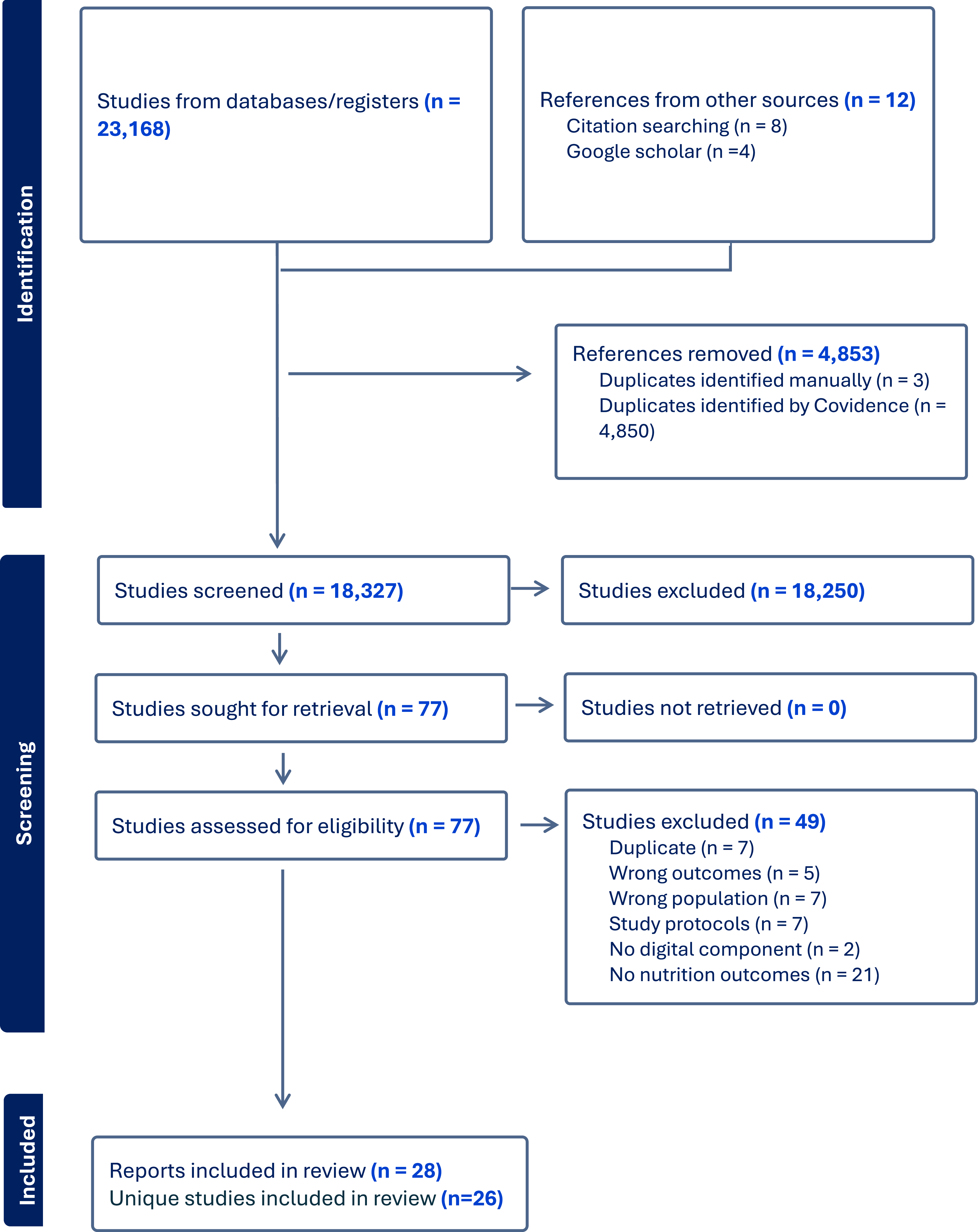


 Open access

