INTRODUCTION
End-of-life decision-making includes the completion of advance directives (Levin et al., Reference Levin, Li and Weiner2008), consideration of the end-points of curative treatment (Philip et al., Reference Philip, Gold and Schwarz2009), the decline or withdrawal of life-sustaining treatment including artificial hydration and nutrition (Good et al., Reference Good, Sneesby and Higgins2011) and the use of do not resuscitate (DNR) orders (Astrow et al., Reference Astrow, Sood and Nolan2008). The decision to enroll in hospice care is a major transition on the trajectory of a terminal illness that also represents an end-of-life decision. However, there is great variation in how and when hospice is considered, as well as in who makes the hospice enrollment decision (Teno et al., Reference Teno, Shu and Casarett2007). In some situations, patients are not actively involved in the decision to enroll in hospice; family members or healthcare providers make the decision or it is made collaboratively (Hirschman et al., Reference Hirschman, Corcoran and Straton2010). Clinicians frequently do not discuss hospice until they are certain that patients are appropriate for hospice enrollment; often late in the course of the illness when the person may have only weeks left to live (Vig et al., Reference Vig, Starks and Taylor2006). Family members have expressed preference for decision-making within the family context, and these decisions have significant emotional impact on both patients and their caregivers (Meeker & Jezewski, Reference Meeker and Jezewski2005).
The dying process has been characterized as a distinct stage of the human life cycle, which is comparable to infancy, childhood, adolescence, adulthood, and late life. Although the nature of each person's final stage of life is unique and distinct, depending upon illness-related factors and psychosocial issues, common developmental landmarks and tasks have been identified (Byock, Reference Byock1996). Viewing human development as change over time that continues until death is central to understanding how change continues during the dying process. The dying person's identity exists as one of multiple identities including, for example, those of spouse, parent, and friend. Many role transitions occur during a serious illness, which allow the dying person to integrate personal strengths and resources rather than being limited merely to the patient role (Steinhauser et al., Reference Steinhauser, Alexander and Byock2009). The end-of-life period is influenced by failing physical or mental function and can have dramatic effects on the person's identity. Such changes require continual reintegration of the self-concept (Knight & Emanuel, Reference Knight and Emanuel2007). Likewise, the dying process influences family development. There is growing recognition of the reciprocity of suffering by patients and family members who experience changes from a terminal illness both individually and collectively. A dyadic perspective is important to recognize both individual and mutual distress and adaptation as well as the physical, emotional, social, spiritual, and financial needs that emerge at the end of life (Witt-Sherman, Reference Witt-Sherman1998). The precepts of palliative care emphasize the importance of considering the patient and family together as a unit of care (World Health Organization, 2010).
The transition from cure-focused to hospice and palliative care has been found to be confusing, difficult, and traumatic (Grainger et al., Reference Grainger, Hegarty and Schofield2010). The complexity of the transition to hospice cannot be underestimated; however, little is known about the how this change influences experiences and development near the end of life. The purpose of this study was to explore and describe the subsequent decisions that faced newly enrolled hospice patients and their caregivers. Following a brief literature review about the transition to hospice and palliative care, this article presents a typology of the decisions and tasks that followed the decision to enroll in hospice.
Transition to Hospice Care
At the end of life, families face some of the most stressful and challenging experiences they will ever have, including increasing intensity of caregiving needs and use of formal services, considerable disruption of the family routines, greater potential for family conflict, economic strains and decisions about whether or not to continue working, and the need to act on decisions such as the use of life-sustaining treatments (Jo et al., Reference Jo, Brazil and Lohfeld2007; Kramer et al., Reference Kramer, Kavanaugh and Trentham-Dietz2010; Townsend et al., Reference Townsend, Ishler and Shapiro2010). Caregivers of people who are at the end of life experience high levels of individual and family distress that can be caused by psychological strain, restrictions on a caregiver's life, and anticipatory loss (Hancock et al., Reference Hancock, Clayton and Parker2007; Zaider & Kissane, Reference Zaider and Kissane2009). Marcella (Reference Marsella2009) identified three reasons for the difficult nature of the transition to hospice as: (1) the implication of impending death that often triggers fears of helplessness, abandonment, and intense emotions; (2) that the transition often occurs rapidly without giving the patient time to come to terms with it; and (3) the lack of information about the nature of hospice and palliative care, which can intensify fear and reluctance (Marsella, Reference Marsella2009).
Growing awareness that death is approaching shifts families into a series of final transitions (Waldrop et al., Reference Waldrop, Kramer and Skretny2005). Glaser and Strauss (Reference Glaser and Strauss1965) presented two awareness contexts that are particularly helpful for considering how hospice enrollment can become a catalyst for change. Open awareness was described as occurring when both the dying person and relative know that the person is dying. Closed awareness occurs when knowledge of the approaching death is hidden from the person who is dying (Glaser & Strauss, Reference Glaser and Strauss1965). The hospice experience is characterized by an open awareness of dying, but this can occur suddenly or gradually. Wittenberg-Lyles et al. (Reference Wittenberg-Lyles, Goldsmith and Ragan2011) characterized the hospice experience as a potentially sudden and “rescued” or gradual and “comforted” journey. A rescued journey involves an abrupt referral to hospice, with explicit prognostic discussions and education about the dying process. Patients move from the familiar cure-focused approach to an unfamiliar hospice context and a refocused approach to care. The comforted journey occurs more slowly, also involving explicit discussions of prognosis together with education about the dying process. In addition, the limits of medicine are also clearly acknowledged and advance care planning (ACP) is discussed openly (Wittenberg-Lyles et al., Reference Wittenberg-Lyles, Goldsmith and Ragan2011).
The transition to hospice care may serve as an important period of individual and family development. Byock (Reference Byock1996) presented a framework of individual development called “Developmental Landmarks and Tasks for the End of Life,” which includes: (1) sense of completion with worldly affairs; (2) sense of completion in relationships with the community; (3) sense of meaning about one's individual life; (4) experienced love of self; (5) experienced love of others; (6) sense of completion in relationships with family and friends; (7) acceptance of the finality of life; (8) sense of new self (personhood) beyond personal loss; (9) sense of meaning about life in general; and (10) surrender to the transcendent, to the unknown, “letting go” (Byock, Reference Byock1996).
The transition to hospice influences family members' awareness and adaptation in meaningful ways. Schulman-Green et al. (Reference Strada and Breitbart2004) found three themes that were common in the transition to hospice: (1) caregivers' acceptance of the impending death, (2) challenges in negotiating the healthcare system across the continuum of care, and (3) changing patient–family dynamics (Schulman-Green et al., Reference Schulman-Green, McCorkle and Curry2004). Family members want to be involved and accept the moral responsibility of being a surrogate decision maker, but surrogates can experience long-term physical and psychological outcomes from being decision makers (Meeker & Jezewski, Reference Meeker and Jezewski2005). Family caregivers experienced the decision-making role as very demanding. Those who were able to see that another's wishes were honored experienced satisfaction (Meeker & Jezewski, Reference Meeker and Jezewski2004). Caregivers who help a family member at the end of life experience many processes before letting go and feeling a sense of role completion or closure. They attempt to accept the reality of the diagnosis, struggling to maintain a sense of control in the presence of an uncontrollable life event (Back et al., Reference Back, Young and McCown2009). This article presents specific choices that became clear after hospice enrollment, and may facilitate growth and development during the final stage of life.
METHOD
Study Design
An exploratory, descriptive, cross-sectional design was employed using qualitative methods. This present study was conducted using a subset of data from a larger project that sought to explore the factors that influence the decision to enroll in hospice. Initially, interviews were conducted with patients and caregivers from 64 families (including the caregivers of some patients who had died). A clear early trend indicated that the decision to enroll in hospice was followed by a series of additional decisions. Because we sought to explore decision making in real time, only data from the subset of participants who were current hospice patients and caregivers (n = 53 families) were analyzed and are presented.
Recruitment
Purposeful sampling was used to identify potential participants who had recently made the decision to enroll in hospice. Protocols were developed with the leadership teams at two hospices to invite the participation of new hospice patients and their caregivers shortly after admission. The study was approved by the University at Buffalo Social and Behavioral Sciences Institutional Review Board. A Health Insurance Portability and Accountability Act (HIPAA) Waiver of Partial Authorization was approved so that the name and address of hospice patients who met inclusion criteria could be sent electronically to the principal investigator (PI).
The study's inclusion criteria were that the hospice patient: (1) was ≥age 65, (2) had been on the homecare program for 2 weeks prior to recruitment and, (3) had a Palliative Performance Scale (PPS) score ≥40. The PPS is a 100 point scale of functional decline that precedes death. People who score <40 are often unable to communicate and generally expected to be actively dying (Anderson et al., Reference Anderson, Downing and Hill1996). The inclusion criteria of age 65 was selected because it establishes access to the Medicare Hospice Benefit and because participants would then be in approximately the same developmental life stage. Family caregivers were invited to participate because end-of-life decision making frequently made in the family context (Hirschman et al., Reference Hirschman, Corcoran and Straton2010).
Procedures
Information sheets about the study were placed in admission packets during the recruitment phase. Invitation letters were mailed by the PI, and interested participants returned a response form. Interviews were arranged, confirmed by phone and rescheduled if the patient was not feeling well. Qualitative data were collected during one face-to-face interview that took place in participants' homes. All interviews were conducted by the first author who is a licensed social worker, and were guided by a semistructured interview guide that included questions about the illness trajectory, social support network, the hospice decision, and the family's experience with hospice care. Interviews lasted 55–90 minutes and were audiotaped with permission. Participants were given a $25 supermarket gift card to thank them for their participation.
Analysis
Audiotaped interviews were transcribed and entered into Atlas ti for qualitative data analysis and management. The analytic process was iterative, and involved grounded theory techniques to identify and saturate categories. Systematic coding or the use of a start list of codes was used to sort participants' answers into content bins that were linked to the key concept in each question on the interview guide. An example of a content bin is “advance care planning.” A content bin for “multiple decisions” was created and open coding or the line by line examination of the data to identify concepts, their properties, and their dimensions was used to identify the decisions that followed hospice enrollment. Categories and subcategories were set up for each type of decision (e.g., final acts [category]; funeral plans [sub-category]). Axial coding or the process of relating categories to their subcategories was used to describe the structure or conditional context of each category and the decisions that followed hospice enrollment (Strauss & Corbin, 1998). The process of integrating and refining the categories was used to establish the developmental framework of five decisions that become salient after hospice enrollment.
Rigor of the qualitative data analysis was maintained by the use of: (1) co-coding or the use of two coders who analyzed the transcripts independently and achieved inter-coder agreement; (2) interdisciplinary observer triangulation or the use of observers from nursing and social work to achieve inter-subjective agreement in the development of categories; (3) an audit trail or the use of memos to document decisions that were made during the data collection, coding, and analysis phases; and (4) peer debriefing for discussion and consultation during data collection and analysis (Padgett, Reference Padgett2008).
RESULTS
Sample
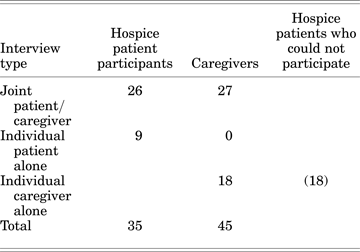
When possible, joint interviews were conducted with both patients and caregivers (n = 26 patients and 27 caregivers [2 caregivers participated in one family]). Individual interviews were conducted with patients alone when there was no caregiver (n = 9 patients) and with caregivers alone when the patient was alive but unable to participate (n = 18 caregivers). In all, a total of 35 patients and 45 caregivers from 53 families were interviewed (n = 80 participants, see Table 1).
Types of interview

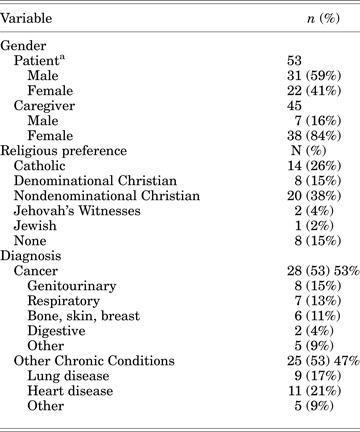
Demographic information was collected about all patients, including those who were unable to participate in an interview. The mean age of patients was 80.3 years and 31 (58%) were male. The mean age of caregivers was 66.3 years and 34 or 84% were female. The sample was entirely Caucasian (100%) and 83% reported their religious preference as some form of Christianity. Twenty-eight or 53% of the patients had cancer and 25 (47%) had other chronic conditions. Table 2 presents the additional demographic characteristics of the sample. The nature of the decision to enroll in hospice as a critical juncture is described and illustrated with participants' own words. Subsequently, a typology of five decisions that follow hospice enrollment are described and illustrated.
Sample characteristics
aPercentages are of the whole sample of patients, including those who were unable to participate in an interview.
bPalliative Performance Scores ranged between 40 and 60.
Hospice Enrollment Decision
Enrolling in hospice was a critical juncture on the trajectory of an illness that was accompanied by the shift from cure-focused to hospice and palliative care, with a greater emphasis on pain and symptom management. Hospice patients and their family caregivers shifted to an entirely new interdisciplinary care team and the majority began receiving care in the home setting. Because dying is a process, not an event, hospice enrollment was described as a milestone marking the entrance into a new phase of life. A patient described how hospice enrollment motivated him to give his children specific information.
Well since the illness has become more dominant, I involve the children — each one. A lot of things were set up before but it all came from the hospice decision. I mean there's an awful lot of detail, so everybody is aware of the generalities. Hospice brought this all on.
A patient's son described how hospice enrollment made him realize that he wanted to be told what was going to happen, by saying “I think it has to do with your relationship with death. The closer you get to it the more you realize that you want someone who is authoritative [knowledgeable] with you.”
A patient's wife described how, following hospice enrollment, her perspective of time changed by saying, “Since the middle of May [hospice enrollment] he's gone way downhill. I think it seems like a fast process but it's really been a slow process.” A patient's daughter described how hospice enrollment brought new consideration of how her mother would die,
At first when she came home [on hospice] we signed the 911 because she seemed just ok and I said she's just having a little problem. But then as I started thinking about it, it was dawning on me that to resuscitate her organs are going to put more work on her heart. It took me time to process because they said to me are you sure you want the 911 to call her in? After two weeks when I saw her I thought I won't call them.
Hospice enrollment brought a shift from a focus on the future to a greater concentration on the present. Hospice enrollment was a sentinel event that became the catalyst for a changing perspective and allowed important new tasks to come into focus.
Typology of Decisions that Follow Hospice Enrollment
Five decisions became central following hospice enrollment: (1) operationalized ACP; (2) surrogate decision making; (3) meaning-making; (4) location of death decisions; and (5) final acts.
Operationalized ACP
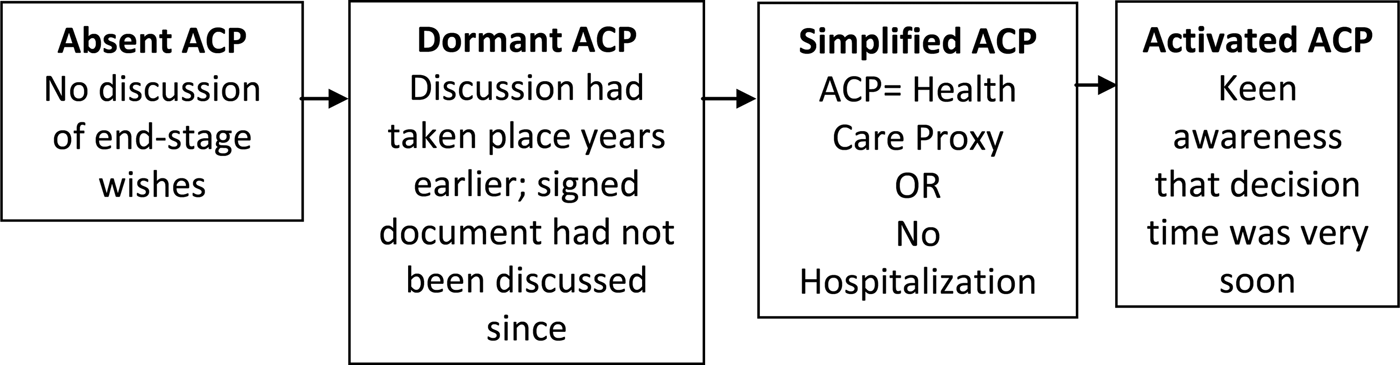
Hospice enrollment routinely includes questions about the patient's wishes for end-stage care and the existence of advance directives. These conversations render a sharpened focus on the possible desire or need for resuscitation, tube feeding, aggressive treatment through dialysis, pacemakers, medications (e.g., antibiotics, thyroid medication), and hospitalization. A focus on the person's wishes for end-stage care also underscored the need for understanding terminology and options for care. Advance directives became much more than a signed form, and the need for understanding and agreement between patient and caregiver became central. Participants' descriptions of their ACP process fell along the continuum from (1) absent ACP, (2) dormant ACP, (3) simplified ACP to (4) activated ACP (See Fig. 1).
The continuum of advance care planning (ACP).
Absent ACP was defined as the lack of any previous discussion of end-stage wishes until the hospice team initiated the discussion. Dormant ACP was used to describe situations in which the discussion of end-stage wishes had occurred years earlier and the signed documents but not been considered since that time. The existence of dormant ACP raises the question of whether the document was reflective of what the person wanted and if wishes may have changed. A patient's wife illustrated dormant ACP by saying, “Yes, we did have a health care something or the other. It wasn't up to date though.” Another wife provided an additional illustration, “I think we might have had living wills. I think that's what we had.” There is a substantive difference between completing a form with ideas about future needs or a future self and the need to make real time choices in the advanced stages of an illness.
Simplified ACP was used to describe situations in which the participant equated having a health care proxy, a DNR order, or the stated wish for no further hospitalization to ACP. People who utilized simplified ACP expressed a finite sense that the document they had completed would cover all situations. A patient's wife illustrated this finitude by saying, “We did all that- DNR. We're not going anywhere.” A patient expressed simplified ACP by saying, “I did that a long time ago. I don't want to lay in a bed forever. I've seen too much of that.” A patient's daughter provided a third illustration of the belief that the form covered all situations by saying, “My dad is a DNR, leave him alone he doesn't want to be bothered.” The hospice team routinely reactivated the conversation and brought advance directives into the present. A caregiver illustrated
That was the first thing that Hospice did when they got here, the DNR was the first thing. I already had a health proxy in fact there was a DNR in effect at the hospital before they got here, I didn't have a copy of it but the hospital did.
Activated ACP was used to describe situations in which there was keen awareness of the need for the discussion of end-stage wishes and that the need for decisions was real. Awareness of the possible need for contingency decisions also became clear. A patient expressed how she needed more information about the symptoms she was experiencing to make decisions.
I wish I'd known what was going to happen. I knew I had cancer but I didn't know what was going to happen to me. Was I going to be nauseous, was I going to be in pain a lot? They always ask me if I'm in pain and I do have pain pills. Was I going to be throwing up? I would have liked a little more [information]…maybe they can't tell you.
The wife of a man with Alzheimer's disease described how they had engaged in activated ACP before he experienced ravaging cognitive decline by saying
I felt that it was a smart thing that we really discuss it while he was able to hold that discussion and fully understand what we were discussing. We both don't want artificial life support, we don't want artificial feeding…
Hospice enrollment and the team's involvement activated the need for the considering end-of-life choices in real time.
Surrogate Decision Making
Family members begin to make decisions for and about a person who is nearing death in both informal and formal ways. Informally, caregivers begin taking charge of the person's everyday care by making decisions about the routines including medication management, meal preparation, and household chores. Most basically, a caregiver described how she made the decision to create a pleasant atmosphere, “I take a lot of stuff and turn it into humor. I make everything very lighthearted around here.” Informal surrogate decision making begins as caregiving needs intensify.
Informal surrogate decision making also changes the balance of a relationship between caregiver and care recipient. The wife of a man with advanced cancer described her decisions about how to care for him and how that changed their relationship,
I handle him like he's fragile. I deal with him as if he were an infant who was born with a disability who needs lots of care, lots of nurturing, but you handle very gently and you watch extensively.
Similarly, a caregiving daughter illustrated how her informal surrogate decision making for her mother was changing their relationship,
She and I fight over whether or not she is going to get the stepladder in the bathroom so she can turn the showerhead down herself. There are certain rules I think—“you cannot do that. If you do that I am going to take away some sort of privilege.”
Recognition of the need for a surrogate decision maker can be sobering. The words of a patient illustrated her awareness,
Yea, I've talked with them [children]. They know I want no extraordinary measures and I think I make things clear. I feel sorry for my youngest one. He's my rock.
Informal surrogate decision making began early in the caregiving process and was the natural outcome of the patient's decline and need for intensifying caregiving.
Formal surrogate decision making is, most simply, speaking for someone else, and it begins when people are no longer able to able to make decisions about their own care. Formally invoking a power of attorney for health care or health care proxy involves stepping into the person's shoes and making life and care decisions about medical procedures, medications, and placement and, potentially, life support decisions. Understanding the impact of that shift in responsibilities on one's children was illustrated by this father, “I review my decisions with my children; I know it is going to be harder on them than on me.” Another patient described how she went along with her children's decisions because she knew they were becoming overwhelmed.
I got a hospital bed. I shouldn't have gotten it so soon but the girls wanted everything set. It was too quick but nobody knew what to do. They were overwhelmed. That was the biggest thing—letting people know what to do. What's coming.
Surrogate decision makers may have a general idea of what the person wishes but unforeseen circumstances can force hard choices. The wife of a heart patient who was being monitored electronically who called the 800 number and then pushed the button described receiving an immediate return call,
“You've got to get him to the ER.” I said, “Well my Hospice nurse is coming out, I'll do it when she gets here.” She hung up and called the Cardiology office and they called to say “You need to get him the hospital emergency room right away.” I said “Why?” She said, “His heart needs help right away.” I said, “The Hospice nurse is on her way, now — she will be here in a few minutes I'm gonna wait for her.”
Surrogate decision making occurred in the family context where other members may have been involved to a greater or lesser extent, as was illustrated by this caregiver, “They're not above making any decisions for her but I make all of them.” Although the potential for conflict between the surrogate decision maker and other family members exists, the words of this daughter illustrated how she dealt with her siblings, “I call my brothers and say, look this is what I'm going to do. And they say, yes madam, whatever. Do what you think is best.”
Surrogate decision makers also experienced decisional conflicts about how much they allowed hospice to manage the caregiving. The words of a caregiving wife illustrated this conflict.
First it was an intrusion and I felt very defensive about the whole thing. Strangers coming into my house and touching my husband and doing stuff. That was really hard for me.
Surrogate decision makers described managing decisions about whether a person who was in pain should have morphine and be sleepy, or whether it was better to withhold the morphine so they could be awake. Participants also described deciding how to manage the differing opinions of a primary care physician and a hospice. Finally, caregiver participants described decisions about how much information to give the patient about his or her prognosis. Surrogate decision making can occur suddenly following rapid change, or slowly and gradually over time. In both cases, deciding on behalf of another is a central part of caregiving for someone who is nearing the end of life.
Meaning-Making
Following hospice enrollment, participants described the growing recognition that death was approaching and that there were important opportunities to make meaningful memories. Frequent mention was made of special times with children, grandchildren, and great- grandchildren. One patient's wife illustrated, “All he could think about was getting home and sitting out on the deck. We have four children and lots of grandchildren they all came in and out all summer.” A patient described special times with his great-granddaughter.
She was 2 in March. She has red hair. She knows sign language. She's so neat. She'll talk with you and her hands are going all the time. She's just adorable. The last time she was up here, I couldn't get her to sit on my lap. I was eating grapes. She ate gummy bears and she sat right there and I sat in the wheelchair so then we were swapping a grape for a gummy bear. And then I got closer to her.
The importance of family gatherings was described by patients and caregivers.
His son who lives in (another state) was home so we all went out to P's favorite restaurant…it was a blessing but all of us were fighting back tears of joy and sadness all at the same time.
Finally, the sincere appreciation of time spent together was illustrated by two caregivers. One patient's daughter explained heightened pleasure from everyday activities, “Her best thing is to put her in the car and just drive her around. She loves it.” The words of a caregiving husband illuminated the reciprocal nature of meaning-making activities
When her time finally comes at least I'll know that she had good quality of life –the best that I could do for her. I take her places still. Even though she doesn't want to get out and walk around. We'll go get ice cream, go sit at Barcelona Beach and watch the waves and the people.
Participants' words illuminated how hospice enrollment created awareness that there were time-limited opportunities for special memories, important conversations, and events.
Location of Death Decisions
Hospice enrollment and growing awareness that death was approaching became the catalyst for considering whether the person could stay at home as care needs intensified, and where the person would die. Participants discussed the desire to die at home, together with the barriers and facilitators of home death.
The desire to remain at home was expressed in the words of this patient's daughter, “I asked him if he wanted to come and stay with us. He said ‘I was born in this house and I'm going to die in this house’”. The same sentiment was echoed by a patient's wife, “I want him home here as long as he can be home.” However, there is the potential for lasting repercussions from a home death that were expressed by this patient, “I don't want to die in this room. I think my daughter [who lives ] here is too emotional.” Patients considered the impact of the location of their death on the loved ones who were providing care.
There can be unforeseen barriers that preclude a home death, including intractable pain, difficulty with symptom management, or other medical crises. The words of a patient's husband illustrated his promise to care for her at home, tempered with the reality that he may not be able to do so.
I made her the promise that she will never go to a hospital and she was going to die in her house. If she is really uncomfortable with her breathing and if they tell her that going to the hospital she can have the fluid sucked out, it's up to her whether she would like to go. That's the only time I would break my promise if it would make her more comfortable while she is alive.
Finally, participants' decisions about the desired location for death were strongly influenced by experiences with hospitalization. The words of this caregiver illuminated dread of returning to a hospital.
He said, “no matter what happens I don't want to go to the hospital again.” So it was such a fear, he just thought I'm going to go to the hospital and never going to come home and I'm going to die in the hospital. And it wasn't so much that he was afraid of dying as much as it was dying in the hospital. Dying in his own bed would be fine.
For a majority of participants, home death was desired, but there was recognition that an inpatient admission might become necessary, and many expressed the awareness that a stay at an inpatient hospice unit might be the best compromise if remaining at home became impossible.
Final Acts
Hospice enrollment triggered the need for consideration of final acts or decisions about organ donation, funeral planning, final wills and testaments, and disposing of property and other resources. This participant described how he had recently finalized his plans
My oldest who is the executor has all the information set up. I switched everything to joint accounts for her (wife's) benefit. We have gone over the wills with everyone because I don't have much to give away; most of it being ours and not mine. I wanted each one of my children to have a remembrance of me so they're all set up and (Name) will handle that; it's been gone over thoroughly; he's gone over all the investments.
Other participants illustrated how they had completed funeral arrangements. One patient explained, “I made all the funeral arrangements to try to get all of that stuff out of the way and get some of the book work done for her (wife).” Another patient expressed relief at having been able to finalize her funeral, “I got her [the hospice chaplain] to promise to officiate at my funeral. I said, ‘Would you?’ and she said, ‘Yes’ and I said, ‘Can we make an appointment for next week?’”
Finally, participants also gave examples of leaving a legacy. The words of this participant illustrated how he wanted to leave memories for his children by saying, “See that little blue book over there? Something I put together for my kids. This is my heritage.” Hospice enrollment set the stage for participants to make final arrangements. Participants expressed both satisfaction and relief at being able to complete these tasks.
DISCUSSION
In-depth in-person interviews were conducted with current hospice patients and caregivers from 53 families, to explore and describe the decisions that follow hospice enrollment. Hospice enrollment represented a critical juncture on the trajectory of a terminal illness, signaling a transition to the final stage of life. Both the shift in participants' perceptions and the care being offered opened the door to a new developmental life phase. Rather than determining or dictating choices that should be made in this phase, the shift created the opportunity to engage with important issues and for each dyad to be deliberate in determining how the remaining time would be used, and to influence the circumstances that would characterize the time of dying. This transition brought the approaching death into focus and facilitated the opportunity to consider meaningful choices about life closure. Participants illustrated the synergy between patient and caregiver decisions that facilitated continuing transformation in the relationship and evidence of ongoing development in the final stage of life.
ACP was found to exist on a continuum that included absent ACP, dormant ACP, simplified ACP, and activated ACP. The hospice team was a catalyst for the reconsideration of end-of-life wishes, because their standard protocol was to ask about the presence of advance directives. This brought the urgency of considering the options from a decision that might have been made about a future self or a future time into sharper focus. The need for surrogate decision making was considered and initiated in both informal and formal ways. Participants expressed the importance of making sure that their surrogate decision maker knew their wishes, but also felt concern about how their loved one would handle the emotional repercussions of stepping into another's shoes. Patients and their caregivers described how recognition of the foreshortened time together underscored the importance of making the most of the time they had by seeing children, grandchildren, and great-grandchildren; creating a legacy; and celebrating special, meaningful events. Recognition that death was approaching clarified questions about where the person wanted to be when he or she was actively dying and whether or not this would be possible. Consideration of the family's emotional response to and memories of a home death became salient in light of other options such as hospitalization, nursing home placement, or a transfer to the hospice inpatient unit. Hospice enrollment brought into focus the need to make or complete the person's final arrangements. Funeral planning and the completion of a will provided comfort that there were no questions left unanswered.
These findings add to the growing knowledge about how people die in the family context, extending awareness about how both individuals and families continue to grow and change both individually and together during the final stage of life. These findings are congruent with the developmental framework developed by Byock (Reference Byock1996). For example, Byock's task of completion of worldly affairs was undertaken by our participants in their “final acts” decisions. Similarly, many of the efforts of our participants toward meaning-making during the final phase of illness represented Byock's tasks of completion in relationships, experiencing love of others, and finding a sense of meaning about one's life. However, what is revealed additionally in our findings is something of the context in which these tasks are addressed, and how interdependent are the efforts of the ill person and the family member. Just as members of each dyad endured reciprocal suffering (Witt-Sherman, Reference Witt-Sherman1998), they also encountered opportunities for reciprocal healing. For many, the open awareness context of having chosen hospice care facilitated these opportunities (Glaser & Strauss, Reference Glaser and Strauss1965). The dying process also involved opportunities for reciprocal growth and the opportunity to finish a relationship through the consideration of important and meaningful decisions and the completion of salient tasks (Witt-Sherman, Reference Witt-Sherman1998).
LIMITATIONS
This study had several limitations. Eighteen patients were unable to participate in the interviews; therefore, those perspectives are absent. The study was cross-sectional, and a one-time interview only captures only one time point. Because decision making is dynamic rather than static, the use of a one-time interview limits the ability to see how growth and change may continue even until death. Longitudinal studies could yield important knowledge about how perspectives may continue to change, and that there may be still further decisions to be made that are not identified here. Only hospice patients and their caregivers were interviewed, which suggests the possibility that the individual and family tasks may be different without hospice as a facilitator. The study participants were entirely white. Although this reflects national trends in hospice utilization, it also underscores the need for additional research with both racially and ethnically diverse populations, to further understand how race, ethnicity, and culture may the influence decision-making and development at life's end.
Implications
Illness trajectories vary widely, and are influenced by diagnosis, age, stage, availability of treatment, and end-of-life care. Moreover, access to, referrals for, and utilization of hospice and palliative care vary widely in the United States. Care continuity and coordination become difficult at the end of life when patients face complex transitions between settings for care (Lorenz et al., Reference Lorenz, Lynn and Dy2008). Patients with hospice stays of ≤14 days had a greater likelihood of dying in an inpatient hospice bed. Patients with stays of <7 days who were referred from hospitals were six times more likely to die in an inpatient hospice bed. Continuous hospice home care in the last week of life is less likely to occur when patients have short hospice stays (Miller et al., Reference Miller, Kinzbrunner and Pettit2003). Hospice and palliative care can relieve suffering by allowing people who are near the end of life and their caregivers to maintain personal integrity in the face of advanced illness and impending death (Strada & Breitbart, Reference Strada and Breitbart2009). Moreover, discussions of life completion may improve important health outcomes for people with advanced serious illnesses and ease caregivers in bereavement (Dumont et al., Reference Dumont, Dumont and Mongeau2008). With short stays, there is not time to address the decisions presented here. The experience with hospice varies widely; therefore, the ability to complete these tasks happens to a greater or lesser extent.
It is important for clinicians to recognize that well-timed encouragement to consider and explore the use of hospice services, although it may indeed diminish hope for cure or recovery, simultaneously offers an opportunity to engage with important and time-sensitive developmental tasks. Patients, with support of family members, may be able to create a satisfying and meaningful final phase of life. Focusing on these tasks and continuing to be challenged with decisions strengthens personhood, identity, and control of one's life. Benefits accrue to both patient and family during the dying phase, and continue for family members by easing their transition to their own next life phase following loss.
ACKNOWLEDGMENTS
The authors are grateful for the contribution of 35 hospice patients and 45 caregivers who graciously shared their experiences for the purpose of helping others. The authors also acknowledge the help of Hospice Buffalo and Hospice of Chautauqua County, and grant support from the Buffalo Center for Social Research.