INTRODUCTION
A key issue in language development relates to the degree of productivity associated with early verb use. This area of research feeds into theoretical debates regarding the initial representation of linguistic knowledge in the minds of nascent language learners. Some researchers (e.g. Fisher, Reference Fisher2002; Naigles, Reference Naigles1990; Naigles, Bavin & Smith, Reference Naigles, Bavin and Smith2005) claim that children as young as 1 ; 9 possess context-independent knowledge of verbs. Researchers working in approaches broadly construed as constructivist or usage-based (e.g. Lieven, Pine & Baldwin, Reference Lieven, Pine and Baldwin1997; Pine & Lieven, Reference Pine and Lieven1993; Theakston, Lieven, Pine & Rowland, Reference Theakston, Lieven, Pine and Rowland2004; Tomasello, Reference Tomasello1992: Reference Tomasello2000) claim that there is no evidence of abstract linguistic knowledge in the early stages of multiword speech. In the constructivist approach it is claimed that early verb constructions are item-based (that is, structured around specific lexical items) or at best partial representations of abstract categories (Tomasello & Abbot-Smith, Reference Tomasello and Abbot-Smith2002).
A recent study by Naigles, Hoff and Vear (Reference Naigles, Hoff and Vear2009) addresses the issue by analyzing the first instances of verb use in the speech of eight English-speaking children (aged 1 ; 3–1 ; 7 at the onset of the study). Using diary data collected by the children's primary caregivers the authors analyzed the first ten instances of thirty-four early emerging verb types and investigated the levels of structural, semantic and pragmatic flexibility attested in the children's verb productions. The authors claim that all the children in the sample displayed some level of productivity, though differences occurred with regard to specific verbs and flexibility measures. While Naigles et al., (Reference Naigles, Hoff and Vear2009) do not claim their data support the notion of an abstract verb category at the onset of development, they also argue against a constructivist approach to early verb development. Instead the authors suggest that abstract grammatical categories are learned from the input but emerge at a much earlier stage than constructivist researchers have claimed.
While there is much literature available to evaluate and debate issues relating to the structural and semantic dimension of Naigles et al. (Reference Naigles, Hoff and Vear2009), less has been written on the pragmatics of verb use, and consequently this will be the focus of the current study. Naigles et al. (Reference Naigles, Hoff and Vear2009) claim that from the onset of verb development children are able to use verbs flexibly (i.e. in the expression of different functions). However, this claim is at odds with other function-oriented studies which indicate that children's initial use of lexical items and multiword constructions is closely tied to specific functions, and to input patterns. For example, Halliday (Reference Halliday1975) claims that there is a one-to-one relationship between form and function in the early stages of multiword development. Similarly Ninio (Reference Ninio1992) presents a pragmatically orientated analysis of early Hebrew single-word development and claims that single-word utterances are employed in the same types of functions as those attested in the input.
In the current study we take as our starting point two issues arising from Naigles et al.'s (Reference Naigles, Hoff and Vear2009) analysis; namely the role of the input with regard to children's early verb use, and the functional categorization employed in the study.
Incorporating the input
When ascertaining the productivity of children's speech it is important to have a clear idea of the type of language available to the child. As Tomasello and Brandt (Reference Tomasello and Brandt2009) point out, it is difficult to evaluate the flexibility or productivity of a child's linguistic system unless information relating to input patterns is also provided. While Naigles et al. (Reference Naigles, Hoff and Vear2009) suggest that the flexibility of verb use in their sample presents a challenge to the item-based, verb island hypothesis, Tomasello and Brandt state:
In the verb island hypothesis, children may be as flexible as you like in their use of particular verbs in syntactic frames and morphological paradigms – so long as they have heard all of these uses in the language around them.
Therefore, in the present study we investigate the pragmatics of verb use in both child speech and the input, in order to ascertain whether the child's verb use is genuinely flexible, or a reflection of functional distribution in the input.
Coding for function
Coding for pragmatic function is problematic; to date there is no consensus on the types of categories that most accurately represent developing and mature linguistic systems. Consequently there is an almost one-to-one relationship between coding taxonomy and researcher. Naigles et al. (Reference Naigles, Hoff and Vear2009) employ an accessible and potentially straightforward coding system involving a binary distinction between commands (e.g. pull as a command for help with a chair) and descriptions (e.g. I pulling as a description of the speaker's current action). However, we suggest that there are issues relating to the validity of the functional codes employed in the study, and that these issues have the potential to distort measures of pragmatic flexibility.
Naigles et al.'s (Reference Naigles, Hoff and Vear2009) ‘command’ category appears relatively sound; however, the category ‘descriptives’ seems unreasonably broad and may actually be used to code utterances which have more in common with a command than a statement. For example, based on Naigles et al.'s comments, an utterance such as need juice would be coded as a descriptive. Such utterances may function as descriptives for mature speakers but for a child need juice is probably closer to a command than a plain descriptive (e.g. ‘I need a drink so go and get me one’). Therefore, there is potential for miscoding and inconsistencies from one sample to the next. Furthermore, due to the method of data collection (diary data), reliability tests were not conducted, adding further concern to the validity of the coding.
Consequently, in the current study we employ codes grounded in empirical research and linguistic theory. While many such coding taxonomies exist we have chosen to use codes at the same level of granularity to those in Naigles et al.'s study (i.e. a two-way distinction) and have opted for Halliday's Phase II codes, ‘Mathetic’ and ‘Pragmatic’. In the following section we outline the theory from which these codes emerge and also our motivation for using them.
Halliday's Mathetic/Pragmatic functions
Halliday (Reference Halliday1975) presents a three-phase model of language development, based on diary data taken from his son (Nigel) aged 0 ; 9 to 1 ; 6. Halliday views language development as a process in which functional distinctions merge and generalize over time, leading to a mature linguistic system of representation in which all utterances are plurifunctional. Three distinct phases are proposed within Halliday's theory. Phase One consists of six unintegrated functions used in the earliest stages of language development; ‘Instrumental’ (‘I want’), ‘Regulatory’ (‘Do as I tell you’), ‘Personal’ (‘Here I come’), ‘Interactional’ (‘Me and you’), ‘Heuristic’ (‘Tell me why’) and the ‘Imaginative’ (‘Let's pretend’). Phase Two is signalled by the merging of functions and also the emergence of multiword speech. The Instrumental and Regulatory functions merge into the ‘Pragmatic’ function (‘language as doing’), and the Personal and Heuristic functions merge into the ‘Mathetic’ function (‘language as learning’). The Interactional function is claimed to contribute to both the Pragmatic and Mathetic. Halliday claimed that during the early stages of Phase Two, utterances only occurred in one function and thus were functionally restricted. For example, more omelette and more bread were always expressed within the Pragmatic function, while utterances such as green peg or red car expressed the Mathetic function (Halliday, Reference Halliday1975: 47). Halliday claimed that the distinction between the Mathetic and Pragmatic function was systematically marked by different intonation patterns in Nigel's speech; a rising tone for the Mathetic and a falling tone for the Pragmatic. Halliday claimed that the end of Phase Two was marked by a shift towards the adult linguistic system in which utterances display plurifunctionality; expressing both the ‘Ideational’ (the representation of experience) and ‘Interpersonal’ (language as a channel for social action) functions of the adult linguistic system. Thus Halliday's approach to the functional component of language incorporates a truly developmental dimension. That is, the pragmatic abilities of the developing child are not simply captured by the presence or absence of particular types of pragmatic/communicative codes, but instead by a gradual shift in the underlying system of pragmatic organization; a shift from independent and uninterconnected pragmatic functions to the plurifunctional, overlapping system which is claimed to be the bedrock of mature linguistic representation.
Few have tested Halliday's Pragmatic/Mathetic distinction directly. However, support for the distinction can be found in a number of studies. As Nelson (Reference Nelson, Minnifie and Lloyd1978) points out, the gradual emergence of a dual system consisting of object-related (Mathetic/Ideational) and social (Pragmatic/Interpersonal) function has been attested in a number of studies of children's speech, for example, Dore's ‘message’ versus ‘code’ (Reference Dore1974), and Nelson's ‘expressive’ versus ‘referential’ (Reference Nelson1973).
In addition to its theoretical depth, another reason for choosing Halliday's Mathetic/Pragmatic distinction relates to issues of granularity. While we do not aim to conduct a direct comparison with Naigles et al. (Reference Naigles, Hoff and Vear2009), it is necessary to analyze our data by means of a system with a comparable degree of functional differentiation. Thus, rather than presenting our findings in terms of a fine-grained system such as the Inventory of Communicative Acts-Abridged (INCA-A) (Ninio, Snow, Pan & Rollins, Reference Ninio, Snow, Pan and Rollins1994), which employs over sixty categories, we have conducted the functional analysis at a broader level.
METHOD
Participants
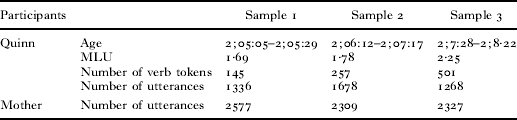
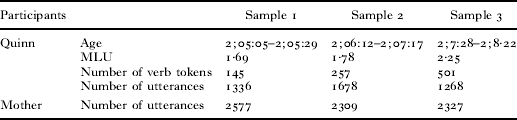
The target child was an English-speaking boy (Quinn) aged 2 ; 5–2 ; 9 with an MLU of 1·69 at the beginning of the data sample and 2·25 in the final sample. Quinn was the third of four children. The data for the study were collected using a DV recorder in the home during everyday activities with Quinn's mother (the author) and in some cases in the presence of his three siblings. Recordings were conducted approximately once a week for one hour.
Data sample
The corpus was divided into three time samples each containing four hours of recordings. All self-repetitions, imitations, partial imitations and incomplete utterances were excluded from the analysis. All utterances containing verbs were extracted from the samples using the method described below. The number of tokens in each sample is displayed in Table 1.
Data sample details
Transcription and function coding
All data were transcribed by trained transcribers into CHAT format (MacWhinney & Snow, Reference MacWhinney and Snow1990). The data had been coded for communicative intent by means of the INCA-A (Ninio et al., Reference Ninio, Snow, Pan and Rollins1994) for use in an earlier study. Again, all coding was conducted by trained research assistants and checked by the author throughout the coding process. Reliability checks were conducted on 10% of the sample, resulting in Cohen's kappa values of 0·79 for interchange codes and 0·82 for speech-act coding. For the purposes of the present study however, the INCA-A codes were combined and grouped according to Halliday's two-way distinction between Mathetic and Pragmatic function. The translation of codes from INCA-A to Mathetic/Pragmatic was based in the first instance on the interchange coding of INCA-A, as it is at this level that the distinction between language as doing and language as learning is most apparent. For example, utterances coded as ‘Negotiating the Immediate activity’ are part and parcel of ‘language as doing’ regardless of speech act (e.g. request, agree to carry out a command), while utterances coded as ‘Discussion of Joint Focus’ are more closely related to language as learning. The INCA-A codes used in the present study and their categorization according to Halliday's two global categories are displayed in the ‘Appendix’. All utterances within the samples were checked in order to ensure the accurate translation between INCA-A codes and the current Mathetic/Pragmatic codes. There were no instances in which an utterance's interchange categories mismatched with the Mathetic/Pragmatic codes of the current study (as outlined in the ‘Appendix’).
Verb identification
A frequency count of lexemes was conducted on the data by means of the FREQ programme from CHILDES (MacWhinney & Snow, Reference MacWhinney and Snow1990). The output of the frequency count was then used to identify the verbs in the sample. Following this a keyword search was conducted to check whether potentially ambiguous lexical items such as cut were being used as verbs rather than nominals. In the present analysis contracted copula forms were omitted (e.g. there's) since it could be argued that such items form lexical wholes with the subject within the child's linguistic system.
Analysis
The analysis incorporated all verbs types with a token frequency of three and above in each of Quinn's three samples. The function of the target verbs was analyzed in order to ascertain their pragmatic flexibility. The function of each of the target verbs was then analyzed in the input sample.
RESULTS
Analysis 1: Quinn's verb use
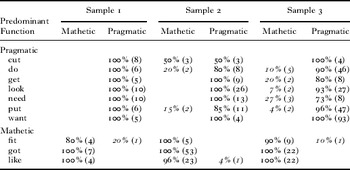
In total 10 verbs met the 3+ token criteria in all three of Quinn's samples, resulting in a data sample of 903 utterances. The results of the function analysis are displayed in Table 2.
Functional analysis of Quinn's verb sample

The majority of verbs in the sample appear to have a clear functional bias, which remains constant across the sample. In Sample 1, nine out of the ten verbs were used to express only one function. That is cut, do, get, look, need, put and want were used exclusively within the Pragmatic function while got and like were employed in Mathetic. Fit displayed a strong Mathetic bias but was also used in the Pragmatic function and thus displays pragmatic flexibility.
The examples below, taken from Sample 1, illustrate the distinction between ‘language as doing’ (the Pragmatic function) and ‘language as learning’ (the Mathetic function):
(1) Pragmatic utterances
Get in (=I'm going to get in)
Cut it (=command for object to be cut)
Do kiwi fruit (=command for kiwi fruit to be peeled)
Need help (=demand assistance in task)
(2) Mathetic utterances
Fit that one (=that one fits)
Got paint (=I've got some paint)
Don't fit (=It doesn't fit)
While the functional bias continues into Samples 2 and 3 there is evidence of emerging flexibility for certain verbs (see examples (3) and (4)).
(3) Pragmatic-dominant verbs with emerging Mathetic instances
Cut
Cut that (=Cut that for me: Pragmatic)
Cut hair off (=The hair has been cut off the doll: Mathetic)
Do
I can't do it (Pragmatic)
Quinn do it (=Quinn did it: Mathetic)
Put
Put it out (=Put it out for me: Pragmatic)
I put honey on it. (Mathetic)
(4) Mathetic-dominant verb with emerging pragmatic instances
Like
Like the swings. (=I like the swings: Mathetic)
Like those one. (=I'd like those ones please: Pragmatic)
By Sample 3 the number of verbs used in both functions has increased to six, though again the frequency with which verbs are used to express their non-dominant function is extremely low. Thus the current study presents a picture of verb use which is markedly different to Naigles et al. (Reference Naigles, Hoff and Vear2009). Quinn's verb use displays a very strong functional bias. In Sample 1 nine of the ten verbs only occur in the expression of a single function, thus indicating very little flexibility with regard to pragmatic function. By Sample 3 all the verbs still retain a strong functional bias, though there is some evidence of flexibility. In the next analysis we turn to the input sample in order to investigate whether Quinn's patterns of verb use are reflected in the ambient language.
Analysis 2: verb use in the input sample
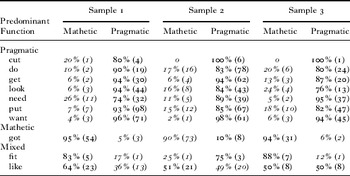
The results of the input analysis are displayed in Table 3. All of Quinn's 3+ frequency verbs were analyzed for function within each of the three data samples. Overall, the use of verbs in the input remained stable over time. Eight of the ten verbs display a strong functional bias with seven verbs being classed as Pragmatically dominant (i.e. cut, do, get, look, need, put and want) and one verb displaying Mathetic dominance (i.e. got). While the eight verbs display a functional bias, a number of them also display a degree of flexibility. For example, do, look, need and put are all used in the expression of the non-dominant function in over 15% of instances.
Functional analysis of the input sample

Two of the ten verbs are not easily classified and consequently are referred to as ‘mixed’ verbs in the current study. Like is classified as a mixed verb as an almost equal number of like utterances express Pragmatic and Mathetic functions. Fit is placed in the mixed verb category since in Samples 1 and 3 it appears to be Mathetic-dominant but in Sample 2 appears to be Pragmatic-dominant. However the low token frequency of fit should be noted and may contribute to the apparent mixed nature of its use with regard to the Pragmatic/Mathetic distinction.
A comparison of Quinn's verb use and the input
Quinn's verb use reflects the input on two dimensions; functional bias and degree of flexibility. First, the functional bias attested in Quinn's verbs appears to mirror that of the input. All seven of Quinn's Pragmatic-dominant verbs are also Pragmatic-dominant in the input. With regard to the Mathetic verbs, got is Mathetic-dominant in both Quinn's sample and the input. Fit, however, does not match quite so well, being Mathetic-dominant in Quinn's speech but mixed in the input. Similarly like, which is a Mathetic verb in Quinn's speech, is mixed with regard to function in the input. In addition to the similarity in functional biases, there are also similarities in the degree of flexibility of verb use in Quinn's speech and the input. The verbs do, get and need are identified as having the highest degree of flexibility in Quinn's speech and all three are also amongst the most flexible forms in the input sample. Conversely, cut, look, put, want and got, which display the least flexibility in Quinn's speech, display low levels of flexibility in the input.
DISCUSSION
In the current study we investigated the flexibility of verb use in the early stages of multiword development, and its relationship with input patterns. The data were taken from one English-speaking child and his mother. We make two main claims based on the data; first, that in Quinn's case verb use displayed strong functional biases, and second, that the functional characteristics of his verb use closely resembled the input sample. Thus, together, the two findings indicate that Quinn used verbs in a conservative and input-driven manner. In this section we discuss each claim in turn.
At the onset of Quinn's speech sample, nine out of the ten verbs analyzed were used exclusively as either Mathetic or Pragmatic verbs. Thus, at age 2 ; 5, Quinn's use of these verbs appeared to be functionally restricted. By Sample 3 only three of the verbs displayed such high levels of functional restrictiveness (i.e. only three verbs were used in the expression of a single function), although all verbs still retained a functional bias.
The findings of the current study appear therefore to be at odds with Naigles et al. (Reference Naigles, Hoff and Vear2009), in which it is claimed that children display flexible verb use from the onset of verb development. However Naigles et al. do point out that the children in their study varied with regard to flexibility of verb use and it may be the case that Quinn's speech is simply a reflection of patterns attested in their more conservative learners. Nevertheless, since Quinn is considerably older than any of the children in Naigles et al.'s study we would have expected to see significant flexibility at the onset of his data sample.
A more likely explanation for the differences between the current study and Naigles et al. (Reference Naigles, Hoff and Vear2009) relates to the coding and categorization of function employed in the two studies. Naigles et al. required the participants' caregivers to code their children's utterances as either commands or descriptives. While it could be argued appropriate to use the category ‘command’, the category ‘descriptive’ is too broad and essentially captures everything that isn't a command. However, if caregivers are asked to code their child's verb use in more specific ways there is an additional burden for them in learning and implementing the coding system. The coding decisions made by Naigles et al. have the potential to distort the pragmatic flexibility attested to the children; many utterances do not fit neatly into the categories. For example, an utterance such as put in with the intent of the child wanting to put a shape in a puzzle (e.g. I'll put it in) would be coded as Pragmatic in the current study as the child is stating an intent to act. However, this type of intent does not seem to fit so readily into the descriptive category within which it would be coded by default within Naigles et al.'s system. Halliday's distinction between ‘language as doing’ and ‘language as learning’ may provide a more meaningful distinction and consequently group verbs in a more psychologically valid manner.
Our next aim was to ascertain the extent to which Quinn's verb flexibility (or lack thereof) reflects input patterns. It could be argued that the functional biases attested in Quinn's sample are simply reflections of verb meaning. For example, when discussing the observation that not all verbs were used flexibly by the children in their study Naigles et al. (Reference Naigles, Hoff and Vear2009) comment that:
These findings seem to follow from the meaning and typical usages of these verbs: Fall and drop were used most commonly in reference to the action of inanimate objects, which are not likely to respond well to commands; moreover, as like is a verb of internal volition, it is not likely to be the subject of commands (children do not tell adults to like things).
There can be no doubt that the meaning of a verb will be reflected in its use, either by young language learners or experienced members of a speech community. However, the question is whether verb meaning alone accounts for the apparent functional restrictions attested in (some) young children's speech. This leads to our second claim, namely the strong relationship between verb use in the input and Quinn's speech sample. The input sample analyzed in the current study indicates a reasonable degree of pragmatic flexibility with regard to verb use. Almost all the verbs included in the current analysis were used both Mathetically and Pragmatically by the mother. Therefore it is not the case that the verbs cannot be used in both functions, as argued by Naigles et al. (Reference Naigles, Hoff and Vear2009). However, the relationship between verb and pragmatic function was skewed; while got was more likely to be used in a Mathetic function, other verbs (e.g. get, look and put) were more closely associated with the Pragmatic function. Quinn's verb use appeared to reflect these input patterns, both in terms of the predominant function for which the verb was used, and also the overall level of flexibility for the verb in question. That is, flexibility in Quinn's verb use reflected flexibility in the input.
Limitations and future directions
Verbs do not have a singular meaning and there is a wealth of literature on issues pertaining to verb semantics in language development (and beyond). The current study has treated verbs as having some kind of core meaning and so has avoided the complexities of factoring in the range of distinct meanings carried by many verbs. In order to fully understand the development of verb use, a more fine-grained analysis of verb meaning is also necessary. The study also carries with it the limitations of a case study based on the language of one child. In order to substantiate our claims the methodology employed in the present study would need to be conducted on a wider range of participants.
CONCLUSIONS
The findings of the current study present a picture of conservative, input-led verb use in the early stages of multiword development. The child in question displayed a strong functional bias in his use of verbs which mirrored frequency patterns attested in the input. Therefore, we conclude that the degree of flexibility attested in early multiword speech is a reflection of flexibility in the input.
Appendix
Conflation of INCA-A codes to Halliday's Phase II codes was based on the interchange component of the INCA-A coding taxonomy. The allocation of interchange types is dsplayed below:
Pragmatic functions
- DHA:
directing hearer's attention
to achieve joint focus of attention by directing hearer's attention to objects, persons and events.
- NIA:
negotiating the immediate activity
to negotiate the initiation, continuation, ending and stopping of activities and acts; to direct hearer's and speaker's acts; to allocate roles, moves and turns in joint attention
- MRK:
marking
to express socially expected sentiments on specific occasions such as thanking, apologizing or to mark some event
- NFA:
negotiating an activity in the future
to negotiate actions and activities in the far future
- PRO:
performing verbal moves
to perform moves in a game or other activity by uttering the appropriate verbal forms
Mathetic functions
- DJF:
discussing a joint focus of attention
to hold a conversation about something that both participants are attending to, e.g., objects, persons, ongoing actions of hearer and speaker, ongoing events
- DRE:
discussing a recent event
to hold a conversation about immediately past actions and events
- DNP:
discussing the non-present
to hold a conversation about topics that are not observable in the environment, e.g. past and future events and actions, distant objects and persons, abstract matters
- DNS:
discussing sentiments of participants
to hold a conversation about participants' non-observable thoughts and feelings
- DRP:
discussing the related-to-present
to discuss past or future events related to objects/people present in environment, and habitual behaviour
Excluded from analysis
- YYY:
uninterpretable
to mark uninterpretable utterances
- DCC:
discussing clarification of communication
to discuss clarification of hearer's ambiguous verbal communication or a confirmation of the speaker's understanding of it
- NIN:
non-interactive speech
to engage in private speech or produce utterances not addressed to present hearer
- TXT:
reading written text and singing
to read or recite written text aloud or sing song/nursery rhyme