Introduction
Anthropogenic pressures such as over-harvesting and the intentional/unintentional introduction of predator species have caused the near to total extinction of some terrestrially-breeding vertebrate species worldwide. In the Southern Hemisphere, at sub-Antarctic latitudes, populations of fur seals, seabirds and other bird species were/are at risk at their breeding islands. However, recolonization and subsequent population recoveries have been reported for seal species (e.g. fur seals, Guinet et al. Reference Guinet, Jouventin and Goerges1994), African penguins (Spheniscus demersus) (Crawford et al. Reference Crawford, van Den Boonstra, Dyer, Upfold, Dann, Norman and Reilly1995), various seabird species including king penguins (Micol & Jouventin Reference Micol, Jouventin, Veitch and Clout2002, Crawford et al. Reference Crawford, Cooper, Dyer, Greyling, Klages, Ryan, Petersen, Underhill, Upfold, Wilkinson, De Villiers, Du Plessis, Du Toit, Leshoro, Makhado, Mason, Merkle, Tshingana, Ward and Whittington2003), and other bird species (e.g. Miskelly & Fraser Reference Miskelly and Fraser2006).
There were two very large breeding colonies of the king penguin at sub-Antarctic Macquarie Island (54°30′S, 158°55′E) when it was discovered in April 1810, one at Lusitania Bay and another at the North-End Isthmus (Mawson Reference Mawson1943). Large numbers of king penguins were still breeding at the North-End Isthmus in 1820 but by 1894 the only evidence a king penguin colony had ever existed there were bones buried under drifted sand (Mawson Reference Mawson1943). The cause of this remarkable local extinction was the killing of birds for the blubber oil trade that had been established after the island's discovery. Meanwhile in 1880, the colony at Lusitania Bay was still present “on a grand scale”, and later in 1894, it was still there but by then “a great heap of king penguin remains attested their recent slaughter” (Mawson Reference Mawson1943). Sometime after 1895 and before 1912, the blubber oil gangs had reduced the Lusitania Bay colony to a remnant population of about 5000 birds (Rounsevell & Copson Reference Rounsevell and Copson1982). Once it had been depleted to the point where it was no longer economically viable, the oil gangs continued to compromise the colony's breeding potential by collecting eggs for food (Mawson Reference Mawson1943). So profound was the continued exploitation of the rookery that by 1930 the population was further reduced to only 600 chicks (c. 3400 birds) (see Falla 1937 in Rounsevell & Copson Reference Rounsevell and Copson1982).
Exploitation of king penguins at Macquarie Island finally ended in 1918 and since then the island has been protected as a wildlife sanctuary (1933–71), and later as a nature reserve (Rounsevell & Copson Reference Rounsevell and Copson1982). The cessation of commercial exploitation has triggered a resurgence in king penguin populations at Macquarie Island (Rounsevell & Copson Reference Rounsevell and Copson1982), South Georgia (Lewis Smith & Tallowin Reference Lewis Smith and Tallowin1979), Heard Island (van den Hoff et al. Reference van den Hoff, Kirkwood and Copley1993), Iles Kerguelen (Weimerskirch et al. Reference Weimerskirch, Bartle, Jouventin and Stahl1988), Iles Crozet (Delord et al. Reference Delord, Barbraud and Weimerskirch2004), and Marion Island (Williams et al. Reference Williams, Siegfried, Burger and Berruti1979). At Macquarie Island, there was a 78-fold increase in the number of chicks produced annually at the Lusitania Bay colony from 1930 to 1980 when the colony contained at least 70 000 breeding pairs (Rounsevell & Copson Reference Rounsevell and Copson1982). There was further expansion of the Lusitania Bay colony to the north and south (Scott Reference Scott1994) and by year 2000 the breeding population was estimated at 150 000–170 000 pairs and still increasing (Parks and Wildlife Service 2006). Rounsevell & Copson (Reference Rounsevell and Copson1982) suggested that the colony which formed at Sandy Bay (Fig. 1) in 1975 was because the Lusitania Bay colony area had reached maximum carrying capacity. Until 1995, no king penguin breeding colonies had been observed on the isthmus since their removal.
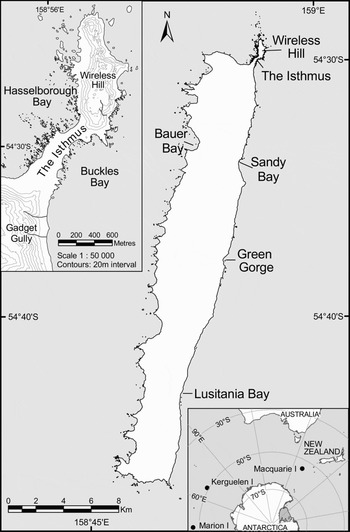
Place names of past and present king penguin (Aptenodytes patagonicus) breeding colonies on Macquarie Island (main map) and the North-End Isthmus (inset).

King penguins take 13–16 months from the time adults arrive at their breeding colonies for the pre-nuptial moult until chicks are fully fledged (van Heezik et al. Reference van Heezik, Seddon, Cooper and Plos1994, Olsson & Brodin Reference Olsson and Brodin1997). Despite this prolonged breeding period, adults may attempt to breed in successive years but the likelihood of having a year off increases with the number of consecutive attempts (van Heezik et al. Reference van Heezik, Seddon, Cooper and Plos1994). Three breeding statuses are recognized, early, late and ineffective breeders (Stonehouse Reference Stonehouse1960, van Heezik et al. Reference van Heezik, Seddon, Cooper and Plos1994). Generally, breeding adults arrive at the colony in late November and egg laying extends from November until March; the laying date determines their status as early or late breeders (Stonehouse Reference Stonehouse1960, van den Hoff et al. Reference van den Hoff, Kirkwood and Copley1993). After about 50 days of incubation, the chicks hatch and growth to fledging takes the full winter and spring seasons to complete.
Here we report a good news story on the re-establishment of a king penguin colony on the isthmus at Macquarie Island around one hundred years after the last king penguins were slaughtered there for their oil. We also describe aspects of their breeding cycle and over-winter survival rates of chicks representative of a newly formed colony.
Methods
Study site
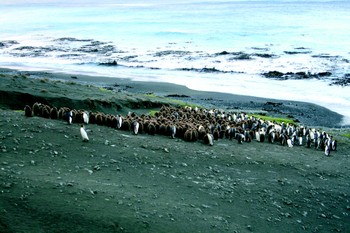
The isthmus (known as North-End Isthmus in Mawson Reference Mawson1943) at Macquarie Island is a low-lying stretch of land connecting Wireless Hill with the remainder of the island to the south (Fig. 1). Locations mentioned throughout the text for Macquarie Island are shown in Fig. 1. Bounded by Buckles Bay to the east and Hasselborough Bay to the west, the isthmus was once a site where the blubber oil (seal and penguin) and skin (fur seal) industry operated (1810–1918). It is now the location of a research station permanently inhabited since 1948. The isthmus has areas of well drained, gently sloping cobble stone and sand beaches or grass over peat (Fig. 2) considered typical of king penguin breeding habitat on Heard Island (53°S, 71°E, Budd Reference Budd and Stonehouse1975).
Overlooking the king penguin colony at Gadget Gully on the isthmus at Macquarie Island (3 June 2008). Note the dry, sloping sand and cobble substrate with a grassy covering, ideal king penguin breeding habitat. The eroded bank formed by the fresh water creek flowing from Gadget Gully creates a natural colony boundary, at this stage. (Photo: Eve Merfield).

Census and population change
Censuses of the king penguins at the Gadget Gully colony were made from September 1993 to March 1994, then weekly from November 1994 to July 1998. Two observations made in April 1999 were followed by a period of observation spanning March to October 2000. There were then no observations until the most recent census on 1 August 2008. On each census occasion, the total numbers of eggs, chicks and adult birds was estimated.
The instantaneous rate of population change (r), also known as the intrinsic rate of change, was determined as follows (Caughley Reference Caughley1977):

Where
lnNt = natural logarithm of the population size at time t
lnN0 = natural logarithm of the population at starting time
t = time interval between population counts.
The number of chicks hatched in year t was taken to be an index of Nt. Over-winter survival is simply defined as the proportion of successfully hatched chicks that survived to fledging in the following summer.
Results
Establishment of the breeding colony and timing of breeding events
The present location of the Gadget Gully (Fig. 1 inset) breeding colony was first used by a small number (max. 56) of moulting adult king penguins from September 1992 to March 1993. By 20 February 1995 over 200 adults were present when the first egg was noticed. On 6 March 1995 three eggs were seen, all hatched but none of the chicks survived beyond 25 May 1995.
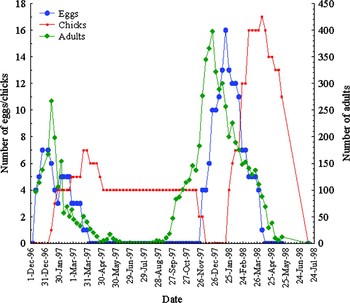
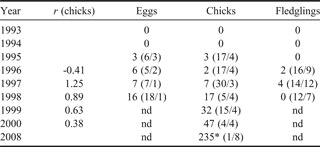
The second breeding season began two months earlier than the first on 3 December 1995 when a single egg was seen; later six eggs were present and two chicks had hatched by 5 February 1996 (Table I). Both chicks were successfully reared to fledging by 16 October 1996. In the following seasons (1996/97 and 1997/98, Fig. 3) the first eggs were laid in late November or early December. Incubation took about 55 days and chicks began hatching by mid–late January. In the 1996/97 season, egg loss was zero (all seven eggs had hatched by 23 March 1997). However, only four chicks survived during the 1997 winter. In 1997/98, 17 chicks hatched but by 12 July all had died (Fig. 3). Chick mortality was high (> 90%) during the 2000 winter, when only four of the 47 chicks seen in April survived through to October when observations ceased.
Chronology of events in the annual breeding cycle for king penguins at the newly formed colony at Gadget Gully, Macquarie Island for the period December 1996–May 1998. Eggs = number of eggs observed, Chicks = number of chicks hatched, Adults = all adults present.

Intrinsic rate of change in king penguin (Aptenodytes patagonicus) chick numbers (r), maximum numbers (date/month of observation) of eggs laid, chicks present and fledglings observed in the newly established colony at Gadget Gully, Macquarie Island (1993–2008).

nd = not determined. * denotes the number of chicks counted under-represents the total number of chicks hatched.
On 1 August 2008 (winter), when the colony was much larger, about 235 chicks were alive. Due to potential egg and chick losses this number probably under represents the total chicks hatched for the 2007/08 breeding season and thus the data were not included in the trend analyses. The data simply indicates increased chick production.
In general, at this newly formed colony, adults arrived for the pre-nuptial moult in mid September, egg laying commenced in late November or early December (1995–1997) and continued until mid February. Incubation averaged 55.6 days (SD ± 6.5, n = 3) and chicks fledged from October–December, about 330 days after hatching (Fig. 3).
The trend in the number of chicks hatched
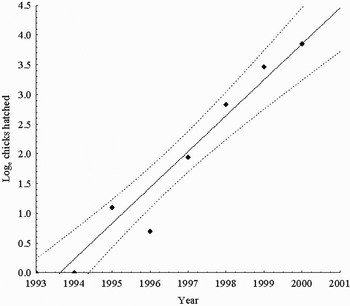
Maximum numbers of king penguin eggs, chicks and fledglings observed within each breeding season at the Gadget Gully colony are presented in Table I. The intrinsic rate of change (r) in annual numbers of chicks hatched during the study period was variable over time (Table I). However, the natural logarithm of the number of chicks hatched was significantly and highly correlated to time (Fig. 4; P = 0.003, r 2 = 0.92). The positive slope of the linear regression represents an annual rate of increase of 0.66 (66%), or a doubling in the number of chicks hatched every 1.06 years (Caughley Reference Caughley1977).
Plot of the natural logarithm (loge) of the maximum number of king penguin chicks hatched at the Gadget Gully colony, Macquarie Island, 1995–2000. The regression has a slope (+0.66) equal to the intrinsic rate of increase (r). Hatched lines are the upper and lower 95% confidence intervals.

Discussion
Following almost total extinction during the blubber oil trading years (1810–1918) it has taken about 100 years for the Macquarie Island king penguin population to recover to a level whereby they once again breed on the isthmus. While we have found no written account stating that king penguins previously bred at Gadget Gully on the isthmus, Mawson (Reference Mawson1943) reported that there were two very large breeding colonies on the island, one at Lusitania Bay and the other on North-End Isthmus (= isthmus). Since Gadget Gully forms part of the general isthmus area and has suitable king penguin breeding habitat a previous colony there is probable. The breeding colony was probably established at Gadget Gully because moulting king penguins congregated at the site in previous years. Initially the number of birds attempting to breed was low and chick mortality was high but in August 2008 there were about 235 chicks present.
Currently there are four king penguin colonies on the east coast of Macquarie Island: one each at Lusitania Bay, Green Gorge, Sandy Bay and now at the isthmus (Fig. 1). Studies of the fossil record at Macquarie Island revealed king penguins were also once (c. 4000 bp) found on the west coast at Bauer Bay (McEvey & Vestjens Reference McEvey and Vestjens1973) where they no longer congregate and on the east coast at Green Gorge (Colhoun & Goede Reference Colhoun and Goede1973) where a colony now exists. Colhoun & Goede (Reference Colhoun and Goede1973) collected insufficient material to carbon date (14C) the material they collected at Green Gorge. However, the bones they discovered were overlain by more recent strata, apparently free of penguin bones, suggesting the colony disappeared from Green Gorge sometime in the recent past (c. 2000–3000 years ago) and has re-appeared there. The work of McEvey & Vestjens (Reference McEvey and Vestjens1973) and Colhoun & Goede (Reference Colhoun and Goede1973), as well as more recent observations at an inter-tidal embankment on the isthmus at Macquarie Island (AAD unpublished data), suggest that the establishment of a blubber oil industry at the island was not the first time the king penguin population at Macquarie Island has been depleted. A catastrophic mid-Holocene event was likely to be the cause for the earlier disappearance of the colonies. However, the extent to which other factors such as food availability and predation limit colony growth is unknown (Crawford et al. Reference Crawford, Underhill, Upfold and Dyer2007). Macquarie Island is seismically active, has a high annual rainfall (954 mm), and is prone to landslips and storm events that could impact upon penguin colonies located near sea level.
More recently, following the termination of the blubber oil industry king penguin numbers have increased on many sub-Antarctic islands. Specifically, at Macquarie Island they now number ~150 000–170 000 breeding pairs (Parks and Wildlife Service 2006) with much potential breeding space unoccupied if the island's coastline is considered potential breeding habitat (Colhoun & Goede Reference Colhoun and Goede1973). The available breeding space at Lusitania Bay appears to have been filled and as a result the penguin population has spilled over onto favourable breeding ground at Sandy Bay (Rounsevell & Copson Reference Rounsevell and Copson1982), Green Gorge and now at the isthmus, the most distant colony from Lusitania Bay. If the population continues its upward trend, king penguins could re-establish a breeding colony at Bauer Bay.
The periodic local population perturbations followed by recolonization suggests king penguins are resilient to catastrophic events. This may be because their breeding cycle ensures that some proportion of the breeding and non-breeding populations are absent from breeding islands during the year. Absenteeism thus provides a buffer and continued potential for population growth.
Regarding the breeding cycle of king penguins at Macquarie Island, information remains relatively scant (see van den Hoff et al. Reference van den Hoff, Kirkwood and Copley1993). From our observations at the newly formed colony at Gadget Gully (Fig. 3) the arrival of adults, the egg-laying period, incubation period and fledging time do not differ markedly from other breeding locations (van den Hoff et al. Reference van den Hoff, Kirkwood and Copley1993). During this study, we did not determine whether the population consisted of early, late or ineffective breeders (Stonehouse Reference Stonehouse1960). What is clear is that the first eggs were noticed in late February–March when late or ineffective breeding pairs attempt to lay eggs (Stonehouse Reference Stonehouse1960, van den Hoff et al. Reference van den Hoff, Kirkwood and Copley1993, van Heezik et al. Reference van Heezik, Seddon, Cooper and Plos1994). Breeding attempts commenced earlier (November/December–February) in following years suggesting failed breeding adults from the previous years, or first time breeders were attempting to breed at the colony. The data presented in Fig. 3 provide a useful baseline against which shifts in the breeding chronology can be compared.
The current size and location of the colony at Gadget Gully makes it suitable for the establishment of an non-invasive study to determine more completely the breeding cycle of king penguins at Macquarie Island. It may also help clarify how this cycle responds to changed food availability (Olsson & Brodin Reference Olsson and Brodin1997) resulting from climatic influences such as the El Niño Southern Oscillation (ENSO) and the Southern Annular Mode. For example, one of the most severe ENSO events in recent time was recorded during 1998 when the colony at Gadget Gully failed to fledge a chick.
Acknowledgements
Dr Eve Merfield counted and photographed the penguins at Gadget Gully during the 2008 winter. Angela Bender drew Fig. 1.