In 1917, when Sir Alfred Mond, commissioner of works, proposed that a national war memorial should be built in London, he met with swift objections from north of the border.Footnote 1 As the duke of Atholl later recalled, “I am afraid that all the rebel spirit that lies dormant in every Scot roused itself within me, and I made a public statement that if the people of Scotland wished to have a National War Memorial to commemorate their own dead it would not be in Hyde Park, London, and put up with Government money, but it would be put up by Scottish hands, with Scottish money, on Scottish soil.”Footnote 2 The result of this declaration was one of a number of national memorials to the First World War in the British Empire. More elaborate and expensive than its Welsh or Irish counterparts, but less overtly concerned with nation building than its Australian or Canadian equivalents, the Scottish National War Memorial is unique in terms of the wealth of distinctive cultural and historical references it draws upon.Footnote 3
There is no English national memorial to add to this list. The national memorial in Edinburgh therefore provides an interesting contrast to those in London. In the latter case, these are not English national memorials but British, and especially in the case of the Cenotaph and the Tomb of the Unknown Soldier, imperial memorials. Englishness is subsumed within this imperial Britishness, and the discourse surrounding these memorials switches back and forth between reflecting on England and the empire un-self-consciously.Footnote 4 North of the border, however, the Scots were able to use imperial sentiment to assert a separate, equal Scottish identity that formed a prominent part of imperial Britishness.
Stephen Heathorn has reminded us that the statue of Earl Haig in London should be considered among these national memorials.Footnote 5 Like Stefan Goebel, who studied the national memorial to Lord Kitchener, among others, he has sought to develop the debates on commemoration of the 1990s, which tended to be characterized by an unnecessary dichotomy between studies concerned with the political messages encoded in war memorials and studies examining the role of memorials in the mourning process.Footnote 6 Rather, Goebel sees war commemoration as “a social act of public recollection that could not be politically neutral.”Footnote 7
Both the Haig memorial and the Scottish National War Memorial were subjects of controversy, but they were so in different ways.Footnote 8 The Scottish project was completed before the Haig memorial was conceived and before the general consensus on the war was fractured in the late 1920s. While both schemes were criticized for the elite control of the project, only in the case of the later memorial did this develop into a controversy over the memorial's interpretation of the war's meaning. Instead, the intrinsically politicized messages about the Scottish nation that characterized a national memorial prompted by the grievous losses in the war were met with general acclaim. This article therefore seeks to examine the Scottish National War Memorial as an expression of national identity that could meet with such approval at that point in time.
The study of expressions of Scottishness in the nineteenth century reveals a nation that was a confident partner in the United Kingdom and the British Empire. Graeme Morton's important work argues that the commemorations of Scottish icons such as Walter Scott, Robert Burns, William Wallace, or King Robert the Bruce were celebrated in terms of Scotland's partnership with England since 1707. He dubs the phenomenon “unionist-nationalism.”Footnote 9 However the failure of the scheme to build a national monument to mark the British victory against France in the Napoleonic Wars leads him to conclude that “unionist-nationalism had died out in the 1860s, to be replaced by an identity that was ‘more Scottish than British.’ Scottish life was to be celebrated, not Scottish death within the British army.”Footnote 10 Morton (writing with Robert Morris) argues that by 1920 the conditions that made unionist-nationalism possible “were already fading away.”Footnote 11
But how is this to be squared with the role of the Scots, particularly Scottish soldiers, in the British Empire? The martial tradition became so closely entwined with the business of empire that numerous authors have emphasized the prominence of Scotland's position at the heart of the empire and an imperial army into the early twentieth century.Footnote 12 Perhaps unionist-nationalism was replaced by imperialist-nationalism, wherein Scottish achievements were celebrated in terms of Scotland's partnership in the empire? Scotland's conspicuously high rate of voluntary enlistment in the First World War can be taken as evidence of the continuing commitment to this martial tradition. Hew Strachan has argued that “Scots now acted out their warrior identity, and in doing so confirmed their Unionism, and even more their identification with the empire.”Footnote 13 Among these “Scottish” recruits were large numbers of Irish Catholics resident in Scotland whose loyalty to Britain might have previously been questioned.Footnote 14 Yet there may be sound demographic reasons to explain the particularities of voluntary recruitment in Scotland.Footnote 15 Nor was commitment to the war unquestioned in Scotland: membership of the antiwar Independent Labour Party tripled in Scotland during the war.Footnote 16 Still, a membership of nine thousand meant it spoke only for a minority. Moreover, the industrial militancy of Red Clydeside was not always antiwar in outlook.Footnote 17 The consensus among historians therefore seems to be that, for the most part, Scotland was a resolute supporter of this imperial war.
It is nonetheless an interesting question, given time to reflect on the war in the turbulent years that followed, whether the Scottish commitment to its martial and imperialist identity would retain its power post war. John Mackenzie believes it did. He argues that the empire “enabled the sub-nationalisms of the United Kingdom to survive and flourish” and, more precisely, that “the imperial relationship remained a lodestar of one significant fraction of Scottish nationalism until at least the Second World War and remained central to the myths and symbols of Scottish Conservatism and Unionism.”Footnote 18 Richard Finlay, the most prolific historian studying twentieth-century Scottish nationalism and national identity, takes a contrary view. He has argued that Scottish national identity suffered a crisis of confidence in the wake of the war and subsequent economic collapse and that popular imperialism waned in consequence. This process appears to have gathered pace from the late 1920s. Furthermore, even when nationalists did perceive some continuing relevance for the empire for Scotland, the inherent contradictions and confusions in the movement were reflected in their views. While one strand of thought rejected the British Empire outright, another saw nationalism as a means to strengthen the empire, and a third strand looked forward to Scotland becoming a self-governing dominion.Footnote 19
The late Angus Calder perceived this last view in the Scottish National War Memorial. In observing the numerous ways in which this distinctly “un-English” memorial was shaped by the concepts of nation and empire, he asserted that it “seems to provide unobtrusive support for the idea, widespread in political circles in 1927, that Scotland should have dominion status within the Empire.”Footnote 20 His elegant, intuitive essay highlights the work of the architect Sir Robert Lorimer and his talented team of artists and craftsmen and women, including Douglas Strachan, whose stained glass windows have also been examined by Juliette Macdonald.Footnote 21
This article seeks to augment these analyses through recourse to the primary sources associated with the process of organizing the memorial. These papers show the extent to which the duke of Atholl was the driving force behind the memorial. The process is instructive in some aspects of the relationship between the social elite and self-made industrialists in Scotland. Above all, the erection of the memorial indicates the multifaceted nature of Scottish identity reflected therein. It shows the ongoing influence of Presbyterianism. It also enriches our appreciation of the imperial dimension of Scottishness and, in particular, of the way in which Scots around the world considered themselves to be part of an “imagined community.”Footnote 22 This article therefore seeks to show how Scotland's religious, martial, and imperial traditions continued to resonate as a means to commemorate this shockingly modern and destructive war.
It is important to begin by establishing who was on the Scottish National War Memorial committee. The committee's character, and particularly its chairman, decisively influenced the nature of the memorial. The membership of the Scottish National War Memorial committee is also interesting for what it can tell us about the upper echelon of Scottish society. The political makeup of the committee reflected the erosion of Liberal political culture and the predominance of Unionist politics in interwar Scotland. It also suggests the declining political power of an aristocracy now largely reduced to a membership of public bodies rather than one of governments.Footnote 23 Nonetheless, aristocrats retained an important social role as trustworthy and disinterested members of committees and inquiries in general, and their involvement in the memorial can be seen as a somber echo of landowners’ recruiting activities during the war.Footnote 24
The driving force behind the war memorial was the duke of Atholl. He was assisted in the first instance by Lieutenant-General Sir John Spencer Ewart, GOC Scotland, and Captain George Swinton, a former officer of the Highland Light Infantry and an authority on town planning and subsequently on heraldry, who had responded enthusiastically to Atholl's 1917 published statement.Footnote 25 They lobbied the key figures within government and in Scotland's political and social hierarchy to get the scheme underway. At his own suggestion, Atholl was appointed chairman of the executive committee by the Secretary for Scotland in October 1918, and in the committee's first meeting in January 1919 he was appointed, along with the vice chairman and the honorary secretary, as an ex officio member of all the subcommittees.Footnote 26 It was further decided that he should chair the two subcommittees relating to construction and propaganda.Footnote 27 Atholl was thus the originator of the scheme and the man who drove it onward to its conclusion. At times he was branded a one-man band.Footnote 28
The committee appointed by the Secretary for Scotland, Robert Munro (a coalition Liberal), comprised nineteen named individuals plus the most senior military and naval officers in Scotland and the Lord Provosts of Edinburgh, Glasgow, Aberdeen, Perth, and Dundee.Footnote 29 The irrepressible Swinton was appointed as secretary. In appointing the committee, Munro sought a membership that was representative of “the nation in the widest sense” and of the various interests who might be concerned in the memorial scheme.Footnote 30 It included neither women nor representatives of the rank and file of the armed forces.Footnote 31 Its inclusion of Roman Catholics was distinctly limited.
Of the nineteen original named committee members, there are seven whose religious inclinations can be identified: four were members of the Church of Scotland, one was Free Church, and two were Catholic Apostolic.Footnote 32 Atholl had considered inviting other prominent Catholics to join the committee, but he feared potential religious and personal friction.Footnote 33 Only two original members were aged less than fifty at the end of the war (Atholl himself and Cameron of Lochiel). Seven held the rank of duke, baron, baronet, or viscount; six were the lord lieutenants of their counties.Footnote 34 Seven had held senior appointments in the army or navy.Footnote 35 Only two may be described as businessmen: Sir John R. Findlay (proprietor of the Scotsman newspaper) and Sir George Younger (scion of the brewing family), although the latter was probably included for his political prominence as Conservative party chairman rather than for his business connections or acumen. Of those whose political leanings may be discerned, six were Conservatives, three were Liberals, and two were Labour MPs.Footnote 36 Neither of the Labour representatives played an active role beyond signing the first report of the committee.Footnote 37 This was, then, a committee comprised of Scotland's great and good: frequently Conservative and hence Unionist in their political affiliations, often aristocratic, Presbyterian, and ex–armed forces, and for the most part, deeply involved in service to the community, the country, and the empire.
The duke of Atholl himself was typical of his colleagues in key respects. John George Stewart-Murray (1871–1942), the marquess of Tullibardine, had attended Eton and then joined the army. In 1899, he married Katharine Ramsay, who later became Scotland's first woman MP.Footnote 38 During the Boer War, “Bardie” raised and commanded the Scottish Horse regiment. He was elected as the Unionist MP for West Perthshire in 1910 and was prominent in the Scottish Land and Property Federation, the scourge of Scottish radicals and land reformers.Footnote 39 He mobilized with the Scottish Horse once more at the outbreak of the First World War and fought at Gallipoli from the end of August 1915.Footnote 40 Both of his brothers also served in the war; one of them, George, was killed in September 1914.Footnote 41 Upon his father's death in January 1917, Bardie became the eighth duke of Atholl and thereafter took on numerous public duties. He became lord lieutenant of Perthshire, and he was Lord High Commissioner to the General Assembly of the Church of Scotland in 1918, 1919, and 1920. He was the lifelong Scottish president of the Save the Children Fund from its inception at the end of the war.Footnote 42 He became a Knight of the Thistle in 1918 and a privy councillor and Lord Chamberlain in 1921. As his wife's biographer commented, the king regarded Bardie as an old friend, and the “appointment was exactly suited to his powers of organization, his flair for coping with important people, his love of ceremony.”Footnote 43 The same might be said for his role in the creation of the war memorial. His active role as chairman meant that he had a significant influence on the fundraising, design, and overall success of the memorial.
The fundraising for the memorial is informative for a number of reasons. It is a means of assessing support for the memorial and identification with it. It also provides a snapshot of the distribution of wealth and power in Scotland and of the decline of the landed aristocracy in particular. Atholl epitomized his class in one further respect: his difficult financial circumstances in this period. His various business interests in the 1920s were largely unsuccessful, and the impact of the Great Depression in the 1930s strained his estate's already difficult finances.Footnote 44 Atholl was therefore unable to make a large donation to the war memorial himself. He was not alone. Committee member David Erskine predicted in 1919, “I fear the bulk of one's friends being landowners, there is not much available cash in that direction. Substantial contributions will have to come more from the industrial classes who have made money by the war.”Footnote 45 Thus, the memorial fundraising reflects the wider dynamics within Scottish society wherein an aristocratic/establishment body of men did the good works, but the hard cash came from the upwardly mobile industrialists of the west coast.
The largest single donation, Sir Alexander Park Lyle's £50,000 (made in August 1922), accounted for 45 percent of the £111,500 collected in total.Footnote 46 The Lyle family fortune had been made in ship owning and sugar refining in Greenock and Glasgow.Footnote 47 By the interwar period, Lyle owned a large property in Perthshire. He was made a baronet in recognition of his generosity.Footnote 48 His Oxford-educated son, Colonel Archibald Lyle, MC, who married into the aristocracy and went on to become vice-lieutenant of Perthshire, had been one of Atholl's officers in the Scottish Horse during the war.Footnote 49 Archibald later gave £2,500 in 1936 in memory of his father in order to pay off a debt accrued by the museum associated with the memorial.Footnote 50 Other notable donations came from the ship owner Sir James Caird (£1,000 in three installments); Sir John T. Cargill, chairman of the Burmah oil company (£2,000 in two installments); and Sir Alex Grant, chairman and managing director of biscuit manufacturers, McVities (£3,350 in eight installments). Lord Leverhulme, the philanthropic soap manufacturer, who had made his wealth in Cheshire but who had bought the Isle of Lewis in 1917, donated £1,000; and Sir John Reid and Hugh Reid of the North British Locomotive Company donated £1,500 between them. Viscount Cowdray, a civil engineer and a founder of S. Pearson and Son, gave £1,000 in 1922. Altogether, of the minority of significant donors whose income sources can be identified, over 40 percent of them derived their wealth from industry. Landowners such as Lord Glenconner (£1,000), the duke of Sutherland (£500), and the marquess of Bute (£500) are in a definite minority, accounting for a little over 10 percent of the total from these substantial individual donations.
Although the lion's share of the money—£81,715 interwar—thus came from fifty-nine individuals, this was balanced by the breadth of support in response to a range of fundraising activities targeting the general population.Footnote 51 Atholl recognized the importance of the idea that the entire nation had contributed to the memorial. In publicity material, he stressed that “the first donation to the War Memorial was 2/6 from an ex-tinker serving in the trenches with the Black Watch in France; the second was £1,000 from a wealthy ironmaster in Scotland.”Footnote 52 In a letter circulated to the editors of newspapers in Scotland, the committee suggested that every Scotsman might subscribe one shilling to the fund, and more than sixty newspapers took up its suggestion.Footnote 53 Despite the fact that virtually every community in Scotland had by then erected its own local war memorial, by the beginning of 1923, 569 out of Scotland's 940 parishes had also subscribed something to the memorial fund. Their donations, prompted by dedicated “Thistle Day” activities, totaled £14,147, mostly donated in small denominations from 1,131,760 individuals.Footnote 54 Scotland's population at the time was just under 5 million.
The breadth of support for the memorial, and thus identification with Scotland and her people's war effort, is also shown in the donations received from the Scottish diaspora. Elizabeth Buettner has shown that Scottishness continued to be celebrated abroad—in this case in India—in the context of union and empire until the 1930s.Footnote 55 Atholl had practical experience of the continuing bond with Scots overseas, having recruited South African Scots for the Scottish Horse during the Boer War. He also looked abroad because of his anxieties about fundraising in Scotland.Footnote 56 Andrew Gibb, who organized the fundraising effort, drew up plans to contact the 391 Scottish societies around the world.Footnote 57 They achieved mixed success at first—as at home, the national memorial stood aside while local schemes went ahead. Atholl (a former Grand Master Mason) told the committee in 1921: “The Masonic Societies—both at home and abroad—have responded splendidly, and the British Consuls throughout the world have given us considerable help. The big sums, however, that we anticipate getting from the Dominions have not yet arrived, as they are not due till the end of this year, the understanding being that they must get rid of their own local Memorials first, after which they have all promised to help us.”Footnote 58
The propaganda and fundraising effort played on the shared sense of Scottishness throughout the diaspora. For example, a leaflet produced in time for St. Andrew's Night 1922 by The Caledonian, the newspaper of the Federated Caledonian Society of South Africa, featured a letter from Atholl plus excerpts from his speech in Glasgow in February 1920, with its ringing phrase about Scottish hands, Scottish money, and Scottish soil. It also featured a letter of endorsement from Sir William Dalrymple for collecting between St. Andrew's “Nicht” and Burns's “Nicht,” in memory of those who “went forth from Scotland and Overseas and shed their blood to bring honour to her name”: “The Governing Body make an earnest appeal to all Scotsmen and Scotswomen throughout South Africa to take the opportunity and privilege of participating, by making a contribution of their mites to a scheme which shall commemorate the deeds of their gallant kinsmen, aye and women too, who on the bloody fields of France and Flanders, the fever swamps of East Africa, and the many stricken lands where war raged, counted not the cost but laid down their lives that we might live as freemen.”Footnote 59
Accompanying such rhetoric was the use of national symbols at home and abroad to rally support. Within Scotland, the anniversary of Bannockburn was nominated as Thistle Day, and much like the sale of poppies before Armistice Day, the national emblem was sold on this flag day.Footnote 60 Similarly, in Ballarat, Victoria, a shared Scottish identity was reaffirmed and exploited through the use of national symbols, with the sale of sprigs of heather and tartan ribbons in aid of the memorial at a Highland Day.Footnote 61 In total, the support provided by Scots societies abroad was impressive. It amounted to just over £11,500 in January 1923. The largest single source was London-based Scots, who donated £5,412. Scots in the rest of England gave £1,027, a sum more or less equaled by Scots in Australia, China, and France. Donations were also received from Ireland, the Argentine, Chile, Ecuador, Gibraltar, Hawaii, India, Japan, Mexico, New Zealand, Persia, the Philippines, Siam, South Africa, Syria, Portugal, and Turkey.Footnote 62 Hence, the imagined community of Scots in the furthest outposts of the Empire and beyond continued to identify with home and with Scotland's sacrifice in the war, and in turn, the memorial's position at the heart of a worldwide network was confirmed.
The design of the war memorial evokes its Scottish identity by reference to history, empire, and religion. Linda Colley has persuasively argued that the British identity was forged in the eighteenth century through war, empire, and Protestantism.Footnote 63 Esther Breitenbach, in her study of missionary societies, has shown that Scottish identity—in her view, the more dominant partner in a dual Scottish and British identity in the late nineteenth century—was particularly characterized by its distinctive Presbyterianism.Footnote 64 Hugh McLeod's view is that, by the era of the two world wars, British national identity was no longer specifically Protestant but still essentially Christian.Footnote 65 How did the Scottish National War Memorial invoke religion?
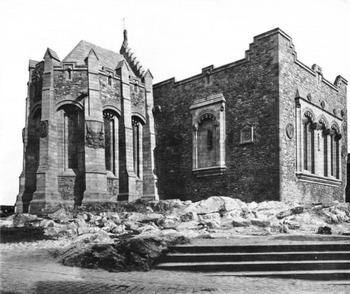
First, it was designed by Sir Robert Lorimer, the architect of the Thistle Chapel in St. Giles Cathedral. He gathered together a remarkable team of artists and craftsmen to build one of the most extraordinary war memorials in the British Isles. Atholl took a close interest throughout. Lorimer wrote of the project: “I’m so frightfully keen to get this work as impressive as we possibly can make it so that people will be really thrilled and moved when they enter it. It's a marvelous opportunity to do a building on the Edin [sic] Castle Rock that with any luck may be a place of pilgrimage for 1,000 years.”Footnote 66 Early proposals for a museum, a Presbyterian chapel, or a memorial that towered above the existing skyline of Edinburgh Castle were eventually dropped in favor of a memorial that was more in sympathy with its perch above Scotland's capital city.Footnote 67 Drawing on the architecture of Stirling and Falkland palaces, Lorimer designed a Hall of Honour, with an octagonal shrine abutted to it.Footnote 68 Despite the abandonment of the chapel plan for fear of sectarianism, the memorial was nonetheless intended to be of a “sacred character” that would provide “a building to which the relatives of the fallen could have recourse for silent prayer, and would also be available for the holding of Commemoration Services by Regiments or relatives.”Footnote 69 As Lorimer explained in his appendix to the committee's first report, he aimed to create “a building whose commemorative uses and associations will in themselves confer upon it a dedicated and religious character, and whose quiet seclusion will commend it to those who resort to it for recollections and prayer, and a building which will stir the emotions by the austere beauty of its proportion and by the perfection of its materials and craftsmanship.”Footnote 70 The travel journalist Henry V. Morton declared the end result to be “Scotland”s first cathedral since the Reformation.”Footnote 71 Another visitor to the memorial, Gwladys Norton Griffiths, wife of “Empire Jack,” the pioneer of tunneling on the Western Front, wrote that she had felt so moved she needed somewhere to kneel. Figure 1 shows the architectural style of the memorial.Footnote 72
Reinforcing the semi-ecclesiastical style of the building is the extensive religious symbolism inside. Juliette MacDonald argues that the theme of sacrifice is repeated throughout Douglas Strachan's stained glass windows in the shrine, along with the fundamental values of Presbyterianism. The windows convey the havoc and terror of war and the restoration of salvation, peace, and law and order.Footnote 73 The oak carving of St. Michael and Pilkington Jackson's sculpture “Reveille” also reinforce this message.Footnote 74 “Reveille” was designed to be the last thing a visitor to the shrine would see as they left the building. Jackson intended it to encapsulate the meaning of the memorial: “the ennoblement of Mankind through Sacrifice, the desire that
—Exterior of the memorial from the northwest

war should end and Right triumph.”Footnote 75 Thus a pronounced Presbyterianism characterized what was intended to be a broadly Christian space for contemplation.
In his discussions with Pilkington Jackson, Atholl's original suggestion for the representation of “the spirit of national sacrifice” was of a foot soldier of the time of Robert the Bruce.Footnote 76 This sense of Scottish soldiers being part of a proud martial tradition and of Scottish history in general can be identified throughout the memorial. For example, key figures from Scotland's military past are included in the stained glass windows in the shrine: Galgacus (who fought the Romans), Alexander III (who fought the Norwegians), and William Wallace and Robert the Bruce (who fought the English). The location within the castle, and even the dramatic way in which the Castle Rock appears to break through the floor of the shrine, were intended to convey a similar message. Lorimer considered the castle to be “the centre round which Scottish history, in all its rugged and varied picturesqueness, has revolved,” and its selection as the location of the memorial made explicit the link between the fallen heroes of the First World War and their predecessors.Footnote 77 The idea of historical continuity also explains the desire to establish a museum in
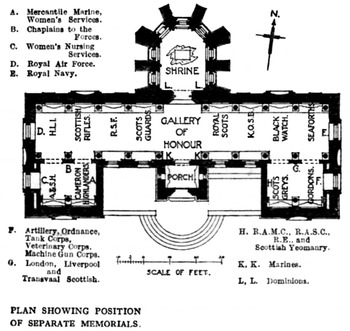
—Plan showing position of separate memorials

association with the memorial. Atholl argued in the official report proposing the memorial: “If this scheme were carried out it would give a worthy memorial of the part played by Scotsmen in the war, the national character of which would be enhanced by its association with all the material available for illustrating the military and civil history of Scotland.”Footnote 78
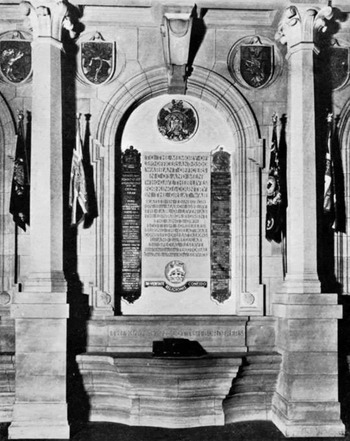
Scotland's martial tradition is at its most apparent in the main feature of the Hall of Honour, the memorials to the twelve Scottish regiments. Figure 2 shows the position of the regimental memorials in relation to the shrine. Each regiment has its own arch, and many chose to describe their origins and to list their pre-1914 battle honors alongside those more recently acquired. For example, the centerpiece to the memorial to the King's Own Scottish Borderers begins: “To the memory of 359 officers and 6,500 warrant officers, NCOs and men who gave their lives for king and country in the Great War.” It continues, in smaller font:
—Regimental memorial to the King's Own Scottish Borderers

“Raised in Edinburgh on 19th March 1689 by the Earl of Leven as the Edinburgh Regiment.” From these anti-Jacobite origins, the King's Own, like the other regiments memorialized here, went on to fight against the French and then throughout the empire. They thus played an active part in forging and defending modern Britain. The regiment's battle honors are listed at either side of the memorial plaque, from earlier battles and campaigns like Namur and Afghanistan to the more recent and deadly familiar like the Somme, Loos, and Ypres (see fig. 3). The battles of the First World War are thereby incorporated into centuries of history through Scotland's martial tradition. These regimental memorials also provide a direct way of linking Scottish individuals and localities to the broadest expanses of the empire and the war effort. Above the regimental arches are engravings of
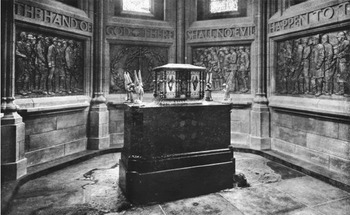
—The shrine showing the bronze frieze and the casket containing the roll of honour

the coats of arms of the counties and principal burghs of Scotland.Footnote 79 At the foot of each memorial are the rolls of honour naming the individuals who fell. These are replicated by the roll of honour placed in a casket at the heart of the shrine. The casket sits on a stone of remembrance, carved with a cross of sacrifice and Kipling's familiar words from countless other imperial war memorials: “Their Name Liveth” (see fig. 4). Tom Laqueur has noted that, in the absence of physical remains, names were the primary sites of mourning.Footnote 80 Indeed, one visitor to the memorial told Atholl, “Seeing my brother's name in the HLI [Highland Light Infantry] book gives one a wonderful sense of the personal share in that ‘heart within Scotland's heart,’ which connects it to myself, and links me in a very close way to all the others, who like yourself have a name dear to them in those Books of `Life’.”Footnote 81
Elsewhere in the memorial, there are inscriptions to Scotsmen who fell while serving in English, Irish, and Welsh regiments, in units of the British dominions and colonies, and those of “Scottish descent” in the Indian Army, and there are specific memorials to the London Scottish, the Liverpool Scottish, and the South African Scottish. Here we see the extraordinary breadth of the imagined community of Scottishness evoked by the memorial, for this last unit included men of Boer descent.Footnote 82 Their names are included in the roll of honour like every other “Scot.” In further recognition of the Scottish diaspora's contribution to the war effort, the archway to the shrine is carved with a “Tree of Empire.” In echo of the burgh shields elsewhere, upon it hang the shields of India, the Union of South Africa, Australia, Newfoundland, New Zealand, and Canada. The Royal Arms of Scotland is at the apex of the archway. Angus Calder read this as a subtle call to grant Scotland dominion status.Footnote 83 Yet this representation of the ultimate British institution, the monarchy, could just as easily be read as an assertion of Scotland's leadership role at the heart of empire.
There are some other hierarchical elements within the memorial. The regimental memorials are arranged with regard to the order of precedence, with the memorials to the Royal Scots and Scots Guards flanking either side of the shrine.Footnote 84 In the rolls of honour, the officers’ names are listed before those of the rank and file, thereby maintaining military hierarchy in two respects. An early suggestion for a hall of valour blazoned with the names of Victoria Cross winners was abandoned when the memorial's design was scaled back in 1923.Footnote 85 Subsequently, “individual tablets to distinguished soldiers and sailors” continued to be discussed, and Atholl considered including a bust or plaque of Haig, Wemyss, Trenchard, and Horne—since the first three were leaders of their respective services at the end of the war and all were Scottish.Footnote 86 (This is another example of the broadest possible definition of Scottishness: Trenchard was English but served in a Scottish regiment.) Ultimately, invidious distinctions were avoided, and the memorial opened in 1927 without any specific individuals identified for special consideration. A year later, however, the death of Field Marshal Sir Douglas Haig prompted a wave of emotion and the suggestion that his heart should be buried in the memorial.Footnote 87 Instead, Haig was honored with a bronze medallion set in a pillar—a side view of his head and shoulders with the captions: “Haig 1861–1928” and “Victorious leader of his men in war. Untiring champion of their case in peace. Erected by the Scottish Branch of the British Legion.”
In addition, anonymous individual figures are represented in perhaps the most remarkable piece of artwork within the memorial, the bronze frieze by Alice Meredith-Williams, based on sketches by her husband Morris Meredith-Williams. It shows seventy-four figures in battle kit or working dress that comprise at least one representative of every rank and unit employed. They include a private in the North Russia Expeditionary Force; a piper, New Zealand (Auckland) Regiment, 16th Waikato Company; a stoker, Fire Party, R.N.; a sergeant, R.E., Pigeon Service; a lieutenant, Royal Flying Corps; and a general.Footnote 88 If not quite egalitarian in its ethos—after all it was organized by a duke and had military service at its heart—this was a remarkably inclusive memorial. However, the policy of including Scots from all corners of the empire did cause some headaches. There were complaints that Scottish officers and men serving in the Indian Army had been overlooked and that a representative of Australian forces had been omitted from the bronze frieze: arrangements were made nearly thirty years after the opening to add the 85th Nova Scotia Highlanders and The Queen's Own Capetown Highlanders to the roll of honour.Footnote 89 Each complainant was effectively asserting membership in this empire-wide imagined community.
The thoroughness of the memorial naturally extended to include the role of the navy and the air force—reflected in the windows at each end of the Hall of Honour—and the Royal Artillery, the Scottish Yeomanry, and the mercantile marine. More unusually, it also specifically honored women who served—one window and the greater part of the southwest bay is devoted to the women's services. There is a bronze panel on the western wall depicting the nursing services, and the women's window shows them tending the wounded, driving an ambulance, making munitions, and farming, although Atholl had his doubts about including this last activity.Footnote 90 Nonetheless, it is rare for women to be depicted on war memorials, and when they are, it is usually as mourning wives or mothers.Footnote 91 In the Scottish National War Memorial, however, perhaps Presbyterian sensibilities informed the decision to avoid a direct representation of a mother and child in favor of a carving of a pelican to symbolize “Mother-Love.”Footnote 92 This is but one of a number of animals depicted in the memorial, a series of remarkable sculptures by Phyllis Bone that took the dedication to inclusivity to extreme lengths in commemorating the “humble beasts” who served. The memorial therefore includes mice and canaries (“The Tunnellers’ Friends”), carrier pigeons, an elephant, an ox, a camel, a reindeer, a horse, a donkey, and a dog.
The logical extension of the acknowledgment of the diversity of women's wartime roles was the commemoration of the impact of the war on the home front more generally; but there were limits. The crucial contribution of Scotland's industrial working class is noted within one of the windows depicting the home front, but the dissension of Red Clydeside is not. Instead, the windows depicting the home front during war show how integrated the experience was with that of war at the front. Thus, we see the leave train, munitions workers, the guarding of the coast, convalescent soldiers, and the zeppelin raid on the Castle Rock that brought the war's violence directly into the heart of the home front. For their part, socialists tended to ignore the war memorial in return. The purely nominal involvement of Labour figures in the war memorial committee mirrored the airbrushing of Red Clydeside from the memorial's record of Scotland's war experience. Forward, the Independent Labour Party (ILP) weekly newspaper, remained aloof from the debates and fundraising for the Scottish National War Memorial but did comment at the time of its opening and took a rather different stance on the historical context in which the memorial was located. William Stewart, wartime Scottish organizer of the ILP and editor of Forward, promised in his article to visit the memorial as a pilgrimage with other war resisters. He wrote: “War Memorials! We have plenty of them. This old Castle is itself a war memorial, as all old castles are, telling of feuds and forays, and tyrannies and cruelties, and the rivalries of rulers in their lust for power throughout the wars of a thousand years.”Footnote 93
In his study of the country's memorials to the First World War, Alex King calls the Scottish National War Memorial “the most flamboyantly monumental of British memorials.”Footnote 94 We may contrast this memorial with the Cenotaph in Whitehall. Jay Winter says: “Lutyens’ Cenotaph is a work of genius largely because of its simplicity. It says so much because it says so little. It is a form on which anyone could inscribe his or her own thoughts, reveries, sadnesses.” It is “without the slightest mark of Christian or contemporary patriotic or romantic symbolism.”Footnote 95 The memorial built by Atholl and Lorimer, “the Scottish Lutyens,” had a similarly inclusive aim, but it took the opposite approach.Footnote 96 Where the Cenotaph, which aimed to include everyone in the empire, had to be plain to allow a multiplicity of meanings to be read into it by a multifaith audience, the Scottish National War Memorial aimed to include everyone from its far smaller audience of all Scots in the world by attempting to represent them all in words or images. It did so by using extensive Presbyterian imagery and local and historical symbols of Scottishness. It thereby located the war within a Christian value system and within a Scottish martial tradition, deeply rooted in local communities yet with strong bonds across empire.
The war memorial was officially opened at 11 a.m. on 14 July 1927, by the Prince of Wales. He received a salute from a guard of honour of the Royal Navy and Royal Air Force at the castle drawbridge, and then, while he advanced into the castle, a short service was held for the general public gathered on the castle esplanade. After he inspected another guard of honour inside the castle, this one formed by the Cameron Highlanders, there was a further short service conducted by the Free Church, United Free Church, and Established Church Moderators. The Roman Catholic Church, in accordance with the church's opposition to ecumenical commemoration, had declined an invitation to take part; instead, it chose to conduct a simultaneous requiem mass at St. Mary's Cathedral in Edinburgh for the Roman Catholic soldiers who fell in the war. It is probable that the virulent sectarianism in Scotland in the 1920s had also informed the decision not to share the service with the Protestant clergymen.Footnote 97 Many of the Catholics in Scotland originated from Ireland. Yet, despite the tensions that arose between the British and the Irish during and after the war, the large congregation in attendance at the cathedral and the prominent display of the Union Jack at the service suggest the desire to commemorate their loss in the context of British patriotism.
After the service at the castle, the Prince unlocked the door to the memorial and laid a wreath. The colors of each regiment were lodged by their respective memorials, and thereafter the Prince received the rolls of honour from the colonels-commanding and their equivalent representatives from the various units to deposit inside the steel casket that had been placed on the outcrop of rock at the center of the shrine. The first visitors to the memorial, the king, the queen, and Princess Mary, arrived shortly afterward.Footnote 98 The king and queen laid a wreath of white and purple heather tied with a Royal Stuart tartan ribbon and then placed further rolls of honour from each branch of the armed forces in the casket.Footnote 99
Despite the inclusive nature of the memorial itself, the opening ceremony, which was staged within a relatively confined space, only permitted the involvement of a more tightly defined group, which reflected the dictates of protocol. Only those directly involved in the ceremony—the royal party, religious leaders, and ceremonial representatives of the armed forces—entered the Crown Square. The general public, save for a handful of widows “who suffered peculiarly heavy losses,” were restricted to the castle esplanade.Footnote 100 Atholl had told the General Secretary of the British Legion that this was to be “essentially a soldiers’ show,” with special preference given to blind and disabled men.Footnote 101 Yet they, along with the members of the memorial committee, the Secretary for Scotland and his predecessors in the post, and special donors, were positioned outside the Crown Square. Among the other people with privileged access inside the castle were Scottish lords lieutenant, various Scottish MPs, newspaper editors, the manager of the Bank of Scotland, and representatives of the Cockburn Society. Those who worked on the memorial were allocated to the roof of the east block of Crown Court, while committee members’ wives or daughters were also allocated spots with a good view.Footnote 102 One concerned observer estimated that “not 2% of the Guards of Honour will have fought in the War” and feared that the opening ceremony would be unpopular in consequence.Footnote 103 In 1920, at the Westminster Abbey service to inter the Unknown Warrior, popular feeling had forced MPs and lords to give up their places to the mothers of dead soldiers.Footnote 104 No such moral pressure applied in 1927. Instead, Atholl made arrangements to involve “the mob,” as he called it, by using a telephone and loud speakers to coordinate the ceremony and the hymn singing inside and outside the castle.Footnote 105 The service was also broadcast by the BBC, with a commentary by Ian Hay, Atholl having appealed to a fellow Scot, Director General John Reith, to ensure that this was done.Footnote 106
The opening ceremony reflected the meaning of the war memorial. The music played by the pipe band of the Cameron Highlanders was slow and redolent “of old triumphs and tragedies in Scottish history.”Footnote 107 The national anthem, “Reveille,” and appropriately martial hymns were played. The latter included “O God Our Help in Ages Past” and “Onward Christian Soldiers” during the community singing, plus a hymn to the tune “York” named “Lord, for All Mankind We Pray,” which included the lines, “Lord of the nations, thus to Thee/Our country we commend.”Footnote 108 A series of traditional tunes that evoked episodes in Scottish martial history were also played. They included “Flowers of the Forest” (Flodden), “Scots wha hae” (Bannockburn), “The Garb of Old Gaul” (Quebec), and “Bonny Dundee” (the Jacobite victory at Killiecrankie). The brief prayers during the ceremony focused on remembering the sacrifices that had been made in “a cause they believed to be honourable and right” and prayed for relief to the disabled and comfort for the bereaved.Footnote 109 Dean of the Thistle Dr. Charles Warr's address also echoed the theme of an historic nation that had made sacrifices in a just cause:
Here, upon this massive crag, … this home and nursery of Scottish Kings, a spot of proud and heroic memories, we are met to consecrate a noble emblem. In the Great War of the nations, Scots went forth at the call of duty and were faithful unto death. From the hills of the North, from the isles of the West, from the straths of the Lowlands, and other parts of the world they came in the gravest hours of the Empire's need. Because they had come and because they had died, freedom had still her dwelling-place in this dear land, and filled its glens and mountains with the music of her holy song. They offered this shrine in proud and thankful remembrance of those who died—a memorial to a sacrifice more precious and without which all else was poor, unreal, and vain; to the ideals of justice, truth, and national righteousness, and to the furthering of peace and goodwill among men.Footnote 110
After the controversies inspired by its inception, the newspapers covered the Scottish National War Memorial appreciatively. The Glasgow Herald considered it to be “noble, dignified, and appropriate.”Footnote 111 The Inverness Courier thought that “Nothing finer has been conceived anywhere as a lasting tribute to the heroic dead, and for generations the Memorial will make an irresistible appeal to high and low, rich and poor.”Footnote 112 The Aberdeen Press and Journal declared that those commemorated
fought and died as Britons, but for all that Scotland wishes to remember them also as Scotsmen, as men who carried on the tradition of centuries of warriors who have not their peers in the annals of the world in arms. Where better could such a memorial be set than on the ramparts of the castle that not only has witnessed the central pageant of Scottish history of kings and captains and men-at arms, but stands in its position, its grandeur and seeming obliviousness to the hand of time, symbolic of Scottish independence? The Scottish nation, however, was not, in its day of pride and remembrance, forgetful of the wider ties and kinship and loyalty, and, fittingly also, the inauguration was performed by the son of the British Sovereign, the heir to the united Crowns, himself a soldier in the Great War.Footnote 113
The true litmus test, however, must be the response of the general public: it was overwhelming. Dense crowds thronged the Royal Mile and castle esplanade for the opening, and thousands visited the memorial subsequently.Footnote 114 An initial run of ten thousand programs was printed for the memorial's opening, and “enormous crowds” proceeded to visit.Footnote 115 A year later, five thousand programs were being printed each month to meet demand.Footnote 116
Such numbers reflect the widespread grief inflicted by the war. It also seems reasonable to construe the acclaim for the memorial as an endorsement both of its undoubted artistic merit and of its interpretation of the meaning of the war and of Scottish identity. Lawrence Weaver, the editor of Country Life, concluded in his guide to the memorial that it is “above all, Scottish, and I know no greater word of praise in this relation. … Sir Robert Lorimer and those who work with him have given Scotland a building that conveys the truth of sacrifice and arouses the emotion of gratitude; that is much to have done.” It is a work of “Scottish piety and Scottish pride.”Footnote 117
When the Second World War broke out, the memorial was mothballed, and the annual service was suspended. When thoughts turned to the commemoration of this war, it became clear that there was limited appetite for further memorials of “lime and stone.” The Scottish National War Memorial was acknowledged to be artistically “outstanding” and seemed already “to provide a full measure of spiritual satisfaction.”Footnote 118 The Scottish regiments announced one after another that they would add a new roll of honour to their regimental bay in the Scottish National War Memorial and that thereafter they would focus their fundraising on housing schemes for disabled veterans.Footnote 119 In 1949 the Scottish War Memorials Advisory Council suggested that the Parliament Hall in Stirling Castle should be restored as a “permanent symbol of Scotland's national sacrifice in the recent war,” but their recommendation went unheeded.Footnote 120 Meanwhile an innovative housing project for disabled Scottish veterans of the war, under the auspices of “The Thistle Foundation,” had gathered support as a semi-official national memorial to the fallen.Footnote 121 It raised money throughout Scotland but did not direct its appeals overseas.
When the annual ceremony at Edinburgh Castle restarted in 1949, it was on a far smaller scale than its 1927 equivalent. The spectators could fit into Crown Square, and the military ceremonial was not attended by royalty. The address was given once more by Charles Warr. He recalled the earlier ceremony, but his sentiments were perhaps more somber and less nationalistic, acknowledging the intensified poignancy of the martyrdom of another generation. He urged that disillusionment should not minimize a sense of indebtedness to the fallen for the survival of the British Commonwealth and Empire and of the human spirit.Footnote 122
The Scottish National War Memorial to commemorate the fallen of the First World War taps into deep roots in Scottish culture and history, and yet it is very much of its time. In this stateless nation, the church and the army have provided a strong and popular basis for cultural nationalism. In its militant Presbyterianism, which was itself an important signifier of Scottishness, the memorial sought to locate the war within a traditional framework so that the losses inflicted could be understood within the familiar theology of sacrifice and redemption. The repeated historical references within the memorial were only amplified by its location within the ancient castle that overlooks the capital city. It thereby associated the First World War with a procession of events, martial and royal, and asserted that, despite its unprecedented destructive impact, this modern, industrial war was firmly in the tradition of Scottish history.
The Scottish National War Memorial indicates the ongoing resonance of a distinctive imperial Scottish identity in the 1920s. Its symbolism was conjured up at the behest of a man whose social status and political views made him more likely than most to espouse these values. That social status was, however, clearly on the wane, as the reliance on funding from West Coast industrialists makes clear. Given that the memorial was dominated to such an extent by the vision of Atholl, an arch-unionist, Angus Calder is wrong to project onto the memorial sympathy for Scotland gaining dominion status. It may be, however, that the breadth of the fundraising effort and the widespread acclaim for the memorial at its opening in 1927 marked a high point after which the public's perception of the war and of Scotland's imperial identity began to fracture. As Heathorn and Adrian Gregory have noted, the high ideals that marked commemoration in the 1920s came to be replaced by a lower-key pacifistic rhetoric in the 1930s, as well as by controversy over the “ownership” of commemorative occasions.Footnote 123 Moreover, Richard Finlay has argued that Scotland's imperial identity was also on the wane interwar, but for many others—often for contradictory reasons—it was still a fundamental part of their vision of Scotland's place in the world at this stage.Footnote 124 There remained sufficient life in the idea of a noble Scottish role at the heart of the empire for it to provide solace. The bonds of empire along with other traditional cultural forms such as Christian imagery, as Jay Winter has argued in relation to other sites of memory, continued to retain their power to soothe the bereaved and to give meaning to the nation's sacrifices in the First World War.Footnote 125 As such, the Scottish National War Memorial was the ultimate expression of this imperial dimension of Scottish national identity.