INTRODUCTION
Hydroidomedusan polyps are involved in associations ranging from simple epibiosis to strict symbiosis (from mutualism to parasitism) with organisms belonging to many animal phyla: sponges, cnidarians, molluscs, annelids, crustaceans, bryozoans, echinoderms, tunicates and fish (Gili & Hughes, Reference Gili and Hughes1995). Boero & Bouillon (Reference Boero, Bouillon and Rhode2005) provided a comprehensive list of about 80 parasitic hydroids considering as ‘parasitic’ the associations in whose ‘at least part of the guest body is embedded in the host tissues’ or ‘the guest lives inside the host’.
Several hydroids are also able to settle on algae or sea grasses and for a group of species (Zanclea alba, Pelagiana trichodesmiae, Fraseroscyphus sinuosus on algae, Aglaophenia harpago, Sertularia perpusilla, Orthopyxis asymmetrica, Cordylophora pusilla on Posidonia oceanica and Lineolaria spinosula, Orthopyxis tincta, Silicularia undulata, Plumularia australis, Plumularia filicaulis var. indivisa, Halecium sp. on Amphibolis) the association is compelling (Borstad & Brinkmann-Voss, 1979; Boero, Reference Boero, Bouillon, Boero, Cicogna and Cornelius1987; Calder, Reference Calder1988; Watson, Reference Watson1992; Boero & Bouillon, Reference Boero and Bouillon1993; Boero et al., Reference Boero, Bouillon and Gravili2000).
The associations between hydroidomedusan polyps and sponges may range from merely occasional to highly specific (Puce et al., Reference Puce, Calcinai, Bavestrello, Cerrano, Gravili and Boero2005). The hydrorhiza of several species creeps on the sponge surface or inside its tissues, and polyps, arising from the sponge surface, are sometimes able to retract disappearing into the sponge tissue (e.g. Cladonema sp.). In some particular associations the hydrorhiza creeps in the sponge canal system where polyps develop and release free swimming medusae (e.g. Dipurena spongicola, D. halterata; Bibrachium euplectellae and Brinckmannia hexactinellidophila) (Schultze, Reference Schultze1880; Bouillon, Reference Bouillon and Teissier1965, Reference Bouillon1971; Schuchert & Reiswig, Reference Schuchert and Reiswig2006). In their association with sponges, hydroids increase their food supply owing to the water current produced by the sponge and receive protection from predators such as nudibranchs. Sponges sometimes exploit the hydrorhiza as a supplementary skeleton thus modifying their growth strategy (Wedler & Larson, Reference Wedler and Larson1986).
Hydroids can live in association with other cnidarians, mainly other hydroids and octocorals, and the term ‘auto-epizoism’ has been coined for species living epizootically on the same or closely related species (Millard, Reference Millard1973; Bavestrello & Cerrano, Reference Bavestrello and Cerrano1992; Galea & Leclère, Reference Galea and Leclère2007). Hebella and Anthohebella are generally observed on the perisarc of other hydroid species (Boero et al., Reference Boero, Bouillon and Kubota1997), although Millard (Reference Millard1975) observed the hydrorhiza of Hebella dispolians penetrating into the coenosarcs of the host and polyps emerging through its hydrothecae. Moreover, the genus Ralpharia is almost exclusively associated with octocorals (Petersen, Reference Petersen1990; Puce et al., Reference Puce, Di Camillo and Bavestrello2008).
Several hydroids are symbiotic with molluscs. Neoturris pileata produces a dense layer on the anterior and ventral edge of the shells of the bivalve Nucula spp. (Edwards, Reference Edwards1965), Hydractinia angusta is associated with Adamussium colbecki (Cerrano et al., Reference Cerrano, Puce, Chiantore and Bavestrello2000, Reference Cerrano, Puce, Chiantore, Bavestrello and Cattaneo-Vietti2001), the Zanclea costata colonies live on Chamelea gallina, Cardium sp. and occasionally on Spisula subtruncata shells (Gravili et al., Reference Gravili, Boero and Bouillon1996; Cerrano et al., Reference Cerrano, Amoretti and Bavestrello1997), the limnomedusan Monobrachium parasiticum lives on the shells of some species of Antarctic bivalves (Jarms & Mühlenhardt-Siegel, Reference Jarms and Mühlenhardt-Siegel1998). Species of Eugymnanthea and Eutima live in the mantle cavity of bivalves such as Mytilus galloprovincialis, M. edulis, Cardium tuberculatum, Ostrea gigas and Crassostrea rhizophorae (Kubota, Reference Kubota1979, Reference Kubota1983; Piraino et al., Reference Piraino, Todaro, Geraci and Boero1994), and benefit from the food transported by the mollusc inner current in exchange for protection against intruders (Rees, Reference Rees1967). In fact, Piraino et al. (Reference Piraino, Todaro, Geraci and Boero1994) suggested that polyps can feed on the trematode sporocysts that infest the bivalve host, causing its parasitic castration.
An association between hydroids and gastropod shells occupied by a living mollusc or hermit crabs is very frequent (Reece, 1967; Puce et al., Reference Puce, Arillo, Cerrano, Romagnoli and Bavestrello2004). The speciose families Hydractiniidae and Cytaeididae are specialized in this kind of association. The benefits deriving from this symbiosis are partially unknown, although trophic advantages for the hydroid and protection from predators for the gastropod or hermit crab have frequently been hypothesized (Rees, Reference Rees1967; Bavestrello, Reference Bavestrello1985; Brooks & Mariscal, Reference Brooks and Mariscal1985). Moreover life on the mollusc shell allows hydroids to live in soft bottoms and in the plankton. In fact, three species of Pandeidae and one of Hydractiniidae were observed in association with pteropods (Quoy & Gaimard, Reference Quoy and Gaimard1827; Chun, Reference Chun1889; Vanhöffen, Reference Vanhöffen1910; Kramp, Reference Kramp1921; Boero & Bouillon, Reference Boero, Bouillon and Rhode2005; Bouillon et al., Reference Bouillon, Gravili, Pagés, Gili and Boero2006).
Similar benefits also emerge in the symbiosis involving Hydractinia exigua and the hermit crab Diogenes pugilator (Cerrano et al., Reference Cerrano, Bavestrello, Puce and Sarà1998) or Hydractinia pruvoti and shells inhabited by Clibanarius erythropus (Bavestrello et al., Reference Bavestrello, Puce, Cerrano, Castellano and Arillo2000b). The association with a shell occupied by a hermit crab (e.g. Pagurus acadianus) is compelling for Hydractinia echinata: the hermit crab induces the metamorphosis of the hydroid larva thanks to particular resident bacteria of the genus Alteromonas (Müller & Buchal, Reference Müller and Buchal1973; Weiss & Buss, Reference Weiss and Buss1987), in the absence of which this metamorphosis is generally impossible. Crabs living in deep sea, both in sandy and muddy bottoms, present hydroids on their skeleton which function as camouflage and protection (Hamond, Reference Hamond1957; Abelló et al., Reference Abelló, Villanueva and Gili1990; Di Camillo et al., Reference Di Camillo, Bo, Puce, Tazioli, Froglia and Bavestrello2008). The hydroids may in turn benefit from food particles lost by the crustaceans.
The genera Proboscidactyla and Teissiera are symbiotic with annelids: Proboscidactyla's hydrorhiza creeps around the rim of the tubes of sabellid polychaetes (Hand & Hendrickson, Reference Hand and Hendrickson1950) and Teissiera colonies grow on the operculum of serpulid polychaetes (Bouillon & Boero, Reference Bouillon and Boero1987).
The symbiosis between hydroids and bryozoans involves many genera such as Cytaeis, Zanclea, Halocoryne, Hydranthea, Octotiara and Zanclella (Boero & Hewitt, Reference Boero and Hewitt1992; Piraino et al., Reference Piraino, Bouillon and Boero1992; Boero et al., Reference Boero, Bouillon and Gravili2000; Puce et al., Reference Puce, Bavestrello, Di Camillo and Boero2007) and shows a wide range of interdependence levels. The bryozoan obtains protection from predators like turbellarians or molluscs, while the hydroid collects food particles exploiting the water current produced by the host and moreover uses the bryozoan skeleton as protection from nudibranch predation. Hydroids may sometimes show a parasitic behaviour toward bryozoans, as in the cases of Halocoryne epizoica (Piraino et al., Reference Piraino, Bouillon and Boero1992) and Cytaeis schneideri (Bavestrello et al., Reference Bavestrello, Puce, Cerrano and Balduzzi2000a).
The Arctic Hydractinia ingolfi and the Antarctic Hydractinia vallini live in association with two brittle star species belonging to the same ophiuroid family. Polyps are abundant both on the oral and aboral side of the disc and on the arms (Svoboda et al., Reference Svoboda, Stepanjants, Smirnov, Battaglia, Valencia and Walton1997).
The genus Bythotiara is associated with both benthic and planktonic tunicates. Polyps live typically in the oral siphon, where they exploit the incurrent water (Raskoff & Robinson, Reference Raskoff and Robinson2005).
The symbiosis between hydroids and fish mainly involves the genera Hydrichthys and Larsonia. Hydrichthys mirus produces plates on the Signatidae skin and probably feeds on the host blood. Boero et al. (Reference Boero, Bouillon and Gravili1991) observed that hydroid colonies can detach from the dead fish and become planktonic while looking for a new host.
This study aims at summarizing the morphological and behavioural adaptations of the symbiotic hydroid species, suggesting that the high number of hydroid relationships with other organisms is not only the result but also the source of the evolutionary radiation of this group.
SYSTEMATIC SURVEY
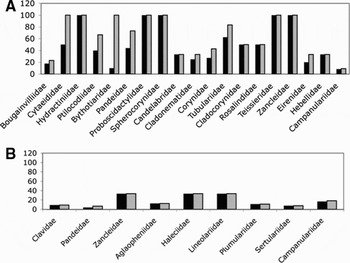
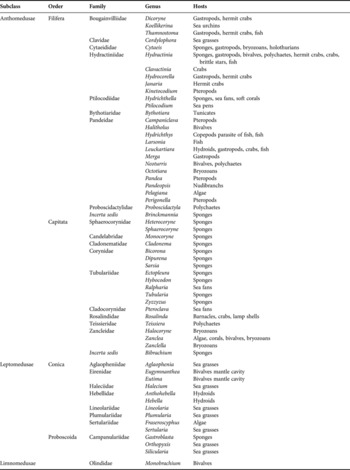
The species involved in symbiosis with animal hosts mainly belong to the subclass Anthomedusae, few species are Leptomedusae and only one species belongs to Limnomedusae (Figure 1A; Table 1).
Percentage of symbiotic genera on the total number of genera (black bars) and on the total number of genera with the polyp stage known (grey bars) present in each family symbiotic with animal (A) and algae/sea grasses (B).

Hydroidomedusae symbiotic genera.

As regards the Anthomedusae, members of 16 families (7 Filifera and 9 Capitata) are involved in symbiotic relationships, representing about 32% of all the Anthomedusae families. Instead, for the Leptomedusae, only 3 families associated with other organisms are reported (2 belonging to the order Conica and 1 to the order Proboscoida) representing 9% of all Leptomedusae families. Finally one family of Limnomedusae (Olindidae) includes one symbiotic genus (Monobrachium).
The same survey, conducted at genus level, shows 44 Anthomedusae genera involved in symbiotic relationships (25 belonging to the order Filifera, 19 to the order Capitata) representing about 20% of the total Anthomedusae genera. Only 5 Leptomedusae genera (4 belonging to the order Conica and 1 to the order Proboscoida), representing about 3% of the total Leptomedusae genera, are involved in symbiotic associations.
The subclass Anthomedusae includes 6 suborders: Margelina, Pandeida, Moerisiida, Sphaerocorynida, Tubulariida and Zancleida. With the exception of the suborder Moerisiida, all the suborders include families in which one or more genera are involved in symbiotic associations: 4 families belong to the suborder Margelina (Bougainvilliidae, Cytaeididae, Hydractiniidae and Ptilocodiidae), 3 to the suborder Pandeida (Bythotiaridae, Pandeidae and Proboscidactylidae), 1 to the suborder Sphaerocorynida (Sphaerocorynidae), 4 to the suborder Tubulariida (Candelabridae, Cladonematidae, Corynidae and Tubulariidae) and 4 to the suborder Zancleida (Cladocorynidae, Rosalindidae, Teissieridae and Zancleidae). Eight of these families may be considered completely ‘symbiotic’ having the polyp stage of all the genera living in association with other organisms although with a different degree of specialization.
The situation is different in the symbiosis with algae and sea grasses. Only 9 families, 3 Anthomedusae and 6 Leptomedusae, are involved. Although several relationships with algae are compelling these relationships are rare and any symbiotic genera or families were observed (Figure 1B; Table 1).
As regards symbiotic relationships, pandeids are generalist comprising genera that live in association with organisms of different unrelated groups (molluscs, crustaceans, bryozoans and fish). The families Cytaeididae, Bythotiaridae, Proboscidactylidae, Teissieridae, Zancleidae, Hydractiniidae and Sphaerocorynidae may be regarded as specialized: all the known genera included in these families are mainly associated with organisms belonging to a particular phylum.
A high specialization for symbiotic life is also evident at the generic level: in spite of some exceptions, the species belonging to the genera Dicoryne and Hydractinia live in association with gastropods or hermit crabs, Zanclella, Halocoryne and Zanclea with bryozoans, Hydrichthys with fish or copepod parasites of fish, Zyzzyzus with sponges and Ralpharia with octocorals.
In the subclass Leptomedusae, Hebella and Anthohebella (family Hebellidae) live in association with other hydroids, Eugymnanthea and Eutima (family Eirenidae) live in the bivalve mantle cavity, and Gastroblasta (family Campanulariidae) is symbiotic with sponges (Gravili et al., Reference Gravili, Bouillon, D'Elia and Boero2007).
Some Leptomedusan species are able to grow on several kinds of substrates, but locally may be associated with a preferred host: in the Ligurian Sea Hydranthea margarica is always associated with the bryozoan Chartella tenella (Boero & Sarà, Reference Boero and Sarà1987) and in the Sulawesi Sea (Indonesia) Nemalecium lighti is symbiotic with the sponge Carteriospongia foliascens (Puce et al., Reference Puce, Calcinai, Bavestrello, Cerrano, Gravili and Boero2005).
ADAPTATIONS TO THE SYMBIOTIC LIFE STYLE
The adaptation to symbiotic life style leads to the evolution of morphological and behavioural specializations in the organisms involved.
Morphological adaptations of hydroids
The hydroids of numerous species of symbiotic Anthomedusae show polymorphic colonies characterized by gastrozooids, gonozooids and dactylozooids.
In species associated with gastropods or hermit crabs, a reactive polymorphism deriving from the hydroid reaction to the contact with the host is frequent: in fact, dactylozooids are mainly produced around the shell opening where the hydroid is in direct contact with the host (Daniaud, Reference Daniaud1951; Braverman, Reference Braverman1960; Edwards, Reference Edwards1972). The same kind of polymorphism is known in some zancleids growing on the bryozoan colonies (Boero et al., Reference Boero, Bouillon and Gravili2000). In Cytaeis capitata (family Cytaeididae) the polyps distributed around the shell opening are characterized by a modified tentacle, longer than others, whose apex is armed by numerous large nematocysts (Puce et al., Reference Puce, Arillo, Cerrano, Romagnoli and Bavestrello2004).
Tentacle reduction in both number and size, possibly as a consequence of the exploitation of food resources produced by the host, has been observed in several symbiotic hydroids. Gastrozooid tentacle reduction is reported for some species that shifted from macrophagy to microphagy (Boero & Hewitt, Reference Boero and Hewitt1992; Piraino et al., Reference Piraino, Bouillon and Boero1992; Puce et al., Reference Puce, Bavestrello, Di Camillo and Boero2007). This adaptation shows its extreme expression in parasitic hydroids such as Cytaeis schneideri, and the species belonging to the genera Halocoryne, Hydrichthys and Larsonia. Tentacle reduction is related to the progressive loss of the ability of capturing prey, still present in Cytaeis and Halocoryne, together with the feeding on bryozoan tentacles, but completely absent in Hydrichthys which probably feeds on blood cells of the host fish (Boero et al., Reference Boero, Bouillon and Gravili1991).
Symbiotic life sometimes leads to the loss of perisarcal protection. This modification occurs in the hydroids of several Anthomedusae genera such as Bytothiara, Proboscidactyla, Zanclea, Hydrichtys and Larsonia, with naked hydrorhiza, and in the theca-less Leptomedusan (i.e. thecate) hydroids Eugymnanthea and Eutima. The hydrorhiza of several Zanclea species may be covered by the calcareous skeleton of the bryozoan host (Ristedt & Schuhmacher, Reference Ristedt and Schuhmacher1985). Host protection probably results in the loss of the hydroid perisarc, which is constantly absent in the species whose polyps are able to retract in the bryozoan and therefore have a strict relationship with the host (Puce et al., Reference Puce, Bavestrello, Di Camillo and Boero2007). The influence of the relationship with the host is evident in the genus Eutima including free and symbiotic species: the typical perisarc theca is present in the free species and absent in the symbiotic ones (Bouillon et al., Reference Bouillon, Gravili, Pagés, Gili and Boero2006). An exception is represented by Eirene hexanemalis, a species with a solitary planktonic hydroid, morphologically similar to the hydroid of Eugymnanthea, and somehow preadapted to a commensal life (Bouillon, Reference Bouillon1983; Boero et al., Reference Boero, Bouillon and Piraino1996).
About 90% of genera symbiotic with animal hosts produce medusae or eumedusoids, while all the species obligate-associated to Posidonia oceanica have a suppressed medusa stage and the propagation is mainly asexually achieved by stolonization (Boero, Reference Boero, Bouillon, Boero, Cicogna and Cornelius1987). Some species such as Fraseroscyphus synuosus living on red algae and Aglaophenia harpago and Sertularella sp. living on Posidonia are provided with clinging organs, by whose they colonize adjacent thalli or leaves (Boero, Reference Boero, Bouillon, Boero, Cicogna and Cornelius1987; Boero & Bouillon, Reference Boero and Bouillon1993; Boero, personal communication). Medusae liberation was observed only in the very peculiar case of the pandeid Pelagiana trichodesmiae, whose polyps are relatively large compared with the colony of the planktonic filamentous cyanobacterium Trichodesmium thiebautii that is able to host up to six adult hydranths per colony (Borstad & Brinckmann-Voss, Reference Borstad and Brinckmann-Voss1979).
Behavioural adaptations of hydroids
Behavioural adaptations are related to unusual trophic strategies, which have evolved as a consequence of symbiotic relationships. Two kinds of trophic strategies may be identified: (i) exploitation of the water current produced by the host. The Zanclella bryozoophila gastrozooids bend over until the hypostome and the tentacle are inside the tentacular crown of the lophophore in order to collect the food particles in the water flow (Boero & Hewitt, Reference Boero and Hewitt1992). The Zanclea cfr. bomala polyps arrange themselves near to the extended lophophores and, after some time in this collection position, fold themselves and eat the food particles entrapped among their tentacles (unpublished); and (ii) parasitic behaviour. The gastrozooids of Cytaeis schneideri adhere with the hypostome to the bryozoan surface and feed on its cuticle (Bavestrello et al., Reference Bavestrello, Puce, Cerrano and Balduzzi2000a). Instead, the gastrozooids of Hydrichthys mirus are able to suck the host blood cells, bending in order to stick the mouth to the fish skin that, in fact, appears eroded in the area around the colony (Boero et al., Reference Boero, Bouillon and Gravili1991). A mild parasitic strategy was observed in Halocoryne epizoica. Its gastrozooids lacking tentacles carefully approach the bryozoan host lophophores, ingest one tentacle at a time and are able to detach them from the lophophore during digestion (Piraino et al., Reference Piraino, Bouillon and Boero1992). Moreover, some species such as C. schneideri and Hydractinia exigua feed on the larvae of their host, bryozoan and hermit crab respectively (Cerrano et al., Reference Cerrano, Bavestrello, Puce and Sarà1998; Bavestrello et al., Reference Bavestrello, Puce, Cerrano and Balduzzi2000a).
Host reactions
Upon contact with a planula, potential hosts may either prevent planula settlement, owing to antifouling systems, or allow it while isolating own tissues from those of the hydroid or, finally, allow settlement and establish a mutualistic relationship.
The settlement of the planula of Ralpharia neira induces the production of a tissue gall in the gorgonian host Ellisella sp. which, subsequently, covers the polyp hydrocaulus (Puce et al., 2008). The observation of hydrocaulus transversal sections has highlighted the presence of a double separation between the tissues of the two organisms. In fact, the gorgonian proteinaceus skeleton is in contact with the perisarc layer produced by the hydroid (Puce et al., 2008).
A host reaction is also frequent in the relationship involving hydroids and sponges. The hydrorhiza of Sphaerocoryne sp., embedded in the tissue of the host sponge belonging to the genus Aka, is filled by numerous nematocysts and is enveloped inside the sponge spicule tracts (Puce et al., Reference Puce, Calcinai, Bavestrello, Cerrano, Gravili and Boero2005). In several zancleids the association with the bryozoan host evolves towards mutualism and the bryozoan reacts to the hydroid presence by covering and protecting the hydrorhiza with its calcareous skeleton and inducing the disappearance of the hydroid perisarc. The defensive function of the hydroid nematocysts sometimes induces the bryozoan to reduce the number of the avicularia, structures involved in the defence of the bryozoan colony (Osman & Haugsness, Reference Osman and Haugsness1981; Ristedt & Schuhmacher, Reference Ristedt and Schuhmacher1985; Puce et al., Reference Puce, Bavestrello, Di Camillo and Boero2007).
DISCUSSION
Hydroids are able to establish symbiotic relationships with most marine phyla. They are pioneer organisms that rapidly settle on virgin substrates but, when substituted by more efficient competitors, they are able to settle again as epibionts (Riedl, Reference Riedl1966; Boero, Reference Boero1984). This aspecific epibiosis represents, in our opinion, the first step towards more stable associations that occur through morphological and/or behavioural adaptations. Piraino et al. (Reference Piraino, Bouillon and Boero1992) and Boero & Bouillon (Reference Boero, Bouillon and Rhode2005) maintain that the cases in which hosts receive some compensation from guests suggest a long history of coexistence, beginning as mutualism and sometimes ending as parasitism.
This symbiotic aptitude is probably enhanced by the perisarc layer that isolates the coenosarc from the host tissue. The perisarc reduces the contact of the hydroid with the anti-fouling host defences and at the same time limits the ‘trouble’ of the epibiont settlement. This fact is probably crucial, as demonstrated by the tendency in several described relationships to isolate the tissues of the hydroid from those of the host. Nevertheless at the hydroid settling stage, the planula is naked, completely deprived of the perisarc coat which is produced in a short time after settlement. It is possible that, at this stage, a certain level of isolation of the planula from the host tissues is obtained through the mucous coat enveloping the planula (Sommer, Reference Sommer1990).
The predominance of Anthomedusae in symbiotic associations with animals suggests that the theca constrains the morphological and behavioural plasticity of polyps in establishing trophic relationships with their hosts. This is strongly supported by the evidence that the Leptomedusae genera mainly involved in these symbiotic relationships (Eutima, Eugymnanthea and Hydranthea) strongly reduced or even lost their theca, and some are completely deprived of perisarc. On the contrary, Leptomedusae predominate in the associations with plants or algae where behavioural adaptations to the symbiotic life are absent and morphological adaptations are related to the hydrorhizal adhesion to the substrate or to the asexual reproduction (Piraino et al., Reference Piraino, Morri and Boero1990).
The ability to settle on/in the tissues or on the skeletal structures of living organisms, allows hydroids to form new ecological niches at low degree of competition. It leads to the evolution of taxa specialized in symbiosis with a particular phylum and it offers wide possibilities of speciation (Cunningham et al., Reference Cunningham, Buss and Anderson1991). The genus Hydractinia is made up of more than 100 species, almost exclusively symbiotic with molluscs and hermit crabs, and the genus Zanclea includes 16 species mainly associated with bryozoan hosts (Bouillon et al., 2006). This evidence suggests that hydroid evolution, mainly in the Anthomedusae, is strongly driven by the aptitude of this group to establish, probably in a short time, coevolutionary interactions with other benthic organisms.