
Introduction
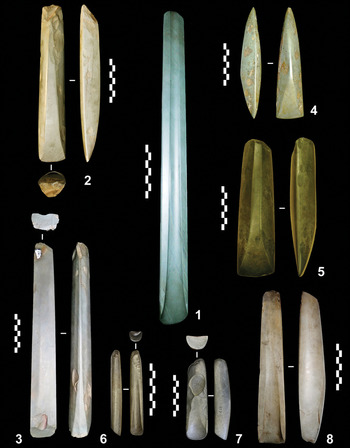
The axes and adzes of the so-called Russian (or East) Karelian type have long been recognised in the study of north-eastern European prehistory due to their distinctive appearance and because of the assumed specialised craft production and long-distance exchange of these artefacts (Ailio Reference Ailio1909: 26; Äyräpää Reference Äyräpää1944) (Figure 1). The Russian Karelian lithic industry thrived amongst hunter-fisher-gatherer communities of the fourth and third millennia BC in north-eastern Europe (in the absence of a suitable geographical term, north-eastern Europe is used here to denote the northern and north-western parts of European Russia, Finland and the Baltic States). Elsewhere in Europe at this time, similar production and exchange networks were more closely associated with agricultural societies and their socio-ideological development (e.g. Bradley & Edmonds Reference Bradley and Edmonds1993; Pétrequin et al. Reference Pétrequin, Kerig and Shennan2015).
Russian Karelian artefacts—axes, adzes and fluted adzes—were widespread in north-eastern Europe: 1) Kiuruvesi (central Finland); 2) Metsäpirtti (the Karelian Isthmus, Russia); 3) Podole (southern coast of Lake Ladoga, Russia); 4) Suna (western coast of Lake Onega, Russia); 5) Salmi (eastern coast of Lake Ladoga, Russia); 6–7) Sakhtysh (central European Russia); 8) Aesoo (south-western Estonia) (scales in cm; photographs by A. Tarasov).

Recent studies have clarified the chronology, the technological organisation of the manufacturing process (the chaîne opératoire) and the spatial distribution of the Russian Karelian industry (Zhulnikov Reference Zhulnikov1999; Kriiska et al. Reference Kriiska, Tarasov, Kirs, Johanson and Tõrv2013; Tarasov & Stafeev Reference Tarasov and Stafeev2014; Tarasov Reference Tarasov2015). Particularly important are investigations conducted by one of the authors of this article (A. Tarasov) at the Fofanovo XIII workshop site on the western shore of Lake Onega (Republic of Karelia, Russia) (Figures 2–3). Here, we use high-resolution data obtained from the site to characterise the Russian Karelian lithic industry, its scale and production methods. We then discuss the wider distribution of these artefacts and set the Russian Karelian industry within the context of long-distance exchange networks of both local forager and agricultural communities. Finally, we discuss the socio-economic roots of the Russian Karelian lithic industry and the hunter-fisher-gatherer societies of the fourth to third millennia BC in north-eastern Europe. The Russian Karelian industry represents an important addition to our wider knowledge of prehistoric technological organisation and exchange networks due to its socio-economic context and wide geographical distribution.
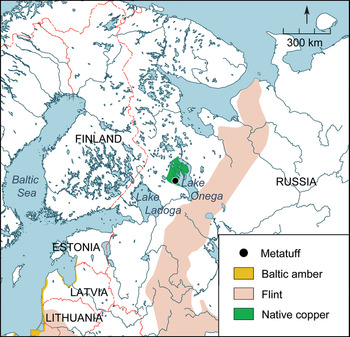
Location of Fofanovo XIII, other workshops and the major metatuff deposit (black dot) in the research area, as well as source areas of amber (yellow), native copper (green) and Cretaceous and Carboniferous flint (pink) (map based on public domain data from Natural Earth (https://www.naturalearthdata.com; figure by K. Nordqvist)).

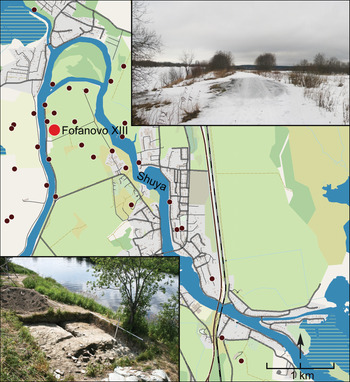
Fofanovo XIII and the nearest lithic workshops (black dots) at the mouth of the Shuya River (map shows current water level). The excavated trench (bottom left inset) is located beside the riverbank (top right inset) (map based on public domain data from Open Street Map (https://www.openstretmap.org; figure by K. Nordqvist; inset photographs by A. Tarasov and K. Nordqvist)).

Russian Karelian lithic industry
Russian Karelian lithic artefacts were first discovered in the nineteenth century and are characterised by their distinctive trapezoidal or triangular cross-sections (Figure 1). Their origins were located in the area of the present-day Karelian Republic (Russia), although documentation of a much wider distribution led to the recognition of Russian Karelian artefacts as an early textbook example of long-distance prehistoric exchange (Äyräpää Reference Äyräpää1944: 65; see also Clark Reference Clark1952).
Most Russian Karelian tools are made of volcanic greenstones, known as ‘metatuff’, with a high silica content (the inaccurate term ‘green slate’ is also common in the literature). The source of this raw material was located in the early twentieth century in the volcanic, rocky massifs found in a small area on the western coast of Lake Onega (Mäkinen Reference Mäkinen1911; Ailio Reference Ailio1919: 1–2)—an observation later confirmed by petrographic and geochemical (ICP-MS) analyses (Heikkurinen Reference Heikkurinen1980; Kriiska et al. Reference Kriiska, Tarasov, Kirs, Johanson and Tõrv2013; Tarasov & Gogolev Reference Tarasov and Gogolev2018) (Figure 2). So far, however, only two quarries with possible evidence of prehistoric extraction have been archaeologically identified in this area.
The metatuffs of western Lake Onega were used to manufacture various stone tools for several millennia before the Russian Karelian industry increased the scale of exploitation and production to an unprecedented level. Most of the approximately 40 known workshops that manufactured Russian Karelian tools are associated with asbestos- and organic-tempered wares of Voynavolok and Orovnavolok types, which date from around the mid-fourth to the mid-third millennium BC (Tarasov et al. Reference Tarasov, Nordqvist, Mökkönen and Khoroshun2017: 107–108; Mökkönen & Nordqvist Reference Mökkönen and Nordqvist2018: 93). Most of these sites are found close to vulcanite outcrops along the lower reaches of the Shuya River (Figure 3). The workshops vary in size and knapping volume, ranging from large sites of more than 10 000m2, with evidence for intensive activity, to small, single-episode knapping floors.
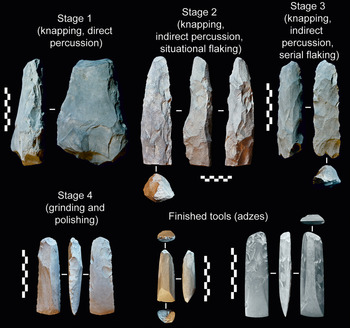
Recent research on this topic has increased our understanding of the chaîne opératoire of Russian Karelian tools (Tarasov & Stafeev Reference Tarasov and Stafeev2014; Tarasov Reference Tarasov2015). The technology was based on the use of soft intenders (percussors for detaching flakes), especially punches for indirect percussion, proceeded through several knapping stages, and finished with complex grinding and polishing that usually covers the entire surface (Figure 4). This sophisticated technique required training to produce even ‘ordinary’ specimens and skill to make the most elaborate pieces (Figure 1:1). The technology, however, was not limited to the Lake Onega area: a similar technology was used (although rarely discussed in the literature) on different lithic materials in the contemporaneous and culturally linked contexts of the Volosovo Culture in central and northern European Russia (Tarasov Reference Tarasov2017: 32).
Preforms (stages 1–4 with their characteristic features) and finished tools of the Russian Karelian type from Fofanovo XIII (scales in cm; photographs by A. Tarasov).

Fofanovo XIII and the scale of specialised production
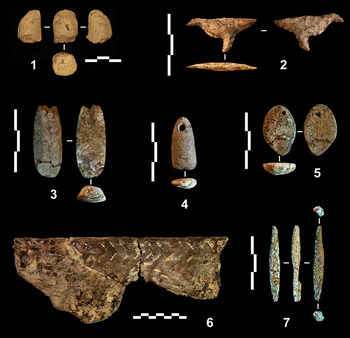
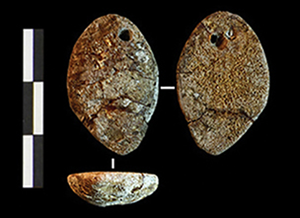
The Fofanovo XIII site is the largest and most thoroughly studied of the Russian Karelian workshops and may serve as an example to illustrate the scale of production. The site was discovered in 1999 adjacent to the mouth of the Shuya River, north of the city of Petrozavodsk (Figure 3). Modern land use (ditch digging and ploughing) had exposed a large quantity of finds (mostly lithic debitage), and, based on their surface distribution, the total area of the site is estimated to be approximately 40 000m2. In 2010–2011, a small 30m2 trench was opened in the western part of the site. Despite its small scale, the excavations recovered a unique assemblage of approximately 350 000 finds (Tarasov & Stafeev Reference Tarasov and Stafeev2014; Tarasov Reference Tarasov2015), most of which (84 per cent) are production debitage and preforms from the manufacture of Russian Karelian-type metatuff axes and adzes (Figure 4). The rest of the assemblage comprises more than 10 000 ceramic sherds representing over 200 vessels (Voynavolok and Orovnavolok Wares), bifacial flint and lydite tools and associated production waste, as well as polished slate points, pendants of (Baltic) amber, pieces of asbestos mineral and native metallic copper, and unburnt bones (predominantly of freshwater fish) (Figure 5).
Finds from Fofanovo XIII: 1) clay figurine; 2) flint figurine; 3–5) amber pendants; 6) asbestos-tempered pottery; 7) copper item (scales in cm; photographs by A. Tarasov).

The finds were densely packed in a 0.5–0.8m-thick cultural layer. The largest concentration of finds was connected with a fireplace and an adjoining stone setting, the function of which cannot be deduced due to the small area investigated. No substantial settlement structures, particularly house pits that are characteristic of contemporaneous basecamps and often visible even on the surface, have been detected. Fofanovo XIII can therefore be considered to be a specialised workshop, rather than a settlement site. Radiocarbon dating (see Tarasov et al. Reference Tarasov, Nordqvist, Mökkönen and Khoroshun2017: 107–108) suggests that the site was utilised recurrently over several centuries between 3500 and 3000 BC. This is consistent with the dating of associated pottery, as well as stratigraphic observations.
Based on insights gained through experimental replication (Tarasov & Stafeev Reference Tarasov and Stafeev2014), the debitage and preforms found during excavation indicate that approximately 1000 axes and adzes were manufactured in the investigated 30m2 area. Assuming that the duration of use and the scale of production were the same across the entire site, the overall output of Fofanovo XIII would have totalled tens of thousands of tools—and this site is just one of many local workshop areas. Such intensity of production clearly would have exceeded the needs of individual and local demand, suggesting that production was oriented towards exchange. There was a great level of technical ‘know how’ (see Pelegrin Reference Pelegrin1990: 123) involved in such large-scale production within designated workshops, using standardised methods and particular high-quality raw materials, not to mention the extent of control exercised over the transportation of both raw materials and products (see below), and evidence of specialised handicraft production (see Bērziņš Reference Bērziņš, Beck, Loze and Todd2003: 35). These craft activities were probably handled by a subset of the local population—lithic specialists engaged in the (presumably part-time) manufacture of Russian Karelian stone tools.
Distribution of Russian Karelian preforms and finished tools
We examine the regional distribution of 1355 preforms and 1268 finished Russian Karelian tools. The accuracy of locating the findspot for each artefact varies from precise GPS-measurements and detailed maps of settlements and workshops to village-level accuracy for many of the stray finds; finds with even less accurate or no details of origin were excluded from the study. Our dataset contains only those items that we have personally examined, and is therefore not comprehensive (the eastern and south-eastern areas, for example, are less well represented), but the overall regional coverage is sufficient for a general analysis.
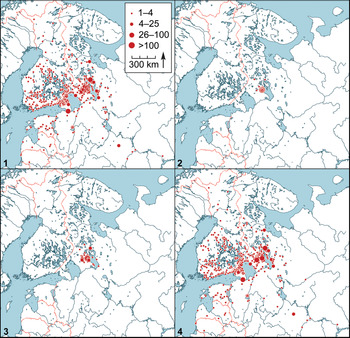
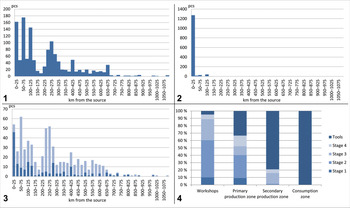
The distribution of preforms and finished tools suggests a hierarchical, three-level model of manufacture and distribution (Figures 4 & 6–7). First, early-stage preforms (stages 1–2), with a few exceptions, are found only in workshops along the lower Shuya River. This limited area close (<50km) to the raw material sources forms the primary extraction and production locus; evidence for all the stages of production is represented in this area. Second, stages 3–4 preforms and half-finished products are also present in the wider region surrounding the primary production area, extending across a distance of 50–150km from the raw material sources and workshops; this represents the area of secondary production (i.e. the completion of a limited number of half-finished items), as well as consumption. Third, in the area more than 150km distant from the raw material sources and primary workshops, we find only finished tools; this area is characterised by the consumption of finished products and, at most, local repair and modification.
Distribution of Russian Karelian artefacts: 1) all tools and preforms (642 locations with a maximum of 688 finds per find location); 2) stage 1 and 2 preforms (34/432); 3) stage 3 and 4 preforms (65/209); 4) finished tools (605/50). Map based on public domain data from Natural Earth (https://www.naturalearthdata.com; figure by K. Nordqvist).

The number of Russian Karelian artefacts shown at 25km intervals from the source area (an arbitrary point zero is set at the mouth of the Shuya River, 61°55′45.3″N, 34°13′4.2″E): 1) finished tools (n = 1268); 2) preforms (n = 1355); 3) number of sites (n = 182; dark blue) and stray find locations (n = 460; light blue). Graph 4 shows the average proportions of different find categories at sites located in different zones. Workshops = workshops with >100 finds (n = 3); primary production zone = other workshops and sites <50km from zero (n = 53); secondary production zone = sites 50–150km from zero (n = 34); consumption zone = sites >150km from zero (n = 71) (figure by K. Nordqvist).

Finished tools have a distribution radius of nearly 1000km from the primary workshops locus on the western coast of Lake Onega. The most distant occurrences in Finnish Lapland and the Kazan region in Russia are located approximately 1900km apart, and the literature reports individual finds from as far apart as Sweden in the west and western Siberia in the east (Ekholm Reference Ekholm1915; Chernetsov Reference Chernetsov and Zbrueva1953). The distribution is uneven and weighted towards the west and south-west of the primary workshops locus, which partly reflects the cultural contacts, natural conditions and waterways that form the basis of prehistoric mobility in the area, and partly the intensity of previous archaeological work in this region. Acknowledging this, and noting that the number of finds generally decreases with distance from the raw material source areas (Figure 7), the fall-off curve is insufficiently smooth to match the down-the-line exchange model (see Renfrew Reference Renfrew, Earle and Ericson1977: 77). Instead, it indicates a more complex distribution system.
The tripartite model shows that access to primary raw-material sources, along with much of the production and at least the initial distribution of the finished products were restricted to certain individuals or groups. A high abundance of tools and preforms in the area up to 150km from the extraction and primary production areas is associated with availability and proximity of producers and consumers, as well as with the partial interchangeability of these roles. The area's outer boundary marks the end of the production zone (i.e. the distribution of preforms) and the first large drop in total finds numbers.
The sinusoidal pattern (Figure 7:1 & 3) seen in the consumption area reflects the inter-regional contacts between different groups or units and areas involved in the exchange. The first considerable peak on either side of the 250km radius indicates active communication between culturally and geographically close forager groups. Smaller peaks at approximately 400km and 650km, however, reflect a more complex picture, consisting of fewer but very long inter-regional contacts, and directed at important redistribution, ritual or other localities. Still further away, connections become less frequent, although they still connect with very distant parts of culturally related areas.
Long-distance exchange, stone axes and social conditions
Prehistoric exchange was quite different from the impersonal transactions of a modern market economy, and was largely inseparable from its social, political and ideological contexts (Oka & Kusimba Reference Oka and Kusimba2008). Exchange was a social strategy used to establish and maintain relationships and alliances, and much of its meaning was determined by the social context and the physical exchange of objects (Bradley & Edmonds Reference Bradley and Edmonds1993: 11–16). Prehistoric exchange systems were often complex, as illustrated by Neolithic obsidian distribution in the Near East. Recent mathematical modelling of this exchange system suggests the existence of a type of small-world network, in which local interaction was complemented by long-distance transactions by some of the participants (Ortega et al. Reference Ortega2014; Ibáñez et al. Reference Ibáñez2016). While acknowledging that different processes may result in fairly similar patterns of distribution, our Russian Karelian material is at least superficially consistent with such a network model.
The emergence of organised, regularly functioning long-distance exchange networks that distributed raw materials produced specifically for exchange is usually strongly connected with the development of agricultural societies (Ortega et al. Reference Ortega2014: 462; Kerig & Shennan Reference Kerig and Shennan2015). Of particular interest here are the axe-heads that played a prominent role in both the socio-economic and ideological construction of the European Neolithic world (Pétrequin et al. Reference Pétrequin, Kerig and Shennan2015). These axes, for example, are described as elaborate handicrafts imbued with exotic or symbolic prowess. They were used ritually and to signify social status, supporting the emerging elite to create, control and maintain relationships with both the community and the supernatural (Pétrequin et al. Reference Pétrequin, Kerig and Shennan2015: 92; see also e.g. Lekberg Reference Lekberg, Apel and Knutsson2006; Klimscha Reference Klimscha, Furholt, Großmann and Szmyt2016). This interpretation, however, is only one side of the equation (Bradley & Edmonds Reference Bradley and Edmonds1993: 205), and neither specialised mass production nor controlled exchange can be automatically associated with a certain socio-political complexity or the existence of institutional inequality (Schortman & Urban Reference Schortman and Urban2004: 202; Oka & Kusimba Reference Oka and Kusimba2008: 361). The varying backgrounds of specialised production and long-distance exchange are also suggested by the Russian Karelian industry.
Russian Karelian tools in wider context
Russian Karelian artefacts provide one indication of the specialised production and long-distance exchange involving foragers in fourth to third millennium BC north-eastern Europe. Baltic amber (mostly succinite) occurs naturally in limited areas along the southern and south-eastern shores of the Baltic Sea (Figure 2). This material was processed in specialised workshops that are well-attested in Lithuania and Latvia (Bērziņš Reference Bērziņš, Beck, Loze and Todd2003; Loze Reference Loze2008), and circulated mostly as finished artefacts as far as Central Russia, Finland and Karelia (Zhulnikov Reference Zhulnikov2008; Núñez & Franzén Reference Núñez and Franzén2011) (Figure 5:3–5). Flint, which is not naturally present across large areas of north-eastern Europe, was extensively imported, although it differs from amber in that it was circulated both as raw material and finished artefacts, and has geographically more widespread sources and a longer history of use (Hertell & Tallavaara Reference Hertell, Tallavaara and Rankama2011; Mökkönen & Nordqvist Reference Mökkönen, Nordqvist, Uino and Nordqvist2016) (Figure 5:2). Other raw materials and artefacts of varying exchange distributions in the region include minerals, such as asbestos from eastern Finland and Karelia and metallic native copper from the western Lake Onega region (Nordqvist & Herva Reference Nordqvist and Herva2013) (Figure 5:7). Many other materials and connections—both tangible and intangible—remain archaeologically invisible.
Although the geographical extent of these exchange networks is broad, surprisingly little attention has been paid to their emergence and how they functioned. The presence of non-local materials has generally been connected with kin-based mobility, the exchange of ‘exotica’ (prestige items) or even actual trade commodities, and, more recently, with ideological motivations (e.g. Herva et al. Reference Herva, Nordqvist, Lahelma and Ikäheimo2014). Russian Karelian artefacts, however, have received little discussion in this context (see Äyräpää Reference Äyräpää1944: 65). We believe that the explanation for the production and long-distance exchange of these artefacts must be sought via a combination of several factors: networks indicate not only economic changes in the scale and organisation of production and distribution, but they also reflect new social and ideological realities.
The geographically restricted location of metatuff outcrops is one factor explaining the placement of the workshops that have yielded Russian Karelian artefacts. The outcrops, however, do not explain how and why production and distribution were organised and controlled. While production was specialised, no archaeological material from associated settlements or burials suggests the existence of strongly institutionalised inequality. At the same time, it is clear that some privileged groups—craftworkers, households or lineages—took advantage of the resources and opportunities to specialise. Low-level social inequality and centralisation of resources is likely, especially given that such gradual changes in socio-political organisation are difficult to detect archaeologically (Ames Reference Ames, Bentley, Maschner and Chippendale2007: 496). Nevertheless, the distribution of tools and preforms within the production zone shows that there was not a monopoly on production. In addition, consumer access to products seems to have been somewhat unregulated: the generally low population densities compared with the sheer number of items produced and their widespread distribution (found along all major waterways) do not suggest extreme exclusivity.
The widespread distribution of Russian Karelian items and their long-distance exchange still requires explanation. Straightforward technological superiority is unlikely to be a sufficient reason, as the elaborate manufacturing technique was not exclusive to these metatuff objects. Rather, the explanation is to be found in the artefacts themselves: in their material (e.g. colour, texture) or other properties (e.g. origin, biography), and in what they were thought to represent. This situation is akin to the exchange of valued lithic objects within Neolithic societies (e.g. Bradley & Edmonds Reference Bradley and Edmonds1993: 49), and echoes the importance of symbolic features and ideologies in transforming northern hunter-fisher-gatherer societies (Herva et al. Reference Herva, Nordqvist, Lahelma and Ikäheimo2014; Herva & Lahelma Reference Herva and Lahelma2020).
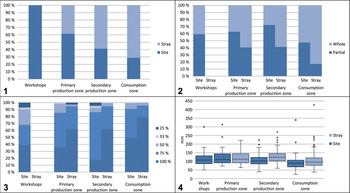
Russian Karelian tools are indeed ostentatious objects, with highly polished, geometric, streaky greenish surfaces. Specimens found as stray finds, which are sometimes interpreted as deposits or offerings (see Johanson Reference Johanson2006), tend to be larger, less fragmented and demonstrate higher quality grinding and polishing than specimens recovered from settlements and workshops. These special properties also seem to increase with distance from the extraction and primary production area (Figure 8). Items originally deposited in watery contexts are often of particularly high quality. This indicates their (ritual) significance (Nordqvist et al. Reference Nordqvist, Herva and Sandell2019) and is paralleled in the deposition practices of many prehistoric European axe traditions (Bradley & Edmonds Reference Bradley and Edmonds1993: 204; Pétrequin et al. Reference Pétrequin, Kerig and Shennan2015: 92). Thus, the spread of Russian Karelian artefacts was at least partly connected to their role in ritual enactments within social and symbolic environments. At the same time, the production of less high quality specimens that exhibit use-wear suggests that the uses and meanings of Russian Karelian artefacts were as complex as the networks that distributed them.
Properties of Russian Karelian artefacts found in different zones (see Figure 7 for explanation): 1) ratio of on-site to stray finds (n = 1268); 2) ratio of complete to broken items (n = 1268); 3) degree of ground surface (n = 1167); 4) variation in specimen length (n = 736) (figure by K. Nordqvist).

The Russian Karelian industry falls within a period of supposedly greater sedentism and increasing settlement sizes in north-eastern Europe (see Mökkönen Reference Mökkönen2011). On the Northern Ostrobothnian seacoast, for instance, local environmental change is thought to have stimulated development towards more socially, politically and economically complex societies (classified as transegalitarian; Nuñéz & Okkonen Reference Núñez and Okkonen2005; Costopoulos et al. Reference Costopoulos2012). Even if the environmental factors and driving forces may differ, aquatic-based subsistence and an increase in settlement density are also well documented around the freshwater Lake Onega (Zhulnikov Reference Zhulnikov2003). Indications of new practices associated with possible social changes can be proposed on the basis of Karelian archaeological material. Fofanovo XIII, for example, can be understood as a place of aggregation, feasting and exchange (cf. Núñez & Okkonen Reference Núñez and Okkonen2005: 35; Mökkönen & Nordqvist Reference Mökkönen and Nordqvist2018: 116 on Northern Ostrobothnia), on account of its non-domestic nature, the presence of numerous ‘exotic’ objects (e.g. amber, flint, copper) (Figure 5) and the highest density of asbestos-tempered pottery recorded in the entire Lake Onega area (around seven vessels/m2). Reconstructing the full complexity of the mechanisms of exchange—and the societies that it connected—solely on the basis of the distribution of Russian Karelian artefacts or the evidence from a single site, however, is insufficient. Future research must therefore undertake a much wider analysis of this dynamic period in north-eastern European prehistory.
Conclusions
The workshops of the Russian Karelian lithic industry testify to the use of sophisticated technology and the specialised, large-scale production of objects intended for exchange. The distribution of preforms indicates spatially restricted production, while that of the finished tools displays a pattern that resembles a small-world network, with objects found as far as 1000km or more from the extraction and production centre. In all these respects, the hunter-fisher-gatherers of north-eastern Europe clearly exhibit similarities with traits that are traditionally associated with Neolithic, or even Chalcolithic, agricultural societies, even though their subsistence practices were different. Although the current archaeological evidence does not suggest significant, permanent, vertical hierarchy, some emerging complexity and inequality cannot be denied.
The long duration and widespread geographical scale under consideration here increase the probability that the meanings and mechanisms involved in the production and exchange processes changed across time and space. Nevertheless, we can say with confidence that the Russian Karelian lithic industry not only aimed to manufacture everyday functional tools, but also served as a medium for communication and the construction of social and ritual relationships. These aspects, stemming from the material and other properties of the objects themselves, are key to understanding their distribution and the societies that made and used them.
Acknowledgements
The authors would like to thank Aivar Kriiska for his long-term support of our research and the two anonymous referees for their valuable comments on an earlier version of this manuscript.
Funding statement
The study was conducted under state order to the Karelian Research Centre of the Russian Academy of Sciences (Institute of Linguistics, Literature and History KRC RAS) and as part of the Helsinki University Humanities project.