





Introduction
The Southern Ocean is the last frontier for non-indigenous species (NIS) establishment, spread and disruption of native communities and ecosystems (McCarthy et al. Reference McCarthy, Peck, Hughes and Aldridge2019). It is the only ocean where almost all biota are native, and very many of those are indigenous (see biodiversity open access databases of OBIS, GBIF and SCAR-MarBIN). The polar regions are hotspots of physical climate change, and, with warming, the shallow waters are likely to become less inhospitable to invaders. Ships (Lewis et al. Reference Lewis, Hewitt, Riddle and McMinn2003, Lee & Chown Reference Lee and Chown2009, McCarthy et al. Reference McCarthy, Peck, Hughes and Aldridge2019) and floating debris, such as plastic (Barnes Reference Barnes2002), can carry fouling biota between continents, and such vectors are becoming more frequent (McCarthy et al. Reference McCarthy, Peck, Hughes and Aldridge2019, Reference McCarthy, Peck and Aldridge2022). Top of an internationally compiled NIS threat list are mytilid mussels (Hughes et al. Reference Hughes, Pescott, Peyton, Adriaens, Cottier-Cook and Key2020), and recently some were transient colonists in the shallows of the northern tip of the Antarctic Peninsula (Cárdenas et al. Reference Cárdenas, Leclerc, Bruning, Garrido, Détrée and Figueroa2020).
The Antarctic Treaty Consultative Meeting has advocated for the implementation of strong biosecurity practices to limit the likelihood of transporting terrestrial NIS to Antarctica and its surrounding archipelagos. Exchange of ballast water protocols have similarly been addressed to minimize the chances of transporting ‘warm water’ plankton or nekton into the Southern Ocean (Australia et al. 2023), but fouling of hulls, particularly thruster-ports, intakes, rudders and complex spaces, has yet to be adequately considered. The vast majority of vessel journeys between southern continents (South America, Africa and Australasia) and Antarctic waters are touristic. Thus, the scientific focus has been on the risk posed by transiting vessels. However, foulers of scientific and national operator support vessels might be more likely to be detected due to the affected vessels visiting research stations with scientists, divers and inspection devices, such as (underwater) remotely operated vehicles. There seems to be little question of opportunity of NIS transport (Barnes Reference Barnes2002, Lewis et al. Reference Lewis, Hewitt, Riddle and McMinn2003, Lee & Chown Reference Lee and Chown2009, McCarthy et al. Reference McCarthy, Peck, Hughes and Aldridge2019), but there is little information available regarding how active or viable lower-latitude, potentially invasive species might be on arrival in Antarctic waters. This matters because, unlike on land, pest invasives have rarely if ever been successfully removed once established in the sea (Giakoumi et al. Reference Giakoumi, Katsanevakis, Albano, Azzurro, Cardoso and Cebrian2019), so smothering species like mytilid mussels could prove catastrophic if they establish and invade Antarctica’s shallows (Hughes et al. Reference Hughes, Pescott, Peyton, Adriaens, Cottier-Cook and Key2020).
Methods and results
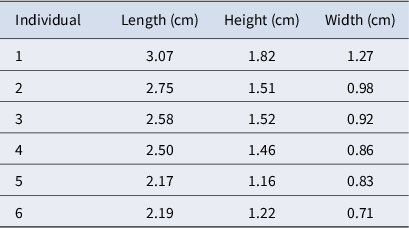
In January 2025, the RRS Sir David Attenborough underwent hull inspection by SCUBA divers at a routine visit to Rothera Research Station (67°34’S, 68°08’ W), West Antarctic Peninsula. The main area of the hull was clean of macroscopic colonization, but some water intake grills had established macrofauna, which was carefully scraped into vials and sealed (Fig. 1). These were then transported to an on-site ambient-temperature aquarium and maintained at ~0°C in water that was not returned to the sea (in case of larval release). These included five mussels identified as Mytilus cf. chilensis of various sizes/ages from 3 mm long to 3.1 cm-long mature adults (lengths, heights and widths shown in Table I).
Non-indigenous species assemblage fouling a water intake grill of a research ship located deep into near-shore Antarctic waters in January 2025. Although the anti-foul-treated hull is clean to visual inspection, the water intakes are not similarly (anti-foul) treated, as they supply drinking water. The sizes of the mussels are given in Table I.

Figure 1 Long description
Panel 1. A macro photo of four marine organisms against a black background. At the top is a dark blue-black mussel with visible growth lines. To its right is a white, conical barnacle with a central aperture. Below the barnacle is a second dark mussel oriented vertically. To the left of the bottom mussel is another white conical barnacle. Small, fibrous byssal threads are visible extending from the mussels.
Panel 2. An underwater photo of a ship's hull and water intake. On the left is the smooth, orange-painted surface of the hull. To the right is a recessed metal grill consisting of a vertical central support and horizontal slats. A large hexagonal bolt head is visible at the top of the vertical support. Numerous small, white and dark organisms, matching the mussels and barnacles from the first panel, are densely packed within the crevices of the grill and along the undersides of the horizontal slats.
Morphometrics of live, adult, non-indigenous invasive Mytilus cf. chilensis recovered from the hull of the RRS Sir David Attenborough while docked at Rothera Research Station, Antarctica.

Table I. Long description
The table consists of four columns: Individual, Length (cm), Height (cm), and Width (cm). There are six rows of data representing six different specimens.
* Individual 1: Length 3.07, Height 1.82, Width 1.27.
* Individual 2: Length 2.75, Height 1.51, Width 0.98.
* Individual 3: Length 2.58, Height 1.52, Width 0.92.
* Individual 4: Length 2.50, Height 1.46, Width 0.86.
* Individual 5: Length 2.17, Height 1.16, Width 0.83.
* Individual 6: Length 2.19, Height 1.22, Width 0.71.
Also present were two adults of the balanamorph barnacle Amphibalanus improvisus. Of note and concern were that both of these NIS were not just alive but active (drawing a siphon current and trying to feed) at ambient typical summer sea surface temperatures of the Southern Ocean. On the day of discovery and collection, the air temperature at sea level was 1.1°C and the sea temperature at 21 m depth was −0.36°C. All specimens were fixed in 96% ethanol.
Discussion
Eradication of NIS from the sub-Antarctic islands is very costly in terms of time and effort, but at least some removals have been achieved. Some countries have established good terrestrial biosecurity practice, but marine protocols vary considerably (from very little action to inspections every season) and may have a much more considerable time/expense cost element for their implementation. The Protocol on Environmental Protection to the Antarctic Treaty prohibits the introduction of NIS to the Treaty area without a permit from a national authority. Nevertheless, some NIS macroalgae and a gymnolaemate bryozoan Membranipora membranacea have been reported to have travelled to Deception Island (Avila et al. Reference Avila, Angulo-Preckler, Martín-Martín, Figuerola, Griffiths and Waller2020). Around Antarctica, a live mussel was first found at one of the most northerly (and warmer water) locations of South Georgia (Ralph et al. Reference Ralph, Maxwell, Everson and Hall1976), but it did not persist. M. cf. platensis briefly arrived at King George Island (Cárdenas et al. Reference Cárdenas, Leclerc, Bruning, Garrido, Détrée and Figueroa2020), also towards the northern tip of the Antarctic Peninsula. Such mussels, as reported here, have now not only travelled to 68°S alive but appeared to be active and feeding at ambient Southern Ocean temperatures (−0.36°C water temperature).
Regular and increasing ice scour in Antarctica’s shallows (Barnes et al. Reference Barnes, Morley, Mathews, Clement and Peck2024) probably means that balanamorph barnacles such as A. improvisus (reported here) might struggle to persist on Antarctic shores. Scouring of local shallow sites there by icebergs is annual. However, as long as the whole life cycle of M. cf. chilensis could cope with freezing temperatures and seasonally low food availability, they might prove major pests because they can establish in deeper depths at which ice scour is less regular, yet right underneath the docking points of vessels.
Worrying aspects of both of the NIS reported here are that they are mass spawners of pelagic larvae. Thus, even unattachment from a ship surface is not required to establish populations in the surrounding shallows, merely larval release (assuming larval viability). However, there was no evidence that either species spawned while at Rothera Research Station. Of further concern, these NIS might not have any natural predators in an establishment scenario. This is because they are both heavily armoured with thick calcareous shells, and this is the only environment on Earth with almost no durophagus (crushing) predators (Aronson et al. Reference Aronson, Frederich, Price and Thatje2015). By chance, this particular near miss was detected at an Antarctic research station with year-round marine science and SCUBA diving facilities, enabling regular monitoring of life in the shallows where detection of invading species might be possible.
Following the detection of these NIS, the vessel was thoroughly cleaned by marine divers outside the Antarctic Treaty area so that no macroscopic fouling was evident any longer. That multiple, high-threat NIS could travel to an Antarctic research station and be active at ambient temperatures, in a climate change hotspot, is a near miss that could have led to the establishment of difficult-to-remove pest species. Such an event will hopefully serve as an urgent warning that the southern polar community (scientific, national operator and touristic) must not take marine biosecurity for granted and must implement effective inspection and cleaning protocols.
Author contributions
David K.A. Barnes conceived the study, helped by Kevin Hughes, Sean McLoughlin, Hamish Rodger and Shea Gilkinson. The specimens were collected by Sean McLoughlin, Hamish Rodger and Shea Gilkinson, and they were identified by David K.A. Barnes. All authors drafted and reviewed the manuscript.
Competing interests
The authors declare none.


 Open access

