Introduction
Antarctica - one of the harshest environments in the world - is characterized by extremely low temperatures, a lack of liquid water, high ultraviolet incidence, severe winds and low nutrient availability (Vero et al. Reference Vero, Garmendia, Martinez Silveira, Cavello, Wisniewski and Castro-Sowinski2019). Nevertheless, the continent is teeming with organisms of all three domains of life: indeed, microorganisms have been detected in every ice-free Antarctic habitat, with bacteria as the dominant group (Lo Giudice & Fani Reference Lo Giudice and Fani2015). Recent studies have revealed that yeasts are also widespread in these habitats, albeit in lower numbers (Vishniac Reference Vishniac, Péter and Rosa2006, Shivaji & Prasad Reference Shivaji, Prasad, Satyanarayana and Kunze2009, Vero et al. Reference Vero, Garmendia, Martinez Silveira, Cavello, Wisniewski and Castro-Sowinski2019). According to their optimal and maximal growth temperatures, two kinds of yeasts have been isolated from these cold environments: psychrophilic and psychrotolerant. The maximal growth temperature of psychrophilic microorganisms is < 20°C, and their optimum growth temperature ranges from 10°C to 15°C. Organisms that are able to grow at 0°C but whose optimum growth temperature ranges from 20°C to 40°C are defined as psychrotolerant (Raspor & Zupan Reference Raspor, Zupan, Péter and Rosa2006). Both psychrophilic and psychrotolerant organisms have evolved and thrived under these extreme conditions, adapting their molecular machinery by producing membrane lipids that are more fluid, storing cryoprotective molecules, manufacturing antifreeze proteins and producing cold-resistant enzymes (Collins & Margesin Reference Collins and Margesin2019). Because of their activity at low temperatures, these enzymes are useful in many industrial processes by enabling energy savings in biocatalytic reactions (Białkowska & Turkiewicz Reference Białkowska, Turkiewicz, Buzzini and Margesin2014). Furthermore, by using such cold-tolerant biocatalysts, processes can convert heat-sensitive substrates as well as avoid undesirable reactions that might otherwise occur if higher temperatures were to be used. For these reasons, the study of cold-adapted strains that can produce cold-active enzymes has increased considerably (Białkowska & Turkiewicz Reference Białkowska, Turkiewicz, Buzzini and Margesin2014). Few reports dealing with the search for new enzymes of industrial interest produced by cold-adapted bacteria, yeasts and filamentous fungi have been published (Lo Giudice & Fani Reference Lo Giudice and Fani2015, Carrasco et al. Reference Carrasco, Villarreal, Barahona, Alcaíno, Cifuentes and Baeza2016, Martinez et al. Reference Martinez, Cavello, Garmendia, Rufo, Cavalitto and Vero2016, Martorell et al. Reference Martorell, Ruberto, Fernández, De Figueroa and Mac Cormack2019). Enzymes are widely used in industrial processes, such as amylases in the detergent field, biopulping and environmental bioremediation, cellulases in the textile and detergent industries, pectinases in juice, wine-making and the paper industry, proteases in the detergent industry, lipases in the detergent field, inulinases for producing fructose and fructooligosaccharides and β-glucosidases in the wine-making industry (Adapa et al. Reference Adapa, Ramya, Pulicherla and Rao2014, Białkowska & Turkiewicz Reference Białkowska, Turkiewicz, Buzzini and Margesin2014, de Ovalle et al. Reference de Ovalle, Cavello, Brena, Cavalitto and González-Pombo2018, Cavello et al. Reference Cavello, Bezus, Martinez, Garmendia, Vero and Cavalitto2019).
The biotechnological use of dye-hydrolytic enzymes produced by microorganisms for decolourizing textile wastewater is a new process that has been only recently explored (Solís et al. Reference Solís, Solís, Pérez, Manjarrez and Flores2012). In particular, cold-adapted yeasts seem to be the most promising potential means to achieve a greener and more economical alternative treatment for reducing polluting textile dye effluents (Rovati et al. Reference Rovati, Pajot, Ruberto, Mac Cormack and Figueroa2013). The textile industry is regarded as one of the most polluting of all: between 2% and 20% of the synthetic dyes used in textile dyeing are spilled into watercourses. Most dyes are known to be degradation-recalcitrant compounds, being difficult to decompose through the usual methods. Over the last few decades, an increasing interest has developed in finding ways to hydrolyse dye compounds in order to reduce the environmental impact and toxicity of these wastewaters. Many reports have been published on the toxicity and mutagenic effects of such pollutants. Moreover, the presence of those compounds interferes with light penetration in water, thus altering photosynthetic rates and impacting negatively on aquatic organisms (Solís et al. Reference Solís, Solís, Pérez, Manjarrez and Flores2012).
Microorganisms can decolourize dyes through two different mechanisms, or through a combination of the two. A microorganism's biosorption capacity can be generally attributed to its cell wall's chemical composition, the structure of which defines the affinity to azo dyes. Enzymatic degradation of dyes involves cleaving chemical bonds and can occur through the action of different enzymes, such as reductases, peroxidases and laccases (Kaushik & Malik Reference Kaushik and Malik2009, Solís et al. Reference Solís, Solís, Pérez, Manjarrez and Flores2012).
In the work reported here, we describe the isolation, identification and characterization of yeasts sampled from King George Island (in the Maritime Antarctic) with respect to their ability to produce extracellular enzymes of industrial interest and for the reduction of the azo-dye pollution present in textile effluents.
Materials and methods
Sampling sites
Samples were collected from different sites in the Fildes Peninsula (Antarctic Specially Protected Area (ASPA) 125), King George Island (62°11′4″S; 58°54′W), located 120 km off the coast of the Antarctic Peninsula in the Southern Ocean (XXXII Antarkos Expedition).
Four collection sites were selected (Fig. S1): Collins Glacier (62°11′05.8″S, 58°52′49.7″W), Half Three Point (62°12′19.8″S, 58°58′56.5″W), Fossil Hill (62°13′40.3″S, 58°56′53.8″W) and Drake Bay (62°10′28.2″S, 58°59′01.6″W). These sites were sampled during the Southern Hemisphere autumn season in May 2016. Different samples were gathered: soil was collected from depths of 0 and 10 cm with a sterile spatula, as well as sediments, lichens, bird feathers and penguin guano with sterile clamps for transportation in sterile 50 ml conical tubes. Seawater was scooped directly into sterile bottles for storage (Table SI). All of the samples were kept at 4°C until processing.
Sample processing and yeast isolation
In order to isolate the cold-adapted yeasts, 1 g of each solid sample was suspended in 9 ml of sterile physiological saline and vigorously shaken for 10 min. After decanting the coarse material, 100 μl of the resulting suspension and a respective 1/10 dilution were spread on plates containing dichloran rose-Bengal chloramphenicol agar (DRBCA; Merck, Germany).
Of the water samples, 2 l were filtered aseptically through 0.22 μm membranes (Millipore, USA), and the filters were placed on DRBCA medium thereafter. The plates were incubated at 4°C and 20°C until growth was detected.
Every yeast colony obtained was examined both macroscopically and microscopically. From each sample, those that displayed a different morphotype were selected and isolated by streaking onto potato dextrose agar (Oxoid, UK) plates. Yeasts that grew at 4°C but not at 20°C were classified as psychrophilic yeasts. Pure cultures of all of the isolates were cryopreserved at -80°C in 20% (v/v) aqueous glycerol by freeze-drying and then stored in the Microbiological Culture Collection of the Centro de Investigación y Desarrollo en Fermentaciones Industriales (CINDEFI-CONICET) Institute, and in the Cátedra de Microbiología, Facultad de Química, Udelar Culture Collection (Montevideo, Uruguay).
Yeast identification
A sequence analysis of the D1/D2 variable domains at the 5´ end of the large rRNA subunit gene was carried out to identify the yeast isolates. DNA was extracted as described by Cavello et al. (Reference Cavello, Bezus, Martinez, Garmendia, Vero and Cavalitto2019). In the polymerase chain reaction (PCR) process, the primers used - ITS1 (5´-TCC GTA GGT GAA CCT TGC GG-3´) and D2R (5´-GGT CCG TGT TTC AAG ACG-3´) - covered both the ITS1-ITS2 and the D1/D2 regions. The PCR process was carried out in 25 μl of a reaction mixture containing 1X PCR Buffer (Bioron Life Science), 0.5 μM of each primer, 0.32 mM deoxynucleoside triphosphates (dNTPs; Bioline), 0.02 U of Taq polymerase (Bioron Life Science) and 20 ng of DNA. The thermal profile used was 96°C for 2 min, followed by 35 cycles of 96°C for 30 s, 51°C for 45 s, 72°C for 120 s and a final extension step at 72°C for 7 min. The PCR products were sequenced in both directions by Macrogen (Macrogen, Inc., Korea).
The sequences were aligned through the use of MEGA 6 software, visually corrected and compared with the databases of the National Center for Biotechnology Information (NCBI) by means of the BLAST program (https://blast.ncbi.nlm.nih.gov). In this work, the species resolution was based on the criterion that strains of a species that diverged in D1/D2 sequences by no more than 1% (Kurtzman Reference Kurtzman2014). Sugar assimilation tests and phylogenetic analyses were performed to confirm the identification, where the latter analyses of the sequences obtained from the isolates were conducted in MEGA 6. Phylogenetic trees were obtained using the maximum likelihood method based on the Kimura-2 parameter model. All of the positions containing alignment gaps and missing data were removed in pairwise sequence comparisons (the pairwise deletion option). The stability of the clades was assessed with 1000 bootstrap replications (Tamura et al. Reference Tamura, Stecher, Peterson, Filipski and Kumar2013).
For the isolates belonging to the Mrakia genus, the ability to assimilate maltose or melezitose was assessed (Fell Reference Fell2011). A total of 5 ml of yeast nitrogen base broth supplemented with 10 g l-1 of each of the abovementioned carbohydrates were inoculated with actively growing yeasts. Control experiments with glucose and without any sugar were performed. Tubes were incubated at 4°C and shaken at 150 rpm for 15 days. Growth was visually assessed. The D1/D2 sequences of the isolates were deposited at the NCBI with the corresponding accession numbers listed in Table I.
Identification and accession numbers of yeasts isolated from King George Island, Antarctica.

Diversity indices
Diversity, richness and dominance of culturable yeasts were quantified using the Shannon-Wiener, Margalef and Simpson indices, respectively, with the aid of PAST software, version 3.11 (Hammer et al. Reference Hammer, Harper and Ryan2001). Dominance was determined by the 1 - Simpson index (Shah & Pandit Reference Shah and Pandit2013, Pelissari et al. Reference Pelissari, Filho, Ebling, Sanquetta, Cysneiros and Corte2018).
Effect of temperature on the growth of yeast isolates
In order to assess yeast growth capability at different temperatures, isolates were streaked for incubation on plates containing yeast extract-peptone-dextrose medium (YPD; 5 g l-1 bactopeptone, 5 g l-1 yeast extract, 20 g l-1 glucose, 20 g l-1 agar) at 4°C, 15°C, 25°C and 30°C. The plates were monitored daily by visual inspection for 2 weeks. Yeasts that grew at > 25°C were classified as psychrotolerant, while those that did not grow at > 25°C but did grow at 4°C and up to 15°C were classified as psychrophilic (Raspor & Zupan Reference Raspor, Zupan, Péter and Rosa2006).
NaCl and metal tolerance
The effect of different concentrations of NaCl on growth was assessed with agar plates of YPD supplemented with 0.5, 1.0, 1.5, 2.0, 2.5, 3.0 and 3.5 M NaCl. The plates were streaked with actively growing yeasts and incubated at 4°C or 20°C, according to the psychrophilic or psychrotolerant nature of each isolate. An appropriate control experiment without any NaCl was performed. After 1 week, growth was visually recorded (Cavello et al. Reference Cavello, Bezus, Martinez, Garmendia, Vero and Cavalitto2019).
Heavy metal tolerance was assessed with yeast nitrogen base broth supplemented with 10 g l-1 glucose plus each of the following metal ions at their respective concentrations: Ni2+, 0.9 g l-1; Zn2+, 7.0 g l-1; Li+, 6.5 g l-1; Cd2+, 6.0 g l-1; and Cu2+, 1.5 g l-1. Tubes were incubated at 4°C or 20°C with shaking at 150 rpm and were visually monitored daily for 1 or 2 weeks, according to the psychrotolerant or psychrophilic nature of the yeasts. Control assays without either metals or a yeast inoculation were also performed. When the incubation time had elapsed, the final state of growth was recorded visually (Russo et al. Reference Russo, Libkind, Giraudo and Delgado2016).
Hydrolytic enzyme screening
The production of several extracellular enzymatic activities (amylases, cellulases, esterases, proteases, pectinases, inulinases, β-glucosidases and xylanases) was assessed on solid media in qualitative activity tests as described in Cavello et al. (Reference Cavello, Bezus, Martinez, Garmendia, Vero and Cavalitto2019). Psychrophilic yeasts were incubated for up 2 weeks at 4 °C, whereas psychrotolerant yeasts were incubated for up to only 1 week at 4°C and 20°C.
For the detection of amylase activity, cells were grown in a medium containing 10 g l-1 soluble starch (Mallinckrodt Baker, Inc., Ireland), 2 g l-1 yeast extract, 5 g l-1 peptone, 0.5 g l-1 MgSO4, 0.5 g l-1 NaCl, 0.15 g l-1 CaCl2 and 20 g l-1 agar. After incubation, the plates were flooded with Lugol's iodine solution to detect the development of clear halos around those colonies producing amylolytic activity over a dark background (Cavello et al. Reference Cavello, Bezus, Martinez, Garmendia, Vero and Cavalitto2019).
Cellulase activity screening was carried out on a carboxymethylcellulose agar medium containing carboxymethylcellulose 2.0 g l-1 sodium salt (Mallinckrodt Baker, Inc.), 2.0 g l-1 NaNO3, 1.0 g l-1 K2HPO4, 0.5 g l-1 MgSO4⋅7H2O, 0.5 g l-1 KCl, 0.2 g l-1 peptone and 17.0 g l-1 agar. After incubation, the plates were flooded with Congo Red solution (1 g l-1) and subsequently destained with 1 M NaCl. The colonies that expressed cellulases displayed a clear halo over a red background (Cavello et al. Reference Cavello, Bezus, Martinez, Garmendia, Vero and Cavalitto2019).
The ability of the isolates to degrade long-chain esters (esterase activity) was assessed on sorbitan monooleate (Tween 80, Sigma-Aldrich, USA). Yeasts were cultured on a Tween 80 medium agar prepared with 10 g l-1 peptone, 5 g l-1 NaCl, 0.1 g l-1 CaCl2⋅2H2O, 10 ml l-1 Tween 80 and 20 g l-1 agar (pH 7.0). The development of a clear zone around a colony due to the complete degradation of the substrate was indicative of the presence of esterase activity (Cavello et al. Reference Cavello, Bezus, Martinez, Garmendia, Vero and Cavalitto2019).
Proteolytic activity was assessed with a skimmed milk-agar medium prepared with 10 g l-1 skimmed milk and 20 g l-1 agar (pH 6.6). After incubation, a positive reaction was detected as a clear zone around the colony over the opaque medium (Cavello et al. Reference Cavello, Bezus, Martinez, Garmendia, Vero and Cavalitto2019).
For the detection of pectinase activity, a selective medium prepared with 10 g l-1 citric pectin (Sigma-Aldrich), 1.4 g l-1 (NH4)2SO4, 2.0 g l-1 K2HPO4, 0.2 g l-1 MgSO4⋅7H2O, 1 ml l-1 solution A (5 mg l-1 FeSO4⋅H2O, 1.6 mg l-1 MnSO4⋅H2O, 2 mg l-1 CoCl2) and 20 g l-1 agar was used. Pectinase-producing colonies were screened and selected by flooding the solid medium plates with Lugol's iodine solution (Cavello et al. Reference Cavello, Bezus, Martinez, Garmendia, Vero and Cavalitto2019).
Production of extracellular inulinases was detected with an inulin-agar medium prepared with 10.0 g l-1 inulin, 5.0 g l-1 peptone, 2.0 g l-1 yeast extract, 0.5 g l-1 MgSO4⋅7H2O, 0.5 g l-1 NaCl, 15.0 g l-1 CaCl2 and 20.0 g l-1 agar. After incubation, the plates were flooded with Lugol's iodine solution. The development of a pale yellow zone around a colony was indicative of inulin hydrolysis (Cavello et al. Reference Cavello, Bezus, Martinez, Garmendia, Vero and Cavalitto2019).
The following esculin-glycerol-agar medium was used to determine β-glucosidase activity: 1.0 g l-1 esculin, 0.3 g l-1 ferric chloride, 1.0 g l-1 casein hydrolysate, 25.0 g l-1 yeast extract, 8.0 ml l-1 glycerol and 20.0 g l-1 agar. The development of a dark brown halo around a colony was indicative of β-glucosidase production (Cavello et al. Reference Cavello, Bezus, Martinez, Garmendia, Vero and Cavalitto2019).
A xylan-agar medium prepared with 10.0 g l-1 xylan from birchwood (Sigma-Aldrich), 5.0 g l-1 yeast extract, 5.0 g l-1 peptone, 1.0 g l-1 K2HPO4, 0.2 g l-1 MgSO4⋅7H2O and 20.0 g l-1 agar was used to detect the xylanase producers. Xylanase-producing colonies were detected by the development of a clear halo around the colony after the plates were flooded with Congo Red solution (1.0 g l-1) and subsequently destained with 1 M NaCl (Cavello et al. Reference Cavello, Bezus, Martinez, Garmendia, Vero and Cavalitto2019).
Decolourization screening on solid media
We assessed the isolates' ability to biodegrade or bioaccumulate various textile dyes on Petri dishes with 20 ml of normal decolourization medium (NDM) prepared with 20.0 g l-1 glucose, 2.5 g l-1 (NH4)2SO4, 2.5 g l-1 yeast extract, 5.0 g l-1 KH2PO4, 0.5 g l-1 MgSO4, 0.13 g l-1 CaCl2 and 20.0 g l-1 agar, supplemented with 0.1 g l-1 (100 ppm) of 0.22 μm filter-sterilized dye solution (Martorell et al. Reference Martorell, Pajot and de Figueroa2012). The following textile dyes were used in this work: Reactive Orange 16, Reactive Black 5 and Reactive Blue 19 (Alconic SRL, Argentina).
Plates were inoculated with actively growing yeasts and incubated for 10 days at 4°C or for 3 days at 20°C for psychrophilic and psychrotolerant yeasts, respectively. Control plates without any yeast inoculation were incubated under both conditions to rule out abiotic decolourization, and growth control plates without any dye were also included. The colour removal from the media and the colour of the developed colonies were recorded by visual inspection. Yeasts that were able to remove the dye from the medium and kept their previous colour were classified as biodegrading yeasts, while those that adopted the colour of the dye present in the medium were classified as bioaccumulators.
Results
Yeast isolation, identification and culturable diversity
In order to isolate cold-adapted yeasts, 13 samples from pristine sites on King George Island were collected and processed. A total of 32 yeast morphotypes were recovered as pure cultures. Among these specimens, only eight were isolated from water samples. When the yeast communities were analysed according to diversity, richness and dominance, moderate diversity and richness (Shannon index = 1.8 and Margalef = 2.0) and low dominance (Simpson = 0.96, dominance = 0.04) were determined.
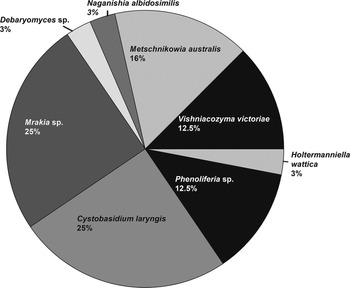
Figure 1 summarizes the distribution of genera among the 32 isolates. The Basidiomycota represented 81%, comprising six different genera: Naganishia, Holtermaniella, Vishniacozyma, Phenoliferia, Mrakia and Cystobasidium. Yeasts representing the Ascomycota phylum, constituting 19% (n = 6), were members of the Metschnikowia and Debaryomyces genera.
Biodiversity of yeasts isolated from Antarctic samples. The pie chart summarizes the percentage distribution of the genera isolated from King George Island, Antarctica.

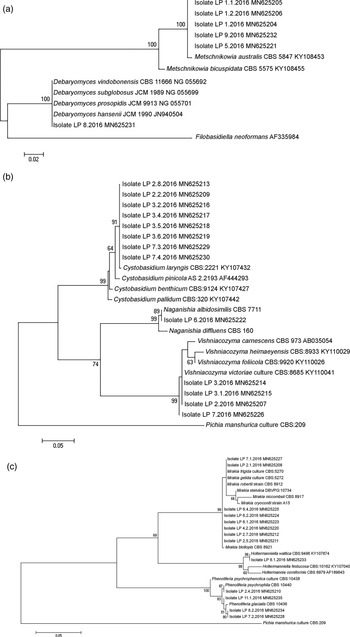
Figure 2 shows the phylogenetic trees depicting the sequence relatedness of all isolates and those corresponding to the most closely related type strains retrieved from GenBank. Only 19 isolates could be identified at the species level by D1/D2 sequence analyses. The rest of the isolates had D1/D2 sequences that differed by < 1% from those corresponding to type strains of more than one species within a genus. According to the criteria adopted, those isolates could not be assigned to only one species by this analysis. Eight (25% of the total number of isolates) were identified as members of the Mrakia genus. For further characterization, carbohydrate assimilation tests were performed in order to differentiate the Mrakia isolates. All but one assimilated maltose and melezitose; only Mrakia sp. LP 6.2.2016 did not. These results enable us to state that the isolate LP 6.2.2016 belonged to Mrakia frigida and that the rest of the isolates could be assigned to Mrakia gelida, Mrakia blollopis or Mrakia robertii. The isolate LP 2.1.2016 also evidenced high homology with the recently reported Mrakia stelviica strain DBVPG:10734. In the phylogenetic tree (Fig. 2c), the isolates LP 2.5.2016, 6.4.2016, 6.2.2016, 6.1.2016, 4.2.2016 and 2.7.2016 formed a cluster with M. blollopis CBS 8921 (type strain), remaining apart from the rest of the Mrakia species. This separation implies that those six isolates were phylogenetically more closely related to M. blollopis than to M. gelida and M. robertii.
Phylogenetic placement of Antarctic a. Ascomycetous, b. psychrotolerant Basidiomycetous and c. psychrophilic Basidiomycetous yeast isolates obtained by maximum likelihood (distance Kimura-2 parameter method) of the D1/D2 domains of the 26S rRNA gene. Bootstrap values ≥ 50 (1000 tree interactions) are indicated at the nodes.

Effect of temperature, salt concentration and the presence of metal ions on the growth of the yeast isolates
All of the isolates were able to grow at 4°C. Thirteen (41%) were classified as psychrophiles due to their ability to grow at 15°C, while the rest (59%) were classified as psychrotolerant. Among this latter group, 53% (n = 10) grew at 30°C on YPD agar (Table II).
Temperature of growth, maximum NaCl tolerance and metal ion tolerance of yeasts isolated from King George Island, Antarctica.

+ = positive growth; - = no growth.
In studies on the effect of salt concentration on growth, we determined that every psychrotolerant yeast grew on medium with 1 M NaCl, whereas among the psychrophilic group, only Holtermanniella wattica LP 8.1.2016 displayed this ability (Table II). Among all of the isolates, 31% (n = 10) grew on a medium containing 2.0 M NaCl. Vishniacozyma victoriae LP 3.2016 grew on a medium of up to 3.0 M NaCl, while Metschnikowia australis LP 5.2016, V. victoriae LP 7.2016 and Debaryomyces sp. LP 8.2016 replicated in the presence of 3.5 M NaCl.
Most yeasts grew on medium supplemented with Ni2+ (75%, n = 24) or Li+ (88%, n = 28), whereas Zn2+ or Cd2+ were tolerated by fewer isolates (56% and 44% of the yeasts, respectively; Table II). With Cu2+, only a small number exhibited tolerance (9.4%, n = 3). None of the isolates grew in the presence of every one the metal ions tested, but 28% (n = 9) manifested tolerance to four of the five metals assayed: those tolerant species belonged to the Phenoliferia, Vishniacozyma, Metschnikowia, Mrakia and Cystobasidium genera.
Extracellular enzymatic activity profile
Table III lists the yeasts' extracellular enzymatic activity profiles (also cf. Fig. S2a–c). The results for psychrotolerant and psychrophilic microorganisms are displayed separately. Among the psychrotolerant yeasts, 68% evidenced at least one extracellular enzymatic activity, whereas all psychrophilic yeasts produced at least two extracellular enzymes and > 80% produced three or more. In both groups, β-glucosidase was the extracellular enzyme most frequently found, having been expressed by 69% of the psychrophilic yeasts (at 4°C) and by 53% of the psychrotolerant isolates (at 20°C). When the latter were incubated at 4°C, only 37% expressed that enzyme.
Extracellular enzyme profile of yeasts isolated from samples from King George Island. Psychrotolerant and psychrophilic yeasts were grouped separately. Psychrotolerant yeasts were tested at 4°C and 20°C. Psychrophilic yeasts were tested at 4°C.

+++ = strong activity; ++ = substantial activity; + = weak activity; - = no activity; Prot = protease; Est = esterase; Amy = amylase; Cel = cellulase; Inu = inulinase; Pec = pectinase; Xyl = xylanase; β-gluc = β-glucosidase.
Inulolytic, pectinolytic and amylolytic activities were less frequent, having been produced by 23–38% of the psychrophiles and by 10–15% of the psychrotolerant isolates. None of the psychrotolerant yeasts produced proteases at either temperature studied. Protease production by psychrophilic yeasts, however, was recorded in 85% of the group (n = 11). Conversely, xylanase activity could not be detected in the psychrophilic group, but was present in 16% of the psychrotolerant yeasts.
Every member of the Vishniacozyma genus expressed two or more extracellular enzymes. LP 3.1.2016 was the only isolate that produced six out of the eight enzymes tested at 20°C. Of the psychrophilic yeasts, every isolate produced at least two extracellular enzymes. Certain isolates of Mrakia (LP 2.7.2016 and LP 7.1.2016) and Phenoliferia (LP 2.4.2016 and LP 7.2.2016) expressed five out of the eight enzymes studied.
Decolourization screening on solid media
The decolourization potential of various textile dyes by the yeast isolates under study was assessed at 4°C and 20°C for the psychrotolerant microorganisms and at only 4°C for the psychrophiles. Three dyes were used: Reactive Orange 16, Reactive Black 5 (both classified as azo dyes) and Reactive Blue 16 (an anthraquinone dye). Isolates of all of the species among the psychrophilic and psychrotolerant groups decolourized at least one of the dyes used (Table IV). At 20°C, all psychrotolerant yeasts decolourized the media supplemented with Reactive Blue 19 and Reactive Black 5. Of the psychrotolerant yeasts, 84% decolourized a NDM supplemented with Reactive Orange 16. At 4°C, > 60% of the psychrotolerant group decolourized the textile dyes assayed: Reactive Black 5 was the most frequently decolourized dye (Table IV & Fig. S2d).
Textile dye decolourization (D) and bioaccumulation (B) abilities of yeasts isolated from King George Island, Antarctica. Normal decolourization medium (NDM) was supplemented with different textile dyes (100 ppm, Alconic SRL). Psychrotolerant and psychrophilic yeasts were grouped separately. Psychrotolerant yeasts were tested at 4°C and 20°C. Psychrophilic yeasts were tested at 4°C.

+ = positive decolourization of the medium and a bioaccumulation in the yeast biomass; - = no decolourization or bioaccumulation.
At both temperatures, 57% of the microorganisms decolourized all of the dyes tested. Almost all Cystobasidium laryngis (n = 8) not only decolourized a NDM supplemented with Reactive Orange 16 and Reactive Black 5, but also degraded those dyes: these isolates did not accumulate the dyes in their biomass. As for Reactive Blue 19, bioaccumulation was evident, but only a few isolates were able to remove and degrade the dye at 4°C.
Every psychrophilic isolate decolourized the NDM supplemented with Reactive Black 5; 92% removed the azo dye by degrading it. Reactive Orange 16 was removed from NDM by 92% of the isolates and was degraded by 75% of those yeasts. The number of psychrophilic isolates that decolourized the NDM supplemented with Reactive Blue 19 was higher than the corresponding number among the psychrotolerants. The main mechanism by which both types of microorganisms removed this dye was through accumulation (79% at 20°C for the psychrotolerants and 54% at 4°C for the psychrophiles).
Of the Mrakia genus, 87% generated a decolourization halo around the colony via different mechanisms (i.e. bioaccumulation or biodegradation), with 75% degrading Reactive Orange 16 and 87% degrading Reactive Black 5, although none degraded Reactive Blue 19.
Discussion
King George Island, located in the Maritime Antarctic, is characterized by its cold temperatures, where the average annual temperature is -2°C, reaching -28°C during the winter seasons (Francelino et al. Reference Francelino, Schaefer, Simas, Filho, de Souza and da Costa2011). In May 2016, we collected samples of terrestrial and aquatic yeasts from different areas of the island including both psychrotolerant and psychrophilic isolates. Almost 41% of the total number of yeasts belonged to the psychrophilic group. The high ratio of psychrophilic isolates in this work can be attributed to the season in which the expedition took place. Most of the previous studies on yeast diversity in Antarctica (in which a predominance of psychrotolerant strains was reported) were based on the analyses of samples collected in summer (Rovati et al. Reference Rovati, Pajot, Ruberto, Mac Cormack and Figueroa2013, Carrasco et al. Reference Carrasco, Villarreal, Barahona, Alcaíno, Cifuentes and Baeza2016, Martinez et al. Reference Martinez, Cavello, Garmendia, Rufo, Cavalitto and Vero2016, Fernández et al. Reference Fernández, Martorell, Blaser, Ruberto, de Figueroa and Mac Cormack2017, Martorell et al. Reference Martorell, Ruberto, Fernández, De Figueroa and Mac Cormack2019). In agreement with this observation, Robinson (Reference Robinson2001) stated that the seasonal increase in temperatures favours the dominance of psychrotolerant microorganisms during the spring and summer, whereas the population of psychrophiles seems more favoured during the colder seasons.
Thirty-two yeast isolates representing eight genera (Naganishia, Holtermaniella, Vishniacozyma, Phenoliferia, Mrakia, Cystobasidium, Metschnikowia and Debaryomyces) had been isolated from samples collected during an autumn expedition to Antarctica in 2016. Almost 60% of the isolates could be identified to the species level. Basidiomycetous yeasts were prevalent, having been detected in 81% of the isolates, in agreement with previous reports stating that Basidiomycetous yeasts were better adapted to this type of habitat, in contrast to the Ascomycetous yeasts (Vaz et al. Reference Vaz, Rosa, Vieira, de Garcia, Brandão and Teixeira2011, Martinez et al. Reference Martinez, Cavello, Garmendia, Rufo, Cavalitto and Vero2016, Vero et al. Reference Vero, Garmendia, Martinez Silveira, Cavello, Wisniewski and Castro-Sowinski2019). Among Basidiomycetous taxa, the most frequently isolated genera were Cystobasidium and Mrakia, followed by Vishniacozyma and Phenoliferia. Even though Vero et al. (Reference Vero, Garmendia, Martinez Silveira, Cavello, Wisniewski and Castro-Sowinski2019) reported that Naganishia and Vishniacozyma were two of the predominant Basidiomycetous genera of Antarctic environments, in the present survey Cystobasidium and Mrakia represented 50% of the total number of isolates and 60% of the Basidiomycetous isolates.
The molecular genetic techniques applied in this study did not enable us to identify Mrakia isolates down to the species level. As M. gelida and M. frigida are known to have identical D1/D2 sequences, those two species cannot be distinguished by comparing this region (Scorzetti et al. Reference Scorzetti, Fell, Fonseca and Statzell-Tallman2002, Fell Reference Fell2011). Physiological tests carried out in this survey indicated that among the Mrakia genus isolates, only LP 6.2.2016 did not metabolize maltose and melezitose. Therefore, that isolate could be identified as M. frigida (Thomas-Hall et al. Reference Thomas-Hall, Turchetti, Buzzini, Branda, Boekhout and Theelen2010, Fell Reference Fell2011, Tsuji et al. Reference Tsuji, Tanabe, Vincent and Uchida2018). The rest of the Mrakia clade assimilated maltose and melezitose, which suggests that those members might belong to M. gelida, M. blollopis or M. robertii (or M. stelviica in the example of isolate LP 2.1.2016): they were thus referred to as Mrakia sp. Turchetti et al. (Reference Turchetti, Sannino, Mezzasoma, Zucconi, Onofri and Buzzini2020) emphasized the necessity of undertaking a more in-depth study of the Mrakia genera phylogeny along with the need for additional gene sequencing to achieve a correct identification of all of the known strains.
Species of the Mrakia genus had been previously identified in Antarctic soil (Tsuji et al. Reference Tsuji, Yokota, Kudoh and Hoshino2015, Martinez et al. Reference Martinez, Cavello, Garmendia, Rufo, Cavalitto and Vero2016). This genus seems to be adapted to cold environments, having been also isolated from Arctic environments, from Alpine and Apennine glaciers and from the cold forest in Abashiri, Japan (Nakagawa et al. Reference Nakagawa, Nagaoka, Taniguchi, Miyaji and Tomizuka2004, Thomas-Hall et al. Reference Thomas-Hall, Turchetti, Buzzini, Branda, Boekhout and Theelen2010, Tsuji et al. Reference Tsuji, Tanabe, Vincent and Uchida2018, Turchetti et al. Reference Turchetti, Sannino, Mezzasoma, Zucconi, Onofri and Buzzini2020).
Among the Ascomycetous species, M. australis was the most frequently isolated. This species has been reported to be endemic to Antarctica and has been isolated from samples of only this cold region. M. australis has been reported to be particularly associated with the maritime environments of Antarctica, and is thought to be ecologically associated with the macroalgae that inhabit the Antarctic seas (Gonçalves et al. Reference Gonçalves, Vitoreli, de Menezes, Mendes, Secchi and Rosa2017).
The Shannon-Wiener diversity index measures species richness and the proportion of each species within a community. The index also considers the distribution of individuals among the species. The Margalef index defines species diversity, while the Simpson index is a common measurement of dominance. The indices obtained here are in agreement with previous reports of yeast diversity in cold regions. In north-western Patagonia, Argentina, Shannon indices ranging from 1.46 to 2.32 were reported by Mestre et al. (Reference Mestre, Fontenla and Rosa2014) upon describing yeast communities from pristine forest soils, whereas Brandão et al. (Reference Brandão, Libkind, Vaz, Espírito Santo, Moliné and de García2011) registered a Shannon index of 2.5 and a low dominance (0.09) for the yeast communities of Nahuel Huapi Lake. Martinez et al. (Reference Martinez, Cavello, Garmendia, Rufo, Cavalitto and Vero2016) observed that yeast communities obtained from samples collected from King George Island in January 2012 and March 2013 also displayed moderate diversity (Shannon = 2.78), high richness (Margalef = 5.59) and low dominance (Simpson = 0.915, dominance = 0.085) indices.
In general, psychrotolerant yeasts displayed a greater salt tolerance than psychrophiles. Among the former group, the isolates from the water samples displayed the greatest tolerance: M. australis LP 5.2016, V. victoriae LP 7.2016, and Debaryomyces sp. LP 8.2016 grew in the presence of 3.5 M NaCl. A salt tolerance (up to 3.0 M NaCl) was also described for psychrotolerant strains of Debaryomyces hansenii by Cavello et al. (Reference Cavello, Bezus, Martinez, Garmendia, Vero and Cavalitto2019).
Yeast isolates obtained in this work proved to be tolerant to a higher metal ion concentration than any other cold-adapted yeast previously reported (Russo et al. Reference Russo, Libkind, Giraudo and Delgado2016, Fernández et al. Reference Fernández, Martorell, Blaser, Ruberto, de Figueroa and Mac Cormack2017). In agreement with Russo et al. (Reference Russo, Libkind, Giraudo and Delgado2016), our study demonstrated that (at the concentrations assayed) Cu2+ was toxic to most yeasts. A high toxicity was also detected when Cd2+ was tested, while Li+, Ni2+ and Zn2+ were toxic in a limited number of examples. The genera Mrakia, Vishniacozyma, Metschnikowia and Phenoliferia had been reported to be, in general, tolerant to Cu2+ (1 mM) and Cd2+ (1 mM), with certain isolates of the Metschnikowia and Phenoliferia genera being sensitive to Cd2+ (Fernández et al. Reference Fernández, Martorell, Blaser, Ruberto, de Figueroa and Mac Cormack2017).
Cold-active enzymes are of emerging interest due to their ability to hydrolyse substrates at low temperatures. Cold-active proteases, lipases and amylases are highly useful as additives for laundry detergents, as those enzymes can improve the washing efficiency at low temperatures, thus preserving the fabrics and saving energy at the same time (Białkowska & Turkiewicz Reference Białkowska, Turkiewicz, Buzzini and Margesin2014). In the survey reported here, we detected that only the psychrophilic yeasts produced proteases; in particular, all of the Mrakia and 75% of the Phenoliferia isolates. None of the psychrotolerant yeasts produced extracellular proteases; this finding agrees with previous studies, in which only a small fraction of the psychrotolerant yeasts from cold habitats had been found to produce those enzymes (Brandão et al. Reference Brandão, Libkind, Vaz, Espírito Santo, Moliné and de García2011, Vaz et al. Reference Vaz, Rosa, Vieira, de Garcia, Brandão and Teixeira2011, Martinez et al. Reference Martinez, Cavello, Garmendia, Rufo, Cavalitto and Vero2016). Cavello et al. (Reference Cavello, Bezus, Martinez, Garmendia, Vero and Cavalitto2019) reported that out of a collection of 45 psychrotolerant yeasts from the Tierra del Fuego Province, only 20% produced proteolytic enzymes. Similar results were documented by Martinez et al. (Reference Martinez, Cavello, Garmendia, Rufo, Cavalitto and Vero2016), where only 20% of a collection of 58 psychrotolerant Antarctic yeasts hydrolysed milk at 8°C.
Esterase activity was expressed by most psychrophiles and by 42% of the psychrotolerants (at 20°C): this activity is one of the most frequently observed in cold-adapted yeasts (De García et al. Reference De García, Brizzio, Libkind, Buzzini and van Broock2007, Martinez et al. Reference Martinez, Cavello, Garmendia, Rufo, Cavalitto and Vero2016). Of the Mrakia isolates, 75% synthesized esterases. The Mrakia genus has been reported by Tsuji et al. (Reference Tsuji, Yokota, Kudoh and Hoshino2015) to hydrolyse milk fat at low temperatures (4–15°C).
Xylanases hydrolyse xylan, a component of plant cell walls. This type of enzyme can be used in the paper and pulp industry and in the production of liquid fuels from lignocellulose. Two Antarctic strains of Naganishia adeliensis have been previously reported as xylanase producers by Gomes et al. (Reference Gomes, Gomes and Steiner2000) and Scorzetti et al. (Reference Scorzetti, Petrescu, Yarrow and Fell2000). In the present work, the isolates that expressed extracellular xylanases on solid media were V. victoriae LP 3.2016 and LP 3.1.2016, along with Naganishia albidosimilis LP 6.2016. The ability of the Vishniacozyma strains to produce this type of enzyme had also been observed by Martorell et al. (Reference Martorell, Ruberto, Fernández, de Figueroa and Mac Cormack2017).
β-Glucosidases are involved in the last step of the enzymatic degradation of cellulose, the main component of vegetal biomass. These enzymes play a crucial role in transforming cellulose into glucose monomers. In addition, β-glucosidases can release monoterpenes that are present in the form of glycosidic conjugates in grapes. These compounds enhance the development of aromas in wines (de Ovalle et al. Reference de Ovalle, Cavello, Brena, Cavalitto and González-Pombo2018). In our survey, 50% of the isolates from six species expressed this enzyme at 4°C. Cavello et al. (Reference Cavello, Bezus, Martinez, Garmendia, Vero and Cavalitto2019) has reported that 35.5% of cold-adapted yeasts from the Tierra del Fuego Province (Argentina) produced β-glucosidases at 6°C.
The food industry, which is the largest consumer of pectinolytic enzymes, uses that catalysis to remove pectin in fruit juice processing and in wine-making. As wine-making is mostly carried out at low temperatures (10–15°C), cold-active pectinases are absolutely essential (Adapa et al. Reference Adapa, Ramya, Pulicherla and Rao2014). Relative to that need, pectinases were produced in the present work by isolates belonging to four Basidiomycota genera: Vishniacozyma, Mrakia, Phenoliferia and Holtermaniella. M. frigida has been previously reported to be a polygalacturonase, pectate-lyase and pectin-methyl-esterase producer (Nakagawa et al. Reference Nakagawa, Nagaoka, Taniguchi, Miyaji and Tomizuka2004, Margesin et al. Reference Margesin, Fauster and Fonteyne2005).
Textile wastewaters cause serious environmental problems when released into natural watercourses. The traditional chemical methods used in the treatment of those effluents are expensive and difficult to apply. In this regard, an attempt to use biological methods to transform dyes into less toxic products has been recently undertaken so as to offer a more economical and environmentally friendly option (Amoozegar et al. Reference Amoozegar, Mehrshad, Akhoondi and Singh2015). As mentioned above, microbial decolouration an occur via two main mechanisms: biosorption or biodegradation, or by a combination of both forms of bioremediation (Solís et al. Reference Solís, Solís, Pérez, Manjarrez and Flores2012). In the present work, we considered the decolouration of the medium along with the colouration of the biomass to be indicative of biosorption (bioaccumulation).
We observed a relationship between the chemical nature of the dye and the level of dye degradation on solid media: Reactive Blue 19 - an anthraquinone dye - was biodegraded (decolouration without bioaccumulation) by 25% of the yeasts at 4°C, while Reactive Black 5 and Reactive Orange 16 were biodegraded by 75% and 59% of the yeasts at 4°C, respectively. Regarding the azo dyes, Reactive Orange 16 seemed to be more difficult to degrade than Reactive Black 5, probably because of the more complex structure of the former. Similarly, Martorell et al. (Reference Martorell, Pajot and de Figueroa2012) observed a relationship between the complexity of the molecular structure of the azo dyes present and the time taken for degradation on solid media.
The extent of medium decolourization was also a function of incubation temperature and of the particular isolate involved. Among the psychrotolerants, the amount of decolouration observed was greater at 20°C than at 4°C. Members of the genus Cystobasidium decolourized every dye tested at 20°C, either by biodegradation or by bioaccumulation.
Rovati et al. (Reference Rovati, Pajot, Ruberto, Mac Cormack and Figueroa2013) explored the ability of Antarctic yeasts to decolourize solid media supplemented with azo dyes and found that only 33% of the yeasts isolated (members of the genera Rhodotorula, Mrakia, Leucosporidiella, Bullera, Debaryomyces, Vishniacozyma, Solicoccozyma and Exophiala) displayed noteworthy activity. Accordingly, the members of Mrakia, Debaryomyces and Vishniacozyma assayed in our study decolourized solid media supplemented with textile dyes.
A medium-decolourizing ability at low temperatures is an essential feature to consider during the design of a form of bioremediation at low temperatures without the need for an especially strict temperature control. Moreover, the trends in process design are currently favouring greener alternatives in which wastewaters are treated before their release into watercourses (Amoozegar et al. Reference Amoozegar, Mehrshad, Akhoondi and Singh2015).
Conclusions
In view of the results obtained in this study and the useful properties of cold-active enzymes for industrial applications, the yeast collection recovered from the samples from King George Island represents a promising resource of new enzymes. The findings also underscore the biotechnological potential of cold-adapted microorganisms of the Maritime Antarctic. The yeasts isolated in this research not only produced biotechnologically useful enzymes, but also have the potential of being used in the decontamination of textile effluents. Among the psychrotolerant group, V. victoriae LP 3.1.2016 seemed to be the most promising yeast with respect to extracellular enzyme production and as a potential tool for the biosorption of toxic textile dyes. To that end, the psychrophiles Mrakia sp. LP 7.1.2016 and Phenoliferia sp. LP 7.2.2016 produced five different hydrolytic enzymes and biodecolourized and biodegraded dyes at low temperature. Certain of the yeasts studied in this survey will be further investigated in order to assess their potential applications.
Acknowledgements
We would like to thank the Instituto Antártico Uruguayo for making possible the expedition in which the samples were collected. We would also like to thank Alconic SRL, who generously provided us with the dyes used in this study. We are grateful to Dr Martín Cavalitto for his thorough and kind editing and proofreading of the English language, and to Dr Donald F. Haggerty, a retired academic career investigator and native English speaker who edited the final version of the manuscript. Two anonymous reviewers kindly took the time to improve our manuscript with their comments.
Financial support
This work was supported with grants from the National Scientific and Technological Research Council and the National Agency for the Promotion of Science and Technology (ANPCyT, PICT 2018-3194; CyT UNLP X780).
Author contributions
All of the authors conceived and planned the experiments. IAC took part in the Antarkos XXXII expedition and collected the samples. GG and IAC processed the samples and carried out the isolation and identification of the isolated yeasts. IAC and BB carried out the experiments. SV and SC contributed to the interpretation of the results. BB took the lead in writing the manuscript. All of the authors provided critical feedback and helped shape the research, analysis and manuscript.
Conflict of interest
The authors declare that they have no conflicts of interest.
Details of data deposit
DNA sequences were submitted to GenBank under the Accession Numbers listed in Table I.
Supplemental material
Two supplemental figures and a supplemental table will be found at https://doi.org/10.1017/S0954102021000420.