Introduction
Ocean pollution is becoming increasingly uncontrolled as the use of oceanic environments has intensified (Marques Reference Marques2020). Plastics, metals, pesticides, drugs, oil, and other urban and industrial waste have a high polluting potential (Landrigan et al., Reference Landrigan, Stegeman, Fleming, Allemand, Anderson, Backer, Brucker-Davis, Chevalier, Corra, Czerucka and Rampal2020). Annually, the global production of plastic waste has reached approximately 350 million tonnes (Rafey et al. Reference Rafey, Pal, Pant, Bohre and Modak2023). Out of this vast quantity, 1.7 million tonnes finish in oceans, representing about 0.5% of worldwide plastic waste (Ritchie and Roser Reference Ritchie and Roser2023). Moreover, the amount of plastic, predominantly microplastics (MPs), present on the ocean surface is presently approximated at 14.4 thousand metric tons (kt), ranging from 35.5 to 66.1 kt, or possibly even reaching 236 kt (Weiss et al. Reference Weiss, Ludwig, Heussner, Canals, Ghiglione, Estournel, Constant and Kerhervé2021). These values underscore the significant impact of plastic pollution on marine ecosystems, emphasizing the urgent need for effective mitigation strategies and environmental awareness (Ritchie and Roser Reference Ritchie and Roser2023).
Filter feeders can ingest plastic actively, mistaking it for food (Marn et al. Reference Marn, Jusup, Kooijman and Klanjscek2020; Senko et al. Reference Senko, Nelms, Reavis, Witherington, Godley and Wallace2020) or passively feeding on particles suspended in the water or deposited at the bottom (Barboza et al. Reference Barboza, Vethaak, Lavorante, Lundebye and Guilhermino2018). Once ingested, plastic can be excreted in the pseudofaeces or accumulate in the body (Liu et al. Reference Liu, Lv, Sun, Ding, Wang, Chang and Chen2022b). The benthic marine filter-feeders, a guild of animals that feed on suspended particles in the water column, may represent more than half of the organisms in marine hard bottoms in terms of biomass and species number (Longo et al. Reference Longo, Corriero, Licciano and Stabili2010). Contamination of marine filter feeders by microplastics has already been identified in different groups of animals and environments (Hamzah et al. Reference Hamzah, Anuar, Khalik, Kolandhasamy and Ibrahim2021; Vered et al. Reference Vered, Kaplan, Avisar and Shenkar2019). Although most studies recording microplastic ingestion by marine invertebrates are derived from controlled laboratory experiments (Ivar-Do-Sul and Costa Reference Sul and Costa2014), the use of polychaetes, sea cucumber, and sponges as bioindicators of microplastic contamination in marine environments is increasing (Fallon and Freeman Reference Fallon and Freeman2021; Vecchi et al. Reference Vecchi, Bianchi, Scalici, Fabroni and Tomassetti2021; Vered et al. Reference Vered, Kaplan, Avisar and Shenkar2019).
The amount of material filtered by benthic invertebrates depends on the quantity of suspended material, static characteristics of materials, and mechanisms by which the flow of water supplies particles to the apparatus used by animals to collect food (Longo et al. Reference Longo, Corriero, Licciano and Stabili2010). Most suspension feeders cannot selectively choose the quantity and quality of their available food resources. A prevailing hypothesis suggests that most suspension feeders exhibit non-selective feeding behaviours (Jørgensen Reference Jørgensen1966). It is proposed that their dietary preferences are predominantly influenced by structural constraints rather than an active choice (Ribes et al. Reference Ribes, Coma, Gili, Svoboda, Julia and Parera2000). In some species, selectivity is observed in the process of particle ingestion (Porter et al. Reference Porter, Godbold, Lewis, Savage, Solan and Galloway2023b; Setälä et al. Reference Setälä, Norkko and Lehtiniemi2016; Ward et al. Reference Ward, Levinton and Shumway2003).
Recent evidence suggests that microplastic accumulation and biological impacts vary among benthic invertebrates with different feeding strategies. Global analyses show that omnivores, predators, and deposit feeders exhibit higher microplastic burdens than filter feeders (Berlino et al. Reference Berlino, Mangano, De Vittor and Sarà2021; Mason et al. Reference Mason, Skov, Hiddink and Walton2022; Porter et al. Reference Porter, Godbold, Lewis, Savage, Solan and Galloway2023b). Some functional traits linked to behaviour and feeding remain unaffected by microplastics (Berlino et al. Reference Berlino, Mangano, De Vittor and Sarà2021). These patterns indicate that feeding mode, species traits, and habitat conditions determine microplastic contamination and its physiological effects.
The ingestion and elimination of microplastic by animals depend on factors like currents (Liu et al. Reference Liu, Lv, Sun, Ding, Wang, Chang and Chen2022b), type and particle size available in the environment (Ward et al. Reference Ward, Rosa and Shumway2019a), size class of the individual (Wu et al. Reference Wu, Yang, Li, He, Wang, Wu and Wang2022), rate of intake versus egestion (pseudofeces) (Bulleri et al Reference Bulleri, Ravaglioli, Anselmi and Renzi2021), surface properties on capture (Ward et al. Reference Ward, Rosa and Shumway2019a), and feeding activity (Winter Reference Winter1978). Benthic filter feeders use diverse external and internal anatomical mechanisms for capturing, selecting, and ingesting particles from the water column (Chen et al. Reference Chen, Deng, Chen, Peng, Qin, Wang and Zhao2022; Fauchald and Jumars Reference Fauchald and Jumars1979; Riisgård and Larsen Reference Riisgård and Larsen2010). These mechanisms can range from simply relying on ambient fluid or particle motion to bring particles within reach of feeding structures (Chen et al. Reference Chen, Deng, Chen, Peng, Qin, Wang and Zhao2022) to complex processes like in the polychaete Chaetopterus, which uses a muscular piston pump (Struck et al. Reference Struck, Paul, Hill, Hartmann, Hosel, Kube, Lieb, Meyer, Tiedemann, Purschke and Bleidorn2011; Weigert et al. Reference Weigert, Helm, Meyer, Nickel, Arendt, Hausdorf, SR, KM, Purschke, Bleidorn and Struck2014), as known as cirri trapping – CTG. Other organism include cirri trapping, as bibalves and barnacles (Hamm and Lenz Reference Hamm and Lenz2021; Hindenberg et al. Reference Hindenberg, Gorb and Büsse2022; Maar et al. Reference Maar, Shavit, Andersen and Kiørboe2024; Riisgård and Larsen Reference Riisgård, Larsen, Rossi, Bramanti, Gori and Orejas2015), choanocyte collar sieving – CSC (sponges) (Asadzadeh et al. Reference Asadzadeh, Kiørboe, Larsen, Leys, Yahel and Walther2020; Leys and Eerkes-Medrano Reference Leys and Eerkes-Medrano2006), antennae trapping – SA (mole crabs) (Horn et al. Reference Horn, Miller, Anderson and Steele2019), ciliary downstream collection – CDC (polychaetes) (Riisgård et al. Reference Riisgård, Nielsen and Larsen2000), mucus-net or pharynx slits – MPS (ascidians) (Mactavish et al. Reference Mactavish, Savage, Vopel and Stenton-Dozey2012; Pierrat et al. Reference Pierrat, Bédier, Eeckhaut, Magalon and Frouin2021), and dentritic tentacles – DT (sea cucumber) in which the sea cucumber sustained a wafting motion of the tentacles combined to enhance particle capture. This will be compounded within high-density aggregations where the baffle effect produced by the expanded tentacle crowns will promote the near-bottom concentration and precipitation of suspended materials (Costelloe and Keegan Reference Costelloe and Keegan1984).
From different studies analysed, it is understood that a systematic review is a scientific investigation to gather and critically evaluate different studies and, based on that, synthesize the results (Júnior et al. Reference Júnior, Silva, Silva, Sá, Friaes, Costa and Oliveira Júnior2023). A review must follow a rigorous methodological approach and analyse the currently available evidence on a given research question (De Campos et al. Reference De Campos, Caetano and Laus-Gomes2023). The present systematic review clarifies the connection between feeding mechanisms and microplastic accumulation in benthic filter feeders and thoroughly synthesizes the current research. Analysing diverse filter-feeding strategies demonstrates how variations in feeding behaviour impact microplastic ingestion, thereby addressing a notable gap in the existing literature.
Previous systematic reviews have been conducted about microplastics on aquatic environments (Ahmed et al. Reference Ahmed, Rahman, Alom, Hasan, Johir, Mondal, Lee, Jaeil, Zhou and Yoon2021), seafood (Danopoulos et al. Reference Danopoulos, Jenner, Twiddy and Rotchell2020), commercial species (Marmara et al. Reference Marmara, Katsanevakis, Brundo, Tiralongo, Ignoto and Krasakopoulou2023), fishes (Oza et al. Reference Oza, Rabari, Yadav, Sahoo, Patel and Trivedi2024), exposure effects (Foley et al. Reference Foley, Feiner, Malinich and Höök2018), and soil invertebrates (Ji et al. Reference Ji, Huang, Feng, Johansen, Xue, Tremblay and Li2021). However, no systematic review has already been done about microplastic accumulation in marine benthic invertebrates. The present study conducted a systematic review of the importance of the feeding mechanism in the accumulation of microplastics by marine benthic filter feeders. It is the first systematic review of this theme and tests the hypothesis that benthic filter feeders’ filtration mechanism is an important driver of microplastic accumulation. Furthermore, we identify knowledge gaps and guide future research on the impacts of plastic pollution in coastal marine environments.
Methodology
Formulating a guiding question for the systematic review protocol
A guiding question was built using the PICOS (Higgins and Green Reference Higgins and Green2008) – Population, Intervention, Comparison, Outcome, and Study Design, strategy to establish inclusion and exclusion criteria, where P – Population and conditions of interest: microplastic studies on filter feeders benthic invertebrate organisms; I – Interventions or exposures: none; C – Comparisons or control groups: particles accumulation in filter feeders with different filtering mechanisms; O – Outcomes of interest: presence and quantity of microplastic accumulated; S – Study design: in-situ studies. The guiding question was: ‘How do different filter-feeding mechanisms affect the quantity of microplastics accumulated in benthic marine invertebrates?’ The PRISMA 2020 guidelines were followed and are described in Tables S1 and S2 (Supplementary Material).
Methodological approach and search strategy
In May 2023, an exhaustive literature search was performed in Web of Science (URL: http://webofscience.com, Accessed: 1 May 2023) and Scopus (URL: http://scopus.com, 1 May 2023). The terms were selected to find peer-reviewed scientific studies on microplastics in benthic marine filter feeders and to obtain data on the number of accumulated particles. The search for journals did not restrict language or the year of publication. This systematic review did not consider monograph works, dissertations, theses, book chapters, or conference abstracts. Only descriptive and analytic study designs (and not experimental) were included. The search was done in Title, Abstract, Author, and Keywords. The terms used in both searches were based on English keywords and are listed in Table 1. Search strategies were planned on a sensitivity-precision basis, balancing the ability to identify as many relevant articles as possible and exclude as many irrelevant articles as possible.
Combination of terms used in the two searches in the Web of Science and Scopus databases. Searches were conducted using the author's title, abstract, and author keywords

Methodological overview and outcomes
Two independent and previously trained researchers reviewed the title, abstracts, and keywords from 138 articles through the free review platform Rayyan Qatar Computing Research Institute (Rayyan QCRI; 2014 version) (Available at http://rayyan.qcri.org/). A summary of the methodology carried out for this systematic review is represented in Figure 1. The selection of articles was double-blind, thus avoiding the risk of bias and divergences between the evaluators, as well as the reliability of the selection of the information and methodological accuracy. In addition, rigorous inclusion and exclusion criteria were determined for selecting studies and methods to deal with discrepancies between reviewers. This systematic review and the selection process of articles are summarized according to the PRISMA 2020 statement guidelines (Page et al. Reference Page, McKenzie, Bossuyt, Boutron, Hoffmann, Mulrow, Shamseer, Tetzlaff, Akl, Brennan and Chou2021), as shown in Figure 1 articles were based on the following exclusion criteria: (I) the wrong population: studies that different species of filter feeders benthic macroinvertebrates (for example, fish or zooplankton); (II) different study areas: studies that were not carried out in marine areas but in freshwater or flooded areas; and (III) wrong sample design: studies with experimental questions that evaluated the microplastic accumulation rate with the number of particles already pre-established based on simulation models. After the exclusions, a total of 42 articles were considered eligible (Figure 2). Ten of these forty-two articles did not contain information about the accumulation of particles. All studies included in the analysis and their corresponding standardization units are detailed in Table S3 of the supplementary material. From each article, the following information was extracted: year of publication, area of study, studied species, and quantity of particles. The classification of the feeding mechanism was based on Riisgård and Larsen (Reference Riisgård and Larsen2010).
PRISMA 2020 flow diagram applied for the systematic review, including searches of databases and registers, sample sizes, and exclusion criteria.

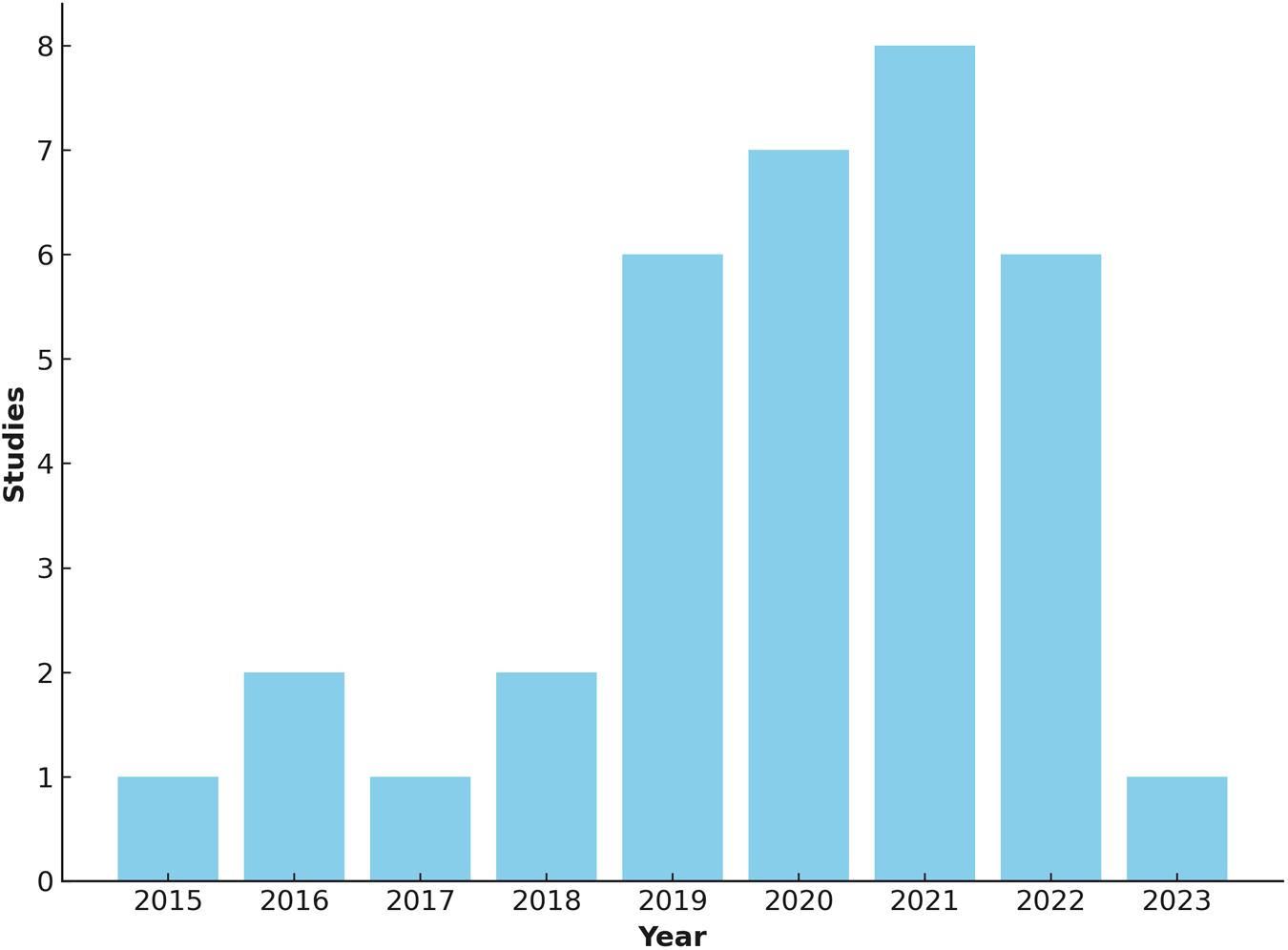
Number of publications by year. Note that the search only considered studies up to March 2023, so the number of articles is low this year.

Assessing and bypassing methodological variabilities
The heterogeneity, which reflects the consistency of evidence in systematic reviews, was assessed through the visual examination of forest plots and by I 2 statistics (Higgins and Thompson Reference Higgins and Thompson2002; Higgins et al. Reference Higgins, Thompson, Deeks and Altman2003) (see Figure S3 in Supplementary Material). When no clear values of microplastic quantities were presented (i.e., when the authors provide only the range), the mean accumulated concentration of microplastics for each species or country was calculated using the equation MPs[C] =  $\frac{{\mathop \sum \nolimits_i^p{x_i}}}{n}{\text{ }}$, where x is the quantity of microplastic in the ith country or species, and n is the number of studies in the ith country or individuals of the ith species.
The RStudio® IDE Software in R® language, version 4.3.0, was used with packages bibliometrix, ggplot2, and metafor for statistical synthesis and general interpretation of results. The keyword cloud was performed with the clustering algorithm that uses the co-occurrence of words and their distances in reduced space using Euclidean distance and the ‘fruchterman’ grouping.
Results
The high value of I2 statistics (99,97%) (see Figure S3 in Supplementary Material) revealed the high methodological heterogeneity of studies (Higgins and Thompson Reference Higgins and Thompson2002; Higgins et al. Reference Higgins, Thompson, Deeks and Altman2003). A systematic effectiveness review has two synthesis options: meta-analysis and narrative synthesis. Since Santos et al. (Santos et al. Reference Santos, Cardoso and Apostolo2022) state that meta-analyses should only be performed if the assumption of homogeneity of the included studies is met, we opted for a narrative synthesis.
The search on the Web of Science returned 125 publications, while the Scopus database returned 91 publications. After removing duplicates, which comprised 76 publications, 140 articles were considered. Only 138 articles were analysed in their entirety since 2 of them were book chapters. From the 138 publications, 96 (69.57%) were excluded in the first step utilizing the PICOS criteria, and 42 (30.43%) were separated for complete reading.
The considered studies (n = 42) were published from 2015 to 2023 (Figure 3). The first article about filter feeders’ microplastic accumulation was published in 2015. The number of studies remained relatively low until 2018, and there was a fast increase in publications between 2019 and 2021, with a slight drop in the following years. The low number of articles in 2023 occurred because this search was conducted in May 2023.
Global map with countries where publications were reported. The blue scale reflects the number of studies per region, and the red scale shows the concentration of microplastics. It also presented whether the study reported microplastics in the number of items per individual (circle), items per gram (triangle), or both units (triangle inside the circle). Datum: WGS84.

The publications were distributed in 20 countries, including Antarctica (Figure 3). China (n = 6) and the USA (n = 5) accounted for 33.33% of the studies. Other countries published only one or two studies. The highest amounts of microplastics accumulated in animals were recorded in Indonesia ([C]: 1054 particles.study−1), Norway (average of 533 particles.study−1), Panama ([C]: 448 particles.study−1), China ([C]: 219.25 particles.study−1), Thailand ([C]: 124 particles.study−1), and Netherlands ([C]:116 particles.study−1). Sometimes, multiple studies or sampling units may represent a single country. In other countries, these values were below 100 particles.study−1. Only studies in China, Italy, Norway, South Africa, Spain, and the USA presented microplastic accumulation in items per gram or individual. When expressing the amount of microplastic by animal weight, studies used dry weight (DW) or wet weight (WW) (see Figure S2 in Supplementary Material).
Bivalves, particularly mussels and clams, are the most studied in different countries (Figure 4 and Figure 5). Although they were only studied in Indonesia and Panama, it is remarkable that marine sponges had the highest concentration of microplastics. On the other hand, scallops, polychaetes, mole crabs, and ascidians contain few microplastics and have also been studied little (see Supplementary Material).
Microplastic concentrations (log of MPs [C]) in different marine benthic organisms (upper panel) and feeding behaviours (lower panel) across countries. CDC: Ciliary downstream collecting, CTG: Cirri trapping/Gills, CSC: Collar sieving/Choanocytes, DT: Dendritic tentacles, MPS: Mucus-net/pharynx slits, SA: Sieving antennae.

Microplastic concentration (log (MPs [C]) in marine benthic filter feeders. CDC: Ciliary downstream collecting, CTG: Cirri-trapping Gills, CSC: Collar sieving choanocytes, DT: Dendritic tentacles, MPS: Mucus-net/pharynx slits, SA: Sieving antennae.

Independent of the country, animals using cirri-trapping or gills are the most studied and had the highest concentration of microplastics, with studies in few countries about those with low concentrations of MPs, like those animals using mucus-net or pharynx slits and sieving-antennae (Figure 4).
Most studies quantified microplastics in only one taxon, and many identified animals at the genus level. Only Fallon and Freeman (Reference Fallon and Freeman2021), Girard et al. (Reference Girard, Fuchs, Kaliwoda, Lasut, Ploetz, Schmahl and Wörheide2021), Sparks (Reference Sparks2020), Joyce and Falkenberg (Reference Joyce and Falkenberg2023), and Sfriso et al. (Reference Sfriso, Tomio, Rosso, Gambaro, Sfriso, Corami, Rastelli, Corinaldesi, Mistri and Munari2020) compared the accumulation of microplastics in different species of the same phylum (Mollusca). Comparisons of the accumulation of plastic in animals with varying feeding mechanisms were conducted by Covernton et al. (Reference Covernton, Cox, Fleming, Buirs, Davies, Juanes and Dower2022) and Sfriso et al. (Reference Sfriso, Tomio, Rosso, Gambaro, Sfriso, Corami, Rastelli, Corinaldesi, Mistri and Munari2020). The highest number of MPs was recorded in sponges using collar sieving choanocytes (CDC) like Tethyid spp. (61 to 612 612 items g‒1 DW); Ircinia spp. (61 to 612 items g‒1 DW); Callyspongia vaginalis (169 ± 71 items g ‒1 DW) and Aplysina cauliformis (23 items g ‒1 DW); followed by mollusks that use cirri/gills trapping (CGT) (Hiatella arctica – 1 to 184 items individual−1; Mytilus edulis – 11 to 105 items g‒1 DW; Crassostrea gigas – 30 to 87 items g – 1 DW) and the polychaete Galathowenia oculate (11 to 880 items g‒1 WW), which use ciliary downstream collecting (CDC). The lowest number of particles were recorded in ascidians (mucus-net or pharynx slits – MPS) as Microcosmus exasperates (1.37 ± 1.29 items individual−1) and mole crabs (sieving antennae – FA) as Emerita analoga (0.65 ± 1.64 items individual−1).
The methods used for digesting animal tissues varied greatly. Methods like 10% potassium hydroxide – KOH solution (Keisling et al. Reference Keisling, Harris, Blaze, Coffin and Byers2020), 69–71% nitric acid – HNO3 solution (Davidson and Dudas Reference Davidson and Dudas2016), or 30% hydrogen peroxide H₂O₂ (Ta et al. Reference Ta, Pupuang, Babel and Wang2022) and 10 M sodium hydroxide – NaOH solution, for example, were used for digestion (Mayoma et al. Reference Mayoma, Sørensen, Shashoua and Khan2020).
Discussion
Despite ocean plastic pollution being a global issue, studies focusing on plastic accumulation in marine benthic filter-feeding invertebrates were identified in only 20 countries, with most studies carried out in China. The high number of studies in China may reflect growing academic interest in microplastic contamination in bivalves. In China, research funding is often aligned with national priorities, which may contribute to the volume of research conducted. Otherwise, Chinese economy has been one of the highest and fastest-growing in the world in the past several years (Akkemik Reference Akkemik2015). China is the top manufacturing country in the world (Jigang Reference Jigang2020) and has the second largest population in the world, with more than 1.4 billion inhabitants, and there is a positive and significant correlation between population quantity and economic level and the number of microplastics in aquatic environments (Cakaj et al. Reference Cakaj, Lisiak-Zielińska, Drzewiecka, Budka, Borowiak, Drapikowska, Cakaj, Qorri and Szkudlarz2023; Chen et al. Reference Chen, Deng, Chen, Peng, Qin, Wang and Zhao2022). The growing interest in the impacts of pollution on marine benthic animals can also be attributed to the economic value of several species for the food industry (Li et al. Reference Li, Yang, Li, Jabeen and Shi2015). Addressing marine plastic pollution is of global significance, particularly as microplastics pose a serious environmental threat to commercially important marine organisms (Fu and Wang Reference Fu and Wang2019), a concern that is currently being highlighted in international negotiations.
The earliest study retrieved by this systematic review on plastic accumulation in marine benthic filter feeders was published in 2015, with a marked increase in publications observed between 2019 and 2022. The lack of studies before 2019 may reflect our strategy of only including studies with the selected keywords in the title, abstract, or author names. The increase in the number of studies after 2019 reveals the growing interest in understanding the path of microplastics and the concern of citizens, managers, and decision-makers about their effects on aquatic environments (Carney and Eggert Reference Carney and Eggert2019; Vergara et al. Reference Vergara, Hoz-M, Ariza-Echeverri, Fernández-Arias and Antón-Sancho2025).
Various methods are used for collecting, digesting, quantifying, and identifying particles in microplastic studies in aquatic organisms (Huang et al. Reference Huang, Si, Qiu and Wang2024). The lack of standardization is worse on the units used to express microplastic quantities. Divergences in methods make comparing and validating results difficult (Ferreira and Lôbo-Hajdu Reference Ferreira and Lôbo-Hajdu2023). Also, the differences in sampling and analytical methods make comparisons with previous studies complex (Knutsen et al. Reference Knutsen, Cyvin, Totland, Lilleeng, Wade, Castro, Petterson, Moskeland and Arp2020). Standardizing protocols is crucial in increasing the studies’ reliability of studies and the certainty of conclusions. Therefore, it is urgent to standardize and optimize analytical protocols for studying microplastics in marine environments (Campanale et al. Reference Campanale, Savino, Pojar, Massarelli and Uricchio2020). The absence of standard methods represents a significant challenge, hampering the application of sophisticated statistical analyses and harming an effective comparison of data from different studies (Simon-Sánchez et al. Reference Simon-Sánchez, Grelaud, Franci and Ziveri2022).
It is essential to implement sampling and analytical processes that have been rigorously tested and validated to obtain reliable and comparable results. The starting point when standardizing methods for microplastic studies in aquatic organisms is proposing sampling protocols to ensure consistency across different studies. These protocols must propose the mesh size to be used, the location and frequency of collections, the amount (weight, area, and volume) and number of samples to be taken, and standard procedures for cleaning and preparing samples for analysis. After standardizing sampling protocols, it is essential to develop fast, cost-effective, and efficient extraction techniques (Khanjani et al. Reference Khanjani, Sharifinia and Mohammadi2023). Although several methods are used for MPs identification (FTIR, Raman, and pyrolysis), it does not represent a problem for comparing studies (Huang et al. Reference Huang, Si, Qiu and Wang2024).
Most publications report microplastics in mollusks (oysters, mussels, and clams), and Mytilus edulis was the taxon with the most studies. The focus on bivalves is not surprising. Marine bivalves are one of the dominant taxa in the marine benthos, occurring from supratidal zones to the deep sea, and have diverse feeding habits. Bivalves have high interest to humans as they have been used as food since prehistoric times (Smaal et al. Reference Smaal, Ferreira, Grant, Petersen and Strand2019) and recently in water quality monitoring and improvement programs (Chahouri et al. Reference Chahouri, Yacoubi, Moukrim and Banaoui2023; Mesquita et al. Reference Mesquita, Gonçalves, Gonçalves, Gonçalves and Summers2023). More than 800 species of bivalves are exploited by humans (Huang et al. Reference Huang, Edie, Collins, Crouch, Roy and Jablonski2023), and the global production of marine bivalves for human consumption was more than 18 million tonnes in 2021, with 12% represented by mussels (FAO 2020). Several species of Mytillidae have been used to assess seawater quality since the 19th century (Anonymous 1886). Mytilus is widely used as a sentinel in environmental monitoring in more than 50 countries, with data dating back to the 1960s (Beyer et al. Reference Beyer, Green, Brooks, Allan, Ruus, Gomes, Brate and Schøyen2017; Cantillo Reference Cantillo1998; Li et al. Reference Li, Qu, Su, Zhang, Yang, Kolandhasamy and Shi2016). The link between mussels, human consumption, and environmental monitoring has resulted in mussels being among the most well-studied marine invertebrates (Inoue et al. Reference Inoue, Onitsuka and Koito2021).
The highest amounts of microplastics were recorded in sponges, bivalves, and polychaetes (particularly Oweniidae), which feed using collar sieving choanocytes (CSC), ciliary downstream collection (CDC), and cirri-trapping gills (CTG). The CSC mechanism uses choanocytes, specialized cells with flagella surrounded by microvilli collars, which generate water currents and trap particles (Gökalp et al. Reference Gökalp, Kooistra, Rocha, Silva, Osinga, Murk and Wijgerde2020; Leys et al. Reference Leys, Reidenbach, Tunnicliffe, Yahel, Reiswig and Shavit2011).
The ciliary downstream collection involves cilia-generated currents that guide particles toward specialized feeding structures, enhancing the capture of fine suspended material (Riisgård et al Reference Riisgård, Nielsen and Larsen2000). Similarly, cirri-trapping gills operate through the movement of gill filaments, generating currents that transport particles to mucus-covered surfaces, where they are retained (Riisgård and Larsen Reference Riisgård and Larsen2010, Reference Riisgård, Larsen, Rossi, Bramanti, Gori and Orejas2015; Stollberg et al. Reference Stollberg, Kröger, Reininghaus, Forberger, Witt and Brenner2021). Animals using mechanisms like dendritic tentacles (DT – echinoderms), mucus-net/pharynx slits (MPS – tunicates), and sieving antennae (SA – crustaceans) appear to accumulate a few microplastic. Although these mechanisms appear less efficient, definitive conclusions cannot be drawn due to the limited number of studies on this topic identified in the present review.
Sponges are well-known as biological pumps due to their ability to filter several hundred times their body volume daily (Reiswig Reference Reiswig1971, Reference Reiswig1974). Pumping is carried out by flagellated chambers connected to an inhalant and exhalant canal system (Asadzadeh et al. Reference Asadzadeh, Kiørboe, Larsen, Leys, Yahel and Walther2020). Individual sponges can filter up to 900 times their body volume of water per hour and filter 50 000 litres of seawater per litre of sponge volume per day (Pile and Witman Reference Pile and Witman1996; Stabili et al. Reference Stabili, Licciano, Giangrande, Longo, Mercurio, Marzano and Corriero2020; Varamogianni-Mamatsi et al. Reference Varamogianni-Mamatsi, Anastasiou, Vernadou, Papandroulakis, Kalogerakis, Dailianis and Mandalakis2021). Recent studies have shown that sponges appear more efficient at capturing microparticles, including microplastics, than other benthic filter feeders (Fallon and Freeman Reference Fallon and Freeman2021; Girard et al. Reference Girard, Fuchs, Kaliwoda, Lasut, Ploetz, Schmahl and Wörheide2021).
The high efficiency of sponges in particle clearance in water makes them promising candidates for biomonitor in studies about oceanic microplastic pollution (Girard et al. Reference Girard, Fuchs, Kaliwoda, Lasut, Ploetz, Schmahl and Wörheide2021). The pumping rate of sponges decreases with increasing animals’ body size (Morganti et al. Reference Morganti, Ribes, Yahel and Coma2019), and sponge size increases with depth (D’aloia et al. Reference D’aloia, Majoris and Buston2011; Lesser Reference Lesser2006). Therefore, the risk of microplastic contamination is higher in shallow coastal areas where sponges are predominantly small. Also, in coastal regions, the availability of tiny plastic particles is higher than in the open ocean due to the proximity of microplastic hotspots (Adamopoulou et al. Reference Adamopoulou, Zeri, Garaventa, Gambardella, Ioakeimidis and Pitta2021; Onink et al. Reference Onink, Kaandorp, van Sebille and Laufkötter2022) and the higher rate of decomposition of large plastic items by ultraviolet radiation and mechanical forces in shallow areas (Corcoran et al. Reference Corcoran, Biesinger and Grifi2009).
The accumulation of pollutants in filter-feeder bivalves is well-studied (Huffman Reference Huffman2021; Joshi et al. Reference Joshi, Rabari, Patel, Patel, Rakib, Trivedi, Paray, Walker and Jakariya2024; Khanjani et al. Reference Khanjani, Sharifinia and Mohammadi2023). When feeding, bivalves pump water through the gills that filter particles and transfer them to the mouth (Jørgensen Reference Jørgensen1983). However, some particles are captured but not ingested, being enclosed with mucus and rejected (Tang et al. Reference Tang, Zhang, Song, Sun, Chen, Huang and Feng2022; Zhao et al. Reference Zhao, Ward, Danley and Mincer2018). The mantle functions as an excretion pathway (Tang et al. Reference Tang, Zhang, Song, Sun, Chen, Huang and Feng2022). Experiments with Mittilys edulis and M. galloprovincialis revealed that they eliminated about 63% and 70% of the ingested microplastics after 6 and 24 h, respectively (Woods et al. Reference Woods, Stack, Fields, Shaw and Matrai2018). Ward et al (Reference Ward, Rosa and Shumway2019a) hypothesized that bivalves are selective particle feeders with mechanisms developed for particle discrimination. This hypothesis is supported by the reduced abundance of microplastics in animal tissues compared to environmental matrices (Li et al. Reference Li, Wang, Rotchell, Shen, Li and Zhu2021). The mechanisms used by bivalves to reduce the abundance of microplastics raise the debate about the efficacy of bivalves as bioindicators for microplastic pollution.
Since bivalves are very species-diverse, have wide geographical and bathymetrical distribution, and are highly ecological and commercially important, this group is expected to be the focus of several studies about microplastics in marine environments. The accumulation in these organisms was very high, as indicated by the heatmap colour gradient. It suggests that, despite being understudied compared to other taxa, sponges may serve as sensitive bioindicators of microplastic pollution due to their continuous filtering activity and porous body structure. Figure 4 summarizes microplastic concentrations detected across marine benthic organisms and filter feeders in different countries. The data is categorized by organism type, showing spatial patterns in microplastic accumulation and feeding behaviour, indicating how feeding strategies relate to microplastic intake. Notably, sponges, though sampled in fewer locations, show some of the highest concentrations, suggesting their role as efficient microplastic bioaccumulators.
In examining the differences between filter-feeding mechanisms and other benthic feeding strategies, it becomes evident that the method of ingestion plays a crucial role in microplastic accumulation. Research suggests that omnivores, predators, and deposit feeders may exhibit higher microplastic burdens compared to filter feeders (Berlino et al. Reference Berlino, Mangano, De Vittor and Sarà2021; Mason et al. Reference Mason, Skov, Hiddink and Walton2022; Porter et al. Reference Porter, Godbold, Lewis, Savage, Solan and Galloway2023b). Organisms that engage in deposit feeding, such as certain polychaetes and holothurians, or grazing, like gastropods, typically consume particles that have settled on or within sediments. This behaviour may reduce their exposure to suspended microplastics, resulting in a greater ingestion of microplastics that settle on the sediment rather than those suspended in the water column (Hiki and Nakajima Reference Hiki and Nakajima2022). Predatory species, on the other hand, are more likely to accumulate microplastics through trophic transfer rather than direct environmental ingestion (Kangas et al. Reference Kangas, Setälä, Kauppi and Lehtiniemi2023), with trophic transfer constituting a significant pathway for microplastic ingestion in these species (Nelms et al. Reference Nelms, Galloway, Godley, Jarvis and Lindeque2018). Conversely, suspension feeders such as sponges, bivalves, and certain polychaetes are in constant contact with large volumes of water, actively filtering out particles, including microplastics. This direct and continuous exposure to contaminated water likely accounts for the higher accumulation observed in taxa with mechanisms such as collar-sieving, ciliary downstream collection, and cirri-trapping gills. Therefore, feeding mode appears to be a critical determinant in the extent of microplastic contamination among benthic marine invertebrates.
Filter-feeding polychaetes capture particles from water by filtering or sieving particles out of solution using different mechanisms, whether mandatory or not, and some species can switch between deposit- and suspension-feeding modes (Fauchald and Jumars Reference Fauchald and Jumars1979; Jumars et al. Reference Jumars, Dorgan and Lindsay2015). Oweniids are generally classified as suspension-feeders that use a ciliated tentacle crown that acts as a downstream-collecting system based on the ‘catch-up principle’ (Riisgård et al. Reference Riisgård, Grémare, Amouroux, Charles, Vétion, Rosenberg and Nielsen2002, Reference Riisgård, Nielsen and Larsen2000). Knutsen et al (Reference Knutsen, Cyvin, Totland, Lilleeng, Wade, Castro, Petterson, Moskeland and Arp2020), using the Biota-Sediment Particle Enrichment Factor to assess microplastics in polychaetes, found 280–31 000 times more microplastics in oweniids than in the sediments. Self and Jumars (Reference Self and Jumars1988) state that although Owenia fusiformis had no significant selection for particle size, they essentially select particles of lower specific gravity. Plastic particles generally have a lower density than sediment grains (Harris Reference Harris2020). However, this can vary depending on the polymer type and the presence of additives, and thus remain suspended longer in the water, explaining the high accumulation of microplastics in benthic polychaetes that feed using ciliated tentacles.
Although other factors influence the accumulation of microplastics in marine organisms, like animal (size, age, and feeding mode) and environmental (temperature, current flow, particle concentration) characteristics, the present systematic review focused on the effect of feeding mechanisms in microplastic accumulation by benthic filter feeders. Moreover, although this systematic review tried to retrieve all articles published about the accumulation of microplastics in marine benthic filter feeders, the choice of keywords may have excluded some studies, revealing a need for standardization also in keywords used in publications. For example, despite its relevance, the term ‘filter feeders’ appeared very little in the articles. This discrepancy highlights potential gaps and unveils less explored dimensions within the research theme based on the specific search criteria used for this study. It is also important to note that it reflects the scope of the present review and not necessarily the entire field, acknowledging that there may be more papers on microplastic accumulation in benthic filter feeders than those included in the dataset.
Limitations of the evidence and implications for future research
Of the 195 countries worldwide, studies using the eligibility criteria were only recorded in 20, revealing the general scarcity of studies, mainly in the tropics, and the concentration of research in a few countries. Most studies focused on commercially important species, mainly bivalves. Also, the heterogeneity of approaches in describing microplastic concentrations makes it challenging to analyse this type of pollution in marine animals. For example, there is a general lack of standardization in field methodologies, sample size, sampling frequency, weight, and size of individuals used, and the unity used to express particle concentration (authors have been using item/individual, item/WW, item/DW, or even item/g). Thus, evidence from the present systematic review calls for the urgent need that more high-quality evidence studies be done in several countries and focusing on more species, mainly those assessing accurate data on the filtration rate and the actual feeding mechanisms used by animals, and that future publications use standard methods related to sampling design, field and laboratory protocols, and unity of measurement.
The most appropriate standardization for reporting microplastic contamination in marine organisms appears to be by weight, as it offers a more consistent and comparable metric across studies. Standardization by individual can be highly variable and potentially misleading, as the size and weight of organisms may differ significantly depending on factors such as geographic location, season, and species-specific traits. These improvements in studies will allow conclusive responses about the role of the feeding mechanism in the accumulation of microplastics in marine animals, contributing to future programs designed to monitor plastic pollution in the oceans.
Conclusion
It is the first systematic review focusing on comparing the accumulation of microplastics in marine benthic filter feeders using different filtering mechanisms. Due to the heterogeneity of data, this review is a narrative synthesis. Studies were only carried out in 20 countries, and China had the most studies, reflecting China’s population, economy, and investment in science. Mollusks, mainly those with economic importance, such as Mityllus, are the most studied animals, while sponges have the highest microplastic concentration. Different filter-feeding mechanisms affect the quantity of microplastics accumulated in benthic marine invertebrates and animals that feed using collar-sieving choanocytes, ciliary downstream collection, and cirri-trapping gills accumulate the most particles. The absence of standardization of sampling design and sampling protocols and unity for expressing microplastic quantity calls for the need of standard methods to guide future studies of microplastics in marine benthic animals, making them comparable and useful in monitoring plastic pollution in the oceans.
Supplementary material
The supplementary material for this article can be found at https://doi.org/10.1017/S0025315425100532
Acknowledgements
S.N.S. the Coordination for the Improvement of Higher Education Personnel (CAPES - 88887.678936/2022-00). J.S.R.F. acknowledges the National Council for Scientific and Technological Development for his Productivity Fellowship (CNPq - 303609/2022-2) and the Ray Lankaster Fund for the financial support during his stay at the Marine Biological Association of the United Kingdom (Plymouth). NJC acknowledges the Fundação de Amparo à Ciência e Tecnologia de Pernambuco (FACEPE -BFP-0151-1.08/24). S.A.J. acknowledges the CNPq for his Productivity Fellowship (CNPq - 305098/2019-5).
Author contributions
Suelen N. Santos: Conceptualization, Investigation, Methodology, Data curation, Writing – original draft, Writing – review & editing, Visualization. Matheus A. Oliveira: Data curation, Software, Formal analysis, Writing – review & editing. Severino A. Júnior: Visualization, Supervision, Project administration. José S.R Filho: Conceptualization, Formal analysis, Methodology, Writing – original draft, Writing – review & editing, Visualization, Supervision, Project administration
Funding
This work was supported by the National Council for Scientific and Technological Development (CNPq - 405460/2022-8).
Conflicts of interest
All authors declare that they have no conflicts of interest.
Data availability
The data that support the findings of this study are available from the corresponding author upon reasonable request.