Introduction
The increase in lone parenthood is a social revolution with considerable psychiatric implications. A quarter of families with dependent children are now headed by lone parents, usually a mother (Office of National Statistics, 2002). Lone mothers have worse mental and physical health than partnered parents and the populace in general (Benzeval, Reference Benzeval1998; Targosz et al. Reference Targosz, Bebbington, Lewis, Brugha, Jenkins, Farrell and Meltzer2003; Crosier et al. Reference Crosier, Butterworth and Rodgers2007). The extent to which this is explained by the associated socio-economic deprivation has been widely debated (Benzeval, Reference Benzeval1998). Two important predictors of mental illness are lack of social support and of financial resource (e.g. Honkalampi et al. Reference Honkalampi, Hintikka, Haatainem, Koivumaa-Honkanen, Tanskanen and Viinamäki2005). In the 1993 British National Psychiatric Morbidity Survey (NPMS), the excess of depression in lone mothers was no longer significant after controlling for employment status, type of accommodation, financial resource, perceived social support and number of life events (Targosz et al. Reference Targosz, Bebbington, Lewis, Brugha, Jenkins, Farrell and Meltzer2003), providing the strongest evidence to date that the excess of depression in lone mothers may be entirely explained by adverse circumstances. This study used access to a car as a proxy measure of financial resource. Only Crosier and colleagues (2007) have studied the relationship of financial strain (amount of debt, etc.) to mental health in lone mothers. They used cross-sectional data from a large, nationally representative Australian sample, and they found this was the most important factor explaining higher scores on the Short-Form-36 mental health scale in the lone mothers. This is consistent with recent findings from the 2000 NPMS of a significant association between mental disorder and debt in the general population (R. Jenkins et al. unpublished observations).
Only 1–3% of families with dependent children are headed by lone fathers (Office of National Statistics, 2002). They are reported to experience worse socio-economic conditions and general health than partnered fathers, but more favourable socio-economic conditions than non-custodial fathers and lone childless men (Benzeval, Reference Benzeval1998; Ringback Weitoft et al. Reference Ringback Weitoft, Burstrom and Rosen2004). Compared with lone mothers, they are socio-economically advantaged, older, more likely to be widowed, and much less likely to be single than divorced or separated (Benzeval, Reference Benzeval1998). Rates of psychiatric disorders in lone fathers have never been studied.
In this paper, we present data from the 2000 British NPMS to demonstrate for the first time the relative contributions of financial strain (debt and borrowing money) and decreased social support to the excess of non-psychotic affective disorder [often termed common mental disorders (CMD)] in lone parents. Our main hypothesis is that increased rates of CMD in lone parents will be explained by economic resources, and that this relationship will be largely mediated by the presence of financial strain. Our alternative hypothesis is that increased rates of CMD in lone mothers will mainly be explained by their decreased access to social support. We will also test and compare these hypotheses with regard to depressive episode, and in lone fathers.
Methods
Procedures
A structured survey involving computer-assisted interviews was carried out on a national probability sample. A total of 15 804 delivery points in Britain were randomly drawn from postal sectors of the Small Area Postcode Address File, stratifying for socio-economic grouping. Using the Kish grid method (Kish, Reference Kish1965) one adult aged between 16 and 74 years was chosen from 12 792 eligible households. Sixty-seven percent (8580 adults) provided a full interview. Further details of methods are given by Singleton and colleagues (Reference Singleton, Bumpstead, O'Brien, Lee and Meltze2001).
Measures
Respondents were asked whether any people they shared a household with were aged <16 years and how they were related to them. From this information respondents were classified in the NPMS (Singleton et al. Reference Singleton, Bumpstead, O'Brien, Lee and Meltze2001) by family unit type: people living with their partner and children (n=2419) (‘partnered parents’); lone parents (n=664); and the remainder who were living as a couple with no children (n=2673), with parents (n=638), or alone (n=2186) and who together comprised our reference group (n=5497). For purposes of the survey, a parent was defined as someone living with at least one of their children; the child could be of any age, provided they were unmarried and had no children of their own. We included the total number of people (whether adults or children) and the number of children under 16 in each household as variables in our analyses. The Revised Clinical Interview Schedule (CIS-R) was also completed. Reliability and validity of the CIS-R has been reported (Lewis et al. Reference Lewis, Pelosi, Araya and Dunn1992; Jordanova et al. Reference Jordanova, Wickramesinghe, Gerada and Prince2004). The instrument produces a total score for neurotic symptoms. The recorded symptoms are also subject to a computer algorithm that provides diagnostic categories according to ICD-10. These include depressive episode, panic disorder, phobia, obsessive–compulsive disorder, and generalized anxiety disorder. An additional ICD-10 category of mixed anxiety/depressive disorder has no diagnostic research criteria, but is defined by the CIS-R system in terms of all persons scoring ⩾12 who have not been placed in one of the other categories. We used the presence of any CMD as our main outcome measure. We also analysed depressive episode separately as it is the most severe of the CIS-R diagnostic categories and approximates to major depressive disorder in DSM-IV (APA, 1992).
Respondents were asked about their individual gross weekly income from all sources. This information was recorded as a categorical variable: <£100, £100–199, £200–299, £300–£399, £400–£499, or ⩾£500. Participants were also asked whether in the last year they had: borrowed money from pawnbrokers, money lenders (excluding banks and building societies), family members or friends in order to pay for everyday needs; or been seriously behind in paying utility bills, credit card or mortgage repayments, other loans, road tax, TV licence or child support payments.
Perceived social support was assessed from respondents' answers to seven questions taken from the 1987 Health and Lifestyle survey (Cox et al. Reference Cox, Blaxter, Buckle, Fenner, Golding, Gore, Huppert, Nickson, Roth, Start, Wadsworth and Whichelow1987), and used elsewhere (Brugha et al. Reference Brugha, Morgan, Bebbington, Jenkins, Lewis, Farrell and Meltzer2003). The seven statements are:
There are people I know – amongst my family or friends –
(1) who do things to make me happy;
(2) who make me feel loved;
(3) who can be relied upon no matter what happens;
(4) who would see that I am taken care of if I needed to be;
(5) who accept me just as I am;
(6) who make me feel and important part of their lives;
(7) who give me support and encouragement.
Each question was scored as (1) not true (2) partly true (3) certainly true, giving a total possible score of 3–21.
The size of an individual's primary support group was assessed by asking the number of people (aged ⩾16 years) who the respondent felt close to. They were asked about (1) adults they lived with (2) relatives they did not live with, and (3) close or good friends they did not live with. We used the total number of people reported as a measure of their primary social group size (Brugha et al. Reference Brugha, Morgan, Bebbington, Jenkins, Lewis, Farrell and Meltzer2003). We also recorded employment status, tenure (whether living in rented accommodation or not) and social class. Social class was derived from the occupation of the respondent.
Data analysis
All analyses were performed using data weighted to take account of the complex survey design and of non-response in order to ensure results were representative of the British Household population aged 16–74 years. We used the relevant ‘survey’ commands in Stata, release 8.0 (StataCorp, 2003), which allow for the use of clustered data modified by probability weights and provide robust estimates of variance. We reported actual numbers and weighted frequencies for depressive episode, and any CMD, together with our chosen socio-economic variables. As a way of establishing the sociodemographic correlates of the elevated rates seen in lone mothers, we determined unadjusted odds ratios of having a depressive episode or any CMD, comparing lone mothers and partnered mothers with other women. We used logistic regression to control for age, household size, the number of children aged <16 years, tenure, employment status, social class and (1) economic factors (income, and self-reported measures of debt and borrowing), (2) perceived social support (total score and network size), and, finally, for both. We repeated this analytical strategy with male participants, but due to the small sample size, it was only feasible to use the overall category of CMD as the dependent variable.
Results
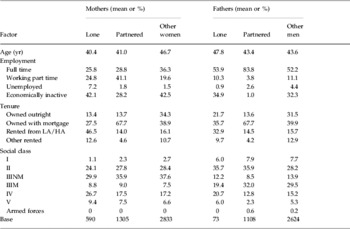
Among the reference group, 906 (34.0%) of the men and 1020 (36.0%) of the women lived alone; 1349 (50.6%) of men and 1526 (53.9%) of women lived with one other person; with the remainder living with more than one other adult. The great majority lived in households without children under 16, although 113 (4.2%) of men and 91 (3.2%) of women lived in households with children they were not parenting.
Among those classed as supported parents, 441 (39.6%) of men and 482 (36.9%) of women lived in three-person households (i.e. with one child); 491 (44.1%) of men and 563 (43.1%) of women lived in four-member households; with the remainder living in households of 5–11 members. In total, 871 (78.7%) of men and 1040 (79.7%) of women were parenting at least one child under 16. The mean number of children under 16 was 1.5 (s.d.=1.0) for supported mothers and 1.4 (s.d=1.0) for supported fathers.
Among those classed as lone parents, 39 (52.7%) of fathers and 255 (43.2%) of mothers lived with only one child. Twenty-six (35.1%) of fathers and 217 (36.8%) of mothers lived in three-member households; while the remainder lived in households with 4–7 members. Fifty (67.6%) of lone fathers and 495 (83.9%) of lone mothers were not caring for any children under 16. The mean number of children under 16 was 1.5 (s.d.=1.1) for lone mothers and 1.1 (s.d.=1.0) for lone fathers.
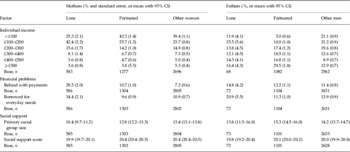
Tables 1 and 2 list the socioeconomic descriptors of lone, supported parents and other people interviewed.
Sociodemographic factors for lone, supported parents and other people

CI, Confidence interval; LA/HA, local authority or housing association.
Sociodemographic and economic characteristics of lone parents (weighted percentages)

CI, Confidence interval.
Mothers
Compared with other women, lone mothers were more than three times more likely to report: being behind with payments (28.5% v. 7.2%, χ2=80.0, p<0.001), or borrowing for everyday needs (34.5% v. 9.6%, χ2=95.2, p<0.001) (Table 2). They also reported significantly smaller primary social groups and lower levels of social support than partnered mothers or reference women.
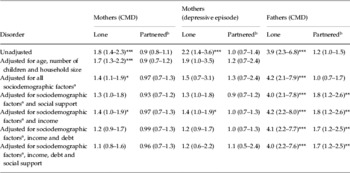
Lone mothers were twice as likely to have a depressive episode, and nearly twice as likely to report any CMD as women without dependent children [Table 3; 33 (5.5%) of lone mothers met criteria for a depressive episode compared with 34 (2.5%) of partnered mothers and 88 (2.5%) of other women. Of lone mothers, 168 (28.4%) were diagnosed with any CMD compared with 210 (16.0%) of partnered mothers and 518 (18.3%) of other women].
Unadjusted and adjusted rates of mental disorders in lone and supported parents, compared with reference group

Values are odds ratio with 95% confidence interval.
CMD, Common mental disorder.
a Sociodemographic factors=age, household size, no. children aged <16 years, tenure, employment status and social class.
b Partnered parent=one caring for dependent children together with a partner
* p<0.05
** p<0.01
*** p<0.001.
The increased rates of depression in lone mothers were reduced and no longer significant when we controlled for sociodemographic factors. The rate of CMD was also reduced but retained significance. There was no further reduction when controlling for income alone (Table 3). However, when we controlled for either income and financial strain, or for primary social group size and social support, the odds ratios of having a CMD in lone mothers were no longer significant.
In the final model in which we adjusted for all of the above factors, there was a further reduction in the odds ratio (OR) for CMD in lone mothers. Significant predictors of having a CMD were: smaller primary social group size (OR 0.9, 95% CI 0.9–0.9, p<0.001) and less social support (OR 0.9, 95% CI 0.8–0.9, p<0.001); borrowing money (OR 2.1, 95% CI 1.7–2.7, p<0.001) and being in debt (OR 1.6, 95% CI 1.3–2.1, p<0.001); living in private (OR 1.8, 95% CI 1.3–2.6, p<0.01) or local authority or housing association (LA/HA) rented accommodation (OR 1.7, 95% CI 1.3–2.4, p<0.01) or owning a house with a mortgage (OR 1.6, 95% CI 1.2–2.1, p<0.01) compared to owning a house outright; and being economically inactive (OR 1.6, 95% CI 1.2–2.2, p<0.01). Significant predictors of having a depressive episode were: smaller primary social group size (OR 0.9, 95% CI 0.9–0.9, p<0.001); borrowing money (OR 2.9, 95% CI 1.7–4.8, p<0.001); living in private rented accommodation (OR 3.7, 95% CI 1.6–8.6, p<0.01); local authority or housing association (LA/HA) rented accommodation (OR 2.4, 95% CI 1.1–4.9, p<0.05) or owning a house with a mortgage (OR 2.8, 95% CI 1.4–5.5, p<0.01) compared to owning a house outright; and smaller household size (OR 0.7, 95% CI 0.5–1.0, p<0.05).
Fathers
Lone fathers were nearly four times more likely to have a CMD than other men: 23 (33.6%) of lone fathers met criteria for a CMD compared with 143 (13.3%) of partnered fathers and 338 (11.3%) of other men. Lone fathers were also more likely than these other two groups to be experiencing depression [3 (6.1%) v. 22 (2.2%) and 75 (2.2%) respectively], but as numbers were low we did not explore these differences further. Compared with lone mothers, lone fathers were rather less likely to report borrowing money (26.5% v. 29.9%; χ2=4.4, p=0.036); or being in debt (18.4% v. 24.8%; χ2=6.6, p=0.010) in the last year. Unlike lone mothers, lone fathers' risk of having a CMD remained undiminished by controlling for sociodemographic variables, income, financial strain and levels of social support. On post-hoc analysis, 54.8% (n=40) of lone fathers were divorced, 21.9% (n=16) widowed, 20.5% (n=15) separated and 2.7% (n=2) single. Among lone mothers, 206 (34.9%) were divorced, 201 (34.0%) single, 134 (22.7%) separated and 50 (8.5%) widowed. For both lone mothers and fathers, the highest rates of CMD were reported by those who were separated (31.3% and 40% respectively).
In the final regression model, factors predicting presence of a CMD in fathers were: being a lone or supported parent (Table 3); lower levels of social support (OR 0.9, 95% CI 0.9–1.0, p=0.03); being in debt (OR 2.1, 95% CI 1.5–2.9, p<0.001) and borrowing more money (OR 2.4, 95% CI 1.7–3.3, p<0.001); living in private rented accommodation (OR 3.1, 95% CI 2.1–4.7, p<0.01); local authority or housing association (LA/HA) rented accommodation (OR 3.1, 95% CI 2.1–4.6, p<0.05) or owning a house with a mortgage (OR 2.8, 95% CI 1.8–4.2, p<0.05) compared to owning a house outright; and being economically inactive (OR 2.2, 95% CI 1.3–3.6, p<0.01).
Discussion
It is clear from our results that lone parenting is associated with diminished mental health. However, there were appreciable differences between fathers and mothers in the sociodemographic correlates of disorder.
Lone mothers
Lone mothers were more likely to report depression and CMD in general, than other women. As predicted in our first hypothesis, the differences regarding CMD were no longer significant after controlling either for income and financial strain or for social support. Measures of financial strain and degree of social support were both significant predictors in the final regression model that explained the excess of CMD in lone mothers. The odds ratios of having depression in lone mothers were of a similar magnitude when controlling for each of these factors, but due to the lower incidence of depression and the consequent reduction in power, they were no longer statistically significant after controlling for socio-economic variables.
This is the first time that the relationship to depression and CMD of financial strain, in the form of debt and the need to borrow money, has been reported in lone mothers. Consumer debt has soared in recent years, in the UK as in other countries, with total UK borrowing on cards, mortgages and loans approaching £1.2 trillion (Bank of England, 2006). The number of bankruptcy petitions issued by the UK courts has risen in recent years (Department for Constitutional Affairs, 2006). R. Jenkins et al. (unpublished observations) have suggested that the association between mental disorder and debt should inform national strategies for managing this debt crisis, as well as training for people working in agencies that loan money or recover debts. These strategies might also be helpful in reducing the social and health inequalities between lone and partnered parents. Recent British government initiatives to encourage employment in lone mothers seem apposite and may have been helpful.
Lone fathers
This is the first published analysis of psychiatric problems in lone fathers. The finding that they were nearly four times more likely than other men to experience a CMD is striking. In a recent systematic review, Neises & Gruneberg (Reference Neises and Gruneberg2005) complained that there is currently no good evidence regarding the health of lone fathers; our results suggest they are a group at high risk of psychiatric morbidity. We found that lone fathers did not experience socio-economic hardships as great as those of lone mothers, and this is in agreement with other studies. Levels of social support were significant predictors of morbidity in lone fathers, as they were for all men in the survey (Brugha et al. Reference Brugha, Weich, Singleton, Lewis, Bebbington, Jenkins and Meltzer2005), and so was financial strain. However, controlling for these factors left their risk of CMD unaltered. Therefore, our hypotheses that excess rates of psychiatric morbidity would be explained by financial strain and inadequate social support were both rejected in lone fathers.
It is perhaps unsurprising that the correlates of CMD in lone fathers differ from mothers, given that they are a sociodemographically different group. As we failed to identify candidate variables to explain their high rates of CMD, more studies are needed to investigate the factors that may be important. In marriage break-ups, courts give custody to the mother unless there are serious concerns. We conjecture that it is the more distressing and disputed break-ups that result in custody being given to the father. Previously longitudinal findings from the same survey have indicated that having a small primary social group predicted the development of mental health problems in men (Brugha et al. Reference Brugha, Weich, Singleton, Lewis, Bebbington, Jenkins and Meltzer2005). Primary social group size did not explain the excess morbidity in lone fathers in our study, but perhaps they lacked a primary social group adapted to their needs, for example access to other parents. Barriers to accessing child care and other practical support services may also cause difficulties for lone fathers. Gender role and role expectations may contribute to poor self-esteem which further leads to depression. The expectations from fathers and lone fathers need to be explored further. We also hypothesized that lone fathers were more likely to be widowed than lone mothers, but while post-hoc analysis confirmed this, it did not seem to explain the high rates of CMD in lone fathers which occurred most frequently in lone fathers who were separated. Greater understanding is needed in this area if appropriate interventions are to be devised and targeted.
Limitations
The number of lone fathers interviewed was small even in this large survey. About a fifth of parents in the survey were not caring for children under 16, and in some cases the children they were living with were adults. However, the number of children under 16 was entered as a variable in analyses and was not a significant predictor of morbidity, suggesting that results are equally applicable to those caring for younger and older children. In a cross-sectional study, the direction of causality of the relationship found between financial strain and mental disorder in lone parents must remain ambiguous, albeit plausible. We measured individual income rather than household income, which may have underestimated the financial resources of some participants, but as lone parents were less likely than partnered parents to be supported by the income of a second adult, we believe our finding that income did not account for the excess morbidity in this group holds. We also reported gross rather than net income. Our use of self-report measures of income and financial strain is a further limitation; to our knowledge the accuracy of self-reports of financial status when compared to objective measures has not been tested.
Conclusion
Lone mothers are over twice as likely to have a CMD or to be depressed as other women, and this seems particularly linked to greater financial strain. This suggests that debt management should be an important strategy in tackling this increased psychiatric morbidity. However, the even larger excess of CMD in lone fathers was not explained by financial strain, income or social support. Lone fathers and lone mothers have different socio-economic profiles, and it appears the reasons they experience CMD may also be different.
Declaration of Interest
None.