Introduction
Detailed descriptions of the patterns of diversification within taxa are particularly informative as they help us describe and comprehend the speciation process (Coyne and Orr Reference Coyne and Orr2004). Such detailed descriptions are relatively rare for both plants and animals and Coyne and Orr (Reference Coyne and Orr2004) emphasise the importance of such descriptions during the actual diversification process rather than making predictions, after-the-fact, when reproductive isolation between populations is already complete.
Black flies (Diptera: Simuliidae) are extremely useful in this regard as most single species previously described on morphological grounds, form, in reality, a continuum of variously staged diversified types from incipient species to well-documented sibling species (Rothfels Reference Rothfels1979; Shields and Procunier Reference Shields and Procunier1982; Adler et al. Reference Adler, Currie and Wood2004).
The Simulium arcticum Malloch complex of black flies is one of the most diverse groups worldwide, second only to the S. damnosum Theobald complex of Africa that is the vector for the blood-bound disease, river blindness (Adler and Crosskey Reference Adler and Crosskey2017). This S. arcticum complex is composed of nine sibling species and at least 21 cytotypes (Shields and Procunier Reference Shields and Procunier1982; Adler et al. Reference Adler, Currie and Wood2004; Shields Reference Shields2013). Of the sibling species, only the larvae of S. negativum Adler, Currie, and Wood are morphologically distinct (Adler et al. Reference Adler, Currie and Wood2004). All other taxa are indistinguishable in all life-history stages except for the linkage of unique paracentric chromosomal inversions in polytene chromosomes, mostly in males. Notably, these taxa might not have been discovered had it not been for the initial cytogenetic analyses (Rothfels Reference Rothfels1979; Shields and Procunier Reference Shields and Procunier1982).
Our research on S. arcticum began in Alaska, United States of America where we described five sibling species (Shields and Procunier Reference Shields and Procunier1982) that were later designated as good biological species by Adler et al. (Reference Adler, Currie and Wood2004). Adler et al. (Reference Adler, Currie and Wood2004) have described an additional four sibling species and we have described 21 cytotypes (types having unique, sex-linked chromosomal inversions but whose reproductive status has yet to be determined) in western Montana, northern Idaho, and eastern Washington, United States of America (Shields et al. Reference Shields, Christiaens, Van Luvan and Hartman2009; Shields Reference Shields2013). We have: (1) determined the reproductive status of some of these taxa (Shields et al. Reference Shields, Clausen, Marchion, Michel, Styren and Riggin2007, Reference Shields, Christiaens, Van Luvan and Hartman2009), (2) formulated a chromosome model of speciation for black flies (Shields Reference Shields2013), (3) determined some environmental factors associated with various taxa (Shields et al. Reference Shields, Clausen, Marchion, Michel, Styren and Riggin2007; Conflitti et al. Reference Conflitti, Shields, Murphy and Currie2015b; Shields Reference Shields2016; Shields and Hokit Reference Shields and Hokit2016) and (4) compared our chromosome data to molecular data from both mitochondria and nuclear DNA that support our chromosome model (Conflitti et al. Reference Conflitti, Kratochvil, Spironello, Shields and Currie2010, Reference Conflitti, Shields and Currie2012, Reference Conflitti, Shields, Murphy and Currie2014, Reference Conflitti, Shields, Murphy and Currie2015a, Reference Conflitti, Shields, Murphy and Currie2015b, Reference Conflitti, Shields, Murphy and Currie2017).
Exclusive of our work in northern Idaho (Shields Reference Shields2013, Reference Shields2014) only three collections of the S. arcticum complex have been made in Idaho, and those are south of our study area: Simulium apricarium Adler, Currie, and Wood (IIL-7) in Twin Falls and Lincoln counties and S. arcticum sensu stricto (IIL-3) in Boise County (Adler et al. Reference Adler, Currie and Wood2004). In addition, no studies of the S. arcticum complex exist for southeastern Washington. The focus of the present study is to survey the southeastern Washington and central Idaho region, a 236 000 km2 area, which is totally unstudied for any member of the S. arcticum complex. In this effort we emphasise analysis of polytene chromosomes of larvae from the major river drainages (Clearwater, Lemhi, Lochsa, Salmon, Selway, and Tucannon rivers) and their associated tributaries.
The unstudied river systems of central Idaho and southeastern Washington provide a unique opportunity because: (1) there is a high probability of finding new taxa of the S. arcticum complex based on the previously studied highly diverse river systems to the north and east (Shields Reference Shields2013), (2) putative remnants or ancestral types were discovered as combinational types of S. saxosum Adler (IIL-2) and S. arcticum sensu stricto (IIL-3) in abundance at the Coeur d’Alene and St. Joe rivers to the north (Shields and Kratochvil Reference Shields and Kratochvil2011). Additional remnants might be found in the present study, and (3) it is possible that we could further describe geographic patterning of S. arcticum types in this unstudied area. On geographic grounds we hypothesise that: (1) S. saxosum (IIL-2) increases from east to west, (2) new taxa of the S. arcticum complex, combinational types, or both exist in this area and (3) there is geographic patterning to the chromosome diversity.
Methods
Collections were made in the springs of 2016 and 2017 to obtain first generation S. arcticum larvae because the quality of their polytene chromosomes is best during this time (Shields Reference Shields2013). Larvae were collected in the swiftest moving water from the surfaces of submergent rocks, twigs, branches, and trailing vegetation. As a single gravid female of some temperate black fly species may lay as many as 800 eggs (Davies and Peterson Reference Davies and Peterson1956), we sampled several locations at the same site and from different substrates to insure collection of a representative sample. Larvae were immediately placed in fresh, 4 °C Carnoy’s fixative (three parts absolute ethyl alcohol, 200 proof: one part glacial acetic acid) and the fixative was changed until it became clear (usually four changes). Where possible, we identified larvae of S. arcticum in the field with a dissection microscope and continued to collect larvae at that site to obtain as large a sample as possible.
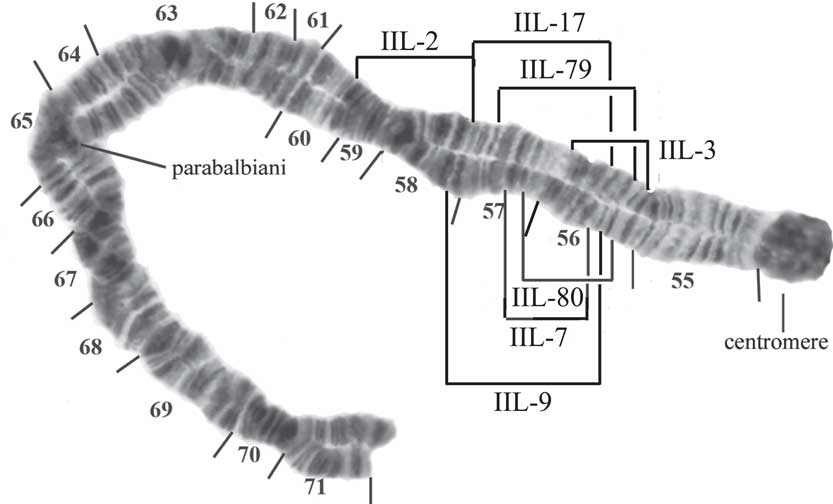
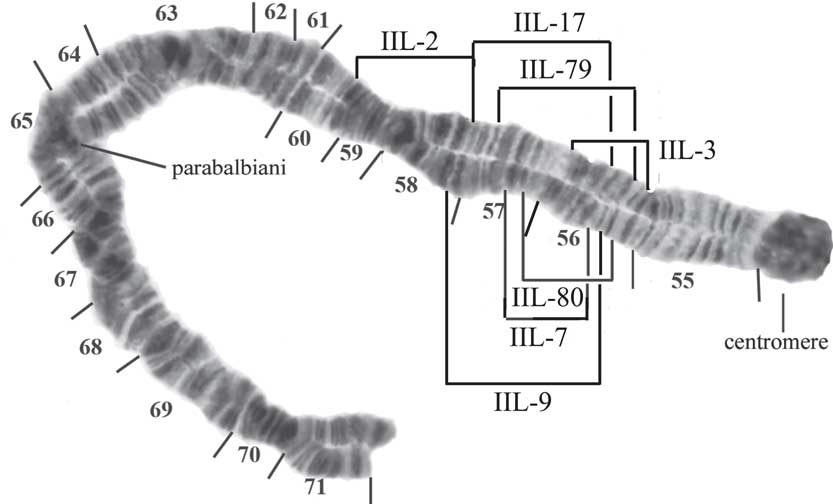
Samples were held on ice (4 °C) until our return to the laboratory where they were sorted to members of the Simulium arcticum complex based on the morphology of head patterns, postgenal clefts and the number of pupal respiratory filaments (Currie Reference Currie1986). Larvae were opened ventrally, placed in tap water for 30 minutes, blotted onto filter paper to remove silk, and hydrolysed in a pre-warmed vial of N HCl at 64 °C for exactly nine minutes. Larvae were stained in Feulgen in the dark for one hour (Rothfels and Dunbar Reference Rothfels and Dunbar1953), cleared in sulphur water for one hour, and placed in tap water overnight. Salivary glands and gonads (testes are spherical while ovaries are elongate) were dissected out in 50% acetic acid, placed on clean microscope slides and squashed. The maps of Shields and Procunier (Reference Shields and Procunier1982) were used to describe chromosome rearrangements. As most of the sex-linked chromosomal inversions in the S. arcticum complex occur in the long arm of chromosome II (Shields Reference Shields2013), we stressed analysis of this region (Fig. 2).
For each larva from each site we determined the linkage of paracentric inversions to sex. For each collection site we determined a percentage of males. These data were used to chromosomally characterise each site and to determine whether there was geographic patterning to the distribution of S. arcticum larvae based on the types and frequency of sex chromosomes. Permanent microscope slides of these taxa are on file in the Shields laboratory in the Department of Life and Environmental Sciences, Carroll College, Helena, Montana, United States of America.
Results
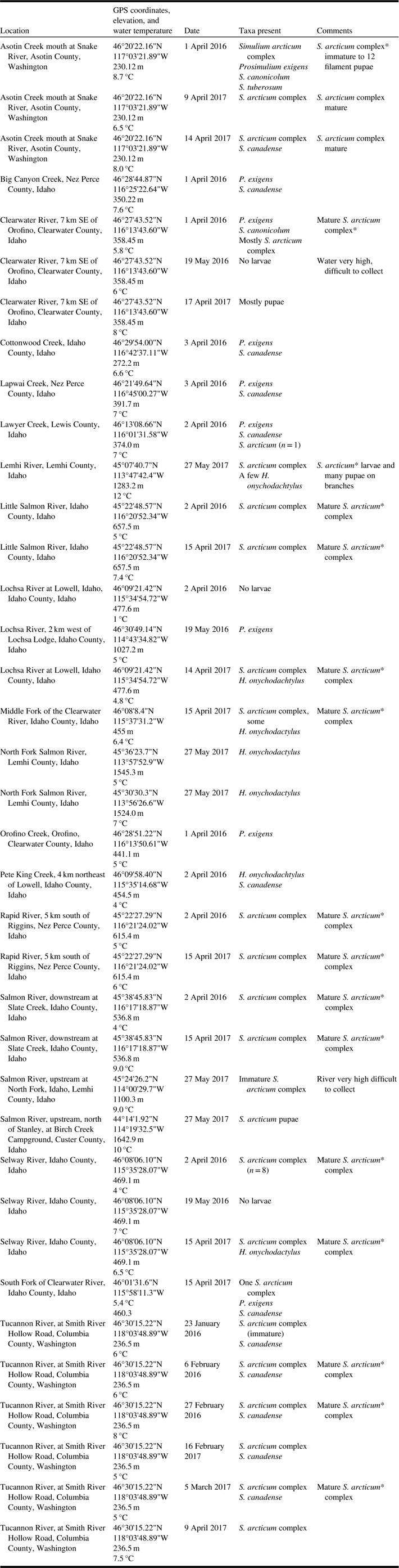
We made 37 collections at 21 geographic sites and found Simulium canadense Hearle at 10 sites, Prosimulium exigens Dyer and Shannon at seven, Helodon onychodachtylus Dyer and Shannon at six, S. canonicolum Dyer and Shannon at two, and S. tuberosum Lundstrom at one site (Table 1). These taxa will be the subject of a separate study and will not be discussed further here.
Larval collections of this study.

* Collections from which polytene chromosomes were analysed.
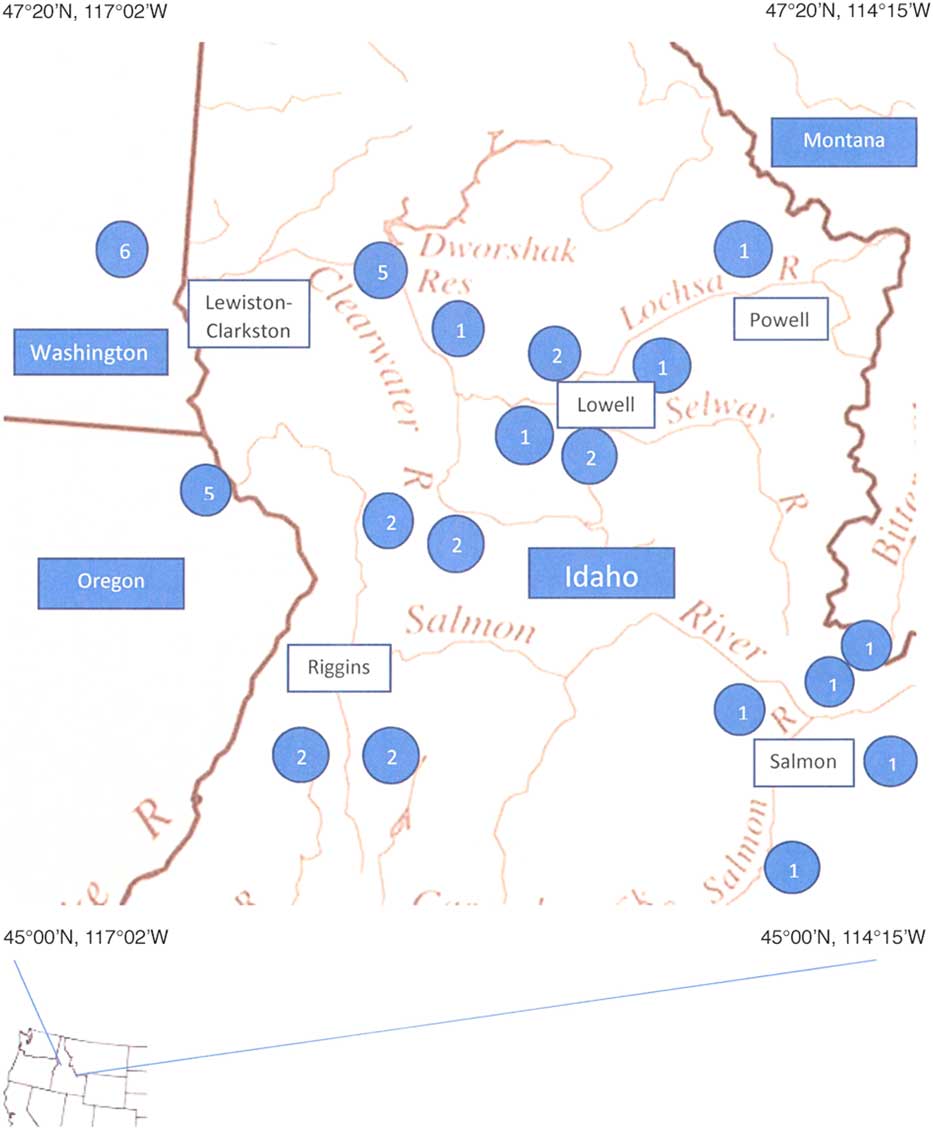
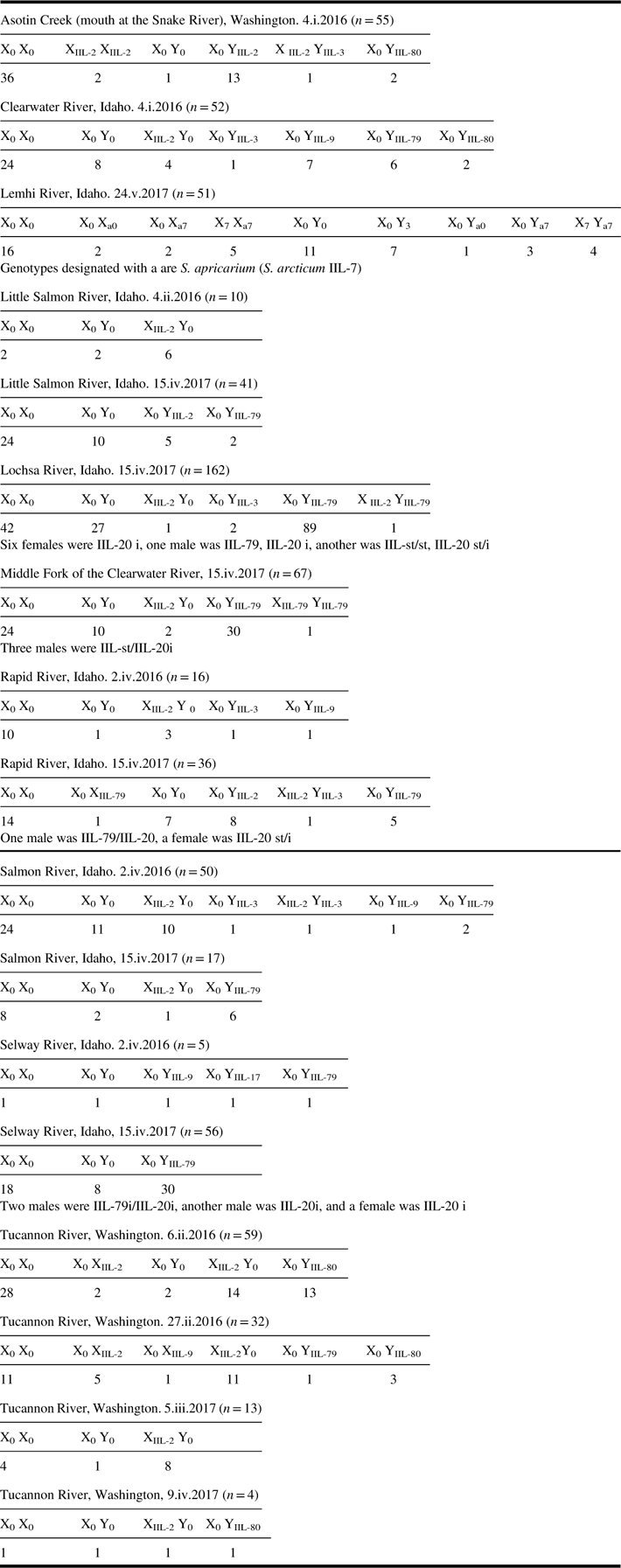
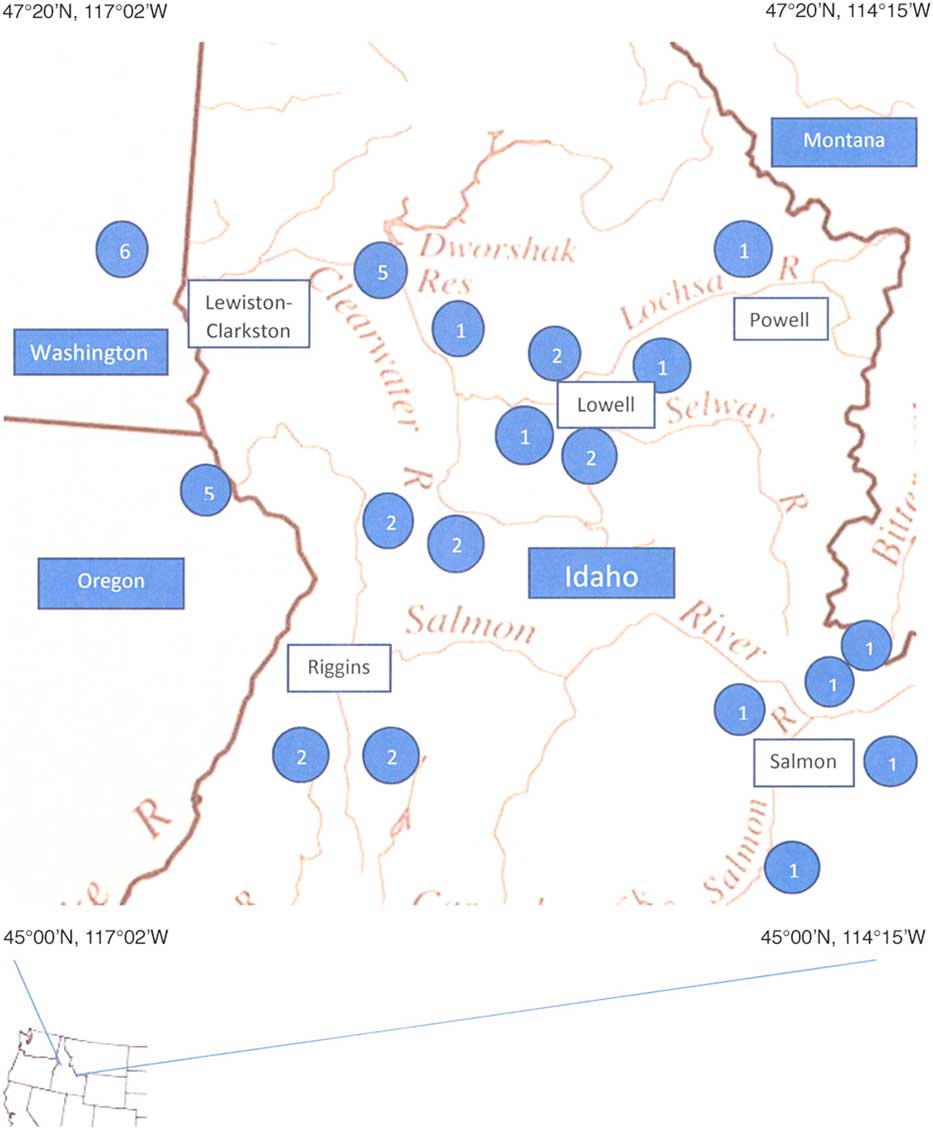
We found members of the S. arcticum complex at 10 sites (25 collections, Table 1; Fig. 1). We obtained analysable polytene chromosomes for 726 individuals from 16 of these collections (Table 2; Fig. 2). At least 50 individuals were analysed for each of these 10 sites. Some collections (Lochsa River and the Middle Fork of the Clearwater River) contained numerous, well-nourished larvae and these collections resulted in increased analysable sample sizes (Table 2).
Map of the major river drainages of central Idaho and southeastern Washington with numbers of collections at each site (blue circles).
Chromosome map of the long arm of chromosome II of the Simulium arcticum complex showing break points (brackets) of the sex-linked inversions observed in this study.
Sex chromosome diversity within the Simulium arcticum complex from various locations in southeastern Washington and central Idaho.
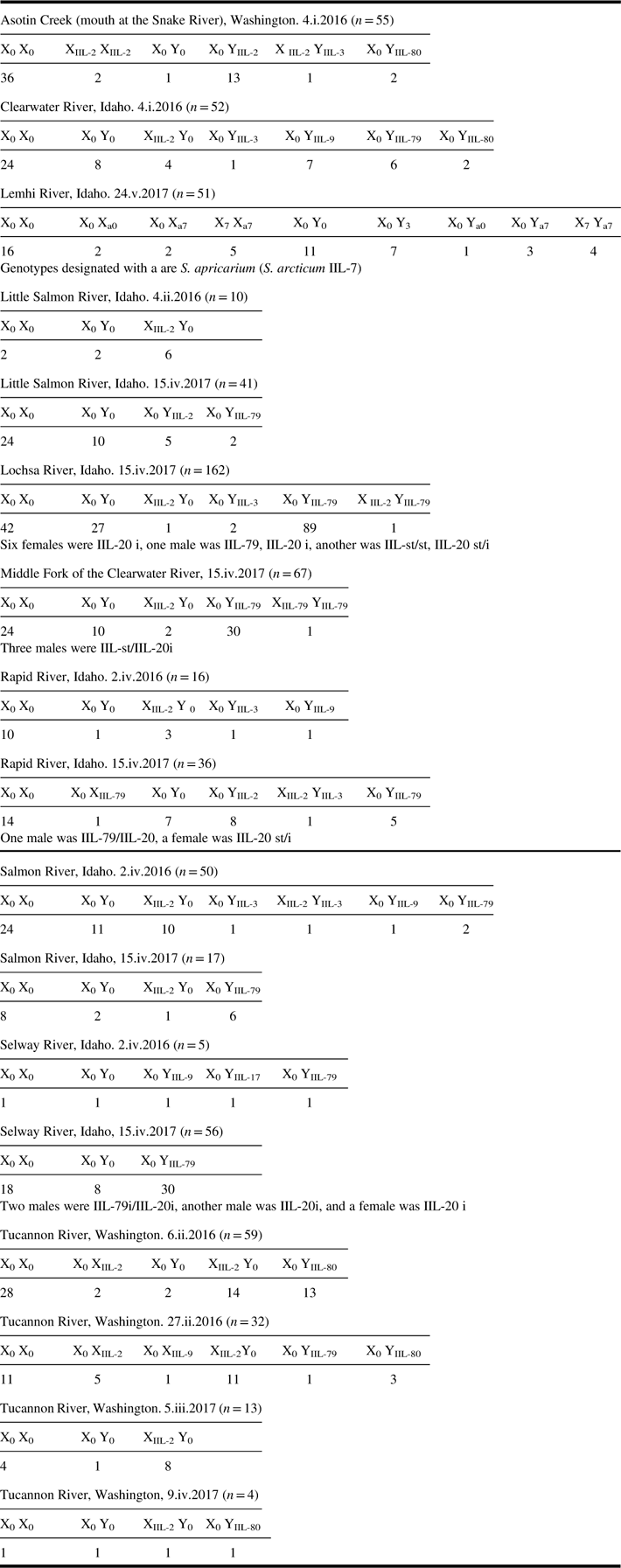
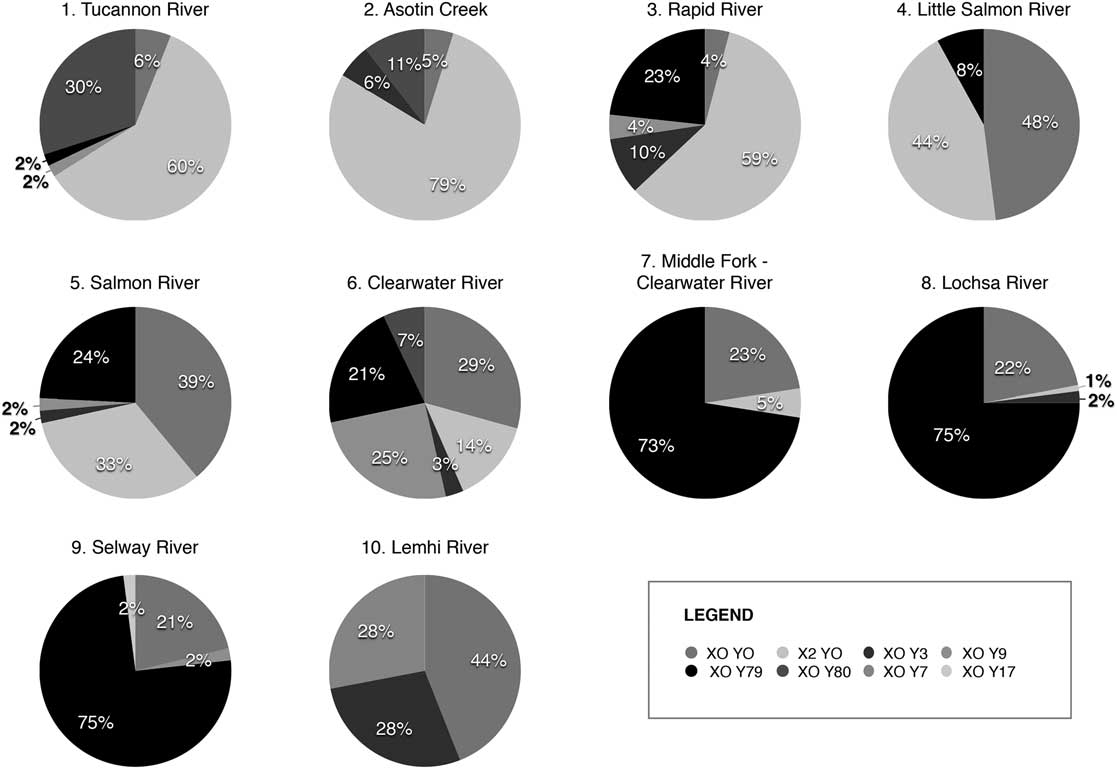
Among larvae of the S. arcticum complex we found four sibling species: S. brevicercum Knowlton and Rowe (X0 X0/X0 Y0), S. saxosum (IIL-2), S. arcticum sensu stricto (IIL-3), and S. apricarium (IIL-7) and four cytotypes: S. arcticum IIL-9, S. arcticum IIL-17, S. arcticum IIL-79, and S. arcticum IIL-80, the latter of which is new to science (Fig. 2). Simulium brevicercum occurred at nine of the 10 sites, S. arcticum IIL-79 at eight sites, and S. saxosum at seven sites. Simulium apricarium and S. arcticum IIL-17 occurred at only one site each. Of the sex determining chromosomes, IIL-79 was most abundant (n=175), Y0 was second (n=94), and X2 was third (n=81). Proportions of S. arcticum males are given (Fig. 3).
Pie-diagrams of the 10 Simulium arcticum collection sites indicating the proportions of taxa at each site. Numbers correspond to collection sites in Figure 1.
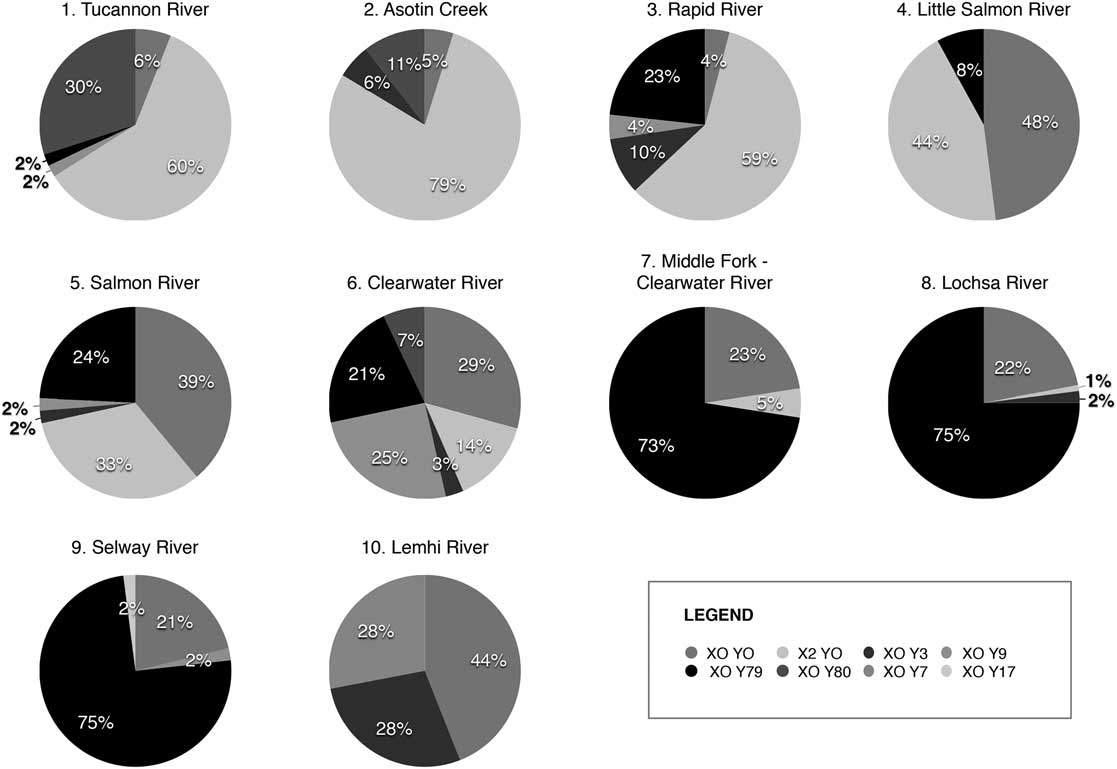
There is geographic structure to the S. arcticum types studied here (Fig. 3). Simulium brevicercum appears widespread, although it never occurs in abundance. Simulium saxosum is abundant in our western collections (Asotin Creek and the Tucannon River). Simulium arcticum IIL-79 is extremely abundant in our northeastern samples (Lochsa, 74.1% of males; Selway, 73.4%, and the Middle Fork of the Clearwater River, 70.0%). Simulium apricarium is not abundant in our collection area but occurs at the Lemhi River in the southeastern range of our analysis. The new cytotype, IIL-80, occurs only in the northwestern region of our analysis (Asotin Creek, and the Tucannon and Clearwater rivers (Table 2 and Fig. 3)).
Discussion
This study extends our knowledge of the distributions and frequencies of sibling species and cytotypes of the S. arcticum complex in an essentially unstudied and vast geographic region. Our predictions about distributions based on previous studies are largely supported. Distributions of the four sibling species observed here agree with previous studies and the presence of S. apricarium in a southern region of our study and its absence elsewhere further defines its distribution. The presence of the cytotype, S. arcticum IIL-79 in northeastern regions of our study further defines its distribution in Idaho. Apparently, ancestral (combinational) types of the S. saxosum and S. arcticum sensu stricto divergence still exist, although in low frequency in our study area. The new cytotype, IIL-80, has a restricted distribution in our study but future studies to the west and south might further define its distribution. This study also confirms that the proximal region of the long arm of chromosome II is a hot spot for chromosome change (Shields Reference Shields2013; Adler et al. Reference Adler, Yildirim, Onder, Tasci, Duzlu and Arslan2016).
The abundance of S. saxosum in our western samples (Asotin Creek and the Tucannon River) confirms our prediction that its distribution would be consistent with that reported from previous studies (Adler et al. Reference Adler, Currie and Wood2004; Shields Reference Shields2013). Simulium saxosum is generally distributed west of the Rocky Mountains in coastal regions from Alaska to California, United States of America (Shields and Procunier Reference Shields and Procunier1982; Adler et al. Reference Adler, Currie and Wood2004). It is exceedingly rare, if present at all, in Montana east of the continental divide (Shields Reference Shields2013).
In previous studies (Shields and Procunier Reference Shields and Procunier1982; Shields Reference Shields2013) female S. saxosum were predominantly XIIL-2/XIIL-2 (double inverted) types. In the present study most S. saxosum females were standard (non-inverted types). This derived characteristic may have evolved in this geographic region.
Simulium arcticum sensu stricto (IIL-3) is widely distributed east of the Continental Divide in Saskatchewan, Canada (Shields and Procunier Reference Shields and Procunier1982; Adler et al. Reference Adler, Currie and Wood2004) and Montana (Shields Reference Shields2013). Thus, its low frequency at six of the 10 sites studied here and its complete absence at the four other western sites agree with findings on its distribution from previous studies (Adler et al. Reference Adler, Currie and Wood2004; Shields Reference Shields2013).
We described “remnants” of a supposed ancestral incipient speciation event between S. saxosum and S. arcticum at the Coeur d’Alene River in northern Idaho (Shields and Kratochvil Reference Shields and Kratochvil2011). In that study “combinational” types (X0 X2, X0 Y0, and X2 Y3) were present in equilibrium frequencies and were interpreted to be the types that had given rise to S. saxosum to the west and S. arcticum sensu stricto to the east yet still were present at the Coeur d’Alene River. The presence of single individuals of X2 Y3 types at Asotin Creek and at the Rapid and Salmon rivers in the present study extend the range of these combinational types to the southwest.
Simulium arcticum IIL-79 was found in high frequency at the St. Joe River, 27 km. south of the Coeur d’Alene, and we also found combinational types between S. saxosum, S. arcticum sensu stricto, and S. arcticum IIL-79 there (Shields Reference Shields2014). In the present study, S. arcticum IIL-79 was found at eight sites and was also found in very high frequency at the eastern sites (Lochsa, Selway, and Middle Fork of the Clearwater rivers). These data suggest that S. arcticum IIL-79 has a broad geographic distribution, particularly in the eastern range of streams studied here. IIL-79 has not been found to the north of the Coeur d’Alene River where 370 larvae of the S. arcticum complex were studied (Shields and Kratochvil Reference Shields and Kratochvil2011), nor has it been found east of the Continental Divide (many 1000s of larvae analysed; Shields Reference Shields2013). Simulium arcticum IIL-79 appears to be distributed throughout central Idaho but mostly in the eastern portion of this area.
Simulium apricarium (IIL-7) occurs primarily at lower elevations in the North American southwest, in the mountain states into the central plains (Adler et al. Reference Adler, Currie and Wood2004) and in lower eastern regions of central Montana (Shields Reference Shields2013). This species is named for its tendency to develop “in the open” and it has previously been found in Twin Falls and Lincoln counties of southern Idaho (Adler et al. Reference Adler, Currie and Wood2004). Our late collection at the Lemhi River revealed the presence of S. apricarium suggesting that it may also occur in other areas of southern Idaho.
We have attempted to identify features of the environment such as elevation (Shields et al. Reference Shields, Clausen, Marchion, Michel, Styren and Riggin2007), river corridor (Shields and Hokit Reference Shields and Hokit2016) and details of the environmental niche (Conflitti et al. Reference Conflitti, Shields, Murphy and Currie2015b) that may influence the presence of taxa of the S. arcticum complex in various geographic regions. The distribution of types of S. arcticum in the present study are consistent with those previously described for S. saxosum in the west and coastal regions and for S. arcticum sensu stricto in the Rocky Mountain region to the east (Conflitti et al. Reference Conflitti, Shields, Murphy and Currie2015a). Certain unstudied environmental factors may influence the distribution of S. arcticum IIL-79 in the Lochsa, Selway, and Middle Fork of the Clearwater rivers. Similarly, the success of S. saxosum (S. arcticum IIL-2) in Asotin Creek and the Tucannon River may be influenced by local environmental factors. In might be important to analyse larvae of the S. arcticum complex in downstream waters of the Snake River. We hypothesise that they will also be high in S. saxosum frequency.
We hypothesised that such a vast area as central Idaho, if studied using the cytogenetic methods employed here, might yield new siblings or cytotypes of the S. arcticum complex. Among 726 larvae from 10 collections in central Idaho we found S. arcticum IIL-80 at Asotin Creek, and the Tucannon and Clearwater rivers. All of these 21 larvae were males. We therefore describe IIL-80 as a cytotype new to science. Four other taxa of the S. arcticum complex are present at the Tucannon River. Therefore, it might be of interest to study this drainage extensively in the future to describe the extent of the IIL-80 distribution, and to determine its reproductive status. In summary, there is geographic structure to the diversity described here with: S. saxosum in the west, S. arcticum IIL-79 in the northeast, and S. apricarium in the southeast.
Population data of this study may also be interpreted with some caution given that characterisation of chromosome diversity at any simulid collection site can be influenced by many factors. Many taxa of black flies are multivoltine (have more than one generation; Adler et al. Reference Adler, Currie and Wood2004). This study attempted to obtain first generation (spring) larvae, with the possible exception of the collection of larvae at the Lemhi River taken on 27 May 2017. Even with the emphasis on collection of first generation larvae, taxa may be developing at different rates and at different stages throughout spring. The ideal circumstance would be to make an early collection of all sites intended for study and then adjust the future collection schedule so as to obtain the largest number of mature and healthy larvae for detailed study. For chromosome analysis immature larvae are not preferred as their salivary gland chromosomes are usually not well developed. Male black flies usually develop slightly before females (Shields Reference Shields2015) and sex-ratios of early collections can be used to further define appropriate collections at later dates. This study was extended to two summers because we were unable to obtain larvae or even sufficient sample sizes at some sites (e.g., Lochsa and Selway rivers in 2016). Given these caveats, we none-the-less described diversity among the S. arcticum complex in central Idaho and southeastern Washington.
Acknowledgements
The James J. Manion Endowed Chair Fund at Carroll College financially supports the research of Gerald F. Shields. Dan Case of Carroll College helped with the figures. The authors thank Peter H. Adler of Clemson University for commenting on an earlier draft of this manuscript.