INTRODUCTION
The rate of introduction of exotic species in marine and estuarine systems has been increasing exponentially for many years and consequently problems associated with their facile adaptation to new environments have also increased (Carlton & Geller, Reference Carlton and Geller1993; Cohen & Carlton, Reference Cohen and Carlton1998; Ruiz et al., Reference Ruiz, Fofonoff, Carlton, Wonham and Hines2000). Hard substrates (floats, docks, piers, retaining walls, buoys, etc.), especially those in estuaries and bays where hydrodynamics are limited, are most susceptible to the introduction of exotic species. At the same time, those introduced species are often unable to spread to surrounding coastal marine areas (Wasson et al., Reference Wasson, Fenn and Pearse2005; Ruiz et al., Reference Ruiz, Freestone, Fofonoff, Simkanin and Wahl2009), although there are exceptions. For example, in South Africa the exotic mussel Mytilus galloprovincialis (Lamarck, 1819) compete with native mussels (Perna perna (Linnaeus, 1758)—Branch & Steffani, Reference Branch and Steffani2004); the tunicate Pyura praeputialis (Heller, 1878), is displacing the native mussel Perumytilus purpuratus (Lamarck, 1819) in Chile (Castilla et al., Reference Castilla, Guinez, Caro and Ortiz2004); the mussel Isognomon bicolor (Adams, 1845) is abundant in Rio de Janeiro (Breves-Ramos et al., Reference Breves-Ramos, Junqueira, Lavrado, Silva and Ferreira-Silva2010) and overtaking the area occupied by the mussel Perna perna that was introduced long ago (Souza et al., Reference Souza, Fernandes, Silva, Silva and Souza2004).
The lower invasibility of coastal marine areas compared to estuaries has been attributed to: (1) lower propagule pressure; (2) selection of estuarine specialists by the transport vector (ballast water); (3) limited establishment of viable populations because of the dispersal of larvae; and (4) stronger biotic resistance (Wasson et al., Reference Wasson, Fenn and Pearse2005). Further, tidal regions often impose a filter due to the wide variation in environmental conditions that occur from low to high tide and which may limit invasibility of some species. Temperature variation during low tides which imposes metabolic costs has long been recognized as a limitation against the upper dispersal of many rocky shore species (Somero, Reference Somero2002). Even tide pools suffer strong temperature variation and constitute a limiting factor for the establishment of some species (Klugh, Reference Klugh1924). Other sources of environment stress in intertidal zones are exposure to storm-generated waves and abrasion by floating debris, desiccation stress, reduced feeding opportunity and shortage of oxygen during low tides (Levinton, Reference Levinton2008). As a consequence, one would expect that the intertidal zone would be less invaded by exotic species than the subtidal zone in coastal marine areas but such comparison has not been done yet.
Crustaceans are among the most common invasive marine organisms (Carlton, Reference Carlton, Galil, Clark and Carlton2011), perhaps because of being carried in the ballast of ocean-going vessels (Carlton & Geller, Reference Carlton and Geller1993; Ruiz et al., Reference Ruiz, Fofonoff, Carlton, Wonham and Hines2000). In this group, barnacles are among the most frequently introduced crustaceans due to their habit of becoming fixed on a variety of substrates, especially in sea ports that have heavy ship traffic (Lewis et al., Reference Lewis, Riddle and Smith2005). Barnacles are also dominant inhabitants of the intertidal zone and some of the famous cases of barnacle introductions in this habitat include the invasion of coastal Argentina and artificial (human-made) substrates in Japan by Balanus glandula Darwin, 1854, native to the eastern Pacific Ocean. In both localities, Balanus glandula is dominating the intertidal zone and causing a decline in native species (Vallarino & Elias, Reference Vallarino and Elias1997; Kado, Reference Kado2003; Schwindt, Reference Schwindt2007). Austrominius modestus (Darwin, 1854) is outcompeting the native Semibalanus balanoides (Linnaeus, 1767) (Crisp, Reference Crisp1958; Harms, Reference Harms1999) apparently due to its tolerance of low salinity and cold waters (Harms, Reference Harms1999; Lawson et al., Reference Lawson, Davenport and Whitaker2004). Chthamalus proteus Dando & Southward, 1980 was introduced more recently in Hawaii but, while considered to be established there, has not yet shown signs of becoming a problem (Southward et al., Reference Southward, Burton, Coles, Dando, DeFelice, Hoover, Parnell, Yamaguchi and Newman1998), but in some manipulative field experiments this species showed potential negative impacts such as decreasing the abundance of the native limpet Siphonaria normalis (Zabin & Altieri, Reference Zabin and Altieri2007) and competing with other barnacles via substrate pre-emption, resulting in niche compression (Zabin, Reference Zabin2009).
Brazil is still in early stages of gathering information on invasions and invasive species in marine systems and therefore research is often centred on certain places and settings, rather than broader regional considerations, thus it is difficult to examine or describe broader trends. The first list of exotic marine species was published in 2009 and included the following barnacles in the suborder Balanomorpha: Amphibalanus reticulatus (Utinomi, 1967), Megabalanus coccopoma (Darwin, 1854) and Striatobalanus amaryllis (Darwin, 1854) (Lopes, Reference Lopes2009). A recent survey of intertidal and shallow water barnacles, on the north-eastern coast produced a checklist of 28 non-symbiont species and increased the number of exotic species (Farrapeira, Reference Farrapeira2010). The revision by Carlton et al. (Reference Carlton, Newman, Pitombo, Galil, Clark and Carlton2011) did not agree with some of the criteria used to classify exotic species in the Farrapeira (Reference Farrapeira2010) study and considered six species as introduced on the Brazilian coast: the three already listed plus Balanus trigonus Darwin, 1854, Amphibalanus amphritite (Darwin, 1854), and Amphibalanus subalbidus (Henry, 1974). In addition to introduced species, cryptogenic species must be considered in bioinvasions to avoid underestimating the importance of species whose origins are still not well known (Carlton & Geller, Reference Carlton and Geller1993; Carlton, Reference Carlton1996). Due to the lack of surveys prior to the 1950s, many species of widespread barnacles in Brazil are considered cryptogenic (e.g. A. eburneus (Gould, 1841), A. improvisus (Darwin, 1854), A. venustus (Darwin, 1854) and Megabalanus tintinnabulum (Linnaeus, 1758)) (Farrapeira, Reference Farrapeira2010; Carlton et al., Reference Carlton, Newman, Pitombo, Galil, Clark and Carlton2011).
Since most previous surveys were done on artificial substrates, here we examine the issue of barnacle invasion in Brazil with the following objectives: (1) determine which species of barnacles have been introduced in the intertidal zones of rocky shores and reefs in Brazil; (2) estimate the abundance of those barnacles (as percentage cover); and (3) create a reference database for future studies of barnacle bioinvasions.
MATERIALS AND METHODS
Study area
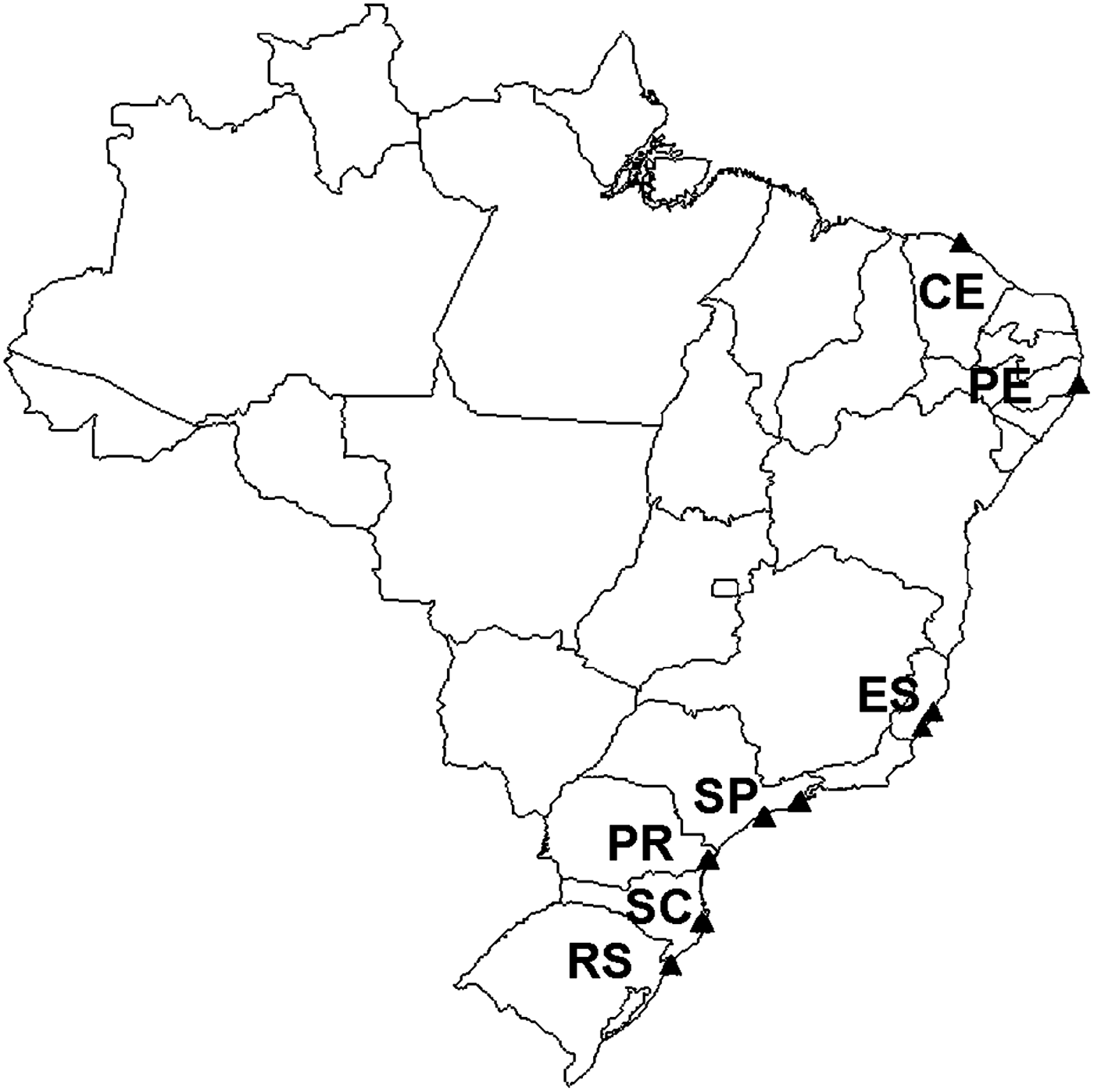
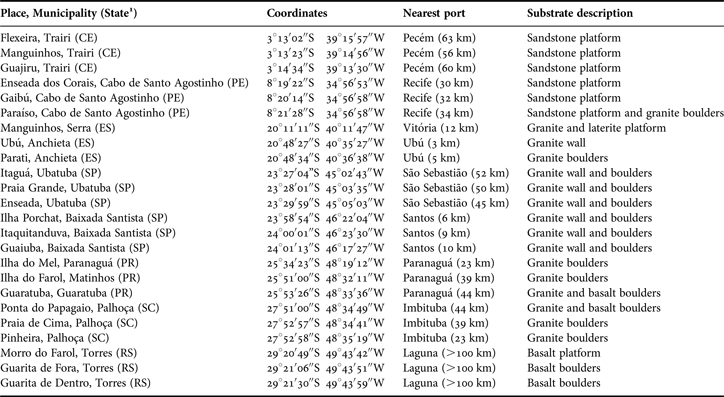
The study was carried out in rocky intertidal zones and coastal reefs over a range of more than 25° latitude, including the States of Ceará (CE), Pernambuco (PE), Espírito Santo (ES) which belong to the Spalding et al. (Reference Spalding, Fox, Allen, Davidson, Ferdana, Finlayson, Halpern, Jorge, Lombana, Lourie, Martin, McManus, Molnar, Recchia and Robertson2007) Tropical Southwestern Atlantic province, and São Paulo (SP), Paraná (PR), Santa Catarina (SC) and Rio Grande do Sul (RS) which belong to the Warm Temperate Southwestern Atlantic province (Figure 1). Three coastal locations were sampled in each state, with a minimum of 5 km between sampling points. Two places were sampled (north and south) in the State of São Paulo (Table 1).
Map of Brazil showing the States and locations where we sampled. Each triangle indicates three sites (except Espírito Santo where north = 1 site and south = 2 sites). State abbreviations as in Table 1.

List of sampling locations along the Brazilian coast.

1 CE, Ceará; PE, Pernambuco; ES, Espírito Santo; SP, São Paulo; PR, Paraná; SC, Santa Catarina; RS, Rio Grande do Sul.
All the sites were at marine open coast and the substrate characteristics of each are shown in Table 1.
Sampling
Samples were collected between July and October 2010 during low spring tides by researchers of the South American Research Group on Coastal Ecosystems—SARCE. Part of this project is to examine and explain latitudinal species distribution patterns throughout coastal South America.
The intertidal zone was divided into horizontal strata following the zonation patterns exhibited by the organisms in each location. Thus, three strata were identified in the States of Paraná, São Paulo, Ceará and in Paraíso (PE), while two strata were recognizable in the remaining places. Ten quadrats were used per stratum, with the exception of Ilha do Mel and Guaratuba, where the rocky coasts were small and we sampled only five quadrats, and Ilha do Farol, where we sampled seven. Percentage cover was estimated for barnacles along with the amount of empty space using the point-intercept method. To estimate cover and empty space, a 0.25 m2 quadrat was used, in which a grid was laid out with 100 points. At each point, barnacles (or empty space) was present or absent. In addition to quadrats, active searches were used to find barnacles. When found, the species and intertidal stratum in which it was found were noted.
Species were identified when possible in the field. When not possible, animals were fixed in alcohol and taken to the laboratory for later identification. Species were classified as native, introduced or cryptogenic following Carlton et al. (Reference Carlton, Newman, Pitombo, Galil, Clark and Carlton2011).
RESULTS
All species were identified in most of the locations, but in Espírito Santo and Ceará, this was not possible with two species in the genus Chthamalus (C. bisinuatus Pilsbry, 1916 and C. proteus). Therefore, both are referred to as Chthamalus spp.
Nine species of barnacles were found in the 24 sampled locations. Of these, three are native (Chthamalus bisinuatus, Chthamalus proteus and Tetraclita stalactifera (Lamarck, 1818)), three are introduced (Amphibalanus amphitrite (Darwin, 1854), A. reticulatus and Megabalanus coccopoma) and three are cryptogenic (A. improvisus, M. tintinnabulum (Linnaeus, 1758) and Newmanella radiata (Bruguière, 1789)).
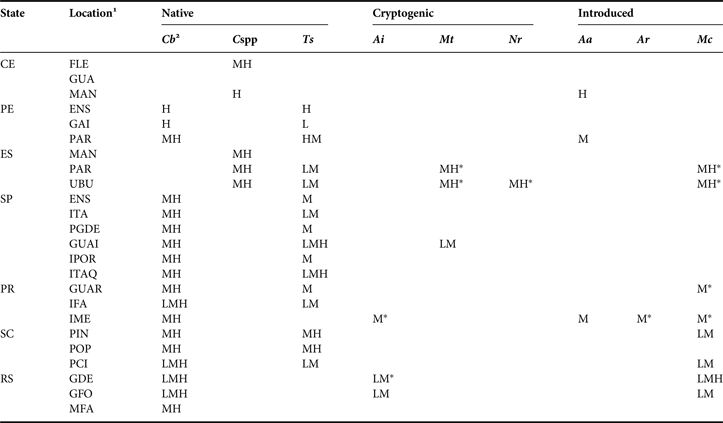
Five species was the greatest richness found in two places, Ubú (Espírito Santo) and Ilha do Mel (Paraná). One species at Ubú (M. coccopoma) and three at Ilha do Mel (M. coccopoma, A. amphitrite and A. reticulatus) were introduced (Table 2). Megabalanus coccopoma was also found at Parati (Espírito Santo), Guaratuba (Paraná), Pinheira and Praia de Cima (Santa Catarina), Guarita de Fora and Guarita de Dentro (Rio Grande do Sul); Amphibalanus amphitrite was found at Manguinhos (Ceará) and Paraíso (Pernambuco) while A. reticulatus was only found at Ilha do Mel (Paraná; Table 2).
Barnacle species and position (low (L), medium (M) or high (H)) in the intertidal zone along the Brazilian coast.

1 FLE, Flecheiras; GUA, Guajiru; MAN, Manguinhos; ENS, Enseada; GAI, Gaibú; PAR, Paraíso; MAN, Manguinhos; PAR, Parati; UBU, Ubú; ITA, Itaguá; PGDE, Praia Grande; GUAI, Guaiúba; IPOR, Ilha Porchat; ITAQ, Itaquitanduva; GUAR, Guaratuba; IFA, Ilha do Farol; IME, Ilha do Mel; PIN, Pinheira; POP, Ponta do Papagaio; PCI, Praia de Cima; GDE, Guarita de Dentro; GFO, Guarita de Fora; MFA, Morro do Farol; 2 Cb, Chthamalus bisinuatus; Cspp, Chthamalus spp.; Ts, Tetraclita stalactifera; Ai, Amphibalanus improvisus; Mt, Megabalanus tintinnabulum; Nr, Newmanella radiatta; Aa, Amphibalanus amphitrite; Ar, Amphibalanus reticulatus; Mc, Megabalanus coccopoma; *, locations where the species were only found by active search ouside the quadrats.
Among the cryptogenic species Amphibalanus improvisus was found at Ilha do Mel (Paraná), Guarita de Dentro and Guarita de Fora (Rio Grande do Sul); M. tintinnabulum at Parati and Ubú in Espirito Santo) and Guaiuba (São Paulo) and N. radiata only at Ubú (Espírito Santo; Table 2).
Some species were found only by active search (qualitative method) in certain localities: A. improvisus at Ilha do Mel and Guarita de Dentro; A. reticulatus at Ilha do Mel; M. coccopoma at Ilha do Mel, Guaratuba, Parati and Ubú; M. tintinnabulum at Parati and Ubú; N. radiata at Ubú (locations marked with * in Table 2).
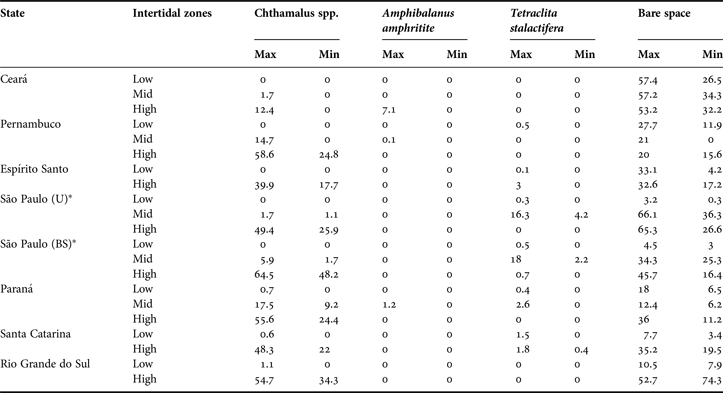
The genus Chthamalus was found at all sites except Guajiru (Ceará), where no species of barnacle was found (Table 2). Chthamalus bisinuatus was usually the most abundant of the barnacles and in the upper intertidal stratum of the rocky shore in São Paulo (Table 3). Tetraclita stalactifera, also native, was found in all sampling sites in the States of Pernambuco, Santa Catarina and São Paulo, and in Parati and Ubú (Espírito Santo), Guaratuba and Ilha do Farol (Paraná). It was also found in all strata, but most abundantly in the mid-intertidal zone in Ubatuba, São Paulo (Table 3). It was found in neither Ceará nor Rio Grande do Sul (Table 2). Megabalanus coccopoma was only found in small numbers in the middle stratum in Paraná and the infralittoral of Santa Catarina and Rio Grande do Sul (all at less than 1%). Amphibalanus amphitrite was more abundant in the upper strata in Ceará (7.1%) (Table 3).
Percentage cover of the most common barnacle species and bare space along the Brazilian coast. Values correspond to the total cover of ten 1 m2 quadrats in one of three sites in each state.

*U, Ubatuba; BS, Baixada Santista.
Usually the upper and middle strata had more available bare space (except in Ceará and Pernambuco), varying from 66.1% in São Paulo to 6.2% in Paraná. Ceará was different than the overall pattern, with equal available space in all three strata (Table 3).
DISCUSSION
The nine species of barnacles were evenly distributed between native, introduced and cryptogenic, which perhaps is not surprising for such an easily transported group of organisms. In contrast, the native Chthamalus spp. was always most abundant, while the introduced and cryptogenic species were always less common when present. Chthamalus spp. was expected to be most abundant considering that it is typical of hard rocky intertidal regions (especially the upper stratum) in Brazil (Young, Reference Young1993; Farrapeira, Reference Farrapeira2009, Reference Farrapeira2010; Masi et al., Reference Masi, Macedo and Zalmon2009). It also has morphological adaptations for this situation of extreme exposure to drying, high temperatures and lack of food when exposed during low tides (Pannacciulli & Relini, Reference Pannacciulli and Relini2000). In Rio Grande do Sul, Santa Catarina, Paraná, São Paulo and Pernambuco this genus was exclusively represented by the species C. bisinuatus, while in the remaining locations both C. bisinuatus and C. proteus may occur because we did not collect samples from those areas and field identification of this genus is very difficult.
While our methodology (which was used for other purposes) may underestimate the abundance of rare species (all species except Chthamalus), we still found three introduced (Amphibalanus amphitrite, A. reticulatus and Megabalanus coccopoma) and three cryptogenic species (A. improvisus, M. tintinnabulum and Newmanella radiata). But, we did not find Striatobalanus amaryllis, Amphibalanus subalbidus or Balanus trigonus that have already been recognized as introduced along the Brazilian coast (Farrapeira, Reference Farrapeira2009, Reference Farrapeira2010; Carlton et al., Reference Carlton, Newman, Pitombo, Galil, Clark and Carlton2011). While they may occur in the intertidal zone, they seem to be more restricted to the sublittoral.
Previously considered cryptogenic, Amphibalanus amphitrite (Neves et al., Reference Neves, Rocha, Pitombo and Roper2007; Lopes, Reference Lopes2009; Farrapeira, Reference Farrapeira2010) may instead have been introduced to the western Atlantic after the Second World War (see review in Carlton et al., Reference Carlton, Galil, Clark and Carlton2011). That same review concluded that information is still lacking to determine the status of M. tintinnabulum and so its status remains cryptogenic. Newmanella radiata is a West Atlantic species found in the Gulf of Mexico (Gittings, Reference Gittings, Felder and Camp2009), Bahamas, Puerto Rico, Venezuela, Trinidad & Tobago (Ross, Reference Ross1969) and along the Brazilian coast, from Pernambuco in the north to Santa Catarina in the south (Farrapeira, Reference Farrapeira2009). Since we do not have enough information about its origin and to know whether the Amazon delta is a natural barrier against dispersal, the species may be either native to its present distribution or the result of human transport across this barrier. Thus we decided to consider it cryptogenic, although previous publications considered it introduced in Brazil.
Amphibalanus reticulatus was only detected at Ilha do Mel by active search and this is the first report of the species on natural substrate in southern Brazil, even though it is one of the most common barnacles on artificial substrates in Paranaguá Bay (Rocha et al., Reference Rocha, Cangussu and Braga2010). It seems to be a sublittoral species (Rigo, Reference Rigo2011) that can rarely recruit and survive in the intertidal, and its rarity prevents it from being sampled with the quadrat methodology. It may have arrived here through: (1) larvae liberated by adults that are encrusted on ship hulls that visited the Paranaguá Port; and (2) larvae liberated by adults already established on artificial substrates in the Port of Paranaguá or the Yacht Club of Paranaguá. This species has been found on artificial substrates in Rio Grande do Norte, Paraíba, Pernambuco and Rio de Janeiro and in natural settings in Maranhão, Pernambuco, Alagoas, Bahia, Rio de Janeiro and Paraná (Calado & Souza, Reference Calado and Sousa2003; Farrapeira, Reference Farrapeira2006, Reference Farrapeira2008, Reference Farrapeira2009, Reference Farrapeira2010; Ignacio et al., Reference Ignacio, Julio, Junqueira and Ferreira-Silva2010; Rocha et al., Reference Rocha, Cangussu and Braga2010). It seems to be rare, while a recent introduction to Brazil, it is becoming more abundant than A. amphitrite in some places, and it has a greater growth rate than A. improvisus (Mayer-Pinto, Reference Mayer-Pinto2004). Also, it is very similar to the native Fistulobalanus citerosum in Paranaguá Bay in respect to the high reproductive effort (>50,000 brooded larvae per individual), continuous liberation of larvae along the year, and minimum age for development of gonads (Rigo, Reference Rigo2011). This shows that it has adapted to local conditions (or already was) and its introduction in natural settings may have consequences for the local native barnacles and other animals in these places. In São Paulo, this species was seen on the sea turtle Chelonia mydas (Linnaeus, 1758) (Loreto & Bondioli, Reference Loreto and Bondioli2008), which indicates that its capacity for transport includes natural vectors as well. Thus, even though not (yet) abundant in our sampling locations, it is important that it be monitored to monitor its possible expansion to avoid damage to the native community.
Megabalanus coccopoma is more widespread, from Espírito Santo on the central coast to Rio Grande do Sul in the south. We did not find it in São Paulo but its known distribution does include São Paulo and Rio de Janeiro. In Rio de Janeiro it is more abundant than, and competes for space with, M. tintinnabulum where there is anthropic perturbation (Lacombe & Monteiro, Reference Lacombe and Monteiro1974; Young, Reference Young1994, Reference Young and Young1998; Ignacio et al., Reference Ignacio, Julio, Junqueira and Ferreira-Silva2010). In Pernambuco and Rio Grande do Norte it is still restricted to artificial substrates and as part of the encrusting fauna on boat and ship hulls (Silveira et al., Reference Silveira, Souza, Fernandes and Silva2006; Farrapeira et al., Reference Farrapeira, Melo, Barbosa and Silva2007).
Amphibalanus improvisus and M. tintinnabulum were already recorded at these locations and are widespread in coastal Brazil (Young, Reference Young1994). They are among the most abundant members of the encrusting community on hulls, which is the most likely method of dispersal (Farrapeira, Reference Farrapeira2010).
Ilha do Mel (Paraná) had the greatest barnacle species richness and consequently, also the greatest number of introduced species. This island is adjacent to the route for ship traffic to the Port of Paranaguá (23 km from the port, but much closer to the traffic lanes) which is the likely source of propagules (Cohen & Carlton, Reference Cohen and Carlton1998; Breton, Reference Breton2005). On the other hand, while the Baixada Santista (São Paulo) is only 6 km from the port of Santos and Manguinhos (Espírito Santo) only 12 km from the port of Vitória, neither had introduced species and both had lower richness than Paranaguá. Why this is so is unclear but might be because researchers only took samples from the quadrats and did not search all substrates in Santos. However, that is not true in Vitória, where all substrates were searched. So, while being near a port may favour introduction, it does not necessarily guarantee successful colonization. An alternative explanation is that processes following introduction such as physical or biological factors that facilitate or prevent the establishment of introduced species are more important at those locations (Wasson et al., Reference Wasson, Fenn and Pearse2005).
The hypothesis that tropical regions have greater number of species interactions that reduce the success of species introductions (Sax, Reference Sax2001) might explain the fewer number of species found to the north of Espírito Santo. However, the most tropical State in this study, Ceará, had more empty space and lower native species richness. This may have led to this area being more vulnerable to introductions if there is a positive correlation between species diversity and resistance to invasion as hypothesized (Stachowicz et al., Reference Stachowicz, Whitlatch and Osman1999; Naeem et al., Reference Naeem, Knops, Tilman, Howe, Kennedy and Gale2000). Greater resistance to invasion in more diverse communities is a consequence of more efficient occupation of space by the native species, which results in less space available for settling for larvae of exotics (Stachowicz et al., Reference Stachowicz, Fried, Osman and Whitlatch2002). If so, the absence of cryptogenic species and only one introduced species in Ceará may be due to: (1) methodological issues, since in this location researchers did not search actively for them outside the quadrats; or (2) other factors such as the lack of propagules or biotic resistance (Ruiz et al., Reference Ruiz, Fofonoff, Carlton, Wonham and Hines2000; Wasson et al., Reference Wasson, Fenn and Pearse2005).
While the three introduced species were found all along the coast of Brazil, their abundance was very low, except for A. amphritite in Manguinhos, Ceará. Native species were dominant in all sampling locations, which are similar to the pattern in coastal North America (Ruiz et al., Reference Ruiz, Freestone, Fofonoff, Simkanin and Wahl2009). Most introduced species in Brazil are sublittoral and may be found along the lower limit of the intertidal region. One exception, Amphibalanus amphitrite, is commonly found in polluted regions of the lower to middle intertidal zones in estuaries and marinas (Lacombe & Monteiro, 1986; Young, Reference Young1994; Junqueira et al., Reference Junqueira, Falcão, Mayer-Pinto and Silva2000; Breves-Ramos et al., Reference Breves-Ramos, Lavrado, Junqueira and Silva2005; Farrapeira, Reference Farrapeira2006, Reference Farrapeira2009). Again, two types of explanation are possible: (1) pre-introduction processes are influencing the propagule availability; or (2) processes following introduction are preventing species establishment (Wasson et al., Reference Wasson, Fenn and Pearse2005). Since most exotic species found are sublittoral, vectors (e.g. ship hulls, buoys and other floating substrates) which favour species that are unaccustomed to exposure to air might be more important than non-selective vectors (e.g. ballast water) for those species. Thus, the intertidal region may be somewhat protected from introductions due to transport selection for species that do not resist desiccation in the intertidal region. Further, only in Ceará the port is offshore and marine larvae would have direct access to open ocean substrates. All other ports are inside estuarine regions and larvae would have to leave the estuary to reach the sampling locations. Studies of the interactions of introduced barnacles with their environment or with the natural community are still lacking in Brazil and we do not have any evidence about processes following introductions (environment stress or biotic resistance) avoiding the establishment of exotics in the intertidal zone.
While A. amphitrite and Balanus trigonus arrived around 100 years ago, in the Americas most introductions occurred in the 1950s just after the Second World War (Carlton et al., Reference Carlton, Newman, Pitombo, Galil, Clark and Carlton2011). But, introductions in the intertidal zones could be even more recent, such as Balanus glandula in Argentina in the 1970s (Vallarino & Elias, Reference Vallarino and Elias1997; Schwindt, Reference Schwindt2007). The scarcity of barnacle studies in South America may explain why we do not see more introductions. Most studies are restricted to, usually submerged, artificial structures in ports and marinas.
While abundance of introduced and cryptogenic species in this study is apparently low (but, 65% of the total number of species), it is important that management focus on preventing future invasions, through assiduous attention to ballast water and ship hull incrustations, importation of allochthonous shellfish stocks for culture, and so forth. In addition to monitoring for introductions, the ecological impact and population dynamics of the species already introduced must be studied to determine the impact of introductions on native species and better understand processes that could avoid the establishment of exotics.
ACKNOWLEDGEMENTS
We thank SARCE—South American Research group on Coastal Ecosystems—and its coordinator, Juan José Cruz Motta for financial support for the field work. Thanks to Tito M.C. Lotufo, Franciane M. Pellizzari and Augusto A.V. Flores who shared their data from Ceará, Paraná and São Paulo, respectively. We also thank Jim Carlton and another anonymous referee who improved the previous version of this manuscript. R.M.R. thanks CNPq for her research grant (303882/2007-7) and A.S.K. and A.P.R.R. thank CAPES, for their graduate fellowships. James J. Roper translated this text from the original Portuguese. This is contribution 1887 of the Zoology Department, Universidade Federal do Paraná.