Introduction
Chronic rhinosinusitis is a common debilitating disease affecting between 10 and 15 per cent of the adult population in Europe and USA.Reference Gliklich and Metson1, Reference Hastan, Fokkens, Bachert, Newson, Bislimovska and Bockelbrink2 Besides the huge economic burden on the health service and the societal impact, individual chronic rhinosinusitis patients frequently suffer significantly impaired quality of life.Reference Lange, Holst, Thilsing, Baelum and Kjeldsen3 Unfortunately, a combination of poor understanding of the condition by clinicians and the lack of consistent effective management algorithms have compromised treatment to date.
A myriad of factors have been implicated in the underlying aetiology of chronic rhinosinusitis, including anatomical, functional (impaired mucociliary clearance), allergic,Reference Wilson, McMains and Orlandi4 infective and environmental factors, and, more recently, microbial biofilms.Reference Wilson, McMains and Orlandi4–Reference Benninger, Ferguson, Hadley, Hamilos, Jacobs and Kennedy6 With the increasing attention paid to biofilms, we have sought to highlight the latest evidence of their role in the pathogenesis of chronic rhinosinusitis.
Materials and methods
The review was performed using databases with independently developed search strategies, including Medline, Embase, the Cumulative Index to Nursing and Allied Health Literature, the Cochrane Library, and Zetoc, in addition to conference proceedings and a manual search of the literature, with the last search conducted on 18 January 2014. We considered all studies, including retrospective case series and prospective cohorts. Key words utilised in the search included the following: ‘biofilms’, ‘chronic rhinosinusitis’, ‘CRS’, ‘DNase’, ‘extracellular DNA’ and ‘biofilm dispersal’.
Biofilm structure and formation
Biofilms are a preferred state in which microbes exist in nature – as opposed to the planktonic (free-floating) form. Biofilms display many differences to their planktonic counterparts with respect to growth and genetic expression. The formation of microbial biofilms begins when independent planktonic bacteria become sessile, and adhere to surfaces to form microcolonies at the interface between these surfaces and air, fluid, or foreign material. The switch to the biofilm phenotype occurs through the activation of intercellular signalling pathways that occurs when microbes reach a critical mass, a phenomenon known as ‘quorum sensing’.
Microbes are encased in an extracellular protective matrix of polysaccharides, nucleic acids, proteins and extracellular DNA, which evade the host immune response and antimicrobial treatment. This matrix can increase the resistance of microbes within biofilms (compared to their planktonic counterpart) to antimicrobials by up to 1000-fold.Reference Gilbert, Das and Foley7
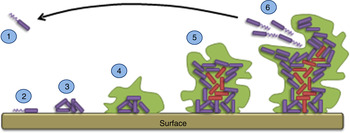
Once the biofilm is mature, bacteria can detach either through external forces or by an active process. The release of planktonic bacteria from the biofilm results in spread of bacteria to other locations, enabling the whole cycle to recommence (Figure 1).
Biofilm life cycle. 1 = free-floating planktonic form; 2 = initial attachment; 3 = proliferation, permanent attachment with loss of motility, and so on; 4 = biofilm matrix produced; 5 = biofilm maturation – different phenotypes, such as persister cells, are present in biofilm; and 6 = biofilm continues to mature, cells are shed from biofilm and process begins again

The pathogenicity of biofilms is well established in a number of chronic diseases, including dental periodontitis,Reference Marsh8 middle-ear infectionsReference Thornton, Rigby, Wiertsema, Filion, Langlands and Coates9 and prosthetic joint infections.Reference Dempsey, Riggio, Lennon, Hannah, Ramage and Allan10 The case for biofilm in the pathogenesis of chronic rhinosinusitis is less clear, and a number of questions need addressing before this extrapolation can be made. The demonstration of biofilm presence on sinus mucosa requires further characterisation work, particularly with respect to species composition, mode of pathogenicity, influence on clinical outcomes and eradication strategies.
Biofilm in chronic rhinosinusitis
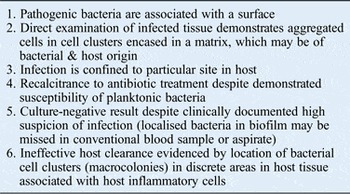
In order to support the biofilm theory in chronic rhinosinusitis, certain key criteria have to be met, based on the findings of Parsek and Singh.Reference Parsek and Singh11 These are summarised in Table I.
Diagnostic criteria for biofilm infections

The presence of biofilms in chronic rhinosinusitis patients was first demonstrated in 2004 via scanning electron microscopy of the nasal mucosa of chronic rhinosinusitis patients (Figure 2).Reference Cryer, Schipor, Perloff and Palmer12 Biofilms were also sampled from frontal recess stents isolated following functional endoscopic sinus surgery (FESS).Reference Perloff and Palmer13 Since then, transmission electron microscopy has substantiated biofilm presence in chronic rhinosinusitis nasal mucosa, with varying specificity and sensitivity. Currently, confocal scanning laser microscopy is the ‘gold standard’ for biofilm detection.
Scanning electron microscopy images of Streptococcus constellatus FH20 biofilms treated with NucB or buffer control. Biofilms were visualised after treatment for 1 hour with buffer (a) or with NucB (b). At higher magnification, extracellular material (white arrow) was observed in the absence of NucB treatment (c), but was not seen in NucB-treated biofilms (d). Reproduced with permission.Reference Hochstim, Choi, Lowe, Masood and Rice19

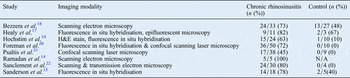
Interestingly, not all patients with chronic rhinosinusitis have biofilms,Reference Cryer, Schipor, Perloff and Palmer12, Reference Ramadan, Sanclement and Thomas14–Reference Singhal, Psaltis, Foreman and Wormald16 and, conversely, biofilms have also been identified in healthy controls.Reference Sanderson, Leid and Hunsaker15, Reference Healy, Leid, Sanderson and Hunsaker17 This variation in part reflects differing biofilm detection methods (Table II),Reference Ramadan, Sanclement and Thomas14, Reference Sanderson, Leid and Hunsaker15, Reference Healy, Leid, Sanderson and Hunsaker17–Reference Sanclement, Webster, Thomas and Ramadan22 but also serves to reinforce the multifactorial nature of chronic rhinosinusitis, where additional host and environmental factors may be pivotal in biofilm pathogenesis.
Biofilm determination in chronic rhinosinusitis

H&E = haematoxylin and eosin; N/A = not assessed
Biofilms – what microbes?
Following the discovery of biofilms in patients with chronic rhinosinusitis, research strategies sought to identify the microbes within the biofilms, with a view of developing a therapeutic strategy. Early studies involved swabbing microbes from patients’ nasal mucosa and using ex vivo biofilm-forming assays (with crystal violet stain).Reference Prince, Steiger, Khalid, Dogrhamji, Reger and Eau Claire23
In a recent study, 75 species of bacteria were isolated from chronic rhinosinusitis aspirates across 20 patients, mostly of commensal bacteria.Reference Shields, Mokhtar, Ford, Hall, Burgess and ElBadawey24 All 24 isolates that were tested subsequently formed biofilms using the crystal violet assay. The ex vivo biofilm assays, however, were not reflective of in vivo biofilm, as there was a disparity between organisms grown from cultures of nasal swabs and those identified from mucosal biopsies using a fluorescence in situ hybridisation technique.Reference Sanderson, Leid and Hunsaker15, Reference Healy, Leid, Sanderson and Hunsaker17 This is because planktonic rather than the biofilm bacterial formation was sampled by nasal swabs.
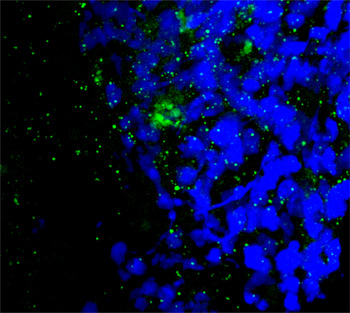
The current gold standard for biofilm species characterisation utilises fluorescence in situ hybridisation probes applied to mucosal biopsies, as this provides contrast between bacterial DNA and host cells (Figure 3). Newer techniques such as multi-locus base composition analysis are also gaining ground; these have identified various anaerobic species, including propionibacterium spp, diaphorobacter spp, peptoniphilus spp and corynebacterium spp.Reference Stephenson, Mfuna, Dowd, Wolcott, Barbeau and Poisson25, Reference Stressmann, Rogers, Chan, Howarth, Harries and Bruce26 Through a combination of these techniques, it is becoming clear that complex polymicrobial communities consisting of bacteria and/or fungi exist within a biofilm.Reference Healy, Leid, Sanderson and Hunsaker17, Reference Foreman, Psaltis, Tan and Wormald20
Confocal laser scanning microscopy images of surface-associated bacteria on mucosa removed from chronic rhinosinusitis patients. Bacteria (green) were visualised using a EUB338 peptide nucleic acid fluorescence in situ hybridisation probe, and epithelial cells (blue) were counterstained with DAPI (4′,6-diamidino-2-phenylindole). Reproduced with permission.Reference Hochstim, Choi, Lowe, Masood and Rice19

It is important to draw a distinction between biofilm infection and colonisation, as there are individuals with biofilms who are symptom-free. Typically, there is an overt inflammatory response in biofilm infection and this is absent in colonisation.
Although microbial communities in biofilms are highly diverse, Staphylococcus aureus has been shown to be the dominant isolate, being found in at least 50 per cent of chronic rhinosinusitis patients.Reference Foreman, Psaltis, Tan and Wormald20, Reference Stephenson, Mfuna, Dowd, Wolcott, Barbeau and Poisson25 The precise role of these individual species as primary or synergistic pathogens, or innocent bystanders, is as yet unclear, though some light has been shed through animal studies.
In a recent sheep model of chronic rhinosinusitis, inoculation of fungi alone in the frontal sinus of sensitised sheep did not result in the formation of robust biofilm.Reference Boase, Valentine, Singhal, Tan and Wormald27 The majority of sinuses developed fungal biofilm when S aureus was co-inoculated with fungi. This synergism may indicate either a primary pathogenic effect of S aureus in establishing a biofilm matrix for fungal growth, or that S aureus may cause mucosal injury promoting fungal biofilm.
Role of intracellular bacteria
Early research focused on biofilms located on the surface of sinonasal epithelium. The concept of intracellular uptake of bacteria into sinonasal epithelium has been gaining momentum in recent years. It challenges the classic views of both infection and mucosal immunity in chronic diseases. The evidence for this has largely been from in vitro cell culture models, with a wide variety of cells such as osteoblasts, fibroblasts and epithelial cells capable of internalising live organisms.Reference Sachse, Becker, von Eiff, Metze and Rudack28–Reference Ellington, Harris, Webb, Smith, Smith and Tan30
S aureus has been recognised to alter its phenotype following internalisation into epithelial cells in vitro,Reference Garzoni, Francois, Huyghe, Couzinet, Tapparel and Charbonnier31 causing alterations in gene regulation involving cell division, nutrient transport and virulence. Other work has shown altered resistance to antibioticsReference Ellington, Harris, Hudson, Vishin, Webb and Sherertz29 and the innate immune system.Reference Bera, Herbert, Jakob, Vollmer and Götz32
This paradigm has been extrapolated to chronic rhinosinusitis, and it is believed that intracellular staphylococci not only can evade the host immune system but also can serve as a reservoir for reinfection. Indeed, a recent study by Wood et al. showed that these intramucosal bacterial microcolonies can exist in chronic rhinosinusitis patients without inducing a local immune response.Reference Wood, Fraser, Swift, Patterson-Emanuelson, Amirapu and Douglas33
A study by Tan et al. prospectively followed up a cohort of 51 chronic rhinosinusitis patients post-operatively (18 primary surgery and 33 revision surgery patients) to clarify whether intracellular infection of sinonasal tissue was an independent risk factor for clinical relapse when compared to biofilm alone.Reference Tan, Foreman, Jardeleza, Douglas, Vreugde and Wormald34 Sinonasal mucosa harvested during surgery was stained with fluorescent molecular probes and imaged using confocal scanning laser microscopy for biofilm and intracellular status. In 20 out of 52 patients (39 per cent), intracellular S aureus was identified. Furthermore, biofilms were associated with the sinus mucosa of these patients, indicating a link between intracellular bacteria and biofilm colonisation. Biofilm alone was found in 16 out of 51 patients (31 per cent), whilst 15 out of 51 patients (29 per cent) showed no evidence of S aureus. The presence of intracellular bacteria was associated with a significantly higher risk of late clinical and microbiological relapse, but biofilm without coexisting intracellular bacteria did not appear to impact on outcomes. There are, however, methodological limitations in this study; specifically, clinical relapse was predominantly based on endoscopic signs of disease and positive microbiology, rather than symptom scores. Hence, the relationship between intracellular bacteria and symptomatic relapse can only be inferred. In addition, the viability of the intracellular bacteria was unknown, as the molecular probes do not distinguish between live and dead bacteria. Nonetheless, the intracellular infection with S aureus is a fresh dimension to consider in the development of potential novel anti-biofilm treatment strategies for refractory chronic rhinosinusitis.
Interaction between biofilm and host
The pathophysiology of chronic rhinosinusitis biofilms occurs primarily at the nasal mucosa, which is a highly specialised immunological barrier; modulation of the innate and adaptive immune response here is postulated to lead to chronic rhinosinusitis. The innate immune system, which consists of mucociliary clearance together with antimicrobial peptides like lactoferrin and toll-like receptors, constitutes the first line of defence against colonisation and infection. Decreased levels of antimicrobial proteins, notably lactoferrin, has also been witnessed in chronic rhinosinusitis patients compared to healthy controls.Reference Psaltis, Wormald, Ha and Tan35, Reference Psaltis, Bruhn, Ooi, Tan and Wormald36 In addition, there is some evidence of defective mucociliary clearance in chronic rhinosinusitis patients. Biofilm-positive chronic rhinosinusitis patients in particular have marked destruction of the epithelial layer, with complete absence of cilia compared to their biofilm-negative counterparts.Reference Galli, Calò, Ardito, Imperiali, Bassotti and Passali37 Additionally, toll-like receptors, which recognise Gram-positive bacteria, are significantly under-expressed in the sinonasal mucosa of chronic rhinosinusitis patients with early post-operative recurrence, when compared to controls or surgery-responsive patients.Reference Lane, Truong-Tran and Schleimer38 This implies an association between deficiencies of innate immunity and biofilm-associated chronic rhinosinusitis. Alterations in the mucosal immunity may therefore facilitate bacterial attachment and subsequent biofilm formation.
In contrast, the association between chronic rhinosinusitis biofilm and the adaptive immune response (cluster of differentiation 4+ T-helper cell) is less consistent. For example, in one study, a marked T-helper type 1 mucosal inflammatory response was reported together with significantly elevated levels of interferon-gamma, granulocyte colony-stimulating factor, macrophage inflammatory protein-1 beta and neutrophils in the sinonasal mucosa.Reference Hekiert, Kofonow, Doghramji, Kennedy, Chiu and Palmer39 However, Foreman and colleagues reported that the presence of S aureus biofilm was associated with a marked T-helper 2 pathway.Reference Foreman, Holtappels, Psaltis, Jervis-Bardy, Field and Wormald40 A recent prospective study also showed that biofilm presence in chronic rhinosinusitis (particularly chronic rhinosinusitis with nasal polyposis) correlated with recruitment of plasma cell and eosinophils, compared to controls.Reference Arjomandi, Gilde, Zhu, Delaney, Hochstim and Mazhar41
Despite compelling evidence that nasal mucosal immunity is altered in the presence of biofilms, both the causative agent and subsequent cytokine response are yet to be fully elucidated. Some insight was given by a study investigating the role of inflammasomes (multiprotein oligomers important in the inflammatory cascade) in chronic rhinosinusitis patients with polyps (S aureus biofilm-positive). Compared to controls, absent in melanoma 2 was upregulated in this group, implying that S aureus may play a role in intracellular triggering of the inflammasome response.Reference Jardeleza, Miljkovic, Baker, Boase, Tan and Koblar42 A recent prospective study investigated the relationship between biofilms and osteitis in chronic rhinosinusitis patients.Reference Dong, Yulin, Xiao, Hongyan, Jia and Yan43 The degree of osteitis was assessed histopathologically and radiologically using the Global Osteitis Scoring Scale. It was shown that the volume of biofilm correlated well with osteitis severity in chronic rhinosinusitis patients, shedding further light on the effect of biofilms on the inflammatory cascade.
The formation of biofilm is dependent on a number of bacterial and environmental factors. For instance, the biofilm matrix polysaccharide poly-N-acetylglucosamine (PNAG) produced by S aureus is an important bacterial factor involved in biofilm formation and host immune evasion.Reference Vergara-Irigaray, Maira-Litrán, Merino, Pier, Penadés and Lasa44–Reference Cerca, Jefferson, Maira-Litrán, Pier, Kelly-Quintos and Goldmann46 The cationic PNAG exopolysaccharide (after deacetylation of residues) is essential for electrostatic interactions with the cell envelope, and confers resistance to the innate immune system through repelling cationic antimicrobial peptides.
Environmental factors such as smoking can have a profound effect on biofilm formation. In vitro repetitive exposure to tobacco smoke induces biofilm formation in diverse bacteria isolated from the sinonasal cavities of patients with chronic rhinosinusitis. Isolates from smokers demonstrate more robust in vitro biofilm formation, and tobacco exposure induces a biofilm, providing further evidence for the role and action mechanism of tobacco smoke in chronic sinonasal inflammation.Reference Goldstein-Daruech, Cope, Zhao, Vukovic, Kofonow and Doghramji47 The biofilm phenotype is reversible, and so smoking cessation may enhance treatment response in biofilm-positive chronic rhinosinusitis.
The importance of biofilms in chronic rhinosinusitis pathogenesis has also been supported by recent animal studies. In a New Zealand rabbit model of sinusitis, Pseudomonas aeruginosa was inoculated into the right maxillary sinus, and the contralateral side was used as a control.Reference Perloff and Palmer48 Biofilm formation favoured the inoculated side. However, the overall prevalence of P aeruginosa in chronic rhinosinusitis is low, and the trauma may have altered physiological mucociliary clearance. This non-physiological chronic rhinosinusitis animal model should therefore be interpreted with caution in the human context. The sheep chronic rhinosinusitis model is anatomically similar to humans, and the larger nasal cavity is superior to those of smaller animals in achieving endoscopic ostial obstruction, without undue impact on mucociliary flow patterns.
Clinical translation
The clinical relevance of biofilms in the pathogenesis and persistence of chronic rhinosinusitis is underlined in both prospective and retrospective studies. In one retrospective study, patients with bacterial biofilms had significantly worse pre-operative radiological scores and statistically worse post-operative outcomes than those without (median follow up of eight months post-FESS).Reference Psaltis, Weitzel, Ha and Wormald49 Similar results were reported in a prospective study in which 36 patients with biofilm-positive disease 16 months post-FESS had statistically worse post-operative disease burden than the 15 biofilm-negative patients.Reference Singhal, Psaltis, Foreman and Wormald16
Disease severity and post-operative persistence can be further stratified based on the constituent microbial species. S aureus is particularly pathogenic in this respect compared with, for example, Haemophilus influenzae biofilm.Reference Foreman and Wormald50
Future treatment strategies
The mounting evidence for the role of biofilms in chronic rhinosinusitis pathogenesis has served as a catalyst for developing biofilm eradication strategies, on two broad themes: inhibition of biofilm formation or dispersion of the mature biofilm.
Quorum-sensing signals represent a unique target for inhibiting biofilm formation, and may potentially unlock bacteria into a planktonic form to increase antibiotic susceptibility. For example, in P aeruginosa biofilms, it has been shown that disabling the signalling molecule acyl-homoserine lactone (las acyl-homoserine lactone) leads to a flat, unstructured biofilm, thus making P aeruginosa more susceptible to disruption by sodium dodecylsulphate.Reference Davies, Parsek, Pearson, Iglewski, Costerton and Greenberg51
Biofilms can be disrupted mechanically using topical saline irrigation or chemically using a surfactant such as baby shampoo. Indeed, in a prospective study of 18 patients with chronic rhinosinusitis post-FESS, daily irrigation with 1 per cent baby shampoo for 4 weeks led to improvement in specific symptoms of thickened mucus and postnasal drainage in 60 per cent of patients.Reference Chiu, Palmer, Woodworth, Doghramji, Cohen and Prince52 The hydrodebrider system (used in combination with saline), has also shown promise in the treatment of S aureus biofilms, in a study utilising a sheep model of chronic rhinosinusitis.Reference Valentine, Jervis-Bardy, Psaltis, Tan and Wormald53 In contrast, the citric acid/zwitterionic surfactant solution, with and without a hydrodebrider system, can significantly adversely affect cilia morphology.Reference Valentine, Jervis-Bardy, Psaltis, Tan and Wormald53
Another strategy is the use of biofilm matrix degrading enzymes, such as dispersin B, alginate lyase and deoxyribonuclease,Reference Kaplan, LoVetri, Cardona, Madhyastha, Sadovskaya and Jabbouri54–Reference Lamppa and Griswold56 which target PNAG, alginate and extracellular DNA respectively. Extracellular DNA within the biofilm matrix has received significant interest in recent years. This molecule has been shown to serve several critical functions, ranging from stabilising the biofilm structureReference Steinberger and Holden57–Reference Martins, Uppuluri, Thomas, Cleary, Henriques and Lopez-Ribot59 and surface adhesion,Reference Vilain, Pretorius, Theron and Brözel60 to the exchange of genetic information.Reference Molin and Tolker-Nielsen61
Many bacteria produce extracellular deoxyribonuclease enzymes that are tightly regulated to avoid excessive degradation of the biofilm matrix. Interfering with these control mechanisms, or adding exogenous deoxyribonucleases, could prove a potent strategy for controlling biofilm growth.Reference Jakubovics, Shields, Rajarajan and Burgess62 Indeed, promising results have so far been obtained in vitro using a novel bacterial deoxyribonuclease (NucB) from a marine bacteria, Bacillus licheniformis, by the biofilm research group at Newcastle University, in both chronic rhinosinusitis and tracheoesophageal speech valve isolates.Reference Shields, Mokhtar, Ford, Hall, Burgess and ElBadawey24, Reference Shakir, Elbadawey, Shields, Jakubovics and Burgess63 There was a five-fold dispersion of biofilm from tracheoesophageal valve isolates using NucB compared to controls. Ultimately, this treatment may be extrapolated to chronic rhinosinusitis.
In recent in vitro studies, the topical application of manuka honey has been shown to dissolve biofilms created by S aureus and P aeruginosa, resulting in bacterial death.Reference Alandejani, Marsan, Ferris, Slinger and Chan64 When applied to the in vivo sheep model, sinus irrigation with manuka honey and its active component methylglyoxal, at concentrations between 0.9 and 1.8 mg/ml, has been demonstrated to be both safe to mucosa and efficacious against S aureus biofilm.Reference Paramasivan, Drilling, Jardeleza, Jervis-Bardy, Vreugde and Wormald65 Another study utilising colloidal silver (consisting of silver particles suspended in water) demonstrated direct attenuation of S aureus biofilms in vitro.Reference Goggin, Jardeleza, Wormald and Vreugde66 These findings may therefore form the basis for a topical irrigation treatment for chronic rhinosinusitis.
Although great strides have been made, future biofilm research should focus on better detection and characterisation of biofilm, immune responses and clinical implications in chronic rhinosinusitis, as well as potential avenues for treatment. Non-invasive biofilm detection could supplant current methods of biofilm detection and species characterisation from invasive nasal mucosal biopsies, as these have limited the number of participants in research (Table II).
Recently, a non-invasive S aureus biofilm diagnostic test (PNAG detection) was shown to reliably identify high-risk chronic rhinosinusitis patients, with results comparable to biopsies.Reference Foreman, Jervis-Bardy, Boase, Tan and Wormald67 The scope for the use of this test is far reaching, but still requires further validation in a larger cohort.
Early confirmation of biofilm-positive disease, with identification of the pathogenic species, will enable more aggressive treatment protocols that can be tailored to the individual, with the aim of improving patient outcomes. The impact of biofilm mass on chronic rhinosinusitis in predicting disease severity is as yet unknown. This may be investigated through the use of BacLight™ Live/Dead® staining with Comstat2 software68 for image analysis.Reference Heydorn, Nielsen, Hentzer, Sternberg, Givskov and Ersbøll69, Reference Singhal, Boase, Field, Jardeleza, Foreman and Wormald70 The biofilm contribution to the pathogenesis of chronic rhinosinusitis with and without polyps also merits closer inspection.
Conclusion
The biofilm theory is compelling and may be applicable to a subset of chronic rhinosinusitis patients, especially those with severe and persistent disease. The heterogeneity of chronic rhinosinusitis should be appreciated in terms of aetiology, pathogenesis and presentation. A ‘one size fits all’ model of treating chronic rhinosinusitis is clearly suboptimal. A multimodality treatment paradigm incorporating biofilm-specific treatments stands to improve the outcomes of the most refractory chronic rhinosinusitis cases. As our understanding of the complexity and potential reversibility of chronic rhinosinusitis biofilms evolves, so too will a new era of chronic rhinosinusitis management.