Introduction
Recovery-oriented services are the gold standard to which mental health services currently aspire. Although there are many different definitions of recovery, there is general consensus that recovery refers to an approach that promotes an individual’s resourcefulness, autonomy, positive sense of self and belief in their ability to live a meaningful life (McCabe et al. Reference McCabe, Whittington, Cramond and Perkins2018). A core principle underpinning the recovery approach is equal partnership between all stakeholders in the planning, delivery and evaluation of mental health services (Keogh et al. Reference Keogh, Higgins, DeVries, Morrissey, Callaghan, Ryan, Gijbels and Nash2014). Although historically family members have felt excluded by mental health service providers, in more recent times, national and international mental health policies emphasise the pivotal role of families in recovery-oriented services (e.g. Department of Health and Children, 2006; Mental Health Commission, 2007; World Health Organization, 2010; International Mental Health Collaborating Network Charter, 2013). Best practice guidance acknowledges the importance of building family members’ capacity to impact positively on people who experience severe mental distress (NICE, 2009; Schiffman et al. Reference Schiffman, Reeves, Kline, Medoff, Lucksted, Hoagwood, Fang and Dixon2015; Health Service Executive, 2017).
While recovery for service users entails a degree of autonomy and connection with self (Kartalova-O’Doherty et al. Reference Kartalova-O’Doherty, Stevenson and Higgins2012), connectedness with others is an integral part of the recovery process (Slade, Reference Slade2009; Gehart, Reference Gehart2012). Harnessing positive aspects from the social environment, such as positive interpersonal interactions and relationships, is central to many people’s recovery (Topor et al. Reference Topor, Borg, Mezzina, Sells, Marin and Davidson2006; Wyder & Bland, Reference Wyder and Bland2014; Reupert et al. Reference Reupert, Maybery, Cox and Scott Stokes2015). Conversely, exposure to negative aspects of social environments, such as involvement in negative relationships, may be experienced as disempowering. This can prompt withdrawal from relationships in order to protect personal well-being (Watts & Higgins, Reference Watts and Higgins2017). Relationships, however, are not universally positive or negative (Onken et al. Reference Onken, Craig, Ridgway, Ralph and Cook2007; Tew, Reference Tew2013), but dynamic processes involving adjustment and negotiation as the recovery journey unfolds (Topor et al. Reference Topor, Borg, Mezzina, Sells, Marin and Davidson2006; Wyder & Bland, Reference Wyder and Bland2014). As people with mental health problems often live with or are supported by family members, these individuals have a significant role in the person’s mental health recovery (Wyder & Bland, Reference Wyder and Bland2014). Family members may be the first to recognise distress and intervene to access support for the person. They may also share their knowledge of the individual with service providers, act as the person’s advocate and provide a range of other financial, instrumental and emotional support (Topor et al. Reference Topor, Borg, Mezzina, Sells, Marin and Davidson2006; Reupert et al. Reference Reupert, Maybery, Cox and Scott Stokes2015).
Although family members are recognised as valuable partners in recovery, they report little experience of recovery-oriented services and partnership (Hungerford & Richardson, Reference Hungerford and Richardson2013). They receive limited information from service providers (Kartalova-O’Doherty et al. Reference Kartalova-O’Doherty, Doherty and Walsh2008; Cleary et al. Reference Cleary, Walsh and Dowling2014; O’Féich et al. Reference O’Féich, Mitchell, Pérez and McDaid2019) and lack knowledge of the philosophy of recovery, how to access services as well as the treatments and support available (van de Bovenkamp et al. Reference van de Bovenkamp, Trappenburg and Grit2010; Hungerford & Richardson, Reference Hungerford and Richardson2013). Family members also report experiencing a conflict between practitioners’ desire to maintain the person’s rights to confidentiality around diagnosis and treatment, and their own need to understand how best they can support and help the person in difficulty (Kartalova-O’Doherty et al. Reference Kartalova-O’Doherty, Doherty and Walsh2008). Consequently, they express a desire for knowledge on mental health issues, in addition to information about how to communicate and maintain positive social relationships with their relative (Solomon, Reference Solomon2004; Jormfeldt et al. Reference Jormfeldt, Rask, Brunt, Bengtsson and Svedberg2010; Cleary et al. Reference Cleary, Walsh and Dowling2014; O’Féich et al. Reference O’Féich, Mitchell, Pérez and McDaid2019). This paper reports the findings of a study that evaluated the acceptability and impact of a co-facilitated, mental health information programme designed for families of people with psychosis as part of the EOLAS mental health information project (EOLAS is the Irish word for knowledge).
EOLAS mental health information project
The EOLAS Programme for Families and Friends is part of a recovery project involving service users, family members, clinicians and academics who co-produced, co-delivered, co-managed and evaluated two mental health information programmes (one for people who have been diagnosed with schizophrenia spectrum or bipolar disorders and a parallel programme for their family members or other supporters).
The family programme consists of 8 weekly sessions, each of 90 minutes’ duration. While no theoretical perspective is privileged, and information on medical, psychological and social perspectives are presented, all the programme content are presented within a recovery ethos and underpinned by the principles of adult learning. The programme focuses on enabling family members to understand how mental health services work, the role of team members, bio/psycho/social treatment options, how to access services and support, how to improve communication within the family and how to care for their own mental health. Furthermore, issues of stigma, coping, advocacy and personal recovery are discussed. Two separate handbooks with information pertaining to each session have been developed (one for the facilitators delivering the programme and one for the participants).
One of the core differences between the EOLAS programmes and other family programmes is the dual nature of the facilitation as it incorporated both peer and clinician facilitation. This dual model of facilitation recognises the potential benefits derived from both peer and clinician involvement in the delivery of education. While the value of clinician input in education is recognised (Lefley, Reference Lefley2009), education programmes designed and led solely by professionals tend not to incorporate recovery-focused content (McNeil, Reference McNeil2013). Furthermore, peer involvement in education recognises the value of experiential knowledge and facilitates the support, empathy and hope provided by peers (Solomon et al. Reference Solomon, Draine, Mannion and Meisel1997; Resnick et al. Reference Resnick, Armstrong, Sperrazza, Harkness and Rosenheck2004; Barber et al. Reference Barber, Rosenheck, Armstrong and Resnick2008; Resnick & Rosenheck, Reference Resnick and Rosenheck2008; Watts & Higgins, Reference Watts and Higgins2017). More detailed information on the participatory approach taken to co-designing the programmes, the programme content and the process used to prepare the facilitators to co-deliver the programme are reported elsewhere (Higgins et al. Reference Higgins, Hevey, Gibbons, O’ Connor, Boyd, McBennett and Monahan2017a,b; Higgins et al. Reference Higgins, Hevey, Boyd, Cusack, Downes, Monahan, McBennett and Gibbons2018).
The present study
Prior to scaling up an intervention, work is required to examine the acceptability of both the intervention and evaluation protocol. Consequently, the present study examined the acceptability and initial outcomes from the family EOLAS programme using a single-group pre-post design. Data on outcomes were collected in order to better understand the potential impact and inform the ongoing development of the programme. The outcome measures were aligned with the programme’s focus on recovery. Consequently, changes in knowledge, confidence, recovery attitudes, advocacy and hope over the course of the programme were assessed. The relationship between changes in the programme’s outcomes was also examined. In addition, qualitative interviews were conducted with participants to develop a greater understanding of their experiences of the programme and the acceptability of the peer-clinician facilitation element.
Methods
A sequential design was used: quantitative data assessing programme outcomes were collected before qualitative data exploring participants’ experiences were obtained. This approach was selected to meet the different objectives of the study; however, the quantitative results did not influence the direction of the subsequent qualitative aspect.
Participants
Following receipt of ethical approval by the Faculty of Health Sciences Research Ethics Committee at Trinity College, Dublin and ethics committees of the participating mental health services, potential family member participants were given an information sheet about the study when they were being recruited to attend the EOLAS information programme. At that time, they were informed that they could choose to participate in the programme without obligation to participate in the research. On day 1 of the programme, participants were given an envelope containing the questionnaire and an information sheet. They were requested to complete the questionnaire and return it in the envelope provided, and if they did not wish to be involved, they were informed that they could return an incomplete questionnaire, thereby facilitating anonymity for participants. The post-programme questionnaire was distributed at the end of the final EOLAS session. The post-programme pack included an opt-in form for the semi-structured interviews, which participants could complete immediately or return at a later time to researchers in the stamped addressed envelope provided. Subsequently, researchers contacted individuals who expressed such interest to discuss participation and schedule interviews with those consenting to participate. Individual interviews were held with participants 2–4 weeks post-programme.
Procedure
Quantitative data were collected using a pre-post design whereby questionnaires were completed prior to and immediately after programme participation. The pre-programme questionnaire collected demographic data on participants. Given the unique nature of the programme, the questionnaire battery comprised a mixture of validated established measures for key outcomes (e.g. recovery attitudes and hope) and scales developed by the research team to be sensitive to the specific key learning outcomes of the programme. A 10-item knowledge scale was developed to assess participants’ knowledge of a range of mental health issues. This was scored using a 5-point Likert scale ranging from 1 (poor) to 5 (excellent); Cronbach’s α was .88. Participants’ confidence in their own ability to cope and their confidence in accessing help for their family member with the mental health difficulty were assessed using a 9-item scale ranging from 1 (not at all confident) to 4 (very confident); Cronbach’s α was .85. Advocacy was evaluated using an 11-item scale ranging from 1 (strongly disagree) to 5 (strongly agree). The scale was based on Brashers et al. (Reference Brashers, Haas and Neidig1999) Patient Self-Advocacy Scale and Cronbach’s α was .72. To assess changes in attitudes towards recovery, the widely used and validated Recovery Attitudes Questionnaire 7 (RAQ-7) (Borkin et al. Reference Borkin, Steffan, Krzton, Wishnick, Wilder and Yangarber2000) was used. The RAQ-7 had a Cronbach’s α of .70. Hope was assessed using two items from the psychometrically supported Herth Hope Index (Herth, Reference Herth1992); these items were selected on the basis of their match to the programme’s content and they had a Cronbach’s α of.68.
The post-programme questionnaire replicated the pre-programme questionnaire and was supplemented with closed questions to elicit information on the number of sessions attended, satisfaction with the programme and perceived usefulness of programme. Open-ended questions elicited participants’ views on the most and least helpful aspects of the programme and yielded additional comments about the programme. The semi-structured interviews with participants were informed by a topic guide developed by the research team. During the interviews, participants were prompted to discuss their personal experience of the programme and the co-facilitation aspect of it, its impact on their lives as well as its impact on other family members.
Data analysis
Quantitative data were analysed using SPSS version 22. Categorical data are summarised using frequencies (n) and percentages (%); continuous data are summarised using means (M) and standard deviations ( s.d. ). The mean scores on scales were calculated, with higher scores on each of these scales representing more positive outcomes. A series of paired sample t tests were conducted to examine changes in knowledge, confidence, advocacy, recovery attitudes and hopes for the participants from Time 1 (T1) to Time 2 (T2). Due to the non-normal distribution of change scores Spearman ρ correlations examined the relationships between changes in variables. Given the number of comparisons conducted, and in order to balance Type 1 and Type 2 errors, statistical significance was set at an adjusted level of .01.
All interviews were audio recorded, transcribed verbatim and entered into the software package NVivo version 8. Thematic analysis, guided by the constant comparative process (Glaser & Strauss, Reference Glaser and Strauss1967), was performed whereby data were systematically coded for ideas and concepts, emerging codes were compared for similarity and differences and merged into higher themes. To enhance the rigour of the qualitative analysis, data were analysed independently by two members of the team and findings compared.
Results
Participant profile
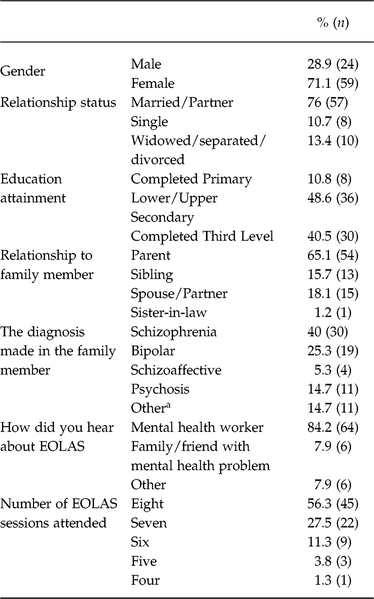
In total, 168 surveys were completed at T1 and 121 at T2. Paired analysis was carried out on 86 surveys. Table 1 presents the profile of participants who completed surveys at both time points. The sample was predominantly female (71.1%, n = 59) with a mean age of 55.5 years ( s.d. = 12.02, range 19–77). Nearly two thirds were parents of the family member (65.1%, n = 54), and the majority (86.6%, n = 71) reported that their family member had received a formal diagnosis of a mental health problem, with schizophrenia being the most common diagnosis. More than half the sample (56.3%, n = 45) attended all eight sessions and over a third (38.8%, n = 31) attended either seven or six sessions. None of the participants attended less than three sessions. There were no statistically significant differences between those who provided data at T1 only and those who completed both T1 and T2 questions in relation to demographic factors (gender, age, marital status, educational level), clinical factors (received a diagnosis, diagnostic category) or baseline psychological factors (knowledge, confidence, advocacy, recovery, hope).
Clinical-–demographic profile of participants

a Other: multiple disorders (6); depression anxiety (3); disassociation (1) and no diagnosis (1).
A total of 15 programme participants (5 men and 10 women) participated in the interviews. Their age ranged from 46 to 70 years (M = 59 years). Participants were mostly mothers (n = 8), three were fathers, two were sisters, one was a mother’s partner and one was a brother. Most had a family member with a diagnosis of a schizophrenia spectrum disorder (n = 12). The average duration of the family member’s mental health difficulties was 13 years, ranging from 18 months to 43 years. Twelve reported that their family member lived with them, while three lived outside the family home. All except one family member were still in contact with mental health services. Most participants reported that they attended at least seven of the EOLAS sessions. Only 3 of the 15 family members had previously attended any kind of mental health information session.
Outcome evaluation
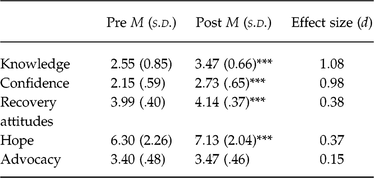
Prior to programme participation, overall knowledge among participants was below the midpoint of the scale. A statistically significant higher level of overall knowledge was found post-programme (Table 2). The programme significantly increased participants’ overall confidence. Although participants showed positive attitudes towards the principles of recovery before participating in the programme, there was a statistically significant increase in such positive attitudes after the programme. The increase in feelings of hope was also statistically significant. However, there was no statistically significant improvement in advocacy overall from pre- to post-programme.
Impact of programme on outcome variables

*** p < .001.
Relationship between changes in programme outcomes
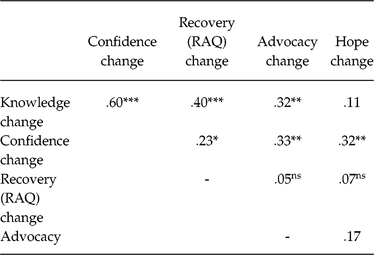
To further examine the changes in the programme outcome variables, a correlation analysis was conducted on the change scores (See Table 3). A number of statistically significant relationships were found: increases in knowledge were associated with increases in confidence, recovery attitudes and advocacy; and increases in confidence were associated with increases in recovery attitudes, advocacy and hope.
Relationships between changes in programme outcomes

RAQ, Recovery Attitudes Questionnaire.
*p < .05, **p < .01, ***p < .001.
Satisfaction and usefulness
To explore perceived satisfaction and usefulness, analysis was completed on all the completed post-programme surveys (n = 121). Almost all (96.7%, n = 117) of the participants who completed the post-programme surveys were either satisfied or very satisfied with the programme. An overwhelming majority also reported the programme to be either very useful (n = 95, 78.5%) or useful (n = 23, 19%). There was a strong correlation between satisfaction and perceived usefulness of the EOLAS programme (Spearman ρ = .65, p < .01), such that those who were more satisfied rated the programme as being more useful. Satisfaction was not significantly associated with participant age (ρ = .033, p = NS) or number of sessions attended (ρ = .065, p = NS). There were no significant differences in satisfaction levels between males (M = 4.69) and females (M = 4.70) [t(51) = 0.07, p = NS]. Similarly there were no differences in satisfaction levels related to educational level [F(3,70) = 0.48, p = NS].
Interviews
Analysis of the interviews resulted in the following five themes: Enhanced knowledge of mental health issues, enhanced confidence to engage with service providers, increased awareness of communication within the family unit, importance of self-care and value of peer support.
Enhanced knowledge of mental health issues
Participants recounted difficulties trying to access information at critical junctures in their family member’s mental illness trajectory, such as at the time of admission or diagnosis. The information acquired through the programme was cited as extremely useful, particularly in comparison to the information available from other sources, such as the literature, the Internet or mental healthcare interactions:
… I felt that from an information point of view it [course] was fantastic … every week you got something new. Whether it was the explanation of the family supports or State Aid available, each week I came home thinking ‘God you know I am after learning something and it was 2 hours really well spent’. (Participant 6)
Consistent with the quantitative findings, participants identified increased knowledge on mental health issues, including diagnosis, terminology, medication, psychosis, the Mental Health Act and resources for support. In addition to learning about different medications, the side effects and importance of following prescription guidelines, the module on medication gave participants an opportunity to have meaningful interactions with a psychiatrist and obtain responses to questions they had for a long period of time:
… and a doctor would come give an understanding to the medication and the way that it works. I just can’t put word on how beneficial it was for me. (Participant 5)
In relation to the Mental Health Act (2001), despite some participants’ lived experience of having a family member detained under the Act, participants reported a lack of understanding of the legislation and the programme appeared to redress this deficit effectively:
… really useful things, one was the voluntary versus involuntary admissions … this was an issue for us [family] in the past … there is an assistance admission team that I hadn’t heard of …. (Participant 10)
Enhanced confidence to engage with service providers
Although there was no statistically significant improvement in advocacy in terms of quantitative scores, some participants reported feeling more confident (as a result of enhanced knowledge) to engage with and question practitioners about care and treatment. It also helped family members advocate for greater involvement in the decision-making process:
Certainly [EOLAS] gave me an understanding on the questions to ask, even on medication. Initially, I had a great confidence in a doctor. If they gave him [family member] a medication, he needs it, so take it … when I lived with (family member) and seen what the dosage was doing to him … I said to his doctor ‘We just had to find a different way’. The fact that I learned so much on the course. I was able to ask the questions and for the two of us to make a decision, a very risky decision to say he’s on no medication. I’m living every day and I’m marking it on the calendar, another day without medication …. Everything is going good …. (Participant 9)
Increased awareness of communication within the family unit
Through the programme, participants reported becoming more aware of how to recognise early warning signs of their family member’s distress as well as becoming aware of negative patterns of communication that escalated to confrontation. They also reported enhanced skills to respond to their family member’s distress in a more empathetic manner and to formulate a plan to manage challenging situations, which previously were experienced as overwhelming:
EOLAS was a God-send because I was in the dark, I was like a zombie walking the streets No direction, no plan, no understanding … I would have judged or chastised … done everything wrong …. Now I’m not a headless chicken. Now I know how to talk to him and it was through the course that I developed these skills …. (Participant 11)
I just couldn’t deal with it and with the knowledge (gained from the EOLAS programme) I just said ‘count to ten and keep calm (says own name) stop shouting or screaming, deal with it in a quiet manner … since the EOLAS programme I seem to be dealing with everything in a much calmer fashion. (Participant 5)
In tandem with a greater awareness of how to respond to their family member’s distress, the programme had a positive impact on communication within the family unit, with participants leading the way in opening discussions with other family members. For some this was a departure from old habits of ‘bottling up’ emotions and avoiding communication in order to ‘stay strong’:
I would go through it [content] with his Dad what went on at the class. … We’re [family] talking through things more and overall I say we’re communicating a lot better, more open about our own feelings on the matter. I would have bottled up a lot of my tension and they [children] are letting us know how they’re feeling a bit more. (Participant 15)
Importance of self-care
The programme emphasised not only the importance of safeguarding their own personal mental health but also the importance of self-care as a prerequisite to being able to provide support to another person.
They laid heavy emphasis on the fact that you have to … to be any use to the patient, you have to be firing on all cylinders yourself, mentally and physically and in order to do that you just need that little bit of a break …. (Participant 3)
Value of peer support
In addition to the value of the information gained, the peer aspect of the programme emerged as an integral part of its success. The experience of learning through mutual sharing not only provided valuable experiential knowledge, but it reduced the sense of isolation participants described hitherto experiencing, providing them with much needed emotional support.
I have done a lot of reading myself. I had done a lot of researching and googling … and I supposed I felt quiet isolated … I had never experienced that level of support or anyone else who had experienced the same as me …. (Participant 11)
The peer facilitators’ openness and willingness to share their lived experience enabled participants to realise that their feelings and experiences were not unique but were shared, thereby validating their experiences:
She (peer facilitator) was quite open about sharing her experience; a very wise person I suppose you realise you haven’t done anything wrong, that everybody has reached the same stages, same peak, the same despair that you’ve reached …. (Participant 10)
It was great that (peer facilitator) had self-experience of when things go wrong and he had been there at the cold face when stuff goes wrong … you were dealing with somebody who had been through it just like you …. (Participant 6)
The mutual sharing reinforced participants’ realisation that they were not ‘alone’ and for many it was a valuable opportunity to speak about their own distress and needs, which was experienced as cathartic:
That’s where the peer support actually really helped as well again it wasn’t really a feature of the EOLAS programme … but actually hearing people, and also people had a need to speak and I found myself that I had a real need to talk. (Participant 10)
Everyone is in the same boat as yourself and you were able to speak out and not feel stigma attached to your situation where everyone would have the same and maybe worse. (Participant 5)
The programme also provided sustained opportunities for reciprocal emotional support, with participants reporting that friendships were formed and contact between participants continued after the programme ended.
Discussion
The current study provides evidence that the EOLAS co-facilitated information and learning programme is acceptable to family members and is associated with positive recovery outcomes in terms of enhanced knowledge, confidence and hope, with further insights provided through interviews in relation to the processes and conditions within the programme that may account for the positive outcomes. To date, there are only a handful of evaluations of educational interventions modelled on co-facilitation (Solomon et al. Reference Solomon, Draine, Mannion and Meisel1997; Pratt et al. Reference Pratt, Lu, Swarbrick and Murphy2011; Coulthard et al. Reference Coulthard, Patel, Brizzolara, Morriss and Watson2013; Green et al. Reference Green, Janoff, Yarborough and Paulson2013), and even fewer programmes focused on families with which the authors can directly compare this study’s findings. Solomon et al. (Reference Solomon, Draine, Mannion and Meisel1997) showed that group family workshops co-facilitated by a mental health specialist and a trained family member positively impacted on family members’ self-efficacy to manage and cope with their relative’s mental distress. Their findings mirror the increased self-efficacy alluded to by participants in this study in terms of feeling more confident, empowered and better able to respond to their relative’s distress as well as advocating for greater involvement in the decision-making process around the person’s care.
The emotional climate within families can influence recovery, with expressed emotion an established factor in short-term relapse in schizophrenia (Kavanagh, Reference Kavanagh1992; Bebbington & Kuipers, Reference Bebbington and Kuipers1994; Butzlaff & Hooley, Reference Butzlaff and Hooley1998). A lack of knowledge about mental health problems can result in family members interacting with their relative in ways that are unhelpful; the inverse is also true, with more knowledge and education family members’ ability to contribute positively to recovery is enhanced (Aldersey & Whitley, Reference Aldersey and Whitley2015). The EOLAS programme redressed information deficits among family members and, similar to other studies, improved knowledge of mental distress, the mental health system, self-care (Dixon et al. Reference Dixon, Lucksted, Stewart, Burland, Brown, Postrado, McGuire and Hoffman2004; Pickett-Schenk et al. Reference Pickett-Schenk, Bennett, Steigman, Cook, Lippincott, Villagracia and Grey2006; Pickett-Schenk et al. Reference Pickett-Schenk, Lippincott, Bennett and Steigman2008; Chiu et al. Reference Chiu, Wei, Lee, Choovanichvong and Wong2013; Lucksted et al. Reference Lucksted, Medoff, Burland, Stewart, Fang, Brown, Jones, Lehman and Dixon2013) and the Mental Health Act (2001). While the provision of knowledge is important, changing behaviour is the ultimate outcome. Although the evaluation was conducted within a short time of programme completion, similar to Bademli & Duman (Reference Bademli and Duman2016) and Lucksted et al. (Reference Lucksted, Stewart and Forbes2008), this study indicated that the enhanced knowledge, confidence and insights gained resulted in participants becoming more conscious of their style of interaction with their distressed relative. This in turn facilitated changes in their communication strategies to deal with challenging and stressful situations and changes in the way they interacted with the wider family unit, with a greater willingness to engage in more open conversation within the family.
A key theme running through much of the writing on recovery is the centrality of hope, which has been described as a ‘vital ingredient’ and ‘cornerstone’ of recovery (Repper, Reference Repper2012; Watts & Higgins, Reference Watts and Higgins2017). The EOLAS programme impacted positively on participant optimism about the future for both themselves and their relative, and on their attitudes towards recovery; such positive impact of the programme is important for a number of reasons. First, family members can diminish hope or co-create and maintain hope with the person (Wyder & Bland, Reference Wyder and Bland2014), with studies indicating that families who have a positive attitude towards recovery are more likely to hold and create hope for their distressed relative (Topor et al. Reference Topor, Borg, Mezzina, Sells, Marin and Davidson2006; Marshall et al. Reference Marshall, Deane, Crowe, White and Kavanagh2013). Second, higher levels of hope in family members is associated with less distress, caregiver burden and maladaptive coping (Geffken et al. Reference Geffken, Storch, Duke, Monaco, Lewin and Goodman2006; Hernandez et al. Reference Hernandez, Barrio and Yamada2013), including in family members who have a relative with a diagnosis of schizophrenia (Friedman-Yakoobian et al. Reference Friedman-Yakoobian, de Mamani and Mueser2009). Third, given the ‘chronicity discourse’ that frequently surrounds discussion on diagnoses such as schizophrenia, improving family members’ perceptions of recovery can be achieved (e.g. in terms of it being possible for people to have a fulfilling and meaningful life even in the presence of enduring symptoms of mental distress).
Similar to other studies reporting the benefits derived from peer support in terms of emotional well-being (Pickett-Schenk et al. Reference Pickett-Schenk, Bennett, Steigman, Cook, Lippincott, Villagracia and Grey2006; Pickett-Schenk et al. Reference Pickett-Schenk, Lippincott, Bennett and Steigman2008; Jönsson et al. Reference Jönsson, Skärsäter, Wijk and Danielson2011; McNeil, Reference McNeil2013), EOLAS participants found the peer element of the facilitation acceptable and valued the opportunity to meet people in similar circumstances to themselves, share their experiences in a ‘safe’ place, learn from each other and provide mutual support. In addition, the space created appeared to help reduce participants’ sense of isolation, with some forming valuable emotional support networks, which were an ongoing source of support after programme completion.
Limitations
The absence of a comparison or control group limits any inferences about the programme’s impact. The self-selection recruitment process may have resulted in study bias with those who were more actively engaged in their relative’s care and more interested and positive about a recovery-based programme opting to participate. Furthermore, the sample comprised mostly female family members. As a result, it cannot be assumed that the views and experiences presented represent all of those who participated in the EOLAS programme. This may also account for the high advocacy scores among participants at baseline and the lack of a statistically significant increase from pre- to post-programme. In addition, the study measures the short-term impact of the programme; therefore, it is not possible to say whether the changes evident in areas such as knowledge and confidence were sustained in the medium term or long-term. Furthermore, measuring advocacy immediately after programme completion may have been too soon to allow for advocacy opportunities to arise and to be acted on by family members.
Conclusion
This study provides evidence that a co-facilitation approach to education is acceptable to participants and provides a means of increasing knowledge among family members as well as nurturing confidence and hope for the future. Furthermore, it demonstrates the value of both clinician and peer input into education and the processes by which family members’ self-efficacy in relation to supporting their relative’s recovery can be facilitated. Rolling out and integrating the programme into services nationally may help address some of the deficits in family support identified in mental health reforms’ recent report on family/carers experiences of the Irish mental health services (O’Féich et al. Reference O’Féich, Mitchell, Pérez and McDaid2019).
Financial support
The study was funded by a grant from GENIO and Health Service Executive Ireland.
Conflict of interest
The authors have no conflict of interest to report.
Ethical standards
The authors assert that all procedures contributing to the work comply with the ethical standards of the relevant institutional committee on human experimentation with the Helsinki Declaration of 1975, as revised in 2008. The study protocol was approved by the institutional review board of each participating institution. Written informed consent was obtained for all interviews.