Introduction
Tinnitus is defined as the perception of sound without an external stimulus.Reference Shiley, Folmer, McMenomey, Cummings, Flint, Harker, Haughey, Richardson and Robbins1 Subjective tinnitus represents the most common form of tinnitus; its incidence is estimated at approximately 10 per cent of the population.Reference Hoffer, Wester, Kopke, Weisskopf and Gottshall2 Most cases are associated with hearing loss, but tinnitus can also occur with normal hearing.Reference Shiley, Folmer, McMenomey, Cummings, Flint, Harker, Haughey, Richardson and Robbins1
Subjective tinnitus is most commonly due to cochlear pathology, although other areas within the auditory pathway can also be responsible.Reference Alleva, Loch and Paparella3 In cases in which the cochlea is the site of tinnitus, the most common diagnoses include presbycusis, noise-induced hearing loss and disorders associated with endolymphatic hydrops.Reference Alleva, Loch and Paparella3
Lack of knowledge about the exact pathophysiology of subjective tinnitus in patients with presbycusis limits our ability to implement effective therapy. Several different therapeutic interventions have been described for the treatment of tinnitus, including tinnitus retraining, tinnitus masking, biofeedback therapy, various drug treatments and, more recently, intratympanic injection therapy.Reference Shiley, Folmer, McMenomey, Cummings, Flint, Harker, Haughey, Richardson and Robbins1, Reference Hoffer, Wester, Kopke, Weisskopf and Gottshall2, Reference Dodson and Sismanis4
Thus far, steroids have been one of the most popular agents used for intratympanic therapy. Steroids are known to have anti-inflammatory and electrolyte-altering effects.Reference Dodson and Sismanis4 Steroid receptors have been demonstrated in the inner ear in animal models and human temporal bones.Reference Pitovski, Drescher and Drescher5, Reference ten Cate, Curtis, Small and Rarey6 A significantly high level of various steroid medications has been demonstrated in the perilymph following transtympanic injection; this has the added benefit of avoiding systemic effects.Reference Shirwany, Seidman and Tang7 Of the various steroids assessed, methylprednisolone has been found to have the best pharmacokinetic profile.Reference Parnes, Sun and Freeman8
However, a review of the literature indicates conflicting results for the use of steroids in patients with subjective tinnitus. Sakata et al. reported retrospectively on 3041 patients who had undergone intratympanic dexamethasone injection.Reference Sakata, Itoh and Itoh9 A 75 per cent improvement in tinnitus was noted immediately after treatment. The only two prospective, randomised studies of the use of intratympanic steroids to treat tinnitus have been performed with dexamethasone. Silverstein et al. administered intratympanic dexamethasone to patients with Ménière's disease, and failed to demonstrate any significant changes in any measured parameter, including tinnitus.Reference Silverstein, Isaacson, Olds, Rowan and Rosenberg10 Araújo et al. tested the effectiveness of dexamethasone injections as treatment for severe, disabling tinnitus, and found that the drug had no advantage compared with saline solution.Reference Araújo, Oliveira and Bahmad11
On the other hand, intratympanic methylprednisolone has been used by Silverstein et al. in an uncontrolled preliminary study of patients with Ménière's disease, autoimmune inner-ear disease, sudden sensorineural deafness and presbycusis.Reference Silverstein, Choo, Rosenberg, Kuhn, Seidman and Stein12 These authors suggested that intratympanic steroids may affect the symptoms of hearing loss and tinnitus in certain patients; 60 per cent of the patients reporting improvement had Ménière's disease.Reference Silverstein, Choo, Rosenberg, Kuhn, Seidman and Stein12
Application of intratympanic steroids has been shown to improve tinnitus in some patients; however, these studies were uncontrolled.Reference Sakata, Itoh and Itoh9, Reference Silverstein, Choo, Rosenberg, Kuhn, Seidman and Stein12 Additionally, although methylprednisolone has been shown to have a better pharmacokinetic profile in the inner ear than intratympanic dexamethasone, no controlled studies have investigated its effect on subjective tinnitus.Reference Parnes, Sun and Freeman8 For this reason, we decided to undertake a prospective, controlled, randomised, single-blinded study to investigate intratympanic methylprednisolone injections as a treatment for subjective tinnitus refractory to medical treatment.
Methods
Study design
This was a randomised, single-blinded, placebo-controlled, prospective study. Patients were randomised to receive one of two treatments: intratympanic methylprednisolone or placebo (saline solution). The treatment protocol comprised three intratympanic injections, one per week for three weeks.
The primary outcome measure was improvement in tinnitus severity, assessed by a self-rated tinnitus loudness scale and by the tinnitus severity index.Reference Shiley, Folmer, McMenomey, Cummings, Flint, Harker, Haughey, Richardson and Robbins1 The outcomes of patients in the two groups were compared.
Patients completed the tinnitus loudness scale and the tinnitus severity index questionnaire at baseline and two weeks after the last injection.
Patients
Starting in June 2005, adult patients (i.e. older than 18 years of age) with subjective tinnitus for whom drug treatment had failed were enrolled in the study. New patients were enrolled over a 30-month period.
Informed consent was obtained from all patients prior to enrolment. The study protocol was approved by the institutional review board of our hospital.
Patients with otosclerosis, chronic otitis media, retrocochlear pathology, hypertension, diabetes mellitus, hypercholesterolaemia, hypo- or hyperthyroidism, or cancer were excluded. Patients with sudden sensorineural hearing loss were also excluded, since we considered it unethical to use a placebo in this group of patients.
Pretreatment evaluation
The initial patient assessment included a detailed history and otomicroscopic examination, followed by pure tone audiometry, speech discrimination and impedance testing. Brainstem evoked response audiometry or magnetic resonance imaging scanning was undertaken when there was suspicion of retrocochlear involvement. Laboratory studies included complete blood count, blood chemistry (including potassium, creatinine and glucose), serum cholesterol and triglyceride levels, and thyroid function tests.
Patients selected as eligible for the study were asked to complete a specific questionnaire regarding the affected ear, tinnitus duration, description of tinnitus (i.e. waterfall, whistle, crickets or other) and previous otological disease. Patients were then asked to complete a self-rated tinnitus loudness scale (using a one to 10 scale, with 10 being loudest) and a tinnitus severity index questionnaire in Turkish. The tinnitus severity index comprised a list of 12 questions regarding common situations related to tinnitus, including emotional distress, interference with work and leisure, sleep disturbance, and the patient's efforts to ignore their tinnitus.Reference Shiley, Folmer, McMenomey, Cummings, Flint, Harker, Haughey, Richardson and Robbins1 Possible answers were ‘never’, ‘rarely’, ‘sometimes’, ‘usually’ and ‘always’, graded on a one to five scale, with one being ‘never’ and five being ‘always’.
Treatment
Patients were randomly assigned to receive 0.3 to 0.4 ml intratympanic injections of either a 62.5 mg/ml methylprednisolone solution (Prednol-L; Mustafa Nevzat, Istanbul, Turkey) or isotonic sodium chloride (saline) solution. The intratympanic injection was performed with the patient lying supine with their head turned 45° to the unaffected side. Topical anaesthesia of the ear drum was induced using a cotton pledget soaked with Emla cream (Astra Zeneca, Istanbul, Turkey), placed under microscopic vision onto the lateral surface of the ear drum and left in place for 20 minutes. During this time, the solutions to be injected were warmed to body temperature to avoid vertigo. Using a 27-gauge needle and a 1 ml syringe, the solution was injected under microscopic vision into the middle ear via the anterosuperior quadrant of the tympanic membrane until the tympanic cavity was visibly filled with the solution. Another needle puncture was made superior to the first one for air escape, as previously described.Reference Barrs13 Patients were instructed to swallow as little as possible and to stay still for 30 minutes. Any side effects were immediately recorded.
Statistical analysis
Statistical analysis was performed using the independent t-test, paired t-test and chi-square test. Significance was determined to be at the confidence level p < 0.05.
Results
Seventy patients with subjective tinnitus refractory to medical treatment were enrolled into the study. Eleven patients (five in the drug group and six in the placebo group) were excluded as they failed to return for follow up.
The aetiology of cochlear tinnitus in our patients was: presbycusis in 28 patients (47 per cent); acoustic trauma in seven (12 per cent); head and neck trauma in four (7 per cent); and ototoxicity in two (3 per cent). We were unable to determine tinnitus aetiology in 18 of our patients (31 per cent).
There was no significant difference between the treatment and control groups regarding age, sex, pure tone average, pretreatment tinnitus intensity, tinnitus laterality and tinnitus duration (Table I).
Comparison of patients in drug and placebo groups

*Data shown as mean ± standard deviation. †self-rated tinnitus loudness scale. Yrs = years; unilat = unilateral; bilat = bilateral; mths = months
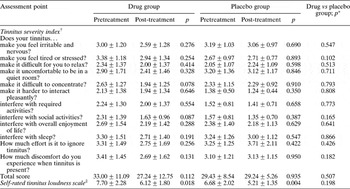
Table II gives patients' pre- and post-treatment tinnitus severity index scores and self-rated tinnitus loudness scores, and compares changes. We failed to find any significant post-treatment differences in any of the individual tinnitus severity index question scores, for either the drug group or the placebo group (p > 0.05 for all). When we assessed post-treatment improvements in individual tinnitus severity index question scores, comparing the drug versus the placebo groups, there were no significant differences (p > 0.05 for all) (Table II).
Tinnitus scores: tinnitus severity index and self-rated tinnitus loudness scale

Data are given are means ± standard deviation. *Change in scores, drug group vs placebo group. †Scale of 1 to 5; ‡scale of 1 to 10.
The average total tinnitus severity index score in both groups also failed to show any significant difference, comparing pre- and post-treatment results (p = 0.112 in the drug group, p = 0.935 in the placebo group). An assessment of post-treatment changes in average total tinnitus index severity score, comparing the drug versus the placebo group, indicated no significant difference (p = 0.507) (Table II).
Assessment of self-rated tinnitus loudness scores showed a significant improvement in both groups, comparing pre- and post-treatment results (p = 0.018 in drug group, p = 0.004 in placebo group) (Table II). However, assessment of post-treatment changes in the self-rated tinnitus loudness score, comparing the drug versus the placebo group, showed no significant difference (p = 0.198) (Table II).
Adverse events
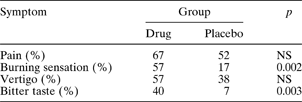
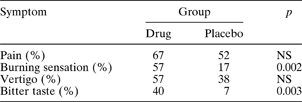
Patients were questioned about the occurrence of any adverse events. Pain during injection was the most commonly reported adverse event, followed by vertigo, burning sensation around the ear or in the throat, and a bitter taste. A burning sensation and a bitter taste were reported more often in the drug group than the placebo group (p = 0.002 and p = 0.003, respectively). There was no significant difference in the two groups in terms of pain during injection and vertigo (Table III).
Adverse effects in drug and placebo groups
NS = nonsignificant
The adverse events reported were generally mild. Patients reported that pain, burning sensation and bitter taste resolved in approximately 10–20 minutes following the injection. Vertigo resolved spontaneously in all patients approximately 2 minutes after the injection. No changes in hearing level were noted in either group after treatment. None of the patients developed otitis media, otitis externa or persistent perforation of the tympanic membrane.
Discussion
The results of this study indicate no benefit of intratympanic methylprednisolone over placebo for the treatment of subjective tinnitus refractory to medical treatment. Intratympanic treatment resulted in significant improvement in self-rated tinnitus loudness scoring in both the drug and the placebo groups. However, there was no improvement in scores for any of the questions of the tinnitus severity index questionnaire.
The potential success of intratympanic methylprednisolone for tinnitus treatment is based on the theory that glucocorticoid receptors exist in human cochlear tissue.Reference Rarey and Curtis14 The interaction of the drug with these glucocorticoid receptors leads to alteration of specific target genes, producing metabolic and anti-inflammatory effects.Reference Schaaf and Cidlowski15, Reference Banerjee and Parnes16 Steroids may also affect the vascularity of the inner ear. Shirwany et al. showed that transtympanic injection of dexamethasone in the guinea pig led to a 29 per cent increase in cochlear blood flow.Reference Shirwany, Seidman and Tang7 Expression of aquaporin 1 (an intrinsic membrane protein which increases the ability of water to pass through an epithelial cell layer) has been shown to increase following intratympanic steroid injection.Reference Fukushima, Kitahara, Uno, Fuse, Doi and Kubo17
Intratympanic application of steroids has been used for the treatment of various inner-ear and vestibular pathological conditions, including sudden sensorineural hearing loss, Ménière's disease and tinnitus.Reference Silverstein, Isaacson, Olds, Rowan and Rosenberg10, Reference Silverstein, Choo, Rosenberg, Kuhn, Seidman and Stein12, Reference Haynes, O'Malley, Cohen, Watford and Labadie18, Reference Battista19, Reference Xenellis, Papadimitriou, Nikolopoulos, Maragoudakis, Segas and Tzagaroulakis20, Reference Sennaroglu, Sennaroglu, Gursel and Dini21
Transtympanic steroid therapy for tinnitus is supported by a body of literature.Reference Sakata, Itoh and Itoh9, Reference Shulman and Goldstein22 Sakata et al. used intratympanic dexamethasone in 1214 patients with cochlear-type tinnitus, and achieved a 71 per cent effectiveness rate.Reference Sakata, Itoh and Itoh9 Shulman and Goldstein used either dexamethasone or hydrocortisone to treat 10 patients with cochlear-type tinnitus, and achieved a 70 per cent rate of tinnitus control.Reference Shulman and Goldstein22
Despite the theoretical benefits of intratympanic steroid treatment and the clinical success of the aforementioned studies, the current study failed to show any significant benefit of intratympanic methylprednisolone application in patients with subjective cochlear tinnitus. There are several possible reasons for a lack of success in our study.
First of all, there is no standard protocol in the literature for intratympanic steroid injection – i.e. the frequency of injections, concentration and type of corticosteroid, and the method of injections. Our approach to intratympanic delivery of methylprednisolone may have resulted in poor diffusion into the inner ear.
• Lack of knowledge about the exact pathophysiology of subjective tinnitus in patients with presbycusis limits our ability to implement effective therapy
• Application of intratympanic steroids has been shown to improve tinnitus in some patients; however, these studies were uncontrolled
• This paper reports a prospective, controlled, randomised, single-blind study investigating intratympanic methylprednisolone injections as treatment for subjective tinnitus refractory to medical treatment
• The results indicated no benefit of intratympanic methylprednisolone over placebo for the treatment of subjective tinnitus of cochlear origin refractory to medical treatment
Another possible cause for a lack of significant improvement following intratympanic methylprednisolone may relate to our study population, most of which comprised patients with presbycusis. Intratympanic application of steroids has been shown to be more effective in patients with labyrinthine hydrops and chronic otitis media, compared with other causes of subjective cochlear tinnitus.Reference Sakata, Itoh and Itoh9, Reference Sakata, Ito and Itoh23 Unfortunately, we were not able to obtain consent for the inclusion of any patients with labyrinthine hydrops, and patients with chronic otitis media were excluded.
Another factor that may have affected our results relates to the increasing evidence suggesting that tinnitus is generated in the central nervous system as a result of deprivation of input or abnormal input from the ear. Alterations in neuronal input are suggested to lead to structural and functional changes in the central nervous system, resulting in tinnitus.Reference Shiley, Folmer, McMenomey, Cummings, Flint, Harker, Haughey, Richardson and Robbins1, Reference Kaltenbach and Afman24 Such theories may explain why individual responses to intratympanic methylprednisolone and to saline were equivalent.
Finally, we would like to emphasise the fact that the use of a self-rated tinnitus loudness scale as an outcome measure in tinnitus studies may not be reliable, as shown in the current study. In our study, treatment resulted in an improvement in this scale in both the drug and the placebo groups. However, the additional use of the detailed tinnitus severity index questionnaire clearly showed that, in fact, our intervention had had no positive effect on patients' subjective experience of tinnitus. The tinnitus severity index is a better tool with which to define and quantify tinnitus, compared with a self-rated tinnitus loudness scale, and thus may be more helpful for the clinical assessment and management of patients with subjective tinnitus.
Conclusion
The current study of patients with subjective tinnitus refractory to medical treatment found that the placebo effect of transtympanic methylprednisolone injection was very high, but that in fact there appeared to be no actual benefit of this treatment over placebo in the treatment of such patients.