Introduction
Cross-sectional studies have shown that there is a high burden of psychiatric disorders, particularly depression and anxiety, in neurological disorders. However, such studies can only be hypothesis generating. In some instances it has been possible to test the hypotheses that (1) the psychiatric disorder is associated with an increased risk for developing the neurological disorder, and (2) the neurological disorder is associated with an increased risk for developing a new-onset psychiatric disorder. In clinical practice, many neurologists and psychiatrists may not be neuropsychiatrists, and there is the potential for either the neurologic disorder or the psychiatric disorder to be unrecognized and untreated. Thus, better understanding of the relationships between these disorders and education of neurologists and psychiatrists may lead to partnerships where doctors from both disciplines can work together to reduce the burden of the overlap of neurological and psychiatric disorders.
This article will focus mostly on epilepsy and its psychiatric comorbidities. Mention will be made of associations between other neurological disorders and psychiatric disorders.
Cross-Sectional Studies of Psychiatric Comorbidity in Epilepsy (Table 1)
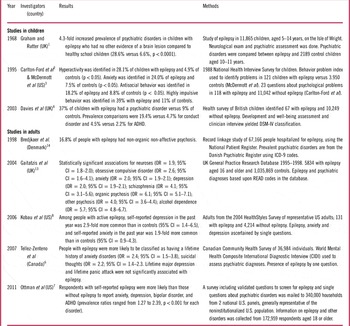
The prevalence of psychiatric comorbidity is increased in children with prevalent epilepsy. This has been supported in several cross-sectional, population-based studies. In an early survey of psychiatric disorders in all children with epilepsy on the Isle of Wight compared to children in the general population, there was an increased prevalence of psychiatric disorders in children with epilepsy who had no other evidence of a brain lesion compared to healthy schoolchildren.Reference Graham and Rutter 1 In a national sample of U.S. children, hyperactivity, anxiety, antisocial behavior, and highly impulsive behavior occurred more in epilepsy than in controls.Reference Carlton-Ford, Miller, Brown, Nealeigh and Jennings 2 , Reference McDermott, Coker and Mani 3 Compared to UK controls, children with epilepsy had a greater prevalence of attention deficit hyperactivity disorder (ADHD) and conduct disorder.Reference Davies, Heyman and Goodman 4
Examples of cross-sectional, community-based and clinical-based studies of epilepsy and psychiatric disorders

n.s. – not significant; OR – odds ratio; 95% CI – 95% confidence interval.
Among community-based adults, psychiatric disorders are more common in prevalent epilepsy than in controls. The occurrence of psychiatric disorders, particularly depression, in seizure-free individuals was about what is expected in the UK general population, although the proportion with psychiatric disorders was greater in individuals still experiencing seizures.Reference Jacoby, Baker, Steen, Potts and Chadwick 5 When psychiatric disorders are assessed according to Diagnostic and Statistical Manual of Mental Disorders (DSM) criteria, the prevalence of anxiety disorders and suicidal ideation was greater in people with epilepsy than in controls in the Canadian Community Health Survey.Reference Tellez-Zenteno, Patten, Jette, Williams and Wiebe 6 In a representative U.S. household survey, bipolar disorder was 2-fold greater in people with self-identified prevalent epilepsy compared to those without,Reference Ottman, Lipton and Ettinger 7 and depression and anxiety were more common in epilepsy in the U.S. HealthStyles Survey.Reference Kobau, Gilliam and Thurman 8
Examining the overlap of epilepsy and schizophrenia, Slater and BeardReference Slater, Beard and Glithero 9 noted that the cumulative incidence of epilepsy was about 3% to age 70,Reference Hauser, Annegers and Kurland 10 and the cumulative incidence of schizophrenia was 0.86% to 26 years of age.Reference Suvisaari, Haukka, Tanskanen and Lonnqvist 11 They reasoned that if epilepsy and schizophrenia were unrelated, 0.04% of people would have both conditions. In fact the prevalence of epilepsy in prevalent schizophrenia far exceeds the threshold for being unrelated and ranges from 0.13% to 3.5%,Reference Flor-Henry 12 and is as high as 9% for psychosis.Reference Gaitatzis, Carroll, Majeed and Sander 13 Additionally, 16.8% of people with epilepsy had non-affective psychosis in the Danish registry.Reference Bredkjaer, Mortensen and Parnas 14
The cross-sectional studies discussed above are elegant and provide information about current psychiatric disorders in epilepsy. This information is crucial for developing partnerships between neurologists and psychiatrists, even if limited conclusions can be drawn from such studies, which are generally viewed as hypothesis generating.
Prevalence studies are cross-sectional and examine people at one point in time. Individuals entering these studies must have survived to be able to enter the study or to have an ongoing neurological disorder. Because some people may have died and others may no longer have the neurological condition (eg, epilepsy), selective attrition can occur. Using incident epilepsy as an example, mortality is increased, particularly in the first years after the onset of epilepsy with a known cause.Reference Forsgren, Hauser, Olafsson, Sander, Sillanpaa and Tomson 15 People with epilepsy are less likely to have continued seizures when the epilepsy etiology is unknown.Reference Hauser, Rich, Lee, Annegers and Anderson 16 Thus, individuals who die and those whose seizures remit are excluded from prevalence studies, creating a prevalence population that is more likely to have epilepsy of long duration. The people with existing psychiatric disorders at the time of cross-sectional sampling are also not representative of those with new-onset psychiatric disorders, as mortality is also increased in psychiatric disorders,Reference Laursen, Munk-Olsen, Nordentoft and Mortensen 17 and people with recurrent or long-standing psychiatric disorders predominate. Despite this limitation, prevalence studies underscore the significant burden that psychiatric disorders have in neurological disorders like epilepsy.
Another limitation of prevalence studies of neurological comorbidity is that it is impossible to know if the greater prevalence of psychiatric disorders results from the occurrence of a first psychiatric disorder after onset of the neurological disorder, recurrence of a psychiatric disorder that was first present before the onset of the neurological disorder, or both of these factors. These methodological concerns raised the need for studies that assess the time order of the relationship between psychiatric disorders and neurological disorders, and will be explored in the remainder of this article.
Psychiatric disorders before and after the diagnosis of neurological disorders (Table 2)
Epilepsy
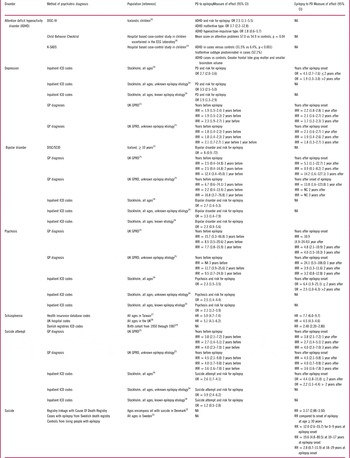
There is ample evidence that several psychiatric disorders and suicide attempt are associated with an increased risk for developing epilepsy in population-based studies. This relationship is bidirectional. Psychiatric disorders, including attention deficit hyperactivity disorder (ADHD), depression, anxiety, bipolar disorder and psychosis, and suicide attempt are associated with an increased risk for the development of epilepsy in population-based studies. Following the incidence of epilepsy, there is an increased risk for development of a first diagnosis of a psychiatric disorder.
Association between psychiatric disorders and risk for developing epilepsy and between epilepsy and risk for developing a first psychiatric disorder

PD – psychiatric disorders; OR – odds ratio; IRR – incidence rate ratio; RR – rate ratio; GP – general practitioner; NA – not applicable; NC – estimate did not converge; psychiatric disorders – depression, anxiety, psychosis, bipolar disorder; DISC-IV – Diagnostic Interview Schedule for Children IV; K-SADS – Kiddie-Schedule for Affective Disorders and Schizophrenia; SCID – Structured Clinical Interview for DSM Disorders.
ADHD
Several studies have shown that ADHD, particularly ADHD predominantly inattentive type, is associated with a statistically significant risk for developing epilepsy.Reference Austin, Harezlak, Dunn, Huster, Rose and Ambrosius 18 – Reference Hesdorffer, Ludvigsson, Olafsson, Gudmundsson, Kjartansson and Hauser 20 ADHD hyperactive-impulsive type is not associated with developing epilepsy.Reference Hesdorffer, Ludvigsson, Olafsson, Gudmundsson, Kjartansson and Hauser 20 In children with ADHD, there is greater frontal lobe gray matter and smaller brainstem volume.Reference Hermann, Jones and Dabbs 19
Depression
The earliest work on the time order of the association between depression and the risk for developing epilepsy used a single question.Reference Forsgren and Nystrom 21 Later studies from Rochester, Minnesota, and Iceland used standardized psychiatric interviews designed to make a DSM diagnosis of major depressive disorder.Reference Hesdorffer, Hauser, Annegers and Cascino 22 , Reference Hesdorffer, Hauser, Olafsson, Ludvigsson and Kjartansson 23 The most recent population-based studies in the General Practice Research Database (GPRD) and in Stockholm inpatients have used codes for depression in medical records.Reference Adelow, Andersson, Ahlbom and Tomson 24 , Reference Hesdorffer, Ishihara-Paul, Mynepalli, Webb, Weil and Hauser 25 Regardless of the methods used to evaluate epilepsy (eg, standardized interviews, ICD codes) and psychiatric disorders (eg, standardized interviews, symptom counts), most studies find that depression is associated with developing incident epilepsy and incident epilepsy is associated with developing new onset depression.
Bipolar disorder
Studies from the GPRD, Sweden, and Iceland show that bipolar disorder is associated with an increased risk for developing epilepsy. When standardized instruments are used to make a DSM diagnosis of lifetime history of bipolar disorder, there is an 8-fold increased risk for developing epilepsy that is not statistically significant.Reference Hesdorffer, Hauser, Olafsson, Ludvigsson and Kjartansson 23 When the risk for developing epilepsy is examined after the diagnosis of bipolar disorder, the increased risk for developing epilepsy ranges from 2.3-fold to 16.8-fold,Reference Adelow, Andersson, Ahlbom and Tomson 24 , Reference Hesdorffer, Ishihara-Paul, Mynepalli, Webb, Weil and Hauser 25 although in the GPRD study it was only statistically significant in the year before the onset of epilepsy.Reference Hesdorffer, Ishihara-Paul, Mynepalli, Webb, Weil and Hauser 25 The lack of statistical significance may be partly due to the low annual incidence of bipolar in incident epilepsy.
Only the GPRD study provides information on the risk for developing bipolar disorder after the onset of epilepsy.Reference Hesdorffer, Ishihara-Paul, Mynepalli, Webb, Weil and Hauser 25 During each of the 3 years after epilepsy onset, there is a 0.9- to 14.2-fold increased risk for developing bipolar disorder.
Psychosis and schizophrenia
Most studies have examined psychosis, and not schizophrenia, as a risk factor for developing epilepsy, in part because the diagnosis of schizophrenia is sometimes made years after the diagnosis of psychosis—a delay that may be due to impaired access to medical care, and psychiatric care particularly, as a consequence of symptoms, attitudes, or beliefs.Reference Lieberman and Fenton 26 Not only is the association between psychosis and development of epilepsy specific, it is also of greatest magnitude when comparison is made to other psychiatric disorders.
In the GPRD study, a first-ever episode of psychosis in each of the 3 years before epilepsy onset was associated with a 7.7- to 15.7-fold increased risk for developing epilepsy.Reference Hesdorffer, Ishihara-Paul, Mynepalli, Webb, Weil and Hauser 25 An association of lesser magnitude was found in the hospital-based Stockholm study.Reference Adelow, Andersson, Ahlbom and Tomson 24 The risk of developing epilepsy was similar for epilepsy of unknown cause and for schizophrenia.Reference Chang, Chen and Tsai 27 , Reference Wotton and Goldacre 28 After the onset of epilepsy, the risk for developing a first episode of psychosis is increased 2.5- to 10.9-fold.Reference Adelow, Andersson, Ahlbom and Tomson 24 , Reference Hesdorffer, Ishihara-Paul, Mynepalli, Webb, Weil and Hauser 25 This increased risk is similar to that seen in incident epilepsy of unknown etiology.
A Danish registry study of a birth cohort compared cases to controls without epilepsy and found a 2.5-fold increased risk for developing schizophrenia after the onset of epilepsy.Reference Qin, Xu, Laursen, Vestergaard and Mortensen 29 The association schizophrenia was notable for an increase in the relative risk for schizophrenia by age at onset of epilepsy (test for trend p<0.01). There was no difference in the risk for developing schizophrenia by seizure type. Two other studies support this association.Reference Chang, Chen and Tsai 27 , Reference Wotton and Goldacre 28
Suicide attempt and completed suicide
Suicide attempt occurs in 4.6% of the general population, and is associated with being female and previously married, as well as with mood disorders, anxiety disorders, substance use disorders, conduct disorder, adult antisocial behavior, antisocial personality disorder, and non-affective psychosis.Reference Kessler, Borges and Walters 30
Suicide attempt is associated with an increased risk for developing epilepsy in studies from Iceland, the UK GPRD, and Stockholm. In Iceland,Reference Hesdorffer, Hauser, Olafsson, Ludvigsson and Kjartansson 23 the combination of suicide attempt and depression increased the risk for developing epilepsy almost 9-fold, while suicide attempt without depression increased the risk 11-fold. Others found that the risk for suicide attempt was associated with a 2.7- to 4.5-fold increased risk for developing epilepsy.Reference Adelow, Andersson, Ahlbom and Tomson 24 , Reference Hesdorffer, Ishihara-Paul, Mynepalli, Webb, Weil and Hauser 25 This risk was greater for epilepsy of unknown etiology. After the diagnosis of epilepsy, the risk for a first suicide attempt was increased 2.1- to 5.1-fold.
Completed suicide is 3.2- to 5-fold more common in epilepsy than in the general population.Reference Rafnsson, Olafsson, Hauser and Gudmundsson 31 , Reference Christensen, Vestergaard, Mortensen, Sidenius and Agerbo 32 Among those with epilepsy and no psychiatric diagnosis in a Danish birth cohort, the risk for suicide is increased 2.35-fold; this is statistically greater than in those with a psychiatric diagnosis.Reference Christensen, Vestergaard, Mortensen, Sidenius and Agerbo 32 In a Swedish case-control study of suicide in epilepsy,Reference Nilsson, Tomson, Farahmand, Diwan and Persson 33 young age at epilepsy onset (ie, less than 20 years of age) was associated with suicide. Similar results were found in incident epilepsy of unknown etiology.
Examples of Other Neurological Disorders Comorbid with Psychiatric Disorders
The explanation for psychiatric comorbidity in degenerative neurological disorders differs from the explanation given for epilepsy (and migraine). In particular, depression is seen as a part of several degenerative neurological conditions (eg, Alzheimer’s disease, Parkinson’s disease), which is consistent with an early symptom that is part of the disorder. However, the association between depression and development of epilepsy is seen as having a shared susceptibility that is not yet understood.
Alzheimer’s disease
Both the Amsterdam studyReference Geerlings, Bouter and Schoevers 34 and a similar study conducted in a U.S. communityReference Chen, Ganguli, Mulsant and DeKosky 35 did not find a significant association between depression and risk for dementia or Alzheimer’s disease. However, in the Amsterdam study sample of elderly people with normal cognition at study entry,Reference Geerlings, Bouter and Schoevers 34 depression was associated with a statistically significant 5.31-fold increased risk for developing Alzheimer’s disease only in the subset with more than 8 years of education.
Alzheimer’s disease is associated with psychosis and suicide attempt. Psychosis affects about 50% of Alzheimer’s individuals.Reference Murray, Kumar, Demichele-Sweet and Sweet 36 Associated factors include a more severe phenotype and rapid cognitive decline even before psychosis manifests. Previous suicide attempts and the clinical dementia rating scale score were associated with the index suicide attempt after diagnosis of Alzheimer’s disease, adjusting for age and gender in a 10-year retrospective cohort study of patients with dementia or Alzheimer’s disease (p=0.017 and p=0.022, respectively), but were not associated with lifetime psychopathology.Reference Barak and Aizenberg 37
Parkinson’s disease
Depression is associated with a 3.13-fold increased risk for developing Parkinson’s disease (95% CI: 1.95–5.01), adjusting for age, gender, and socioeconomic status in a large retrospective cohort study.Reference Schuurman, van den Akker and Ensinck 38 . In clinic-based patients with rapid onset dystonia-Parkinsonism with motor manifestations, due to a missense mutation in the ATP1Ae gene, the frequency of psychiatric disorders was compared to normal controls.Reference Brashear, Cook and Hill 39 Patients with motor manifestations had a statistically significant greater prevalence of mood disorder, psychotic disorder, and substance abuse or dependence.
Stroke
In 2 meta-analyses of prospective studies,Reference Dong, Zhang, Tong and Qin 40 , Reference Pan, Sun, Okereke, Rexrode and Hu 41 depression was associated with a statistically significant 1.32- to 1.45-fold increased risk for a first stroke after adjusting for confounders. Depression is also associated with stroke risk factors, including myocardial infarctionReference Pratt, Ford, Crum, Armenian, Gallo and Eaton 42 and diabetesReference Eaton, Armenian, Gallo, Pratt and Ford 43 ; however, the mediating effects of myocardial infarction and diabetes on the association between depression and incident stroke have not been studied. One to 2 months after a stroke, there is a 11–15% risk for depression in community samples and a 9–19% risk in hospitalized patients.Reference Whyte and Mulsant 44 In the post-stroke period, it may be difficult to disentangle symptoms of depression from outcomes after stroke, particularly in regard to diminished ability to think or concentrate, and fatigue or loss of energy. There are no large studies of anxiety and stroke.
A history of psychosis was found in 3.8% of 15,791 people admitted for stroke in a population-based study in Nova Scotia.Reference Kisely, Campbell and Wang 45 Those with psychosis were significantly more likely to die due to ischemic heart disease and cerebrovascular disease and less likely to have procedures and medications.
Suicide completion is increased 1.9-fold in people with stroke in the Swedish population.Reference Eriksson, Glader, Norrving and Asplund 46 Risk factors for suicide attempt in this study include young age, being male, living alone, lower education, and lower income. Similar results are reported in a Danish population.Reference Teasdale and Engberg 47
Essential tremor
In a Spanish prospective study, comparing the risk for essential tremor in people with self-reported depression to those without,Reference Louis, Benito-Leon and Bermejo-Pareja 48 there was a 1.78-fold increased risk for developing essential tremor (95% CI: 1.11–2.89), adjusting for gender, educational category, smoking, drinking, diabetes mellitus, hypertension, and dementia. This was unchanged when patients with dementia were removed. There are no epidemiological studies assessing psychosis, anxiety, or suicide attempt in essential tremor.
Migraine
Depression and suicide attempt are associated with developing migraine, and migraine is associated with development of these outcomes. In a random sample of 1707 young adults from a large health plan followed over a 3-year period, prior depression was associated with an increased risk for developing migraine and prior migraine was associated with an increased risk for developing depression [significant odds ratios (ORs) adjusting for age, gender, and education were 3.2 and 3.1, respectively].Reference Breslau, Davis, Schultz and Peterson 49 Suicide attempt was increased 2.4-fold in migraine without aura and 5.4-fold in migraine with aura.Reference Breslau, Davis and Andreski 50 The greatest percentage with suicide attempt was in migraine with aura and major depression (38.5%).
Conclusions
There are several possible explanations for the comorbidity of psychiatric disorders and neurological disorders, both of which arise out of the brain. One explanation is that comorbid disorders shares a characteristic that is part of the diagnosis of both disorders. This may be the case for the comorbidity of depression and epilepsy. A second explanation is that one disorder may directly cause another disorder; this is unlikely for the psychiatric disorders and neurological disorders addressed here. A third explanation is that two conditions may be comorbid due to an underlying common risk factor, but this is not well elucidated in the literature. And the fourth explanation is that psychiatric disorders may herald neurological disorders, as is described for the early symptom of depression and development of Alzheimer’s disease.
In population-based studies, relationships between psychiatric disorders and neurological disorders have so far been unable to disentangle which explanation discussed above might clarify the overlap of neurological disorders with psychiatric disorders and suicide attempt. One study provided some insight into the co-occurrence of epilepsy and major depression, suggesting that serotonin is associated with a decreased risk for developing epilepsy in randomized trials for selective serotonin reuptake inhibitors (SSRIs) and serotonin–norepinephrine reuptake inhibitors (SNRIs) for treatment of depression, whereas those in the placebo group had a 17-fold increased risk for epilepsy.Reference Alper, Schwartz, Kolts and Khan 51 Other hypotheses have not been studied in population-based studies, although they have been explored in more select clinical samples, in which left temporal lobe epilepsy may be associated with psychosis and neurophysiological and neurochemical abnormalities have been proposed.Reference Sachdev 52
There is a strong comorbidity between neurological disorders and psychiatric disorders, particularly psychosis and suicidal behavior. Suicide attempt and completion are described mostly in the 3 episodic disorders discussed here, epilepsy, stroke, and migraine, and in a degenerative disorder, Alzheimer’s disease.
The debilitating effects of combined psychiatric and neurological disorders make it crucial for physicians caring for people with psychiatric disorders to screen for neurological disorders and vice versa. Additionally, neuropsychiatrists can address these comorbid disorders simultaneously. Only then can treatments and other interventions be used to ameliorate the joint disease burden and improve the health and quality of life of affected individuals. Suicidal behavior in neurological disorders is particularly important and must be addressed emergently. It is necessary to refer people with neurological disorders (eg, epilepsy, stroke, migraine, and Alzheimer’s disease) who have attempted suicide for interventions to reduce the risk for repeated suicide attempt and death due to suicide.
Disclosures
Dale Hesdorffer has the following disclosures: Upsher-Smith, consultant/advisor, consulting fees; Acorda, consultant/advisor, consulting fees; Cyberonics, consultant/advisor, consulting fees; Mount Sinai Injury Prevention Center, consultant/advisor, consulting fees; NYU Comprehensive Epilepsy Center, consultant/advisor, consulting fees; Epilepsy Study Consortium, researcher, research support; NIH grant, principal investigator of subcontract, research support; CDC grant, principal investigator, research support; PCORI grant subcontract, principal investigator of subcontract, research support; Epilepsy Foundation, principal investigator, research support.