1 Language from above and below
Whilst most of the contributions to this special issue consider how the forms of speech are represented, in this article I examine the metalinguistic comments made by compilers of pronouncing dictionaries in the eighteenth century. As noted by Agha (Reference Agha2003, Reference Agha2007), these metalinguistic comments were key to the enregisterment of the prestigious variety of spoken English which was later to become known as RP. They were also instrumental in propagating the stigmatisation of certain forms of speech, most notably those associated with the lower classes. As such, these pronouncing dictionaries constitute evidence of eighteenth-century language ‘from above’, both in the sense of ‘from the perspective of a higher social position’ and in the Labovian sense of ‘above the level of consciousness’ (Labov Reference Labov2001: 274).
The twenty-first century has witnessed a turn in historical linguistics, and particularly in historical sociolinguistics, to the study of ‘language history from below’ (Elspaß Reference Elspaß and Elspaß2007: 4). At the beginning of the century, Trudgill & Watts argued that most histories of English had ‘presented a system of self-perpetuating orthodox beliefs and approaches’ (Reference Trudgill, Watts, Watts and Trudgill2002: 1) with a focus on the history of Standard English, to the exclusion of other regional, national and social varieties. Elspaß recommends that the study of ‘language history from below’ should concentrate on non-literary texts, especially ego-documents such as letters and diaries, since these constitute ‘material as close to actual speech as possible, only in written form’ (Sević Reference Sević and Beedham1999: 340, cited in Elspaß Reference Elspaß, Langer, Scharloth and Vandenbussche2007: 5). Research in this vein has been facilitated by the creation of several corpora of ego-documents, such as the Corpus of Early English Correspondence (CEEC 1998), Corpus of Scottish Correspondence (Meurman-Solin Reference Meurman-Solin2007) and currently under construction, the Corpus of Irish English Correspondence (McCafferty & Amador Moreno Reference McCafferty, Amador-Moreno, Migge and Chiosáin2012). The Language of the Labouring Poor in Late Modern England (LALP) project is particularly important in this regard, since it involves creating a searchable corpus of the pauper letters collected and transcribed by Tony Fairman (see, for example, Fairman Reference Fairman and Elspaß2007 for an early account of the LALP corpus).
A searchable corpus of pauper letters partly based on Fairman's collection would appear to be the holy grail of language history from below, providing as it does access to ego-documents produced by the lowest class of society, paupers. This evidence is important because it has not been available before and promises to fill a yawning gap in our knowledge of historical sociolinguistic variation. However, it is important not to assume that pauper letters are necessarily more ‘authentic’ than other sources of evidence for lower-class language. In writing letters soliciting financial help, the authors of these documents may well have been using a register different from that of everyday speech. Fairman himself cautions against preferencing the view from below, arguing that such a view ‘is as one-sided as a view from above’ and recommending ‘a panorama of all forces, formal and informal’ (Reference Fairman and Elspaß2007: 42). In this spirit, the LALP project states as one of its research questions:
How does the language found in the pauper petitions compare to reflections of lower-class language (spoken, written) in contemporary literature and depositions as well as meta-linguistic comments found in pronunciation grammars and other contemporary manuals? (https://wp.unil.ch/lalp/project-description/)
What Fairman and the LALP team are advocating is a holistic approach in which all available sources of evidence are considered in order to build as complete a picture as possible of the language of the lower classes.
In this article, I examine metalinguistic comments from late eighteenth-century pronouncing dictionaries to determine what we can learn about lower-class English in this period. This ‘view from above’ tells us how such language was perceived and regarded, what variants were indexed as typical of lower-class speakers and subsequently stigmatised. I address the following research questions:
• Where do we find metalinguistic comments about the labouring classes?
• How is their language regarded?
• What features of pronunciation are indexed as being associated with the labouring classes?
• What effect did these metalinguistic comments have on the perception of lower-class language?
In section 2 I address the first of these questions and focus on the pronouncing dictionaries which proliferated from the second half of the eighteenth century. I discuss the social and historical contexts of these dictionaries and then provide an account of the Eighteenth-Century English Phonology (ECEP) database, from which most of the evidence discussed in this article is drawn. Section 3 concentrates on the key terms used in metalinguistic comments on the pronunciation of the lower classes. The word vulgar and its derivatives are found to be the most frequent labels used in pronouncing dictionaries, so definitions of these terms in eighteenth-century dictionaries and examples of their use in other contexts are discussed. In section 4, I provide an account of the features of pronunciation labelled as ‘vulgar’ in eighteenth-century works on pronunciation and in section 5 I argue that these sources of metalinguistic comment played an important part in the enregisterment (Agha Reference Agha2003) of and subsequent stigmatisation of a repertoire of ‘vulgar’ pronunciation associated primarily with the lower classes.
2 The nature of the evidence
2.1 Metalinguistic comments and enregisterment
Beal & Cooper (Reference Beal and Cooperforthcoming) discuss the importance of metalinguistic comments as evidence for historical enregisterment. Agha defines the process of enregisterment as establishing ‘a linguistic repertoire differentiable within a language as a socially recognised register’ which has come to index ‘speaker status linked to a specific scheme of cultural values’ (Reference Agha2003: 231). This process is conducted by means of messages in which linguistic features are linked with social characteristics in a ‘speech chain’ (Agha Reference Agha2007: 64–77) by which such messages are transmitted and received. Metalinguistic comments constitute such messages and when included in widely read documents they can be influential, since each reader has the potential to absorb and pass on the message as a link in the speech chain. I return to the issue of the influence of pronouncing dictionaries in section 5, but first I consider the social and historical context in which these dictionaries were published and the nature of the metalinguistic comments they contain.
2.2 Eighteenth-century pronouncing dictionaries
In his study of the development of Standard English, Holmberg notes that ‘it is in the eighteenth century that the snob value of a good pronunciation began to be recognised’ (Reference Holmberg1964: 20). Jones also recognises a shift in attitudes in this century, narrowing this down to the second half:
Between 1750 and 1800 … there is a sea-change in the way linguistic usage is perceived to relate to criteria such as social status and place of geographical origin (the two often vitally interconnected). (Jones Reference Jones2006: 117)
Beal (Reference Beal2004: 1–13) outlines the social, political and intellectual changes which took place in Britain in what historians term the ‘long’ eighteenth and nineteenth centuries (1688–1815 and 1789–1914 respectively). These include the expansion of education and increasing social and geographical mobility, all of which have the potential to bring speakers of different varieties of English into contact. As Beal (Reference Beal2009) and Johnstone (Reference Johnstone2009) have noted in the context of post-industrial Sheffield and Pittsburgh respectively such contact leads to heightened awareness of linguistic differences and the enregisterment of social and geographical dialects. The second half of the eighteenth century was a period of similar heightened sociolinguistic awareness. Elocutionists such as Thomas Sheridan and John Walker mounted highly successful lecturing tours of Britain. Their success testifies to the demand among the affluent, educated people of the middling sort for guidance on effective enunciation and correct pronunciation. For those unable to attend these lectures but still affected by what Labov (Reference Labov1972: 117) terms ‘linguistic insecurity’, pronouncing dictionaries provided such instruction. The first English dictionary to provide a detailed account of the recommended pronunciation of every word was that by Buchanan (Reference Buchanan1757). Many more were to follow in the second half of the eighteenth century, the most successful and influential of which were those by Sheridan (Reference Sheridan1780) and Walker (Reference Walker1791). Walker's dictionary was so successful that it was still being published in new editions right up to 1904. These dictionaries provided transcriptions of each headword, usually involving diacritics, and variant fonts, but in the case of Spence (Reference Spence1775) a phonemic alphabet devised by the author. Such information provides direct evidence with which to reconstruct eighteenth-century pronunciation, but since the aim of these authors was to describe and prescribe what they considered correct pronunciation, it does not provide information about lower-class language. However, many of these dictionaries, most notably Walker's (Reference Walker1791), also included prefaces and notes in which proscribed pronunciations were discussed. These constitute a rich source of metalinguistic comments about the kind of pronunciations their readers should avoid, and so provide us with evidence of how the language of the labouring poor was regarded.
2.3 The Eighteenth-Century English Phonology Database (ECEP)
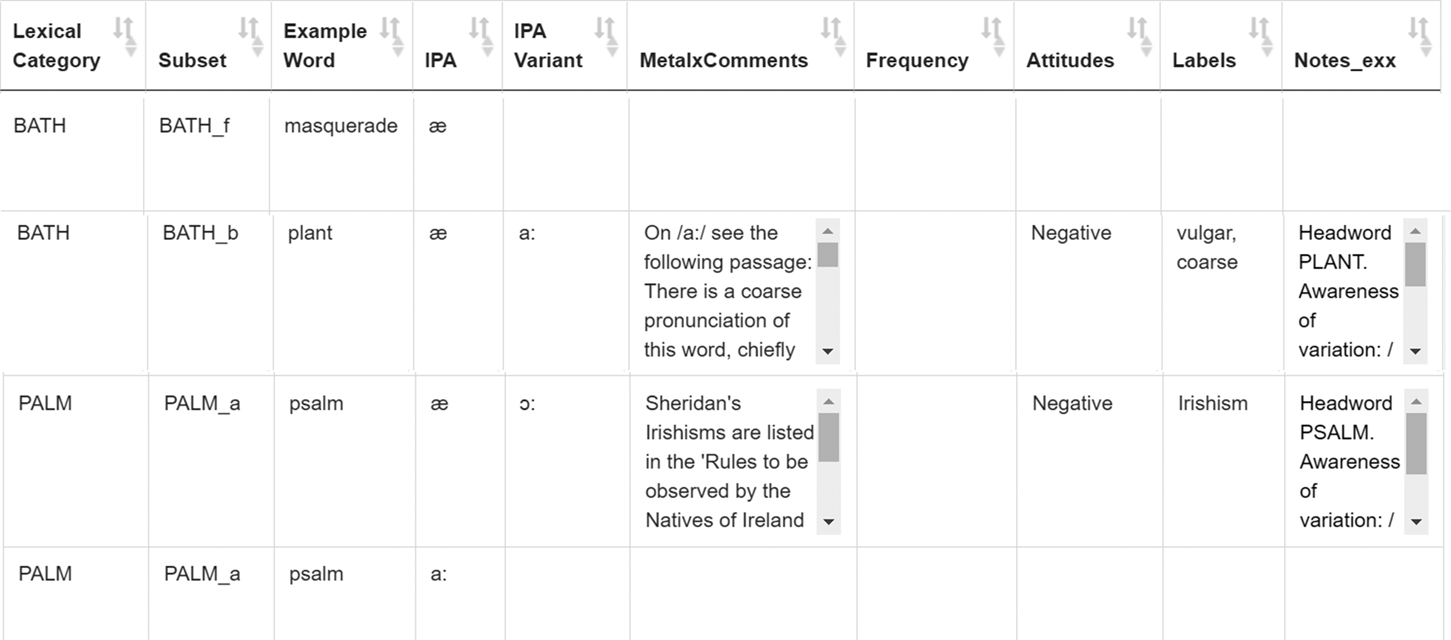
Although, as stated above, eighteenth-century pronouncing dictionaries provide a wealth of information about the pronunciation of the period, each dictionary has its own system of notation, and some of them are very difficult to access. With this in mind, a team of researchers from the universities of Sheffield and Vigo created the ECEP database.Footnote 1 Figure 1 is a screenshot from the ECEP database. The lexical sets and subsets are those set out in Wells (Reference Wells1982) for the comparison of vowel phonemes in accents of English, with a supplementary set of consonantal sets devised by the ECEP team. Example words are those words given as examples of those subsets which appear in the dictionaries selected for ECEP. IPA is the IPA equivalent identified by the ECEP team for the pronunciation of the segment concerned indicated by the majority of the eighteenth-century sources, whilst IPA variant denotes an alternative pronunciation indicated by some sources, either as the recommended pronunciation or a dispreferred alternative. Attitudes indicate the stance of the eighteenth-century author(s) to the variant, whilst labels provide the terms used to express these stances. Finally, the metalinguistic comments column gives more detailed citations from the sources.
Screenshot from ECEP

The full version of the metalinguistic comment partly shown in figure 1 is as follows:
PLANT, plant4
There is a coarse pronunciation of this word, chiefly among the vulgar, which rhymes it with aunt. This pronunciation seems a remnant of that broad sound which was probably given to the a before two consonants in all words, but which has been gradually wearing away, and which is now, except in a few words, become a mark of vulgarity. (Walker Reference Walker1791: s.v. plant)
The superscripted number here refers to Walker's system for representing different pronunciations of alphabetic letters. His <a4> represents IPA /æ/, whilst his <a2> as in half represents /aː/. Walker uses the words coarse, vulgar and vulgarity in association with the lengthened pronunciation of <a> in most words of the bath set. Elsewhere, Walker writes that ‘pronouncing the a in after, basket, plant, mast, &c. as long as in half, calf, &c. borders very closely on vulgarity’ (Reference Walker1791: 10). This tells us that the lengthened vowel in these words of the bath set, which is lengthened and backed to /ɑː/ in present-day RP, was considered ‘vulgar’ by Walker (see Beal Reference Beal1999: 105–18 for a fuller account of the distribution of variant pronunciations of bath words in eighteenth-century pronouncing dictionaries). In the next section, I discuss in more detail the nature of the metalinguistic labels used by Walker and other eighteenth-century authors to describe and evaluate pronunciations attributed to the lower classes.
3 Labels for lower-class language
3.1 Frequently used labels
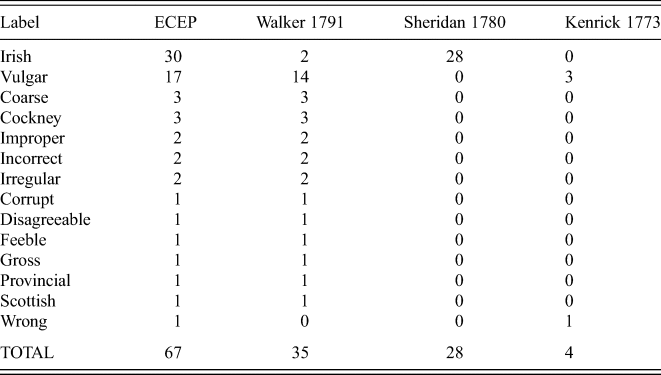
Walker's use of the terms coarse, vulgar and vulgarity is by no means unusual in eighteenth-century discourse about lower-class language. As shown in figure 1, ECEP includes a search term labels which enables the user to find all the metalinguistic terms associated with the keywords included in the database. It also includes a search term attitudes whereby metalinguistic comments are designated as displaying positive or negative attitudes. Since attitudes to lower-class language in the ECEP data sources are overwhelmingly negative, I have collated in table 1 the results of searches for negative terms included in the database entries.
Negative labels in ECEP

The labels chosen for these searches are those which could be applied to the pronunciation of lower-class speakers. Walker also uses the terms pedantic and affected in connection with pronunciations of which he disapproves, but these are applied to the language of academics and fashionable people respectively. Apart from the labels Irish, Scottish and provincial, which refer primarily to stigmatised geographical variants, all the terms in table 1 refer to variants indexed as lower-class, uneducated or just plain wrong. Although there are eleven sources for the data in ECEP, only three of these yield metalinguistic labels. This is because Kenrick (Reference Kenrick1773), Sheridan (Reference Sheridan1780) and Walker (Reference Walker1791) are the only ones with extensive commentaries and/or notes in which variant pronunciations of specific words are discussed evaluatively. Walker accounts for more than half (35/67) of the tokens in table 1 and all of those with a single entry except for wrong in Kenrick. Sheridan has almost as many (28/67), but all of these are tokens of the label Irish. Sheridan was acutely aware of the stigmatisation of Irish English, having been born and educated in Ireland. His success as an elocutionist in England did not protect him from the scorn of English critics such as Samuel Johnson, who is quoted as saying ‘what entitles Sheridan to fix the pronunciation of English? He has in the first place the disadvantage of being an Irishman’ (Boswell Reference Boswell, Hill and Powell1934: ii, 161). The preface to Sheridan's dictionary includes a set of ‘rules to be observed by the natives of Ireland’ pointing out Irishisms to be avoided. Walker copied these, augmenting them with remarks on the pronunciation of the Scots, the Welsh and the Cockneys. Of these geographical categories, only Cockney refers to a variety stigmatised because of its association with social class as well as geographical location. Ireland in the late eighteenth century was part of Great Britain, and the mass emigration of the Irish poor to English industrial cities associated with the Great Famine (1845–9) was yet to occur, so the main cause for stigmatisation of Irish, Scottish and Welsh variants was that they differed from the emerging standard pronunciation in England (see Mugglestone Reference Mugglestoneforthcoming for an account of the emergence of this standard). In the following sections, I will therefore concentrate on the terms used to index variants associated with the lower classes, the most frequent of which is vulgar. Before discussing the connotations of this word and its derivatives in the late eighteenth century, I consider Trapateau's (Reference Trapateau2010, Reference Trapateau2016) more detailed studies of Walker's use of metalinguistic labels.
Trapateau (Reference Trapateau2010) created a database of all the critical terms used in Walker's A Critical Pronouncing Dictionary. These terms are discussed in Trapateau (Reference Trapateau2016): out of a total of 484 tokens of Walker's most frequently used critical labels, 94 were of the term vulgar. The next highest occurrence was of corrupt with 90 occurrences, then correct with 77 and improper with 54. No other term had more than 50 occurrences. Correct describes the pronunciations approved by Walker, and so is in opposition to terms such as vulgar, corrupt and improper. If we take only the negative terms from Trapateau's list, i.e. vulgar, corrupt, improper, gross, obsolete and affectation, the total number of tokens is 306, of which the 94 tokens of vulgar constitute 31 per cent. So, in both ECEP and Trapateau's database, vulgar was the most frequently used non-geographical term of disapprobation. In order to understand what connotations vulgar and its derivatives had in the late eighteenth century, we need to examine definitions in dictionaries of the period and examples of its use.
3.2 Vulgar and its derivatives in eighteenth-century usage
Wild (Reference Wild, DeCesaris and Bernal2008) discusses the use of the labels vulgar and popular in Johnson's and Webster's dictionaries and in the Oxford English Dictionary (OED). She notes that ‘modern critics’ who count Johnson's uses of the term vulgar ‘are assuming a present-day English understanding of the word’ (Wild Reference Wild, DeCesaris and Bernal2008: 1209). Johnson defines the word vulgar as follows:
1. Plebeian; suited to the common people; practised among the common people.
2. Vernacular; national
3. Mean; low; being of the common rate
4. Publick; commonly bruited (Johnson Reference Johnson1755: s.v. vulgar)
The first definition clearly associates the word vulgar with the lower classes, as does the third. The pejorative terms mean and low demonstrate that vulgar has negative connotations. By contrast, definition 2 is more neutral, applying as it does to vernacular languages. Walker, like most authors of eighteenth-century pronouncing dictionaries, takes over Johnson's definitions and admits to this in his preface:
With respect to the explanation of words, except in very few instances, I have scrupulously followed Dr. Johnson. His Dictionary has been deemed lawful plunder by every subsequent Lexicographer; and so servilely has it been copied, that such words as he must have omitted merely by mistake … are neither in Mr. Sheridan's, Dr. Kenrick's, nor several other Dictionaries. (Walker Reference Walker1791: viii)
The entry for vulgar is one of those few for which Walker has not ‘scrupulously followed Dr. Johnson’, for he omits the neutral definition 2. Walker's definition is ‘Plebeian, suited to the common people, practised among the common people; mean, low, being of the common rate; publick, commonly bruited’ (Reference Walker1791: s.v. vulgar). So, when Walker labels a pronunciation as vulgar, he clearly intends this to mean that such a pronunciation is associated with the lower classes. In the fourth edition of his dictionary, Walker departs further from Johnson in adding a new definition of vulgarism. In Johnson's dictionary, this is a non-count noun, described as grossness, meanness, vulgarity (Johnson Reference Johnson1755: s.v. vulgarism). Walker notes the need for a new definition of this word as a count noun, referring to specific instances of vulgarity:
An expression used only by the vulgar or common people
This word is in no Dictionary that I have met with, but seems sufficiently authorized both in writing and conversation to entitle it to a place in a repository of the English Language. (Walker Reference Walker1806: s.v. vulgarism)Footnote 2
The Oxford English Dictionary confirms that this use of vulgarism as a count noun had been in general use before 1806 The first citation in this sense is from a letter of Horace Walpole written in 1746: ‘The Countess..has entertained the town with an excellent vulgarism’ (OED: s.v. vulgarism). The OED provides only this extract, but the full text of this letter reveals that the vulgarism committed by the countess was one of social behaviour rather than speech. In confining his definition of vulgarism to expressions used by the common people, Walker highlights the importance of speech as a social marker. Other extracts from Walpole's letters (Lewis Reference Lewis1973–83) demonstrate that vulgarism was used with relation to language by the late eighteenth century.
Though all archdukes wear the virgin's name first (with fifty others) nobody says, ‘Come hither, Moll’ – at least no mortal ever did, but the late Landgrave of Hesse, who had learnt that vulgarism and used it about his wife Princess Mary, when he spoke of her to her sisters Amalie and Caroline, who did not guess whom he meant. (Walpole: letter to Mary Berry, 12 May 1791)
You!—you are no more a judge of what makes a good letter than Dame Piozzi, who writes bad English when she ought to be exactly accurate, but mistakes vulgarisms for synonymous elegancies. (Walpole: letter to Mary Berry, 5 November 1795)
What is noticeable about all these examples from Walpole is that the person committing the vulgarity is not a member of the working class. In the OED citation it is a countess, in the 1791 letter a German aristocrat, and in the 1795 letter Hester Piozzi, a friend of Dr Johnson who scandalised English society by marrying her Italian music teacher after the death of her first husband. The same pattern can be found in letters from the Mary Hamilton papers.Footnote 3 Correspondents refer to people as ‘vulgar’ who are perhaps just a little lower in rank than themselves, certainly not working class, and once again Hester Piozzi's travel journal comes in for criticism. John Dickenson writing to Mary Hamilton on 2 August 1789 states ‘I have read the first Volume of Mrs Piozzis tour – & am astonished at the Vulgarity of the Language’. Those accused of vulgarity and of committing vulgarisms of language and behaviour are those who should know better. Likewise, those who could afford to buy pronouncing dictionaries would not be working class, but people of the middling sort who lacked the assurance of the upper classes and dreaded being mistaken for members of the lower classes. The stigma of vulgarity was to become even more widespread in the nineteenth century, when cheaper pamphlets with titles such as Vulgarisms and other Errors of Speech (Anon. Reference Anon1868) proliferated. Chapman (Reference Chapmanforthcoming) notes that ‘the avoidance of “vulgarisms” remained a priority in nineteenth-century prescriptive discourse’, and Mugglestone (Reference Mugglestone2003) provides many examples of pronunciations labelled as ‘vulgar’ in nineteenth-century publications. The next section focuses on a selection of pronunciation variants labelled as ‘vulgar’ in eighteenth-century pronouncing dictionaries and other works on pronunciation. These variants have been selected because they were the subject of extensive comment in these eighteenth-century sources.
4 ‘Vulgar’ pronunciations
4.1 bath and cloth
Where eighteenth-century authors comment on variant pronunciations, the variation concerned is usually an indication of change in progress. In many cases, the variant preferred by these authors eventually becomes the norm in RP, whilst pronunciations condemned as ‘vulgar’ either disappear or survive in non-RP accents, whether these be national, regional or social varieties. In other cases, the ‘vulgar’ variant eventually prevails even in RP, though sometimes not until the twentieth century. Variants of the bath and cloth vowels exemplify these two trajectories: both were subject to lengthening and backing from the seventeenth century onwards and in both cases the lengthened and/or backed variants were labelled ‘vulgar’ in eighteenth-century sources. In present-day RP, bath has a long back vowel /ɑː/ but, except in the most conservative variety of RP, typically associated with older members of the British aristocracy and royals, cloth has /ɒ/.
Walker's comment on the vulgarity of lengthened pronunciations of certain bath words has already been cited in section 2.3 as an example of his use of this evaluative term. However, this is not the only instance of Walker's explicit condemnation of such variants. Evidence from seventeenth-century sources, most notably Cooper (Reference Cooper1687), points to lengthening (but not backing) of the bath vowel before preconsonantal /r/ as in barge, carp, dart, preconsonantal /s/ as in blast, cast, gasp, mask, voiceless <th> as in path, voiced <th> followed by /s/ or /ər/ e.g. father, rather, lather, paths and, varying with /ɔː/, before preconsonantal /n/ as in grant, lance and before /l/ when it precedes /f, m/ and /v/ as in half, balm, calve. The seventeenth-century sources make no evaluative judgements about these lengthened variants, and the evidence points to a conditioned sound change. Walker seems to be aware that lengthened vowels were previously acceptable in these contexts, but that the tide of opinion has turned against some of them. He writes of the lengthened pronunciation that, although it had previously been heard in words such as glass and fast,
this pronunciation of a seems to have been for some years advancing to the short sound of this letter, as heard in hand, land, grand &c and pronouncing the a in after, answer, basket, plant, mast &c as long as in half, calf, &c. borders very closely on vulgarity. (Walker Reference Walker1791: 10–11)
Walker seems here to be suggesting that the trajectory of change in the bath vowel is from long to short, contradicting earlier evidence. It is more likely that short, long and backed variants were all in use in the late eighteenth century, but that the values attached to these variants changed over time. Evidence that the long back /ɑː/ was considered vulgar before Walker's dictionary was published comes from a German author, Georg Christoph Lichtenberg, living in England in 1770 and 1774–5. Horn & Lehnert cite him as writing that ‘zierlichen Mädchen’ (dainty young ladies) ‘pronounced the <a> in nasty so high that it sounded like nehsti’ in order to avoid the vulgar /ɑː/ (Reference Horn and Lehnert1954: 343). Further evidence for the vulgarity of the /ɑː/ pronunciation is given by Stephen Jones, who adds a fourth annotation for <a> in the third edition of his dictionary, since he recognised the need for such a distinction in bath words:
my 4th a, though it is more open than the a in hat, stops considerably short of the broad protracted pronunciation commonly heard among the vulgar. (Jones Reference Jones1798: iii)
Jones (Reference Jones1798) has many more words with this notation than Walker has for his <a4>, but he describes this as less ‘broad’ and ‘protracted’ than the ‘vulgar’ variant, so probably /aː/ rather than /ɑː/. Mugglestone argues that the stigmatisation of /ɑː/ by authors such as Walker ‘led to the creation of an artificial and compromise “middle sound”, one intermediate between [æ] and [ɑː]’ (2003: 81). Whether this was ‘artificial’ or the kind of ‘fudged’ variant sometimes found in dialect contact situations (Chambers & Trudgill Reference Chambers and Trudgill1980: 110), it was certainly associated with the speech of those who wished to avoid the stigma of vulgarity.
The vowel in the cloth set has a similar history to that of bath, with early lengthening attested from Cooper (Reference Cooper1687) and stigmatisation of the lengthened variant in the late eighteenth century. Walker comments on this parallel:
What was observed of the a, when followed by a liquid and a mute, may be observed of the o with equal justness. This letter, like a, has a tendency to lengthen, when followed by a liquid and another consonant, or by s, ss or s and a mute. But this length of o, in this situation, seems every day growing more and more vulgar; and as it would be gross to a degree to sound the a in castle, mask, and plant, like the a in palm, psalm, &c. so it would be equally exceptionable to pronounce the o in moss, dross, and frost, as if written mauwse, drawse, and frawst. (Walker Reference Walker1791: 22)
Beal & Condorelli (Reference Beal and Condorelli2014) extracted all the tokens of ‘long’ and ‘short’ pronunciations of the cloth words included in ECEP in eight of the dictionary sources (the study was conducted before ECEP was completed, so not all sources were yet available). The earliest source was Johnston (Reference Johnston1764) and the latest Scott (Reference Scott1799). We found that, apart from Johnston (Reference Johnston1764), all the sources had more instances of short than long vowels in this set. There was a sudden rise in the number of short tokens between Kenrick (Reference Kenrick1773) and Perry (Reference Perry1775), after which all our sources had short vowels in the majority of tokens. All these sources were recording what the authors considered to be the ‘correct’ pronunciation, so Walker's assertion that the long variant had been ‘growing more vulgar’ is borne out. In the case of cloth, the long variant was eventually to become associated with old-fashioned upper-class speech, but this is still marked as different from the norm. As with bath, long and short variants existed throughout the eighteenth and nineteenth centuries, but whereas the innovatory variant [ɑː] eventually became the norm in RP, [ɔː] was increasingly marginalised as either ‘too posh’ or ‘vulgar’. Lass discusses the ‘curious see-saw development’ in the pre-fricative lengthening of both /a/ and /ɒ/, in which ‘from the 1680s to the 1780s the use of the lengthened vowel expands; in the 1780s–90s a reaction sets in’ (Reference Lass and Wright2000: 225). In the case of cloth he states that ‘restoration of /ɒ/ … is not a reversed merger, but a shift of prestige in a set of coexisting variants’ (Reference Lass and Wright2000: 224).
The same could be said about the apparent reversal of lengthening in bath. The metalinguistic comments in Walker's dictionary and other late eighteenth-century sources help us to trace these shifts.
4.2 price and choice
Wells writes of his price and choice sets that ‘the history of the various diphthongs involved is in fact very complex and the subject of some scholarly disagreement’ (Reference Wells1982: 209). Words in the price set mostly derive from those with Middle English /iː/, whilst choice words had either /ɔɪ/ or /uɪ/. By the eighteenth century, the reflexes of these vowels and diphthongs sounded alike: price words had something like /ʌɪ/, whilst choice had this or /əɪ/. MacMahon sums up this situation as follows:
Historically, as a result of the gradual merging of the reflexes of ME /iː/ and /uɪ/, both phonetic realisations, by the seventeenth and eighteenth centuries, were diphthongs with [ə]-ish starting points. This was to lead to the loss of a phonemic distinction, which was subsequently reversed. (MacMahon Reference MacMahon and Romaine1998: 413)
Whether a phonemic merger can be reversed is a matter of debate (Milroy Reference Milroy1992: 156–8), but if there ever had been a merger, late eighteenth-century sources provide evidence for separate price and choice sets, albeit with a distribution of words different from that of present-day RP. What is clear from the metalinguistic comments in some of these sources is that certain pronunciations were considered vulgar. Walker writes of the digraph <oi>:
The general, and almost universal sound of this diphthong is that of the a in water, and the first e in me-tre [ɔi]. This double sound is very distinguishable in boil, toil, spoil, joint, point, anoint, &c. which sound ought to be the more carefully preserved, as there is a very prevalent practice among the vulgar of dropping the o, and pronouncing the words as if written bile, tile, spile, &c. … I remember, very early in life, to have heard coin pronounced as if written quine by some respectable speakers; but this is now justly banished as the grossest vulgarism. (Walker Reference Walker1791: 35)
As in his discussion of bath words, Walker here concedes that the variant which he labels vulgar was once ‘respectable’, but that this is no longer the case. Earlier sources label some of the /aɪ/ pronunciations of choice words as vulgar, but not all. Kenrick writes:
A vicious custom indeed prevails, in common conversation, of sinking the first broad sound intirely, or rather of converting both into the sound of i or y, … thus oil, toil are frequently pronounced exactly like isle, tile. … And yet there are some words so written, which by long use, have almost lost their true sound, such are boil, join and many others; which it would now appear affectation to pronounce otherwise than bile, jine. (Kenrick Reference Kenrick1773: 39)
Between the publication dates of Kenrick and Walker, Nares is fairly neutral in his evaluation of the /aɪ/ variant in boil, broil, join, poison and spoil. He notes that this is ‘commonly’ used and he does not specify any class of speaker as having this pronunciation, going on to suggest that ‘the only objection to giving the true sound to oi in join is that it is so constantly rhymed to fine, line, and the like, by our best poets’ (Reference Nares1784: 73, cited in Lass Reference Lass and Lass1999: 103). In the last three decades of the eighteenth century, words of the present-day choice set have variant pronunciations. The /aɪ/ variant is stigmatised as vulgar by the end of the century as Walker (Reference Walker1791) testifies, but some two decades earlier, a speaker hoping to avoid the taint of vulgarity by pronouncing boil and join with /ɔɪ/ risked being accused of affectation. Of course, only the socially mobile would need to worry about being considered affected: the labouring classes continued to use the /aɪ/ pronunciation, and Lass notes that by the nineteenth century ‘spellings like bile, jine had become provincial stereotypes’ (1999: 103).
4.3 Unstressed vowels
I have noted elsewhere that ‘the pronunciation of unstressed vowels was a potential minefield for eighteenth-century speakers who aspired to “correct” pronunciation’ (Beal Reference Beal1999: 153) Walker warns:
It may, indeed, be observed that there is scarcely any thing more distinguishes a person of mean and good education than the pronunciation of the unaccented vowels. When vowels are under the accent, the prince and the lowest of the people, with very few exceptions, pronounce them in the same manner; but the unaccented vowels in the mouth of the former have a distinct, open and specific sound, while the latter often totally sink them, or change them, into some other sound. Those, therefore, who wish to pronounce elegantly, must be particularly attentive to the unaccented vowels; as a neat pronunciation of these, forms one of the greatest beauties of speaking. (Walker Reference Walker1791: 23)
There is evidence for the reduction of vowels in unstressed syllables to something like schwa from at least the sixteenth century onwards. Dobson (Reference Dobson1957: 827 ff.) considers that by this time schwa in unstressed syllables was widespread at least in colloquial speech. Of the sources in ECEP, only Kenrick has a distinct notation for what we now call schwa: all the others employ a short vowel also used in stressed syllables. For all the other sources except Spence (Reference Spence1775) this is the vowel of Wells’ strut set in RP, described in eighteenth-century sources as ‘obscure’ or ‘guttural’. This is the vowel that MacMahon (Reference MacMahon and Romaine1998: 413) terms ‘[ə]-ish’ in the onset of price and choice discussed in section 4.2. (Spence, as a northerner, has no strut/foot distinction, so he uses his symbol for the short /ɪ/ of kit to represent unstressed vowels.) Although Shields argues that ‘the full, spelling pronunciation of unstressed syllables’ was ‘recommended by virtually all 18c writers’ (Shields Reference Shields1974: 54), Beal (Reference Beal1999: 153–9) finds otherwise, and evidence from ECEP confirms Beal's findings. Use of the unstressed vowel was considered vulgar only in specific contexts.
In his discussion of pronunciations of <ow>, Walker writes:
When this diphthong [sic] is in a final unaccented syllable, it has always the second sound, like long o [oː] in borrow, sorrow, fellow, willow, &c. The vulgar shorten this sound, and pronounce the o obscurely, and sometimes as if followed by r, as winder and feller, for window and fellow; but this is almost too despicable for notice. (Walker Reference Walker1791: 37)
The context for Walker's remarks on unaccented vowels cited above (section 4.3) is his discussion of the letter <u>:
There is an incorrect pronunciation of this letter when it ends a syllable, not under the accent which prevails, not only among the vulgar, but is sometimes found in better company; and that is giving the u an obscure sound, which confounds it with vowels of a very different kind. Thus we not unfrequently hear singular, regular, and particular, pronounced as if written sing-e-lar, reg-e-lar, and par-tick-e-lar; but nothing tends more to tarnish and vulgarize the pronunciation than this short and obscure sound of the unaccented u. (Walker Reference Walker1791: 23)
In this environment, the reduction of the vowel is accompanied by the loss of /j/ or /i/, which is discussed in section 4.4. Walker also comments on the pronunciation of <e> in words where it comes between a consonant and final <l> or <n>: ‘nothing is so vulgar and childish as to hear swivel and heaven pronounced with the e distinctly, or novel and chicken with the e suppressed’ (Walker Reference Walker1791: 14). Here, he is objecting not to schwa but to syllabic consonants in novel and chicken, which he transcribes with his representation of /ɪ/ in his dictionary, whilst swivel and heaven have <vl> and <vn> respectively. As with Kenrick's discussion of choice words discussed in section 4.1, those who wish to avoid being thought of as vulgar need to tread a very narrow path between these variants (and buy a pronouncing dictionary).
4.4 Yod-dropping and yod-coalescence
Beal et al. (Reference Beal, Sen and Wallis2020) discuss the results of a survey of sources in ECEP which reveal patterns of variation and change in words with reflexes of ME /yː, iu, ɛu, eu/. Since none of Wells’ lexical sets deals with these satisfactorily, the ECEP team created three new sets, deuce, feature and sure, in order to investigate the nature of the preceding consonant as well as the vowel or diphthong concerned. Dobson (Reference Dobson1957: 701–4, 799–803) demonstrates that the reflexes of these ME vowels and diphthongs had converged as a single phoneme with [yː] and [iu] variants by at least 1500. By the seventeenth century, the [iu] variant had become more common, and the onset developed to /j/. This in turn affected the preceding consonants /s, z, t, d/, so that the /j/ coalesced with these to produce /ʃuː, ʒuː, ʧuː, ʤuː/ in words such as sure, azure, tune and duke respectively. This process is known as yod-coalescence. In some words, the /j/ could be dropped altogether, giving /uː/ in words such as rude, suit and in some varieties news, tune, duke, a process known as yod-dropping. In the context discussed in section 4.3, the reduction of the vowel to schwa may have occurred earlier than the development of /i/ to /j/, so these pronunciations are termed yod-less.
The sources in ECEP show evidence of all three of these processes, but, as Walker notes with regard to the yod-less forms, certain variants are condemned as vulgar. Walker takes issue with Sheridan on the matter of yod-coalescence:
Mr. Sheridan's greatest fault seems to lie in not attending to the nature and influence of the accent; and because nature, creature, feature, fortune, misfortune, &c. have the t pronounced like ch or tsh, as if written creat-chure, fea-tshure, &c. he has extended this change of t into tch, or tsh, to the word tune, and its compounds, tutor, tutoress, tutorage, tutelage, tutelar, tutelary, &c. tumult, tumour, &c. which he spells tshoon, tshoon-eble, &c. tshoo-tur, tshoo-triss, tshoo-tur-idzh, tshoo-tel-idzh, shoo-tel-er, tshoo-tel-er-y, &c. tshoo-mult, tshoo-mur, &c. Though it is evident, from the foregoing observations, that as the u is under the accent, the preceding t is preserved pure, and that the words ought to be pronounced if written tewtor, tewmult, tewmour, &c. and neither tshootur, tshoomult, tshoomor, as Mr Sheridan writes them, nor tootor, toomult, toomour, as they are often pronounced by vulgar speakers. (Walker Reference Walker1791: 55)
In his entry for duke, Walker notes:
There is a slight deviation often heard in the pronunciation of this word, as if written Dook; but this borders on vulgarity; the true sound of the u must be carefully pronounced, as if written Dewk. (Walker Reference Walker1791: s.v. duke)
Walker is not alone in this opinion of yod-dropping. The Scottish orthoepist James Elphinston writes:
The vulgar English drop it [/j/], not only in the provinces: in the capital do we hear Look, bloo, rool, trooth, noo, toon, doo, dook, soo; for Luke, blue, rule, truith, new, tune, due and dew, duke, sue; and the like. (Elphinston Reference Elphinston1786–7: II.10)
However, Kenrick considers yod-lessness to be a lesser evil than yod-coalescence:
a very general custom prevails, even among the politest speakers, of giving the t alone the force of ch in many words, such as nature, creature, &c. … For my own part, nevertheless, I cannot discover the euphony; and though the contrary mode be reprobated as vulgar, by certain mighty fine speakers, I think it more conformable to the general scheme of English pronunciation. (Kenrick Reference Kenrick1773: 32)
Here, the date of Kenrick's publication may be relevant: Beal et al. (Reference Beal, Sen and Wallis2020) find that sources in ECEP later than 1775 have very few examples of yod-lessness in their recommended pronunciations. Of course, there is still variation in these sets of words in present-day English, where certain social, regional and national varieties have yod-dropping more frequently and in more contexts than others. What the eighteenth-century sources reveal is that yod-less, yod-coalesced and yod-dropped variants were all associated with the lower classes at that time.
4.5 Variant pronunciations of individual words
The pronunciations discussed in sections 4.1–4.4 all involved sound changes which were in progress in the late eighteenth century. The pronouncing dictionaries published in this period also include comments about variant pronunciations of individual words, since no rule of pronunciation could guide them. This section presents some examples of these words by way of illustration.
The word oblige had two variant pronunciations in the late eighteenth century: one reflecting its French etymology in which the vowel in the second syllable was pronounced /iː/ and an anglicised variant in which it was pronounced /aɪ/. The first citations for this word in the OED are from c. 1325, so the natural development of its pronunciation would be for the /iː/ to develop to /aɪ/ as part of the Great Vowel Shift. However, especially with a word like oblige, which was used in politeness formulae, there were incentives for retaining/restoring the French pronunciation. With regard to the pronunciation of the letter
Walker writes:
There is an irregular pronunciation of this letter, which has greatly multiplied within these few years, and that is, the slender sound heard in ee. This sound is chiefly found in words derived from the French and Italian languages; and we think to show our breeding by a knowledge of those tongues, and an ignorance of our own. … When Lord Chesterfield wrote his letters to his son, the word oblige was, by many polite speakers, pronounced as if written obleege, to give a hint of their knowledge of the French language. … But it was so far from having generally obtained, that Lord Chesterfield strictly enjoins his son to avoid this pronunciation as affected. (Walker Reference Walker1791: 15)
Chesterfield's letters were mostly written between 1737 and 1754 but not published until 1774. Walker goes on to write that, whilst Chesterfield's letters were being written, the pronunciation with /iː/ ‘became so general, that none but the vulgar ever pronounced it in the English manner’, but that once the letters were published Chesterfield's influence was such that ‘the polite world’ began pronouncing it with /aɪ/ so that it is by 1791 ‘pronounced with the broad English i in those circles where, a few years ago, it would have been an infallible mark of vulgarity’ (1791: 15). Whether Chesterfield actually caused this shift in the valorisation of variant pronunciations of oblige or not, this lengthy comment by Walker gives us insight into the changes in what was considered polite or vulgar in the course of the eighteenth century. Where French-derived pronunciations are concerned, we need to bear in mind the ambivalent attitudes to French in a century during which Britain and France were often at war (see Beal Reference Beal, Percy and Davidson2012 for further discussion of this).
Other cases in which Walker labels variant pronunciations of individual words as vulgar usually involve deviating from the pronunciation indicated in the spelling by ‘dropping’ a letter. With regard to the vocalisation of /l/ Walker writes:
L ought always to be suppressed in the auxiliary verbs would, could, should: it is sometimes suppressed in fault; but this suppression is become vulgar. (Walker Reference Walker1791: 47)
In his discussion of the pronunciation of <w>, Walker gives advice as to where this letter should or should not be pronounced: ‘In swoon … this letter is always heard; and pronouncing it soon, is vulgar’, but ‘[i]n sword and answer, it is always silent’. Walker goes on to state that the <w> should not be pronounced in two, nor in toward and towards when these are used as prepositions. However, ‘in the adjectives and adverbs toward and towardly, froward and frowardly, the w is heard distinctly’. Finally, he notes that the <w> ‘is sometimes dropped in the last syllable of awkward, as if written awkard, but this pronunciation is vulgar’ (Walker Reference Walker1791: 57).
These examples provide an insight into the difficulties faced by the eighteenth-century speaker who wishes to avoid the stigma of vulgarity in speech. The next section considers the nature and extent of the influence that metalinguistic comments on vulgar pronunciations may have had, and to what extent they reflect the actual speech of the labouring class.
5 Perception and reality
The previous sections have provided evidence of pronunciations which were indexed as vulgar in the late eighteenth century and of the use of this word and its derivatives to describe pronunciations and behaviours which were associated with ‘the common people’. Examples of ‘vulgar’ and its derivatives in letters from this period showed that the terms were used, not with reference to people from the labouring class, but to those of a higher class who had been caught speaking or behaving like those of a lower class. This raises two questions: were the pronunciations labelled as vulgar actually used by the lower classes and what influence, if any, did the proscriptions of authors such as Walker have on lower-class speakers?
The pauper letters which form the basis of the LALP project have the potential to provide answers to the first of these questions, but so far the project has concentrated on finding evidence for regional rather than social variants. Gardner et al. (Reference Gardner, Auer, Iten, Frank and Schreier2022) analyse letters from Dorset and Cumbria and find spellings which indicate pronunciations identified as occurring in the dialects of these counties by nineteenth-century dialectologists. An example of this is the presence of an unetymological <r> in ‘“a torll” for at all’ (Gardner et al. Reference Gardner, Auer, Iten, Frank and Schreier2022: 60) indicating the hyper-rhoticity of southwestern dialects in a Dorset letter. None of the features identified in Gardner et al. (Reference Gardner, Auer, Iten, Frank and Schreier2022) are labelled as vulgar in the eighteenth-century sources cited in the previous sections, but both letters analysed in that article have several instances of h-insertion and, in one Dorset letter, h-dropping. This feature was labelled as ‘Cockney’ by Walker, and as a ‘defect which more generally prevails in the counties than any other’ by Sheridan (Reference Sheridan1762: 34). However, Sheridan goes on to note that h-dropping ‘is gaining ground among the politer part of the world’ thus contrasting the provincial speech of ‘the counties’ with ‘the polite’, a term which is usually the antonym of ‘vulgar’ at this time. Walker's label of ‘Cockney’ refers to a specific locality, London, but he censures the ‘peculiarities’ of the Cockneys more than those of other parts of England because ‘as they are the models of pronunciation to the distant provinces’ they ‘ought to be the more scrupulously correct’ (Reference Walker1791: xii). H-dropping was to become the principal shibboleth of vulgarity in the nineteenth century and, according to Wells, it is still (or was in 1982) ‘the single most powerful pronunciation shibboleth in England’ (Reference Wells1982: 254). Although it is not labelled ‘vulgar’ by the eighteenth-century sources in ECEP, it is indeed stigmatised by these sources, and the LALP data shows that it was certainly a feature of lower-class speech.
Walker's dictionary was extremely influential throughout the nineteenth century, as Mugglestone notes:
By the end of the nineteenth century, John Walker had … become a household name so that manuals of etiquette could refer to those obsessed with linguistic propriety as trying to ‘out-Walker Walker’. … Walker had in effect become one of the icons of the age, commonly referred to as ‘Elocution Walker’ just as Johnson had come to be labelled ‘Dictionary Johnson’ in the public mind. (Mugglestone Reference Mugglestone2003: 35)
To what extent, though, would the influence of Walker and other authors of pronouncing dictionaries influence the language of the lower classes? The first answer that comes to mind is ‘not at all’. These dictionaries were neither intended for, nor available to, this class: the paupers whose letters make up the LALP corpus were more concerned with survival than elocution. Agha, referring to those eighteenth-century authors who ‘sought to connect descriptions of pronunciation to prescriptions for national standards’, suggests that ‘initially, at least, these prescriptivist works exerted an influence only within a small discourse community’ (Reference Agha2007: 207). The prescriptions and proscriptions of Walker and other eighteenth-century authors formed links in a speech-chain which was extended in the nineteenth century by the more affordable ‘penny manuals’, but even these would have been beyond the reach of those petitioning for poor relief. However, the one author in ECEP who came from a working-class background, Thomas Spence, provides proof that lower-class people who had access to books and who came into contact with ‘polite’ speakers could be influenced by prescriptive discourse. Spence states in his preface that he wrote his Grand Repository of the English Language specifically for ‘the laborious part of the people, who generally cannot afford much time or expence in the educating of their children’ (Reference Spence1775: no pagination) and on the title page writes that the dictionary is intended
For the use of every one whether Native or Foreigner, that would acquire a complete knowledge of the English language, with the least waste of time and expence; but especially for those who are but indifferent readers, from not having been taught to pronounce properly. (Spence Reference Spence1775: title page)
For Spence, acquiring what he termed ‘the most proper and agreeable Pronunciation’ was a means to gain literacy for the labouring classes, and his ‘New Alphabet’ was intended to facilitate this. Spence wrote his dictionary in Newcastle, where he came into contact with middle-class, educated Tynesiders in debating clubs and the Newcastle Philosophical Society. He later moved to London and was very active in radical political circles there. Contact with different geographical and social dialects seems to have made him more aware of the stigma of non-standard pronunciation, for in his last publication he writes:
Why should people be laughed at all their lives for betraying their vulgar education, when the evil is so easily remedied. How ridiculous it is to hear people that can read saying Any Think – A Horange – Idear – Noar. (Spence Reference Spence1814: no pagination)
The features of pronunciation which Spence cites here as revealing ‘vulgar education’ are not the northeastern dialect features for which Spence's speech was ridiculed, but the shibboleths of vulgarity which were most prominent in nineteenth-century (and later) discourse: pronunciation of <ing>, h-insertion and linking or intrusive /r/ (see Mugglestone Reference Mugglestone2003: 212). Some members of the labouring classes were aware of the stigma of vulgarity, but access both to the discourse in which pronunciation variants were labelled ‘vulgar’ and models of ‘correct’ pronunciation depended on access to those of a higher class.
6 Conclusion
In this article, I have attempted to provide an account of how the language of the lower classes was regarded in the late eighteenth century. The article deals with the representation of speech in metalinguistic comments from pronouncing dictionaries and other sources. These demonstrate that the negative label ‘vulgar’ was frequently applied to pronunciations considered to be associated with the lower classes. However, the labelling of these variants as ‘vulgar’ was primarily intended as a warning to the middle-class readers of the pronouncing dictionaries, who would be most concerned to avoid the stigma of being associated with the class below. Research carried out so far by the LALP team has focused on identifying features of local dialect in letters from Dorset and Cumbria. Such features, when mentioned in pronouncing dictionaries, tend to be labelled ‘provincial’ rather than ‘vulgar’, but one feature common to the two letters analysed by Gardner et al., insertion and dropping of /h/, is labelled ‘Cockney’ by Walker and became highly stigmatised and labelled ‘vulgar’ in the nineteenth century. Further analysis of the pauper letters from a wider geographical area, including London, should reveal the extent of overlap between the features labelled ‘vulgar’ in metalinguistic comments and the usage of the labouring poor.