Introduction
The “psychological footprint” of disaster extends far beyond the geographical boundaries of physical harm and destruction, affecting both direct impact victims and persons distant from the scene who are exposed indirectly.Reference Shultz, Espinel, Galea and Reissman 1 , Reference Shultz, Espinel, Flynn, Cohen and Hoffmann 2 The 2010 earthquake in Haiti provided the rare opportunity for isolating and examining the psychological effects of indirect exposure to a disaster due to a natural hazard by surveying a sample of first- and second-generation Haitian-Americans living in Miami, Florida. Separated from Haiti by an expanse of Atlantic Ocean and Caribbean Sea (1,100 kilometers: 600 nautical miles), participants in the survey sample experienced no direct exposure to the destructive physical forces of the earthquake, yet they maintained very strong familial and friendship ties to the direct-impact victims. Survey results presented a detailed composite picture of indirect exposure to a disaster.
The 2010 Earthquake in Haiti
On January 12, 2010, a catastrophic, magnitude 7.0 earthquake struck southern Haiti with the epicenter located just outside the densely-populated capital city of Port-au-Prince. Instantly, half of the Haitian population experienced strong to violent ground-shaking. Within minutes, 300,000 Haitians were dead or dying, 300,000 were seriously injured, and 1.9 million were displaced from uninhabitable home sites, collectively accounting for 20% of Haiti's national population of 10 million.Reference Shultz, Marcelin, Madanes, Espinel and Neria 3 , Reference Shultz, Marcelin, Espinel, Madanes, Allen and Neria 4 The earthquake precipitously collapsed all sectors of critical infrastructure and crippled government function. Economic losses exceeded Haiti's annual Gross Domestic Product. Despite the far-flung destruction and the extraordinary mortality rate (one of the two deadliest quakes since 1900), all physical damage, human harm, and societal disruption took place within the borders of Haiti, leaving the island nation razed and decimated.Reference Shultz, Marcelin, Madanes, Espinel and Neria 3
In the 2010 earthquake in Haiti, physical harm was paralleled by exceptional psychological consequences. One of the strongest predictors of psychological consequences following the onset of a disaster is the severity of exposure to the traumatizing forces of harm.Reference Shultz, Espinel, Galea and Reissman 1 , Reference Norris, Friedman and Watson 5 - Reference Shultz, Neria, Allen and Espinel 7 A detailed “trauma signature” (TSIG) analysis documented that multiple evidence-based psychological risk factors were prominent at extreme levels during this disaster; a TSIG analysis predicted probable high rates of psychological distress, psychopathology, and complicated grief broadly throughout Haiti.Reference Shultz, Marcelin, Madanes, Espinel and Neria 3 In contrast to the concentration of physical harm within Haiti, the psychological effects of the 2010 earthquake in Haiti were constrained neither by national borders nor island coastlines.
Hypotheses
The present study was used to examine three hypotheses that emerged from the review of the literature. First, a catastrophic disaster produces not only widespread psychological consequences for those who are directly exposed on-scene, but may be “mirror-imaged” for family and friends who are distant from the scene and only indirectly exposed. Second, understanding the indirect “trauma signature” requires close attention to the unique, defining features of the disaster event. Third, the intensity of indirect exposure will predict the severity of trauma-related distress and mental health consequences for persons who are indirectly exposed.
In the present study, the coincidence of having all direct exposure to the 2010 earthquake limited to persons within southern Haiti, while having access to a community of Haitian-Americans living in Miami, presented an opportunity to examine indirect disaster exposure separated from direct exposure.
Methods
Participants and Procedures
Survey participants were recruited and surveyed through adult continuing education classes at a university located in the heart of the Haitian-American community in Miami, Florida. Participants in the present analysis were 42 first- and second-generation Haitian-Americans in Miami-Dade County, Florida, who had family or friends in Haiti during the earthquake. Twenty-two were born in Haiti and 20 were born outside Haiti (primarily in the United States). These 42 were a subset of a larger study (n = 114); 71 non-Haitians (and one Haitian-American reporting no family or friends in Haiti) were not included in these analyses.
Measures
Participant Demographics—The survey requested information on ethnicity, race, age, gender, marital status, employment status, and number of family members and friends in Haiti during the 2010 earthquake.
Indirect Exposure Questionnaire—This instrument was designed to examine the unique attributes of indirect exposure to the 2010 earthquake in Haiti. The questionnaire consisted of four subparts, with a total of 111 data elements collected for each participant.
Ten items asked respondents about exposure to televised earthquake coverage and community conversations about the earthquake, and a range of emotional reactions (helplessness, survivor guilt, stress, sadness, distraction, sleep difficulties). These items also were combined into a 10-point “Earthquake Reactions” scale, one of three indicators of indirect exposure used in the structural equation model (Cronbach's α = .87).
Ten items asked respondents to indicate whether any family members or close friends were killed, severely injured, displaced, or missing. These items were also combined into a 10-point “Indirect Exposure to Earthquake Consequences” scale (Cronbach's α = .89).
Sixteen items indicated the range of primary family members (8 items, Cronbach's α = .94), extended family members (4 items, Cronbach's α = .86), and close friends (4 items, Cronbach's α = .85) of the Haitian-American survey respondents who were in Haiti and affected by the earthquake.
The final set of items consisted of a checklist of 25 earthquake-related experiences that may have occurred to persons in Haiti known to respondents. Three answer columns allowed participants to check whether each of the 25 earthquake experiences had occurred to one or more primary family members, extended family members, or close friends. Therefore, this subset of items consisted of a total of 75 data points—three check boxes for each of 25 earthquake experiences (Cronbach's α = .97). For primary family members, a 25-point “Primary Family Member Earthquake Experiences” scale was created.
PHQ-9: Assessment of Major Depressive Disorder (MDD)—The Patient Health Questionnaire-9 (PHQ-9) is a nine-item, 4-point Likert-type scale, corresponding to the nine DSM-IV criteria for MDD.Reference Kroenke, Spitzer and Williams 8 Respondents reported the frequency of each of the nine symptoms of MDD, ranging from 0 (not at all) to 3 (almost every day), resulting in a maximum total score of 27, with higher scores representing increased severity of MDD symptoms. A high level of internal consistency reliability was observed for the PHQ-9 (Cronbach's α = .88). In the present study, the university institutional review board disallowed the inclusion of one of the nine PHQ-9 items (“suicidality”) on the survey. The PHQ-9 results reported here are based on the remaining eight items (maximum total score of 24). In this study, the PHQ-9 was neither intended nor used for diagnostic classification of MDD.
GAD-7: Assessment of Generalized Anxiety Disorder (GAD)—The GAD-7 is a seven-item, 4-point Likert-type scale, corresponding to DSM-IV criteria for GAD.Reference Spitzer, Kroenke, Williams and Lowe 9 Respondents reported the frequency of each of the seven symptoms of GAD, ranging from 0 (not at all) to 3 (almost every day), resulting in a maximum total score of 21, with higher scores representing increased severity of GAD symptoms. The GAD-7 scale has good reliability, as well as good criterion, construct, factorial, and procedural validity.Reference Spitzer, Kroenke, Williams and Lowe 9 A high level of internal consistency reliability was observed for the GAD-7 in the present study (Cronbach's α = .90).
CG: Complicated Grief—Complicated grief reactions were assessed using a nine-item screening measure.Reference Prigerson 10 , Reference Prigerson and Jacobs 11 The presence of the following symptoms were surveyed: yearning for the deceased, preoccupation with the deceased that interrupts normal activities, trouble accepting the loss, detachment, bitterness, loneliness, feeling that life is empty, feeling that part of one's self has died, and loss of security or safety. Respondents indicated the frequency of these experiences in the past month on a 5-point scale (almost never, rarely, sometimes, often, and always). Internal consistency was excellent (Cronbach's α = .94). Following Prigerson'sReference Prigerson 10 recommended algorithm, the screen was considered positive when participants reported loss of a loved one during the 2010 earthquake in Haiti and at least five other symptoms (including yearning) scored 4 or 5 (often or always).
SF-12 (MCS and PCS subscales): Assessment of Physical Health and Mental Health Status—The Short Form Health Survey (SF-12) is a 12-item scale that is used to assess perceptions of health. Subscales are used to describe perceptions of general physical health status, the “physical component summary” (SF-12-PCS) and mental health status, the “mental component summary” (SF-12-MCS). Internal consistency reliability and validity of the SF-12 have been established in diverse populations throughout the United States and norm data are available.Reference Ware, Kosinski and Keller 12 In the present study, internal consistency reliability was computed for SF-12-PCS (Cronbach's α = .74) and SF-12-MCS (Cronbach's α = .80).
Statistical Analyses
Univariate descriptive statistics were computed for sample demographic characteristics. Frequencies and percentages were computed for all 111 items on the Indirect Exposure Questionnaire, and means and standard deviations were computed for subscales constructed from the exposure measures. Bivariate associations between Indirect Exposure (with two 10-item scale indicators: Earthquake Reactions and Indirect Exposure to Earthquake Consequences; and one 25-item scale indicator: Primary Family Member Earthquake Experiences) and each of the measures of Symptom Levels (PHQ-9, GAD-7, CG, SF-12-MCS, SF-12-PCS) were assessed using a two-tailed Pearson correlation.
Finally, the researchers estimated the association between two latent structures: Indirect Exposure and Symptom Levels, using structural equation modeling (SEM).Reference Hoyle and Smith 13 , Reference Kline 14 Two latent factors were specified: Indirect Exposure (with three indicators: Earthquake Reactions, Indirect Exposure to Earthquake Consequences, Primary Family Member Earthquake Experiences) and Symptom Levels (with five indicators: PHQ-9, GAD-7, CG, SF-12-MCS, SF-12-PCS). The SEM strategy was used to assess measurement errors in the dependent and independent variables. Analysis was conducted in AMOS, Version 18Reference Arbuckle 15 using the Maximum-Likelihood method, which specified two latent factors: Indirect Exposure and Symptom Levels.
The χ2 was used as a fit index to evaluate how the “proposed” model (i.e., the model being evaluated) fits the data when compared to the “saturated” model (the baseline model that represents perfect model fit). A nonsignificant χ2 traditionally has been used as a criterion for not rejecting a SEM model. This nonsignificant χ2 indicates that the discrepancy between the matrix of the parameters estimated based on the model being evaluated is not different from the one based on the empirical data. However, this is a very strict and sensitive criterion that is influenced by the number of variables and participants.Reference Landry, Smith, Swank and Miller-Loncar 16 Thus, additional fit indices also were used: the χ2/df ratio, the Root Mean Square Error of Approximation (RMSEA) index with two-sided 90% confidence intervals, the Comparative Fit Index (CFI), and the Non-Normed Fit Index (NNFI). A model in which χ2/df was ≤3, CFI and NNFI were >.90, and the RMSEA index was between .00 and .06 with confidence intervals between .00 and .08 was considered acceptable.Reference Hu and Bentler 17 These moderately stringent acceptance criteria clearly reject inadequate or poorly-specified models while accepting models that meet real-world criteria for reasonable fit and representation of the data.Reference Kelloway 18
Results
Sample Characteristics
Analyses are based on 42 participants of Black race and Haitian ethnicity who reported having family and/or friends in Haiti on the day of the earthquake. Among the participants, 25 (60%) were female, 8 (19%) were married, and 28 (67%) were employed. Mean age was 35 years (range 18-66 years).
News of the Earthquake and Emotional Reactions
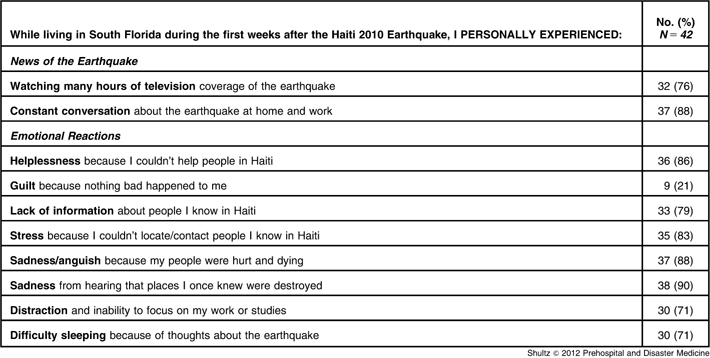
The frequencies and percentages for the 10 items are in Table 1. Yes responses to the 10 items were summed to create an “Earthquake Reactions” scale (possible range 0-10). The mean number of yes responses for all 10 items was 7.55. Mean scores represent the composite score for this “exposure” scale across the individual participants, taking into account the number of items comprising the scale. Most respondents received a steady flow of earthquake information from two sources: television news broadcasts and unceasing conversation on the topic with family and close friends within the Haitian-American community (Table 1). The majority experienced a range of powerful emotional reactions. All items on the scale have a 71% or above “yes” response except the “guilt” item. This exception may reflect the “self-directedness” of guilt in contrast to the remaining items that are more “other-directed.” Alternatively, this item, intended to capture “survivor guilt,” may not be culturally salient for Miami Haitians, or may simply not have translated well on this English language questionnaire (Haitian Creole is the first language of most participants).
News of the Earthquake and Emotional Reactions of Haitian-Americans Following the 2010 Earthquake in Haiti

News of Death, Injury, Displacement of Family and Friends
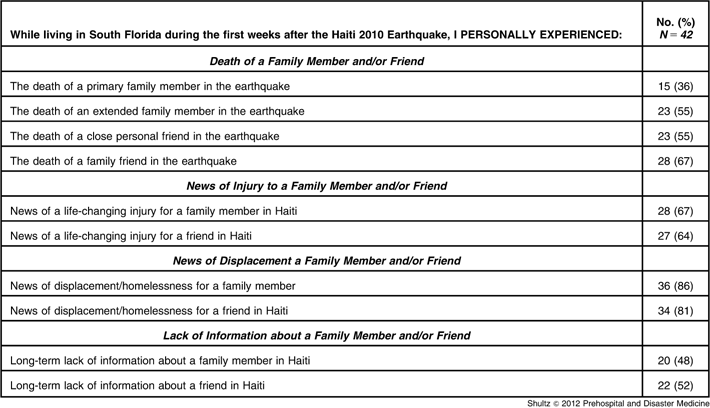
The frequencies and percentages for the 10 items are listed in Table 2. High proportions of Miami-survey participants reported having family members and close friends killed, injured, displaced, or missing. Yes responses to the 10 items were summed to create an “Indirect Exposure to Earthquake Consequences” scale (possible range 0-10). The mean number of yes responses for all 10 items was 6.10. The mean score represents the composite score for this “exposure” scale across the individual participants (means for the exposure scales align well with the standardized measures of psychological symptom levels when incorporated into the SEM model).
Exposure to News of Death, Injury, Displacement of Family and Friends in the Haiti 2010 Earthquake

Enumeration of Family and Friends Affected by the Earthquake
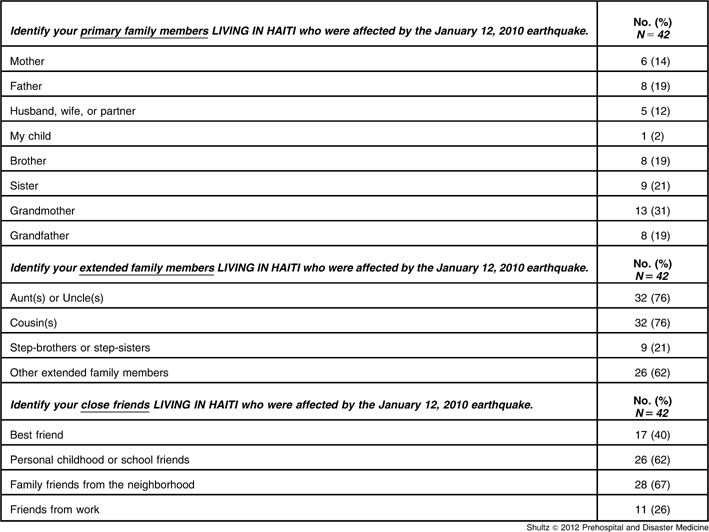
Frequency data on the nature of the familial and friendship relationships between Haitian-Americans and persons they knew who were in Haiti and affected by the quake are in Table 3. Respondents enumerated an array of primary and extended family members and friends affected by the quake; typically, survey respondents indicated a personal or familial connection to direct impact victims from five or six separate categories of relatedness.
Family Members and Friends Who Were Living in Haiti and Affected by the Earthquake by Type of Relationship to Haitian-American Respondents

Earthquake-Related Experiences of Family and Friends
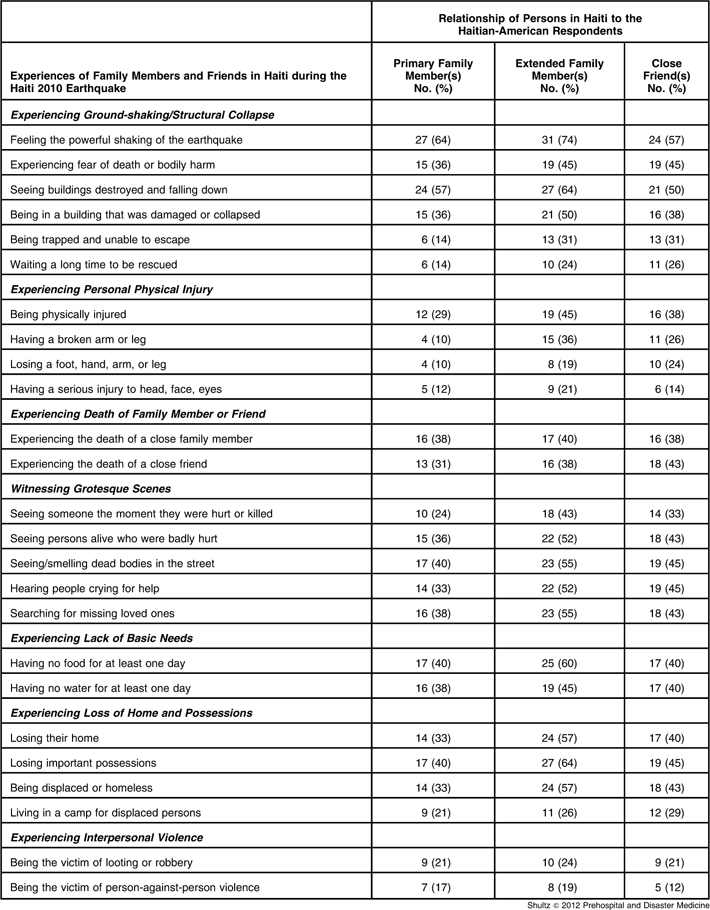
The frequencies and percentages for 25 earthquake-related experiences are in Table 4. Respondents indicated whether each of these experiences occurred to their primary family members, extended family members, or close friends, thus creating a total of 75 data points. Yes responses to the 25 items in Table 4 for primary family members were summed to create a “Primary Family Member Earthquake Experiences” scale (possible range 0-25).
Earthquake-Related Experiences of Family Members and Friends of Haitian-American Respondents

Earthquake-related experiences were sub-grouped into categories of ground-shaking/structural collapse, personal physical injury, death of a family member or friend, witnessing grotesque scenes, lack of basic needs, loss of home and possessions, and interpersonal violence. The mean numbers of earthquake-related experiences (out of 25) known to have occurred to primary family members was 7.67; impacting extended family members, 10.98; and affecting friends, 9.12. Mean scores represent the composite score for these “exposure” measures across the individual participants, taking into account the number of items comprising the scale. When considering the full range of direct disaster experiences among members of each participant's network of Haiti-based family and friends, the “dose” of indirect exposure is notable.
Indirect Earthquake Exposure Measures in Relation to Indicators of Trauma-Related Health Consequences
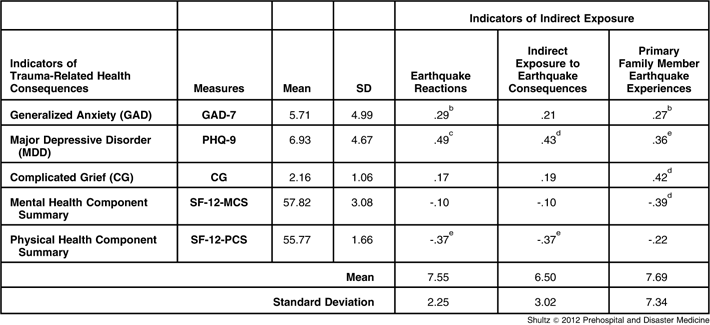
The zero-order correlations among the three indicators of Indirect Exposure (Earthquake Reactions, Indirect Exposure to Earthquake Consequences, and Primary Family Member Earthquake Experiences) in relation to the five symptom-level indicators (PHQ-9, GAD-7, CG, SF-12-MCS, SF-12-PCS) are in Table 5. Because all variables are contingency variables, means are used for the three constructed exposure scales and the five standardized symptom-level indicators and the covariance matrix is based on these means and correlations. For the survey sample, this pervasive—although purely indirect—exposure to the trauma and suffering of loved ones and friends was associated significantly with symptoms of major depression, complicated grief, and diminished physical and mental health status; and marginally associated with generalized anxiety (Table 5).
Indirect Earthquake Exposure Measures in Relation to Indicators of Trauma-Related Health ConsequencesFootnote a

a N = 42.
b P <.07, two-tailed.
c P <.001, two-tailed.
d P <.01, two-tailed.
e P <.05, two-tailed.
Indirect Earthquake Exposure Measures in Relation to Trauma-Related Mental Health Consequences and Health Status
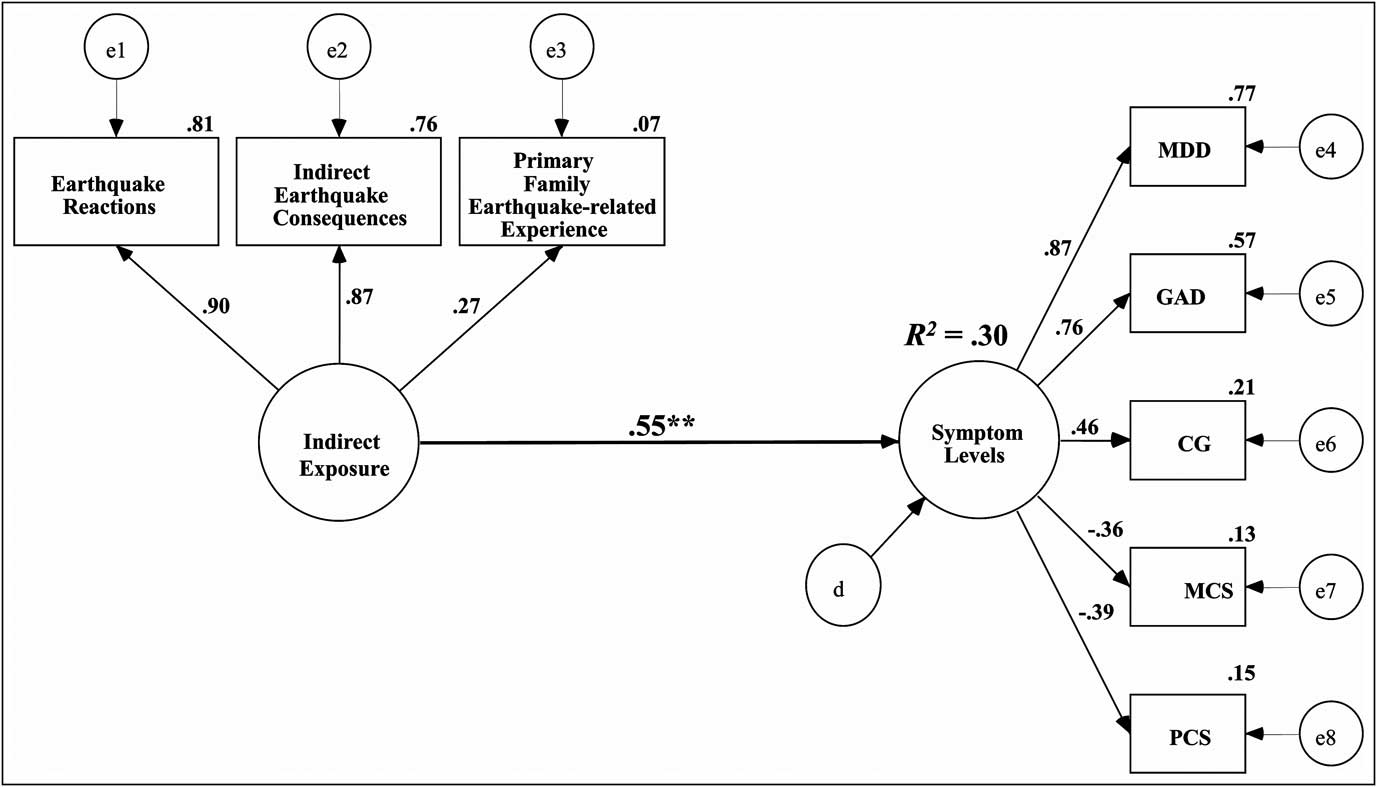
The associations between indicators of indirect exposure and symptom levels of trauma-related health consequences and health status were estimated using Structural Equation Modeling (SEM). Two latent factors were specified: (1) Indirect Exposure (three indicators: Earthquake Reactions, Indirect Exposure to Earthquake Consequences, and Primary Family Member Earthquake Experiences) and (2) Symptom Levels (five indicators: PHQ-9, GAD-7, CG, SF-12-MCS, SF-12-PCS).
As can be seen from Figure 1, this model fit the observed data very well: χ2[ Reference Norris and Wind 19 ] = 25.92, P > .13, χ2 /df = 1.36, NNFI = .99, CFI = 1.0, RMSEA = .0001 (90% CI, 0.00-0.08). Indirect Exposure explained 30% of the variance in Symptom Levels. Participants with high levels of Indirect Exposure also displayed high Symptom Levels [β = .55, t = 3.09, P < .002, SE = .264].
Structural Equation Model Displaying Indirect Earthquake Exposure Measures in Relation to Symptom Levels of Trauma-Related Health Consequences.
Rectangles indicate measured variables and large circles represent latent constructs. Small circles reflect residuals (e) or disturbances (d); bold numbers above or near endogenous variables represent the amount of variance explained (R 2). Unidirectional arrows depict hypothesized directional links. Standardized maximum likelihood parameters are used. Bold estimates are statistically significant.
Abbreviations: CG, complicated grief; GAD, generalized anxiety disorder; MCS, mental component summary; MDD, major depressive disorder; PCS, physical component summary.
**P <.01 two-tailed.

Discussion
The Nature of Indirect Disaster Exposure
Indirect Exposure to Natural Disasters—Norris and WindReference Norris and Wind 19 described the evolving distinction between direct and indirect effects of disasters. The modest literature on indirect exposure is particularly lacking in studies of disasters due to natural hazards. However, there is a relevant literature on seismic events (earthquakes, tsunamis) that focuses on gradations of exposure at varying distances from the origin in relation to markers of both physical harm and trauma-related mental health consequences.Reference Peleg, Reuveni and Stein 20 These studies tend to reference “intensity of exposure” rather than “indirect” exposure per se. Earthquakes provide the optimal natural laboratory for examining psychological effects in relation to degree of exposure to hazards because they are concentric events, where both force and harm dissipate with increasing distance from the epicenter. Classic studies of survivors of three major earthquakes—1988 in Spitak, Armenia,Reference Goenjian, Najarian and Pynoos 21 , Reference Goenjian, Steinberg and Najarian 22 1989 in Newcastle, AustraliaReference Carr, Lewin, Webster, Hazell, Kenardy and Carter 23 and 1999 in Athens, GreeceReference Groome and Soureti 24 —consistently found increasing severity of psychological symptoms with increasing proximity to the earthquake epicenter.
Two studies based on the 2004 tsunami in Southeast Asia clearly distinguished direct from indirect exposure. In a study of bereaved Norwegians who lost a loved one in the tsunami, rates of post-traumatic stress disorder (PTSD) and other mental health disorders were twice as high for survivors who had been on-scene compared with persons who had remained in Norway.Reference Kristensen, Weisæth and Heir 25 A study of refugees from Sri Lanka and Indonesia who had been “living in exile” in Norway prior to the disaster found that psychological symptom levels were associated with the degree of indirect exposure to the tsunami and chronic stressors of refugee life.Reference Stige and Sveaass 26
Indirect Exposure to Human-Generated Disasters—Appreciation for the importance of indirect mental health effects was catapulted forward in the recent age of terrorism and mass violence.Reference Norris and Wind 19 Following the attacks of September 11, 2001, an entire American populace was impacted psychologically despite the pinpoint geographic concentration of all physical destruction and harm. Immediately post-attack, surveys conducted in the New York City areaReference Galea, Ahern and Resnick 27 , Reference Galea and Resnick 28 and nationwideReference Schuster, Stein and Jaycox 29 - Reference Silver, Holman, McIntosh, Poulin and Gil-Rivas 31 demonstrated the widespread and pervasive nature of psychological distress and post-traumatic stress symptoms throughout the United States. Related studies documented gradations of distress and symptoms of psychopathology in relation to proximity to Ground Zero.Reference Blanchard, Kuhn and Rowell 32 - Reference Neria, Olfson and Gameroff 36 Corroborating investigations were conducted by researchers in Israel who examined the psychological effects of both direct and indirect exposure to ongoing terrorism.Reference Besser and Priel 37 - Reference Bleich, Gelkopf and Solomon 43 Congruent evidence also has come from the realm of non-intentional, human-generated events; multiple studies have confirmed that persons who are geographically closest to the point of a technological disaster (e.g., a nuclear plant accident) bear the highest risks for psychiatric outcomes.Reference Cohidon, Diene and Carton 44 - Reference Smith, North, McCool and Shea 48
Key Features of the Present Study
Results of this study provide a detailed account of the pervasiveness and potency of the psychological effects of indirect exposure to disaster. Two features distinguish this analysis: (1) all survey participants had significant indirect exposure but no direct exposure, and (2) participants were asked about a detailed array of disaster-specific indirect exposures. Rarely has a study examined the types and frequencies of a broad range of disaster-specific indirect exposures derived from the unique hazard profile of the disaster event. In the present study, a total of 111 exposure data points were collected for each respondent in order to systematically investigate the dimensions of indirect exposure.
As described previously, the 2010 earthquake in Haiti was physically catastrophic and brought into play the complete spectrum of evidence-based risk factors for psychological distress and psychopathology for persons who directly experienced the earthquake inside Haiti.Reference Shultz, Marcelin, Madanes, Espinel and Neria 3 The present study extends the logic of the Trauma Signature Analysis of the Haiti quakeReference Shultz, Marcelin, Madanes, Espinel and Neria 3 by examining the nature of the psychological impact of indirect exposure for Haitian-Americans living in Miami.
Multiple Indirect Exposures to the Experiences of Multiple Family Members and Friends
Most notable among findings was the multiplicity of indirect exposures for Haitian-Americans living in Miami, related to the direct, on-scene experiences of a multiplicity of family members and friends living in Haiti. For the survey sample, this pervasive—although purely indirect—exposure to the trauma and suffering of loved ones and friends was associated significantly with symptoms of major depression, complicated grief, and diminished physical and mental health status; and marginally associated with generalized anxiety (Table 5). These factors were combined to create a robust structural equation model (SEM) displaying strong, predictive relationships between Indirect Exposure and Symptom Levels of five trauma-related health consequences (Figure 1).
Findings of this study were expected given the point-by-point correspondence between the indirect exposures of Haitian-Americans with the direct exposures of loved ones and friends in Haiti across the complete range of evidence-based risk factors for disaster-associated mental health consequences. This represents a “mirror-imaging” of exposure risk factors, experienced “one step away.”
Unique Stressors for Haitian-Americans
Haitian-Americans did experience several stressors that were not shared with their counterparts in Haiti. Prominent among these was extensive television viewing of the Haiti earthquake. In the United States, continuous, “24/7” news coverage of the event continued over several weeks. This allowed Haitian-Americans to repeatedly view graphic and panoramic television coverage highlighting the worst of the damage and the extremes of human suffering. Family members and friends in Haiti, where loss of power and communications was widespread, were restricted to their immediate field of view, while Haitian-Americans experienced a bombardment of images and commentary. Extensive television viewing of disaster events has been shown to predict psychological consequences.Reference Schuster, Stein and Jaycox 29 - Reference Silver, Holman, McIntosh, Poulin and Gil-Rivas 31 , Reference Pfefferbaum, Seale and McDonald 49 - Reference Bernstein, Ahern and Tracy 54 .
As recent immigrants to the United States, Haitian-American survey participants also may have experienced the ongoing, chronic stressors of acculturation, language barriers, economic hardships in Miami during a time of global economic crisis, and responsibilities for supporting relatives in Haiti. While the present survey was performed with adult respondents, recent studies of Haitian-American children in Miami have shown elevated rates of PTSD, depression, and psychological distress, providing a bellwether for the stressors experienced throughout the community.Reference Fawzi-Smith, Betancourt and Marcelin 55 , Reference Douyon, Herns Marcelin, Jean-Gilles and Page 56
Study Limitations
This study has several limitations. First, the sample of persons with family and friends in Haiti is small, selective, and relatively heterogeneous, as might be expected from a convenience sample of students and persons affiliated with an urban university. However, this limitation is partially offset by the ability to collect detailed event-specific exposure data on each subject. The prevalence and intensity of indirect exposure across the array of data was sufficiently strong and consistent to predict symptom levels and produce a robust SEM model. Moreover, the extreme nationwide impact of the 2010 earthquake in Haiti also increased the salience and degree of indirect exposure found in Haitian-Americans. Therefore, it is assumed that findings would not have been substantively different with a larger sample, just replicated more times over. Second, the study was conducted as an anonymous survey and follow-up of subjects was not possible. Third, stressors associated with acculturation that may have contributed to community-wide baseline mental health symptom levels were not assessed. However, the SEM analysis clearly linked earthquake-specific indirect exposures to symptom levels of trauma-related health consequences.
Conclusion
In the near-term aftermath of the 2010 earthquake in Haiti, Haitian-Americans living in Miami who had family and friends living in Haiti during the quake were surveyed. All survey participants had significant indirect exposure but absolutely no direct exposure, and data were collected on a wide array of disaster-specific indirect exposures. Initial hypotheses regarding the dynamics of indirect disaster exposure were confirmed. First, direct exposure of family and friends to the catastrophic impact of the 2010 earthquake in Haiti was “mirror-imaged” for Haitian-Americans who were distant from the scene and only indirectly exposed. Second, portrayal of the indirect exposure experience of Haitian-Americans was focused and enriched by attending to the unique, defining “trauma signature” of the 2010 earthquake in Haiti. Third, the intensity of indirect exposure to this specific disaster event strongly predicted symptom levels of psychological distress and impairment and diminished health status. Clearly the burden of disaster-related psychological consequences extends far outside of the impact zone, especially for indirectly-exposed populations with strong affiliation to direct impact victims.
Abbreviations
- CFI:
-
comparative fit index
- CG:
-
complicated grief
- DSM-IV:
-
Diagnostic and Statistical Manual of Mental Disorders, Fourth Edition
- GAD:
-
generalized anxiety disorder
- MDD:
-
major depressive disorder
- NNFI:
-
non-normed fit index
- PHQ:
-
patient health questionnaire
- PTSD:
-
post-traumatic stress disorder
- RMSEA:
-
root mean square error of approximation
- SEM:
-
structural equation modeling
- SF-12:
-
short form health survey with 12-item scale to measure perceptions of health
- SF-12-PCS:
-
SF-12 subscale with physical component summary
- SF-12-MCS:
-
SF-12 subscale with mental component summary
- TSIG:
-
trauma signature analysis