In the early 1990s, the activism of a highly mobilized transnational network of women succeeded in placing violence against women on the international agenda. The conscientious framing of women's rights as human rights by this network, and the subsequent activism by women at the United Nations World Conference on Human Rights held in Vienna in 1994,Footnote 1 helped to raise public awareness and the political saliency of violence against women. In addition, it helped connect women's advocacy groups to the larger global human rights regime. The continued activism of women mobilizing at local, regional, and international venues resulted in the dissemination of important legislative measures aimed at combating violence against women. However, the paradox that has challenged the progression of the larger human rights agenda threatens the future of these policy gains. While the global human rights regime “is almost certainly more influential today than at any time since World War II” (Beitz Reference Beitz2001, 269), gross violations of human rights continue on a daily basis. We are in a period when human rights are simultaneously increasingly important and imperiled globally (Sikkink Reference Sikkink1998, 518). The decoupling of policy and practice allows states to adopt human rights legislation while they continue to engage in or allow oppressive practices (Berkovitch Reference Berkovitch1999; Meyer et al. Reference Meyer, Boli, Thomas and Ramirez1997). Although many states now profess the advancement of women's rights in the form of new legislation aimed at combating violence against women, these changes reflect more rhetoric than reality.
What accounts for the decoupling of policy and practice? What can be done to ensure that domestic reform includes changes in practices? In this article, I analyze the role played by international organizations and transnational networks in promoting and ensuring substantive change in women's human rights both theoretically and empirically. In the first section, I examine the different mechanisms by which countries adopt new policy and introduce a new model that accounts for the decoupling of policy and practice. The umbrella pattern demonstrates how some states respond rhetorically to international pressure through policy adoption despite the lack of commitment or capacity to implement the new legislation. I also propose that international organizations can improve the prospects of implementation by focusing on local capacity-building measures through the distribution of resources and the facilitation of transnational cooperation.
In the second section, I present an empirical study of the European Union and its efforts to promote policy adoption and implementation in its member states. While the advocacy events surrounding the UN's Vienna conference marked a shift in activism from domestic arenas into the international arena, subsequent efforts have often been at the regional level. Over the past decade, the EU has paid increased attention to issues of women's human rights. Although it has stopped short of adopting binding legislation, a fact that has garnered criticism from local and international women's rights advocates, it has undertaken initiatives with the potential to greatly improve domestic efforts. In regards to policy adoption, I evaluate EU efforts in relation to other international initiatives, and then provide a comparative and aggregate analysis of policy adoption in member and candidate states. To address EU capacity-building efforts, I focus on one particular initiative, the Daphne project, which is the EU's primary mechanism for addressing gender violence. In addition to highlighting characteristics of this project, I provide empirical evidence of its efforts to improve local capacity through resource distribution and the facilitation of transnational cooperation. While the EU is certainly a unique type of international organization, with different forms of authority and resources that must be carefully acknowledged, I argue that there are still wider lessons, positive and negative, to be gleaned from a thorough examination of its initiatives.
INTERNATIONAL ORGANIZATIONS, TRANSNATIONAL ACTIVISM, AND THE POLICY PROCESS
Part of the new global environment is the ability of transnational actors to shift their activities to different arenas to take advantage of political opportunities (Lenz Reference Lenz2003; Tarrow Reference Tarrow2005). International organizations (IOs) and transnational advocacy networks (TANs) play an important part in changing the political opportunity structures (POS) for domestic groups.Footnote 2 Their most widely acknowledged contributions are their ability to raise awareness about societal issues and to transmit global norms to states that help provide political momentum and societal pressure for change (Keck and Sikkink Reference Keck and Sikkink1999; Naples and Desai Reference Naples and Desai2002; Tarrow Reference Tarrow2005; True and Mintrom Reference True and Mintrom2001). IOs, in particular, can contribute to POS by providing a new venue for domestic groups to take their grievances. The most often cited model on the interaction between IOs and domestic groups is the “boomerang pattern” by Margaret E. Keck and Kathryn Sikkink (1999). In the boomerang pattern, societal groups facing unresponsive states take their grievances to the international community, usually IOs, which in turn place pressure on the recalcitrant states to change their practices.Footnote 3 A successful “boomerang,” however, in which local groups are able to use the international community to engage in information and leverage politics, relies on a number of factors: 1) There must be a lively and local grassroots movement with capable advocacy organizations; 2) these local organizations must be connected to international or transnational networks; 3) the targeted state must be open (or compelled) to respond to the international community; and 4) the targeted state must be capable of responding. Unfortunately, these conditions are not found in many countries.
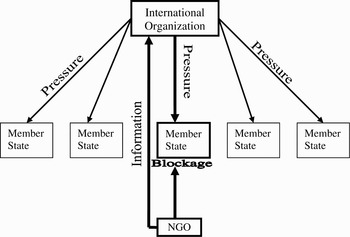
While IOs and TANs have been heralded for their role in the dissemination of norms, the decoupling of policy and practice suggests that rhetoric is disseminated rather than true support for reform. I propose that new insights are gained on patterns of influence once we decouple policy and practice. With decoupling, two different patterns become salient: the boomerang and the umbrella. In the latter umbrella model, we can begin to conceptualize the problems associated with top-down policymaking models that are not accompanied by a vibrant grassroots movement capable of monitoring adequate implementation. When groups of activists succeed in placing an issue on an IO's agenda, the IO does not always respond by placing pressure on select countries or regions; instead, the IO's response is more dispersed: IOs may place pressure on all of their members. A boomerang action might still occur, but the response is expanded, in a shape much like an umbrella (see Figure 1). In this way, the combined activism of advocacy groups can actually expand beyond the geographical scope of the network. It is this pattern of expanded response that helps explain why we see widespread policy adoption but problematic implementation. In the boomerang model, societal groups play an important part in the policy feedback loop that provides monitoring for policy; nongovernmental organizations (NGOs) keep IOs appraised of state compliance. NGOs can also play an important part in the implementation of human rights initiatives. In the umbrella model, pressure might be placed on states where there are only weak societal organizations that lack strong ties to the larger network and are incapable of monitoring, pressuring, or aiding in policy implementation. This problem is compounded by a state that lacks capacity to respond adequately to grassroots monitoring.
The umbrella pattern. Note: At the center of the figure, with the bold lines and boxes, is a simplified version of the Boomerang Pattern. The added member states and lines denote the dispersed IO response suggested by the Umbrella Pattern.

While the boomerang still accounts for some of the positive changes we see in parts of the world, and in many ways represents an ideal set of circumstances for future change, what can be done when the conditions are less than ideal? What happens when member states respond with policy adoption but not implementation, which the umbrella mechanism demonstrates? Compliance in policy but not practice is a major concern for most international organizations. In order to be effective, international institutions must address the capacity of member states to implement their provisions (Tallberg Reference Tallberg2002; Young Reference Young, Rosenau and Czempiel1992). In addition to coercive strategies, IOs also employ management strategies that focus more on domestic capacity building than on monitoring and sanctions (Montoya Reference Montoya2008; Raustiala and Slaughter Reference Raustiala, Slaughter, Calsnaes, Risse and Simmons2002). It is the difference between IO authority—a power relationship—and IOs as an authority—an expert relationship (Barnett and Finnemore Reference Barnett and Finnemore2004). IOs, as an authority on human rights, can exert their influence by engaging in capacity-building measures that serve to aid domestic organizations (state and societal) with policy implementation. IOs contribute to this bottom-up capacity through the distribution of resources and the facilitation of transnational networks.
Resources, both monetary and informational, are an important part of the IO repertoire. IOs often provide resources to help states implement new programs. For example, these resources might be helpful when the state is willing but unable to implement new internationally driven policies. IOs also provide resources to societal groups. This type of resource distribution can be used to circumvent unresponsive or inefficient states and give resources directly to domestic organizations addressing violence against women or other human rights issues. IOs further contribute to the capacity building of domestic organizations through their facilitation of TANs. This is arguably one of the most important ways that IOs expand political opportunities for domestic groups. The formation of TANs links actors in civil societies, states, and international organizations in a way that can multiply the opportunities for marginalized groups to mobilize (Keck and Sikkink Reference Keck and Sikkink1999). TANs have been recognized as providing women's movements with a new spatial direction for mobilization (Risse and Sikkink Reference Risse, Sikkink, Risse, Ropp and Sikkink1999). Networks foster communication and facilitate the pooling and sharing of resources. They contribute to the development of research and best practices in a way that can greatly aid the capacity building of domestic organizations.
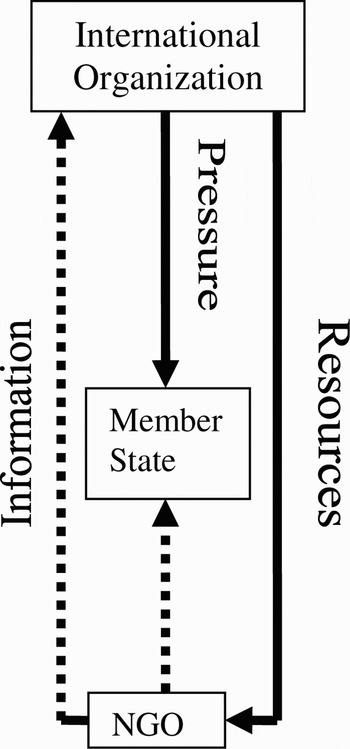
By focusing on capacity-building strategies, IOs can instigate a reverse boomerang to states with underdeveloped grassroots movements (see Figure 2). Management strategies may provide a more effective means of enacting change in member states than just the top-down pressure to change policy. With increased strength, not only do local advocates provide the information and monitoring necessary for international organizations to remain engaged, but these groups can also serve as a policy filter. Local groups will be better able to determine what the needs of vulnerable populations are, as well as to develop more effective advocacy and implementation strategies.
Reverse boomerang.

While international organizations, such as the UN, can engage in this process, regional organizations may be better positioned to engage in these management strategies. A strong regional organization may be able to provide more tailored resources to a smaller constituency of member states, and facilitate a tighter transnational network of advocacy organizations. Melinda Adams and Alice Kang (Reference Adams and Kang2007) identify regional advocacy networks (RANs) as the collection of individuals and organizations from the same world region working together toward a common goal. They argue that RANs are more attuned to local constraints, such as lack of political will from domestic governments. RANs are also better able to identify unique political opportunities peculiar to the region. RANs in Europe have been quite adept at identifying such political opportunities; in particular, they have made use of the alternate venues and resources provided by European institutions.
EUROPEAN UNION EFFORTS TO COMBAT VIOLENCE AGAINST WOMEN
The European Union has proven to be an important venue for women's transnational activism. While most social policy falls outside the original scope of the EU, the EU has adopted binding legislation on gender equality, in no small part due to the transnational activism of women's groups in the 1980s and 1990s.Footnote 4 Until more recently, however, EU involvement in gender equality issues was limited to employment policy. Getting gender violence on the EU's agenda took much longer; early attempts to elicit its involvement on this issue were largely ignored. In the 1980s, the European Parliament's Committee on Women's Rights issued a report and proposed a resolution on violence against women. Although both the report and the resolution were adopted, little else was done. The issue was largely seen as being outside the purview of the economic jurisdiction of the Union.
The EU remained inactive on the issue of violence against women until the mid-1990s, when the external and internal political environment of the Union began to shift. Outside the EU, women's international activism helped place violence against women on the international human rights agenda. The discourse and mobilization surrounding the UN conferences in Vienna and Beijing and the Declaration on the Elimination of Violence Against Women helped reenergize local advocates and provide them with leverage to pressure domestic and regional institutions. Inside the EU, the adoption of the Maastricht Treaty in 1993 and the Amsterdam Treaty in 1997 strengthened EU institutions and served to expand the scope of EU policy beyond economic issues, placing a greater emphasis on human rights.Footnote 5 This expanding jurisdiction helped to create a new political space for such issues as violence against women (Joachim Reference Joachim2007; Pollack and Hafner-Burton Reference Pollack and Hafner-Burton2000). European advocates from withinFootnote 6 and outsideFootnote 7 of European Union institutions took advantage of the political opportunities provided by these external and internal shifts to lobby the EU to take a more active stance on gender violence. Their efforts helped place the issue on the agenda not only of EU institutions but also of many member states.
The EU's response to the UN's and domestic advocates' call to improve efforts to combat violence against women has come in two forms. First, it has identified violence against women as an important European issue and supported the adoption of new policy. This support has been criticized as being largely rhetorical. Although the EU, arguably, has more coercive power over its member states than do other IOs, it has refrained from exerting its binding authority on issues pertaining to violence against women. Instead, the EU has undertaken a number of nonbinding initiatives that, while important for norm distribution, fail to hold member states accountable for poor domestic practices. The EU's second approach, one of capacity-building strategies, is more impressive. Utilizing its bureaucratic strengths, the EU has developed initiatives that provide domestic advocacy organizations with valuable resources and has facilitated increased transnational cooperation and networking. In the subsequent subsections, I discuss and evaluate these two different types of initiatives.
Policy Reform: European Union Initiatives
Other than the European Parliament's 1986 Resolution on Violence against Women, the EU's initiatives aimed at combating violence against women have occurred primarily after the mid-1990s. Efforts aimed at policy reform have been in the form of soft law reports, communications and recommendations,Footnote 8 conferences and meetings of experts, and public awareness campaigns.
The momentum for EU action supporting policy reform really began with the “Campaign for Zero Tolerance for Violence against Women” called for by the European Parliament and funded by the European Commission.Footnote 9 With a budget of €4 million, the campaign had several main objectives: to raise public awareness about domestic violence, to work toward better prevention, and to emphasize the elimination of all forms of violence, including domestic violence. In addition to the awareness-raising aspects of the campaign, a number of other developments took place. During this time, major research projects were looking at the practices and attitudes in European member states. Three European Union conferences called on experts to draw up norms and recommendations aimed at eradicating violence against women that could be adopted by the EU and member states.Footnote 10 The campaign closed at the International Conference in Lisbon, with the Portuguese European Council president reemphasizing the messages of the campaign and calling on the Council, the Commission, and member states to “make the solemn commitment to combat all forms of violence against women, through the adoption of legal, administrative and other provisions, to ensure a study of violence and its prevention and the protection, assistance and compensation of the victims.”Footnote 11
Since the campaign, several resolutions have been adopted: a 2000 Resolution on Trafficking of Women, a 2003 Resolution on the Elimination of Domestic Violence against Women, a 2004 Resolution on the Elimination of Honor Crimes against Women, and a more comprehensive 2006 Recommendation on Combating Violence against Women.
While an important part of norm dissemination, the EU campaigns, conferences, reports, and soft law measures fall short of the stronger stance taken by the EU on other gender equality issues. They also fail to incorporate any oversight or monitoring mechanisms for policy reform in the member states, something that has been lamented by advocacy groups, as well as by IOs. The United Nations and the Council of Europe (COE) have both adopted means, though imperfect, of evaluating policy developments in member states. The UN requires the EU, all of whose states are members of the Convention on the Elimination of All Forms of Discrimination Against Women (CEDAW), to submit periodic reports that are subject to review. The UN's Rapporteur on Violence against Women also aids in the monitoring of local practices. The COE, another regional organization with arguably less coercive authority than the EU, has adopted a more comprehensive approach to policy dissemination. In 2002, the COE adopted the Recommendation on the Protection of Women against Violence, which outlined an inclusive definition of violence against women; listed specific measures that states should introduce, develop, and improve; and provided a monitoring framework by which member states would be required to report their progress every two years to a Group of Specialists.
Although the EU, generally, has refrained from exercising its authority in promoting policy reform, an exception to this rule is found in the accession process. The accession process and the conditionality of membership provides for a situation in which the European Union is able to exert more top-down authority over a wider range of issues than it does over countries that are already established within the membership (Bartels Reference Bartels2005; Grabbe Reference Grabbe2006; Schimmelfennig and Sedelmeier Reference Schimmelfennig and Sedelmeier2005; Vachudova Reference Vachudova2005). Countries applying for membership are required to adopt not only binding legislation but also the entire acquis communautaire, the larger body of legislation that includes soft law measures. In addition to explicit pressure placed on these countries to improve their gender equality and human rights practice, there is an implied pressure for member states to demonstrate that they are normatively compatible with the advanced industrial democracies of the West.Footnote 12
Policy Reform: Patterns in the EU Member States
Without an explicit and coercive stance on violence against women, policy development in EU member states has been uneven. Pressure for the reform of national policies in EU countries has come from many sources and via different mechanisms. Although with policy it is always difficult, if not impossible, to establish conclusive causality, there are conditional and temporal patterns that are suggestive of three different mechanisms for policy adoption. The first mechanism is domestic driven reform, where local advocates are able to push for change via a strong movement and/or a responsive government. The second mechanism is boomerang reform, when domestic advocates, working with less responsive governments, are provided leverage by the involvement of the international community and IOs (in this case the UN, the COE, and, to some extent, the EU). The third mechanism is the umbrella reform, when reform occurs in the absence of strong local advocacy as a result of dispersed international pressure.
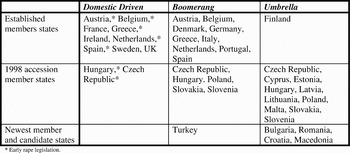
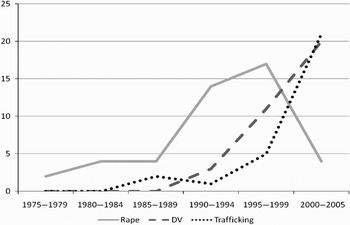
In order to demonstrate the patterns of policy adoption in the EU member states, I examined policy adoption both comparatively and in the aggregate. For the comparative analysis, I have classified the EU member and candidate states on the basis of the characteristics of movement strength and government responsiveness in order to determine what type of change is most likely: domestic driven, boomerang, or umbrella (see Figure 3). Then, I conducted a cross-country, cross-temporal analysis of legislation combating gender violence from 1975 to 2006.Footnote 13 Included are 104 pieces of legislation that reformed existing laws or introduced new ones. The legislation is broken down into three types of gender violence: sexual assault, domestic violence, and sexual trafficking.Footnote 14 At the aggregate level I examined temporal policy trends in these different gender violence policies as they relate to international policy initiatives (see Figure 4).
Patterns of policy adoption.

Policy reform in EU member states 1975–2006.

Domestic Driven Reform
Prior to the 1990s, the international community played a minimal role in promoting policies to combat violence against women; thus, reform required a favorable domestic climate in which there was strong local advocacy (from within and/or outside of the government) and a responsive government. Sexual assault and domestic violence, though not the primary focus of most movements, were important issues raised by Western European feminists, particularly in the 1980s.Footnote 15 Take-Back the Night marches and the burgeoning shelter movement are two examples of grassroots mobilization aimed at combating violence against women. However, only a few governments responded with reform, and only in regards to rape laws. Among these countries were the UK and Ireland, both of which had comparatively strong movements on gender violence, and Sweden, a country where the government has been fairly responsive to a wide array of gender equality issues. Two surprising early responders were Hungary (1976) and Greece (1984), countries with comparatively weak mobilization. From 1989 to 1992, as women were also mobilizing internationally to get violence against women on the international agenda, domestic reforms on rape laws continued in almost every one of the early member states, with the exception of Italy and Germany; both of these countries had and continue to have strong grassroots mobilization, but at the time had very unresponsive governments. The Czech Republic, another Central Eastern European (CEE) country with relatively low mobilization, albeit higher than other countries in the region, reformed its rape law in 1992. During this time period, there was growing international awareness about violence against women, which may have contributed to local mobilization; however, 1993 marks the point of more active international involvement, with the UN Human Rights Conference in Vienna and the signing of the UN Declaration on the Elimination of Violence against Women.
Boomerang Patterned Change
Starting in 1993 and continuing throughout the 1990s, there has been an increase and diversification in policy reform regarding issues addressed and countries doing the reforming. During this time period, it is hard to distinguish between domestic driven and boomerang supported policy, but the conditions of external and internal pressure were available in almost all of the early EU member states.Footnote 16 The wider understanding of violence against women, advocated by transnational activists and supported in international initiatives, is reflected in the policy reform during this time period. While some of the countries may have garnered enough local momentum to push for these further reforms, it is likely that many were at least somewhat aided by the support of the international movement. Countries with strong local mobilization but less responsive governments were the more likely beneficiaries of the changed international environment.Footnote 17
The Central European countries are especially difficult to categorize because violence against women has been largely an internationally imported issue. While these countries have comparatively weaker women's movements, and could be placed comfortably in the umbrella pattern category, there is enough grassroots mobilization not to entirely rule out. On the other hand, Turkey, one of the most controversial candidate states, has a dynamic women's movement that has long addressed the issue of violence; international involvement has helped supply local groups with the necessary leverage to push for legislative reforms.
Umbrella Patterned Change
While many of the newer Central European member states have at least the moderate local advocacy necessary to allow for some boomerang patterned reform, for the most part the CEE member states and the newer member and candidate states from southeastern Europe tend to be those most likely to have their reform initiated through the top-down umbrella mechanism. In Latvia, Lithuania, and Estonia, not only is there very little grassroots mobilization but the governments have also been reluctant even in responding to international pressure. In fact, the newer southeastern member and candidate states have been more responsive, in part due to the increased scrutiny that they have been placed under through the accession process. Also, by going through accession later, they are held up to higher standards, as most of the more explicit EU soft law policy has been added during their accession evaluation period.
With so many reforms resulting from the boomerang and umbrella mechanisms, reliance on domestic governing institutions for implementation has been problematic. Even in countries that were able to initiate domestic reform without external pressure, shifts in governing coalitions have resulted in less favorable climates for policy implementation. Many of the more recent reforms have occurred in countries with low levels of grassroots mobilization and weak institutional resources for implementation. In countries with active local groups, but inconsistently responsive government, the boomerang process may result in changed policies, but it is questionable whether or not there will be the effort or resources necessary to implement the new policies. In these countries, in particular, it is important to address issues of local capacity.
The European Union and Capacity Building Strategies
Although the EU efforts to support policy reform are questionable, its initiatives aimed at capacity are much more impressive. These measures move beyond rhetorical support for combating violence against women and have the potential to greatly improve the ability of domestic organizations to enact meaningful change. One effort, in particular, has demonstrated the EU's commitment to addressing the issue of violence against women, the Daphne project. Daphne was started by the European Commission in 1997 with the purpose of developing a coordinated and comprehensive approach to dealing with violence against women and children in European society. Daphne was designed to distribute resources to NGOs, as well as to support and promote cooperation between advocacy organizations.Footnote 18
To date, the EU has allocated almost €200 million to the Daphne project. In turn, Daphne has provided program funding for hundreds of advocacy organizations. It has run in three phases: the Daphne Initiative (1997–99), the Daphne Program (2000–3), and Daphne II (2004–8). The most recent phase of Daphne, Daphne III, was approved in 2007 with a budget of €120 million. It will run until 2013. With each phase, the scope of Daphne has expanded in terms of funding allocated, the type of projects funded, and the number of organizations involved.
Although there have been minor changes and refinements made during the different phases of Daphne, the list of objectives and criteria for Daphne funding has remained fairly consistent. In the most recent call for proposals, the program lists both general and specific objectives.Footnote 19 The general objective of the Daphne project is “to contribute to the protection of children, young people and women against all forms of violence.” The specific objective is “to contribute to the prevention of and the fight against all forms of violence occurring in the public or the private domain against children, young people and women, including sexual exploitation and trafficking in human beings, by taking preventive measure and by providing support and protection for victims and groups at risk.” In order to meet these objectives, Daphne supports three types of actions: 1) specific actions taken by the Commission; 2) specific transnational projects of Community interest involving at least two member states; and 3) support to the activities of nongovernmental organizations or other entities pursuing an aim of general European interest regarding the general objectives of the program.
These projects supported by Daphne can undertake a number of different advocacy endeavors. For example, research on violence is an important advocacy approach; research projects might focus on mapping existing legislation and analyzing its effectiveness, or gathering quantitative and qualitative data on the scope and nature of violence. Other projects may focus on awareness campaigns aimed at the general public, to target populations or certain professions (such as medical or legal personnel). Funds are also used to establish or support victim services and provide training for staff (or other professional personnel). In addition, in the interest of pooling resources, Daphne supports projects aimed at facilitating networking and the exchange of good practices.
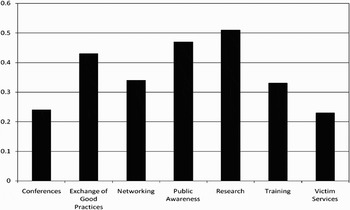
Although Daphne supports many projects directed at children and young people, approximately half of its funding goes to initiatives focused on violence against women. Figure 5 shows a breakdown of the type of activities aimed at combating violence against women that were supported from 1997 to 2004. Almost half of the supported projects reported that they incorporated research and public awareness as grant activities. Victim services and training were also reported in a number of the projects. In funding these projects, Daphne has become an important new source of resources for domestic organizations. By maintaining a European focus, supporting projects aimed at the exchange of good practices, and coordinating projects so that they build in a cumulative fashion, Daphne serves not only as a source of money for those organizations receiving funding but also as a source of information and expertise for all organizations committed to combating violence against women.
Activities funded by Daphne 1997–2004. Note: The author coded projects using the projects reports posted on the Daphne Toolkit. This figure illustrates the percentage of Daphne projects reporting the various types of activities addressing violence against women. A report for an individual project may have included more than one of these activities.

In addition to resource distribution, Daphne also contributes to capacity building through its emphasis on transnational cooperation. To begin with, Daphne facilitates transnational networks by supporting projects aimed at building transnational cooperation. A number of projects reportedly incorporate such activities as conference planning and networking. Daphne also facilitates network building by requiring that applicants for each grant include organizations from at least two EU member or candidate countries. By making transnational partnership a prerequisite for funding, Daphne encourages organizations to make connections beyond domestic borders.
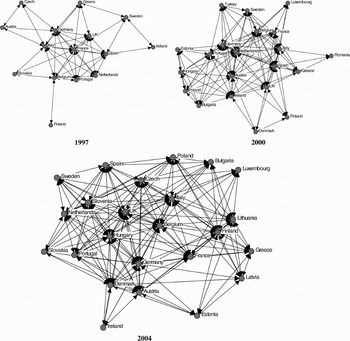
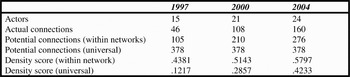
In order to examine empirically the way that the EU has facilitated transnational networking, I employ social network analysis (SNA).Footnote 20 SNA is the mapping and measuring of relationships among people, groups, and organizations.Footnote 21 SNA can be used cross-temporally to examine the evolution and expansion of a network and to illustrate changes in the level of transnational cooperation between countries. It also illustrates characteristics of partnerships by mapping out the location of actors within the network. I apply SNA to examine the transnational cooperation on Daphne-funded projects addressing violence against women in 1997, 2000, and 2004, to represent the first year of each phase of the program. The SNA is represented visually in Figure 6 and mathematically in Figure 7.
Visual SNA of Daphne networks.

Mathematical SNA of Daphne network.

The network mapping provides a glimpse at the evolution of Daphne networks. Over the years, not only has the number of organizations participating in Daphne projects increased but also the diversity of those organizations included. More countries have organizations participating in Daphne projects with each subsequent phase. In 1997, the first year of the program, 15 countries had organizations participating in Daphne, in 2000 21 countries were represented, and in 2004 24.Footnote 22 The expansion of the network is seen not only by the increase in the number of countries that have organizations receiving funding but also by the increased number of transnational partnerships. As the network develops, it become denser, meaning that there are more ties between actors. This increase in density is seen visually in Figure 6 and mathematically in Figure 7.Footnote 23
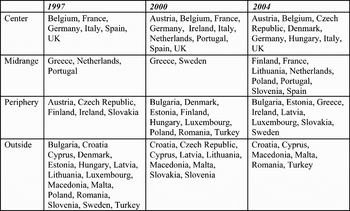
The SNA also provides comparative data about the relative location of countries within the network. Central actors are those with a wider array of partners, or, in this analysis, central actors are those with more transnational partnerships. Peripheral actors are those with a smaller array of partners or less transnational partnerships. In Figure 8, I categorize network location as central, midrange, and peripheral, as well as indicating which countries were left outside the network altogether.Footnote 24 With regard to the aggregate cross-temporal pattern, this classification shows that by 2004 not only have more countries entered the network, but also more are located in the central and midrange positions. With respect to comparative analysis, many of the more established member states have been able to take advantage of Daphne's opportunities in terms of resources and partnerships, some with bottom-up capacity for change, but particularly those relying more on boomerang mechanisms of adoption; of particular note are Germany, Italy, and Portugal. By 2004, there are also an increasing number of newer member states moving into the network, even into more central locations. Boomerang countries (those with a comparatively higher level of grassroots advocacy) were better able to find good positions within the network, for example, the Czech Republic, Hungary, and Slovenia. Even some of the umbrella states (including the newest member and candidate states) were able to make it into the network, although most of them were located on the periphery.
Network location of member and candidate states.

Daphne has a lot of potential to contribute to domestic capacity; however, thus far, countries with stronger local advocacy organizations have been able to take better advantage of its opportunities. In order for Daphne to live up to its capacity-building potential, future projects and networks will need to incorporate more of the countries that have depended on international support of gender violence initiatives. While Daphne's transnational project partnerships may prove to be only short-term utilitarian relationships, they may also be the start of more enduring network linkages. Future research is needed to more fully assess the nature of these partnerships (such research might examine the power dynamics among organizations in different countries, the degree of collaboration, and the length of partnerships). However, projects like Daphne can provide important resources, as well as the incentive and opportunity for building ties across national boundaries in a way that may contribute to increased transnational advocacy and, thus, increased domestic capacity.
CONCLUSIONS
While international organizations and transnational activism have been credited with increasing global awareness and prompting a wave of widespread reform, large gaps remain between policy adoption and policy implementation. In this article, I have argued that the conditions that contribute to the adoption by countries of stronger policies to combat violence against women are not always sufficient to ensure that these policies are put into practice. Some countries, particularly those most vulnerable to international scrutiny and dependent on international or regional support, have adopted human rights policies in order to comply with international pressure. This is a relatively costless effort that can be made even when governments lack the intention or the ability to follow through. In the absence of strong local advocacy to oversee or contribute to implementation, these policy “reforms” are more rhetoric than reality. In other countries, international pressure has provided stronger local movements with the leverage they need to pressure resistant governments to respond. However, once again, this is no guarantee that governments will be able to put the policy into practice. Even countries that were able to initiate domestic reform without pressure from the external environment, through grassroots mobilization and/or sympathetic governments, may experience problems when less supportive party coalitions come to power.
In order to see better implementation, there are two things that international and regional organizations can do to address the gap between policy on the books and policy in practice. First, they must provide for stronger oversight in the implementation process. The United Nations and the Council of Europe have adopted mechanisms for monitoring and evaluating their member states. However, both organizations are limited in their coercive authority to deal with states that fail to make significant progress. The process of shame can be effective, but only to an extent. The EU, a unique type of regional organization, has established more coercive authority in areas of gender equality and human rights, yet it has been reluctant to exercise this authority on the issue of violence against women.
The other step that can and should be taken by international and regional organizations involves initiatives aimed at capacity building. In particular, resources can be distributed to local organizations that can then provide continual monitoring and internal pressure, or can actually participate in the implementation process. The stronger the local capacity, the more consistent progress will be, even during times of less supportive governments. The EU has been more willing to engage in this type of strategy through the Daphne project. It has used its vast resources to fund local endeavors and to facilitate transnational cooperation that has the potential for greatly improving domestic capacity. However, not all countries have been able to take advantage of these opportunities. Increased bureaucratization and the competitiveness of the process make it harder for smaller developing advocacy organizations to initiate their own projects and compete for funding. Thus, special initiatives might become necessary to make sure that the countries with the least prospect for internally driven reform are able to benefit from these capacity-building endeavors.