Introduction
The Southern Region of Brazil has favourable environmental conditions for the cultivation of annual winter forage crops, which can contribute to forage planning and the diversification of agricultural activities (Ferrazza et al., Reference Ferrazza, Soares, Martin, Assmann and Nicola2013). Beyond their essential role in ruminant nutrition, pastures also play a strategic role in the sustainability of production systems (Barcellos et al., Reference Barcellos, Ramos, Vilela and Martha Junior2008). They reduce feed costs, enhance carbon sequestration and improve soil structure and fertility (Fronza et al., Reference Fronza, Ten Caten, Bittencourt, Zambiazi, Schmitt Filho, Seó and Loss2024; Oliveira et al., Reference Oliveira, Maia, Freitas and Cerri2022). Collectively, these ecosystem services strengthen resilience and ensure long-term productivity of grazing-based systems.
Within this context, defoliation interval is a critical factor influencing forage productivity and quality, as it directly affects biomass accumulation and nutritional value. Shorter intervals promote greater leaf-to-stem ratios and improved in vitro digestibility, thereby enhancing forage utilization efficiency (Prado et al., Reference Prado, Zanine, Ferreira, Rodrigues, Santos, Pinho and Portela2022). Grazing management directly affects pasture productivity and persistence by balancing biomass accumulation and plant regrowth. Rest periods aligned with plant morphological development have been associated with improved forage structure and quality, resulting in higher leaf proportion and better animal performance under grazing conditions (Irigoyen et al., Reference Irigoyen, Poli, Corrêa, Tontini, López, da Silva and Steyn2024).
In addition to management practices, abiotic factors such as temperature, humidity, photoperiod and water availability play a decisive role in forage growth, directly influencing dry matter (DM) accumulation and plant composition (Da Silva et al., Reference da Silva, da Costa, Farias, dos Santos, Rocha and Silva2021). Temperature plays a central role in this process, being crucial for plant growth and phenological behaviour. To quantify these effects, thermal sum is used, defined as the daily accumulation of thermal units above a base temperature, below which plant development is minimal or does not occur (Gilmore and Rogers, Reference Gilmore and Rogers1958), reaffirmed by Huang et al. (Reference Huang, Gao, Nan and Zhang2021) in modern phenological modelling.
The development of management tools to prolong pasture performance remains a constant challenge. These challenges highlight the need for further studies to investigate the relationship between management practices and pasture productivity (de Lima et al., Reference de Lima, de Freitas, Pontes-Prates, Gómez, Savian and de Faccio Carvalho2025), deepening the understanding of the effects of different strategies, such as grazing intensity and frequency, on biomass accumulation dynamics, structural composition and plant response to varying environmental conditions (Pereira et al., Reference Pereira, Baumont, Nantes and Paulino2018).
Therefore, we hypothesized that wheat pastures grazed at 330 thermal sums (TS) would present greater forage production, higher carrying capacity, improved nutritional quality and lower senescence compared with pastures managed at 550 TS. Thus, the objective of this study was to evaluate the effects of two grazing management strategies based on TS on pasture productivity, structural characteristics and nutritional composition over two agricultural years.
Materials and methods
The experiment was carried out over 2 years, from May to October 2023 and 2024, in an area of the Laboratório de Bovinocultura de Leite (LABLEITE) and Grupo de Estudo em Aditivos na Produção Animal (GEAPA), from the Departamento de Zootecnia of the Universidade Federal de Santa Maria (UFSM), in Santa Maria - RS, located in the Central Depression region of Rio Grande do Sul, latitude: 29°41′03″ S (−29.6842) and longitude: 53°48′25″ W (−53.8069). The animals used in this research were treated in accordance with the rules of the Ethics Committee for the Use of Animals at the institution of origin, registered under the number 8375180424.
Experiment design and treatments
The experimental design was a randomized complete block design with repeated measures over time on wheat pasture (Triticum aestivum L.), in which paddocks represented the experimental units. The treatments considered were T1: 330 TS and T2: 550 TS, with three repetitions each in two agricultural years. The experimental area used was 1.8 hectares divided into six paddocks. Each paddock was considered the experimental unit, as treatments were applied at the paddock level and measurements were obtained repeatedly over time within each experimental unit.
Agronomic management
The wheat pasture (Triticum aestivum L.), cultivar Xfront®, was established on 15 March 2023, via no-till, with a sowing density of 120 kg/ha, 100 kg N/ha was used at the base when the wheat was planted, and two top dressings of 75 kg/ha and 35 kg/ha of N. This fertilization regime aligns with empirical evidence demonstrating that split nitrogen application can increase wheat grain yield compared to a single application (Hu et al., Reference Hu, Sadras, Lu, Zhang, Han, Liu, Xie, Yang and Zhang2021). The first top dressing was carried out on 19 May 2023, just after the end of the first grazing period for the animals in the experimental units, while the second top dressing was carried out on 19 July 2023, just after the end of the third grazing period with the aim of increasing forage production. All blocks were fertilized at the same time. In the second year, the same cultivar was used and established on 26 March 2024. Fertilization management was like the previous year, with the first top dressing on 29 May 2024 and the second on 17 July 2024. However, due to excessive rainfall and flooding events that occurred in Rio Grande do Sul during 2024, which negatively affected pasture development, an additional top dressing of 25 kg/ha of N was applied on 9 September 2024.
Pasture management and tester animals
The grazing method used was rotational stocking based on TS. To determine the instantaneous animal load to be used during grazing, the forage supply was considered to be 4–6 kg DM of wheat leaf blades for every 100 kg of body weight (BW), based on the methodology of Da Trindade et al. (Reference Da Trindade, Neves, Pinto, Bremm, Mezzalira, Nadin, Genro, Gonda and Carvalho2016), who, in studies on tropical natural grasslands, evaluated forage supply levels of 4, 8, 12 and 16 kg DM/100 kg BW and found a positive relationship forage available allowance and DM intake.
The criterion for determining the start of grazing was the height of the pasture, with an entry height of approximately 20 cm and an exit residue height of 10 cm. The start of subsequent grazing periods was determined based on the TS. Lactating Holstein with an average BW of 630 kg was used, according to the availability of pasture and the stocking density calculated at the beginning of each grazing period.
Grazing management was based on TS accumulation rather than fixed rest periods; therefore, the interval between grazing events varied according to climatic conditions and temperature accumulation throughout the experimental period. A total of six grazing cycles were carried out under the 330 TS treatment and four grazing cycles under the 550 TS treatment. The average grazing occupation period was approximately 2 days and one night for both treatments. Animals were not considered experimental units, since treatments were imposed on paddocks.
Heat sum management
The meteorological data used came from INMET – Instituto Nacional de Meteorologia (National Institute of Meteorology), with the data corresponding to the period when the crop was analysed in the field.
The TS were defined according to the leaf emission rate, using the phyllochron, in other words, the time interval between two leaves being issued, with an average duration of 110 TS for wheat (Soltner, Reference Soltner2005). The daily TS (TSd, degree days) was calculated using the adapted methods (Gilmore and Rogers, Reference Gilmore and Rogers1958; Streck et al., Reference Streck, Bosco, Menezes, Garcia, Alberto and Lago2005):
 $TSd={Tmax-Tmin \over 2}-Tb$
where Tmin is the minimum daily temperature, Tmax is the maximum daily temperature and Tb is the base temperature for wheat pasture growth, considered as 2°C, since temperatures below this threshold are assumed not to promote significant plant growth and development (Del Pozo et al., Reference Del Pozo, García-Huidobro, Novoa and Villaseca1987).
Bromatological and structural analyses
To assess forage mass (FM) (kg/ha DM), a double-sampling procedure was adopted (Wilm et al., Reference Wilm, Costello and Klipple1944), consisting of forage sampling immediately before the beginning of grazing and immediately after animal removal from each paddock. At each sampling time, four forage cuts were collected per experimental area from sites representative of the average sward height using a 0.25 m2 quadrat. The harvested forage was weighed fresh, oven-dried at 55°C until constant weight to determine DM concentration, and the dry matter yield (DMY) obtained for each quadrat was extrapolated to kilograms of DM per hectare (kg DM/ha).
The botanical composition of wheat and structural composition of the forage from the cuts was determined by manually separating the components (kg/ha DM): leaf blade, culm + sheath, dead material and other species. From botanical and morphological separation, leaf blade mass (kg DM/ha), forage production and botanical composition were determined. Apparent forage consumption was estimated as the difference between pre- and post-grazing FM and expressed on a DM basis.
The stocking density was expressed as kilogram of BW per hectare (kg BW/ha), considering the sum of the BW of the lactating cows allocated to each paddock relative to the paddock area during each grazing period.
To estimate the nutritional value of the forage, samples were collected using the grazing simulation technique, after observing the animals’ ingestive behaviour for 15 min at the start of each grazing session (Euclides et al., Reference Euclides, Macedo and Oliveira1992). The simulated grazing samples were oven-dried with forced air circulation at an average temperature of 55 °C until they reached a constant weight and weighed to determine the percentage DM. They were then ground in a “Willey” type mill with a 1 mm mesh sieve (chemical analysis) and a 2 mm mesh sieve (digestibility estimation). Total DM was determined in an oven at 105°C for a minimum of 8 h and mineral matter by incineration in a muffle furnace at 550°C for 4 h. Crude protein (CP) was determined using the micro Kjeldhal method, according to AOAC (1995). The concentration of neutral detergent fibre (NDF) was obtained using thermostable α-amylase (Termamyl 120L, Novozimes Latin America, LTDA), with the aid of an autoclave, according to the technique described by Van Soest et al. (Reference Van Soest, Robertson and Lewis1991) and adapted by Senger et al. (Reference Senger, Kozloski, Sanchez, Mesquita, Alves and Castagnino2008) and the content of acid detergent fibre (ADF) and lignin content (ADL), carried out according to the methodology of Van Soest et al. (Reference Van Soest, Robertson and Lewis1991), with ADL being extracted using 72% sulphuric acid. The hemicellulose (HEM) and cellulose (CEL) contents were obtained by differences between the (NDF and ADF) and (ADF and ADL) contents, respectively. The in vitro dry matter digestibility test (IVDMD) was conducted according to the methodologies of Tilley and Terry, adapted by Goering and Van Soest (Reference Goering and Van Soest1970), with inoculum from fistulated cattle. The samples were analysed at the Laboratory of Bromatology and Ruminant Nutrition (LABRUMEN) at the UFSM.
The forage samples collected in the pre-grazing period of each cycle were subjected to structural (wheat) and botanical separation in order to estimate the following variables: percentage of leaves (PL), percentage of stem plus sheath (PS), percentage of dead material (PDM), percentage of other species (POS), DMY and dry matter yield per cycle (DMYC) (Figure 1).
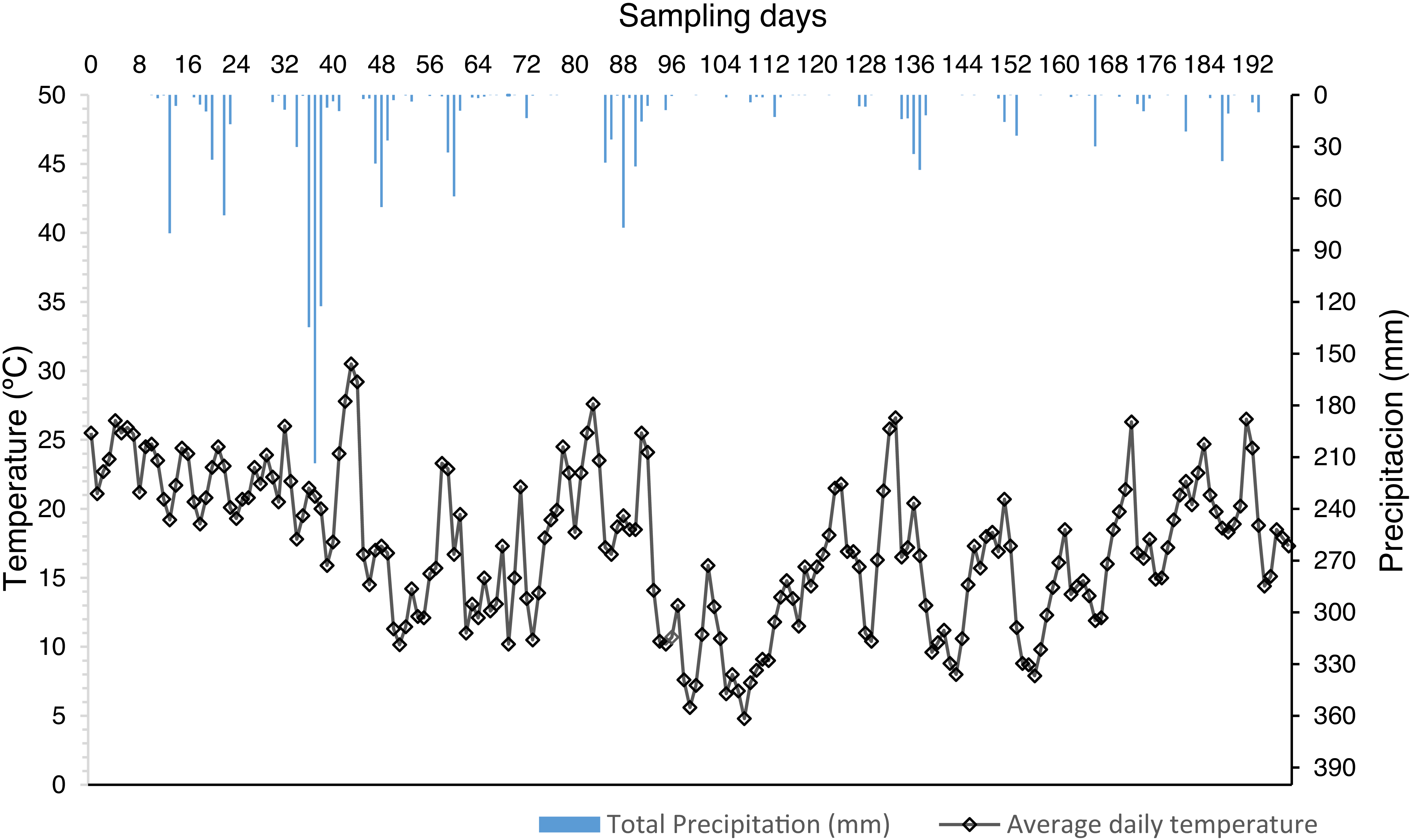
Total precipitation and average air temperature in the São Pedro mapping unit, Santa Maria, RS, 2024.

Statistical analysis
Statistical analyses were carried out using PROC MIXED in SAS (Version 9.4, SAS Inc., Cary, NC, USA) and the following model:

where Yijkl is the observed value of the dependent variable; Mi is the fixed effect of management (i = 1 or 2); aj is the random effect of area/block (j = 1 or 2), assumed N(O,σa 2); ɷijk is the random error associated with the plots (k = 1 to 3), assumed ∼ N(0,σω 2); Tl is the fixed effect of the evaluation period; MxTij is the interaction effect between the previously described fixed effects; eijkl is the experimental error, assumed ∼ NRM (0,R); N indicates Gaussian distribution, σa 2 and σɷ 2represent the variances associated with the random effects of area/block and plot, respectively; NRM indicates multivariate analysis given repeated measures over time, R represents a variance and covariance matrix. The compound symmetry (CS) and first-order autoregressive AR (1) matrices were used, with the CS matrix for the bromatological composition, structural composition and DM production per cycle variables (kg DM/ha) and AR (1) for the DM production variable (kg DM/ha), as it had the best value for the Bayesian criterion. A 5% significance level was used for all analyses.
Repeated measures over time were considered within paddocks, with evaluation periods treated as repeated observations of the same experimental unit. The covariance structure was selected according to the lowest Bayesian Information Criterion value to account for temporal correlation among repeated measurements.
Results
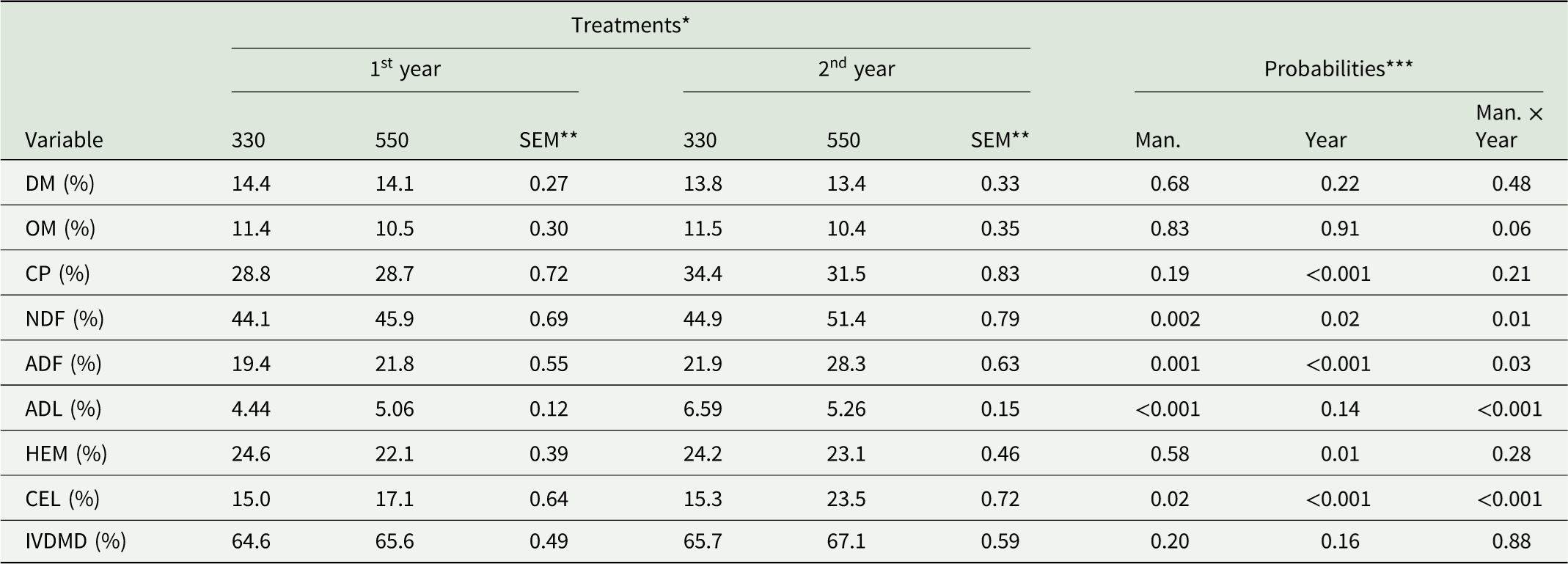
In general, pasture management based on TS did not affect DM, OM, CP and IVDMD of forage (Table 1). However, CP increased 5.6% and 2.3% for this variable in the treatments with 330 and 550 TS, respectively, in the second year of evaluation (P < 0.001; Table 1).
Bromatological composition of wheat pasture (XFront®) subjected to different dry matter (DM) levels as grazing intervals, on soil from the São Pedro mapping unit, Santa Maria, RS, March 2023–October 2024

Table 1. Long description
The table presents the bromatological composition of wheat pasture subjected to different dry matter levels as grazing intervals over two years. It has 10 rows and 11 columns. The columns are labeled as Treatments for the 1st year (330, 550, SEM), Treatments for the 2nd year (330, 550, SEM), and Probabilities (Man., Year, Man. x Year). The rows are labeled with variables: DM (percent), OM (percent), CP (percent), NDF (percent), ADF (percent), ADL (percent), HEM (percent), CEL (percent), and IVDMD (percent). Each cell contains specific values corresponding to the variables and treatments. Notable trends include variations in CP, ADF, ADL, and CEL percentages across different treatments and years, with significant changes highlighted in the probabilities section.
Legend: *330 = 330 of TS; 550 = 550 of TS; **SEM = standard error; ***Man = TS management; Year = year of evaluation; Man × Year = interaction between management and year; DM (% dry matter); OM (% organic matter); CP (% crude protein); NDF (% neutral detergent fibre); ADF (% acid detergent fibre); ADL (% lignin); HEM (% hemicellulose); CEL (% cellulose); IVDMD (% in vitro dry matter digestibility).
Significant interactions were observed between management and year of evaluation for the variables NDF, ADF, ADL and CEL, reflecting the joint influence of these variables on the structural composition of the forage. Despite this, the HEM values did not show significant differences between management practices; however, a reduction in HEM levels was detected when comparing the 2 years of evaluation.
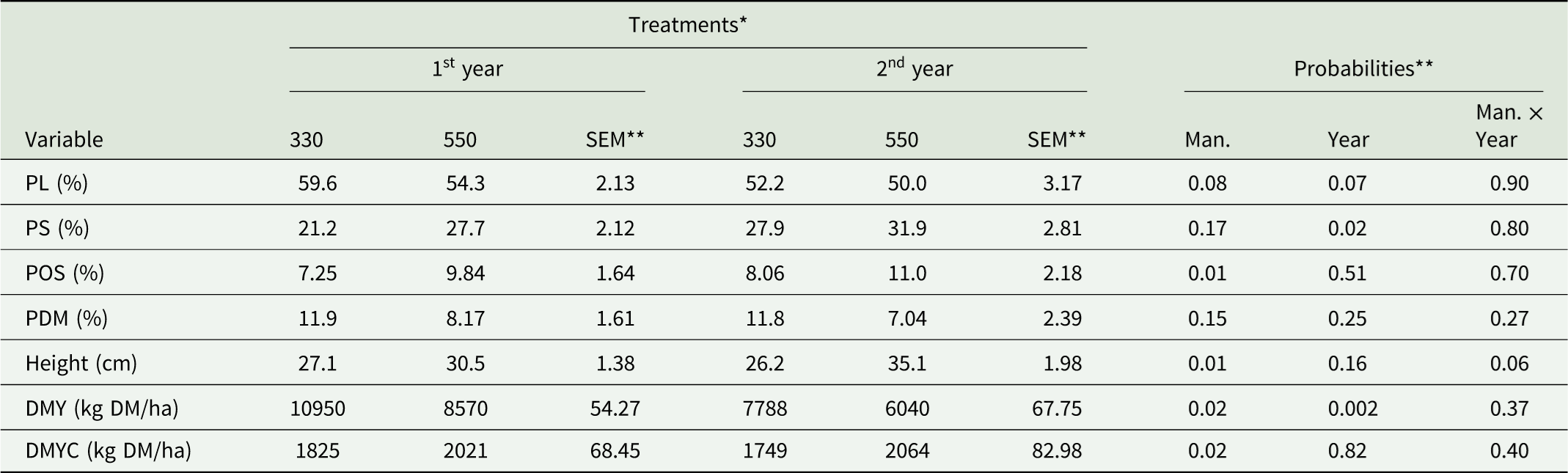
Regarding production and structural composition variables, no difference was observed for the variables PL and POS between treatments (P > 0.05; Table 2). The percentage PS variable showed a difference between the years of evaluation, with an increase of 6.7 and 4.2% for 330 and 550 TS, respectively, between the first and second years of evaluation. The variables PDM, height (cm), DMY and DMYC differed between treatments (P > 0.01; Table 2).
Structural composition and production of wheat pasture (XFront®) subjected to different grazing intervals (TS), on soil from the São Pedro mapping unit, Santa Maria, RS, March 2023–October 2024
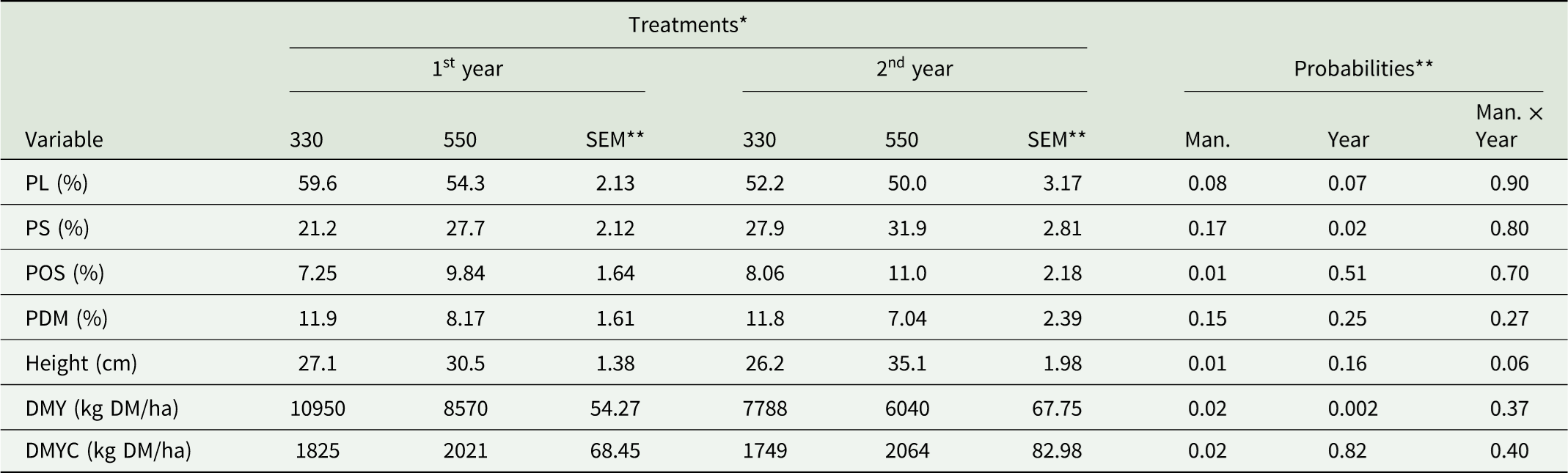
Table 2. Long description
A table with 8 rows and 11 columns comparing wheat pasture structural composition and production under different grazing intervals. The columns are divided into treatments for the 1st year, treatments for the 2nd year, and probabilities. The row labels include PL (percent), PS (percent), POS (percent), PDM (percent), Height (centimeters), DMY (kilograms dry matter per hectare), and DMYC (kilograms dry matter per hectare). Row 1: PL (percent), 59.6, 54.3, 2.13, 52.2, 50.0, 3.17, 0.08, 0.07, 0.90. Row 2: PS (percent), 21.2, 27.7, 2.12, 27.9, 31.9, 2.81, 0.17, 0.02, 0.80. Row 3: POS (percent), 7.25, 9.84, 1.64, 8.06, 11.0, 2.18, 0.01, 0.51, 0.70. Row 4: PDM (percent), 11.9, 8.17, 1.61, 11.8, 7.04, 2.39, 0.15, 0.25, 0.27. Row 5: Height (centimeters), 27.1, 30.5, 1.38, 26.2, 35.1, 1.98, 0.01, 0.16, 0.06. Row 6: DMY (kilograms dry matter per hectare), 10950, 8570, 54.27, 7788, 6040, 67.75, 0.02, 0.002, 0.37. Row 7: DMYC (kilograms dry matter per hectare), 1825, 2021, 68.45, 1749, 2064, 82.98, 0.02, 0.82, 0.40.
Legend: *330 = 330 of TS; 550 = 550 of TS; **SEM = standard error; PL (percentage of leaves); PS (percentage of culm+sheath); POS (percentage of other species); PDM (percentage of dead material); Height (pasture height); DMY (dry matter yield); DMYC (dry matter yield per cycle).
Discussion
Confirming the hypothesis, wheat cultivation subjected to grazing with an interval based on 330 TS resulted in higher biomass production and lower pasture senescence. The results are consistent with studies showing that the use of TS can ensure efficient pasture management without compromising nutritional composition. From a practical perspective, shorter grazing intervals based on lower TS may improve forage utilization efficiency and maintain pasture availability for lactating dairy cows throughout the grazing season (Da Trindade et al., Reference Da Trindade, Pinto, Neves, Mezzalira, Bremm, Genro, Tischler, Nabinger, Gonda and Carvalho2012).
The stability of DM observed between the two TS treatments over the 2 years suggests that wheat maintained a balance between growth and development without compromising palatability and digestibility. A study by Garagorry (Reference Garagorry2012), which evaluated pasture management based on TS, also found that there were no significant differences in DM and OM content, maintaining the nutritional quality of the forage.
CP contents varied between the years of evaluation, being significantly higher in the second year (Figure 2; Table 1). These differences may be associated with variations in environmental conditions and fertilization management over the years, including the additional N application performed in 2024. Similar responses in CP concentration under different climatic and nitrogen availability conditions were reported by Soares et al. (Reference Soares, Pin and Possenti2013). Furthermore, higher concentrations of CP can increase the nutritional value of forage and potentially improve nutrient intake in dairy cattle grazing systems (NASEM, 2021).
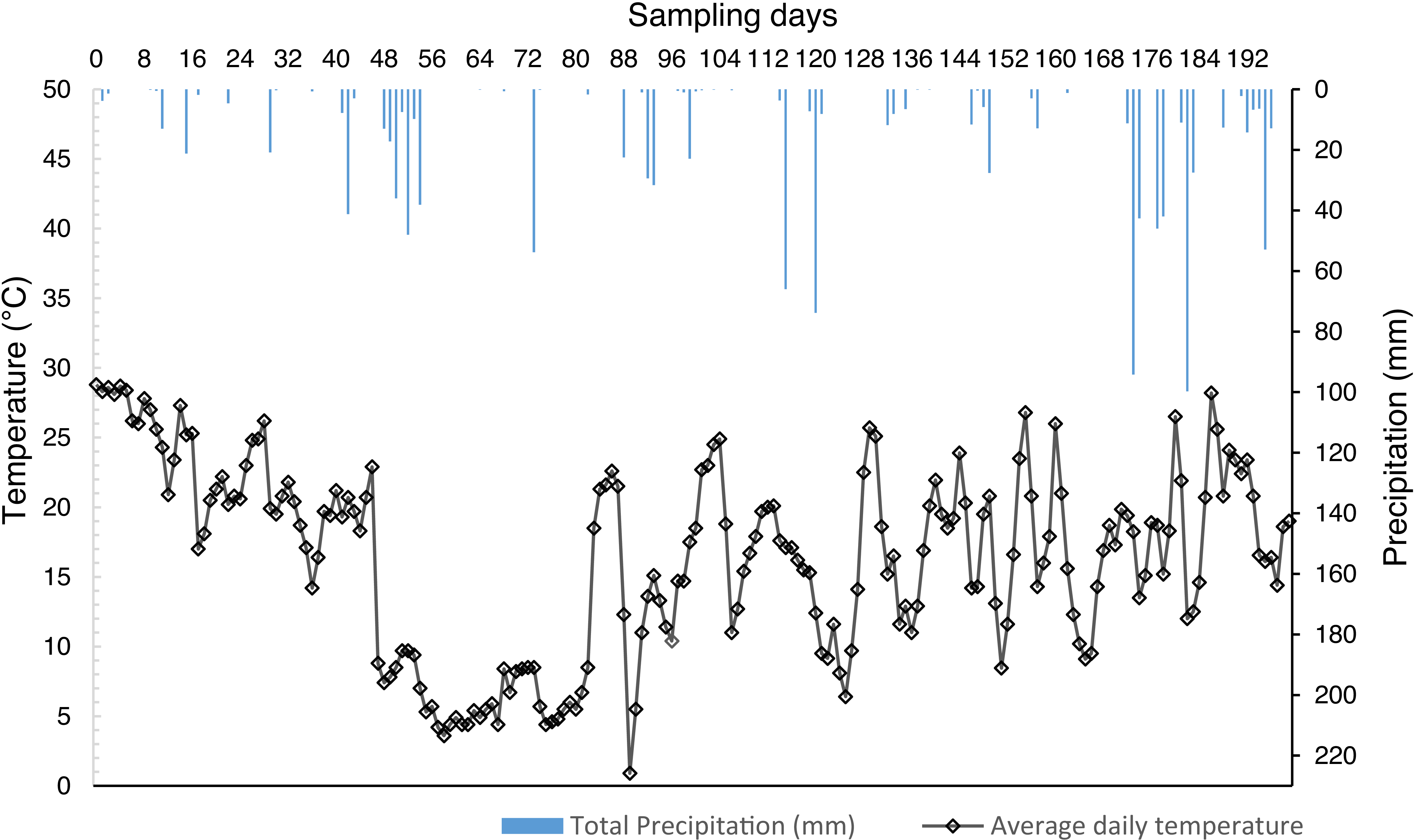
Total precipitation and average air temperature in the São Pedro mapping unit, Santa Maria, RS, 2023.

Significant interactions were observed for NDF, ADF, ADL and CEL contents, showing that the fibre composition of the forage was influenced by management conditions and the years of evaluation. Differences in ADL (Table 1) content between years may be related to variations in environmental conditions and pasture management during the experimental period. Environmental factors such as precipitation and temperature are known to influence lignification processes and structural composition in forage grasses (Wilson and Minson, Reference Wilson and Minson1980). Under conditions of higher TS, as observed in the 550 TS treatment, the forage likely reached a more advanced phenological stage at harvest, which may have contributed to reductions in HEM content and increases in NDF and ADF concentrations, the major structural components of the cell wall. In addition, differences in nitrogen dynamics associated with the management strategy may also have influenced forage structural composition (Delevatti et al., Reference Delevatti, Cardoso, Barbero, Leite, Romanzini, Ruggieri and Reis2019). These changes in fibre composition may directly affect forage intake and digestibility, since more mature pastures with higher fibre concentrations generally reduce animal selectivity and voluntary intake (Van Soest, Reference Van Soest1994).
The variation in the proportion of PS between the years of evaluation reflects the phenological advancement of wheat plants as the accumulated temperature increases. As the cycle progresses, significant morphophysiological changes occur, such as stem elongation and leaf expansion, resulting in greater accumulation of less nutritious structures, such as stems and dead material, to the detriment of leaves. According to Brunetti et al. (Reference Brunetti, Carvalho, Chiavegato and da Silva2016), increasing the interval between grazings, when exceeding the light interception threshold, favours biomass accumulation mainly by increasing the proportion of stalks and dead material. Similarly, Echeverria (Reference Echeverria2019), when studying winter pastures subjected to different heat sums, observed that the proportion of leaves decreased from approximately 60% to 54%, while that of stems increased from about 22% to 27%, reflecting the advance in the stage of wheat development, a pattern consistent with the results of this study.
The increase in the PDM variable with the increase in TS is associated with greater canopy senescence, caused by less light entering the lower layers of the pasture, which favours the accumulation of dead material. This response is typical of more advanced stages of the phenological cycle of forage plants, in which the renewal of green tissue is reduced. Similar results were observed by Silva (Reference Silva2019), who, when evaluating different annual pasture management systems, found a significant increase in dead material, with average values between 8% and 10%, as plants progressed to stages of senescence. From a management perspective, a greater accumulation of dead material can reduce grazing efficiency and increase forage losses, compromising the use of pasture by dairy cows (Carvalho et al., Reference Carvalho, da Trindade, Mezzalira, Poli, Nabinger, Genro and Gonda2009).
The higher DMY observed under management with 330 TS may be associated with the shorter interval between grazings, which favoured tillering and reduced senescence losses, resulting in greater biomass accumulation. The values obtained were 10950 and 8570 kg/ha for 330 TS and 7788 and 6040 kg/ha for 550 TS, respectively, in the 2 years of evaluation. These results are in line with those reported by Meinerz et al. (Reference Meinerz, Olivo, Fontaneli, Agnolin, Horst and de Bem2012), who observed total DM production ranging from 8000 to 12000 kg/ha in pastures under different climatic and fertilization conditions. In addition, pasture height is positively associated with above-ground biomass accumulation, making it an important indicator of forage availability and grazing potential (Genro and Silveira, Reference Genro and da Silveira2018). From a practical standpoint, the greater forage accumulation observed under shorter grazing intervals may contribute to increased stocking capacity and improved forage availability during periods of high feed demand in grazing dairy systems (Da Trindade et al., Reference Da Trindade, Neves, Pinto, Bremm, Mezzalira, Nadin, Genro, Gonda and Carvalho2016).
The difference in DMYC between treatments can be attributed to the influence of TS on the growth dynamics of forage plants. Higher TS values, such as 550 TS, provide biomass accumulation by allowing for longer plant recovery time between grazings, resulting in higher average production per grazing cycle in the 2 years of evaluation. Meinerz et al. (Reference Meinerz, Olivo, Fontaneli, Agnolin, Horst and de Bem2012), who observed DMYs of 2103, 2522 and 1679 kg DM/ha in three successive harvests of dual-purpose wheat cv. BRS Tarumã, demonstrating substantial variation in forage production among regrowth cycles. Similarly, Confortin et al. (Reference Confortin, Sanches, Silva and Monteiro2021), when evaluating the growth of annual ryegrass under different grazing intensities, observed that shorter rest intervals, based on reduced TS, limited biomass accumulation by keeping plants in the vegetative stage, without inducing flowering. However, despite the greater production per grazing cycle under 550 TS, the longer grazing interval may increase senescence losses and reduce forage quality over time, which can negatively affect grazing efficiency in intensive dairy systems (Cauduro et al., Reference Cauduro, de Faccio Carvalho, Barbosa, Lunardi, Nabinger, Gonçalves and Devincenzi2006).
The results obtained with shorter TS indicate that reduced grazing intervals help maintain the canopy in a vegetative stage for longer periods, increasing leaf proportion and reducing stem and dead material accumulation. From a practical perspective, this management strategy may improve forage utilization efficiency, maintain higher nutritional quality and support greater stocking rates in grazing dairy production systems (Carvalho et al., Reference Carvalho, da Trindade, Mezzalira, Poli, Nabinger, Genro and Gonda2009). Nevertheless, differences in environmental conditions and fertilization management between years should be considered when interpreting the productive and nutritional responses observed in the present study.
Conclusion
Bearing in mind that temperature has an impact on morphogenesis, the use of shorter grazing intervals based on 330 TS was associated with lower NDF, ADF and ADL concentrations, reduced pasture senescence and greater DM production compared with the 550 TS interval. These results suggest that shorter TS intervals may help maintain wheat pasture in a more vegetative stage, representing a promising strategy for improving pasture management in grazing dairy systems under the conditions evaluated.
Supplementary material
The supplementary material for this article can be found at https://doi.org/10.1017/S002185962610080X
Author contributions
Conceptualization: J.V.; methodology: O.S.P. and J.V.; formal analysis: O.S.P., S.N.P. and T.A.D.V.; investigation: O.S.P., C.F. and K.P.C.; writing – original draft preparation: O.S.P.; writing – review and editing: P.O.S., J.V., A.F.B. and T.A.D.V.; supervision and funding acquisition: J.V. All authors have read and agreed to the published version of the manuscript.
Funding statement
This research received a specific grant from the enterprise Coordenação de Aperfeiçoamento de Pessoal de Nível Superior (CAPES) and support from the company Biotrigo Genética.
Competing interests
The authors declare there are no conflicts of interest.
Ethical standards
Not applicable.