Introduction
This article is about transport arrangements for reaching the South Geographic Pole in Captain Robert Falcon Scott’s second expedition, the British Antarctic Expedition 1910–13 (BAE). It investigates why he did not take dog teams beyond the Ross Ice Shelf (Barrier) after announcing in the expedition’s fundraising prospectus that “a picked party of men and dogs” would make the “final dash” for the Pole.
It follows-on from a research article “Dogs of the British Antarctic Expedition 1910–13” (Alp, Reference Alp2019), which covered the period from Scott’s public announcement of his second expedition through to its final departure from Antarctica; from September 1909 to January 1913. To view a read-only version of that article without cost, click here. A full version may be obtained via the doi in the “References” section below.
This article covers a 75-day period, from 22 February 1911 to 8 May 1911, in greater depth. Its purpose is to investigate evidence relating to Scott’s change of mind about dog transport being used to reach the Pole. It is not the purpose of this article to compare Scott’s dogs against Captain Roald Amundsen’s dogs or to provide in-depth coverage of non-canine BAE transport. It is not concerned with post factum hypotheses about how a better outcome for the BAE might have been achieved, aiming simply to assemble and analyse verifiable evidence in chronological order.
The fundamental research question is “What factor(s) caused Scott to change his mind, between 22 February 1911 and 8 May 1911, about dog transport being used to reach the South Pole?”
This article starts by reviewing Scott’s initial Antarctic transport strategy. It then examines, in chronological order, events that may have contributed to Scott’s change of mind. It is shown that several events were crucial and some popular suppositions appear to be immaterial. Scott’s lecture of 8 May 1911 “Future Plans for the Expedition” is reviewed. His leadership technique for getting the BAE men to understand and support the new plan is examined and its influence on current perceptions of the expedition and the BAE men is investigated.
Previous works on the subject
A literature review has shown that none of the eight works reviewed addressed my fundamental research question, confirming it to be the least understood change Scott made to his Antarctic transport strategy (Alp, Reference Alp2019, “Literature review”). This is disappointing as the subject of dog management is central to Scott’s wider reputation.
Roland Huntford’s Scott and Amundsen (Huntford, Reference Huntford2002) does not investigate Scott’s initial Antarctic transport strategy, even though it is outlined in the expedition’s prospectus (Scott, Reference Scott1909). Huntford instead makes assertions about Scott’s transport strategy, for example:
When, in the middle of 1909, he [Scott] realized that the motor sledges were unlikely to get him all the way to the Pole, and animal transport was going to be needed, he decided on ponies instead - because Shackleton had used them (p. 256).
He made pertinent comments about Scott’s change of transport strategy, without investigating Scott’s rationale:
Having first put all his trust in the motor sledges, he had now lost faith in them altogether.
The dogs had been a disappointment. This was an arbitrary, not to say irrational statement, made in the face of very considerable evidence to the contrary. On the return from the depot journey, the dogs had run twenty or thirty miles a day, bringing Scott home far ahead of the pony party. Nonetheless, he decided the dogs were unlikely to reach the Beardmore Glacier. He was “inclined to chuck them for the last part of the journey.”
Ponies, he announced, were the only reliable form of transport, but they could only be taken to the foot of the Glacier. Thence, for the 1,000 miles or so and 10,000 feet of climbing to the Pole and back, it would be man-hauling all the way (p. 378).
Susan Solomon’s The Coldest March (Solomon, Reference Solomon2001) does not mention Scott’s prospectus and does not investigate Scott’s publicly announced transport strategy. Like Huntford, she makes assertions, “Scott planned to follow Shackleton’s promising strategy in relying mainly upon Manchurian ponies. He also took some dogs” (p. 51) and “Based upon his frustrations with the canines on that trek [the Discovery expedition’s southern journey], Scott had little hope that they [dogs] would be useful for more than shorter journeys as far as the Barrier edge in 1911-12” (p. 274).
Ranulph Fiennes’ Captain Scott (Fiennes, Reference Fiennes2003) includes a direct quotation from Scott’s prospectus, “The main objective is to reach the South Pole and to secure that objective for the British Empire” (p. 160), suggesting Fiennes was aware of the prospectus’ statement about using dog transport to reach the Pole. A few pages later, he appears to lose sight of Scott’s intention, “He would use four types of transport at the start of his journey and discard any that didn’t work as he went along” (p. 165). Fiennes also seems to forget an important quotation in his own book, “Up to this day [21 February 1911] Scott had been talking to Meares of how dogs would go to the Pole. After this, I never heard him say that” (p. 214).
All three writers appear to overlook strong evidence that Scott initially planned to use dog transport to reach the Pole. The evidence is presented in the next section.
Extensive searching has failed to locate any research article of the last ten years that addresses Scott’s initial transport strategy and his subsequent change of mind.
Scott’s initial Antarctic transport strategy: September 1909 to February 1911
Scott’s public fund raising prospectus of September 1909 plainly stated the expedition’s main objective, “The main object of this Expedition is to reach the South Pole and to secure for the British Empire the honour of that achievement” (Scott, Reference Scott1909, p. 2).
The prospectus announced his intention to use dog transport to reach the Pole:
The problem of reaching the South Pole from a wintering station is a problem of transport. The distance to be covered, there and back, is about 1500 miles; the time at disposal in a single season is about 150 travelling days. An average of 10 miles per day can be easily maintained by men, provided adequate transport arrangements are made. […] Dogs, if not overladen, could be used for [Beardmore] Glacier work, and might travel the whole distance to the Pole if properly husbanded by being lightly laden and well fed on the lower plateau (p. 3).
[P]onies will be taken in sufficient numbers to ensure a thoroughly adequate amount of food being taken to the base of the Glacier. A dog team with a relay of men will transport the loads over the Glacier surface and a picked party of men and dogs will make the final dash across the inland ice sheet (p. 5).
On page 5 (of 6), the prospectus briefly identified “scientific objects of the expedition”, secondary to the goal of reaching the Pole. Scott later explained to expedition members his rationale for publicly downplaying science:
[T]he Scientific public as well as the more general public will gauge the ‘result’ of the Scientific work of the expedition largely in accordance with the success or failure of the main object. With success, all roads will be made easy; all work will receive its proper consideration. With failure, even the most brilliant work may be neglected and forgotten, at least for a time (Scott, Reference Scott1911d, p. 1).
Scott wrote an article “Plans of the British Antarctic Expedition, 1910” (Scott, Reference Scott1910) for The Geographical Journal (GJ), the peer-reviewed monthly journal of Royal Geographical Society (RGS). The Society was by now a part-funder and backer of the expedition, so Scott would have been mindful of the strong opinions held by influential RGS figures like Clements Markham and Leonard Darwin. Scott’s article therefore emphasised the importance of scientific discovery, the strength of his scientific staff and the rigorous challenges to be faced by his men. He wrote passionately:
[I]t appeals to our national pride and the maintenance of great traditions, and its quest becomes an outward visible sign that we are still a nation able and willing to undertake difficult enterprises, still capable of standing in the van of the army of progress (p. 12).
Scott’s GJ article downplayed the potential usefulness of ponies, dogs, motor tractors and ski. It was silent about his intention to use dogs in the final dash for the Pole, presumably cognisant of prevailing RGS beliefs about the virtues of hard manual labour. Those familiar with Max Jones’ The Last Great Quest will probably recognise Scott’s faithfulness to the “tripartite process of measurement promoted by Clements Markham since the 1870’s: measuring the world, measuring manliness, and measuring empire” (Jones, Reference Jones2003, p. 69).
Scott made a presentation “The Forthcoming Antarctic Expedition” to the weekly evening meeting of the Royal Institution of Great Britain on 27 May 1910, five days before the Terra Nova left London. The Times of 28 May 1911 quoted extensively from Scott’s article in the GJ, which was later reproduced in full (minus its appendix) in Proceedings of the Royal Institution of Great Britain (volume 19), 1910, pp. 864–71.
After the expedition left Britain, Scott often spoke to his men about using dogs to reach the Pole, as noted below. He also shared his initial Antarctic transport strategy with foreign newspapers, for example, the Lyttleton Times, 28 October 1910, p. 7.
Key elements of Scott’s initial Antarctic transport strategy were:
o Several supply depots would be established on the Barrier in autumn 1911, during a 60–70 day programme.
o Ponies, dogs and motors would be used on the Southern Journey.
o The journey’s duration would be up to 150 days.
o Ponies would haul the bulk of the cargo (including dog food and human food) across the Barrier, commencing in early October 1911, with men and dogs travelling lightly loaded.
o Men and dogs would relay cargo up the Glacier, with men in small parties returning to base as supply depots were established for the returning Polar Party.
o A small team of men and dogs would make a dash for the Pole.
o Whenever possible, the large scientific staff would “endeavour to achieve the greatest possible scientific harvest which the circumstances permit” (Scott, Reference Scott1910, p. 12).
This was Scott’s strategy for about 19 months, until May 1911.
Confirmation of Scott’s intention to use dog transport to reach the Pole appears in his letter to Joseph Kinsey, the expedition’s New Zealand agent, written shortly after the Terra Nova was unloaded at Cape Evans:
I believe these animals [the dogs] are going to do very good work, but of course there are not sufficient to do the whole journey alone – relying on the ponies I propose to reserve the best efforts of the dogs for the last part of the route (Scott, Reference Scott1911a, p. 4).
At about the same time Lieutenant Henry Bowers recorded his expectations for deployment of dogs on the Southern Journey:
[T]he actual Polar Party will probably be only 8 strong at the top of the Glacier where the big plateau is reached. The rough idea is the 4 will then make a dash with the dogs which will have been saved as much wear and tear up the Glacier as possible. […] All being well Scott, Evans and Dr. Wilson will be 3 of the 4, then with the dogs [Cecil] Meares should have preference as the 4th. If on the other hand, the dogs gave out and ponies had to do it Titus [Lawrence Oates] would be the man (Bowers, Reference Bowers1913, vol 1, pp. 43–44).
Scott needed most of the ponies and dogs to be fit for the Southern Journey. As discussed in “Loss of ponies” (below), he had up to 15 ponies in mind for the journey. There is no record of how he intended to assign up to 15 pony leaders [in November 1911 there were no spare men after assigning 10 pony leaders].
As late as 22 February 1911, Scott was confident about taking dogs to the Pole. That day he returned to Safety Camp from the First Depot Journey, the dogs having finished with a 3-day speed trial. He spoke enthusiastically with Lieutenant Edward Evans:
Scott was most enthusiastic about the capabilities of Meares’ dogs, and he then expressed an opinion that he would probably run the dogs light on the Polar Journey and do the final plateau march to the Pole itself with them. What a pity he didn’t! (Evans, Reference Evans1961, p. 76).
Scott’s evolving plans
The next glimpses of Scott’s evolving transport plans, between his GJ article and his May 1911 presentation to the men at Cape Evans, appear in work papers, now held by the British Library. The Diaries of Captain Robert Scott is a 6-volume set of Scott’s original base diaries (two volumes), work papers (one volume), sledging diaries (two volumes) and the South Polar Times. Apart from the South Polar Times, they are facsimile copies of Scott’s handwritten notebooks and work papers. Volume III “Sledging Orders 1910–1911” (Scott, Reference Scott1911e) (hereafter Vol. III), contains a broader range of material than is suggested by its title, including letters, work papers, plans and other documents. Unfortunately, Vol. III does not have page numbers, most pages are undated and it has not been compiled in chronological order.
The contents of Vol. III seem to have been accumulated over several months, from arriving at Lyttleton in November 1910 until Scott’s lecture on 13 September 1911. There are work papers for several autumn depot journeys, the Winter Journey to Cape Crozier, the Western Geological Journey, the Eastern Journey and the revised Southern Journey. The title page is shown in Figure 1.
Title page of Vol. III (Scott, Reference Scott1911e).

First depot journey
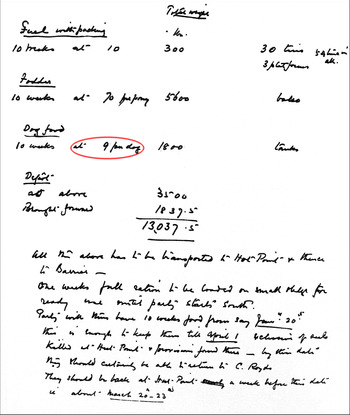
Scott’s GJ article outlined his intention to establish several supply depots on the Barrier during a 60 to 70 day period. One of Scott’s work papers (Fig. 2) is about a 10-week exercise, commencing around 20 January 1911, consisting of several autumn depot journeys (effectively an autumn depot programme).
Scott’s notes for a 10-week autumn depot programme (Scott, Reference Scott1911e, n.d.).

The First Depot Journey took place prior to the study period of this article. The dog teams fully met or exceeded expectations. In brief:
o The main objective was to advance the greatest weight of stores possible, as far south as possible. A second objective was to gain experience in animal management; to optimise some of the transport arrangements and techniques envisaged for the coming Southern Journey. A modest scientific programme included objectives such as measuring mid-barrier minimum temperatures and making meteorological observations along the route.
o The journey commenced on 24 January 1911, with 12 men, 8 ponies and 24 dogs. The 24 best sledge dogs were selected from the 32 available.
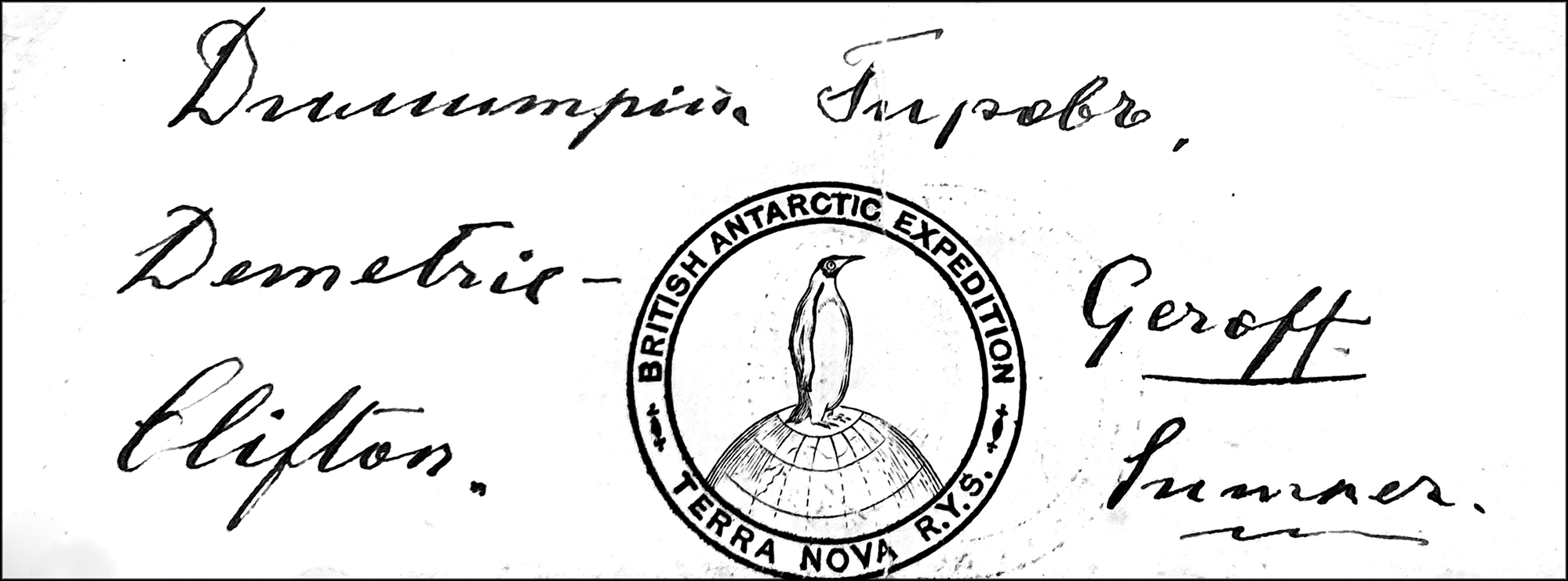
o Dog drivers were Meares and Doctor Edward Wilson, assisted by Scott and Evans, with teams of 13 and 11 dogs, respectively. Demetrie Geroff (see Fig. 3), the most experienced dog handler, was surprisingly omitted from the First Depot Party.
o Scott’s naval armada organisation model, with all transport resources travelling the same route at the same time for the same daily mileage, had the virtues of simplicity of navigation and simplicity of control. The downside was the slowest animals dictated the daily achievements of all, causing the better animals to be under-utilised. The party did not therefore achieve its full potential. Even though dogs could operate in harsher conditions than ponies, that potential was wasted. Oates dryly commented in a letter to his mother, “their [naval officers] ignorance about marching with animals is colossal” (Oates, Reference Oates1911a, p. 5) and “It is this trying to work three kinds of transport that knocks me, they can’t do it in the army, so I am jolly sure Scott is not going to” (p. 12). He asked her (pp. 13-14) to send a copy of the 370-page 1908 War Office publication about managing horses, Animal Management, presumably to enlighten Scott and others about effective horse trekking. On wonders whether this may be the source of Huntford’s “shilling book about transport” anecdote.
o Scott was initially sceptical about the dogs, “but certainly also the dogs will not pull heavy loads” (Scott, Reference Scott and Jones2006, p. 107). He became more trusting as the dogs increased in fitness, “The dogs are doing excellently – getting into better condition every day” (p. 109), and later “The way in which they keep up a steady jog trot for hour after hour is wonderful” (p. 129).
o Temperatures dropped to minus 21 Fahrenheit in the later stages of the journey, “Meares said he felt the nip of it more than anything he [and presumably the dogs] had ever experienced in Siberia” (Bowers, Reference Bowers1913, vol 2, p. 27). The ponies suffered terribly.
o The party reached 79° 29’ south and established One Ton Depot on 17 February 1911.
o At no point were dogs recorded as a limiting factor. They delayed their departure for one to two hours every morning and also after the lunch break, always catching-up with the ponies by end of day. (Bowers, Reference Bowers1913, vol 2, p. 11; Wilson, Reference Wilson and King1972, p. 102).
o An incident involving the dogs occurred on the return journey, as discussed in “The crevasse incident” (below).
o The dog teams reached Safety Camp on 22 February 1911.
Demetrie’s preferred spelling in the English-speaking world, courtesy of Canterbury Museum MS509.

It appears that by 22 February 1911 (the day Scott told Evans he was intending to take dogs to the Pole) the dogs had already met or exceeded all expectations on the First Depot Journey. There was nothing in the dogs’ achievements for Scott to be disappointed about, and no reason to doubt the dogs’ reliability (see “Scott’s May 1911 lecture” below).
The crevasse incident
Scott’s concerns about crevasse-risk arose from his personal experience of a frightening crevasse incident with Edgar Evans and William Lashly on the Discovery expedition and from Frank Wild’s account of the loss of Shackleton’s last pony on the Nimrod expedition.
Scott knew there would be no way of rescuing a 400-kilogram pony from a deep crevasse (even if it survived the fall). Rescue efforts would require a sturdy tripod derrick, lifting tackle and a sling. He therefore avoided taking ponies over crevassed areas.
He knew from his Discovery expedition that sledging harnesses or roping men together would prevent serious human injury in a crevasse drop. The drop could be unpleasant and the rescue process stressful and time-consuming for small parties, but rescue was always effective.
We do not know how Scott perceived crevasse-risk to dogs prior to the crevasse incident. He had long-planned to take dogs up the deeply crevassed Glacier, suggesting he thought their 30-35 kilogram weight would be safe.
The risk of injuring or losing dogs in a crevasse was highlighted for Scott when he, Meares, Wilson and Apsley Cherry-Garrard travelled back from One Ton with the dogs. On 21 February 1911, they took a short cut, leaving the established route and venturing through an area near White Island known for crevasses (avoidable by passing directly through Corner Camp). It was not long before most of Meares’ and Scott’s dog team dropped through the lid of a crevasse. Fortunately, the men and sledge did not follow. All the dogs were rescued alive, with Scott being lowered on an alpine rope to retrieve the last two which had fallen out of harness. Scott wrote, “[T]hree of them [dogs] are passing blood and have more or less serious internal injuries. Many were held up by a thin thong round their stomach, writhing madly to get free” (Scott, Reference Scott and Jones2006, p. 132). One died a month later.
Scott was relieved all dogs had been recovered alive, “Scott has just said that at one time he never hoped to get back with the thirteen, or even half of them” (Cherry-Garrard, Reference Cherry-Garrard1913, p. 125). But some time later, after expressing his enthusiasm about the dogs to Evans (see “Scott’s initial Antarctic transport strategy: September 1909 to February 1911” above) Scott had second thoughts. Perhaps he was shocked by the realisation that a team of dogs dropping into a crevasse is potentially much more serious than if a man in a sledging harness drops into the same crevasse. Dogs can fall out of harness or suffer internal injuries. Men cannot fall out of harness and are not at risk of internal injuries when dropping into a void. Men can be readily pulled back to the surface, one by one; dog team rescue is much more complex and risky.
A week after the crevasse incident, Bowers wrote:
He [Scott] said however that he had no confidence whatever in the motors after the way their rollers had become messed up unloading the ship. He had had his confidence in the dogs much shaken on the return journey [presumably by the crevasse incident], and now he had lost the most solid asset – the best of his pony transport (Bowers, Reference Bowers1913, vol 2, pp. 94–95).
The subject of crevasses-risk was apparently discussed at length after Scott’s lecture on 8 May 1911, “There was a long discussion on the possibility of getting ponies up the great Beardmore Glacier” (Griffith Taylor, Reference Griffith Taylor1916, p. 242).
Crevasse-risk did not suddenly arise during the 75-day period during which Scott changed his mind. It is an ever-present hazard of travel in Antarctica. It did, however, become a major factor for Scott after he realised how much more serious it could be for dogs than for men. Wild’s journal had alerted Scott to the large number of vast crevasses on the Glacier and the likelihood of multiple crevasse incidents. The prospect of multiple dog deaths and injuries had to be taken seriously.
It is suggested crevasse-risk for dogs was an important factor in Scott’s change of mind.
“The dogs are as thin as rakes”
On 22 February 1911, the day the dog teams returned to Safety Camp, Scott wrote:
The dogs are as thin as rakes; they are ravenous and very tired. I feel this should not be, and that it is evident that they are underfed. The rations must be increased next year and we must [Scott’s emphasis] have some properly thought out diet. The biscuit alone is not good enough (Scott, Reference Scott and Jones2006, p. 134).
It appears Scott saw Meares as being responsible for the dog ration problem, but the evidence suggests Scott knew better than Meares what was required:
o Scott wrote, “Few [authorities] place its [a dog’s] food for a long journey at less than 1½ lb per diem” (Scott, Reference Scott2009, p. 316).
o On 11 November 1902, Scott wrote about food and fuel consumed on the southern journey, “[E]ach night, after the first start, would see a reduction of between thirty and forty pounds …” (Scott, Reference Scott2009, p. 390). With three men and 18 dogs, and allowing 8 pounds for human food and fuel, the dogs would have been receiving about 1½ pounds each.
o There is no evidence Meares had expertise in dog nutrition. In Siberia, sledge dogs were fed on dried salmon during winter (New Zealand Times, 15 September 1910). Meares most likely had a local helper attending to dog food in Siberia. It seems he had no experience with biscuit-based dog rations prior to the BAE.
o In November 1910, in Lyttleton, Scott wrote, “Mears is reluctant to feed the dogs on seal, but I think we ought to do so during the winter” (Scott, Reference Scott and Jones2006, p. 11). Scott had learned from the Discovery expedition that working dogs need dietary fat.
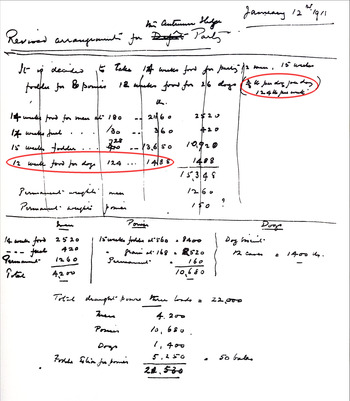
Scott’s work paper of 12 January 1911 (Fig. 4) shows one version of his provisioning plan for the autumn depot programme. It shows a ration of two-thirds of a pound of biscuit per dog per day, which is consistent with his journal entry of 27 January 1911, “Meares has estimated to give them two-thirds of a pound of biscuit a day. I have felt sure he will find this too little” (Scott, Reference Scott and Jones2006, p. 107).
Autumn depot programme provisions (Scott, Reference Scott1911e, 12 January 1911).

Other work papers (e.g. Fig. 2) show Scott also considered a ration of 9 pounds of biscuit per dog per week, but that ration was apparently never implemented. Scott clearly put a lot of effort into planning dog rations – not surprising since at 1½ pounds per dog per day, two teams of 11 dogs each would consume over 230 pounds of rations per week, which is almost as much as a team of four men would consume in four weeks.
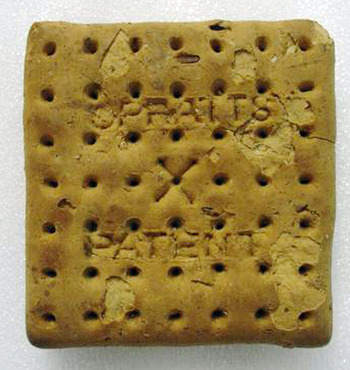
Dog biscuits from the Terra Nova weighed two per pound (Cherry-Garrard, Reference Cherry-Garrard2010, p. 467; Wilson, Reference Wilson and King1972, p. 102). They were different from the earlier Discovery expedition biscuits weighing three per pound (Fig. 5). Apparently, Scott and Meares decided to feed the dogs on leftover Discovery dog biscuits before using the new Terra Nova biscuits. They went to Hut Point together on 15 January 1911 “to test the ice and see how the land lies” (Scott, Reference Scott and Jones2006, p. 88), confirming a worthwhile stock of leftover Discovery dog biscuits.
Discovery dog biscuit, weighing 148.7 g (5.25 ounces), courtesy of Canterbury Museum 1982.147.2.

It is evident from Scott’s 22 January 1911 letter to Kinsey that he, Meares and Oates worked closely together in planning animal transport and animal rations for the entire expedition (Scott, Reference Scott1911b, p. 1). There was no rift evident between Meares and Scott at this stage, suggesting consensus agreement over the dog rations recorded by Scott. Wilfrid Bruce commented on the relationship between Meares and Scott prior to the start of the First Depot Journey, in a letter to his sister Kathleen Scott, “He’ll probably go with Con [Scott] to the pole, so you’ll hear lots more about him. Con thinks a lot of him” (Bruce, Reference Bruce1911).
On 24 January 1911, Scott noted 500 pounds of dog biscuits would be taken on from the Discovery hut (Scott, Reference Scott and Jones2006, p. 104). On 28 January 1911, Wilson wrote, “Meares took his dog team in to Hut Point and brought out some dog biscuit” (Wilson, Reference Wilson and King1972, p. 99) and the next day Evans recorded, “I went in with Meares to Hut Point to bring out some 250 lbs of dog biscuit” (Evans, Reference Evans1961, p. 71). About 500 pounds of ex-Discovery dog biscuits were to be used. With 24 dogs consuming two-thirds of a pound per day, 500 pounds would last about 31 days.
Scott wrote to Kinsey on 31 January 1911, “such people as Bowers, Oates and Meares will take a lot stopping when they have the hang of this business. The dog teams are in splendid condition, and will take out heavy loads this journey if the ponies don’t” (Scott, Reference Scott1911c, p. 2).
The dog ration was soon increased to one pound per day. At that rate, 500 pounds would feed 24 dogs for about 21 days. This is roughly consistent with Cherry-Garrard’s note of 20 February 1911, “[W]e have a bare two days’ biscuit for dogs” (Cherry-Garrard, Reference Cherry-Garrard1913, p. 121).
By 4 February 1911, the party was at Corner Camp, well away from Hut Point and from all wildlife, so no additional dog food could be obtained for the rest of the journey, other than by breaking into cargo designated for depots. Wilson wrote:
Our dogs are getting 1 lb of dog biscuit each a day. They get nothing on turning out – 1 biscuit after the first march and 2 in the evening after the second march. The biscuits are Spratts and contain meat and codliver oil – but we have decided that 1 lb of these biscuits is too little for them. They are thinning down very much (Wilson, Reference Wilson and King1972, p. 102).
On 12 February 1911, Bowers confirmed the ration, “Meares was feeding them on 1 lb per day which I do not think enough” (Bowers, Reference Bowers1913, vol 2, p. 13).
On 19 February 1911, Scott surprisingly wrote, “ponies and dogs have had what under ordinary circumstances would have been a good allowance of food” (Scott, Reference Scott and Jones2006, p. 129). From his Discovery dog management experiences (noted above), Scott knew 1½ pounds per day was required, yet now seemed surprised that 1 pound was proving inadequate.
Towards the end of the First Depot Journey, the dogs were in poor condition but were being pushed as hard as possible. Cherry-Garrard wrote on 20 February 1911, “We travelled fast, doing nearly 78 miles in the first three days [homeward bound], by which time we were approaching Corner Camp. The dogs were thin and hungry and we were pushing them each day just so long as they could pull” (Cherry-Garrard, Reference Cherry-Garrard2010, pp. 126–127).
The sad conclusion of this section is that for reasons unknown, Meares and Scott provided an inadequate dog ration of one pound per day on the First Depot Journey, despite Scott knowing 1½ pounds per day was typical. We do not know if the underfeeding was an ill-considered scientific experiment, or simply a hasty reduction of cargo weight. If an experiment, it is surprising Scott did not explain the objective(s) and rationale in his journal and one would expect the two dog-teams to receive different experimental rations. [The human nutrition experiment of the Winter Journey provides a model of well-considered dietary experimentation.]
Scott and Meares subsequently settled on a ration of 1½ pounds for the Southern Journey, which proved satisfactory. Meares and Oates also prepared a large quantity of seal-based pemmican for dogs the following season, but it could not be used on the Southern Journey because it was left behind with the abandoned motors.
Second Depot Journey
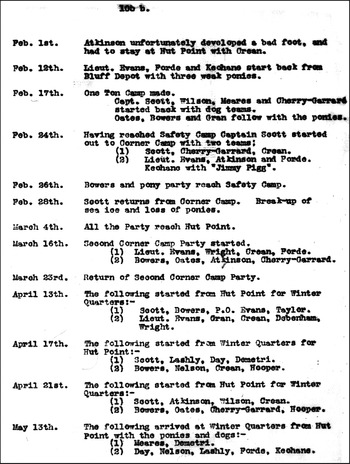
After returning to Safety Camp on 22 February 1911, Scott spent a day organising the Second Depot Journey [Scott’s terminology, The Star (Christchurch), 2 April 1912], deploying all transport resources at his disposal. He departed Safety Camp on 24 February 1911 with two man-hauled sledges and one pony-drawn sledge. Participants are listed in Figure 6. Left behind at Safety Camp were Meares, Wilson and the two dog teams (Wilson, Reference Wilson and King1972, p. 108; Gran, Reference Gran and Hattersley-Smith1984, p. 63).
Barrier activities in February–May 1911 (Cherry-Garrard, Reference Cherry-Garrard1913, p. 105b), courtesy Alexander Turnbull Library Micro-MS-0754.

Cherry-Garrard explained why the dogs did not participate in the Second Depot Journey, “But the dog teams were done [worn out] ‘the dogs are thin as rakes; they are ravenous and very tired. […]’. In addition, several dogs were feeling the effects of injuries due to the crevasse incident” (Cherry-Garrard, Reference Cherry-Garrard2010, pp. 138-139).
Perhaps Scott felt let down by the dog teams being unfit for work. The Second Depot Party moved six full weeks’ provisions, one bag of oats and ¾ of a bale of fodder from Safety Camp to Corner Camp (Scott, Reference Scott and Jones2006, p. 137) without assistance from the dogs.
By now, the dogs were under something of a cloud. They had been unable to participate in the Second Depot Journey and sadly, this was to be repeated for the Third Depot Journey.
Loss of ponies
Scott’s initial scheme of advance is outlined in his 12 January 1911 letter to Kinsey (Scott, Reference Scott1911a). It was written shortly after the Terra Nova was unloaded at Cape Evans and before any depot journeys:
Of the remaining 15 [ponies] I propose to take 10 on the depot journey. After that journey, I shall be in a good position to judge their capacity of helping us on the main journey … (p. 3)
I shall hope to avoid further losses [of ponies] on this [Depot] journey, and during the winter, but one cannot be blind to the risks and must realise that it will be most fortunate if we can keep them all alive until the end of the year. […] The position is this that we ought to have enough pony transport for our needs next season [17 alive at the time of writing, including two with Campbell’s Party], but that there is a chance of wholesale failure and should it fail, it must mean the failure of the Southern Journey (pp. 3–4). […]
I don’t anticipate any further serious losses [of dogs], as they are well looked after and well trained. I believe these animals are going to do very good work, but of course there are not sufficient to do the whole journey alone – relying on the ponies I propose to reserve the best efforts of the dogs for the last part of the route. There are 29 trained dogs remaining [seemingly excluding the two young ex-Peary Greenland dogs], which I will form into two teams of 13 with 3 spare. (p. 4).
Scott did not quantify “wholesale failure” of ponies, but from his reactions (below) to the loss of six ponies, that threshold was unfortunately crossed.
Bowers wrote on 1 March 1911, while three ponies drifted on an ice floe, apparently doomed [in what Scott pointedly called the Bowers Incident]:
My feelings were nothing to what poor Captain Scott had had to undergo that day. I at once broached the hopeful side of the subject – remarking that with the two that Campbell had left we had 10 ponies at winter quarters. […] He said, ‘of course we shall have a run for our money next season but as far as the Pole is concerned I have very little hope’. (Bowers, Reference Bowers1913, vol 2, pp. 94–95).
Scott wrote on 2 March 1911, “The events of the past 48 hours bid fair to wreck the expedition” (Scott, Reference Scott and Jones2006, p. 138).
Cherry-Garrard later wrote:
When Scott first sat down at his little table at Winter Quarters [about 22 April 1911] to start working out a most complicated scheme of weights and averages for the Southern Journey, his thoughts were gloomy, I know. ‘This is the end of the Pole,’ he said to me, when he pulled us off the bergs after the sea-ice had broken up; the loss of six ponies out of the eight. […] – these were not cheerful recollections with which to start to plan a journey of eighteen [sic] hundred miles (Cherry-Garrard, Reference Cherry-Garrard2010, pp. 182–183).
Without an adequate number of ponies, it would not be possible to take the required quantity of Dog Party provisions to the foot of the Glacier. In other words, inadequate pony traction for the first stage of the Southern Journey would cause the dogs to have insufficient food for the two later stages. There were “not sufficient [dogs] to do the whole journey alone [without ponies for the first stage]” (Scott, Reference Scott1911a, p. 4).
Naturally, Scott would soon be thinking about re-arranging his scheme of advance in order to reduce the number of ponies required to reach the Pole. He knew Shackleton had come within 100 miles of the Pole using just four ponies. We have no information about the options Scott considered, leading to his decision that men would now have to play a greater role by hauling sledges beyond the Barrier because dogs would not have sufficient food to reach the Pole. Sledge hauling had a long naval tradition and several of the BAE men – Scott, Wilson, Lashly, Crean and PO Evans – were well seasoned and enthusiastic.
It would be instructive at this point to investigate Scott’s provisioning plan for Dog Party travel beyond the Barrier. Ideally, the investigation would start by reviewing the quantity of provisions Scott had planned, together with a matching transport plan. As noted in “Scott’s evolving plans” (above), Vol. III contains provisioning plans and transport plans for most of the BAE journeys. Strangely, it does not contain such information about Scott’s initial southern plan. It is not clear whether Scott ever calculated the provisions required for Dog Party work on the Glacier and on the Polar Plateau. In any event, no record has survived.
On the subject of missing information, no explanation has survived for Scott and Meares settling on 20 ponies and 30 Siberian Huskies. There is no suggestion in Scott’s lecture notes or journals that expedition funding constrained the number of animals purchased. Scott apparently determined the number of animals himself, with Meares’ role being “to collect the twenty ponies and thirty dogs which I have decided to take” (Scott, Reference Scott1910, p. 13). One idly wonders whether the numbers came from careful calculation of animal traction required to attain the Pole, or simply a matter of Terra Nova deck space for dogs and cargo hold space for dog and pony food. Vol. III itemises a large amount of cargo left in storage at Lyttleton for a second voyage of the Terra Nova. Deck space and cargo hold capacity limited the quantity of many items taken south in November 1911.
This section has identified another possible explanation for Scott’s change of mind – making the Southern Journey possible with a reduced number of ponies.
Third Depot Journey
The Third Depot Party (without dogs) left Hut Point on 16 March 1911, two days after the Western Geological Party arrived. Participants are listed in Figure 6. Their job was to advance provisions from Safety Camp to Corner Camp, “On arrival there [Safety Camp] we picked up 340 lbs. of oats and 4 cases of biscuit [about 184 pounds] for Depot at Corner Camp also our own provisions and oil” (Bowers, Reference Bowers1913, vol 3, p. 35). They then loaded items for consumption back at the Discovery hut, “some fodder for our two ponies and also some stores for the sixteen men in our little community” (Griffith Taylor, Reference Griffith Taylor1916, p. 193). This was because the hut had not been adequately provisioned for the 16 men, 2 ponies and 2 dog teams now stranded there, waiting for the sea ice to form before returning to Cape Evans.
Once again, the dogs had been unfit for sledge work, as noted by Thomas Griffith Taylor on 16 March 1911:
Just outside the door [of the Discovery hut] were the dog-lines. The dogs lay in ‘rifle-pits’ dug out of the icy slopes above the bay. Poor fellows, their fur was clogged with ice, and their short commons [underfeeding] on the Barrier made them woefully thin. Very miserable did they look for some days […] [then] it was pleasant to see how the rest and abundance of seal-meat soon improved them out of all recognition (Griffith Taylor, Reference Griffith Taylor1916, pp. 193–194).
By now, the dogs had been back from the First Depot Journey for over three weeks, recovering quite slowly under the care of Meares and Wilson. We can never know if Demetrie’s extensive experience in dog management would have made for a quicker recovery, had he been present.
By now, Scott must surely have been frustrated the dogs could not be used for sledge work after the One Ton round trip of less than 300 miles, even after three weeks’ rest. Next season they would have to be fit for a round trip of 1500 miles. He later used the term “disappointed”. Edwardian-era conventions about controlled politeness may seem almost passive-aggressive to modern readers – Scott was effectively saying he was completely disenchanted and dissatisfied with the Dog Party.
On 17 March 1911 (the day after the Third Depot Party departed Hut Point), Scott made an ominous journal entry, “The scheme of advance must be very different from that which I first contemplated” (Scott, Reference Scott and Jones2006, p. 147). “The tipping point” (below) picks up this theme.
False scents across the trail
Other matters have been investigated to determine whether they could have played a role in Scott’s change of mind. All seem immaterial but are included in following sections for completeness:
o Scott’s attitude towards working dogs and animal cruelty
o The nobility of men hauling sledges
o Dog motivation in a featureless landscape
o Dog heartworm
o The presence of Amundsen
Scott’s attitude towards working dogs and animal cruelty
Scott has been criticised for having a British attitude towards establishing and maintaining authority over working dogs. For example, David Thomson criticised Scott for not using the “Norwegian manner” (Thomson, Reference Thomson1977, pp. 223–224), as though there was no other effective method for sledge dog management. Roland Huntford raised the criticism to a personal level, “Scott had an uneasy emotional attitude towards animals, his reaction toward animal suffering was mawkishly sentimental” (Huntford, Reference Huntford2002, p. 313). He also claimed Scott had an irrational bias against dogs, “Scott’s plans - insofar as they existed - were absurd. His irrational mistrust of dogs, his reliance instead on horses …” (p. 262) and “Although Scott nursed an irrational, indeed a paranoiac dislike and mistrust of dogs …” (p. 408). Such characterisations altered public perceptions of Scott in the late 1970s. This section investigates whether Scott’s change of mind was driven by “irrational bias against dogs”.
Scott recorded his opinions about managing sledge dogs in The Voyage of the Discovery:
Broadly speaking, there are two ways in which dogs may be used – they may be taken with the idea of bringing them all back safe and sound, or they may be treated as pawns in the game, from which the best value is to be got regardless of their lives (Scott, Reference Scott2009, p. 315).
He went on to say he was comfortable with the first approach but not the second, openly admitting he found aspects of dog management during the Discovery expedition (under-feeding, over-working, shouting, beating and killing the spent animals like pawns) to be repugnant and distasteful. He therefore changed his approach for the BAE.
Scott hired Meares to manage dog transport in the BAE. Meares had experience of dog driving in Siberia, where dogs were an important family asset, to be carefully protected to remain fit for work as long as possible. Scott thereby hired a man, with sub-Arctic dog driving experience, to match his personal sensitivities towards dogs. Siberian dog handling practices were well established and could be considered mature (Alp, Reference Alp2019, “Dogs on the Depot Journey: early 1911”). Siberian methods were not the same as the “Norwegian manner” advocated by Thomson and others. One idly wonders whether such writers actually understood the differences.
Meares was expected to minimise cruelty in dog management, and as a military man, to be hardened to animal distress, suffering and death, sparing Scott from being personally involved. Scott thereby implemented a coping strategy where his personal sensitivities were shielded. He planned to share the driving of Meares’ team on the First Depot Journey. Unlike BAE ponies, there was no plan to kill the dogs at the end of their Southern Journey because they were needed for subsequent journeys that season.
The BAE practise of chaining dogs amongst cargo on the cluttered open deck of the Terra Nova, as they crossed the stormy Southern Ocean, can be seen as harsh or cruel, even though it was common practice at the time. Seemingly, Scott did not see it as cruelty, although he did express sympathy for the dogs.
The claim Scott was “mawkishly sentimental” may be more a reflection of Huntford’s own 20th Century upbringing than Scott’s 19th Century life, when the culling of worn-out, unwilling and aged animals would have been everyday occurrences, an unavoidable part of life. It may not have been welcome, but it would have been accepted; there was no choice. Scott’s men would have developed a respect and affection for individual animals, but they would not have been treated like household pets.
Scott wrote on 12 January 1911, “Whether the Southern Journey is successful or not, it may be taken as certain that all these ponies and the greater number of dogs, will have gone” (Scott, Reference Scott1911a, p. 4), showing he accepted the inevitability of many animal deaths.
Before commencing the First Depot Journey, Scott apparently had an open mind about the newly landed dogs, “I withhold my opinion of the dogs” (Scott, Reference Scott and Jones2006, p. 104). From his Discovery dog management experiences, he would have recognised the lack of fitness in Meares’ dogs at the time. So did Oates after his first experience:
Went on a journey yesterday to Glacier Tongue with Meares and 9 dogs only 14 miles there and back and we returned both walking, one dog being dragged on the sledge two more not able to pull atal [sic] and the rest dead beat (Oates, Reference Oates1911a, p. 4).
Scott’s hands-on dog driving experiences “Siberian fashion for the first time” was successful (Scott, Reference Scott and Jones2006, p. 87).
Early in the First Depot Journey Wilson wrote, “Dog driving like this in the orthodox [Siberian] manner is a very different thing to the beastly dog driving we perpetrated in the Discovery days. I got to love all my team” (Wilson, Reference Wilson and King1972, p. 100). Evans wrote, “I never saw anybody less vicious in nature than ‘Mother’ Meares: he never knocked the dogs about unless it was absolutely necessary” (Evans, Reference Evans1961, p. 72). Meares was managing the dogs in the manner Scott wanted.
During the First Depot Journey, Scott took a mater-of-fact approach to recording the dogs’ performance, good or bad, as their fitness improved. He regularly recorded his distress about animal suffering (mostly ponies) but unlike Oates’ ponies, Scott never intervened on the dogs’ behalf.
It is suggested Scott’s change of mind was not influenced by concerns about cruelty in dog management because he had a dog handler who took the dogs’ long-term well-being to heart.
The nobility of men hauling sledges
A belief in the moral superiority of human muscle power, popular in Victorian times, was advocated by influential figures in the Royal Navy and the RGS, particularly by Scott’s mentor, Markham.
In The Voyage of the Discovery, Scott expressed a degree of sympathy for the belief, possibly to placate Markham:
In my mind, no journey ever made with dogs can approach the height of that fine conception which is realised when a party of men go forth to face hardships, dangers, and difficulties with their own unaided efforts, and by days and weeks of hard physical labour succeed in solving some problem of the great unknown. Surely in this case the conquest is more nobly and splendidly won (Scott, Reference Scott2009, p. 318).
There is still controversy over whether the quotation should be taken as a freestanding expression of Scott’s personal values, or as a fanciful ideal about avoiding the pain and suffering experienced by the Discovery dogs, frankly acknowledged in the three preceding pages. In any event, no such sentiment appears in his lectures or journals of the Terra Nova expedition.
Scott’s isolated quotation appears twice in Scott and Amundsen, presumably to reinforce Huntford’s adverse characterisation of Scott (Huntford, Reference Huntford2002, p. 184, 379). Jones ably makes the point in The Last Great Quest that Huntford’s generalisation is “highly misleading” (Jones, Reference Jones2003, p. 118).
Scott procured three non-human modes of traction (dogs, ponies and motors) for the BAE. He thus showed by his actions that by 1910 he did not believe in the moral superiority of men hauling sledges, in preference to other types of traction. There is no evidence to suggest Scott reduced the dogs’ workload in order to increase the amount of manual sledge hauling.
Dog motivation in a featureless landscape
The idea that sledge dogs can lose interest and motivation if they do not have a clearly marked route (visual or scent), or something of interest to follow, was widely accepted by the BAE men. Scott and Wilson had experienced this problem on the Discovery expedition but apparently took no steps to address it on the BAE. Perhaps Scott reasoned that by hiring Meares as dog handler he had eliminated the problem.
Scott wrote at Corner Camp, heading south:
A dog must be either eating, asleep or interested [Scott’s emphasis]. His eagerness to snatch at interest, to chain his attention to something, is almost pathetic. The monotony of marching kills him. This is the fearfullest [sic] difficulty for the dog driver on a snow plain without leading marks or objects in sight (Scott, Reference Scott and Jones2006, p. 117).
Bowers wrote, “Still dogs are fine goers when there is good surface – like sea ice – and interest for them” (Bowers, Reference Bowers1913, vol 2, p. 12).
Dennistoun wrote, presumably echoing Meares’ sentiments, “Down here they [the dogs] lose heart on the Barrier very much” (Dennistoun, Reference Dennistoun1913, p. 260).
Scott’s contemporaries implemented straightforward solutions. Amundsen had a champion cross-country skier dedicated as a forerunner, carrying no load. His sole function was to set the pace and direction for the dogs that followed. Mawson also used a forerunner.
There is no direct evidence of dog motivation problems occurring on the First Depot Journey.
We have no insight into what Scott intended to do (if anything) about this potential problem under his initial scheme for the Southern Journey, once the dogs had reached the Glacier and the ponies had been left behind. Under his new scheme, the dogs easily followed the scent trail of unwashed men, sweating ponies and animal dung across the Barrier.
It is suggested the problem of dogs losing motivation could indeed have been a factor in Scott’s change of mind, but relatively minor.
Dog heartworm
Eleven dogs suffered sudden deaths through the two winters of the BAE. Doctor Edward Atkinson attributed many of the deaths to dog heartworm (dirofilaria immitis). This diagnosis may be questionable as the adult female heartworm is 230 to 310 mm in length, yet none was discovered during several post mortem examinations.
Only one such death had occurred (on 10 January 1911) prior to the 75-day period when Scott changed his mind. The second death occurred on 17 May 1911.
It is suggested the incidence of dog heartworm did not influence Scott’s change of mind because with just one previous death, he had no way of knowing how large a problem it was to become.
The presence of Amundsen
Another possible factor in Scott’s change of mind was the discovery of Amundsen in the Bay of Whales. Scott wrote on 22 February 1911, upon hearing about Amundsen:
The proper, as well as the wiser, course for us is to proceed exactly as though this had not happened. To go forward and do our best for the honour of the country without fear or panic (Scott, Reference Scott and Jones2006, p. 135).
It is suggested the presence of Amundsen did not influence Scott’s change of mind.
The tipping point
Scott’s attitude changed from being “most enthusiastic about the capabilities of Meares’ dogs” on 22 February 1911 to one of disappointment and distrust by 8 May 1911 (see “Scott’s May 1911 lecture” below). His transport strategy changed from dog transport to the Pole to no dogs beyond the Barrier.
It is suggested the tipping point was reached between 12 and 15 March 1911, as Scott organised the Third Depot Journey. Two far-reaching incidents had already occurred – the crevasse incident and the loss of six ponies on the First Depot Journey. By about 12 March 1911, Scott could see the dogs would be unfit for the Third Depot Journey, confirming his lingering doubts about their endurance.
Scott wrote on 17 March 1911, the day after the Third Depot Party departed:
It is ill to sit still and contemplate the ruin which has assailed our transport. The scheme of advance must be very different from that which I first contemplated. The Pole is a very long way off, alas!
Bit by bit I am losing all faith in the dogs and much in Meares - I’m afraid neither he nor they will ever go the pace [course] we look for (Scott, Reference Scott and Jones2006, p. 147, 462). [Wording removed in Huxley’s lightly redacted official edition of Scott’s Last Expedition has been reinstated from Jones’ editorial note on page 462.]
Scott’s usage of pace is baffling for a modern reader. Given the success of the speed trial, he presumably did not mean speed. The obsolete definition course or way does however make sense in the situation he faced. By now, he knew the polar journey was going to be a challenging one, rather than the “final dash” to the Pole with dogs he had originally envisaged.
It seems his change of mind occurred shortly before 17 March 1911. From that date, his actions show he had (privately) abandoned his initial Antarctic transport strategy:
1. On 17 March 1911, he recorded that the scheme of advance must change.
2. On 20 April 1911, Scott relieved Wilson of his dog driving duties and made Demetrie responsible for Wilson’s team (Wilson, Reference Wilson and King1972, p. 122). He would not have done this if dogs were still to go to the Pole, as the Russian youth was not a candidate for sharing British glory in attaining the Pole.
3. On 27 April 1911, he announced the winter lecture programme. Two lectures on horses were scheduled and none on dogs (Griffith Taylor, Reference Griffith Taylor1916, p. 229).
Scott’s May 1911 lecture
On 8 May 1911, Scott lectured the men at Cape Evans on “Future Plans for the Expedition” even though Meares, Demetrie, Day, Nelson, Lashly, Forde and Keohane remained at Hut Point until 13 May 1911(Wilson, Reference Wilson and King1972, p. 128). There is no evidence anybody else was involved or consulted in creation of the new plan (Bowers’ involvement came later).
Scott’s journal entry after the lecture is relatively brief:
I gave an outline of my plans for next season on Monday evening. Everyone was interested, naturally. I could not but hint that in my opinion the problem of reaching the Pole can best be solved by relying on the ponies and man-haulage. With this sentiment, the whole company appeared to be in sympathy. Everyone seems to distrust the dogs when it comes to glacier and summit work. (Scott, Reference Scott and Jones2006, p. 189).
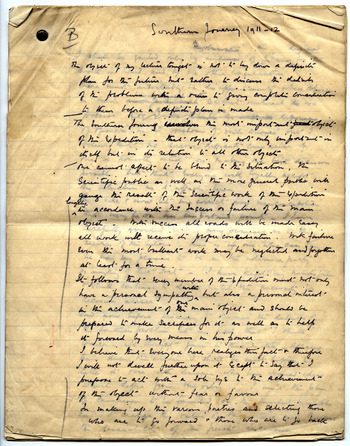
Scott’s lecture notes (Scott, Reference Scott1911d) are more informative. Although the introductory comments suggest an open presentation of problems for discussion (Fig. 7), it was actually a detailed exposition of how Scott proposed to adapt Shackleton’s 1907–1909 scheme of advance. Eleven pages of notes contain arithmetic about timelines, distances, pony loads, pony fodder, human food and dates for killing ponies. Griffith Taylor wrote, “He had thought out all possible details, and ultimately carried out his plans exactly” (Griffith Taylor, Reference Griffith Taylor1916, p. 241). With full disclosure of his reasoning and calculations, Scott presumably hoped his scientists would detect any errors that had slipped through.
First page of Scott’s May 1911 lecture notes (Scott, Reference Scott1911d), courtesy of Canterbury Museum 2010.102.1.

The original copy of Scott’s lecture notes is held by Canterbury Museum, and a typescript version is held by SPRI as MS 1453/28.
The elements of the new transport strategy were:
o Ponies would provide the main effort for the first stage of the Southern Journey but would not go beyond the Barrier. They would be killed progressively as cargo diminished, in accordance with a schedule based upon Shackleton’s dates.
o Any assistance the dogs and motors could provide by transporting pony fodder would be welcome, but could not be relied upon.
o Men would haul all cargo for the second and third stages unaided (i.e. up the Glacier and across the plateau to the Pole).
o Men would return to base in small parties as supply depots were established for the returning Polar Party.
o The journey would commence about 1 November 1911, with provisions for 144 days. The Pole would be reached around day 84.
o The scientific staff would continue as planned with their “scientific harvest”.
Scott thus abandoned his initial scheme of reaching the Pole with dog transport and was now intending to scale-up Shackleton’s 1907–09 scheme, “I have therefore taken Shackleton’s journey as a basis” (Scott, Reference Scott1911d, p. 3).
Scott would now rely only on pony and human traction. By taking more men and more ponies than Shackleton had taken, he intended to increase his range by at least 200 miles and by taking more provisions, he would avoid the food shortages Shackleton had experienced. Dogs and motor tractors were surplus to requirements in this new scheme – they were not included in any of the calculations, but simply noted as possible helpers for transporting pony fodder. By implication, dog and motor parties would have to haul their own provisions and create their own return depots.
The lecture notes outline Scott’s new transport strategy:
We are confining our considerations at present to what our experience or opinion points to as the most reliable sources of energy under the different conditions. In the case of the first stage, it must be conceded that the ponies are the most reliable (Scott, Reference Scott1911d, p. 8).
We have the dogs and motor sledges to help [the ponies] in the first part of the journey possibly also with a large party [of men] – help to pulling sledges (p. 10).
I will leave these figures for the moment to consider the transport arrangements at our disposal more especially here with regard to the 2nd stage of the journey. It is within the bounds of possibility that either ponies, dogs or motor sledges can be taken up the glacier but I think that it will be agreed that it would be unwise to arrange a plan which assumed that either of these agents could be employed on the glacier or above it. I shall have more to say on this point, for the present I merely point out that the safest plan must depend on the performance of the 2nd & 3rd stages of the journey by men alone (p. 5).
Scott’s lecture notes signal a lack of confidence in the dogs but do not provide any explicit criticism or explanation. From the journals of those present, we can gain an insight into Scott’s verbal comments during the lecture.
Frank Debenham wrote:
As regards transport, he felt sure that the only reliable means was the ponies. […] If the ponies can pull 550 lbs each they alone will be able to pull all that is necessary to the base of the Beardmore. The dogs he was frankly disappointed in and he doubted whether they would get as far as the Beardmore (Debenham, Reference Debenham and Debenham Black1992, p. 103).
Griffith Taylor wrote, “He relied on the ponies essentially, and frankly confessed that he was disappointed with the dogs, though he added that this may have been due to their food” (Griffith Taylor, Reference Griffith Taylor1916, p. 241).
Charles Wright wrote, “Captain Scott has just given his lecture on ‘The Future Plans of the Expedition’ and it seems [we] will rely almost entirely on pony and man haulage, expecting the dogs and motor cars to be of little use” (Wright, Reference Wright, Bull and Wright1993, p. 138).
Cherry-Garrard wrote, “The gist of it is that he trusts to men and ponies for the Pole […] the dogs helping the ponies rather than the other way round … The motors and the dogs he considers disappointing” (Cherry-Garrard, Reference Cherry-Garrard1913, pp. 178–179).
George Simpson wrote, “I think what he said comes as a revelation to us all …He went into great detail and long calculations, and it appears that with all our resources there is little margin” (Simpson, Reference Simpson1912, pp. 81–82).
In summary, Scott had changed his mind and provided little by way of explanation, other than stating that ponies would be more reliable than dogs and motors, and that neither dogs nor motors could be trusted. Attendees at the lecture heard this message consistently, the most commonly recorded words about dogs being disappointed and variations of not reliable. No other factors or explanations for his change of mind were identified in Scott’s lecture notes or by attendee’s journals.
The rationale behind Scott’s delivery technique
Having made his decision about the Southern Journey, Scott needed the men to understand and whole-heartedly support the new scheme of advance. He sincerely believed the new scheme offered the best [only] chance of reaching the Pole. He therefore needed to build the men’s trust in ponies, despite abundant evidence that they were not as well suited to Antarctic conditions as the dogs. This was his leadership challenge for the lecture.
In such situations, a leader will often seek to create a clear, shared purpose for the entire enterprise. With that objective, it seems Scott embarked upon a circuitous performance. He did not admit that too many ponies had been lost for the Southern Journey to follow the initial scheme of advance. He led the men to believe the dogs were inherently disappointing and unreliable, when in fact the problems came from the inadequate ration set by Meares and himself. It seems that crevasse-risk was discussed with only ponies in mind. The lecture was held prior to the return of both experienced dog handlers.
His brief journal entry after the lecture hints at smug satisfaction – no errors had been identified in his calculations. The men had accepted his proposition that ponies can be relied upon and dogs cannot. From a leadership perspective, the challenge had been solved. Scott’s approach permanently alienated Meares.
Scott had kept his First Depot Journey plans to himself until the last minute, resulting in Oates and him having misaligned objectives for the ponies, as described below. Debenham wrote on 18 April 1911, without explicitly mentioning the Scott-Oates communication failure:
It will need very careful organisation on our side next year. If the Owner [Scott] will consult the senior men I think it can be done but if he keeps them in the dark as they were on this depot trip things are likely to go wrong (Debenham, Reference Debenham and Debenham Black1992, pp. 95–96).
Some of the key men, notably Oates and Bowers, had contributed to the loss of ponies through their inexperience with comparable conditions and by not knowing precisely what Scott had in mind:
o Bowers had been in charge of three ponies lost after the sea ice broke-up beneath their campsite. These were three of the four best ponies, having reached 79° 29’ south. Scott pointedly referred to this as the Bowers Incident (Scott, Reference Scott and Jones2006, p. 138). Oates blamed Scott’s indecisiveness during the rescue attempt, “The loss of the [three] ponies was Scott’s fault entirely” (Oates, Reference Oates1911c, p. 1).
o The pony ration, set by Oates and Scott, was inadequate for the conditions, causing rapid emaciation and loss of condition on the journey.
o Oates seemed unaware Scott was expecting to deploy about 15 ponies on the Southern Journey. He wanted to eliminate some of the weaker ones. Bowers recorded on 11 February 1911, “Titus advised the Owner [Scott] to take Blucher and Blossom as far as they could go and then kill them for dog food the following year. Captain Scott however was adverse [sic] to killing anything this season” (Bowers, Reference Bowers1913, vol 2, p. 8). Cherry-Garrard later wrote, “Oates had always been for taking the worst ponies out on the Depot Journey: travelling as far on to the Barrier as they could go, and then killing them and depoting [sic] their flesh” (Cherry-Garrard, Reference Cherry-Garrard2010, p. 183).
o Oates was opposed to horse snowshoes, so only one set was taken. He left them at Corner Camp, to Scott’s annoyance. In September 1911, he wrote, “The ponies are unshod but have snow shoes which I believe will be an unmitigated nuisance to us - the snow shoes I mean” (Oates, Reference Oates1911b, p. 20). This was despite Scott stating, “We must not forget the lessons learnt – advantages of pony snow shoes …” (Scott, Reference Scott1911d, p. 10). The nature of problems encountered with pony snowshoes is not clear. Scott and Oates never resolved their differences on this matter.
The relative merits of dogs versus ponies were evident to all participants in the First Depot Party. The dogs were faster, able to travel in worse weather, did not need protective snow walls to be erected at end of day and worked as team – in the sense they started together, travelled together and finished together, working about four hours per day. The ponies were of variable speed (limiting the daily advance of the entire party), and they made heavy going in soft deep snow. Oates had been critical and negative about them all.
Scott was in no position to demonstrate objectively that ponies were well suited to local conditions because the dogs had shown otherwise. He therefore had to reach out to the men on emotional grounds, stressing disappointment and distrust of the dogs. He chose to say nothing negative about the ponies. He knew Bowers and Oates were likely to play vital roles in attaining the Pole so avoided commenting on their contributions to pony losses.
Scott’s lecture notes include a prompt (to himself), “Refer to losses in autumn, to previous ideas & modification which has necessitated abandonment of subsidiary plans” (Scott, Reference Scott1911d, p. 10). Perhaps he had intended to give a balanced account of events leading to his change of mind. Only Wright recorded any reason for the change of mind, commenting that the delayed start saved the ponies from low October temperatures (Wright Reference Wright, Bull and Wright1993, p. 138).
In his “Message to the Public”, Scott identified “The loss of pony transport in March 1911” as the number one reason for the failure of the Polar Party (Scott, Reference Scott and Jones2006, p. 421). By being specific about the month, he was presumably stressing the loss of three of the best ponies in the Bowers Incident. If one accepts Scott’s “Message to the Public” as expressing his true sentiments then his May 1911 lecture can be seen as a rhetorical performance, at least regarding the merits of ponies and dogs.
Scott’s lecture has left something of a gap in the narrative of the BAE, albeit understandable. There was of course no obligation on him to keep complete and balanced records for the benefit of future generations of historians.
In brief, Scott chose to talk up the merits of the ponies. It was perhaps better to criticise the animals that were having their role downgraded rather than criticise those upon which the whole enterprise now depended. His pitch was, “In the case of the first stage it must be conceded that the ponies are the most reliable” (Scott, Reference Scott1911d, p. 8), reinforced by his personal endorsement of Oates’ pony management capabilities (Scott, Reference Scott1911d, p. 10).
Conclusions
This article’s fundamental research question was “What factor(s) caused Scott to change his mind, between 22 February 1911 and 8 May 1911, about dog transport being used to reach the South Pole?” Evidently, there were several factors, chiefly:
1. Loss of too many ponies,
2. Crevasse-risk to dogs, and
3. Risk of the dogs becoming unfit for work during the 1500 mile Southern Journey
The greatest single driver for Scott changing his mind was that too many ponies were lost on the First Depot Journey. Without an adequate number of ponies, it would be physically impossible to transport enough Dog Party provisions to the foot of the Glacier for Scott’s initial Antarctic transport strategy to be feasible.
The risk of dog teams falling into crevasses, with injury or death to dogs, weighed heavily in Scott’s mind. If (potentially multiple) repetitions of the crevasse incident were to occur on the Glacier, then the Polar Party would be in serious trouble. Possibly this is a risk Scott would have been unwilling to accept, regardless of pony losses.
Underfeeding the dogs on the First Depot Journey was a mistake. Scott seemed optimistic it could be put right for the Southern Journey.
There was a risk that the dogs, even with a more generous ration, could progressively lose motivation and condition in a featureless landscape. The risk was well understood by Scott when he made preparations in England, suggesting he was prepared to accept it. He did not have any contingency for the risk, and because of underfeeding on the First Depot Journey, there had been no opportunity to evaluate the full potential of properly fed dogs. Scott had insufficient evidence for a rational decision on trusting the dogs for the 1500-mile Southern Journey.
The claim Scott’s personal biases and beliefs about working animals caused him not to use dog transport beyond the Barrier is not supported by this article.
The claim Scott held a belief in the moral superiority of human muscle power, causing him to reduce the dogs’ role in order to increase the men’s role in the Southern Journey, is not supported by this article.
Scott’s rhetorical approach for presenting his change of mind is open to criticism. In the interests of team motivation and morale, he chose to build up the men’s trust in ponies, at the expense of the Dog Party’s reputation.
Acknowledgements
I would like to acknowledge the generous and knowledgeable assistance provided by Frank Graveson, NZ Polar Medal, an engineer and dog-handler with Antarctic Division, NZDSIR 1963–1964. Anne Strathie, researcher and author, has been a great sounding board, reviewer and source of valuable information. Dr David Harrowfield and Dr. Max Jones have been generous with insight, encouragement and practical suggestions. I would like to thank staff of the Alexander Turnbull Library, Canterbury Museum, the Thomas H Manning Polar Archives and the Royal Geographical Society (with IBG) for assistance in locating and providing historic documents.